


This World History Grades 9-10 test covers Absolutism and the Enlightenment. Like a classroom assessment, it includes documents to analyze, knowledge questions and a short writing task. To prepare, review the lesson first, then practice with the worksheet.
Time : 50 min
The test has three parts: knowledge (34 points), documents (46 points), and a written argument (20 points). Answer in complete sentences and cite the documents.
Document 1 – Absolute and limited monarchy in Europe
Schematic map prepared for this unit with Natural Earth data; borders approximate (c. 1715).
Document 2 – A bust of Voltaire
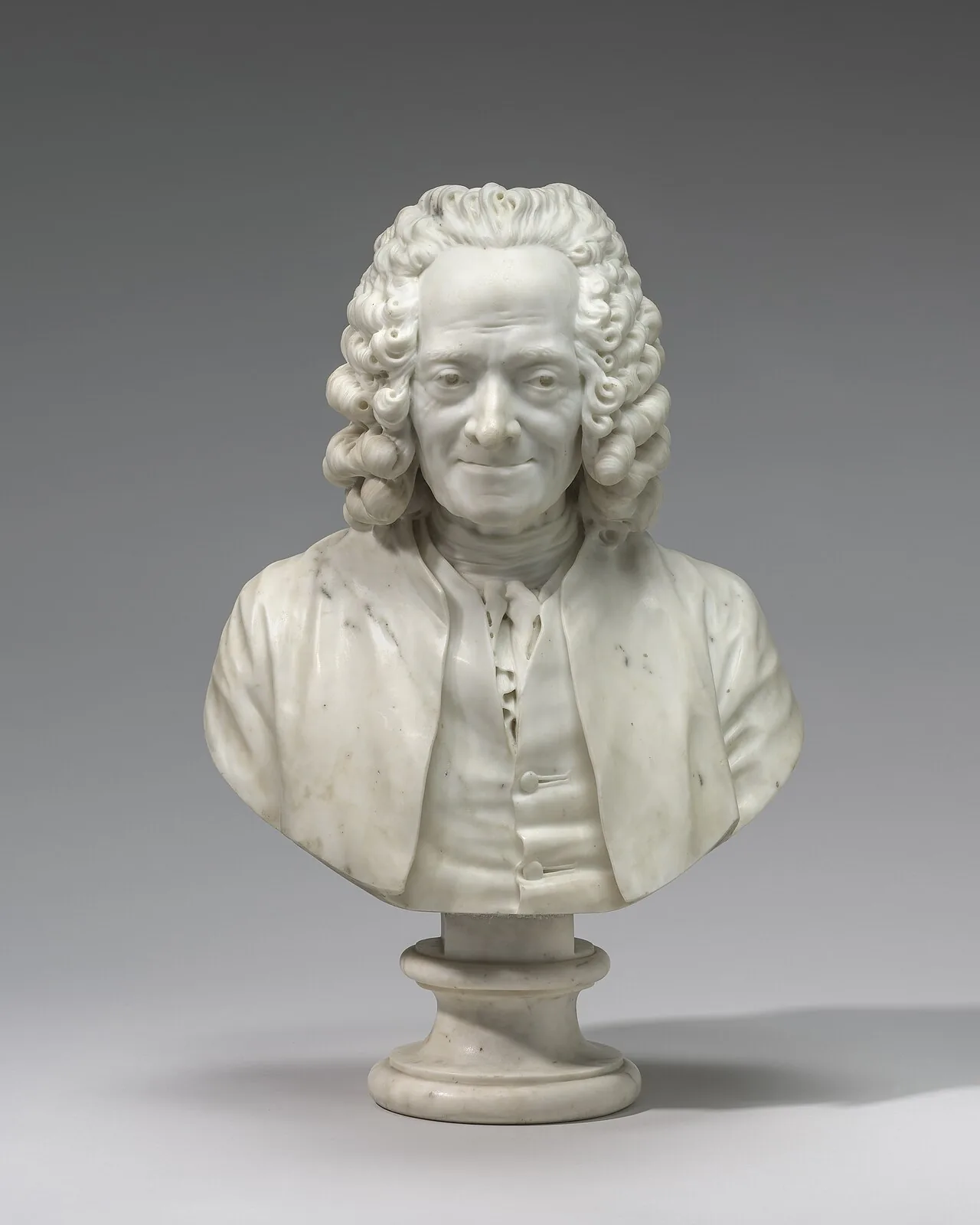
Wikimedia Commons; National Gallery of Art, Washington, D.C.
Document 3 – Locke on natural law
The state of nature has a law of nature to govern it, which obliges every one: and reason, which is that law, teaches all mankind, who will but consult it, that being all equal and independent, no one ought to harm another in his life, health, liberty, or possessions: for men being all the workmanship of one omnipotent, and infinitely wise maker; all the servants of one sovereign master, sent into the world by his order, and about his business; they are his property, whose workmanship they are, made to last during his, not one another’s pleasure: and being furnished with like faculties, sharing all in one community of nature, there cannot be supposed any such subordination among us, that may authorize us to destroy one another, as if we were made for one another’s uses, as the inferior ranks of creatures are for our’s.
Source: John Locke, Second Treatise of Government, 1689, chapter 2, section 6; Project Gutenberg edition (ebook 7370).
*Obliges: binds. *Workmanship: creation. *Subordination: ranking one below another.
John Locke, Second Treatise of Government, 1689, chapter 2, section 6.
Document 4 – Key dates
- 1643-1715 Reign of Louis XIV
- 1649 Execution of Charles I
- 1685 Revocation of the Edict of Nantes
- 1689 English Bill of Rights
- 1748 The Spirit of Laws
- 1751-1772 The Encyclopédie
- 1762 The Social Contract
Dates as given in standard reference works.
Questions
- Part 1 – Knowledge. Define absolutism, divine right, and social contract. (12 pts)
- Part 1. Document 1: name the countries shaded in yellow, in blue, and in pink, and say what the legend tells you about each group. (10 pts)
- Part 1. Name three Enlightenment thinkers and give one idea of each. (12 pts)
- Part 2 – Documents. Document 2: present the document, describe the sculpture, and explain what it shows about Voltaire’s reputation in 1778. (14 pts)
- Part 2. Document 3: present the document, say what Locke thinks people owe one another, and explain why this idea challenges absolute monarchy. (14 pts)
- Part 2. Document 4: calculate how many years Louis XIV reigned, and how many years separate the Bill of Rights from The Social Contract. (8 pts)
- Part 2. Using Documents 1 and 3 and the lesson, compare the government of France under Louis XIV with that of England after 1689. (10 pts)
- Part 3 – Written argument (LEQ). Evaluate the extent to which Enlightenment ideas challenged absolute monarchy in the eighteenth century. Use the documents and the lesson. (20 pts)


Quick review: flashcards
Tap a card to see the answer.