


This worksheet on Absolutism and the Enlightenment belongs to the World History Grades 9-10 course. Its questions use primary sources, maps and timelines, and they move from basic recall to short writing tasks. Before you start, review the lesson; afterward, try the true or false quiz.
Exercise 1 : Vocabulary of absolutism and the Enlightenment
Match each term with its definition. Write the letter next to the number.
- Absolutism
- Divine right
- Natural rights
- Social contract
- Separation of powers
- Salon
- Enlightened absolutism
- Mercantilism
A. A regular gathering in a private home where people discussed ideas. B. The belief that a monarch rules by the authority of God. C. Rights that belong to people as human beings. D. Government in which a monarch holds supreme power. E. The idea that the state is based on an agreement among people. F. Dividing government among separate branches. G. The belief that a state grows rich by exporting more than it imports. H. Rule by a monarch who adopts some reforms but keeps full power.
Exercise 2 : Voltaire in London
Document 1 – The Royal Exchange of London
Take a view of the Royal-Exchange in London, a place more venerable than many courts of justice, where the representatives of all nations meet for the benefit of mankind. There the Jew, the Mahometan, and the Christian transact together as tho’ they all profess’d the same religion, and give the name of Infidel to none but bankrupts. There the Presbyterian confides in the Anabaptist, and the Churchman depends on the Quaker’s word.
Source: Voltaire, Letters concerning the English Nation, Letter 6, English edition of 1733; Wikisource.
*Mahometan: Muslim (old English usage). *Infidel: unbeliever.
- Present the document (nature, author, date, context).
- According to Voltaire, what do the merchants of different religions do together?
- Which people does he say are called “infidels”? What does this joke suggest?
- Why might a Frenchman of 1733 find this text provocative?
- What reason do you have to be careful when you use this text as evidence of English society?
Exercise 3 : Montesquieu on liberty
Document 1 – The danger of united powers
When the legislative and executive powers are united in the same person, or in the same body of magistrates, there can be no liberty; because apprehensions may arise, lest the same monarch or senate should enact tyrannical laws, to execute them in a tyrannical manner. Again, there is no liberty, if the power of judging be not separated from the legislative and executive powers. Were it joined with the legislative, the life and liberty of the subject would be exposed to arbitrary controul; for the judge would be then the legislator. Were it joined to the executive power, the judge might behave with all the violence of an oppressor.
Source: Montesquieu, The Spirit of Laws, 1748, book 11, chapter 6, English translation by Thomas Nugent (1750); Wikisource.
*Controul: control. *Moderate government: government with limits.
- Present the document (nature, author, date).
- According to Montesquieu, when is there “no liberty”?
- Name the three powers he identifies, using the diagram.
- Which kind of government would, in his view, put the three powers in one hand? Which of the monarchs you studied fits this description?
- Explain why this idea mattered to the founders of the United States.
Exercise 4 : Rousseau on freedom
Document 1 – The opening of The Social Contract
Man is born free; and everywhere he is in chains. One thinks himself the master of others, and still remains a greater slave than they. How did this change come about? I do not know. What can make it legitimate? That question I think I can answer.
Source: Jean-Jacques Rousseau, The Social Contract, 1762, book 1, chapter 1, translated by G. D. H. Cole (1913); Project Gutenberg edition (ebook 46333).
*Legitimate: lawful, justified. *Yoke: heavy wooden frame placed on animals, here a symbol of oppression.
- Present the document (author, date, work).
- What contradiction does Rousseau point out in the first sentence?
- What question does he say he can answer?
- Why were such ideas dangerous in a monarchy such as France?
- Explain how Rousseau’s question differs from the view of Bossuet and of Louis XIV that power comes from God.
Exercise 5 : The English Bill of Rights
Document 1 – Rights claimed by Parliament, 1689
That the pretended power of suspending the laws or the execution of laws by regal authority without consent of Parliament is illegal; That the pretended power of dispensing with laws or the execution of laws by regal authority, as it hath been assumed and exercised of late, is illegal; That the commission for erecting the late Court of Commissioners for Ecclesiastical Causes, and all other commissions and courts of like nature, are illegal and pernicious; That levying money for or to the use of the Crown by pretence of prerogative, without grant of Parliament, for longer time, or in other manner than the same is or shall be granted, is illegal […]
Source: English Bill of Rights, December 1689 (extract); text from the Avalon Project, Yale Law School.
*Prerogative: special power of the king. *Commissions: boards set up by royal order. *Grant of Parliament: Parliament’s approval.
- Present the document (nature, date, context).
- List three royal powers that the document calls illegal.
- Which clause protects the people’s money from the king?
- Explain how the document shows the difference between England and France under Louis XIV.
- Why is the Bill of Rights called a limit on power rather than a rejection of monarchy?
Exercise 6 : Two views of the state of nature
Document 1 – Hobbes, 1651
In such condition, there is no place for Industry; because the fruit thereof is uncertain; and consequently no Culture of the Earth; no Navigation, nor use of the commodities that may be imported by Sea; no commodious Building; no Instruments of moving, and removing such things as require much force; no Knowledge of the face of the Earth; no account of Time; no Arts; no Letters; no Society; and which is worst of all, continuall feare, and danger of violent death; And the life of man, solitary, poore, nasty, brutish, and short.
Source: Thomas Hobbes, Leviathan, 1651, part 1, chapter 13 (“Of the Natural Condition of Mankind”); text of the Project Gutenberg edition (ebook 3207), 1651 spelling kept.
*Industry: work. *Nasty: unpleasant.
Document 2 – Locke, 1689
The state of nature has a law of nature to govern it, which obliges every one: and reason, which is that law, teaches all mankind, who will but consult it, that being all equal and independent, no one ought to harm another in his life, health, liberty, or possessions: for men being all the workmanship of one omnipotent, and infinitely wise maker; all the servants of one sovereign master, sent into the world by his order, and about his business; they are his property, whose workmanship they are, made to last during his, not one another’s pleasure: and being furnished with like faculties, sharing all in one community of nature, there cannot be supposed any such subordination among us, that may authorize us to destroy one another, as if we were made for one another’s uses, as the inferior ranks of creatures are for our’s.
Source: John Locke, Second Treatise of Government, 1689, chapter 2, section 6; Project Gutenberg edition (ebook 7370).
*Obliges: binds. *Workmanship: creation. *Subordination: ranking one below another.
- Present each document (author, date, work).
- How does Hobbes describe life without government?
- What does Locke say the law of nature teaches?
- Compare the two views: what is the main difference?
- Which of the two views is closer to the claims of an absolute monarch? Explain.
Exercise 7 : Force or consent?
Document 1 – Hobbes on the need for power
The finall Cause, End, or Designe of men, (who naturally love Liberty, and Dominion over others,) in the introduction of that restraint upon themselves, (in which wee see them live in Common-wealths,) is the foresight of their own preservation, and of a more contented life thereby; that is to say, of getting themselves out from that miserable condition of Warre, which is necessarily consequent (as hath been shewn) to the naturall Passions of men, when there is no visible Power to keep them in awe, and tye them by feare of punishment to the performance of their Covenants […]
Source: Thomas Hobbes, Leviathan, 1651, part 2, chapter 17 (“Of the Causes, Generation, and Definition of a Common-wealth”); Project Gutenberg edition (ebook 3207), 1651 spelling kept.
*Designe: purpose. *Common-wealths: states. *Covenants: agreements. *Foresight: looking ahead.
Document 2 – Rousseau on the right of the strongest
The strongest is never strong enough to be always the master, unless he transforms strength into right, and obedience into duty. Hence the right of the strongest, which, though to all seeming meant ironically, is really laid down as a fundamental principle. But are we never to have an explanation of this phrase? Force is a physical power, and I fail to see what moral effect it can have. To yield to force is an act of necessity, not of will–at the most, an act of prudence.
Source: Jean-Jacques Rousseau, The Social Contract, 1762, book 1, chapter 3, translated by G. D. H. Cole (1913); Project Gutenberg edition (ebook 46333).
*Prudence: caution. *Duty: moral obligation.
- Present the two documents.
- According to Hobbes, why do men live in commonwealths?
- What does Rousseau say about a “right” based on force?
- Compare their ideas: where do they disagree?
- Write two sentences explaining which view an absolute monarch would prefer.
Exercise 8 : The giant on the title page
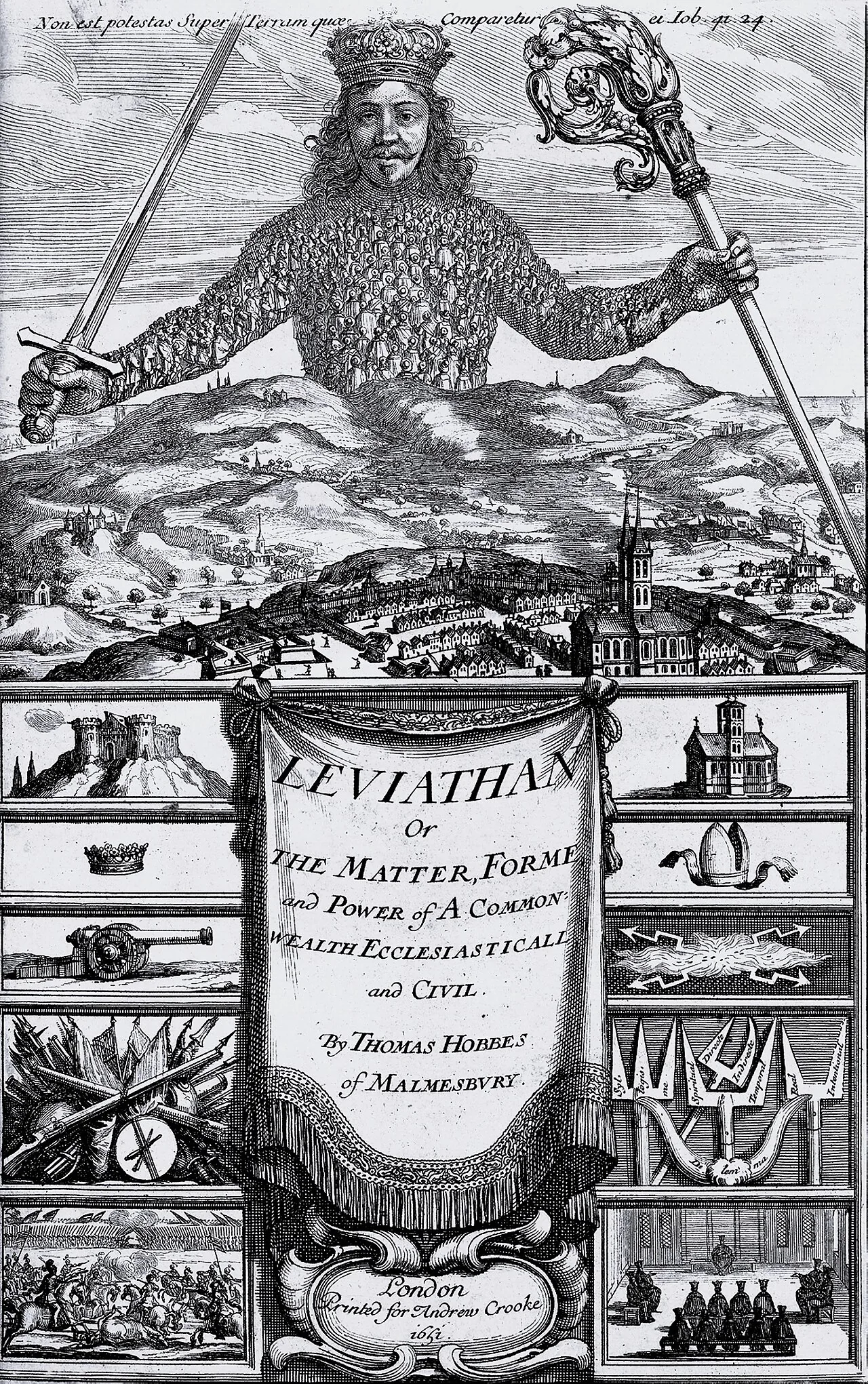
- Present the image (nature, author, date).
- Describe the giant: what does he hold, and what is his body made of?
- What do the sword and the staff stand for?
- What message does the picture give about the relationship between ruler and people?
- Why is it important that the people are shown inside the giant’s body?
Exercise 9 : A picture of knowledge
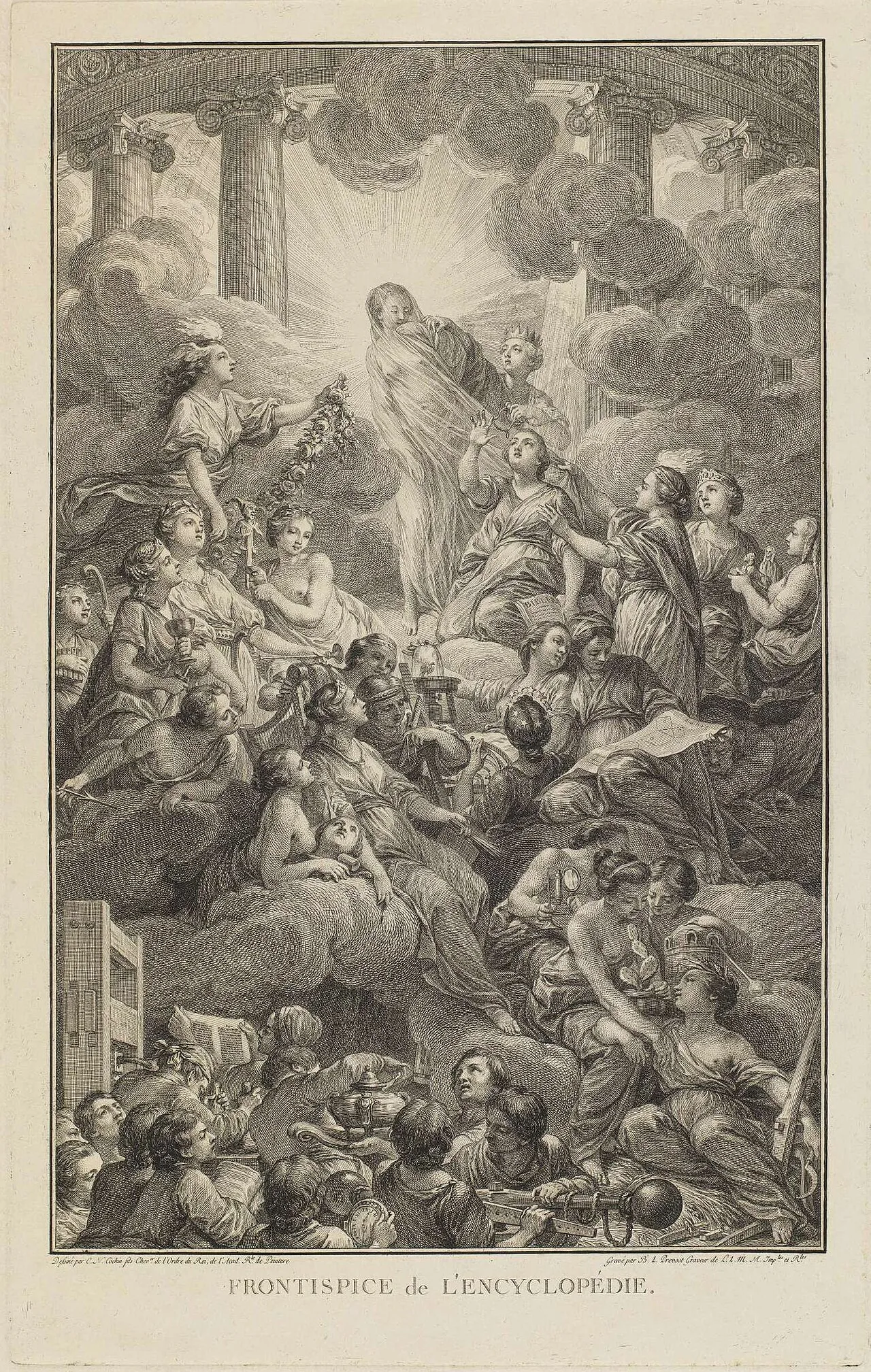
- Present the image (nature, designer, engraver).
- What figures appear at the top of the picture, and what are they doing?
- Who or what is gathered at the bottom?
- What does the picture suggest about the aims of the Encyclopédie?
- Why would the Church and the king be uneasy about it?
Exercise 10 : The palace as a message
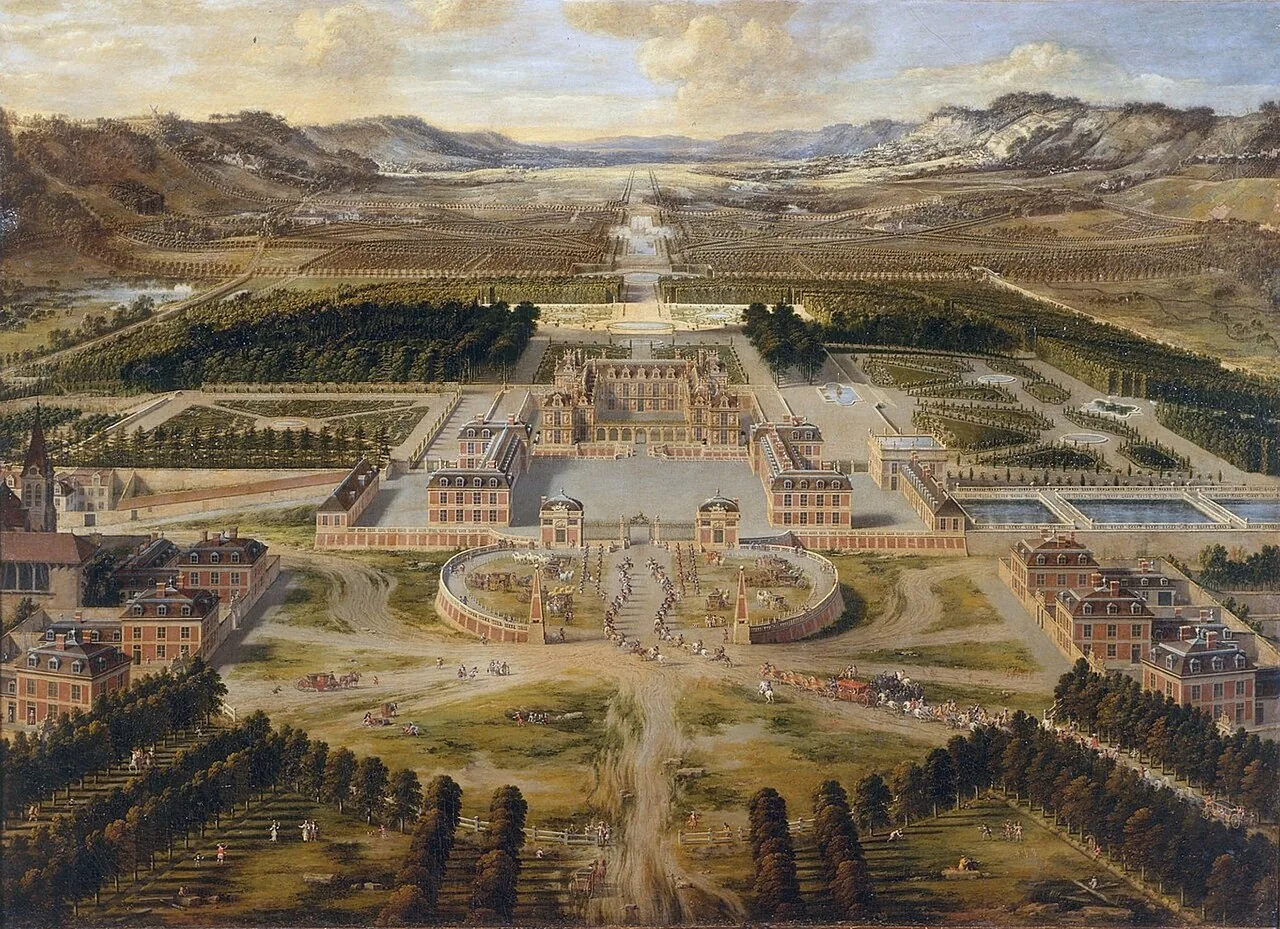
- Present the painting (author, date, subject).
- Describe the layout: what do the avenues and gardens do?
- What idea of power does the layout express?
- Why did Louis XIV want his nobles to live at Versailles?
- What can this picture not tell us about life in the palace?
Exercise 11 : Frederick and Voltaire
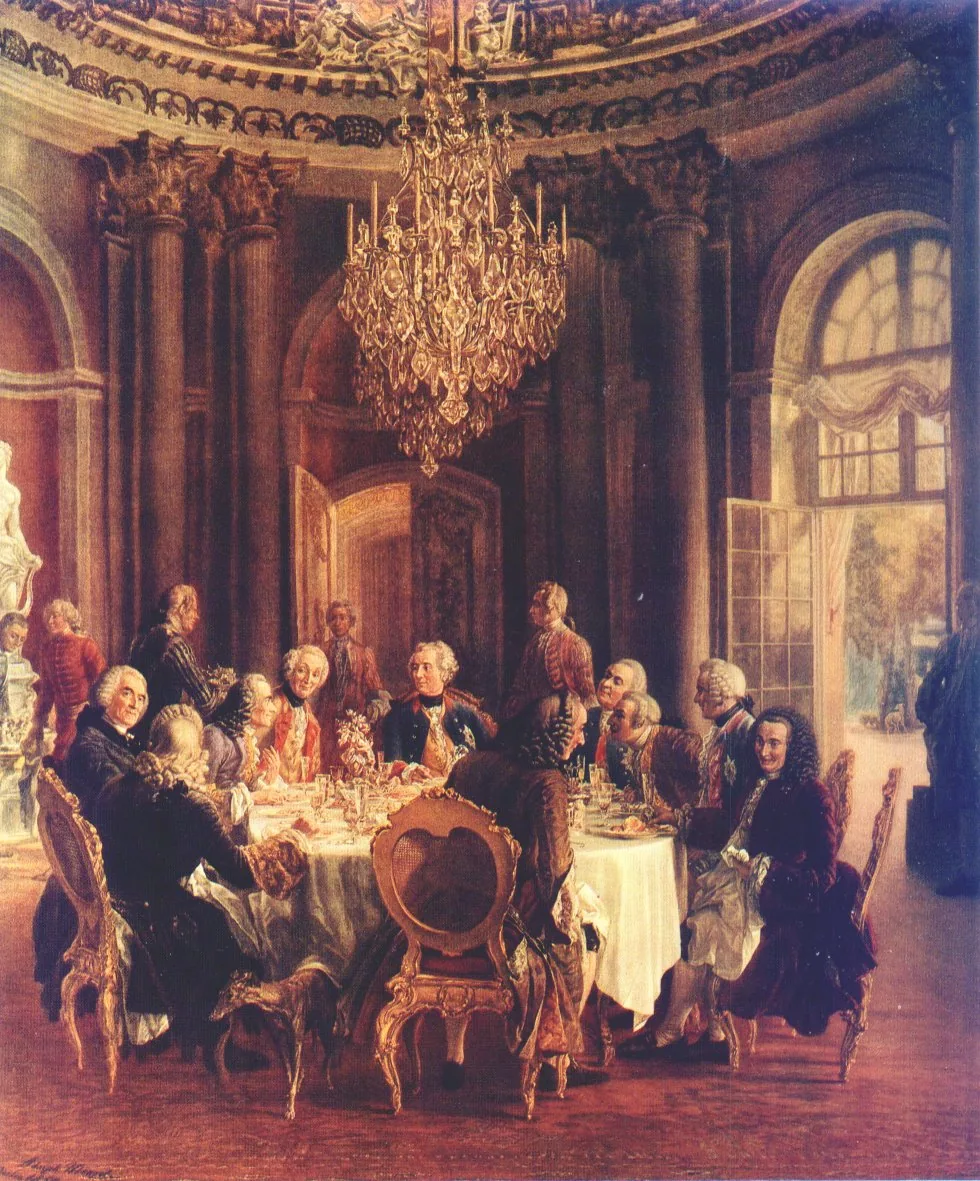
- Present the painting. Why must we be cautious about its date?
- Describe the scene: who is present, and what are they doing?
- What does the setting suggest about Frederick II?
- Why would a king invite philosophes to his court?
- Does this scene prove that Frederick was an enlightened ruler? Explain.
Exercise 12 : Great works of the Enlightenment
Document 1 – Some landmark works
| Work | Author | Year |
|---|---|---|
| Leviathan | Hobbes | 1651 |
| Two Treatises of Government | Locke | 1689 |
| The Spirit of Laws | Montesquieu | 1748 |
| The Social Contract | Rousseau | 1762 |
| On Crimes and Punishments | Beccaria | 1764 |
| A Vindication of the Rights of Woman | Wollstonecraft | 1792 |
Source: dates of first publication as given in standard reference works (Encyclopaedia Britannica). Table prepared for this unit.
- Which work was published first, and which last?
- How many years separate Locke’s book from Montesquieu’s?
- How many of these works appeared while Louis XIV was alive (he died in 1715)?
- Which book appeared closest to the beginning of the American Revolution in 1775 (before or after)?
- What does the table suggest about the spread of Enlightenment ideas across the century?
Exercise 13 : Locate the capitals of power and ideas
- Name the city numbered 1 (the palace of Louis XIV is nearby).
- Name the city numbered 2 (the capital of England).
- Name the city numbered 5 (capital of the Habsburgs).
- Name the city numbered 6 (Peter the Great’s new capital).
- Name the city numbered 7 (where Rousseau was born) and number 8 (where Kant lived).
Exercise 14 : How ideas traveled
- Which arrow links London and Paris? Which writer made this trip, and when?
- Which arrow leads to Potsdam? Who traveled there?
- Which ruler is linked to the purple arrow?
- What does the green arrow suggest about the American colonies?
- Why did Paris act as a center of the Republic of Letters?
Exercise 15 : Order the events
Put the events in order from the earliest to the latest, then give the century of each.
- Publication of the Encyclopédie begins (1751).
- The court moves to Versailles (1682).
- English Bill of Rights (1689).
- Execution of Charles I (1649).
- Rousseau publishes The Social Contract (1762).
- Death of Louis XIV (1715).
Exercise 16 : Durations
Calculate each duration and write a sentence of explanation.
- The length of Louis XIV’s reign (1643-1715).
- The time between the Edict of Nantes (1598) and its revocation (1685).
- The time between Hobbes’s Leviathan (1651) and the Bill of Rights (1689).
- The time taken to publish the Encyclopédie (1751-1772).
- The time between the Bill of Rights (1689) and Rousseau’s Social Contract (1762).
Exercise 17 : Guided research: Émilie du Châtelet
Find out about a woman of the Enlightenment. Use at least two reliable sites, such as the Encyclopaedia Britannica, the Stanford Encyclopedia of Philosophy, or a museum or university site. Suggested keywords: Émilie du Châtelet Newton translation, Émilie du Châtelet biography.
- When and where did she live?
- What scientific work did she do?
- What was her relationship with Voltaire?
- Which sites did you use, and why do you trust them?
Hint: look for the book she translated and the date it was published.
Exercise 18 : CER paragraph: Locke and the Glorious Revolution
Claim, evidence, reasoning. Write one paragraph that answers the question: Did the Glorious Revolution of 1688-1689 limit royal power? Your paragraph must (1) make a claim, (2) use at least two pieces of evidence from this lesson, and (3) explain how the evidence supports the claim.
Hint: use the Bill of Rights and the contrast with France.
Exercise 19 : SAQ: the Enlightenment
Answer all three parts in complete sentences. a) Identify one idea of the Enlightenment about government. b) Explain how one development, such as the Scientific Revolution or the spread of salons, helped the Enlightenment spread. c) Explain one way in which Enlightenment ideas challenged an absolute monarchy.
Exercise 20 : True or false? Justify
Say whether each statement is true or false and justify your answer in one sentence.
- Louis XIV moved the court to Versailles in 1682.
- The Bill of Rights of 1689 allowed the king to raise taxes without Parliament.
- Hobbes argued that people should always rebel against kings.
- The Encyclopédie was published without any opposition.
- Frederick II invited Voltaire to Potsdam.
- All Enlightenment thinkers opposed slavery.
Exercise 21 : Causes and consequences: the Enlightenment
Complete the chain. For each cause, state a consequence, and then explain the link in one sentence. 1) The Scientific Revolution. 2) The wars of religion and the English civil war. 3) The growth of salons, newspapers, and the printing trade. 4) The weaknesses of absolute monarchy (debts, privileges, censorship).
Exercise 22 : Stimulus-based multiple choice
Use the following statement from the lesson: “When the legislative and executive powers are united in the same person […] there can be no liberty” (Montesquieu, 1748). Choose the best answer. 1) Which idea does the quotation support? A. Divine right B. Separation of powers C. Mercantilism D. Enlightened absolutism. 2) Which ruler most clearly held all three powers? A. William III B. Louis XIV C. A Dutch stadtholder D. The English Parliament. 3) Which later document applied this idea? A. The Edict of Nantes B. The Treaty of Westphalia C. The U.S. Constitution D. The Instruction of Catherine II.


Quick review: flashcards
Tap a card to see the answer.