


This worksheet on The Atlantic Revolutions: America, France and Haiti belongs to the World History Grades 9-10 course. Its questions use primary sources, maps and timelines, and they move from basic recall to short writing tasks. Before you start, review the lesson; afterward, try the true or false quiz.
Exercise 1 : Vocabulary of the Atlantic revolutions
Match each term with its definition.
- Consent of the governed
- Old Regime
- Estate
- Terror
- Creole
- Emancipation
- Constitution
- Indemnity
A. One of the three orders of French society before 1789. B. A written plan of government. C. The principle that governments rule by permission of the people. D. A person of European descent born in the Americas. E. The period of 1793-1794 when French revolutionary leaders used mass executions. F. A payment demanded to compensate for losses. G. The freeing of people from slavery. H. The system of government and society in France before 1789.
Exercise 2 : The principles of 1776
Document 1 – The Declaration of Independence
We hold these truths to be self-evident: That all men are created equal; that they are endowed by their Creator with certain unalienable rights; that among these are life, liberty, and the pursuit of happiness; that, to secure these rights, governments are instituted among men, deriving their just powers from the consent of the governed; that whenever any form of government becomes destructive of these ends, it is the right of the people to alter or to abolish it, and to institute new government, laying its foundation on such principles, and organizing its powers in such form, as to them shall seem most likely to effect their safety and happiness.
Source: Declaration of Independence, July 4, 1776, second paragraph, drafted chiefly by Thomas Jefferson; text from the Avalon Project, Yale Law School.
*Unalienable: that cannot be taken away. *Prudence: caution.
- Present the document (nature, authors, date, context).
- List three rights that the Declaration says all men possess.
- According to the text, where do governments get their power?
- What may the people do when a government destroys these rights?
- Why does the text also advise caution about changing government?
Exercise 3 : A constitution that ends slavery
Document 1 – Saint-Domingue’s constitution, 1801
There cannot exist slaves on this territory, servitude is therein forever abolished. All men are born, live and die free and French. Art. 4. All men, regardless of color, are eligible to all employment. Art. 5. There shall exist no distinction other than those based on virtue and talent, and other superiority afforded by law in the exercise of a public function. The law is the same for all whether in punishment or in protection.
Source: Constitution of the French Colony of Saint-Domingue, July 1801, title 2, articles 3 to 5; English translation published by the Louverture Project and on Wikisource.
*Servitude: slavery. *Public function: office in government.
- Present the document (nature, date, context).
- What does article 3 decide about slavery?
- What does article 5 say about distinctions between people?
- Compare with the Declaration of Independence: what is similar and what is different?
- Why can this document be used both to praise and to criticize Toussaint’s government? (Use the lesson.)
Exercise 4 : The Rights of Man
Document 1 – Declaration of the Rights of Man, 1789
Men are born and remain free and equal in rights. Social distinctions may be founded only upon the general good. 2. The aim of all political association is the preservation of the natural and imprescriptible rights of man. These rights are liberty, property, security, and resistance to oppression. 3. The principle of all sovereignty resides essentially in the nation. No body nor individual may exercise any authority which does not proceed directly from the nation. 4. Liberty consists in the freedom to do everything which injures no one else; hence the exercise of the natural rights of each man has no limits except those which assure to the other members of the society the enjoyment of the same rights.
Source: Declaration of the Rights of Man and of the Citizen, August 26, 1789, articles 1 to 4, approved by the National Assembly of France; text from the Avalon Project, Yale Law School.
*Imprescriptible: that cannot be lost. *Sovereignty: supreme power.
- Present the document (nature, authors, date).
- Which four rights are named in article 2?
- Where does sovereignty reside, according to article 3?
- How does article 4 define liberty?
- Who is left out of this declaration? Explain.
Exercise 5 : Wollstonecraft’s argument
Document 1 – A Vindication of the Rights of Woman, 1792
I do not wish them to have power over men; but over themselves. In the same strain have I heard men argue against instructing the poor; for many are the forms that aristocracy assumes. “Teach them to read and write,” say they, “and you take them out of the station assigned them by nature.” An eloquent Frenchman, has answered them; I will borrow his sentiments. But they know not, when they make man a brute, that they may expect every instant to see him transformed into a ferocious beast. Without knowledge there can be no morality! Ignorance is a frail base for virtue!
Source: Mary Wollstonecraft, A Vindication of the Rights of Woman, 1792, chapter 4; Project Gutenberg edition.
*Them: women. *Aristocracy: rule by a privileged class.
- Present the document (author, date, work).
- What kind of power does she want women to have, and what kind does she not want?
- What comparison does she make between women and the poor?
- What does she mean by “Without knowledge there can be no morality”?
- How does this text apply Enlightenment ideas to a new group?
Exercise 6 : Two declarations
Document 1 – American Declaration, 1776
We hold these truths to be self-evident: That all men are created equal; that they are endowed by their Creator with certain unalienable rights; that among these are life, liberty, and the pursuit of happiness; that, to secure these rights, governments are instituted among men, deriving their just powers from the consent of the governed; that whenever any form of government becomes destructive of these ends, it is the right of the people to alter or to abolish it, and to institute new government, laying its foundation on such principles, and organizing its powers in such form, as to them shall seem most likely to effect their safety and happiness.
Source: Declaration of Independence, July 4, 1776, second paragraph, drafted chiefly by Thomas Jefferson; text from the Avalon Project, Yale Law School.
*Unalienable: that cannot be taken away.
Document 2 – French Declaration, 1789
Men are born and remain free and equal in rights. Social distinctions may be founded only upon the general good. 2. The aim of all political association is the preservation of the natural and imprescriptible rights of man. These rights are liberty, property, security, and resistance to oppression. 3. The principle of all sovereignty resides essentially in the nation. No body nor individual may exercise any authority which does not proceed directly from the nation. 4. Liberty consists in the freedom to do everything which injures no one else; hence the exercise of the natural rights of each man has no limits except those which assure to the other members of the society the enjoyment of the same rights.
Source: Declaration of the Rights of Man and of the Citizen, August 26, 1789, articles 1 to 4, approved by the National Assembly of France; text from the Avalon Project, Yale Law School.
*Imprescriptible: that cannot be lost.
- Present each document.
- Which rights does each list?
- What does each say about the source of government power?
- Compare their message about equality.
- Give one idea that the two texts share and one difference in style or emphasis.
Exercise 7 : Burke and the Rights of Man
Document 1 – Edmund Burke, 1790
I thought ten thousand swords must have leaped from their scabbards to avenge even a look that threatened her with insult. But the age of chivalry is gone. That of sophisters, economists, and calculators has succeeded; and the glory of Europe is extinguished forever.
Source: Edmund Burke, Reflections on the Revolution in France, 1790, on the arrival of the royal family in Paris in October 1789; Project Gutenberg edition (Works, vol. 3, ebook 15679).
*Cavaliers: knightly gentlemen. *Sophisters: clever but misleading arguers.
Document 2 – The Rights of Man, 1789
Men are born and remain free and equal in rights. Social distinctions may be founded only upon the general good. 2. The aim of all political association is the preservation of the natural and imprescriptible rights of man. These rights are liberty, property, security, and resistance to oppression. 3. The principle of all sovereignty resides essentially in the nation. No body nor individual may exercise any authority which does not proceed directly from the nation. 4. Liberty consists in the freedom to do everything which injures no one else; hence the exercise of the natural rights of each man has no limits except those which assure to the other members of the society the enjoyment of the same rights.
Source: Declaration of the Rights of Man and of the Citizen, August 26, 1789, articles 1 to 4, approved by the National Assembly of France; text from the Avalon Project, Yale Law School.
*Imprescriptible: that cannot be lost.
- Present the two documents.
- What does Burke mourn in his passage?
- What kind of people does he blame for the end of the “age of chivalry”?
- Compare the tone and aim of the two texts.
- Explain which text is a source for the hopes of the revolution and which for fear of it.
Exercise 8 : Toussaint through the eyes of an abolitionist
Document 1 – Wendell Phillips on Toussaint Louverture
I am to tell you the story of a negro, Toussaint Louverture, who has left, hardly one written line. I am to glean it from the reluctant testimony of his enemies, men who despised him because he was a negro and a slave, hated him because he had beaten them in battle.
Source: Wendell Phillips, lecture “Toussaint L’Ouverture,” 1861, as quoted in Jacques Nicolas Léger, Haiti: Her History and Her Detractors (New York, 1907), part 1, chapter 7; Wikisource.
*Negro: the word then in common use. *Glean: gather bit by bit.
- Present the document (author, date, occasion). Why was the year 1861 important?
- What problem does Phillips mention about the sources on Toussaint?
- Why does he mention Napoleon and Washington?
- What was Phillips’s goal in giving this speech?
- How should a historian use this text?
Exercise 9 : Grievances against a king
Document 1 – The list of grievances, 1776
The history of the present King of Great Britain is a history of repeated injuries and usurpations, all having in direct object the establishment of an absolute tyranny over these states. To prove this, let facts be submitted to a candid world. He has refused his assent to laws, the most wholesome and necessary for the public good. He has forbidden his governors to pass laws of immediate and pressing importance, unless suspended in their operation till his assent should be obtained; and, when so suspended, he has utterly neglected to attend to them. He has refused to pass other laws for the accommodation of large districts of people, unless those people would relinquish the right of representation in the legislature, a right inestimable to them, and formidable to tyrants only.
Source: Declaration of Independence, July 4, 1776, list of grievances against King George III (beginning); text from the Avalon Project, Yale Law School.
*Usurpations: seizures of power. *Assent: approval. *Inestimable: priceless.
- Present the document.
- Whom does the text accuse and of what?
- Name two actions the king is said to have taken against colonial legislatures.
- Why does the text say representation is “formidable to tyrants only”?
- How does this list help to explain the causes of the American Revolution?
Exercise 10 : Signing the Declaration
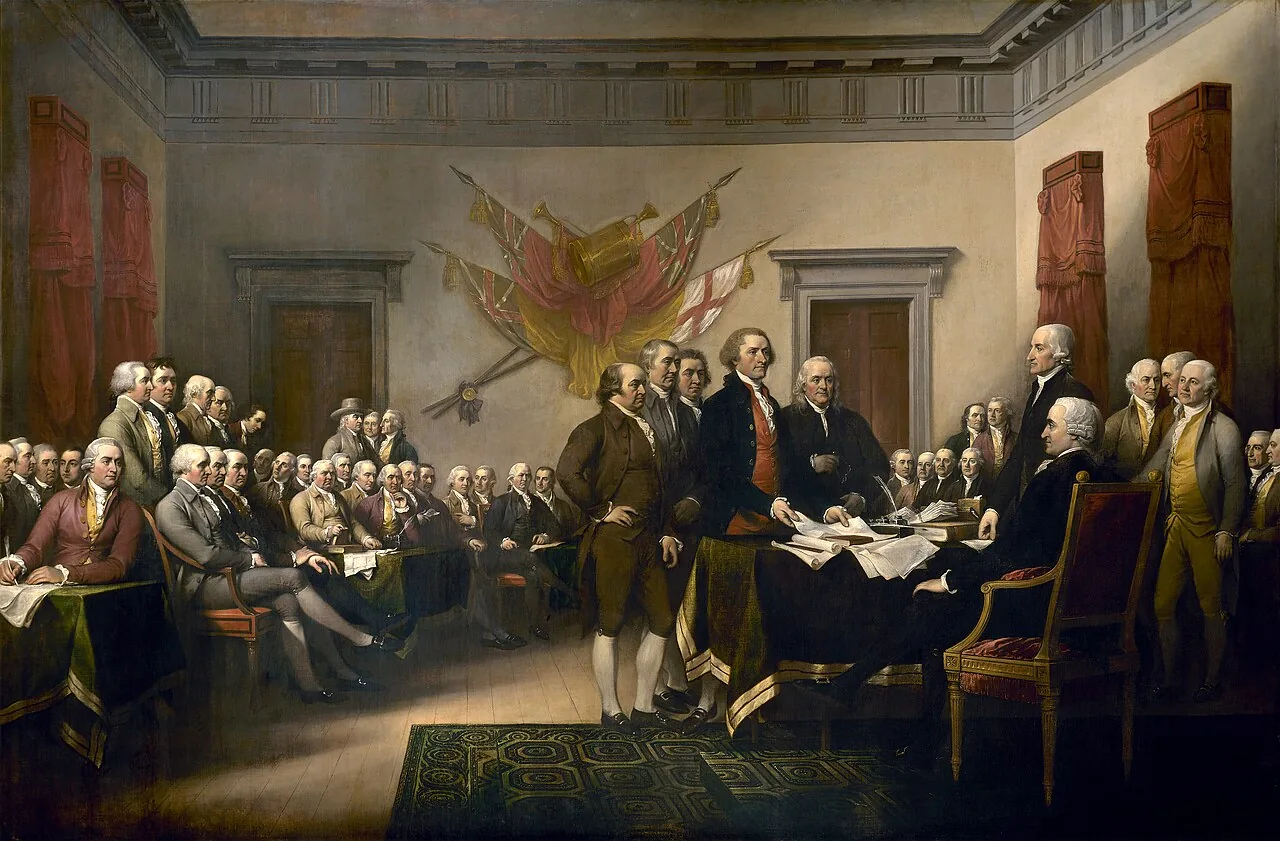
- Present the painting (author, date, subject). Why must we be careful about the date?
- Describe the composition: who stands at the center and who sits?
- What details suggest solemnity?
- Why is this scene partly imagined?
- What does the painting show about who made the revolution?
Exercise 11 : A caricature of the Old Regime
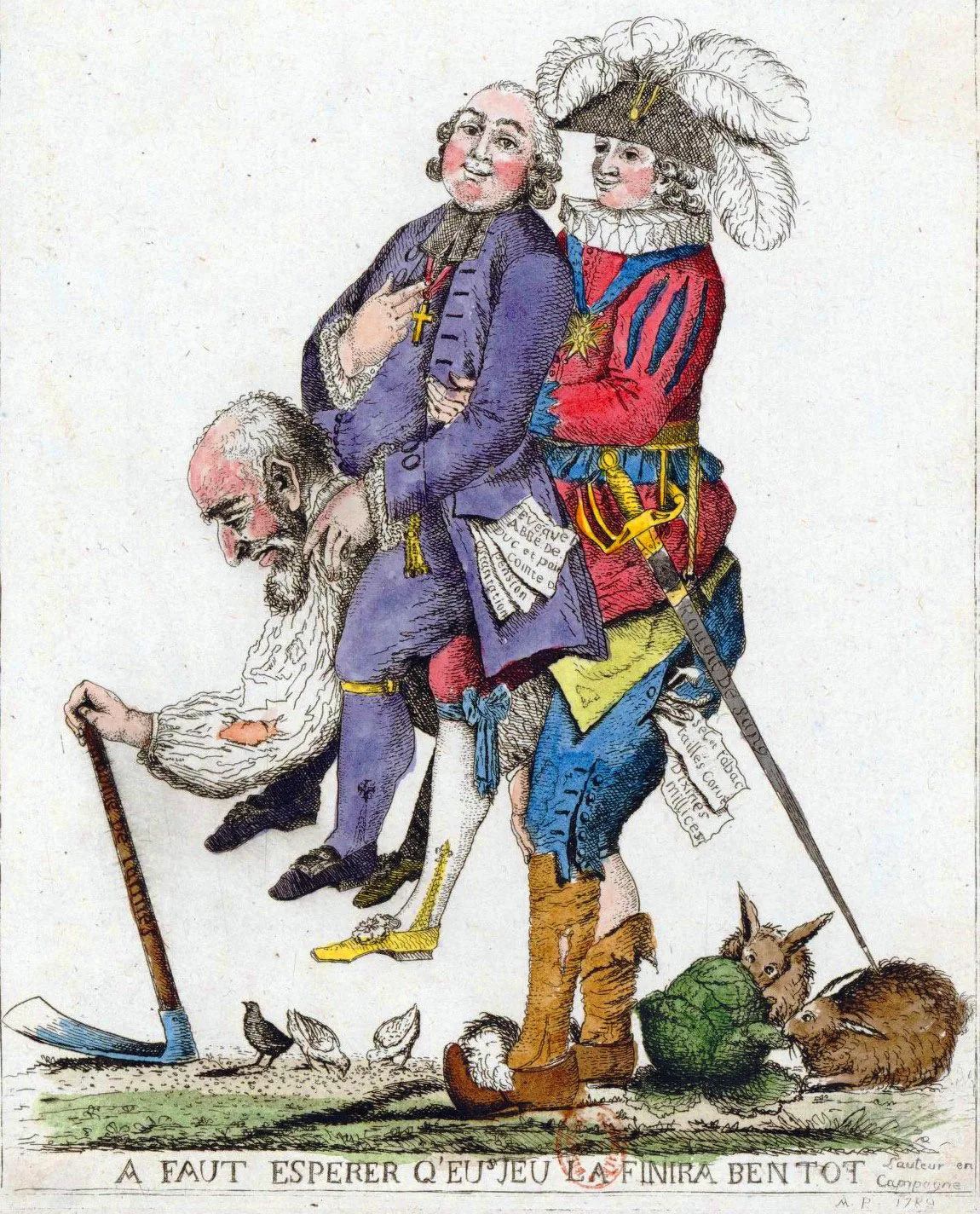
- Present the image and say what kind of document it is.
- Who are the three figures, and how can you recognize them?
- What does the position of the figures suggest?
- What does the caption suggest will happen?
- Why is the source biased, and what can a historian still learn from it?
Exercise 12 : Insurrection in Saint-Domingue
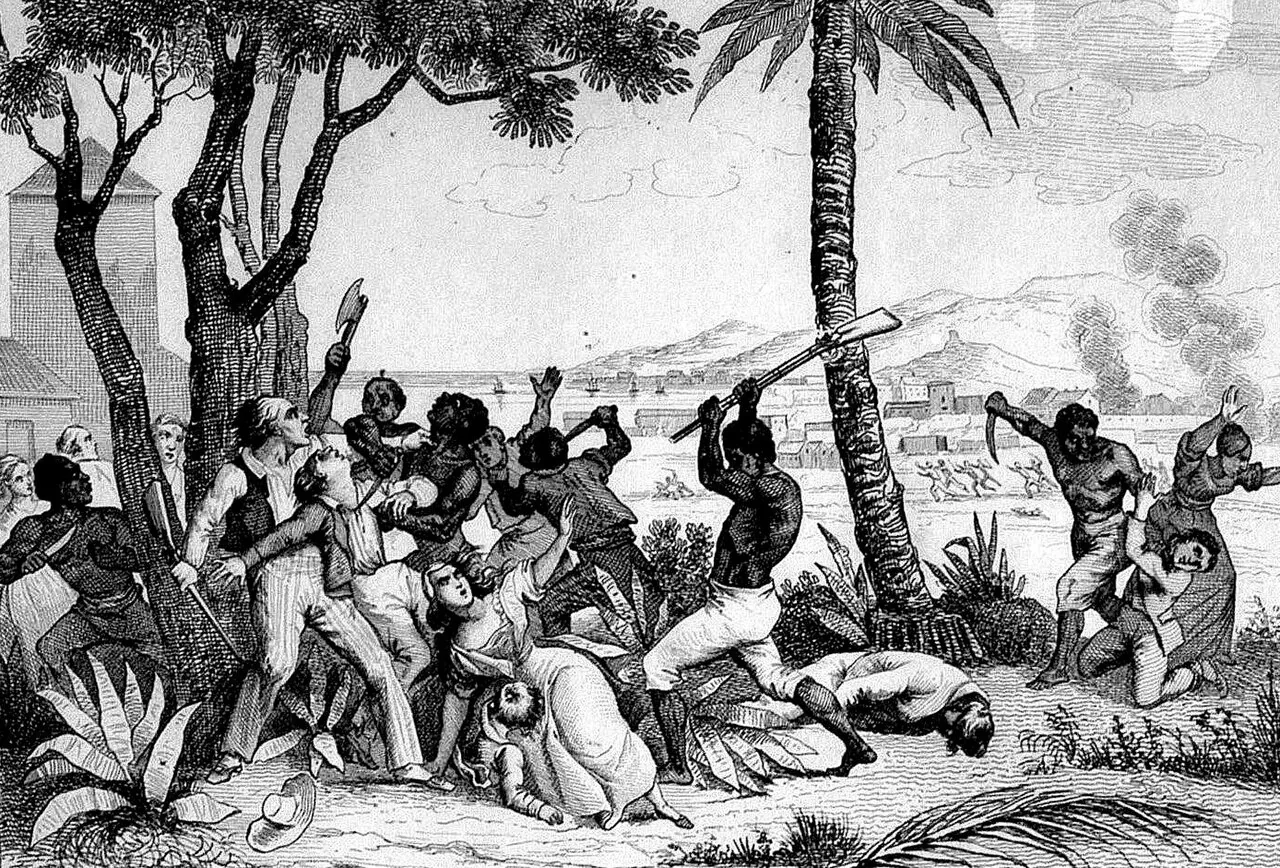
- Present the engraving and date it.
- Describe the scene: who attacks whom, and what is burning?
- Whose point of view does the artist appear to share?
- What is missing from the image?
- Which other sources would you look for to balance it?
Exercise 13 : The last battle
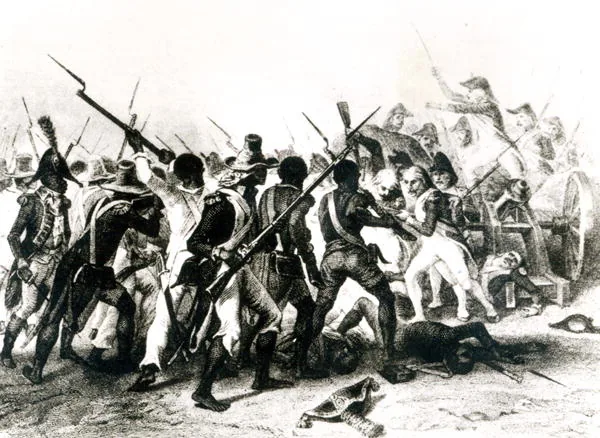
- Present the engraving and say when the event took place.
- Describe the fighters and their weapons.
- What was the result of this battle?
- Why was the war in Saint-Domingue so hard for French soldiers? (Use the lesson.)
- What happened on January 1, 1804?
Exercise 14 : Population of Saint-Domingue and the United States
Document 1 – Peoples of two societies
| Place and year | Total population | Enslaved |
|---|---|---|
| Saint-Domingue, 1789 (approximate) | about 560,000 | about 500,000 |
| United States, 1790 (census) | 3,929,214 | 697,681 |
Source: U.S. Census Bureau, First Census of the United States (1790); for Saint-Domingue, figures commonly given by historians, which vary (about 500,000 enslaved, 30,000 whites, and 28,000 free people of color). Table prepared for this unit.
- Calculate the approximate share of enslaved people in each society (divide and round to the nearest whole number).
- Which society had the higher share?
- Explain why this difference helps to explain the outcome of the revolution in Saint-Domingue.
- Why should historians treat the figures for Saint-Domingue as approximate?
Exercise 15 : The Atlantic world
- Name the city numbered 1 where the Tea Party took place in 1773.
- Name the city numbered 2 where Congress adopted the Declaration.
- Name the place numbered 3, site of the British surrender in 1781.
- Name the city numbered 4, scene of the French Revolution.
- Name the place numbered 5, the capital of the richest French colony, and the numbered cities in Latin America (6 and 7).
Exercise 16 : The island of Hispaniola
- Which color marks the French colony of Saint-Domingue, and which the Spanish part?
- Name the city numbered 1 where the battle of Vertières was fought nearby.
- Name the city numbered 2 where Haiti’s independence was proclaimed in 1804.
- Name the city numbered 3, now the capital of Haiti.
- Name the city numbered 5, capital of Spanish Santo Domingo, and explain why the island’s division mattered to Toussaint in 1801.
Exercise 17 : Order the events
Put in order: A) Napoleon seizes power in France (1799). B) The Declaration of Independence (1776). C) The Estates General meets (1789). D) Slave uprising in Saint-Domingue (1791). E) France abolishes slavery (1794). F) Independence of Haiti (1804). G) British surrender at Yorktown (1781).
Exercise 18 : Durations and intervals
Calculate and explain: 1) the time between the Declaration of Independence (1776) and the Declaration of the Rights of Man (1789); 2) the length of the war in Saint-Domingue from August 1791 to January 1804; 3) the time between the abolition of slavery by France (1794) and its restoration (1802); 4) the age of Toussaint at his death if he was born about 1743 and died in 1803.
Exercise 19 : Guided research: Toussaint Louverture
Find out about Toussaint Louverture. Use at least two reliable sites, such as the Encyclopaedia Britannica, the Library of Congress, or the Smithsonian. Suggested keywords: Toussaint Louverture biography, Haitian Revolution Library of Congress.
- When and where was he born, and what was his status?
- Which armies did he fight with, and when?
- How did he come to rule Saint-Domingue?
- How did his career end?
- Which sites did you use, and why do you trust them?
Hint: look for the dates 1743, 1794, 1801, and 1803.
Exercise 20 : CER paragraph: shared ideas, different results
Claim, evidence, reasoning. Write one paragraph that answers: How did the Haitian Revolution go further than the American Revolution in applying the idea that all men are equal? Use at least two pieces of evidence and explain your reasoning.
Hint: use the Declaration of Independence, the Constitution of 1801, and the census figures.
Exercise 21 : SAQ: the French Revolution
Answer all three parts. a) Identify one cause of the French Revolution. b) Explain one way in which the American Revolution influenced the French Revolution. c) Explain one way in which the French Revolution failed to fulfill the ideals of its Declaration of 1789.
Exercise 22 : True or false? Justify
Say whether each statement is true or false and justify in one sentence.
- The Declaration of Independence was approved on July 4, 1776.
- In 1789 the French Third Estate made up about two percent of the population.
- France abolished slavery in its colonies in 1794.
- Toussaint Louverture proclaimed Haiti’s independence on January 1, 1804.
- The Haitian Revolution had no influence outside the island.
- Bolívar received help from Haiti.
Exercise 23 : Causes and consequences
For each cause give one consequence and explain the link. 1) British taxes on the colonies after 1763. 2) The debts of the French monarchy. 3) The Declaration of the Rights of Man and the news that reached Saint-Domingue. 4) Napoleon’s invasion of Spain in 1808.


Quick review: flashcards
Tap a card to see the answer.