


This World History Grades 9-10 lesson covers The Atlantic Revolutions: America, France and Haiti, part of the unit “Revolutions.” First, read the full lesson with its primary sources, maps and key terms. Then practice with the worksheet, check yourself with the quiz and get ready with the test.
On the night of August 22, 1791, in the rich plain north of Cap-Français on the island of Saint-Domingue, bells rang and the sky filled with the glow of burning cane fields. Enslaved men and women, who made up nearly nine in ten of the colony’s people, had risen against their masters. They were not the first people in the Atlantic world to demand liberty in 1791.
Fifteen years earlier, thirteen British colonies had declared that “all men are created equal.” Similarly, two years earlier, the French National Assembly had proclaimed that “men are born and remain free and equal in rights.” The leaders of those revolutions did not all mean the same thing by “men,” and the people of Saint-Domingue soon forced the question: did the words apply to everyone? Between 1776 and 1804, three revolutions on two continents answered it in different ways.
Guiding question: How did the revolutions in British North America, France, and Saint-Domingue draw on the same ideas of liberty and equality, and why did they have such different results?
1. The American Revolution
Causes
After Britain won the Seven Years’ War (1756-1763), it ruled a vast empire in North America and owed a huge debt. As a result, Parliament decided that the thirteen colonies should pay part of the cost of their defense. The Stamp Act of 1765 taxed printed paper, the Townshend duties of 1767 taxed imports such as glass and tea, and the Tea Act of 1773 helped the East India Company sell tea cheaply.
However, colonists answered that they had no representatives in Parliament, so Parliament had no right to tax them: “no taxation without representation.” They also boycotted British goods, formed committees of correspondence, and took inspiration from Locke and Montesquieu. Then, on December 16, 1773, colonists threw about 340 chests of tea into Boston harbor. Parliament replied with the Coercive Acts (1774), which the colonists called the Intolerable Acts, closing the port of Boston and limiting self-government in Massachusetts.
Document 1 – The Boston Tea Party
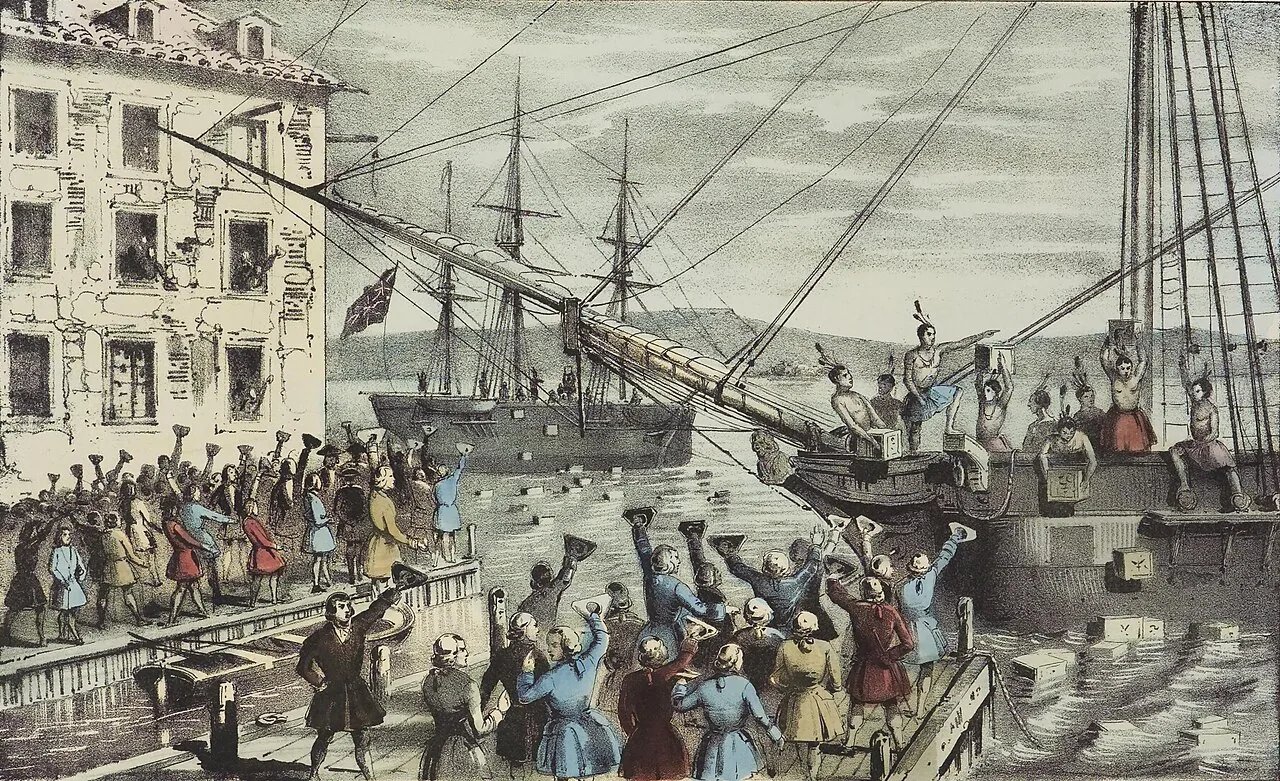
Source: Nathaniel Currier, 1846, Library of Congress; image from Wikimedia Commons, public domain.
Commentary. Currier made his lithograph in 1846, seventy-three years after the event. The name “Boston Tea Party” itself dates from the 1830s, so the image shows how later Americans remembered the protest. It shows men, some of them disguised as Native Americans, tossing tea from the ship while a crowd cheers on the wharf and from windows. In reality, the protesters planned the action carefully and did not damage anything but the tea. Therefore, the print is useful as evidence for the memory of the event, not as an eyewitness view of it.
War and independence
Fighting began at Lexington and Concord, Massachusetts, on April 19, 1775. In June 1776 the Continental Congress, meeting in Philadelphia, appointed five men to write a declaration, and Thomas Jefferson drafted it. Finally, Congress approved the final text on July 4, 1776. The Declaration based independence on natural rights and on the consent of the governed, and it listed the king’s abuses.
Meanwhile, George Washington led the Continental Army through hard years. The turning point was the victory at Saratoga in October 1777, which persuaded France to ally with the Americans in 1778. Then the war ended at Yorktown, Virginia, in October 1781, where a French fleet and army helped trap the British army under Lord Cornwallis. By the Treaty of Paris (1783), Britain recognized the independence of the United States.
Definition: Consent of the governed
The principle that a government’s authority comes from the agreement of the people it rules. The Declaration of Independence states that governments derive “their just powers from the consent of the governed.”
Document 2 – The principles of the Declaration of Independence
We hold these truths to be self-evident: That all men are created equal; that they are endowed by their Creator with certain unalienable rights; that among these are life, liberty, and the pursuit of happiness; that, to secure these rights, governments are instituted among men, deriving their just powers from the consent of the governed; that whenever any form of government becomes destructive of these ends, it is the right of the people to alter or to abolish it, and to institute new government, laying its foundation on such principles, and organizing its powers in such form, as to them shall seem most likely to effect their safety and happiness.
Source: Declaration of Independence, July 4, 1776, second paragraph, drafted chiefly by Thomas Jefferson; text from the Avalon Project, Yale Law School.
*Unalienable: that cannot be taken away. *Instituted: set up. *Prudence: wise caution. *Transient: short-lived.
Commentary. Jefferson drafted this passage, the heart of the Declaration, in June 1776, and Congress edited it. It claims that rights belong to everyone and that people may abolish a government that violates them, using ideas close to Locke’s. It also shows a cautious side: the authors say that people should not change old governments for “light and transient causes.” We should remember that the same men who signed it included slaveholders, that Jefferson himself held more than six hundred people in bondage during his life, and that Congress removed a passage criticizing the slave trade from his first draft. The words were bigger than the people who wrote them, and later generations used them to demand rights for others.
A new nation
The first government, under the Articles of Confederation (1781), was too weak to tax or regulate trade. Then, in 1787, delegates met in Philadelphia and wrote a new Constitution that created a federal government with three branches: a Congress, a president, and federal courts. Each could check the others, as Montesquieu had advised. The states ratified it in 1788, and in 1791 they added the Bill of Rights, ten amendments protecting freedom of speech, religion, and fair trials.
Yet the new republic also protected slavery: the Constitution counted three-fifths of the enslaved population in apportioning seats in the House and allowed the slave trade to continue until 1808. The 1790 census counted about 3.9 million people, and slaveholders held roughly 700,000 of them in bondage. Women could not vote, and the law denied citizenship to Native Americans.
2. The French Revolution
The crisis of the Old Regime
Before 1789 French society, later called the Old Regime, had three orders or estates: the clergy (First Estate), the nobility (Second Estate), and everyone else (Third Estate), which made up about ninety-eight percent of the population, from wealthy merchants to peasants. The first two estates held privileges, such as exemption from the main land tax, while the Third Estate paid most of the taxes. Also, the king’s government was nearly bankrupt after a series of costly wars, including its aid to the American Revolution. Then a bad harvest in 1788 raised the price of bread, so in 1789 Louis XVI called the Estates General, a body that had not met since 1614, to approve new taxes.
Definition: Old Regime
The political and social system of France before the Revolution of 1789, based on a monarchy with absolute claims, three estates, and legal privileges for the clergy and nobility.
Document 3 – The Third Estate carries the others
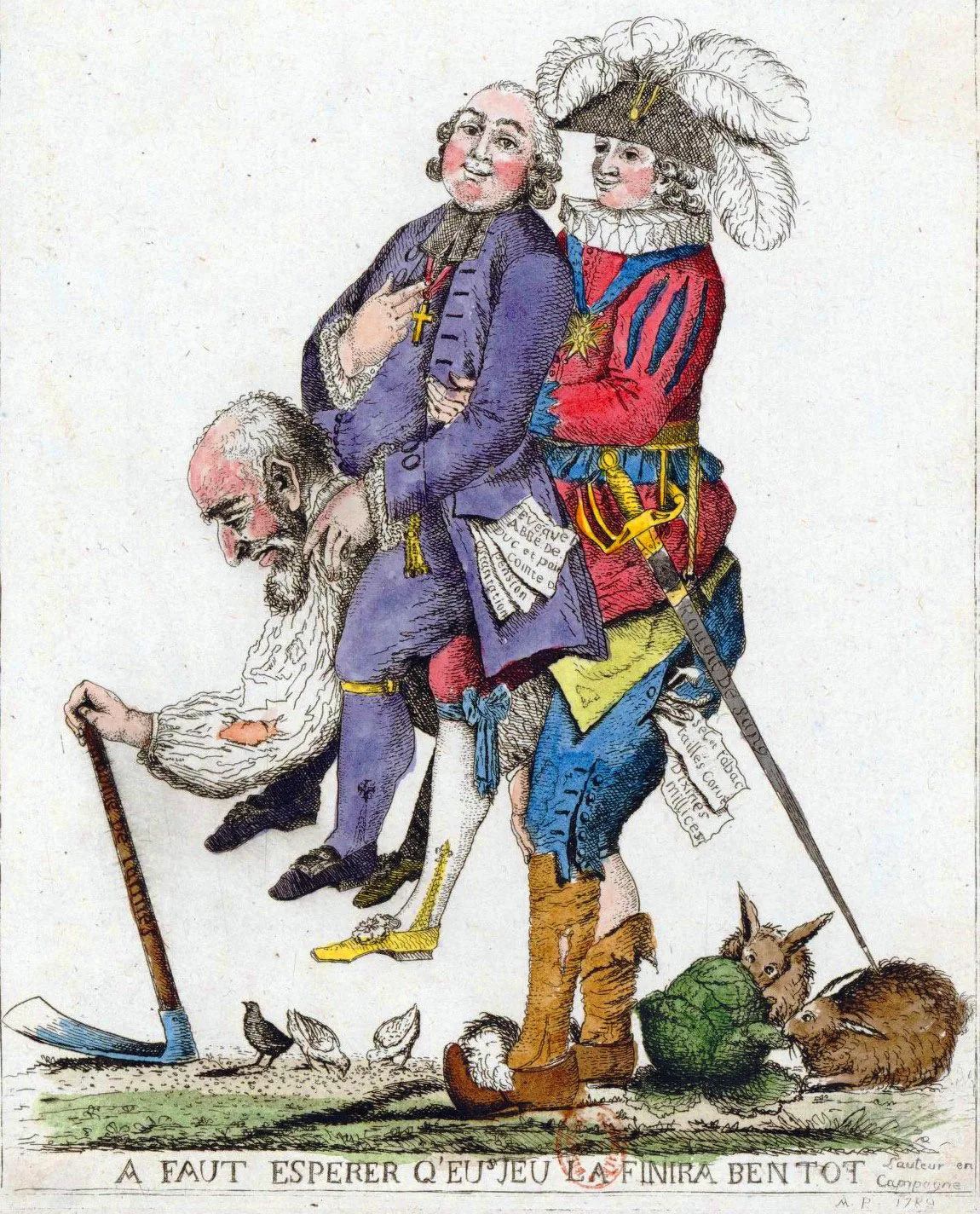
Source: anonymous caricature, 1789, Wikimedia Commons, public domain.
Commentary. This caricature, one of many printed in 1789, shows an old peasant with a pickaxe and a sack bent under the weight of a noble in a feathered hat and a priest in a robe, who sit on his back and shoulders. The saying below it, “It is to be hoped that the game will soon be over,” hints that the peasant will soon throw them off. The artist is anonymous and sympathizes with the Third Estate, so the image shows opinion, not fact: nobles and clergy were not all idle, and many peasants owned some land. But it reveals how many people saw the Old Regime.
From the Bastille to the Republic
When the Estates General met at Versailles in May 1789, the deputies of the Third Estate demanded that the three orders vote together by head, not by order. On June 17 they declared themselves the National Assembly, and on June 20, locked out of their hall, they swore in a tennis court not to separate until France had a constitution. Then, on July 14, a Paris crowd stormed the Bastille, a royal fortress and prison that stood for royal power, in search of gunpowder and weapons.
Meanwhile, in August, peasants attacked manor houses in the “Great Fear.” As a result, on the night of August 4 the Assembly abolished feudal privileges, and on August 26 it adopted the Declaration of the Rights of Man and of the Citizen. Finally, in October a crowd of Parisian women marched to Versailles, protesting the price of bread, and brought the king back to Paris.
Document 4 – The taking of the Bastille
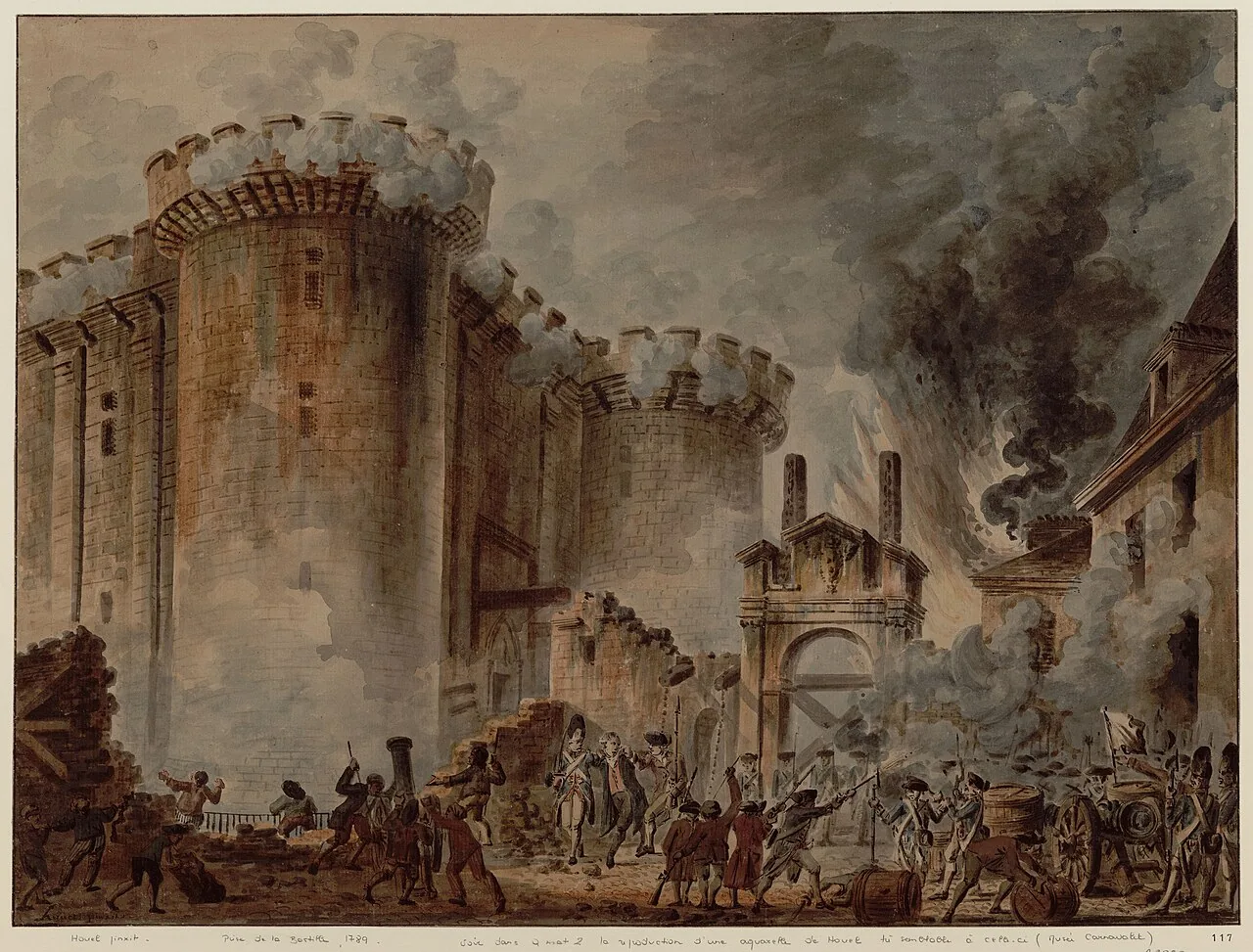
Source: Jean-Pierre Houël, 1789; image from Wikimedia Commons, public domain.
Document 5 – The Declaration of the Rights of Man, 1789
Men are born and remain free and equal in rights. Social distinctions may be founded only upon the general good. 2. The aim of all political association is the preservation of the natural and imprescriptible rights of man. These rights are liberty, property, security, and resistance to oppression. 3. The principle of all sovereignty resides essentially in the nation. No body nor individual may exercise any authority which does not proceed directly from the nation. 4. Liberty consists in the freedom to do everything which injures no one else; hence the exercise of the natural rights of each man has no limits except those which assure to the other members of the society the enjoyment of the same rights.
Source: Declaration of the Rights of Man and of the Citizen, August 26, 1789, articles 1 to 4, approved by the National Assembly of France; text from the Avalon Project, Yale Law School.
*Imprescriptible: that cannot be lost. *Sovereignty: supreme power.
Commentary. Deputies of the National Assembly wrote the Declaration, drawing on Enlightenment thinkers and on the American declarations. It also states that rights belong to all men, that political power comes from the nation and not from the king, and that liberty is limited only by the rights of others. The text speaks in universal language, but men wrote it. It did not mention women, and it said nothing about slavery in the colonies. Consequently, the questions that this silence raised drove much of the history that followed.
The Republic and the Terror
The Assembly wrote a constitution in 1791 that created a constitutional monarchy, redivided France into departments, and put the Church’s property under state control. But the king tried to flee in June 1791, and officials stopped him at Varennes. Then, in April 1792, France went to war with Austria and Prussia, and in September 1792 the Convention abolished the monarchy and proclaimed the Republic. The Convention tried Louis XVI and executed him on January 21, 1793.
With France at war with much of Europe and in revolt in the west, the Committee of Public Safety, dominated by Maximilien Robespierre, ruled through the Reign of Terror (1793-1794). Courts officially sentenced about 17,000 people to death and executed them, and many more died in prison or in civil war. Finally, after Robespierre’s fall in July 1794, the revolution moved to the right, and in November 1799 General Napoleon Bonaparte seized power.
Definition: Reign of Terror
The period from 1793 to 1794 when the revolutionary government of France used special courts and the guillotine to eliminate people it called enemies of the Revolution, in a time of foreign war and civil war.
Document 6 – A conservative reaction: Edmund Burke, 1790
I thought ten thousand swords must have leaped from their scabbards to avenge even a look that threatened her with insult. But the age of chivalry is gone. That of sophisters, economists, and calculators has succeeded; and the glory of Europe is extinguished forever.
Source: Edmund Burke, Reflections on the Revolution in France, 1790, on the arrival of the royal family in Paris in October 1789; Project Gutenberg edition (Works, vol. 3, ebook 15679).
*Cavaliers: knightly gentlemen. *Sophisters: clever but misleading arguers. *Economists: here, men who reason about the economy.
Commentary. Burke, a British member of Parliament who had supported the American colonists, wrote his Reflections in 1790 as a warning against the French Revolution. In this passage he describes the royal family’s arrival in Paris in October 1789 and mourns the loss of a society based on loyalty and tradition; he scorns the “sophisters, economists, and calculators” who he thinks have replaced it. The text is rhetorical and emotional, and it shows the fear many conservatives felt. Burke wrote it before the Terror, and his predictions proved partly right, but he said little about the injustices of the Old Regime. However, Thomas Paine answered him in Rights of Man (1791).
Women and the revolution
Women took part in every stage. For example, they were in the crowd that went to Versailles, they formed clubs, and they petitioned the Assembly. But they did not gain the vote. In 1791 Olympe de Gouges, a playwright, published a Declaration of the Rights of Woman and of the Female Citizen, and in 1793 the authorities guillotined her after she criticized Robespierre. In England, Mary Wollstonecraft wrote her Vindication of the Rights of Woman in 1792, arguing that women had the same capacity for reason as men if they received the same education.
Document 7 – Mary Wollstonecraft on women’s education
I do not wish them to have power over men; but over themselves. In the same strain have I heard men argue against instructing the poor; for many are the forms that aristocracy assumes. “Teach them to read and write,” say they, “and you take them out of the station assigned them by nature.” An eloquent Frenchman, has answered them; I will borrow his sentiments. But they know not, when they make man a brute, that they may expect every instant to see him transformed into a ferocious beast. Without knowledge there can be no morality! Ignorance is a frail base for virtue!
Source: Mary Wollstonecraft, A Vindication of the Rights of Woman, 1792, chapter 4; Project Gutenberg edition.
*Aristocracy: rule by a privileged class. *Morality: sense of right and wrong. *Superiority in essence: said to be built into nature itself.
3. The Haitian Revolution
Saint-Domingue before 1789
Saint-Domingue, the western third of the island of Hispaniola, was the richest colony in the world. Its sugar, coffee, indigo, and cotton plantations supplied a large share of the sugar and coffee that Europeans consumed. They depended on the labor of around half a million enslaved Africans, whom planters worked brutally. Many died within a few years of arrival, so planters had to bring in new captives every year. Free people included about 30,000 whites (rich planters, colonial officials, and poor whites) and about 28,000 free people of color, many of them mixed-race and some of them planters and slaveholders whom the law denied political equality. Color, status, and wealth divided the colony’s society.
Revolution and emancipation
News of the French Revolution reached the colony in 1789. Free people of color demanded equal rights under the Declaration, but the planters resisted. In 1790 Vincent Ogé, a free man of color, led a small revolt, but troops crushed it and executed him in 1791. Then, in August 1791, enslaved people in the north rose in a well-organized rebellion, supposedly after a religious ceremony at Bois Caïman led by Dutty Boukman, a vodou priest. Within weeks tens of thousands of insurgents controlled much of the north, burning plantations and killing whites. In response, the planters and colonial authorities killed as well. The war that followed lasted twelve years and involved France, Spain, and Britain.
Document 8 – The uprising of August 1791
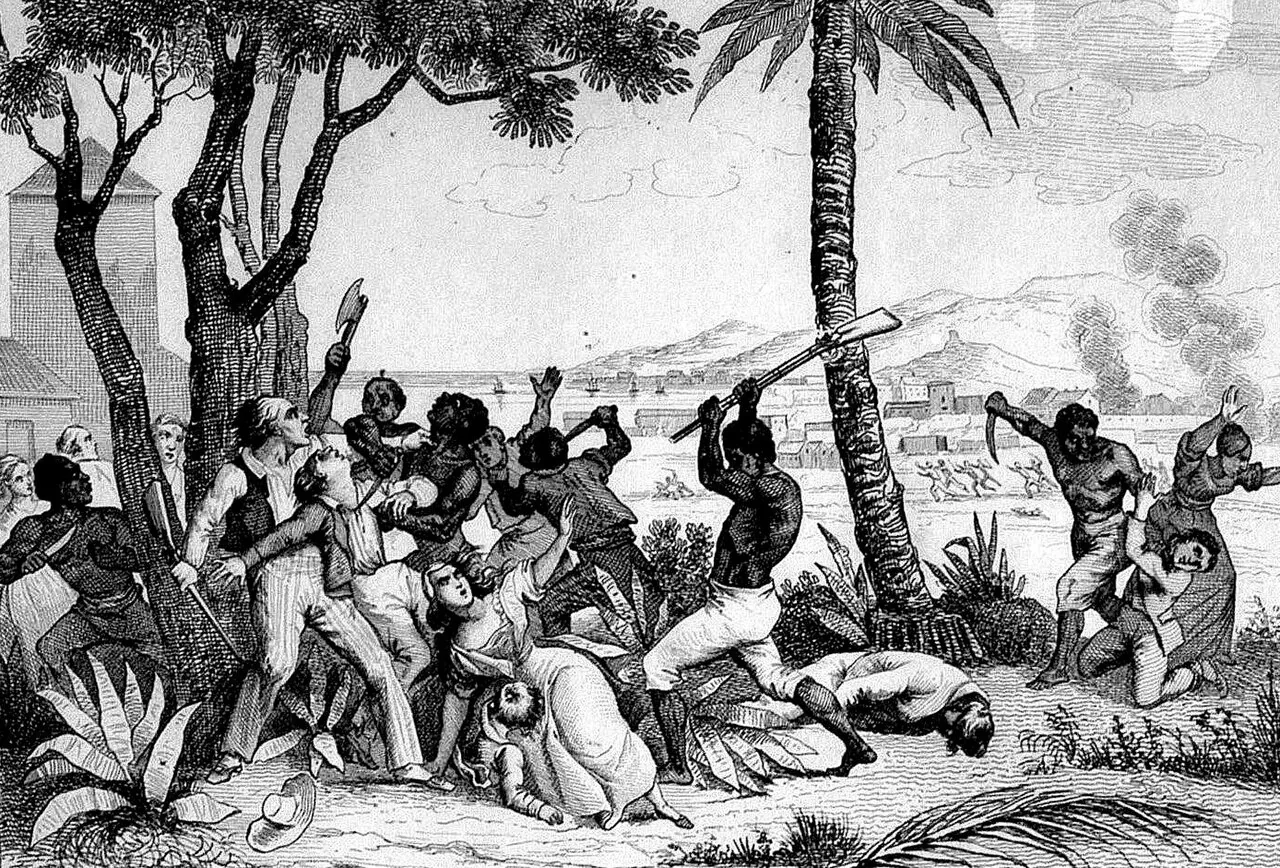
Source: Martinet and Masson, nineteenth-century engraving; image from Wikimedia Commons, public domain.
Commentary. This engraving, published in the nineteenth century in a French illustrated history, shows white colonists, among them women and children, assaulted by insurgents while a plantation burns. It reflects the point of view of French publishers, who stressed the violence of the insurgents and left out the brutality of slavery and the colonists’ own massacres. It is therefore a source for how Europeans of that time pictured the revolt, rather than for what happened. A historian would pair it with the writings of the insurgents and of the colonists’ own accounts.
In 1793 the French commissioner Léger-Félicité Sonthonax proclaimed freedom for the enslaved in the north to win their support in the war against Spain and Britain, and on February 4, 1794 (16 Pluviôse), the Convention in Paris abolished slavery in all French colonies. Among the insurgent leaders, Toussaint Louverture, a formerly enslaved man who had been freed before the revolution and who was in his late forties, rose to the top.
He first fought for Spain, then joined the French after the abolition, and defeated both the Spanish and the British, who evacuated in 1798. By 1801 he governed the whole island, including the Spanish eastern part. He issued a constitution naming himself governor for life, declaring that “there cannot exist slaves on this territory.”
Document 9 – Haiti’s Constitution of 1801
There cannot exist slaves on this territory, servitude is therein forever abolished. All men are born, live and die free and French. Art. 4. All men, regardless of color, are eligible to all employment. Art. 5. There shall exist no distinction other than those based on virtue and talent, and other superiority afforded by law in the exercise of a public function. The law is the same for all whether in punishment or in protection.
Source: Constitution of the French Colony of Saint-Domingue, July 1801, title 2, articles 3 to 5; English translation published by the Louverture Project and on Wikisource.
*Servitude: slavery. *Public function: government office.
Commentary. An assembly of colonists and officials wrote the Constitution of 1801 under Toussaint’s direction. It affirmed that Saint-Domingue was part of the French Empire, but it set its own laws, and article 3 abolished slavery forever and declared all men “free and French.” In addition, article 5 ended distinctions except those of “virtue and talent.” The same constitution also required plantation workers to remain on the estates and made Catholicism the only public religion, and it gave Toussaint nearly absolute power, which some of his supporters resented. It is evidence of a political project that was ambitious and authoritarian at the same time.
Napoleon, war, and independence
Napoleon Bonaparte, First Consul of France since 1799, wished to restore the colony’s profits and the old order. In 1802 he sent a large expedition under his brother-in-law General Charles Leclerc. In May 1802 he also ordered the restoration of slavery in the colonies that France had regained. French officers arrested Toussaint by trickery in June 1802 and deported him to France, where he died on April 7, 1803, in the cold fortress of Fort de Joux in the Jura mountains.
But the fighting continued, as the former slaves who had become soldiers refused to go back to slavery, and yellow fever killed thousands of French soldiers, including Leclerc himself. Then Jean-Jacques Dessalines took command, and on November 18, 1803, his army won the battle of Vertières, outside Cap-Français. On January 1, 1804, Dessalines proclaimed the independence of Haiti, a Taíno name for the island, the second independent republic in the Americas and the first country founded by formerly enslaved people.
Document 10 – Toussaint Louverture
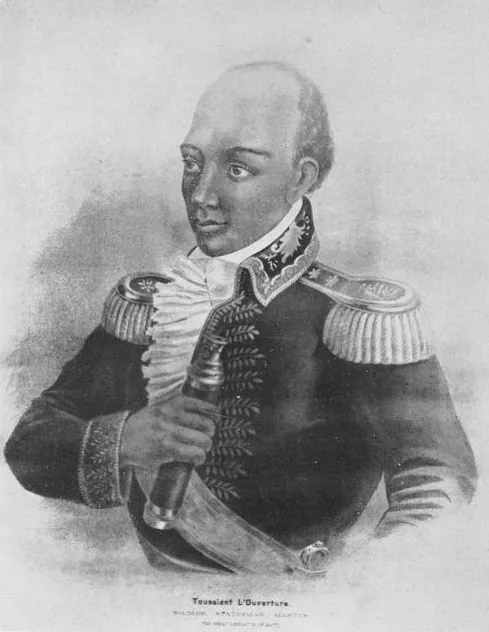
Source: nineteenth-century engraving; image from Wikimedia Commons, public domain.
Document 11 – Toussaint Louverture seen from the United States
I am to tell you the story of a negro, Toussaint Louverture, who has left, hardly one written line. I am to glean it from the reluctant testimony of his enemies, men who despised him because he was a negro and a slave, hated him because he had beaten them in battle.
Source: Wendell Phillips, lecture “Toussaint L’Ouverture,” 1861, as quoted in Jacques Nicolas Léger, Haiti: Her History and Her Detractors (New York, 1907), part 1, chapter 7; Wikisource.
*Negro: the word then in common use in English; today “Black” or “African American” is used. *Glean: gather bit by bit.
Commentary. Wendell Phillips, an American abolitionist, delivered his speech about Toussaint in 1861, on the eve of the Civil War, to persuade his audience that Black people could be great leaders. He compares Toussaint to Cromwell, Napoleon, and Washington. The passage points out a real problem: Toussaint left almost no personal writings and most information comes from his opponents. But the text is a speech with a goal, and its praise should be read in that light. It shows that Haiti remained a symbol for abolitionists in the United States long after 1804.
The Haitian Revolution reshaped the Atlantic world. As a result, Napoleon, defeated in the Caribbean, gave up his American ambitions and sold Louisiana to the United States in 1803 for about fifteen million dollars. Slaveholders in the United States and across the Caribbean feared similar uprisings, and many governments refused to recognize Haiti. The United States did so only in 1862.
In 1825 France demanded an indemnity of 150 million francs from Haiti in return for recognition. Later France reduced it to 90 million francs, but the debt burdened the new country for generations. Yet Haiti also inspired antislavery movements and helped other revolutionaries: in 1816 President Alexandre Pétion gave Simón Bolívar weapons and ships on the condition that he free the enslaved people in the lands he liberated.
4. Revolutions in Latin America
Definition: Creole
In the Spanish and Portuguese empires, a person of European descent born in the Americas. Creoles were often wealthy but ranked below officials born in Europe, which fueled their resentment of colonial rule.
When Napoleon invaded Spain in 1808 and put his brother on the Spanish throne, the creoles (people of European descent born in the Americas) formed local governments in the name of the captive king, and many soon moved toward independence. In Mexico, a priest named Miguel Hidalgo called for revolt on September 16, 1810, and Mexico won independence in 1821. In South America, Simón Bolívar, a wealthy Venezuelan, wrote in 1815 his famous Letter from Jamaica describing the case for independence.
With the help of Haiti, he won the battle of Boyacá in 1819 and created the republic of Gran Colombia. His general Antonio José de Sucre then won the final battle in Spanish South America at Ayacucho in 1824. José de San Martín freed Argentina, Chile, and then Peru. In Brazil, the prince regent Pedro declared independence from Portugal in 1822 and became emperor. The new states mostly kept slavery for decades and kept power in the hands of creole elites; Indigenous people and people of African descent gained far less than the revolutionary slogans promised.
5. The legacy of the Atlantic revolutions
The revolutions spread the idea that governments rest on the consent of the governed, that rights belong to all people, and that written constitutions can limit power. They helped to end the Atlantic slave trade and slavery in the following century: Britain abolished the slave trade in 1807 and slavery in its empire in 1833, France abolished slavery again in 1848, and the United States did so in 1865. They also strengthened nationalism and the idea of citizenship. But they left many questions open: the rights of women, of workers, of Indigenous peoples, and of the formerly enslaved. These questions shaped the political struggles of the nineteenth century, which we will meet again in the next units.
- 1765 Stamp Act
- 1773 Boston Tea Party
- 1776 Declaration of Independence
- 1781 British surrender at Yorktown
- 1789 Estates General; storming of the Bastille; Declaration of the Rights of Man
- 1791 Slave uprising in Saint-Domingue
- 1793 Execution of Louis XVI; start of the Terror
- 1794 France abolishes slavery
- 1801 Toussaint’s constitution
- 1802 Napoleon moves to restore slavery in French colonies; Toussaint arrested
- 1804 Independence of Haiti
- 1819-1824 Bolívar and Sucre win independence in northern South America
Key takeaways
- The American Revolution (1775-1783) began as a protest against taxes without representation and produced a republic based on natural rights, a federal Constitution (1787), and a Bill of Rights (1791), but it kept slavery.
- The French Revolution (1789-1799) overthrew the Old Regime, proclaimed the Rights of Man, and abolished the monarchy, but it passed through the Terror and ended with Napoleon.
- The Haitian Revolution (1791-1804) was the only slave revolt that created a new state; it forced France to abolish slavery in 1794 and defeated Napoleon’s army in 1803.
- Napoleon’s invasion of Spain led to independence movements in Latin America, led by Bolívar, San Martín, Hidalgo, and others.
- All the revolutions used the language of natural rights, but women, enslaved people, and Indigenous peoples had to struggle for the rights that the declarations promised.
- The Haitian Revolution influenced the Louisiana Purchase (1803), frightened slaveholders, inspired antislavery movements, and left Haiti with a heavy debt.

Quick review: flashcards
Tap a card to see the answer.