


This World History Grades 9-10 lesson covers Absolutism and the Enlightenment, part of the unit “Revolutions.” First, read the full lesson with its primary sources, maps and key terms. Then practice with the worksheet, check yourself with the quiz and get ready with the test.
Focus question : How did absolute monarchs gain power, and how did the thinkers of the Enlightenment challenge unlimited power with ideas of liberty, rights, and the rule of law?
On a spring day in 1682 the court of Louis XIV left Paris for good and moved to a palace that had been little more than a hunting lodge in the 1650s. Thousands of nobles followed the king to Versailles. For example, they watched him wake up in the morning, attended his meals, and competed for the honor of holding his candlestick at night. Seventy years later, in the same city but in a very different world, nobles and writers gathered in the drawing rooms of Paris.
They heard a new play read aloud, argued about the powers of kings, and also discussed a gigantic dictionary of human knowledge that the Church and the royal government had tried to ban. In the space of two generations, Europeans had moved from admiring a king who claimed to rule by the will of God to asking whether any ruler deserved unlimited power.
Guiding question: How did absolute monarchs gain power in the 1600s, and how did the thinkers of the Enlightenment turn people against unlimited power and toward the ideas of liberty, equality, and the rule of law?
1. Europe in crisis and the rise of absolute monarchy
The 1600s were a century of war and fear. Between 1618 and 1648 the Thirty Years’ War, which began as a religious quarrel between Catholics and Protestants in the Holy Roman Empire, drew in Spain, France, Sweden, and Denmark. As a result, parts of Germany lost a large share of their population to fighting, hunger, and disease.
In England, a civil war between King Charles I and Parliament (1642-1651) ended with the execution of the king in 1649. In France, between 1648 and 1653, nobles and judges rose against the royal government in a series of revolts known as the Fronde, which the young Louis XIV never forgot. Therefore, many people concluded that the answer to disorder was a strong ruler who could keep the peace.
Definition: Absolutism
A system of government in which a monarch holds supreme power and does not have to share it with a parliament, nobles, or courts. Louis XIV of France is the classic example of an absolute monarch.
Definition: Divine right of kings
The belief that a king receives his authority directly from God, so that he answers to God alone and not to his subjects. Bishop Jacques-Bénigne Bossuet, who tutored Louis XIV’s son, wrote a famous defense of this idea.
Absolute monarchs claimed that their power came from God and that rebellion was therefore a sin. They also built tools that made their claims real. They created standing armies paid for by taxes, which gave kings a force that no noble could match. Next, they appointed royal officials to collect taxes and enforce orders in the provinces. In addition, they tried to control religion, trade, and the arts. The best-known absolute monarchs were Louis XIV of France, Peter the Great of Russia, and the rulers of the Habsburg lands and of Prussia.
2. Louis XIV and Versailles
Louis XIV became king in 1643 at the age of four. In fact, he reigned for seventy-two years, until 1715, longer than any other major European monarch. When his chief minister, Cardinal Mazarin, died in 1661, the twenty-two-year-old king announced that he would rule without a first minister. From then on he presided over his councils himself and chose ministers from outside the great noble families.
His finance minister Jean-Baptiste Colbert practiced mercantilism, the idea that a state grows richer by exporting more than it imports. Colbert encouraged royal factories that made tapestries, mirrors, and cloth. He also built roads and canals, and he tried to build a navy and a merchant fleet. At the same time, the royal army grew to hundreds of thousands of men during Louis’s wars. However, these wars brought France territory but also heavy debts and famine at home.
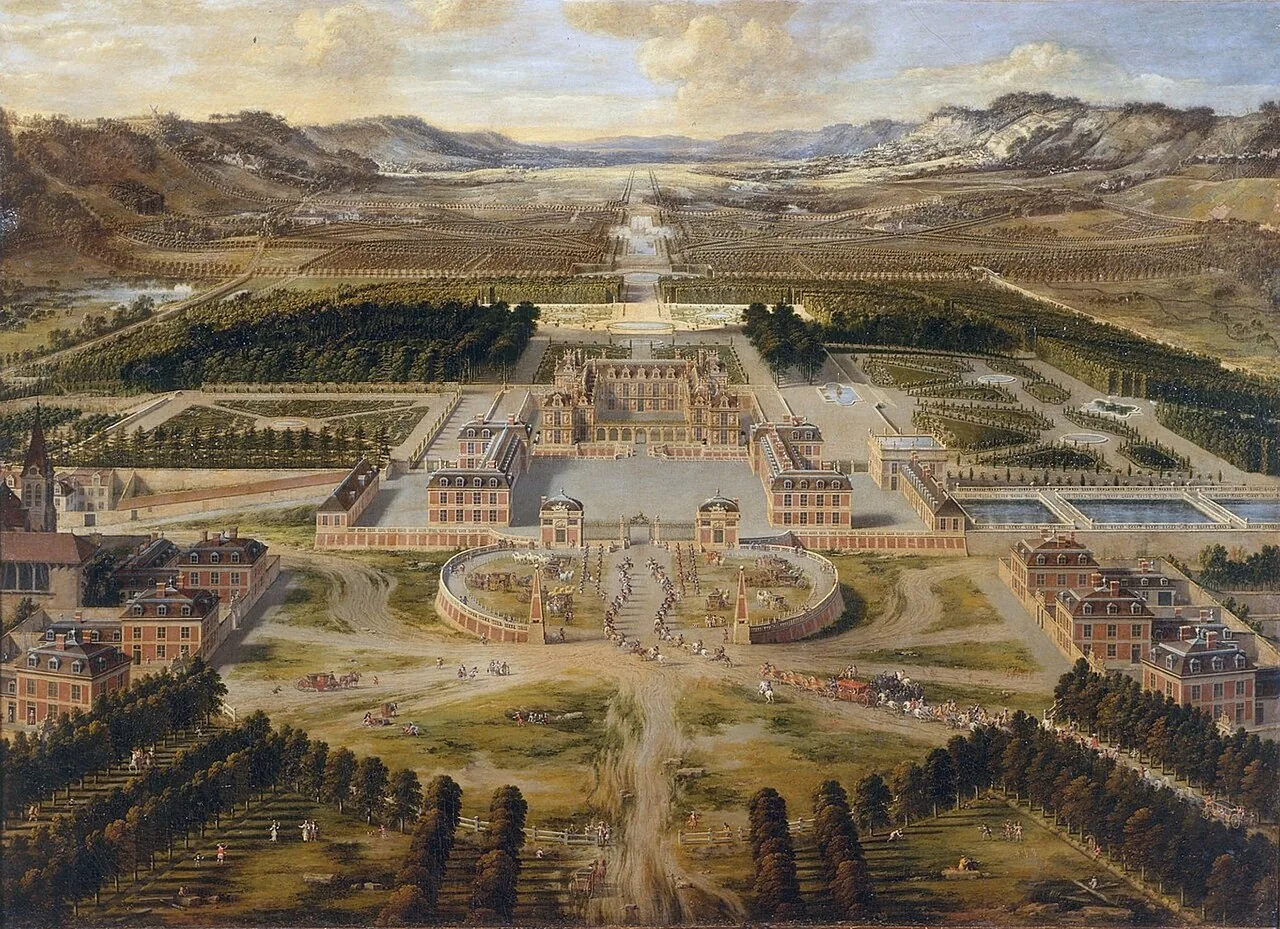
Versailles and the court
The palace of Versailles was both a home and a tool of government. Louis enlarged it between the 1660s and the 1680s. Then, in 1682, he made it the seat of the court and government. Thousands of nobles, servants, and officials lived there or nearby. The king turned the daily routine of his life into a ceremony in which nobles took part and competed for favor.
Indeed, to be near the king was to have a chance at pensions, offices, and honors. A noble who stayed away on his own lands lost influence. One who spent his money on festivals and fine clothes at court, however, often had little left for a private army. In this way the king turned the old warrior nobility, which had rebelled in the Fronde, into a court nobility that depended on him.
Document 1 – Louis XIV in his coronation robes
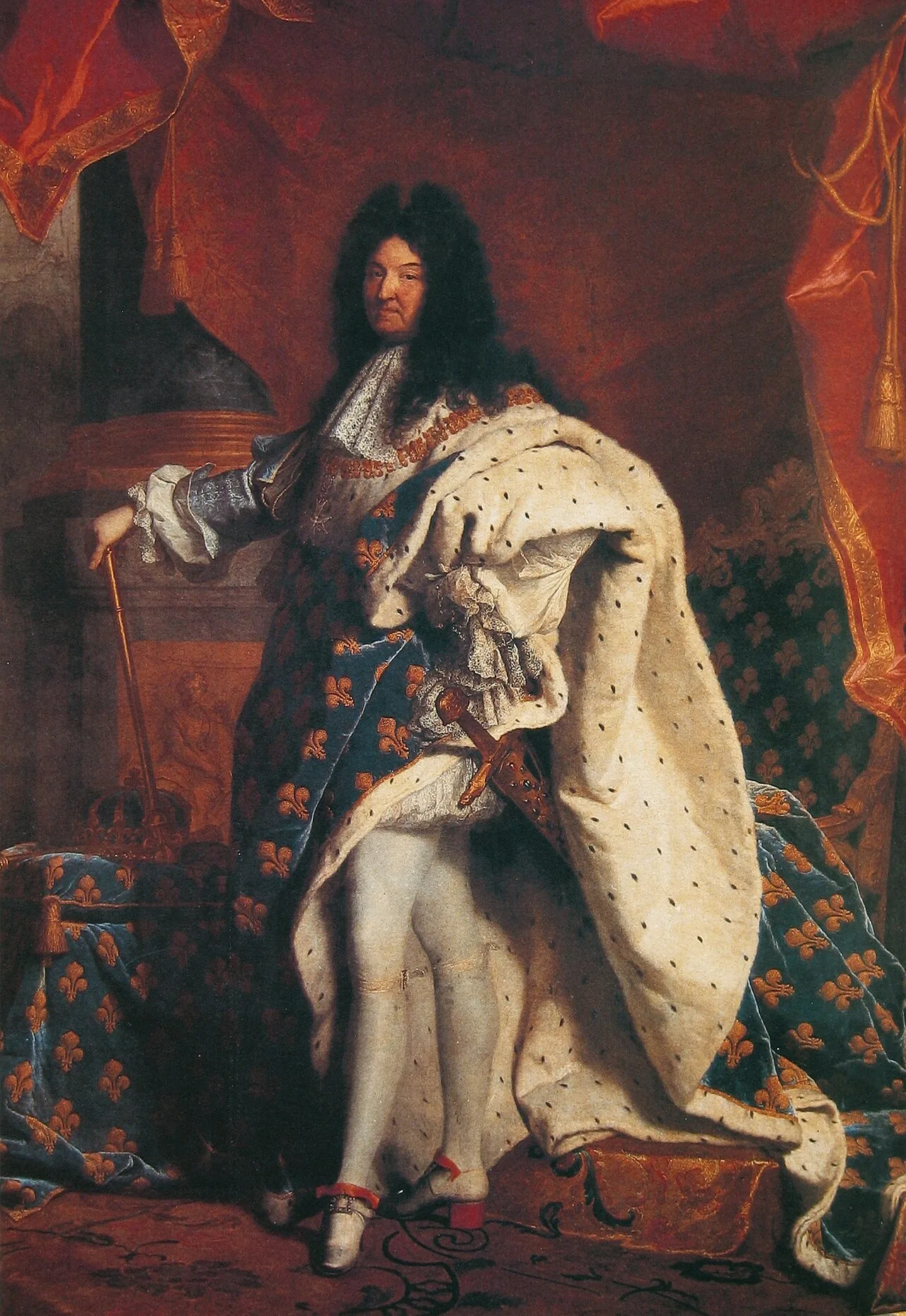
Source: Hyacinthe Rigaud, 1701, Louvre Museum; image from Wikimedia Commons, public domain.
Commentary. Rigaud painted this portrait in 1701 as a gift for the king’s grandson, who had become king of Spain. But Louis liked it so much that he kept it. The king does not wear armor or look like a warrior. He stands in a pose of ease, with the royal sword at his side, and one hand on his scepter. The great blue cloak decorated with fleur-de-lis falls around him.
The painter shows the legs of a king who had loved to dance, and the red-heeled shoes of a courtier. Meanwhile, the crown rests on a cushion beside him. Rigaud meant to impress viewers, so the picture shows power as dignity, wealth, and permanence rather than as force. The portrait does not show the king as he really looked, since he was sixty-two years old. Instead, it states what the monarchy wanted to show.
Religion and war
Louis also tried to enforce religious unity. In 1685 he revoked the Edict of Nantes. His grandfather Henry IV had issued it in 1598, and it had given French Protestants (Huguenots) the right to worship in many places. The king ordered the destruction of Protestant churches and closed their schools. Perhaps 200,000 Huguenots fled to England, the Dutch Republic, Prussia, and the American colonies, taking skills and money with them.
As a result, Protestant countries denounced the king. For Louis, a kingdom ought to have one king, one law, and one faith. His wars against Spain, the Dutch Republic, and an alliance led by England and the Habsburgs lasted almost without a break from 1667 to 1713. They expanded France’s borders slightly but left the country exhausted when he died in 1715.
3. Absolutism elsewhere, and its limits in England
Other rulers copied the French model. Peter the Great (ruled 1682-1725) forced the Russian nobility to cut their beards, wear Western clothes, and serve the state. He also built a modern army and navy, and in 1703 he founded a new capital, St. Petersburg, on land that Russia had won from Sweden in the Great Northern War. In the Habsburg lands, Maria Theresa (ruled 1740-1780) reformed taxes and the army. In Prussia, a small state with a strong army, Frederick II, called the Great (ruled 1740-1786), seized the rich province of Silesia from Austria in 1740-1742. As a result, Prussia became a great power.
England, however, took a different path. After a civil war and a short military republic under Oliver Cromwell, the monarchy returned in 1660, but the quarrel between kings and Parliament went on. In 1688 Parliament invited the Dutch prince William of Orange and his wife Mary, the daughter of King James II, to take the throne.
James fled in what people later called the Glorious Revolution. In December 1689 Parliament passed the Bill of Rights. It declared that the king could not suspend laws or raise taxes without Parliament’s consent, that elections ought to be free, that members of Parliament could speak freely, and that Parliament should meet often. The Dutch Republic, a federation of provinces ruled by merchants and a stadtholder, also limited power. These examples mattered: they proved that a country could be strong without an absolute king.
4. The Scientific Revolution and the Enlightenment
The Enlightenment grew out of a revolution in the way Europeans studied nature. In 1543 the Polish astronomer Nicolaus Copernicus argued that the Earth moves around the sun. Then, in 1610, Galileo Galilei used a telescope to observe the moons of Jupiter, and in 1633 the Roman Catholic Church forced him to deny that the Earth moves.
Finally, in 1687, Isaac Newton published the Principia, which explained the motion of falling objects and planets with the same laws. Francis Bacon argued for experiment, and René Descartes wrote in 1637 that one must doubt everything until reason proves it. Both thinkers showed that careful observation and logic could uncover how the world works. If nature follows laws that reason can discover, many people asked, why not society?
Definition: Enlightenment
An intellectual movement of the 1700s that used reason, science, and debate to question traditional authority in government, religion, and society. Its thinkers believed in progress, natural rights, freedom of expression, and education. Immanuel Kant summed it up in 1784 with the motto “Dare to know.”
5. Thinkers on government and liberty
Seventeenth-century English thinkers asked how a government begins. Thomas Hobbes (1588-1679), who wrote during the civil war, argued in Leviathan (1651) that without a government people live in a “war of every man against every man.” They must therefore give up their freedom to a powerful sovereign who keeps them safe. His book supported strong government, although not divine right. For Hobbes, the ruler’s power rested on an agreement among the people.
Document 2 – Life without government
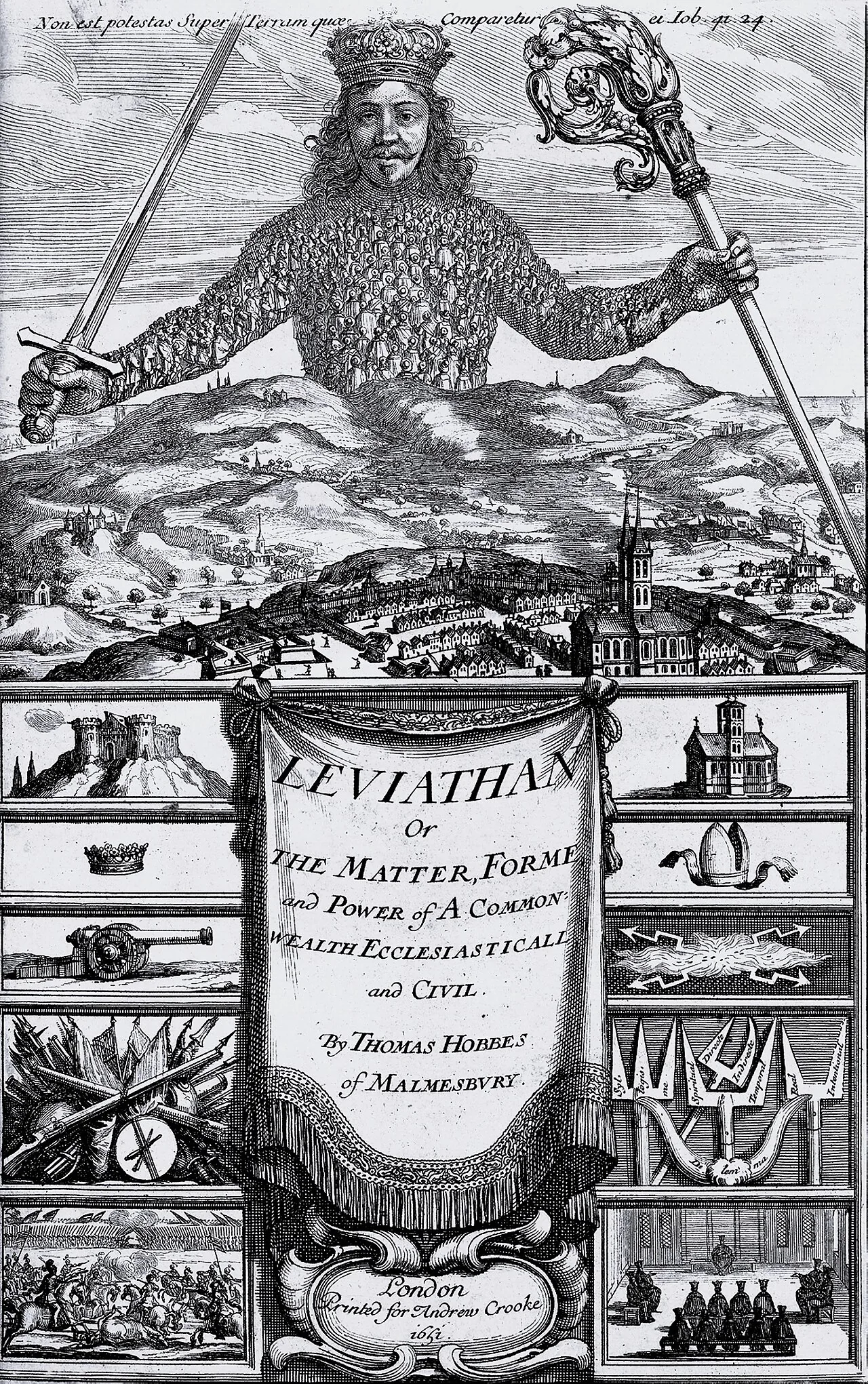
Source: frontispiece of Thomas Hobbes, Leviathan, 1651 (British Library); image from Wikimedia Commons.
Document 3 – Hobbes on life without government
In such condition, there is no place for Industry; because the fruit thereof is uncertain; and consequently no Culture of the Earth; no Navigation, nor use of the commodities that may be imported by Sea; no commodious Building; no Instruments of moving, and removing such things as require much force; no Knowledge of the face of the Earth; no account of Time; no Arts; no Letters; no Society; and which is worst of all, continuall feare, and danger of violent death; And the life of man, solitary, poore, nasty, brutish, and short.
Source: Thomas Hobbes, Leviathan, 1651, part 1, chapter 13 (“Of the Natural Condition of Mankind”); text of the Project Gutenberg edition (ebook 3207), 1651 spelling kept.
*Industry: work, effort. *Culture of the Earth: farming. *Commodious: comfortable. *Nasty: unpleasant.
Commentary. Hobbes wrote Leviathan in exile in France, just after the English civil war. The picture on the title page shows the sovereign as a giant whose body consists of his subjects. The giant holds the sword of the state in one hand and the bishop’s staff in the other. The passage describes what Hobbes believes happens without such a power. There is fear, there is no trade or learning, and life is “solitary, poore, nasty, brutish, and short.” The text is a philosophical argument rather than a historical report, because Hobbes did not claim that such a time had existed everywhere. It reveals the fear of disorder shared by many people of his time.
John Locke and natural rights
John Locke (1632-1704) drew very different conclusions. In his Two Treatises of Government, published in 1689, he argued that people have natural rights to life, liberty, and property that exist before any government. People form governments to protect those rights, and if a government destroys them, the people have the right to change it. This theory justified the Glorious Revolution and, nearly ninety years later, the American Revolution.
Definition: Natural rights
Rights that people hold simply because they are human beings, not because a ruler grants them. Locke named life, liberty, and property; Thomas Jefferson wrote of “life, liberty, and the pursuit of happiness.”
Definition: Social contract
The idea that government rests on an agreement, spoken or unspoken, between the people and their rulers. For Hobbes, people give up their freedom for safety; for Locke, they lend power to rulers for the protection of their rights; for Rousseau, they join together to form a community governed by the general will.
Montesquieu and the separation of powers
In France, the philosophes (the French word for the thinkers of the Enlightenment) carried these debates into the public. Montesquieu (1689-1755), a judge and noble from Bordeaux, studied the governments of many countries in The Spirit of Laws (1748). Impressed by England, he argued that liberty is safest when different hands hold the power to make laws, the power to carry them out, and the power to judge, each checking the others. This separation of powers later shaped the United States Constitution and many others.
Voltaire and tolerance
Voltaire (François-Marie Arouet, 1694-1778) was the most famous writer of his century. After a nobleman had him beaten, he went into exile in England from 1726 to 1728. There he admired its relative freedom of speech and religion. His Letters concerning the English Nation (1733) praised English trade, tolerance, and respect for merchants and scholars, but the French authorities burned the French edition.
He used satire, plays, essays, and thousands of letters to attack censorship, superstition, and religious persecution. In 1762 Toulouse executed a Protestant merchant, Jean Calas, on a false charge of murdering his son. Voltaire campaigned until a court overturned the verdict in 1765, and he wrote a Treatise on Tolerance (1763). His motto in practice was freedom of thought and speech.
Document 4 – Voltaire on religious tolerance in London
Take a view of the Royal-Exchange in London, a place more venerable than many courts of justice, where the representatives of all nations meet for the benefit of mankind. There the Jew, the Mahometan, and the Christian transact together as tho’ they all profess’d the same religion, and give the name of Infidel to none but bankrupts. There the Presbyterian confides in the Anabaptist, and the Churchman depends on the Quaker’s word.
Source: Voltaire, Letters concerning the English Nation, Letter 6, English edition of 1733; Wikisource.
*Mahometan: Muslim (old English usage). *Infidel: unbeliever. *Anabaptist, Quaker: Protestant groups.
Commentary. Voltaire wrote his Letters after returning from England and first published them in English in 1733. He describes the Royal Exchange, where merchants of many religions do business together and trust one another. He is using London to criticize France, where the authorities persecuted Protestants. His point is that trade and tolerance go together. Read the text with care, since Voltaire exaggerated English harmony to make his case. At the time, for example, English law still barred Catholics and non-Anglicans from many offices. Still, it shows how the philosophes used foreign examples to criticize their own country.
Jean-Jacques Rousseau (1712-1778), born in Geneva, was the most radical of the major philosophes. In The Social Contract (1762) he argued that sovereignty belongs to the people as a whole and that legitimate laws express the general will, the common interest of the community. His opening sentence, “Man is born free, and everywhere he is in chains,” became one of the most famous lines in political writing. French and Genevan authorities banned his books. During the French Revolution, however, people often invoked his ideas to support popular sovereignty.
6. Salons, books, and the spread of ideas
The thinkers did not work alone. In Paris and other cities, wealthy women such as Madame Geoffrin (1699-1777) held salons, regular gatherings where writers, artists, scientists, and nobles met to read and debate. Madame Geoffrin welcomed artists on Mondays and writers on Wednesdays, and she supported the Encyclopédie with money. Coffeehouses, reading clubs, scientific academies, Masonic lodges, and newspapers gave readers in many European cities a “Republic of Letters” in which ideas passed quickly from one country to another.
Document 5 – A reading in a Paris salon
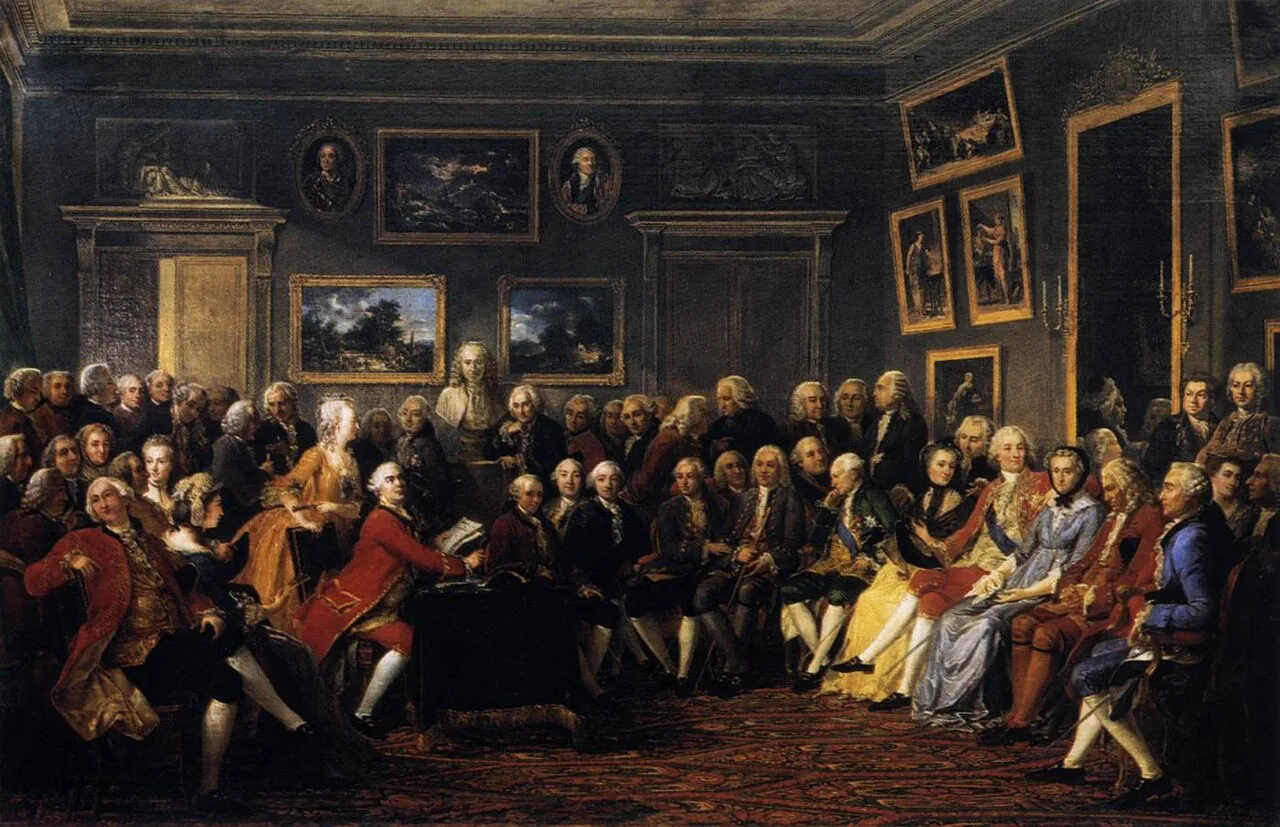
Source: Anicet-Charles-Gabriel Lemonnier, painted in 1812; image from Wikimedia Commons, public domain.
Commentary. Lemonnier painted this scene nearly sixty years after the event, so it is a reconstruction, not an eyewitness view. It shows about fifty people, nobles in embroidered coats and ladies in silk gowns, who sit and stand in a grand room. An actor reads aloud a play by Voltaire, whose marble bust looks over the audience (Voltaire himself was away from Paris). The image tells us that the Enlightenment was a social world as well as a body of writing. It also shows that the leading figures included wealthy and well-born people. Finally, it shows that women had a real role as hosts and patrons, though few could publish under their own names or sit in the academies.
The Encyclopédie
The great monument of the Enlightenment was the Encyclopédie, edited by Denis Diderot and Jean d’Alembert and published between 1751 and 1772. It grew to seventeen volumes of text and eleven volumes of engravings, with more than seventy thousand articles on science, trades, philosophy, and government. Its goal, said Diderot, was to change the way people think. The Church and the royal government repeatedly tried to stop it.
In 1759 the king’s council withdrew its license, and Pope Clement XIII condemned it. However, its supporters finished the work in secret with the help of officials who protected it. Women also contributed to the movement. Émilie du Châtelet (1706-1749) translated Newton’s Principia into French. In 1792 the English writer Mary Wollstonecraft published A Vindication of the Rights of Woman, arguing that women should receive the same education as men.
7. Enlightened absolutism and its limits
Several rulers read the philosophes and tried to apply some of their ideas while keeping all their power. Historians call them “enlightened absolutists.”
Frederick II of Prussia described himself as the “first servant of the state.” Soon after he came to the throne he limited the use of judicial torture, allowed many religions to practice, and invited Voltaire to live at his palace at Potsdam from 1750 to 1753. However, he also waged wars that cost hundreds of thousands of lives, and he left serfdom in place.
Catherine the Great of Russia (ruled 1762-1796) corresponded with Voltaire and Diderot and bought Diderot’s library when he needed money. In 1767 she wrote a long Instruction for a commission to prepare new laws. Yet after the huge peasant uprising led by Emelian Pugachev (1773-1775), she gave the nobles still more power over their serfs.
Joseph II of Austria (sole ruler 1780-1790) issued an Edict of Toleration for Protestants and Orthodox Christians in 1781 and ended the harshest forms of serfdom. However, many of his reforms provoked revolts, and his successors canceled them after his death.
Definition: Enlightened absolutism
A style of rule in which a monarch adopts some reforms inspired by the Enlightenment, such as religious toleration, better laws, or education, while keeping absolute power.
Contradictions and limits
The movement also had deep contradictions. Many thinkers who praised liberty accepted or ignored slavery, which carried some twelve million Africans across the Atlantic between the 1500s and the 1860s. Some philosophes spoke out: Montesquieu mocked the arguments used to defend slavery, and the Encyclopédie published articles that condemned the slave trade. Others invested in colonial trade or wrote about human races in ways that later fed racism. Politics largely excluded women, and most Enlightenment writers addressed an educated minority. These contradictions help explain why people later used the ideas of the Enlightenment against the societies that had produced them. Enslaved people, women, and workers would demand that “all men” truly mean everyone.
8. Legacy
By the 1770s the ideas of Locke, Montesquieu, and Rousseau had crossed the Atlantic and entered the minds of educated colonists in British North America. In France, the nobility and the middle class also read them widely. The monarchy’s debts, a bad harvest, and the example of the American Revolution would soon bring them into politics. The next unit follows the Atlantic revolutions that used the language of natural rights to overthrow kings and empires.
- 1618-1648 Thirty Years’ War in the Holy Roman Empire
- 1649 England executes Charles I
- 1651 Hobbes publishes Leviathan
- 1661 Louis XIV begins to rule without a first minister
- 1682 The court moves to Versailles
- 1685 Louis XIV revokes the Edict of Nantes
- 1687 Newton publishes the Principia
- 1689 English Bill of Rights; Locke’s Two Treatises
- 1715 Death of Louis XIV
- 1748 Montesquieu publishes The Spirit of Laws
- 1751-1772 Publication of the Encyclopédie
- 1762 Rousseau publishes The Social Contract
- 1740-1786 Reign of Frederick II of Prussia
- 1762-1796 Reign of Catherine the Great
Key takeaways
- Between about 1650 and 1715, absolute monarchs such as Louis XIV claimed to rule by divine right and used standing armies, royal officials, and court ceremony to control nobles and subjects.
- England limited royal power in the Glorious Revolution, and the Bill of Rights (1689) placed the king under Parliament and the law.
- The Scientific Revolution convinced educated Europeans that reason and observation could explain the world, and the Enlightenment applied that idea to government, religion, and society.
- Hobbes defended strong government, Locke argued for natural rights and the right of resistance, Montesquieu proposed a separation of powers, Voltaire defended tolerance and free speech, and Rousseau argued that sovereignty belongs to the people.
- Salons, coffeehouses, newspapers, academies, and the Encyclopédie spread the new ideas through a Republic of Letters.
- Enlightened absolutists such as Frederick II, Catherine II, and Joseph II adopted some reforms but kept their power, and the movement failed to challenge slavery and the exclusion of women.

Quick review: flashcards
Tap a card to see the answer.