



This World History Grades 9-10 lesson covers The Industrial Revolution, part of the unit “Revolutions.” First, read the full lesson with its primary sources, maps and key terms. Then practice with the worksheet, check yourself with the quiz and get ready with the test.
In the autumn of 1842 a young German named Friedrich Engels, twenty-one years old, arrived in Manchester to work in a cotton mill owned by his father’s firm. For nearly two years he walked through the city’s streets and alleys, looked into the houses of workers, and listened to what they told him. Then, in 1845, he published what he saw. Manchester then had a forest of chimneys, streets black with smoke, and a river the color of ink.
For example, in 1801 it had about 75,000 people; by 1851 it had more than 300,000. Machines driven by steam made cloth faster and cheaper than any hand weaver could, factories employed thousands, and a new kind of society appeared: wealthy owners, a growing middle class, and a mass of workers who sold their labor for wages. The change was so deep that historians call it a revolution.
Guiding question: Why did the Industrial Revolution begin in Britain in the 1700s, how did it change how people worked and lived, and who gained or lost from it?
1. Why Britain? Conditions for industrialization
Until the 1700s most people in the world lived on farms and made most things by hand at home or in small workshops. Britain began to change first, for several reasons. First, an agricultural revolution raised food output: landowners enclosed open fields, planted crops such as turnips and clover that restored the soil, and bred better livestock, so that fewer farmers could feed more people. The population of England and Wales grew from about 8.9 million in 1801 to about 17.9 million in 1851, and many villagers left the land to find work in towns. Second, Britain had rich coal and iron deposits close to rivers and ports.
Third, it had a long coastline, navigable rivers, and a growing network of canals, and the Royal Navy and a worldwide empire gave British merchants access to raw materials and markets overseas, including cotton grown in the Americas by enslaved workers. Fourth, Britain had banks, insurance companies, and a government that protected property after the Glorious Revolution of 1688-1689. Finally, a culture of science and practical invention, with societies and workshops where inventors, instrument makers, and entrepreneurs met, encouraged people to try new machines.
Definition: Industrial Revolution
The shift, beginning in Britain in the later 1700s, from hand production and farming to machine production in factories powered by water and then steam. It transformed work, cities, trade, and family life.
Definition: Factory system
A way of producing goods in which workers gather in one large building to operate power-driven machines under the direction of an owner or manager, working set hours for wages.
2. The new machines: textiles, steam, iron, and rails
Cotton and the machines that spun and wove it
The first industry to change was cotton cloth. Imported Indian cotton fabrics had become fashionable in Europe, and British inventors looked for ways to make cotton thread and cloth at home. John Kay’s flying shuttle (1733) made weaving faster; thread then became the bottleneck, and James Hargreaves’s spinning jenny (about 1764) let one worker spin many threads at once.
Richard Arkwright’s water frame (1769) made stronger thread and needed water power, so he built a large mill at Cromford in 1771, the model of the new factory. Samuel Crompton’s mule (1779) combined the two earlier machines, and in 1785 Edmund Cartwright patented a power loom. As a result, cotton goods became Britain’s leading export. In the United States, Eli Whitney’s cotton gin (1793) made it much easier to clean short-staple cotton. As a result, the demand of British mills drove the expansion of slavery in the American South, where the enslaved population grew from about 700,000 in 1790 to about 3.2 million in 1850.
Document 1 – A spinning mule
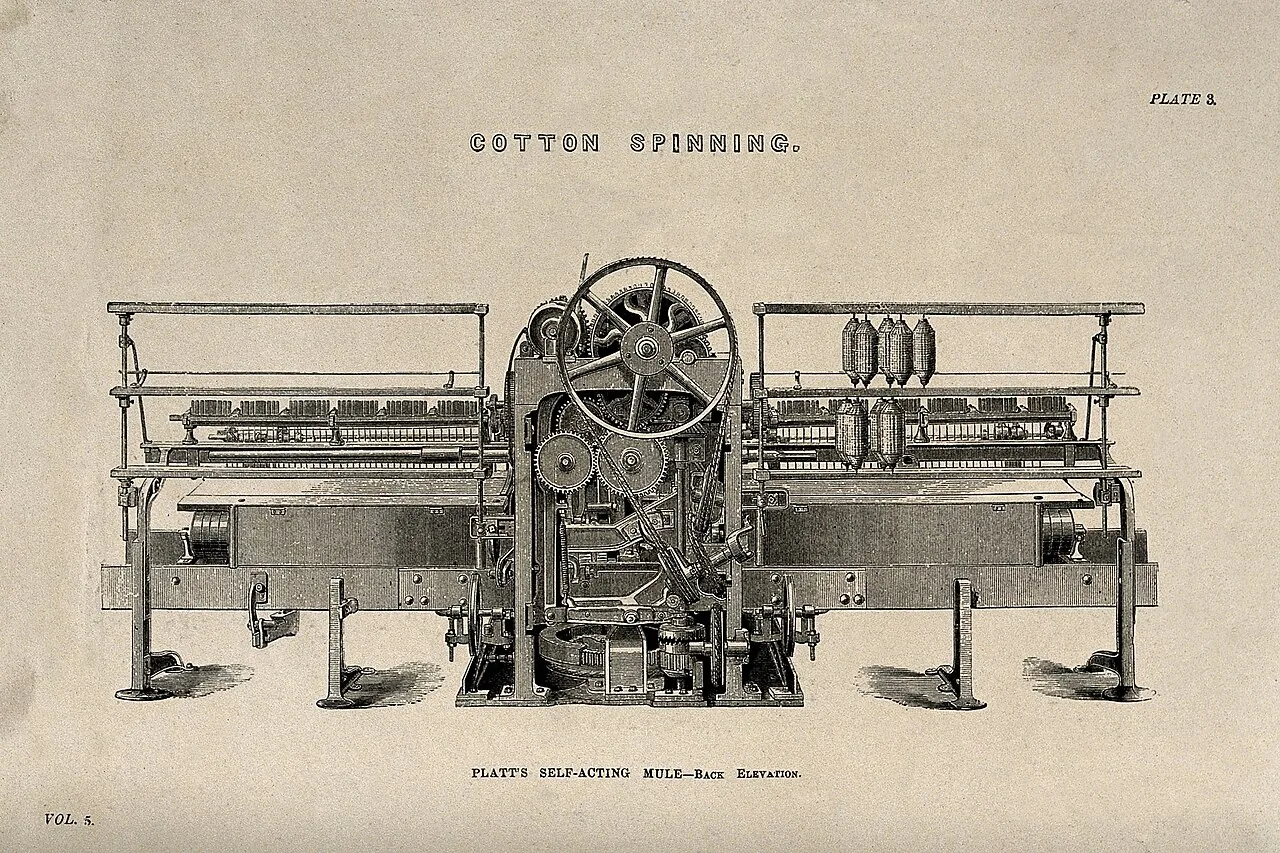
Source: engraving of Platt Brothers’ self-acting mule, Wellcome Collection (CC BY 4.0), via Wikimedia Commons.
Commentary. This engraving shows a late version of the spinning mule, a machine that stretched and twisted cotton into thread on hundreds of spindles at a time, and that moved back and forth on a carriage. The self-acting version, which did not need a skilled spinner to guide it, was introduced in the 1820s and 1830s. However, the picture shows a machine, not its human operators. It hides the noise, the heat, the dust, the children who crawled beneath the moving parts to clean them, and the long hours of work. It is a good source for how machines looked and worked, and a poor one for what it was like to work with them.
Steam and iron
Early mills used water wheels, and so they had to be built beside rivers. The steam engine removed this limit. In 1712 Thomas Newcomen built an engine to pump water out of mines. Then, in 1769, James Watt patented a separate condenser that made the engine much more efficient, and with his partner Matthew Boulton he sold engines that could turn wheels and machines in factories.
Therefore, mills could now be built in towns, near workers and markets, and they could use coal. Iron also changed. In 1709 Abraham Darby of Coalbrookdale learned to smelt iron with coke instead of charcoal, which made iron cheaper and stronger. Then, in 1779 the first iron bridge was built across the Severn nearby. By the middle of the century iron went into machines, ships, bridges, and rails.
Document 2 – Manchester, “Cottonopolis”
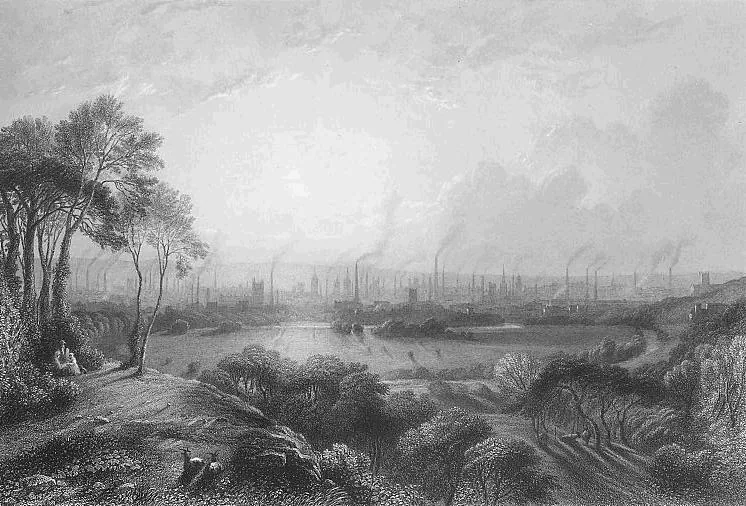
Source: nineteenth-century engraving, Wikimedia Commons, public domain.
Commentary. The engraver places the viewer on a green hillside above a calm river, with the city on the horizon: the factories look almost small, a smoky line along the edge of the landscape. Such prints of the 1800s often presented industry as a part of the landscape, as a mark of progress. The picture is a valuable source for the appearance of the early industrial city, but it presents a distant, orderly view, and it cannot show the streets, houses, and living conditions of the people in them. For that we need other sources, such as Engels’s description.
Transport: canals and railways
Raw materials and goods needed better transport. After the Bridgewater Canal opened in 1761 to carry coal to Manchester, a network of canals linked mines, mills, and ports. Then came the railway. George Stephenson’s locomotive Rocket won the Rainhill trials in 1829, and in 1830 the Liverpool and Manchester Railway, thirty-one miles long, opened as the first intercity line to run only steam locomotives for passengers and freight on a schedule. By 1850 Britain had more than 6,000 miles of track.
Railways moved raw cotton from the port of Liverpool to the mills of Manchester in hours instead of days. They also created huge demand for coal, iron, and engineering, and they changed the sense of time: towns had to adopt a common railway time. In 1851, the Great Exhibition in the Crystal Palace, a hall of iron and glass in London designed by Joseph Paxton, showed machines and goods from around the world to some six million visitors, and Britain called itself the “workshop of the world.”
3. New ideas about the economy
Thinkers tried to understand the new world. The Scottish philosopher Adam Smith published The Wealth of Nations in 1776. He argued that wealth comes from labor and trade, that the division of labor makes workers far more productive, and that markets, guided by competition, serve the public better than government rules. Later writers summed up his approach in the French phrase laissez-faire, “let it be,” the idea that governments should not interfere in the economy.
Document 3 – Adam Smith on the division of labor
But in the way in which this business is now carried on, not only the whole work is a peculiar trade, but it is divided into a number of branches, of which the greater part are likewise peculiar trades. One man draws out the wire; another straights it; a third cuts it; a fourth points it; a fifth grinds it at the top for receiving the head; to make the head requires two or three distinct operations; to put it on is a peculiar business; to whiten the pins is another; it is even a trade by itself to put them into the paper; and the important business of making a pin is, in this manner, divided into about eighteen distinct operations […]
Source: Adam Smith, An Inquiry into the Nature and Causes of the Wealth of Nations, 1776, book 1, chapter 1 (“Of the Division of Labour”); Project Gutenberg edition (ebook 3300).
*Manufactory: workshop. *Peculiar trade: a separate specialized job. *Operations: separate tasks.
Commentary. Smith chose a very small product, the pin, to show how a task divided into some eighteen steps allows each worker to become faster and more skillful. In a later passage he reports that ten workers in a small workshop could make upwards of 48,000 pins a day, whereas a single worker could scarcely make one pin or twenty. Smith’s main point is about productivity, and he also warned that repeating the same simple task all day might dull a worker’s mind. His text explains one reason factories were so productive; it is not a report of how a factory felt to work in.
Definition: Division of labor
Splitting the making of a product into many simple steps, each done by a different worker. It raises output but can make the work repetitive.
The English clergyman Thomas Malthus was more pessimistic. In his Essay on the Principle of Population (1798) he argued that population tends to grow faster than the food supply, so that hunger, disease, and misery would always check its growth. His ideas also influenced debates about poor relief and the New Poor Law of 1834. In the 1800s food production in fact rose faster than he expected, but his theory shaped arguments about poverty. Others, including the socialists Robert Owen and later Karl Marx and Friedrich Engels, blamed the system itself and called for cooperation or revolution.
4. Cities, factories, and working lives
Industrialization pulled people into towns. As a result, in 1851 for the first time more than half of the people of England and Wales lived in towns. Manchester, Liverpool, Birmingham, Leeds, and Glasgow grew at a great pace. Houses for workers were built quickly and cheaply, often back to back, with little ventilation, no sewers, and one water pump for many families. Because of this, epidemics of cholera, typhoid, and tuberculosis struck crowded districts. Cholera reached Britain in 1831, killing tens of thousands in the epidemics that followed. Irish families, many of them fleeing poverty and later the Great Famine of the 1840s, settled in districts such as Little Ireland in Manchester.
Document 4 – Engels describes a Manchester slum
In a rather deep hole, in a curve of the Medlock and surrounded on all four sides by tall factories and high embankments, covered with buildings, stand two groups of about two hundred cottages, built chiefly back to back, in which live about four thousand human beings, most of them Irish. The cottages are old, dirty, and of the smallest sort, the streets uneven, fallen into ruts and in part without drains or pavement; masses of refuse, offal and sickening filth lie among standing pools in all directions; the atmosphere is poisoned by the effluvia from these, and laden and darkened by the smoke of a dozen tall factory chimneys.
Source: Friedrich Engels, The Condition of the Working-Class in England in 1844, 1845, chapter on the great towns (Little Ireland, Manchester); English translation by Florence Kelley Wischnewetzky (1887); Project Gutenberg edition (ebook 17306).
*Rookery: crowded slum. *Offal: waste parts of slaughtered animals. *Effluvia: foul smells.
Commentary. Engels was a young middle-class German, a socialist who wanted to show what the new factories did to workers, and who later helped write the Communist Manifesto. He walked through Manchester’s poorest districts and described what he saw, and his book has become one of the best-known accounts of working-class life in the 1840s.
In fact, the details agree in many points with doctors’ reports, parliamentary inquiries, and other observers. But his tone is political and angry, and he exaggerated at times; historians read him alongside official statistics and other sources. For what the cottages and the streets looked like, he is a powerful witness; for the overall standard of living in Britain, he is only part of the story.
Factory work was hard and strictly timed. Workers thus followed the factory bell, not the sun. A normal working day lasted twelve to fourteen hours, six days a week, and wages were low, especially for women and children, whom owners often preferred because they were cheaper and more obedient.
For example, in textile mills children as young as six or seven worked as piecers, tying broken threads, and as scavengers, crawling under moving machines to clear fluff. Accidents were also common, and a worker who lost a hand lost his livelihood. In the mines of Britain, women and children hauled coal in dark tunnels. Skilled hand workers, such as handloom weavers, saw their wages and trade collapse when power looms replaced them.
Document 5 – A weaving shed in 1835
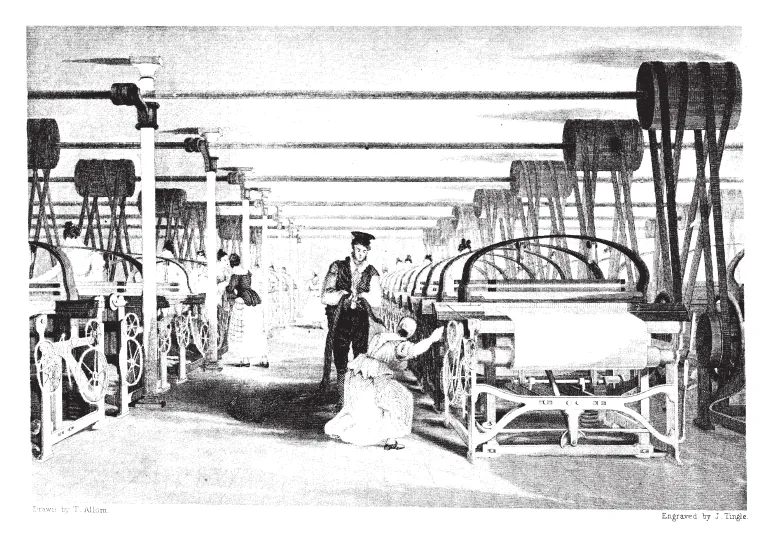
Source: Baines, History of the Cotton Manufacture, 1835; image from Wikimedia Commons, public domain.
Commentary. The engraving was published in a book by Edward Baines, a newspaper owner who admired the cotton industry, and it presents a tidy and well-lit weaving shed, with a man in a cap standing near a woman who tends a loom. It was meant to show the factory favorably, which means the picture leaves out the noise, the lint in the air, and the long hours. It is useful to see how looms were arranged and powered by overhead belts, and how the industry wanted to be seen, but it is not an unbiased record of working conditions.
5. Reform and protest
Workers and reformers responded in many ways. Between 1811 and 1816 the Luddites, bands of skilled textile workers in the English Midlands and the north, broke machines that they believed threatened their trades, and in 1812 Parliament made machine-breaking a crime punishable by death. In August 1819 a peaceful meeting of some 60,000 or more people at St. Peter’s Field in Manchester, demanding the vote for working men, was attacked by mounted soldiers: about fifteen people were killed and hundreds injured, in what was called the Peterloo massacre.
Then, trade unions were legalized in 1824-1825. After the Reform Act of 1832 gave the vote to many middle-class men and gave new industrial towns like Manchester representatives in Parliament, working people turned to Chartism, a movement whose People’s Charter (1838) demanded the vote for all men, secret ballots, and annual elections.
Parliament also passed factory laws. The Factory Act of 1833 banned children under nine from working in textile mills, limited the hours of older children, and created the first factory inspectors. In addition, the Mines Act of 1842 banned women, girls, and boys under ten from working underground. The Ten Hours Act of 1847 limited the working day of women and young people in textile mills. Finally, the Public Health Act of 1848 set up a central board of health. However, many mill owners opposed these laws and argued that regulation would ruin trade.
Document 6 – The Factories Inquiry of 1833, as Engels reports it
The report of the Central Commission relates that the manufacturers began to employ children rarely of five years, often of six, very often of seven, usually of eight to nine years; that the working-day often lasted fourteen to sixteen hours, exclusive of meals and intervals; that the manufacturers permitted overlookers to flog and maltreat children […]
Source: Friedrich Engels, The Condition of the Working-Class in England in 1844, 1845, chapter on the factory system, summarizing the report of the Central Commission of the Factories Inquiry Commission of 1833; translation by Florence Kelley Wischnewetzky; Project Gutenberg edition (ebook 17306).
*Overlookers: supervisors. *Maltreat: treat cruelly. *Exclusive of meals: not counting mealtimes.
Commentary. Here Engels summarizes an official government source: the report of the commission that investigated factories in 1833, which helped lead to the Factory Act. The passage tells us that very young children worked long hours and that supervisors were allowed to beat them. As Engels is retelling the report, we should read it as a secondhand account; the original report also contains owners’ replies, and Engels, who wanted to condemn the system, selects the harshest facts. Still, it remains strong evidence that child labor was widespread and was seen as a problem even by the officials who investigated it.
6. Winners, losers, and the wider world
Historians still debate how the Industrial Revolution affected living standards. Average incomes in Britain rose in the long run, and new goods such as cheap cotton clothing became widely available, but for many workers in the first half of the century wages rose slowly while hours were long and cities were unhealthy. Also, the middle class of owners, merchants, and professionals grew and gained political influence.
In addition, women and children entered paid work in large numbers. Meanwhile, the revolution had global effects: Indian handloom weavers lost markets to British machine-made cloth, cotton grown by enslaved workers in the American South fed British mills, and Britain’s lead in iron, coal, and steam gave it the strength to expand its empire. From the early 1800s industrialization spread to Belgium, France, Germany, and the United States, and later to Japan and Russia.
Document 7 – A classic statement of the revolution in production
The bourgeoisie cannot exist without constantly revolutionising the instruments of production, and thereby the relations of production, and with them the whole relations of society. Conservation of the old modes of production in unaltered form, was, on the contrary, the first condition of existence for all earlier industrial classes. Constant revolutionising of production, uninterrupted disturbance of all social conditions, everlasting uncertainty and agitation distinguish the bourgeois epoch from all earlier ones. All fixed, fast-frozen relations, with their train of ancient and venerable prejudices and opinions, are swept away, all new-formed ones become antiquated before they can ossify. All that is solid melts into air, all that is holy is profaned, and man is at last compelled to face with sober senses, his real conditions of life […]
Source: Karl Marx and Friedrich Engels, The Communist Manifesto, 1848, part 1; English translation of 1888; Project Gutenberg edition.
*Bourgeoisie: the class of owners of factories and capital. *Revolutionising: constantly transforming. *Ossify: harden.
Commentary. Marx and Engels wrote the Manifesto in 1848 as a program for a communist party. In this passage they argue that the owners of factories could not exist without constantly changing the tools and methods of production, so that society itself was always in upheaval. The text praises the power of capitalism as much as it criticizes it, but it was written as a political pamphlet, with a goal to persuade. It is valuable as evidence of how critics of industrial society understood their time.
- 1709 Abraham Darby smelts iron with coke at Coalbrookdale
- 1733 John Kay’s flying shuttle
- 1764 Hargreaves’s spinning jenny (about)
- 1769 Watt’s steam engine patent; Arkwright’s water frame
- 1776 Adam Smith publishes The Wealth of Nations
- 1779 Crompton’s mule; the Iron Bridge
- 1793 Eli Whitney’s cotton gin
- 1811-1816 The Luddite revolts
- 1819 Peterloo massacre in Manchester
- 1825 Stockton and Darlington Railway opens
- 1830 Liverpool and Manchester Railway opens
- 1833 Factory Act
- 1842 Mines Act
- 1848 The Communist Manifesto; Public Health Act
- 1851 Great Exhibition at the Crystal Palace
Key takeaways
- The Industrial Revolution began in Britain in the late 1700s thanks to more food and people, coal and iron, canals and ports, banks, empire, and a culture of invention.
- New machines for spinning and weaving, powered first by water and then by steam, created the factory system and made cotton Britain’s leading industry.
- Iron, steam, canals, and railways transformed transport and manufacturing; by 1851 Britain called itself the workshop of the world.
- Adam Smith explained the gains of the division of labor; Malthus feared that population would outrun food; Marx and Engels attacked the system.
- Cities grew fast and were overcrowded and unhealthy, and factory work was long and dangerous, especially for women and children.
- Reform came through protest, unions, Chartism, and laws such as the Factory Act of 1833 and the Mines Act of 1842.
- The revolution had global effects: it harmed Indian handloom weavers, fed the expansion of slavery in the American South, and spread to other countries.

Quick review: flashcards
Tap a card to see the answer.