


This World History Grades 9-10 lesson covers Nationalism and Imperialism, part of the unit “Empires and world wars.” First, read the full lesson with its primary sources, maps and key terms. Then practice with the worksheet, check yourself with the quiz and get ready with the test.
In January 1871, in the Hall of Mirrors at Versailles, German princes proclaimed the Prussian king emperor of Germany in the palace of the monarchs whom Prussian armies had just defeated. Thirteen years later, in November 1884, diplomats from fourteen countries sat down in Berlin, in a house on the Wilhelmstrasse, to settle how Europeans would trade and claim land in a continent where they had invited not one African ruler.
Between those two scenes lies a period of about forty years in which two powerful ideas reshaped the world: nationalism, which built new nations and made old empires tremble, and imperialism, which carried the rivalries of European nations onto other continents. By 1914, European states, along with the United States and Japan, controlled most of Africa and large parts of Asia and the Pacific.
Guiding question: Why did industrial nations carve out empires between 1870 and 1914, and how did people in Africa and Asia experience, resist, or take part in that change?
1. Nationalism builds new states and shakes old empires
Nationalism is the belief that people who share a language, a history, and a homeland should form one political community, and that this community deserves its own government. The French Revolution and Napoleon spread the idea across Europe, but after 1815 conservative rulers tried to hold it back. In 1848 revolutions broke out in many cities, and most failed. But the idea survived, and in the 1860s and 1870s it succeeded, sometimes by diplomacy and often by war.
Definition: nationalism
Strong loyalty to a nation, based on a shared language, history, culture, or homeland, and the belief that each nation should govern itself. It can unite a people and it can also lead to rivalry and hatred of other nations.
Italy had been a patchwork of kingdoms and papal and foreign-ruled lands. The prime minister of Piedmont-Sardinia, Count Camillo di Cavour, used diplomacy and an alliance with France, while the soldier Giuseppe Garibaldi led volunteers to conquer Sicily and Naples in 1860. Italy became a kingdom in 1861. Venice joined in 1866, and Rome became the capital in 1870-1871.
Germany had consisted of dozens of states since the end of the Holy Roman Empire. Then the Prussian minister-president Otto von Bismarck united them under Prussian leadership through three short wars: against Denmark in 1864, against Austria in 1866, and against France in 1870-1871. On January 18, 1871, the German princes proclaimed the German Empire, with King Wilhelm I of Prussia as emperor.
Document 1 – The proclamation of a new empire
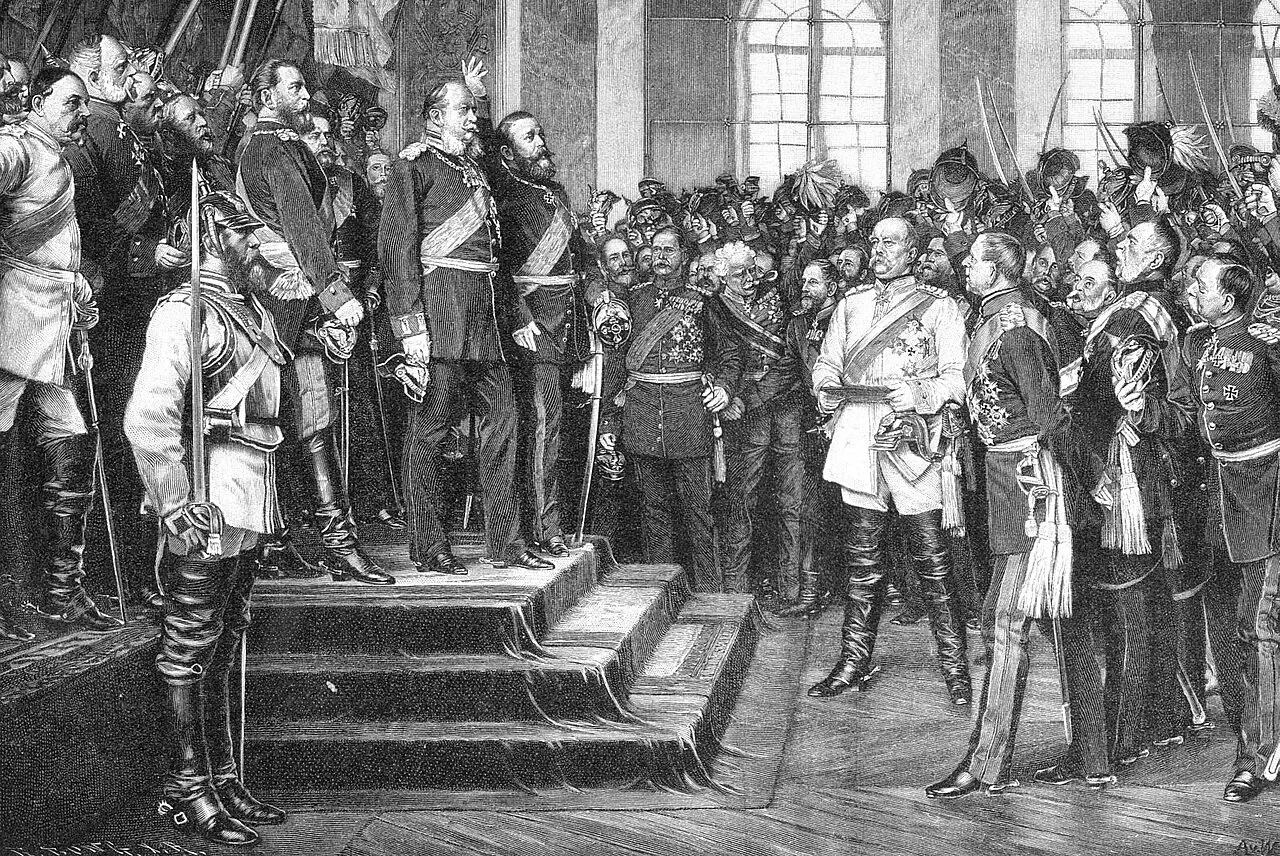
Commentary. The print shows officers crowded into the Hall of Mirrors as they acclaim the new emperor, with Bismarck, in white, among them. The choice of place was a message to France: the palace of Louis XIV had become the stage for a German triumph. France lost Alsace and most of Lorraine in the peace of 1871, and the wish to recover them became a lasting grievance. The picture is a nineteenth-century illustration, so it shows how Germans wanted the event remembered as much as what happened.
Nationalism worked differently inside the great multinational empires. Austria-Hungary, reorganized as a dual monarchy in the Compromise of 1867, ruled Germans, Hungarians, Czechs, Poles, Serbs, Croats, Romanians, and many others. Meanwhile, the Ottoman Empire had lost Greece in the 1820s and 1830s and kept losing land in the Balkans, where Serbs, Bulgarians, and others wanted their own states. Likewise, the Russian Empire ruled Poles, Ukrainians, Finns, and Baltic peoples. In these empires nationalism was not a force for union but for breaking apart, and later chapters will show how it helped start World War I.
Nationalism also fed the competition for colonies. A nation that had just been unified, like Germany or Italy, often wanted colonies as a sign of power; in 1897 the German foreign minister Bernhard von Bülow said that Germany wanted its “place in the sun.” Older powers such as Britain and France feared that rivals would take what they did not. As a result, pride, fear, and prestige pushed governments to claim land that few of their citizens had ever seen.
2. Why industrial nations wanted empires
Several motives drove empire, and historians still debate which mattered most. Historians usually name four: economic, strategic, cultural, and political.
Four motives for empire
Economic motives. The Industrial Revolution had created factories that needed raw materials, such as cotton, rubber, palm oil, copper, and tin, and that produced more goods than home markets could buy. After a long economic slowdown that began in 1873, many governments raised tariffs against each other’s goods and looked for protected markets overseas. Investors hoped for higher profits in lands where labor was cheap. Strategic motives. Steamships needed coaling stations and harbors, and navies needed bases; the Suez Canal, opened in 1869, shortened the route from Europe to India and made Egypt a prize.
For example, Britain bought a large block of the canal company’s shares in 1875 and occupied Egypt in 1882. Cultural motives. Many Europeans and Americans believed in a “civilizing mission” and in the duty of Christian missionaries to bring their faith and their schools to other peoples. Others used the ideas of Charles Darwin to argue that nations compete like species, and that stronger races would naturally rule weaker ones. This belief, called Social Darwinism, was false science, but it gave empire an air of respectability. Political motives. Governments used overseas victories to win popular support at home, and they claimed land so that rivals would not.
Definition: imperialism
A policy by which a powerful nation extends its control over other lands and peoples, by conquest, by treaties, or by economic pressure. The territories it rules form an empire.
Definition: Social Darwinism
The use of ideas from Darwin’s theory of evolution to claim that some nations or races are naturally superior to others. Scientists rejected these claims, but supporters of empire widely used them to justify imperial rule.
Technology and conquest
New technology made conquest easier. The steamship and the railway carried soldiers and goods. The telegraph and undersea cables let a government in London or Paris send orders within hours. Also, quinine, a medicine made from the bark of the cinchona tree, protected Europeans from malaria and allowed them to travel inland. In addition, breech-loading rifles and, after 1884, the Maxim machine gun gave European armies a decisive advantage in most battles. The imbalance was not total, as the examples of Ethiopia and Japan below will show, but it was large.
Document 2 – A French leader defends colonial expansion (1884)
In the area of economics, I am placing before you, with the support of some statistics, the considerations that justify the policy of colonial expansion, as seen from the perspective of a need, felt more and more urgently by the industrialized population of Europe and especially the people of our rich and hardworking country of France: the need for outlets [for exports]. […] Gentlemen, we must speak more loudly and more honestly! We must say openly that indeed the higher races have a right over the lower races …. I repeat, that the superior races have a right because they have a duty. They have the duty to civilize the inferior races […]
Jules Ferry, speech before the French Chamber of Deputies, March 28, 1884 (translation by Ruth Kleinman, modernized text; Internet Modern History Sourcebook, Fordham University).
*higher races, lower races: in this speech Ferry uses the racial language common in the 1880s. Modern historians reject the idea of “higher” and “lower” races. *outlets: markets where factories can sell their goods.
Commentary. Jules Ferry, twice prime minister of France, spoke to the Chamber of Deputies in 1884. He gave an economic reason first: French industry needed markets. Then he gave a moral reason: a duty of “superior” peoples to “civilize” others. Notice how easily Ferry places the two arguments side by side. The speech shows what the supporters of empire said in public. It does not tell us what the conquered people thought, and it ignores them entirely.
Document 3 – A poet calls empire a duty (1899)
Take up the White Man’s burden—
Send forth the best ye breed—
Go bind your sons to exile
To serve your captives’ need;
To wait in heavy harness,
On fluttered folk and wild—
Your new-caught, sullen peoples,
Half-devil and half-child.
Take up the White Man’s burden—
In patience to abide,
To veil the threat of terror
And check the show of pride;
By open speech and simple,
An hundred times made plain,
To seek another’s profit,
And work another’s gain.
Rudyard Kipling, “The White Man’s Burden,” first published in McClure’s Magazine, February 1899 (first two stanzas; text of The Five Nations, 1903, on Wikisource).
*ye: you. *captives: here, the peoples taken under imperial rule. *sullen: silent and resentful.
Commentary. Rudyard Kipling, a British writer born in Bombay, wrote the poem in February 1899 and addressed it to Americans, as the United States was deciding whether to keep the Philippines. The poem treats empire as a heavy duty that brings no reward except ingratitude. But it also calls the peoples whom empire rules “half-devil and half-child,” which shows the racial hierarchy at its center. Some Americans, such as the writer Mark Twain, answered with sharp criticism of imperialism, and many Asians and Africans, of course, did not accept the picture.
3. The partition of Africa
Until about 1880, Europeans controlled only about ten percent of the African continent, mostly along the coasts. The main holdings were Algeria, held by France since 1830; the Cape Colony, held by Britain; and Angola and Mozambique, held by Portugal. In the interior, African kingdoms and states, such as the Zulu, the Asante, the Ethiopian empire, and the Sokoto Caliphate, governed their own lands. However, within about twenty-five years the situation changed completely. Historians call this rapid claiming of territory the Scramble for Africa.
How the scramble began
Several events started the scramble. Explorers such as David Livingstone and Henry Morton Stanley had mapped the interior, and as a result their books aroused interest. Then, in 1876, King Leopold II of Belgium organized a geographic conference in Brussels and then used Stanley to sign treaties with local chiefs along the Congo River, presenting his project as a humanitarian one. France, led by Pierre Savorgnan de Brazza, also claimed the north bank of the Congo. Britain occupied Egypt in 1882, and Germany, under Bismarck, claimed Togo, Cameroon, and South West Africa in 1884 and then East Africa.
The Berlin Conference
To avoid a war among the European powers, Bismarck invited them to Berlin. The Berlin Conference met from November 15, 1884, to February 26, 1885. Fourteen states took part, among them the United States and the Ottoman Empire, but no African ruler or representative attended. The conference did not draw the map of Africa, as is often said. The European powers drew the borders later by treaties among themselves. What it did was to set the rules of the game.
Trade would be free on the Congo and the Niger, the powers had to announce new claims along the coast to one another, and real authority on the ground had to back every claim, a principle known as effective occupation. The powers also promised in the final act to care for the “moral and material well-being” of the Africans and to fight the slave trade, and they accepted the claims of Leopold II’s association in the Congo basin, which became the Congo Free State.
Definition: effective occupation
A rule agreed at the Berlin Conference: a European power could claim African territory only if it set up real authority there, with officials, police, or troops. The rule pushed the powers to hurry inland and occupy as much land as they could.
The race accelerates
After 1885 the race accelerated. Britain, France, Germany, Italy, Portugal, Belgium, and Spain divided the continent by agreements, and by wars when agreements failed. In 1898, a British force under General Kitchener, using machine guns, crushed the army of the Mahdist state at Omdurman in Sudan, and then met a French expedition at Fashoda. France gave way, and the crisis ended in a treaty.
The most famous dream of empire was that of Cecil Rhodes, a mining magnate and prime minister of the Cape Colony, who wanted a chain of British territories “from the Cape to Cairo.” In 1899, a war began between Britain and the two Boer republics, the Transvaal and the Orange Free State, in a region that had become rich after the discovery of gold in 1886. It lasted until 1902 and ended with a British victory. In 1910 Britain created the Union of South Africa, which a white minority governed.
Document 4 – The giant of the Cape to Cairo
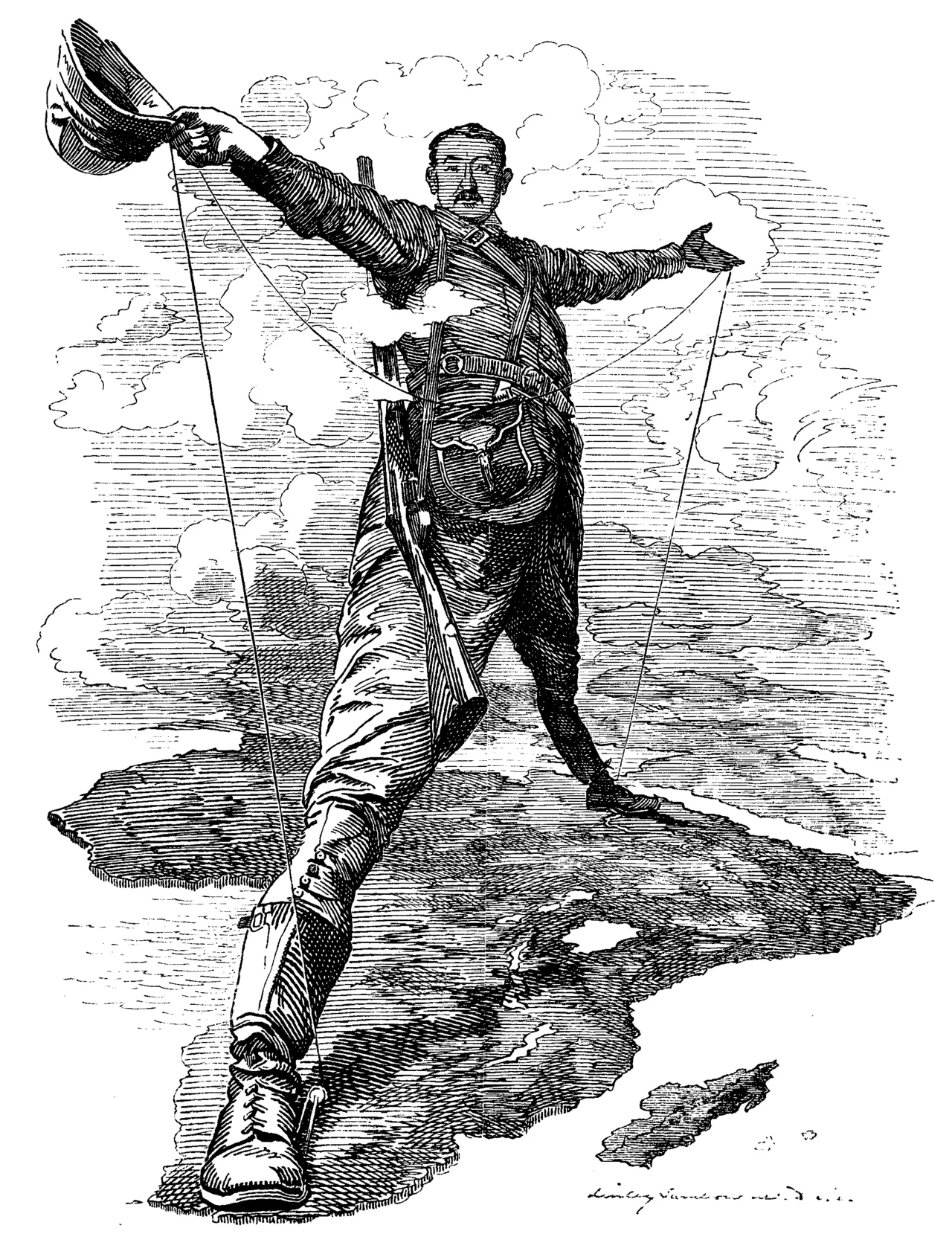
Commentary. This cartoon from the British magazine Punch shows Rhodes as a colossus, with one foot at the Cape and the other in Egypt, holding the telegraph wire that was to join the two. The cartoonist meant it as praise for his vision, though it also shows how a single man could appear to dominate a whole continent and how little place the people living there had in the image. In fact, Rhodes never completed the line, because Germany held East Africa between the British possessions.
Africans did not accept the partition passively. Some resisted with armies, some negotiated, and some used the conflicts among Europeans to their advantage. In 1896, at the battle of Adwa, the Ethiopian emperor Menelik II defeated an Italian army, an event that made Ethiopia a symbol of independence.
Meanwhile, in German East Africa the Maji Maji rebellion of 1905-1907 united many peoples against forced cotton growing, and the Germans put it down with great loss of life. In German South West Africa, in 1904-1908, the German army crushed an uprising by the Herero and the Nama, and tens of thousands of people died, many of them driven into the desert or held in camps. By 1914 only Ethiopia and Liberia remained independent.
4. The Congo Free State
The Congo Free State shows more clearly than any other case the gap between the promises made in Berlin and what happened on the ground. It was not a colony of Belgium but the personal possession of one man, King Leopold II, who ruled it from Brussels without ever visiting. It covered an area of about 2.3 million square kilometers, nearly all of the Congo River basin.
At first it brought little profit, until the invention of the pneumatic tire in the late 1880s and the growth of the bicycle and automobile created a worldwide demand for rubber. Wild rubber grew in the Congo forests, so the state and the companies it gave concessions to forced villagers to collect it.
The rubber system
The system worked through quotas. Each village had to deliver a fixed amount of rubber. Soldiers of the Force Publique and company sentries, armed with rifles, punished those who failed: they flogged them with whips made of hippopotamus hide, burned villages, and took women and children as hostages until the men brought in the rubber. Some soldiers cut off the hands of victims to prove that they had not wasted bullets.
Meanwhile, missionaries, especially Protestants from Britain and the United States, wrote about what they saw. A missionary, Alice Seeley Harris, took photographs, and a former shipping clerk in Liverpool, Edmund Dene Morel, noticed that ships brought rubber and ivory from the Congo but carried back weapons, ammunition, and officials rather than goods for trade.
The reform campaign
In 1903 the British government sent its consul, Roger Casement, to travel up the Congo. He spent more than two months in the interior. In December 1903 he wrote a report, which he published in 1904, that described mutilated children, hostages, and emptied villages. With Morel, Casement founded the Congo Reform Association in 1904. Newspapers, church groups, and writers such as Mark Twain and Arthur Conan Doyle took part in the campaign.
Public opinion pressed the Belgian parliament to take over the colony in 1908, and from then on people called it the Belgian Congo. Reforms followed, but forced labor continued for many years. Historians cannot give an exact death toll, because no census existed, and they debate the estimates; they agree that the loss of life from violence, hunger, and disease was enormous.
Document 5 – A photograph that changed opinion
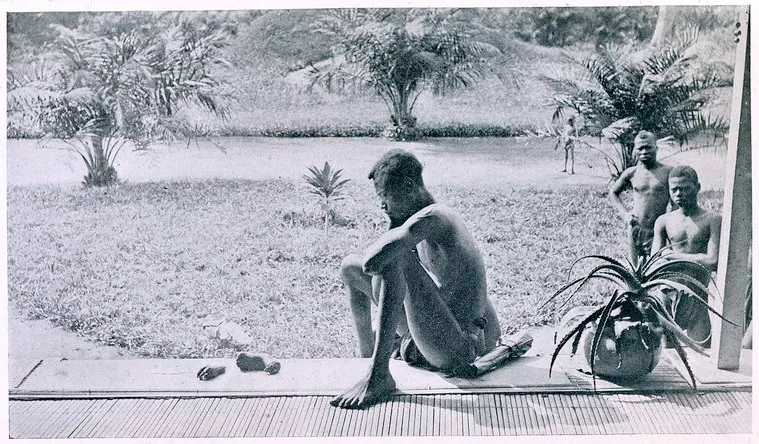
Commentary. Harris photographed the man sitting on the porch beside the remains of his child, who, according to the mission account, had been killed by sentries of a rubber company. Campaigners made the photograph into lantern slides and showed it to church audiences in Britain and the United States. It was powerful evidence because it was a photograph, a new kind of proof, and because an eyewitness took it. A historian must still ask who took it, why, and for whom; the photograph shows a man and objects, and the explanation comes from the mission account and from Casement’s report, which agree on the pattern of violence.
5. Asia and the Pacific
In Asia, Europeans did not need a Berlin Conference, because they had already taken many of the key steps. In India, the British East India Company had come to rule most of the subcontinent. After the great rebellion of 1857-1858, in which Indian soldiers (sepoys) and many civilians rose against the Company, the British Parliament abolished the Company and placed India under the Crown in 1858; Queen Victoria became Empress of India in 1876-1877.
India supplied soldiers, cotton, tea, and jute, and it also bought British manufactures. The British built railways, telegraphs, and schools, mostly to serve the empire. Famines and the heavy cost of colonial rule fed an Indian nationalist movement. Indian leaders founded the Indian National Congress in 1885.
China and the unequal treaties
China was never fully colonized, but foreign powers forced it to open to foreign trade. After the First Opium War (1839-1842), caused by British efforts to sell opium to China and by the Chinese government’s attempt to stop the trade, the Treaty of Nanking gave Britain the island of Hong Kong, opened five ports to British trade, and forced China to pay an indemnity. Then a second war in 1856-1860 brought more concessions.
The foreign powers called these treaties agreements, but the Chinese called them unequal treaties. In the 1890s, after China lost a war to Japan, Germany, Russia, Britain, and France each gained a lease or a special position in a part of China, called a sphere of influence. The United States, which had no sphere, proposed the Open Door policy in 1899, asking that all nations trade freely. In 1899-1901 a joint foreign army crushed the Boxer movement, which attacked foreigners and Chinese Christians, and the Qing dynasty fell in 1911-1912.
Definition: sphere of influence
A region where one foreign power has special rights, especially for trade, investment, and railways, without formally governing it. In China around 1900, several powers each held a sphere of influence.
Southeast Asia and the Pacific
In Southeast Asia, France created French Indochina in 1887 from Vietnam and Cambodia, and added Laos in 1893. The Dutch ruled the islands of the East Indies, now Indonesia, and made peasants grow export crops. Britain held Burma, Malaya, and Singapore. Only Siam (now Thailand) stayed independent, helped by its kings’ reforms and by the rivalry between Britain and France. In 1898, the United States, after a short war with Spain, gained the Philippines, Guam, and Puerto Rico under the Treaty of Paris, and annexed Hawaii. Filipino nationalists, who had been fighting Spain, then fought the United States in the Philippine-American War of 1899-1902. Thus, the United States, which had begun as a colony itself, had become an imperial power.
6. Japan: a different path
Japan took a very different road. For about two centuries the Tokugawa shogunate had allowed almost no foreign contact. In July 1853, an American squadron under Commodore Matthew Perry sailed into Edo Bay with steam-powered warships and a letter from the American president asking for trade. The next year Japan signed the Convention of Kanagawa, which opened two ports. In 1858 it signed treaties with several powers that let foreigners stand trial before their own consuls and kept Japan’s tariffs low. As a result, Japanese leaders saw these unequal treaties and the fate of China as a warning.
Document 6 – Americans in Japan
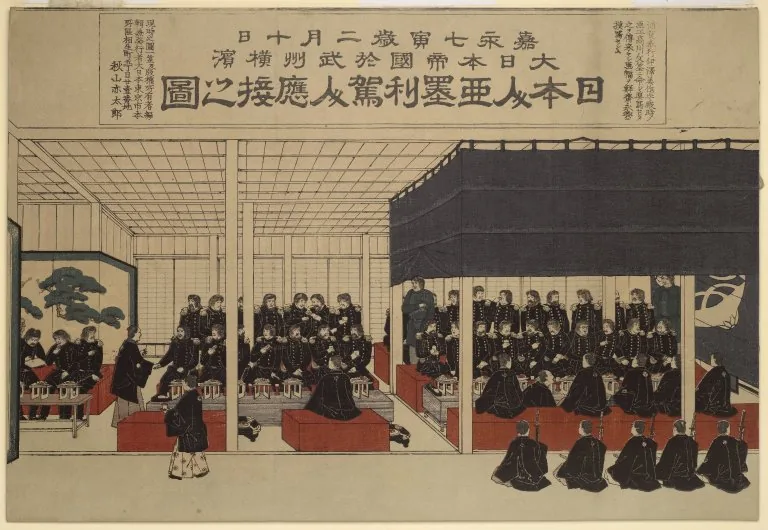
Commentary. A Japanese artist recorded the formal welcome of the American envoys. The scene is orderly, with officials seated in ranks, and the title proudly says that the Japanese received the Americans. The print is a reminder that Japanese officials did not see themselves as helpless: they negotiated, gathered information, and then decided to learn from the foreigners.
In 1868 a group of samurai leaders overthrew the shogun and restored power to the young Emperor Meiji. Historians call the change the Meiji Restoration. The new government promised a break with the past in a short declaration, the Charter Oath, which it issued in the Emperor’s name in April 1868.
Document 7 – The Charter Oath (1868)
First. An assembly shall be organized on a broad basis: all policies (of the state) should be decided by public opinion. Second. Both Government and people shall be united in one heart: every undertaking should be pushed with vigor. Third. Civil and military classes with distinction and also commoners shall each carry out their aims: it is necessary that the spirit of the nation shall not be tired out. Fourth. Mean usages of the past should be destroyed: all things shall be founded on the Universal Law (or Way) of Heaven and earth. Fifth. Knowledge should be sought in the wide world: foundations of the royal realm shall be firmly established (elevated).
The Charter Oath of Meiji Japan, April 1868, in the translation by Harada Tasuku quoted in William Elliot Griffis, The Mikado: Institution and Person (1915), chapter 14 (Wikisource).
*usages: customs. *the royal realm: the empire of Japan.
Commentary. The five articles promised discussion, unity, and an end to old customs, and the last one set a goal: to seek knowledge “in the wide world.” Its authors wrote the oath to calm rivalries among the clans, and the “public opinion” of the first article meant mostly that of the samurai class at that time. It did not create a parliament; that came only with the constitution of 1889. But it announced a policy of learning from the West while keeping the Emperor at the center.
Document 8 – The Emperor in Western dress
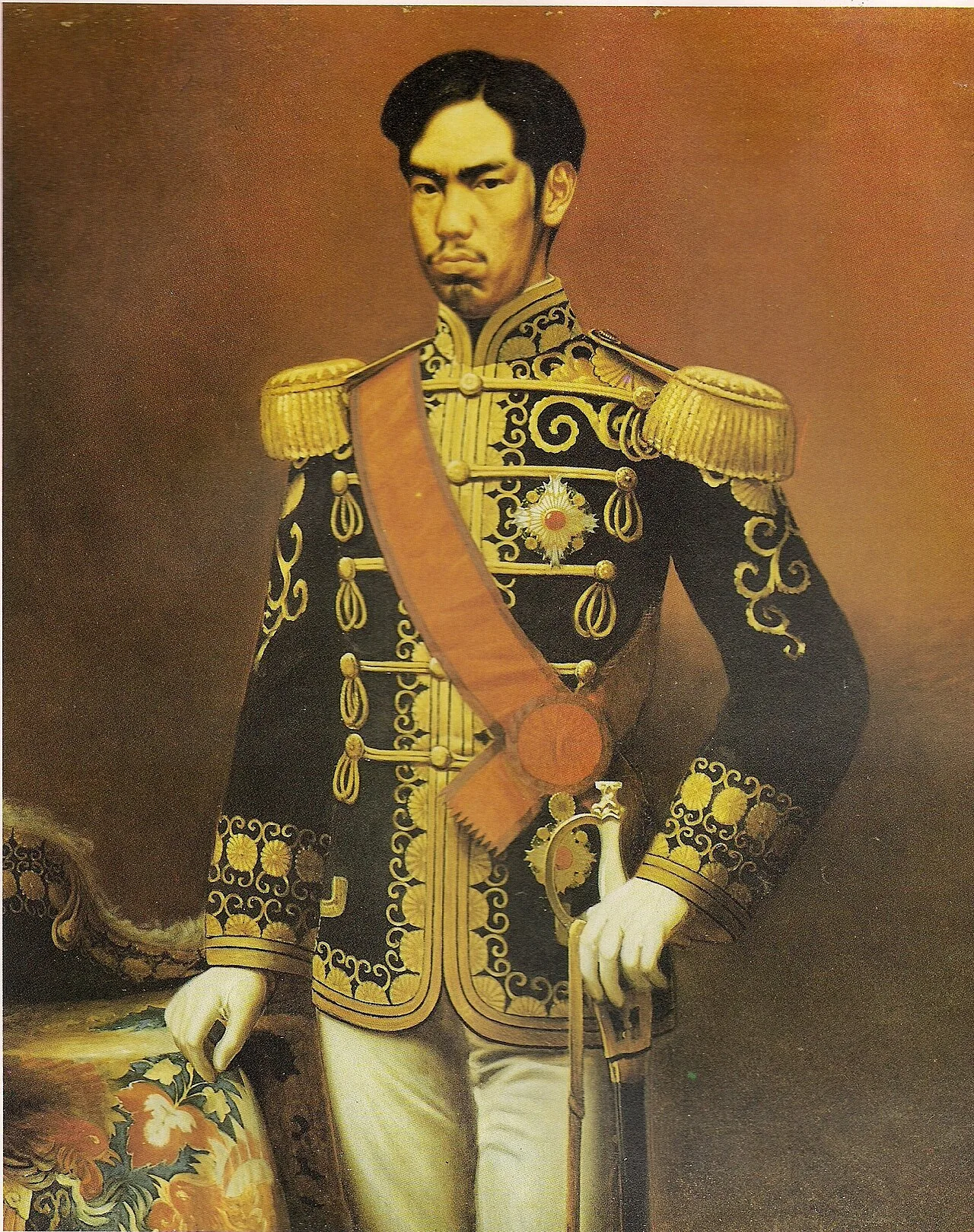
In a few decades the government ended the rule of the old domains and created a national army based on conscription in 1873. It also opened a railway from Tokyo to Yokohama in 1872, built factories and schools, and sent the Iwakura Mission (1871-1873) to study the United States and Europe. The government issued a constitution in 1889, and a parliament, the Diet, met in 1890. The portrait shows the result: an emperor in a military uniform of European style.
Japan then followed the example of the Western powers. It defeated China in the war of 1894-1895 and gained Taiwan; it won a war against Russia in 1904-1905. The United States negotiated the Treaty of Portsmouth that ended it. Japan made Korea a protectorate in 1905 and annexed it in 1910. Japan also persuaded the powers to end the unequal treaties, in stages, by 1911. Its victory over Russia showed many Asians that an Asian nation could defeat a European great power.
7. Resistance, consequences, and criticism
Colonial rule changed economies and societies. Railways ran from mines and plantations to ports, not between cities in the interior. Colonial governments pushed farmers to grow crops for export, such as cotton, rubber, tea, and groundnuts, and sometimes farmers stopped growing enough food. Schools trained clerks and interpreters, and these educated people later formed the nationalist movements that demanded independence. Borders drawn by Europeans often ignored the lands of peoples and cut through kingdoms, and the problems that this caused did not end with independence.
Even at the height of empire, critics spoke out. The British economist J. A. Hobson, in Imperialism: A Study (1902), argued that empire served the interests of investors and arms makers rather than those of the nation as a whole. In addition, missionaries and journalists exposed abuses in the Congo, in the Putumayo region of Peru, and elsewhere. Colonial subjects themselves also protested, from the Indian National Congress to the leaders of the Philippine independence movement.
The race for empire also made Europe more dangerous. Britain, France, and Germany nearly went to war over Morocco in 1905 and again in 1911. Alliances, naval arms races, and national pride, along with the rivalries in the Balkans, led the European powers into a crisis in the summer of 1914. The next chapter shows how a single assassination in Sarajevo set off a world war.
- 1861 Italy becomes a kingdom
- 1868 Meiji Restoration; Charter Oath
- 1869 Suez Canal opens
- 1871 Proclamation of the German Empire at Versailles
- 1884-1885 Berlin Conference; the powers recognize the Congo Free State
- 1896 Ethiopia defeats Italy at Adwa
- 1898 Spanish-American War; Fashoda crisis
- 1899-1902 South African (Boer) War
- 1904 Casement publishes his report on the Congo; Russo-Japanese War begins
- 1908 Belgium takes over the Congo
- 1910 Japan annexes Korea
Key takeaways
- Nationalism created Italy (1861) and Germany (1871), and it threatened multinational empires such as Austria-Hungary and the Ottoman Empire.
- Industrial nations sought raw materials, markets, naval bases, prestige, and a “civilizing mission”; Social Darwinism gave empire a false scientific excuse.
- The Berlin Conference (1884-1885) set rules for claiming Africa, including effective occupation; no African took part, and Europeans drew the borders later. By 1914 only Ethiopia and Liberia were independent.
- In the Congo Free State, forced rubber collection led to terrible violence; Casement’s report and a reform campaign led Belgium to take over the colony in 1908.
- In Asia, Britain ruled India, France Indochina, the Dutch the East Indies, the United States the Philippines; China was forced to sign unequal treaties.
- Japan modernized after 1868, became an imperial power by 1910, and showed that an Asian state could defeat a European one.
- Colonial rule changed economies and borders, produced nationalist movements, and increased the tensions that led to World War I.

Quick review: flashcards
Tap a card to see the answer.