


This World History Grades 9-10 lesson covers World War I, part of the unit “Empires and world wars.” First, read the full lesson with its primary sources, maps and key terms. Then practice with the worksheet, check yourself with the quiz and get ready with the test.
On the morning of June 28, 1914, Archduke Franz Ferdinand, the heir to the throne of Austria-Hungary, drove through the streets of Sarajevo, the capital of Bosnia, with his wife Sophie. A first attacker had already thrown a bomb at his car without success. Later that morning, a nineteen-year-old Bosnian Serb named Gavrilo Princip stepped up to the stalled car and shot them both.
Within six weeks, the great powers of Europe were at war. Four years and three months later, the German, Austro-Hungarian, Russian, and Ottoman empires had collapsed, millions of soldiers and civilians were dead, and the map of Europe and the Middle East was redrawn. People first called the conflict the Great War, and only later, after a second one, World War I.
Guiding question: Why did a regional crisis in the Balkans become a world war, why did the fighting last so long and cost so much, and why did the peace settlement fail to produce a lasting peace?
1. The long causes of the war
Historians often sum up the long-term causes with the letters M-A-I-N: militarism, alliances, imperialism, and nationalism. None of them made war certain, but together they made Europe a place where a local crisis could spread quickly.
Militarism
Militarism means that governments built huge armies and gave their generals great influence. Germany, France, Russia, and Austria-Hungary all relied on conscription and on detailed plans for rapid mobilization, so that a delay of a few days could seem a danger. Britain and Germany also engaged in a naval race: after Britain launched the battleship Dreadnought in 1906, both countries built ever more powerful warships.
Definition: militarism
The belief that a nation should keep a strong military and use it to defend or advance its interests, together with the great influence of the army and navy in government.
Alliances and rivalries
Alliances divided Europe into two camps. Germany, Austria-Hungary, and Italy formed the Triple Alliance in 1882. Then France and Russia signed an alliance in 1894, and Britain settled its quarrels with France in the Entente Cordiale of 1904 and with Russia in 1907, creating the Triple Entente. The powers meant the alliances to deter attack.
Instead, they meant that a war between two countries could pull in all the others. Imperial rivalries, such as the Moroccan crises of 1905 and 1911, kept tempers high. However, nationalism did the most damage in the Balkans, where Serbia, which had become larger in the Balkan Wars of 1912-1913, wished to unite the South Slavs. For this reason, Austria-Hungary, which had annexed Bosnia in 1908 and ruled many Slavic peoples, saw Serbian nationalism as a mortal threat.
Definition: alliance system
A network of agreements by which nations promise to support each other if an enemy attacks one of them. Before 1914 the Triple Alliance and the Triple Entente divided the great powers of Europe into two armed camps.
2. The July Crisis and the outbreak of war
Document 1 – The Archduke in Sarajevo
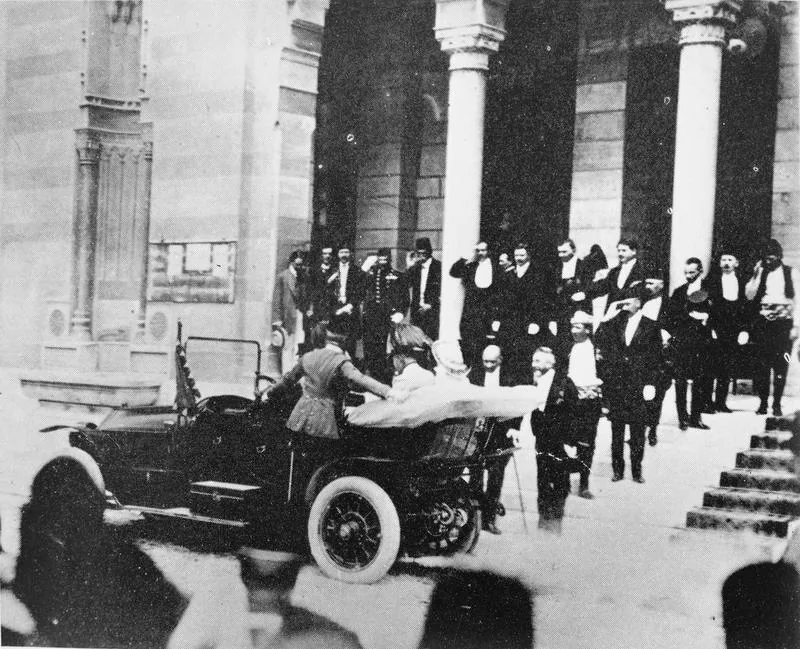
Commentary. This photograph shows the Archduke and his wife at the Sarajevo town hall, minutes before the shooting. It is a reminder of how ordinary the scene was: a couple on an official visit, crowds in the street, and a small group of young conspirators, members of a movement called Young Bosnia, who had received weapons from Serbia. Historians still discuss how far officials in Belgrade knew of the plot, but the Austrian government decided to blame Serbia.
From assassination to war
Historians call the chain of events that followed the July Crisis. First, on July 5-6, Germany promised Austria-Hungary its support, a promise often called the “blank check.” Then, on July 23, Austria-Hungary sent Serbia an ultimatum with demands harsh enough to be hard to accept. Serbia accepted most of them on July 25, but Austria-Hungary declared war on July 28. In response, Russia, which saw itself as the protector of the Slavs, began to mobilize its army on July 30.
As a result, Germany, which feared a war on two fronts, declared war on Russia on August 1 and on France on August 3. German strategy, the Schlieffen Plan, called for a quick victory over France by marching through neutral Belgium. When German troops crossed the Belgian border on August 4, Britain, which had promised to protect Belgian neutrality, declared war on Germany. Italy remained neutral at first, and the Ottoman Empire entered the war on the German side in the autumn.
Definition: mobilization
The process of preparing an army for war by calling up reservists and moving troops and supplies. In 1914 mobilization plans had such tight timing that a general mobilization almost meant a declaration of war.
Historians have debated ever since who was responsible. The Treaty of Versailles blamed Germany and its allies. Many historians later argued that all the great powers shared responsibility, while others have stressed the role of German and Austrian decisions in July 1914. What is clear is that the leaders of every country expected a short war.
3. A war of attrition
French and British forces stopped the German advance through Belgium and northern France at the battle of the Marne in September 1914, a few dozen miles from Paris. Both sides then tried to outflank each other, and by the end of the year a line of trenches ran from the North Sea to the Swiss border. For more than three years the line moved very little. Historians call this line the Western Front.
Soldiers lived in muddy trenches protected by barbed wire, facing artillery, machine guns, and snipers. An attack meant climbing out of the trench and crossing “no man’s land,” and defenders with machine guns usually had the advantage. In 1916, the Germans attacked the fortress of Verdun, and the French held it at enormous cost. In the same year the British and French attacked on the Somme. On the first day, July 1, the British army suffered 57,470 casualties, including 19,240 killed, according to the standard count. Yet, after months of fighting, the front moved only a few miles.
Document 2 – A trench on the Somme
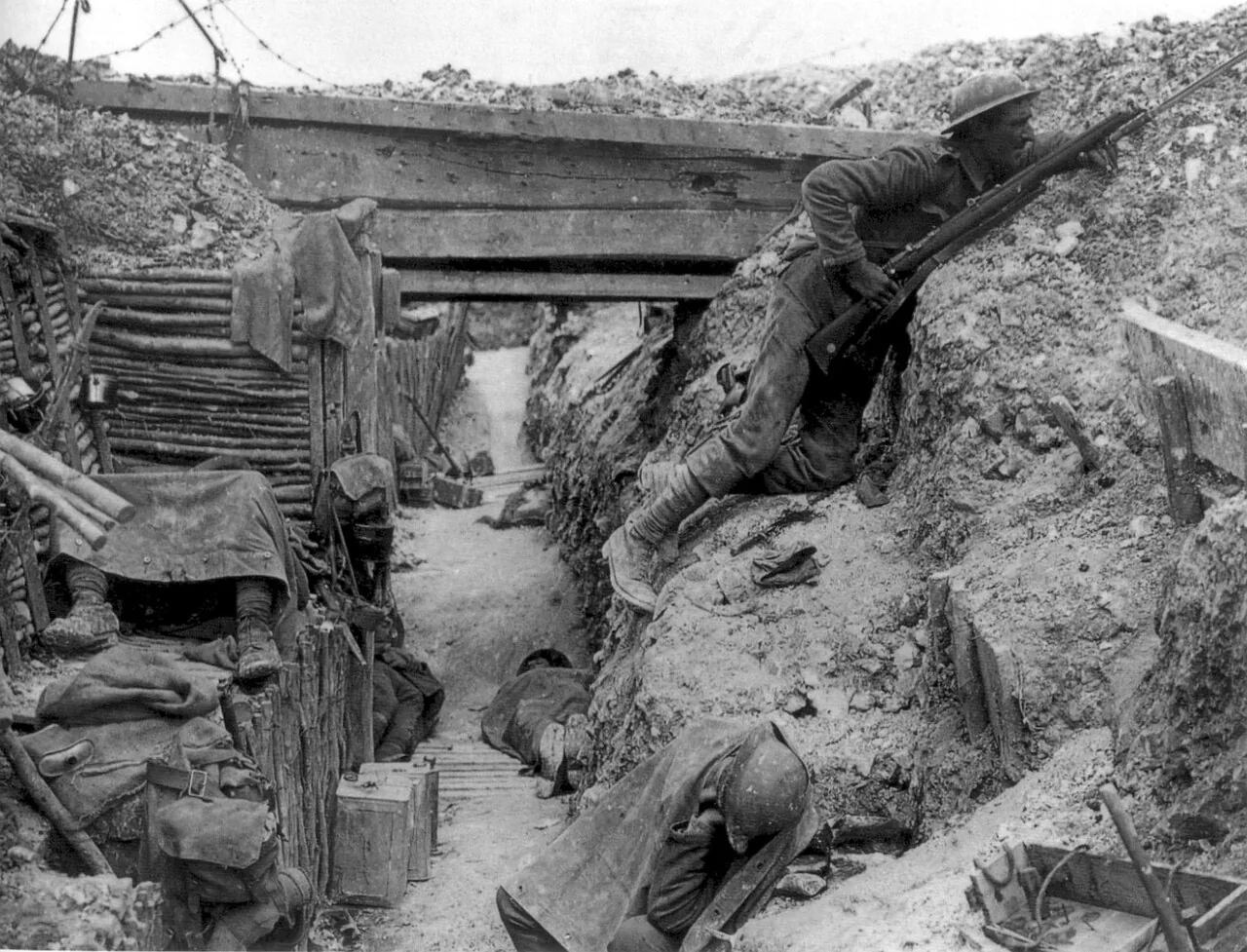
Commentary. A soldier crouches on the parapet of a trench with his rifle ready, while others lie in the trench below. The wooden planks, the mud, and the barbed wire at the top are typical of the Western Front. The photograph is also a reminder of how war was recorded: official photographers could show soldiers in action, but the army did not allow them to show the worst of it.
New weapons made the war more terrible. Germany used chlorine gas at Ypres in April 1915, and both sides soon used poison gas; armies issued gas masks, and gas caused many injuries. Tanks appeared in 1916, armies used aircraft to observe and bomb, and submarines attacked merchant ships. In May 1915, a German submarine sank the British liner Lusitania, and many Americans died. Nor was the war only in the west.
In the east, Russian and German armies fought over a huge front. In 1915 the Allies failed to take the Gallipoli peninsula from the Ottoman Empire, Italy joined the Allies, and Bulgaria joined the Central Powers. Meanwhile, fighting spread to the Middle East and to the colonies in Africa and the Pacific. Millions of soldiers from the empires, from India, Africa, Canada, Australia, and New Zealand, fought and died in the war.
Document 3 – A soldier-poet remembers a gas attack
Bent double, like old beggars under sacks,
Knock-kneed, coughing like hags, we cursed through sludge,
Till on the haunting flares we turned our backs
And towards our distant rest began to trudge.
Men marched asleep. Many had lost their boots
But limped on, blood-shod. All went lame; all blind;
Drunk with fatigue; deaf even to the hoots
Of gas-shells dropping softly behind.
…
If you could hear, at every jolt, the blood
Come gargling from the froth-corrupted lungs,
Bitter as the cud
Of vile, incurable sores on innocent tongues,—
My friend, you would not tell with such high zest
To children ardent for some desperate glory,
The old Lie: Dulce et decorum est
Pro patria mori.
Wilfred Owen, “Dulce et Decorum est,” written in 1917, published in Poems (1920) (first stanza and the end of the poem; Wikisource).
*flares: rockets that light the battlefield. *hoots: here, the sound of shells. *cud: food chewed again; here, a sickening mass. *dulce et decorum est pro patria mori: Latin for “it is sweet and fitting to die for one’s country,” from the Roman poet Horace.
Commentary. Wilfred Owen, a British officer, wrote the poem in 1917, and it appeared in print after his death in 1918. He describes exhausted soldiers marching away from the front, a gas attack, and a man who is too late to put on his mask. In the last lines Owen speaks to those at home who repeat patriotic slogans, and he calls the Latin phrase “the old Lie.” The poem is a powerful testimony, but it is also one man’s view, and Owen wrote it to change the minds of readers who believed in the glory of war.
Total war
The war also changed life at home. This was total war: governments took control of factories, food, and transport; they introduced conscription (in Britain in 1916) and rationing; and women took jobs in factories and offices. A British naval blockade cut off Germany from imports and caused hunger there, while German submarines tried to starve Britain. In addition, governments used censorship and propaganda to keep up morale and to recruit soldiers.
Definition: total war
A war in which a nation uses all of its resources, including its factories, its food supply, and its civilians, and in which the home front is as important as the battlefield.
Document 4 – A poster to hate the enemy
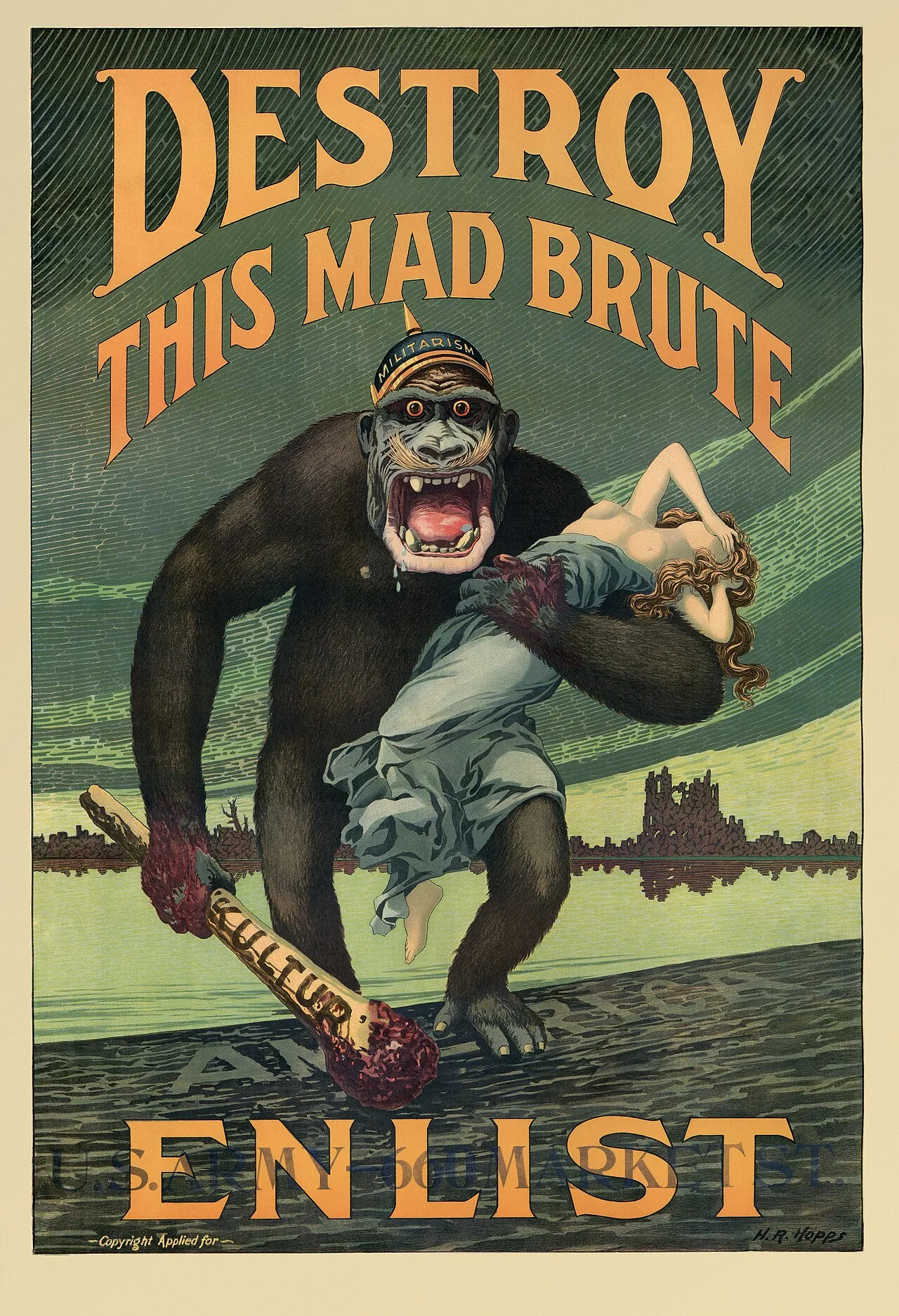
Commentary. The American poster by Harry Hopps shows a gorilla in a spiked helmet, a club marked “Kultur” in its hand, carrying a half-dressed woman onto the shore of America. It refers to German actions in Belgium and the sinking of the Lusitania, and it turns the enemy into a monster to push men to enlist. Propaganda like this is not evidence of what the enemy did. Instead, it is evidence of how a government wished its citizens to feel.
One crime of the war took place away from the fronts. In 1915, the Ottoman government, which accused Armenians of siding with Russia, arrested Armenian leaders in Constantinople on April 24 and deported hundreds of thousands of Armenians to the Syrian desert. Historians estimate that around one million Armenians died, with estimates ranging from 600,000 to 1.5 million. Many historians and governments call it a genocide, a word coined later, but the Turkish government rejects that description.
4. 1917-1918: the turning point
Two events in 1917 changed the war. First, in Russia, revolution overthrew Tsar Nicholas II in March, and in November the Bolsheviks under Lenin took power. In March 1918 they signed the Treaty of Brest-Litovsk and left the war, giving up large territories to Germany. Second, the United States entered the war. Germany had resumed unrestricted submarine warfare on February 1, 1917, hoping to starve Britain before American help could arrive. In January 1917 the German foreign minister had also sent a secret telegram to the German ambassador in Washington, to pass on to Mexico.
Document 5 – The Zimmermann telegram (1917)
We intend to begin on the first of February unrestricted submarine warfare. We shall endeavor in spite of this to keep the United States of America neutral. In the event of this not succeeding, we make Mexico a proposal of alliance on the following basis: make war together, make peace together, generous financial support and an understanding on our part that Mexico is to reconquer the lost territory in Texas, New Mexico, and Arizona. […] Please call the President’s attention to the fact that the ruthless employment of our submarines now offers the prospect of compelling England in a few months to make peace.
Arthur Zimmermann, German Foreign Secretary, telegram to the German ambassador in Washington for transmission to Mexico, January 16, 1917, as decoded and translated by British intelligence (Wikisource).
*endeavor: try. *reconquer: win back.
Commentary. British naval intelligence intercepted and decoded the telegram and gave it to the American government in February. The newspapers then published it on March 1. The proposal that Mexico should join Germany and recover Texas, New Mexico, and Arizona angered Americans, especially in the Southwest. Together with the submarine attacks on American ships, it therefore moved public opinion toward war. On April 2 President Woodrow Wilson asked Congress for a declaration of war, and Congress voted on April 6.
The end of the war
American soldiers began to arrive in large numbers in 1918, just as Germany, now free of the war in the east, launched a great offensive in March. However, the offensive failed to break the Allied lines. From August the Allies, now with American troops, pushed the Germans back. Then the Central Powers collapsed one by one: Bulgaria in September, the Ottoman Empire in October, and Austria-Hungary in early November. In Germany, sailors mutinied and revolution broke out, and the Kaiser, Wilhelm II, abdicated on November 9. The warring sides signed an armistice in a railway car near Compiègne, and it took effect at 11 a.m. on November 11, 1918.
Document 6 – Wilson’s program for peace (1918)
I. Open covenants of peace, openly arrived at, after which there shall be no private international understandings of any kind but diplomacy shall proceed always frankly and in the public view. […] XIII. An independent Polish state should be erected which should include the territories inhabited by indisputably Polish populations, which should be assured a free and secure access to the sea, and whose political and economic independence and territorial integrity should be guaranteed by international covenant. […] XIV. A general association of nations must be formed under specific covenants for the purpose of affording mutual guarantees of political independence and territorial integrity to great and small states alike.
Woodrow Wilson, address to Congress on the Fourteen Points, January 8, 1918 (points I, XIII, and XIV; Avalon Project, Yale Law School).
*covenants: agreements. *autonomous: self-governing. *territorial integrity: a state’s right to keep its borders.
Commentary. In January 1918 Wilson set out the American goals in the Fourteen Points. Among them were open diplomacy instead of secret treaties, an independent Poland, and a general association of nations, which became the League of Nations. Wilson spoke of the right of peoples to decide their own future. This idea of self-determination gave hope to many peoples in Europe, but it also raised hopes in Asia and Africa that the victors did not meet.
5. Making the peace
The Paris Peace Conference opened in January 1919. The leaders of the four main victors, the “Big Four,” made most decisions. They were President Wilson, Prime Minister David Lloyd George of Britain, Premier Georges Clemenceau of France, and Prime Minister Vittorio Orlando of Italy. Germany and the other defeated states did not take part in the discussions. The Allies showed them the terms and asked them to sign. Wilson wished for a peace based on his principles. Clemenceau, whose country Germany had invaded twice in fifty years, wished to make Germany unable to attack again. Lloyd George stood between the two.
Document 7 – The Big Four
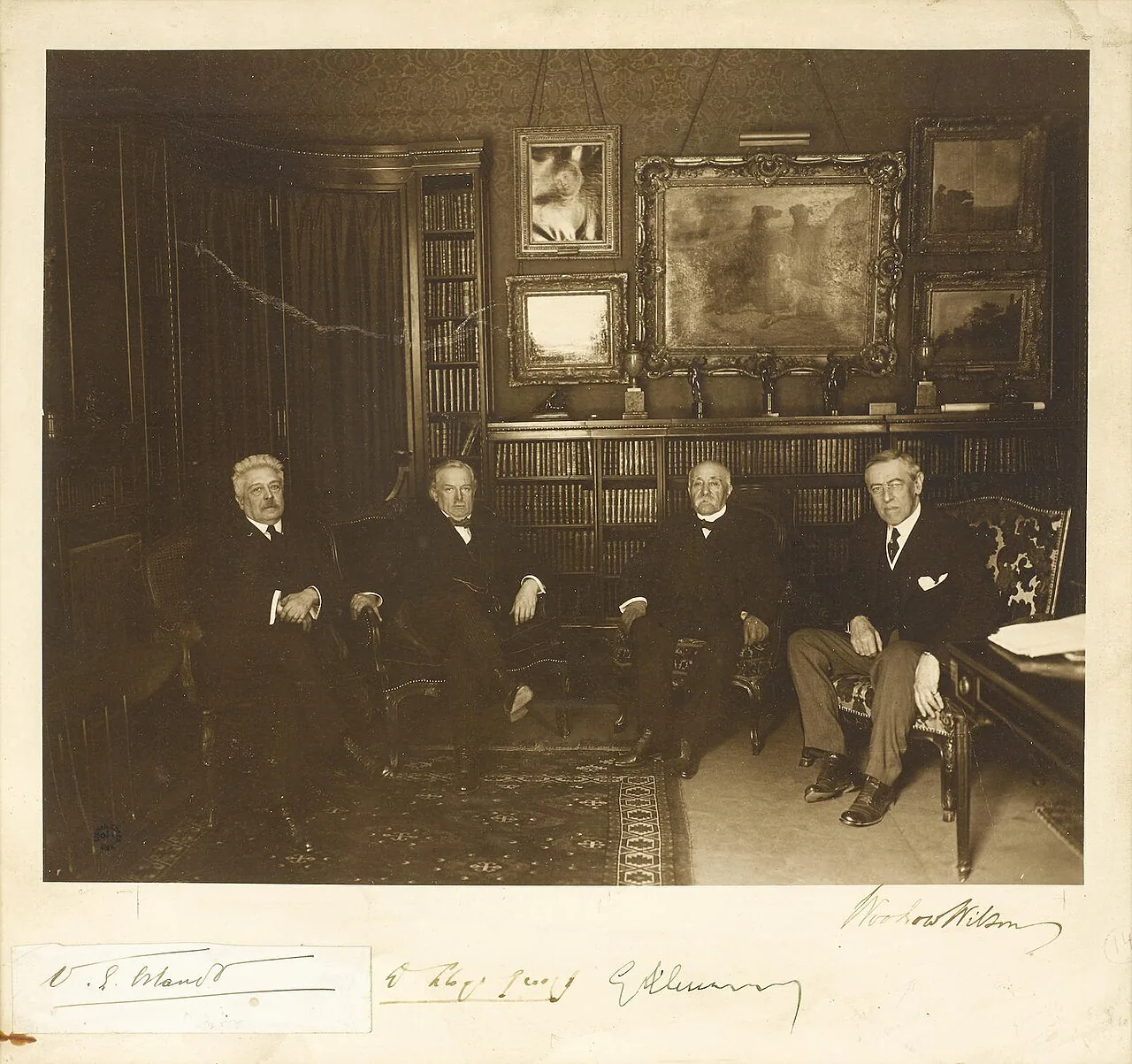
Commentary. The signed photograph shows the four leaders who decided the main terms. Their aims differed: Wilson put his hopes in a League of Nations, Clemenceau in security against Germany, Lloyd George in a balance between the two, and Orlando in the territory promised to Italy in 1915. As a result, every treaty of the conference was a compromise among them, and each leader returned home to criticism.
The Allies and Germany signed the Treaty of Versailles on June 28, 1919, in the Hall of Mirrors, exactly five years after the assassination in Sarajevo. It was the same room where German princes had proclaimed the German Empire in 1871. Germany lost Alsace-Lorraine to France, land to Poland, which gained access to the sea through a corridor, and all its overseas colonies, which came under League of Nations mandates.
The treaty demilitarized the Rhineland and limited the German army to 100,000 men, with no tanks, military aircraft, or submarines. Germany also had to pay reparations. In 1921 the Reparation Commission fixed the total demanded of the defeated powers at 132 billion gold marks. The most debated clause was Article 231.
Document 8 – The “war guilt” clause (1919)
The Allied and Associated Governments affirm and Germany accepts the responsibility of Germany and her allies for causing all the loss and damage to which the Allied and Associated Governments and their nationals have been subjected as a consequence of the war imposed upon them by the aggression of Germany and her allies.
Treaty of Versailles, June 28, 1919, Part VIII (Reparation), Article 231 (Avalon Project, Yale Law School).
*aggression: an attack or the starting of a war.
Commentary. The authors meant the article to give a legal basis for reparations, since the Allies claimed that Germany had to pay for the damage it caused. Germans read it as a statement of moral guilt, and it deeply offended them. The treaty became known in Germany as a Diktat, an order that outsiders imposed. A historian has to separate what the article says (responsibility for loss and damage) from how people understood it.
Document 9 – The signing at Versailles
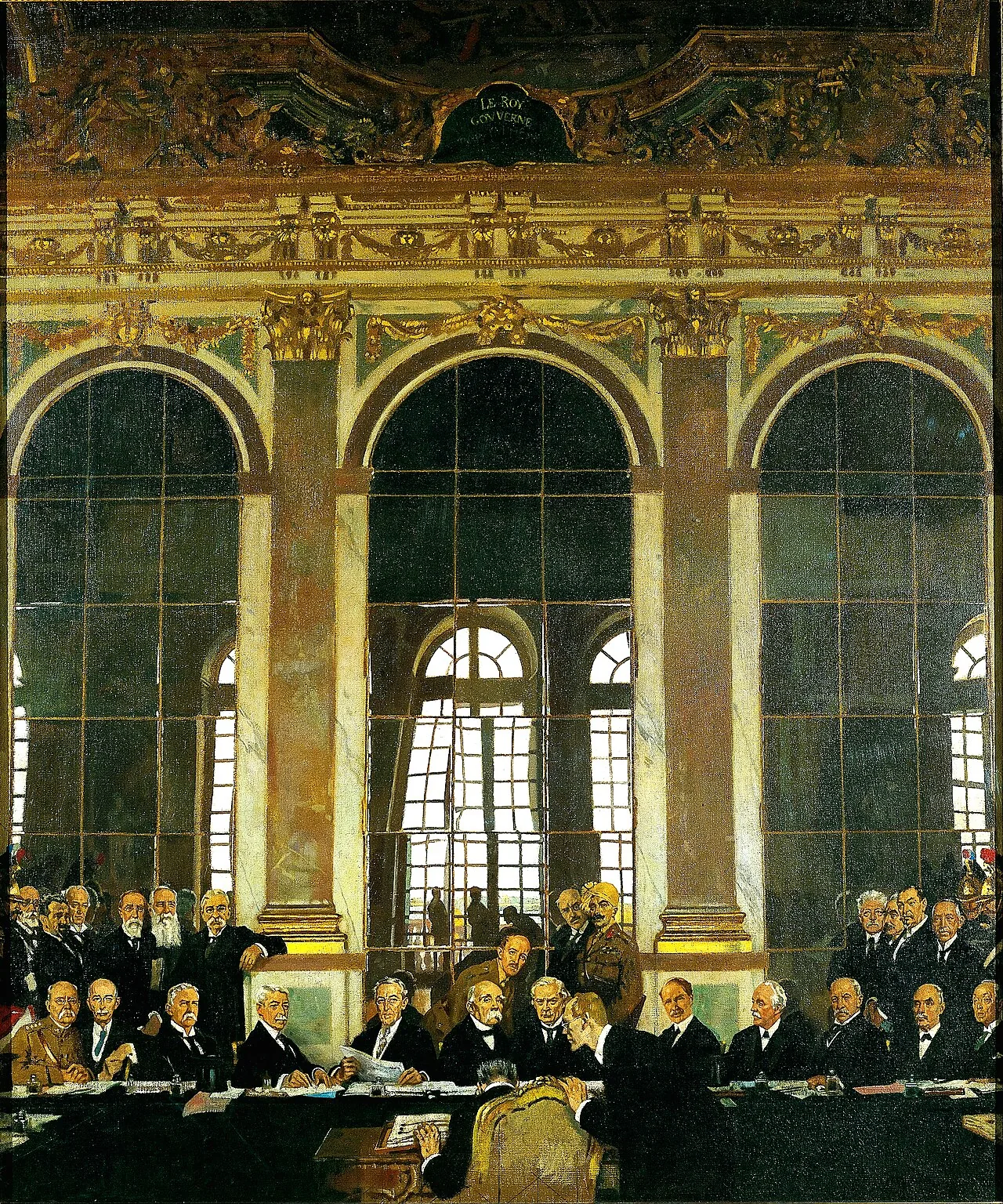
Commentary. The British painter William Orpen, an official war artist, recorded the moment of signing. Delegates in dark suits crowd around the table under the painted ceiling and the tall mirrors, and the vast hall dwarfs the small table where the delegates sign the treaty. The painting makes the treaty look solemn and orderly, but the real story was the dispute over its terms.
Other treaties dealt with Germany’s allies. The empires of Austria-Hungary and the Ottoman Empire broke up, and new or enlarged states appeared: Poland, Czechoslovakia, Yugoslavia, Austria, Hungary, and the Baltic states. Meanwhile, Britain and France took control of former Ottoman lands in the Middle East as League mandates. The victors redrew the map on the principle of national self-determination in Europe, but not in the colonies. In 1919 protest movements broke out in Egypt, India, Korea, and China, where students marched on May 4, angry that the victors gave former German rights in Shandong to Japan. However, the United States Senate refused to approve the treaty, and the United States never joined the League of Nations.
6. The cost and the legacy
Estimates of the dead vary, but between about eight and a half and eleven million soldiers died. Millions of civilians also died from violence, hunger, and disease, including those in the influenza pandemic that spread in 1918. Russia, Germany, France, and Austria-Hungary suffered the greatest losses in numbers, while Serbia lost the largest share of its people. Four empires disappeared, nations were newly born, and governments took on new powers. The war also left debts, a sense of grievance in Germany, and a European order that depended on the cooperation of countries that did not trust each other. The next chapter looks at how that peace came apart.
- June 28, 1914 Assassination of Archduke Franz Ferdinand at Sarajevo
- July 28, 1914 Austria-Hungary declares war on Serbia
- August 4, 1914 Germany invades Belgium; Britain declares war
- September 1914 Battle of the Marne; trench warfare begins
- 1916 Battles of Verdun and the Somme
- April 6, 1917 United States declares war on Germany
- March 1918 Treaty of Brest-Litovsk; German spring offensive
- November 11, 1918 Armistice
- June 28, 1919 Treaty of Versailles signed
Key takeaways
- Militarism, alliances, imperial rivalry, and nationalism made Europe unstable; the assassination at Sarajevo on June 28, 1914, set off the July Crisis and a chain of declarations of war.
- On the Western Front, trenches, machine guns, artillery, and gas produced a stalemate and enormous casualties; Verdun and the Somme became symbols of attrition.
- Total war mobilized whole societies: conscription, rationing, women in factories, censorship, and propaganda.
- In 1917 Russia left the war after revolution, and the United States entered after unrestricted submarine warfare and the Zimmermann telegram.
- The armistice took effect on November 11, 1918. The Treaty of Versailles took land, colonies, and arms from Germany, imposed reparations, and included the “war guilt” Article 231.
- The peace created new states and the League of Nations but left many grievances, and the United States did not join the League.

Quick review: flashcards
Tap a card to see the answer.