


This World History Grades 9-10 test covers World War I. Like a classroom assessment, it includes documents to analyze, knowledge questions and a short writing task. To prepare, review the lesson first, then practice with the worksheet.
Time : 50 min
The test has three parts: knowledge (34 points), documents (46 points), and a written argument (20 points). Answer in complete sentences and cite the documents.
Document 1 – The Western Front
Natural Earth data; front line approximate.
Document 2 – I Want You for U.S. Army (1917)
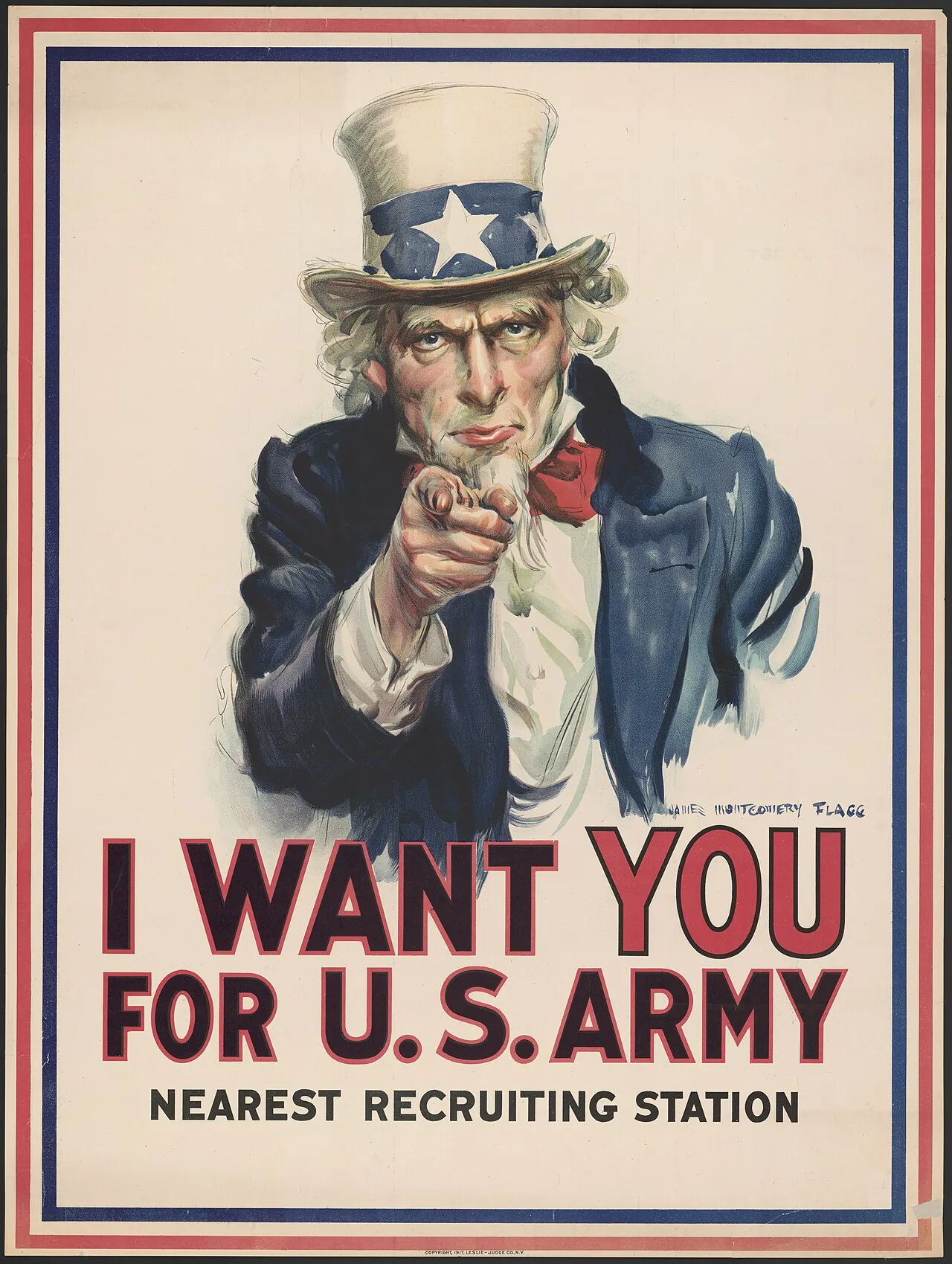
James Montgomery Flagg, 1917, Library of Congress, via Wikimedia Commons.
Document 3 – The Zimmermann telegram (1917)
We intend to begin on the first of February unrestricted submarine warfare. We shall endeavor in spite of this to keep the United States of America neutral. In the event of this not succeeding, we make Mexico a proposal of alliance on the following basis: make war together, make peace together, generous financial support and an understanding on our part that Mexico is to reconquer the lost territory in Texas, New Mexico, and Arizona. […] Please call the President’s attention to the fact that the ruthless employment of our submarines now offers the prospect of compelling England in a few months to make peace.
Arthur Zimmermann, German Foreign Secretary, telegram to the German ambassador in Washington for transmission to Mexico, January 16, 1917, as decoded and translated by British intelligence (Wikisource).
*endeavor: try. *reconquer: win back.
Arthur Zimmermann, German Foreign Secretary, telegram to the German ambassador in Washington for transmission to Mexico, January 16, 1917, as decoded and translated by British intelligence (Wikisource).
Document 4 – The Treaty of Versailles, Article 231 (1919)
The Allied and Associated Governments affirm and Germany accepts the responsibility of Germany and her allies for causing all the loss and damage to which the Allied and Associated Governments and their nationals have been subjected as a consequence of the war imposed upon them by the aggression of Germany and her allies.
Treaty of Versailles, June 28, 1919, Part VIII (Reparation), Article 231 (Avalon Project, Yale Law School).
*aggression: an attack or the starting of a war.
Treaty of Versailles, June 28, 1919, Part VIII (Reparation), Article 231 (Avalon Project, Yale Law School).
Document 5 – Key dates
- June 28, 1914 Assassination at Sarajevo
- July 28, 1914 Austria-Hungary declares war on Serbia
- August 4, 1914 Germany invades Belgium; Britain declares war
- April 6, 1917 United States declares war
- November 11, 1918 Armistice
- June 28, 1919 Treaty of Versailles signed
Dates from standard reference works.
Questions
- Part 1 – Knowledge. Define militarism, alliance system, and total war. (12 pts)
- Part 1. Explain three long-term causes of World War I (militarism, alliances, imperial rivalry, or nationalism) and give one example for each. (12 pts)
- Part 1. Document 1: the map shows the Western Front. Through which country did Germany march in August 1914, which city on the map was the goal of the advance, and which two places on the map were the scenes of battles in 1916? Explain why the front barely moved from 1915 to 1917. (10 pts)
- Part 2 – Documents. Document 2: present the document and explain how it tries to persuade men to enlist. Why were posters like this useful to a government in total war? (14 pts)
- Part 2. Document 3: present the document, explain what Germany proposes to Mexico, and say why the telegram helped to bring the United States into the war. (10 pts)
- Part 2. Document 4: present the document, explain why many Germans felt insulted by it, and say how a historian should read this article. (14 pts)
- Part 2. Document 5: calculate the time between the Austrian declaration of war and the armistice, the time between the armistice and the signing of the Treaty of Versailles, and the time between the American declaration of war and the armistice. (8 pts)
- Part 3 – Written argument (LEQ). Evaluate the extent to which World War I changed the relationship between governments and their citizens in the countries that fought it. Use the documents and the lesson. (20 pts)


Quick review: flashcards
Tap a card to see the answer.