


This World History Grades 9-10 test covers Nationalism and Imperialism. Like a classroom assessment, it includes documents to analyze, knowledge questions and a short writing task. To prepare, review the lesson first, then practice with the worksheet.
Time : 50 min
The test has three parts: knowledge (34 points), documents (46 points), and a written argument (20 points). Answer in complete sentences and cite the documents.
Document 1 – Asia and the Pacific around 1914
Natural Earth data; colonial control simplified by modern country outlines.
Document 2 – In the Rubber Coils (1906)
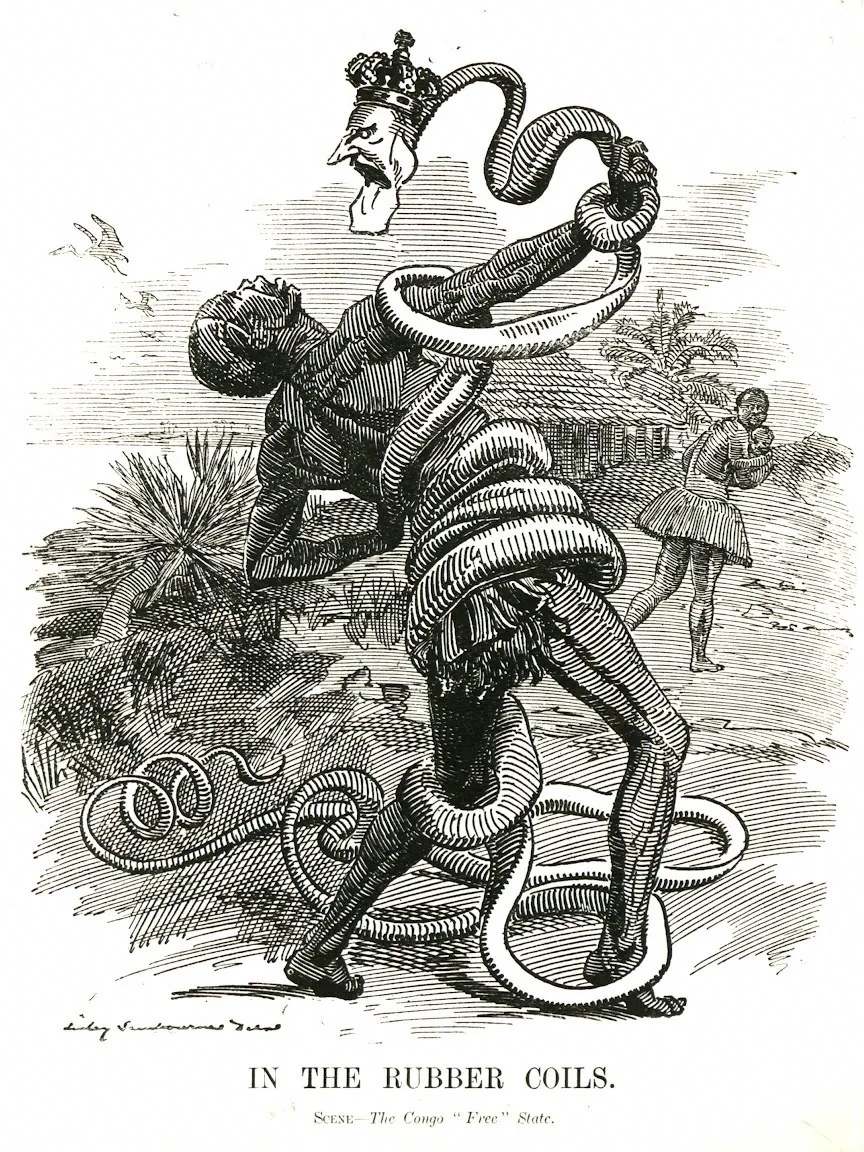
Edward Linley Sambourne, <em>Punch</em>, November 28, 1906, via Wikimedia Commons.
Document 3 – Jules Ferry on colonial expansion (1884)
In the area of economics, I am placing before you, with the support of some statistics, the considerations that justify the policy of colonial expansion, as seen from the perspective of a need, felt more and more urgently by the industrialized population of Europe and especially the people of our rich and hardworking country of France: the need for outlets [for exports]. […] Gentlemen, we must speak more loudly and more honestly! We must say openly that indeed the higher races have a right over the lower races …. I repeat, that the superior races have a right because they have a duty. They have the duty to civilize the inferior races […]
Jules Ferry, speech before the French Chamber of Deputies, March 28, 1884 (translation by Ruth Kleinman, modernized text; Internet Modern History Sourcebook, Fordham University).
*outlets: markets where factories can sell their goods.
Jules Ferry, speech before the French Chamber of Deputies, March 28, 1884 (translation by Ruth Kleinman, modernized text; Internet Modern History Sourcebook, Fordham University).
Document 4 – Roger Casement on the Congo (1903)
Men, he said, still came to him whose hands had been cut off by the Government soldiers during those evil days, and he said there were still many victims of this species of mutilation in the surrounding country. […] This boy described the circumstances of his mutilation, and, in answer to my inquiry, said that although wounded at the time he was perfectly sensible of the severing of his wrist, but lay still fearing that if he moved he would be killed.
Roger Casement, British consul, Report on the administration of the Congo Free State, dated December 11, 1903, published in Parliamentary Papers, Africa No. 1 (1904) (Project Gutenberg, ebook 50573).
*sensible: aware. *severing: cutting off.
Roger Casement, British consul, Report on the administration of the Congo Free State, dated December 11, 1903, published in Parliamentary Papers, Africa No. 1 (1904) (Project Gutenberg, ebook 50573).
Document 5 – Key dates
- 1842 Treaty of Nanking
- 1853 Perry arrives in Edo Bay
- 1868 Meiji Restoration
- 1884 Berlin Conference opens
- 1896 Battle of Adwa
- 1904 Casement report published
- 1905 Treaty of Portsmouth
- 1908 Belgium takes over the Congo
Dates from standard reference works.
Questions
- Part 1 – Knowledge. Define nationalism, imperialism, and effective occupation. (12 pts)
- Part 1. Name three motives for imperialism and give one example for each. (12 pts)
- Part 1. Document 1: name the places numbered 1, 3, 4, 5, and 10, and say which power ruled each in 1914. (10 pts)
- Part 2 – Documents. Document 2: present the document, explain who the snake and the man represent, and say what the cartoonist wanted the public to think. (14 pts)
- Part 2. Document 3: present the document and explain the two reasons that Ferry gives for colonial expansion. (10 pts)
- Part 2. Document 4: present the document and explain how it contradicts the claim that empire brought “civilization” (Document 3). Say why a historian can trust this source and what its limits are. (14 pts)
- Part 2. Document 5: calculate the number of years between the Meiji Restoration and the Treaty of Portsmouth, and between the opening of the Berlin Conference and the Belgian takeover of the Congo. Which event shows that an African state resisted conquest? (8 pts)
- Part 3 – Written argument (LEQ). Evaluate the extent to which economic motives, rather than other motives, explain the expansion of European and Japanese empires between 1870 and 1914. Use the documents and the lesson. (20 pts)


Quick review: flashcards
Tap a card to see the answer.