


This World History Grades 9-10 test covers The Industrial Revolution. Like a classroom assessment, it includes documents to analyze, knowledge questions and a short writing task. To prepare, review the lesson first, then practice with the worksheet.
Time : 50 min
The test has three parts: knowledge (34 points), documents (46 points), and a written argument (20 points). Answer in complete sentences and cite the documents.
Document 1 – Industrial Britain
Schematic map prepared for this unit with Natural Earth data.
Document 2 – The Crystal Palace
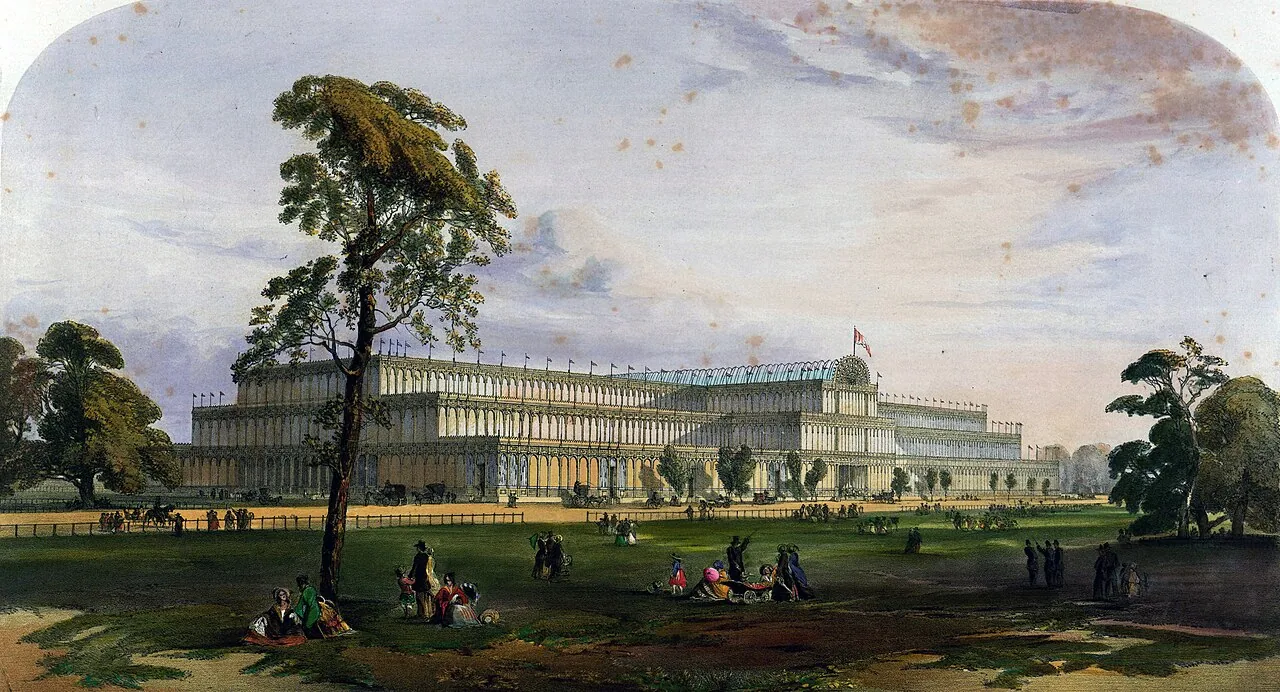
Wikimedia Commons; Dickinson Brothers, 1854.
Document 3 – A Manchester slum, 1844
In a rather deep hole, in a curve of the Medlock and surrounded on all four sides by tall factories and high embankments, covered with buildings, stand two groups of about two hundred cottages, built chiefly back to back, in which live about four thousand human beings, most of them Irish. The cottages are old, dirty, and of the smallest sort, the streets uneven, fallen into ruts and in part without drains or pavement; masses of refuse, offal and sickening filth lie among standing pools in all directions; the atmosphere is poisoned by the effluvia from these, and laden and darkened by the smoke of a dozen tall factory chimneys.
Source: Friedrich Engels, The Condition of the Working-Class in England in 1844, 1845, chapter on the great towns (Little Ireland, Manchester); English translation by Florence Kelley Wischnewetzky (1887); Project Gutenberg edition (ebook 17306).
*Rookery: crowded slum. *Offal: waste parts of slaughtered animals. *Effluvia: foul smells.
Friedrich Engels, The Condition of the Working-Class in England in 1844 (1845).
Document 4 – Population
| Year | Manchester | England and Wales |
|---|---|---|
| 1801 | 75,000 | 8.9 million |
| 1851 | 303,000 | 17.9 million |
Census figures rounded; see exercise on population growth.
Questions
- Part 1 – Knowledge. Define Industrial Revolution, factory system, and division of labor. (12 pts)
- Part 1. Document 1: name the city that was the center of the cotton industry, the port through which cotton arrived, and the place where iron was smelted with coke. (10 pts)
- Part 1. Name three inventions of the Industrial Revolution and the inventor of each. (12 pts)
- Part 2 – Documents. Document 2: present the document, describe the building, and explain what the exhibition of 1851 meant for Britain. (14 pts)
- Part 2. Document 3: present the document, describe what Engels saw, and explain why a historian must be careful with this source. (14 pts)
- Part 2. Document 4: calculate how much Manchester grew between 1801 and 1851 and how many times larger it became, and compare with England and Wales. (8 pts)
- Part 2. Using Documents 2 and 3 and the lesson, explain two opposite views of industrial progress. (10 pts)
- Part 3 – Written argument (LEQ). Evaluate the extent to which the Industrial Revolution improved the lives of ordinary people in Britain between 1760 and 1850. Use the documents and the lesson. (20 pts)


Quick review: flashcards
Tap a card to see the answer.