


This worksheet on The Industrial Revolution belongs to the World History Grades 9-10 course. Its questions use primary sources, maps and timelines, and they move from basic recall to short writing tasks. Before you start, review the lesson; afterward, try the true or false quiz.
Exercise 1 : Vocabulary of the Industrial Revolution
Match each term with its definition.
- Factory system
- Division of labor
- Laissez-faire
- Urbanization
- Luddites
- Chartism
- Enclosure
- Trade union
A. A movement in the 1830s and 1840s that demanded voting rights for working men. B. The growth of towns and the movement of people into them. C. Workers who broke machines that threatened their trades. D. Production in large buildings with power-driven machines and set hours. E. Splitting a product’s making into many simple tasks. F. An association of workers who bargain together for better wages and conditions. G. Fencing in open fields so that landowners could farm them privately. H. The idea that government should not interfere in the economy.
Exercise 2 : The pin factory
Document 1 – Adam Smith on the division of labor
But in the way in which this business is now carried on, not only the whole work is a peculiar trade, but it is divided into a number of branches, of which the greater part are likewise peculiar trades. One man draws out the wire; another straights it; a third cuts it; a fourth points it; a fifth grinds it at the top for receiving the head; to make the head requires two or three distinct operations; to put it on is a peculiar business; to whiten the pins is another; it is even a trade by itself to put them into the paper; and the important business of making a pin is, in this manner, divided into about eighteen distinct operations […]
Source: Adam Smith, An Inquiry into the Nature and Causes of the Wealth of Nations, 1776, book 1, chapter 1 (“Of the Division of Labour”); Project Gutenberg edition (ebook 3300).
*Manufactory: workshop. *Peculiar trade: separate specialized job.
- Present the document (author, date, work).
- How many steps does Smith say the making of a pin is divided into?
- What would happen if a worker who had not been trained tried to make pins alone?
- Explain how the division of labor increases output.
- What does the text not tell us about the lives of the workers?
Exercise 3 : Little Ireland
Document 1 – A Manchester slum, 1844
In a rather deep hole, in a curve of the Medlock and surrounded on all four sides by tall factories and high embankments, covered with buildings, stand two groups of about two hundred cottages, built chiefly back to back, in which live about four thousand human beings, most of them Irish. The cottages are old, dirty, and of the smallest sort, the streets uneven, fallen into ruts and in part without drains or pavement; masses of refuse, offal and sickening filth lie among standing pools in all directions; the atmosphere is poisoned by the effluvia from these, and laden and darkened by the smoke of a dozen tall factory chimneys.
Source: Friedrich Engels, The Condition of the Working-Class in England in 1844, 1845, chapter on the great towns (Little Ireland, Manchester); English translation by Florence Kelley Wischnewetzky (1887); Project Gutenberg edition (ebook 17306).
*Rookery: crowded slum. *Offal: waste parts of slaughtered animals. *Effluvia: foul smells.
- Present the document (author, date, work).
- Describe the location of Little Ireland.
- List three details about the housing and the streets.
- Why must we be careful about the author’s point of view?
- Name another kind of source that could confirm or correct his account.
Exercise 4 : Children in the mills
Document 1 – The Factories Inquiry, 1833
The report of the Central Commission relates that the manufacturers began to employ children rarely of five years, often of six, very often of seven, usually of eight to nine years; that the working-day often lasted fourteen to sixteen hours, exclusive of meals and intervals; that the manufacturers permitted overlookers to flog and maltreat children […]
Source: Friedrich Engels, The Condition of the Working-Class in England in 1844, 1845, chapter on the factory system, summarizing the report of the Central Commission of the Factories Inquiry Commission of 1833; translation by Florence Kelley Wischnewetzky; Project Gutenberg edition (ebook 17306).
*Overlookers: supervisors. *Maltreat: treat cruelly.
- Present the document. Who is the source, and what is it summarizing?
- At what ages did manufacturers start to employ children?
- How long was the working day?
- What treatment of children does the report mention?
- Explain how a report like this could lead to the Factory Act of 1833.
Exercise 5 : Needlewomen in London
Document 1 – A sweated trade, 1844
The girls who sew neckties must bind themselves to work sixteen hours a day, and receive 4.5s. a week. {210} But the shirtmakers’ lot is the worst. They receive for an ordinary shirt 1.5d., formerly 2d.-3d.; but since the workhouse of St. Pancras, which is administered by a Radical board of guardians, began to undertake work at 1.5d., the poor women outside have been compelled to do the same. For fine, fancy shirts, which can be made in one day of eighteen hours, 6d. is paid. The weekly wage of these sewing-women according to this and according to testimony from many sides, including both needle-women and employers, is 2s. 6d. to 3s. for most strained work continued far into the night.
Source: Friedrich Engels, The Condition of the Working-Class in England in 1844, 1845, chapter “The Remaining Branches of Industry” (London needlewomen); translation by Florence Kelley Wischnewetzky; Project Gutenberg edition (ebook 17306).
*s.: shilling. *d.: penny (twelve pence made a shilling). *Pawn: leave an object with a lender in exchange for a loan.
- Present the document.
- How many hours a day must the necktie sewers work, and what do they earn a week?
- What does the passage say about the shirtmakers?
- Why does Engels call the system of deposits “shameful barbarism”?
- How does this text show that industrialization affected workers outside factories?
Exercise 6 : Praise and protest
Document 1 – Adam Smith, 1776
But in the way in which this business is now carried on, not only the whole work is a peculiar trade, but it is divided into a number of branches, of which the greater part are likewise peculiar trades. One man draws out the wire; another straights it; a third cuts it; a fourth points it; a fifth grinds it at the top for receiving the head; to make the head requires two or three distinct operations; to put it on is a peculiar business; to whiten the pins is another; it is even a trade by itself to put them into the paper; and the important business of making a pin is, in this manner, divided into about eighteen distinct operations […]
Source: Adam Smith, An Inquiry into the Nature and Causes of the Wealth of Nations, 1776, book 1, chapter 1 (“Of the Division of Labour”); Project Gutenberg edition (ebook 3300).
*Manufactory: workshop.
Document 2 – The Factories Inquiry, 1833, in Engels’s account
The report of the Central Commission relates that the manufacturers began to employ children rarely of five years, often of six, very often of seven, usually of eight to nine years; that the working-day often lasted fourteen to sixteen hours, exclusive of meals and intervals; that the manufacturers permitted overlookers to flog and maltreat children […]
Source: Friedrich Engels, The Condition of the Working-Class in England in 1844, 1845, chapter on the factory system, summarizing the report of the Central Commission of the Factories Inquiry Commission of 1833; translation by Florence Kelley Wischnewetzky; Project Gutenberg edition (ebook 17306).
*Overlookers: supervisors.
- Present each document.
- What does Smith emphasize about factory work?
- What does the second text emphasize?
- Compare the two views of the new methods of production.
- Why can both texts be true at the same time?
Exercise 7 : Population or exploitation?
Document 1 – Malthus, 1798
Population, when unchecked, increases in a geometrical ratio. Subsistence increases only in an arithmetical ratio. A slight acquaintance with numbers will shew the immensity of the first power in comparison of the second. By that law of our nature which makes food necessary to the life of man, the effects of these two unequal powers must be kept equal.
Source: Thomas Malthus, An Essay on the Principle of Population, 1798, chapter 1; Project Gutenberg edition.
*Geometrical ratio: growth by multiplication (1, 2, 4, 8). *Arithmetical ratio: growth by addition (1, 2, 3, 4).
Document 2 – Marx and Engels, 1848
The bourgeoisie, historically, has played a most revolutionary part. The bourgeoisie, wherever it has got the upper hand, has put an end to all feudal, patriarchal, idyllic relations. It has pitilessly torn asunder the motley feudal ties that bound man to his “natural superiors,” and has left remaining no other nexus between man and man than naked self-interest, than callous “cash payment.”
Source: Karl Marx and Friedrich Engels, The Communist Manifesto, 1848, part 1 (“Bourgeois and Proletarians”), English translation of 1888; Project Gutenberg edition.
*Bourgeoisie: the class of owners of factories. *Nexus: bond. *Patriarchal: ruled by the father or elder.
- Present the two documents.
- According to Malthus, what limits the growth of population?
- According to Marx and Engels, what has the bourgeoisie done to older social ties?
- Compare their explanations of poverty or social change.
- Which of the two texts would a factory owner find more threatening, and why?
Exercise 8 : How the machines took over
Document 1 – The victory of machinery
In the closing years of the last century, Dr. Cartwright, a country parson, had invented the power-loom, and about 1804 had so far perfected it, that it could successfully compete with the hand-weaver; and all this machinery was made doubly important by James Watt’s steam-engine, invented in 1764, and used for supplying motive power for spinning since 1785. With these inventions, since improved from year to year, the victory of machine-work over hand-work in the chief branches of English industry was won […]
Source: Friedrich Engels, The Condition of the Working-Class in England in 1844, 1845, chapter “The Industrial Proletariat”; translation by Florence Kelley Wischnewetzky; Project Gutenberg edition (ebook 17306).
*Carding engine: machine for combing raw cotton. *Power-loom: loom driven by steam. *Motive power: the force that moves machines.
- Present the document.
- Name three inventions that the passage mentions.
- What did James Watt’s steam engine provide?
- What was the result for hand workers?
- Compare this account with the lesson: which inventor does Engels name that the lesson also mentions?
Exercise 9 : Capitalism in permanent revolution
Document 1 – The Communist Manifesto, 1848
The bourgeoisie cannot exist without constantly revolutionising the instruments of production, and thereby the relations of production, and with them the whole relations of society. Conservation of the old modes of production in unaltered form, was, on the contrary, the first condition of existence for all earlier industrial classes. Constant revolutionising of production, uninterrupted disturbance of all social conditions, everlasting uncertainty and agitation distinguish the bourgeois epoch from all earlier ones. All fixed, fast-frozen relations, with their train of ancient and venerable prejudices and opinions, are swept away, all new-formed ones become antiquated before they can ossify. All that is solid melts into air, all that is holy is profaned, and man is at last compelled to face with sober senses, his real conditions of life […]
Source: Karl Marx and Friedrich Engels, The Communist Manifesto, 1848, part 1; English translation of 1888; Project Gutenberg edition.
*Bourgeoisie: owners of factories. *Ossify: harden.
- Present the document (authors, date, work).
- According to the text, what must the bourgeoisie constantly do?
- What was the condition of earlier industrial classes?
- What does the text say happens to “all that is solid”?
- Is the authors’ tone only critical? Explain, and say how a historian should use this source.
Exercise 10 : Over London by Rail
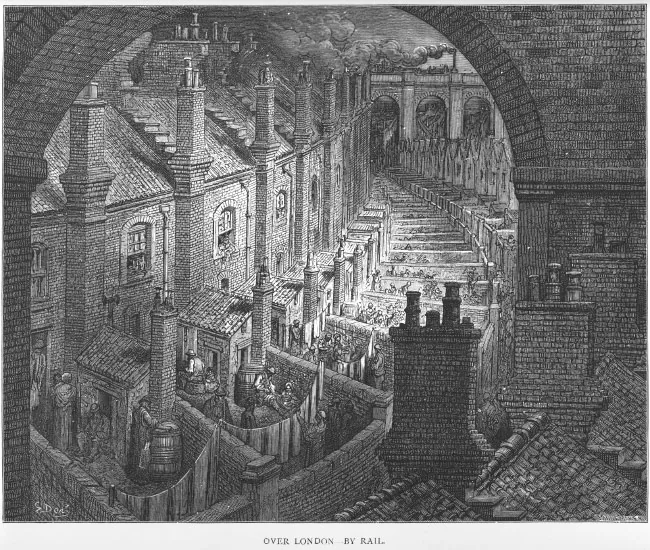
- Present the image (author, date, source).
- Describe what you see in the foreground and the background.
- What contrast does the artist suggest between the railway and the houses below?
- What impression of the industrial city does the picture give?
- Why is this image a useful source, and what are its limits?
Exercise 11 : The weaving shed
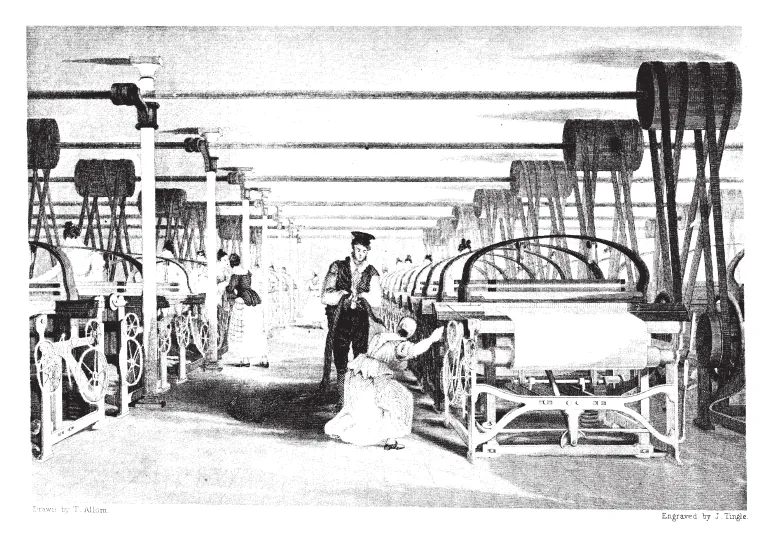
- Present the engraving.
- How are the looms powered?
- Who works at the looms?
- What does the owner’s point of view lead the artist to show, or leave out?
- Which other source would you add to learn about working conditions?
Exercise 12 : Coalbrookdale by night
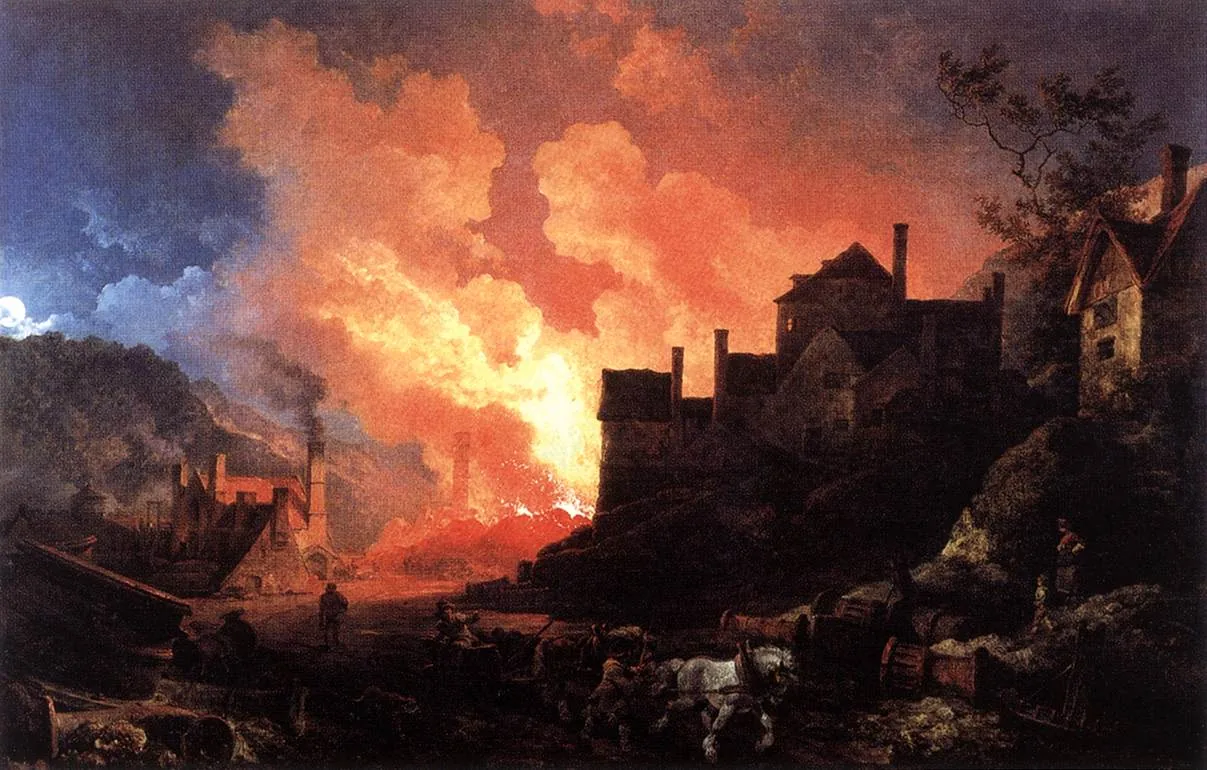
- Present the painting (author, date, location).
- Describe the light, colors, and subject.
- What feeling does the artist convey about industry?
- Why was Coalbrookdale important in the history of iron?
- Is the painting a document of fact or of feeling? Explain.
Exercise 13 : A new age of travel
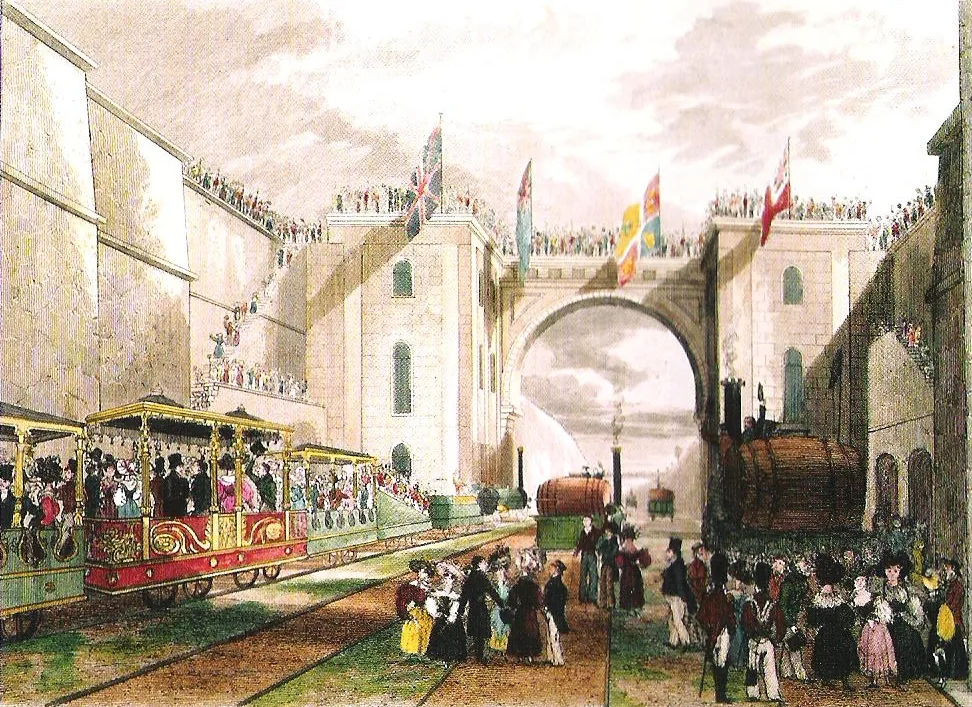
- Present the image and say what event it shows.
- Describe the train and the crowd.
- What mood does the artist convey?
- How did railways change trade and everyday life?
- What is missing from this celebratory picture? (Think of accidents, workers, and costs.)
Exercise 14 : Population growth in the age of industry
Document 1 – Manchester and England and Wales
| Year | Manchester (approximate) | England and Wales (approximate) |
|---|---|---|
| 1801 | 75,000 | 8.9 million |
| 1831 | 183,000 | 13.9 million |
| 1841 | 243,000 | 15.9 million |
| 1851 | 303,000 | 17.9 million |
Source: census figures for the township and borough of Manchester and for England and Wales, as given in the censuses of 1801 to 1851 and rounded here. Table prepared for this unit.
- By how many people did Manchester grow between 1801 and 1851?
- About how many times larger was Manchester in 1851 than in 1801? About how many times larger was England and Wales?
- Which grew faster, the city or the country? Give a reason.
- Name two problems that rapid growth could cause.
Exercise 15 : Britain: coal, cotton, and iron
- Name the city numbered 1 (the capital).
- Name the city numbered 2, nicknamed “Cottonopolis.”
- Name the port numbered 3, where raw cotton arrived.
- Name the city numbered 4 (a center of metalworking) and number 8, the site where Darby smelted iron with coke.
- Name the city numbered 7 on the Clyde and number 6 in the north-east.
Exercise 16 : Where did the cotton come from?
- Which two regions supplied raw cotton to the mills of Lancashire?
- Which ports in the United States and Britain do the arrows link?
- Who picked the cotton in the American South?
- Why did the demand of British mills affect slavery?
- How did the industrial revolution affect Indian handloom weavers?
Exercise 17 : Order the events
Put in order: A) Liverpool and Manchester Railway opens. B) Watt patents his steam engine. C) The Factory Act. D) Crompton’s mule. E) Peterloo. F) The Great Exhibition. G) Adam Smith publishes The Wealth of Nations.
Exercise 18 : Durations
Calculate: 1) the time between Watt’s patent (1769) and the opening of the Liverpool and Manchester Railway (1830); 2) the time between the Factory Act (1833) and the Ten Hours Act (1847); 3) the length of the Luddite revolts (1811-1816); 4) the time between the Peterloo massacre (1819) and the Reform Act (1832).
Exercise 19 : Guided research: the Liverpool and Manchester Railway
Find out about the first intercity railway. Use at least two reliable sites, such as the Science Museum Group, the Encyclopaedia Britannica, or the National Railway Museum. Suggested keywords: Rainhill trials Rocket 1829, Liverpool and Manchester Railway 1830 opening Huskisson.
- When were the Rainhill trials held, and who won?
- When did the railway open, and how long was it?
- What accident happened on the day it opened?
- What did the railway carry?
- Which sites did you use, and why do you trust them?
Hint: look for George and Robert Stephenson and the date September 15, 1830.
Exercise 20 : CER paragraph: progress for whom?
Claim, evidence, reasoning. Write one paragraph that answers: Did the Industrial Revolution improve life for ordinary workers in Britain before 1850? Use at least two pieces of evidence from the lesson and explain your reasoning.
Hint: weigh Smith’s output figures against Engels’s description and the Factory Act.
Exercise 21 : SAQ: why Britain?
Answer all three parts. a) Identify one reason the Industrial Revolution began in Britain. b) Explain how the steam engine changed the location of factories. c) Explain one effect of industrialization on workers’ lives.
Exercise 22 : True or false? Justify
Say whether each statement is true or false and justify in one sentence.
- The Industrial Revolution began in Britain.
- The Factory Act of 1833 banned all child labor.
- The Liverpool and Manchester Railway opened in 1830.
- Adam Smith defended government control of all trade.
- British mills used cotton grown by enslaved workers.
- The Luddites were generals in Napoleon’s army.
Exercise 23 : Causes and consequences
For each cause give a consequence and explain the link. 1) The agricultural revolution. 2) The invention of the steam engine. 3) The growth of factory towns. 4) The mistreatment of children in mills.


Quick review: flashcards
Tap a card to see the answer.