


This worksheet on Nationalism and Imperialism belongs to the World History Grades 9-10 course. Its questions use primary sources, maps and timelines, and they move from basic recall to short writing tasks. Before you start, review the lesson; afterward, try the true or false quiz.
Exercise 1 : Vocabulary of nationalism and empire
Match each term with its meaning, then use three of the terms in sentences about the period 1870-1914.
- nationalism
- imperialism
- Social Darwinism
- effective occupation
- sphere of influence
- unequal treaty
- Meiji Restoration
(a) a region where a foreign power has special trade and railway rights without governing it; (b) the overthrow of the shogun in 1868 and the return of power to the emperor; (c) loyalty to a nation and the belief that it should govern itself; (d) a treaty forced on a weaker state that gives the stronger one special rights; (e) a rule of the Berlin Conference that a claim had to be backed by real authority on the ground; (f) the false use of Darwin’s ideas to claim that some nations or races are superior; (g) a policy of extending a nation’s control over other lands and peoples.
Hint: look back at the definitions in the lesson.
Exercise 2 : A French leader explains colonial policy
Document 1 – Jules Ferry on colonial expansion (1884)
In the area of economics, I am placing before you, with the support of some statistics, the considerations that justify the policy of colonial expansion, as seen from the perspective of a need, felt more and more urgently by the industrialized population of Europe and especially the people of our rich and hardworking country of France: the need for outlets [for exports]. […] Gentlemen, we must speak more loudly and more honestly! We must say openly that indeed the higher races have a right over the lower races …. I repeat, that the superior races have a right because they have a duty. They have the duty to civilize the inferior races […]
Jules Ferry, speech before the French Chamber of Deputies, March 28, 1884 (translation by Ruth Kleinman, modernized text; Internet Modern History Sourcebook, Fordham University).
*outlets: markets where factories can sell their goods.
- Present the document (nature, author, date, context).
- What economic reason does Ferry give for colonial expansion?
- What moral reason does he add? Quote the words that express it.
- Why might a politician put these two reasons together in a speech?
- Whose point of view is missing from this document?
Hint: ask who is speaking, to whom, and what he wants his audience to do.
Exercise 3 : Kipling’s poem
Document 2 – Kipling, “The White Man’s Burden” (1899)
Take up the White Man’s burden—
Send forth the best ye breed—
Go bind your sons to exile
To serve your captives’ need;
To wait in heavy harness,
On fluttered folk and wild—
Your new-caught, sullen peoples,
Half-devil and half-child.
Take up the White Man’s burden—
In patience to abide,
To veil the threat of terror
And check the show of pride;
By open speech and simple,
An hundred times made plain,
To seek another’s profit,
And work another’s gain.
Rudyard Kipling, “The White Man’s Burden,” first published in McClure’s Magazine, February 1899 (first two stanzas; text of The Five Nations, 1903, on Wikisource).
*ye: you. *sullen: silent and resentful.
- Present the document (nature, author, date, to whom it was addressed).
- According to the poem, what does the “burden” consist of? Give two details.
- How does the poet describe the peoples to be ruled? Quote two phrases.
- What claim about empire does the poem make? What evidence in the text supports it?
- Explain why a person in the Philippines in 1899 might have disagreed with this poem.
Hint: reread the words used to describe the peoples; they show the attitude of the writer.
Exercise 4 : The promises of Berlin
Document 3 – The Berlin Act (1885), Article 6
All the Powers exercising sovereign rights or influence in the aforesaid territories bind themselves to watch over the preservation of the native tribes, and to care for the improvement of the conditions of their moral and material well-being, and to help in suppressing slavery, and especially the slave trade. They shall, without distinction of creed or nation, protect and favour all religious, scientific or charitable institutions and undertakings created and organized for the above ends, or which aim at instructing the natives and bringing home to them the blessings of civilization.
General Act of the Berlin Conference on West Africa, Article 6, February 26, 1885 (English text, South African History Online).
*tribes: the word used by the diplomats for African peoples. *undertakings: projects.
- Present the document (nature, date, who adopted it).
- What do the powers promise to do for the “native tribes”?
- Which people receive special protection under this article?
- Was any African ruler or representative among those who adopted it? What does this suggest about the document?
- Why would a historian compare this text with reports of what happened in the Congo?
Exercise 5 : Casement reports from the Congo
Document 4 – Roger Casement, report on the Congo (1903)
Men, he said, still came to him whose hands had been cut off by the Government soldiers during those evil days, and he said there were still many victims of this species of mutilation in the surrounding country. […] This boy described the circumstances of his mutilation, and, in answer to my inquiry, said that although wounded at the time he was perfectly sensible of the severing of his wrist, but lay still fearing that if he moved he would be killed.
Roger Casement, British consul, Report on the administration of the Congo Free State, dated December 11, 1903, published in Parliamentary Papers, Africa No. 1 (1904) (Project Gutenberg, ebook 50573).
*sensible: aware. *severing: cutting off.
- Present the document (nature, author, date, context).
- What does Casement say he saw himself, and what did people tell him?
- Who, according to the passage, committed the mutilations?
- Why was a report by a British consul more convincing to the British government than a missionary’s letter would have been?
- What are the limits of this source? What would a historian want to check?
Hint: note the difference between “came to my actual notice” and “he said.”
Exercise 6 : The Charter Oath
Document 5 – The Charter Oath of Meiji Japan (1868)
First. An assembly shall be organized on a broad basis: all policies (of the state) should be decided by public opinion. Second. Both Government and people shall be united in one heart: every undertaking should be pushed with vigor. Third. Civil and military classes with distinction and also commoners shall each carry out their aims: it is necessary that the spirit of the nation shall not be tired out. Fourth. Mean usages of the past should be destroyed: all things shall be founded on the Universal Law (or Way) of Heaven and earth. Fifth. Knowledge should be sought in the wide world: foundations of the royal realm shall be firmly established (elevated).
The Charter Oath of Meiji Japan, April 1868, in the translation by Harada Tasuku quoted in William Elliot Griffis, The Mikado: Institution and Person (1915), chapter 14 (Wikisource).
*usages: customs. *the royal realm: the empire of Japan.
- Present the document (nature, date, context).
- Which articles promise a change in how decisions are made?
- Which article shows that Japan would borrow from other countries? Quote it.
- Why did the new leaders of 1868 want to strengthen Japan quickly? Use what you know about Perry and the unequal treaties.
- What does the oath not promise?
Exercise 7 : Promises and reality in the Congo
Document 1A – The Berlin Act (1885), Article 6
All the Powers exercising sovereign rights or influence in the aforesaid territories bind themselves to watch over the preservation of the native tribes, and to care for the improvement of the conditions of their moral and material well-being, and to help in suppressing slavery, and especially the slave trade. They shall, without distinction of creed or nation, protect and favour all religious, scientific or charitable institutions and undertakings created and organized for the above ends, or which aim at instructing the natives and bringing home to them the blessings of civilization.
General Act of the Berlin Conference on West Africa, Article 6, February 26, 1885 (English text, South African History Online).
Document 1B – Casement on rubber and hostages (1903)
The summing up of the situation by the majority of those with whom I sought to discuss it was that, in fact, it was forced labour conceived in the true interest of the native, who, if not controlled in this way, would spend his days in idleness, unprofitable to himself and the general community. […] and therefore if I saw women and children seized as hostages and kept in detention until rubber or other things were brought in, it was better that this should be done by the cap-gun of the “forest guard” than by the Albini armed soldiers of the Government who, if once impelled into a district, would overturn the entire country side.
Roger Casement, British consul, Report on the administration of the Congo Free State, 1903, published in Parliamentary Papers, Africa No. 1 (1904) (Project Gutenberg, ebook 50573).
*cap-gun: an old, simple gun. *Albini: a type of rifle. *forest guard: a sentry placed in a village by a company.
- Present each document in one sentence.
- What does Document 1A promise about the treatment of Africans?
- What does Document 1B describe? Whose words is Casement repeating in the second part?
- In what way does 1B contradict 1A? Use one quotation from each.
- Write two sentences evaluating how far the Berlin Act protected the people of the Congo.
Hint: Casement is reporting the excuses offered to him, and he does not agree with them.
Exercise 8 : Two defenses of empire
Document 2A – Jules Ferry (1884)
In the area of economics, I am placing before you, with the support of some statistics, the considerations that justify the policy of colonial expansion, as seen from the perspective of a need, felt more and more urgently by the industrialized population of Europe and especially the people of our rich and hardworking country of France: the need for outlets [for exports]. […] Gentlemen, we must speak more loudly and more honestly! We must say openly that indeed the higher races have a right over the lower races …. I repeat, that the superior races have a right because they have a duty. They have the duty to civilize the inferior races […]
Jules Ferry, speech before the French Chamber of Deputies, March 28, 1884 (translation by Ruth Kleinman, modernized text; Internet Modern History Sourcebook, Fordham University).
Document 2B – Rudyard Kipling (1899)
Take up the White Man’s burden—
Send forth the best ye breed—
Go bind your sons to exile
To serve your captives’ need;
To wait in heavy harness,
On fluttered folk and wild—
Your new-caught, sullen peoples,
Half-devil and half-child.
Take up the White Man’s burden—
In patience to abide,
To veil the threat of terror
And check the show of pride;
By open speech and simple,
An hundred times made plain,
To seek another’s profit,
And work another’s gain.
Rudyard Kipling, “The White Man’s Burden,” first published in McClure’s Magazine, February 1899 (first two stanzas; text of The Five Nations, 1903, on Wikisource).
*ye: you.
- Present each document in one sentence (author, date, form).
- Which document stresses profit and markets, and which stresses duty and sacrifice? Quote from each.
- Find one idea that both authors share.
- Why might a politician in a parliament and a poet writing for a magazine make different arguments?
- Which document, in your view, is more likely to have influenced ordinary citizens, and why?
Exercise 9 : A photograph from the Congo
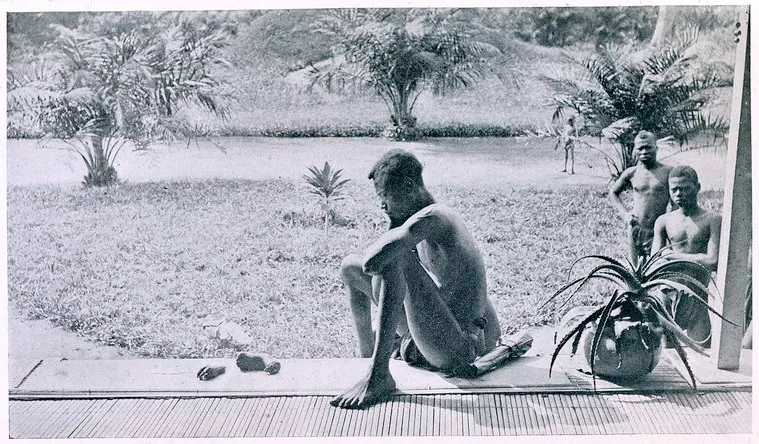
- Present the document (nature, photographer, date, place).
- Describe what you see: the man, the objects on the ground, the people in the background.
- What was the purpose of such photographs in 1904? Who was meant to see them?
- Why is it important to know who took a photograph and why, before using it as evidence?
- How does this image relate to what Casement wrote in his report?
Hint: think about missionary lectures and the Congo Reform Association.
Exercise 10 : The Cape to Cairo
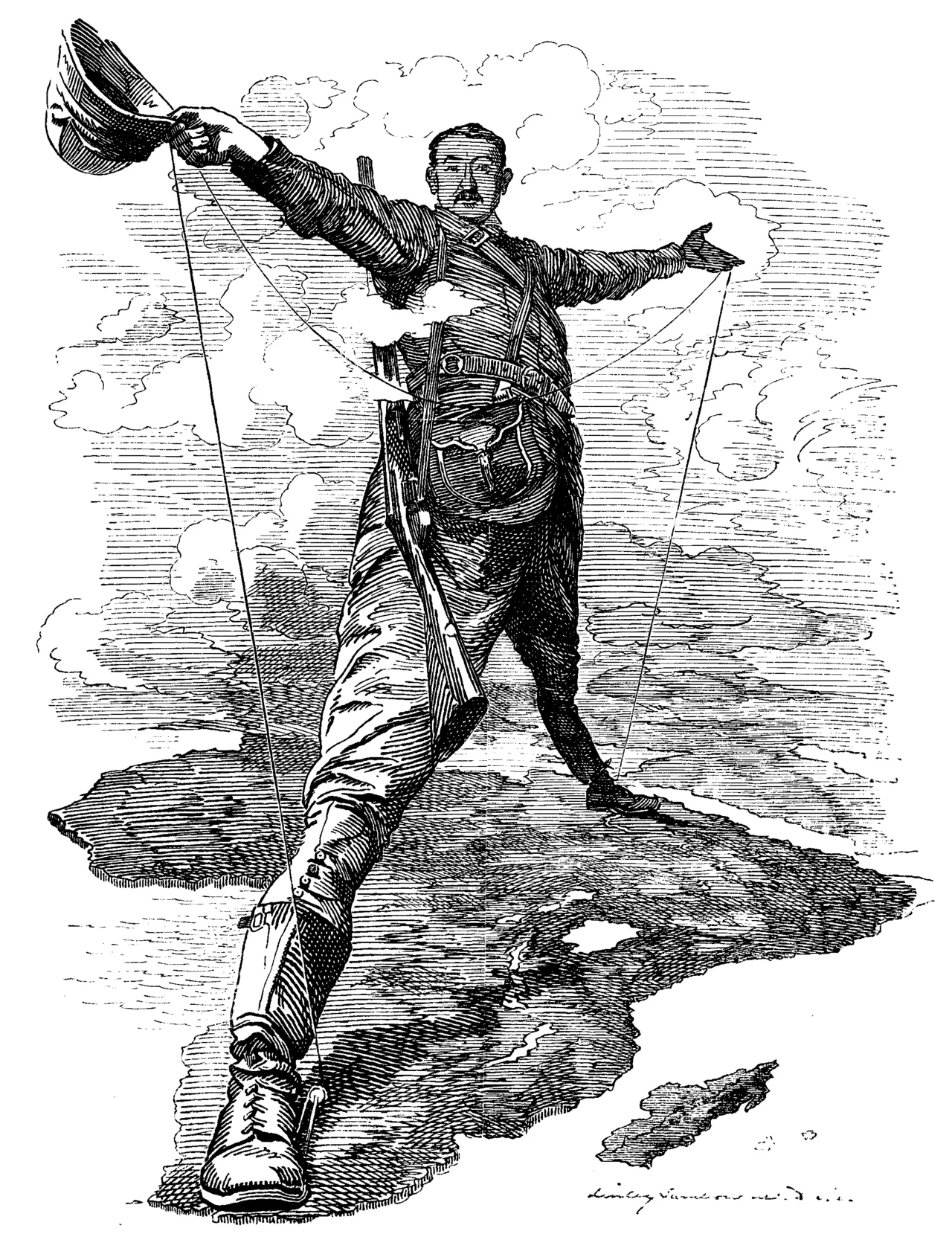
- Present the document (nature, artist, date, place of publication).
- Describe the figure and what he holds. What does the size of the figure suggest?
- What does the cartoonist think of Rhodes: admiration or criticism? Give two clues.
- Which people living in Africa appear in the cartoon?
- What did Rhodes hope to achieve with the line he holds?
Exercise 11 : A cartoon against Leopold
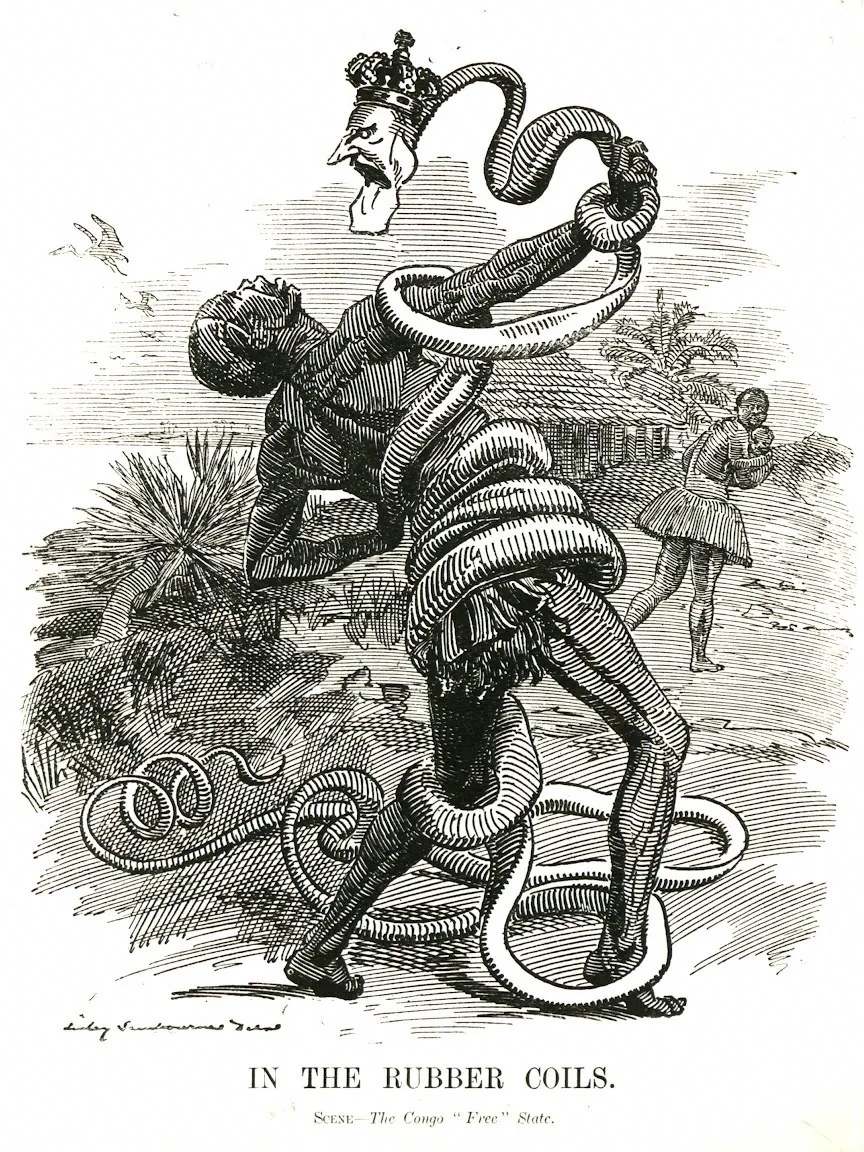
- Present the document (nature, artist, date).
- Who does the snake represent? What clues in the picture tell you?
- What is the man in the coils doing? Describe his posture.
- The title says “In the Rubber Coils.” Explain the double meaning.
- Why did cartoons like this help the reform movement?
Exercise 12 : The emperor in uniform
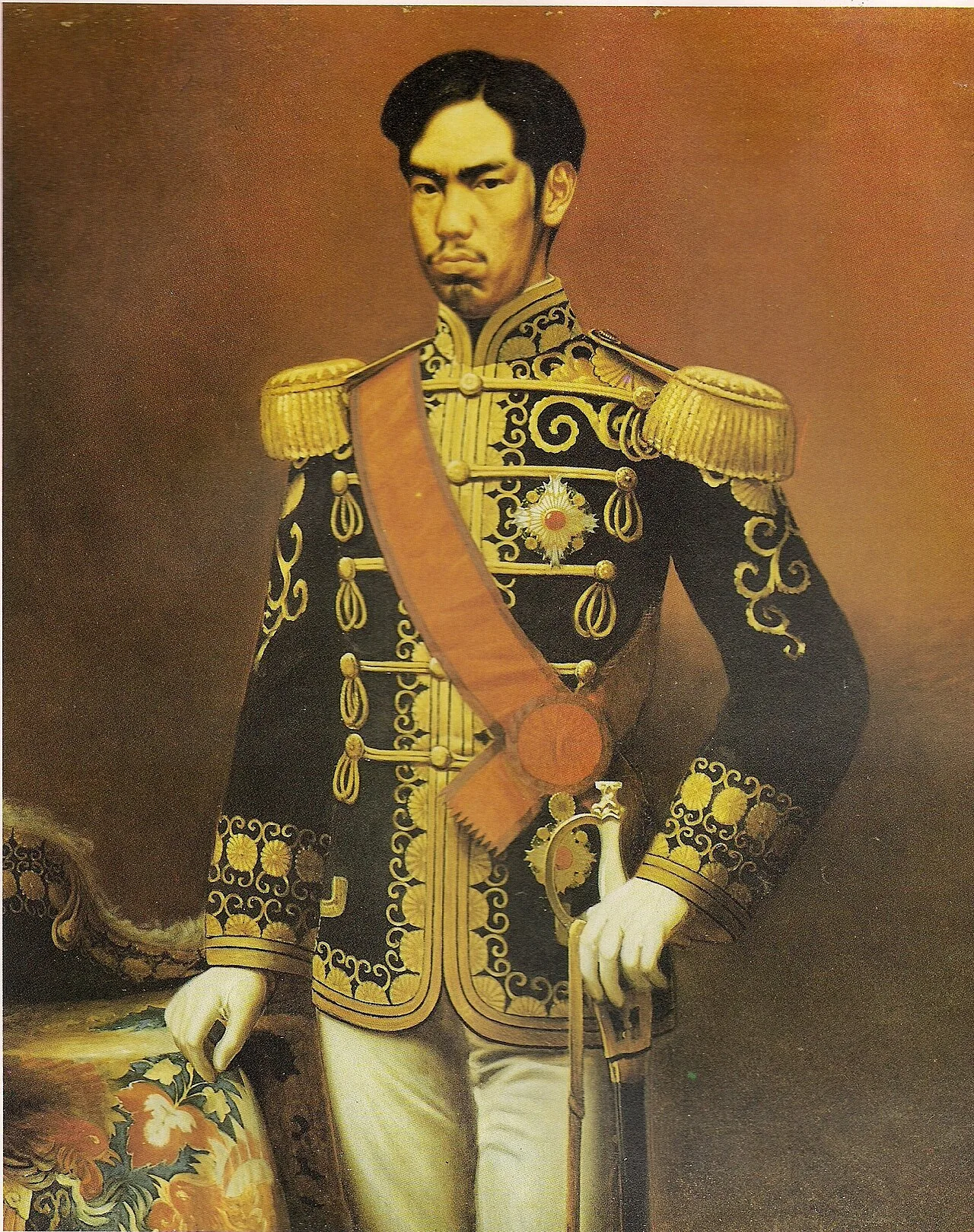
- Present the document (nature, artist, subject).
- Describe the clothing and the objects shown.
- Compare this clothing with what you would expect of a Japanese ruler before 1853. What does the change tell you?
- Why would the government of the Meiji period want portraits like this to be seen?
- Explain how this portrait helps show the policy stated in the fifth article of the Charter Oath.
Hint: the fifth article speaks of seeking knowledge in the wide world.
Exercise 13 : A palace and a message
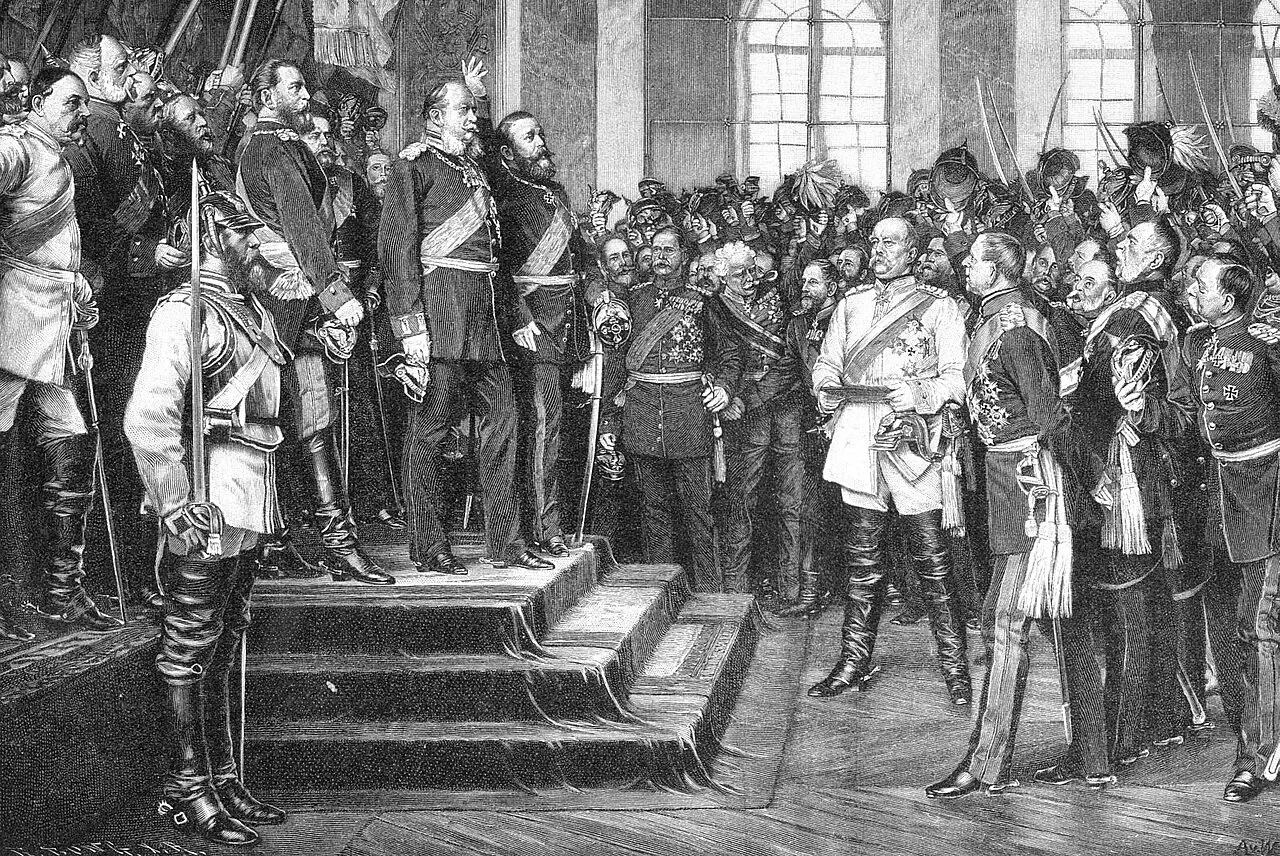
- Present the document (nature, event, date, place).
- Describe the scene: who is at the center, and who surrounds him?
- Why was the Hall of Mirrors at Versailles chosen for this ceremony? Think about the war that had just ended.
- How might French people have reacted to the ceremony?
- Explain what the scene shows about the role of nationalism in the 1870s.
Exercise 14 : Numbers behind the Scramble
The figures below are approximate; historians use ranges because early censuses are incomplete.
| Subject | Figure | Source |
|---|---|---|
| Share of Africa controlled by Europeans in the 1870s | about 10 percent | Scramble for Africa (reference article citing T. Pakenham, 1991) |
| Congo Free State: area | 2,345,409 square kilometers | Reference article Congo Free State (estimate) |
| Congo Free State: population in 1907 (estimate) | 9,130,000 | Reference article Congo Free State (estimate) |
| German colonial territory in 1914 | 2.6 million square kilometers | Reference article Scramble for Africa |
| German colonial subjects in 1914 | 14 million | Reference article Scramble for Africa |
| Population of the German Empire (about 1914) | 64.9 million | Reference article World War I casualties (estimate) |
- What fraction of Africa was under European control in the 1870s, and how would you describe the change by 1914 (see the lesson)?
- Calculate the population density of the Congo Free State in 1907 (population divided by area), rounded to one decimal place.
- Calculate how many colonial subjects there were for each German in the German Empire, rounded to the nearest tenth (divide 14 million by 64.9 million, then invert the result or divide 64.9 by 14).
- Why should a historian treat these figures with caution?
Hint: 9,130,000 ÷ 2,345,409 gives the number of people per square kilometer.
Exercise 15 : Locate the empires in Africa
Use the map of Africa in 1914 (shaded by colonial power) and the numbered places.
- Name the places numbered 1 to 8.
- For each place, name the power that ruled it in 1914, or say that it was independent.
- Which two African states were independent in 1914? Which of them is in East Africa?
- Which power held the largest continuous area in the north and west? Which color is it?
- Rhodes dreamed of a British line “from the Cape to Cairo.” Which colonial territory, colored in brown, interrupted the line in East Africa?
Hint: use the legend; point 4 has a different color from the rest of the continent.
Exercise 16 : Casement’s journey
Use the map of the Congo basin. The territory of the Congo Free State is shaded green. The dashed line is a railway and the red arrow shows the direction of Casement’s journey in 1903.
- Name the places numbered 1 to 7: 1 is at the Atlantic end of the river; 3 is where the railway ends; 6 is a lake visited by Casement.
- Which river is the main transport route of the area? Where does it enter the ocean?
- Why was a railway built between 2 and 3? Think of what a map of the river shows between these two points.
- In which direction did Casement travel from 3 to 6? In which part of the Free State is the district of the Equator?
- Why was the rubber from this region difficult to send to the world market without a railway and a river steamer?
Hint: look at the river between 2 and 3; the lesson says the railway was completed in 1898.
Exercise 17 : Put the events in order
Put these events in chronological order and give the date of each.
- Casement’s report on the Congo is published
- The Berlin Conference opens
- Commodore Perry arrives in Edo Bay
- The Treaty of Nanking ends the First Opium War
- Ethiopia defeats Italy at Adwa
- The Charter Oath is issued in Japan
- Belgium takes over the Congo Free State
- The Suez Canal opens
Hint: first sort the events by decade, then by year.
Exercise 18 : Durations
Use the dates in the lesson to calculate each period.
- From Perry’s arrival in Edo Bay (1853) to the Meiji Restoration (1868).
- From the end of the Berlin Conference (1885) to the Belgian takeover of the Congo (1908).
- From the Treaty of Nanking (1842) to the Charter Oath (1868).
- How many years did the German Empire exist before the Berlin Conference began (1871 to 1884)?
- The Boer War began in 1899 and ended in 1902. About how long did it last?
Exercise 19 : Guided research: the battle of Adwa
Find out why Ethiopia was able to remain independent. Use at least two reliable sources, such as an encyclopedia, a museum, or a university site. Suggested keywords: Battle of Adwa 1896 Menelik II, Ethiopia Italy Treaty of Wuchale, Adwa African victory.
- Who led Ethiopia, and who led the Italian forces?
- What was the cause of the war? Look for the dispute over the Treaty of Wuchale.
- What was the result of the battle, and what treaty followed?
- Why did the victory matter for Africans and for other peoples under colonial rule?
- List the sources you used and say why you trust them.
Hint: look for the two versions of Article 17 of the treaty, one in Italian and one in Amharic.
Exercise 20 : CER paragraph: the Berlin Conference
Write a Claim, Evidence, Reasoning paragraph that answers: Did the Berlin Conference of 1884-1885 benefit the people of Africa?
- Claim: state your position.
- Evidence: use at least two details from the lesson, Document 3 (Berlin Act, Article 6), or Document 4 (Casement).
- Reasoning: explain how the evidence supports your claim.
Hint: think about who was present, who was absent, and what happened in the Congo after the conference.
Exercise 21 : SAQ: motives and responses
Answer in complete sentences.
- Identify one economic motive for imperialism and give an example.
- Identify one cultural or religious justification used for imperialism.
- Explain one way in which the experience of Japan was different from that of Africa or China in this period.
Exercise 22 : True or false? Justify
Say whether each statement is true or false and justify your answer in one sentence.
- The Berlin Conference drew the borders of all African colonies.
- Representatives of African states took part in the Berlin Conference.
- The Congo Free State was a colony of the Belgian government from 1885.
- Ethiopia defeated an Italian army in 1896.
- Japan was never forced to sign unequal treaties.
- The United States gained the Philippines after war with Spain.


Quick review: flashcards
Tap a card to see the answer.