


This worksheet on World War I belongs to the World History Grades 9-10 course. Its questions use primary sources, maps and timelines, and they move from basic recall to short writing tasks. Before you start, review the lesson; afterward, try the true or false quiz.
Exercise 1 : Vocabulary of the Great War
Match each term with its meaning, then use three of the terms in sentences about 1914-1919.
- militarism
- alliance system
- mobilization
- total war
- armistice
- reparations
- mandate
- self-determination
- propaganda
(a) the right of a people to decide its own government; (b) payments demanded from a defeated state to cover the damage of war; (c) a war in which a nation uses all its resources, including civilians; (d) an agreement to stop fighting; (e) one-sided information used to shape opinion; (f) the preparation of an army for war; (g) a territory placed under the temporary control of a power by the League of Nations; (h) the great influence of the army and the belief in military strength; (i) a network of promises of mutual defense.
Hint: look back at the definitions and at the commentary on the documents in the lesson.
Exercise 2 : The telegram that angered America
Document 1 – The Zimmermann telegram (1917)
We intend to begin on the first of February unrestricted submarine warfare. We shall endeavor in spite of this to keep the United States of America neutral. In the event of this not succeeding, we make Mexico a proposal of alliance on the following basis: make war together, make peace together, generous financial support and an understanding on our part that Mexico is to reconquer the lost territory in Texas, New Mexico, and Arizona. […] Please call the President’s attention to the fact that the ruthless employment of our submarines now offers the prospect of compelling England in a few months to make peace.
Arthur Zimmermann, German Foreign Secretary, telegram to the German ambassador in Washington for transmission to Mexico, January 16, 1917, as decoded and translated by British intelligence (Wikisource).
*endeavor: try. *reconquer: win back.
- Present the document (nature, author, date, context).
- What does Germany plan to start on February 1? What does it hope the United States will do?
- What does Zimmermann offer Mexico, and what does he ask for in return?
- Why did the publication of this telegram anger Americans, especially in the Southwest?
- Why did Germany think that submarine warfare could “compel England to make peace”?
Hint: remember the British blockade and the sinking of the Lusitania.
Exercise 3 : A soldier-poet and the old Lie
Document 2 – Wilfred Owen, “Dulce et Decorum est” (1917)
Bent double, like old beggars under sacks,
Knock-kneed, coughing like hags, we cursed through sludge,
Till on the haunting flares we turned our backs
And towards our distant rest began to trudge.
Men marched asleep. Many had lost their boots
But limped on, blood-shod. All went lame; all blind;
Drunk with fatigue; deaf even to the hoots
Of gas-shells dropping softly behind.
…
If you could hear, at every jolt, the blood
Come gargling from the froth-corrupted lungs,
Bitter as the cud
Of vile, incurable sores on innocent tongues,—
My friend, you would not tell with such high zest
To children ardent for some desperate glory,
The old Lie: Dulce et decorum est
Pro patria mori.
Wilfred Owen, “Dulce et Decorum est,” written in 1917, published in Poems (1920) (first stanza and the end of the poem; Wikisource).
*flares: rockets that light the battlefield. *cud: food chewed again; here, a sickening mass. *dulce et decorum est pro patria mori: “it is sweet and fitting to die for one’s country” (Latin).
- Present the document (nature, author, date, context).
- Describe the condition of the soldiers in the first stanza. Quote two phrases.
- What does the speaker see and hear in the last stanza?
- What is “the old Lie” and to whom does the poet say it should not be told?
- Why can a poem be valuable to a historian even though it is not a factual report?
Exercise 4 : Sassoon and the home front
Document 3 – Siegfried Sassoon, “Suicide in the Trenches” (1918)
I knew a simple soldier boy
Who grinned at life in empty joy,
Slept soundly through the lonesome dark,
And whistled early with the lark.
In winter trenches, cowed and glum,
With crumps and lice and lack of rum,
He put a bullet through his brain.
No one spoke of him again.
You snug-faced crowds with kindling eye
Who cheer when soldier lads march by,
Sneak home and pray you’ll never know
The hell where youth and laughter go.
Siegfried Sassoon, “Suicide in the Trenches,” in Counter-Attack and Other Poems (1918) (Wikisource).
*crumps: the sound of exploding shells. *cowed: frightened and beaten down. *glum: gloomy.
- Present the document (nature, author, date).
- How does the poet describe the soldier before the war? How does he describe him in the trenches?
- To whom does the last stanza speak? What does the poet want them to do?
- What claim does the poet make about how civilians saw the war? Which words support it?
- Why might a government have wanted to censor a poem like this?
Exercise 5 : Why the United States fought
Document 4 – Woodrow Wilson asks for war (1917)
We are glad, now that we see the facts with no veil of false pretense about them, to fight thus for the ultimate peace of the world and for the liberation of its peoples, the German peoples included; for the rights of nations great and small and the privilege of men everywhere to choose their way of life and of obedience. The world must be made safe for democracy. Its peace must be planted upon the tested foundations of political liberty. We have no selfish ends to serve. We desire no conquest, no dominion.
Woodrow Wilson, address to a joint session of Congress asking for a declaration of war, April 2, 1917 (Wikisource).
*aggrandizement: increase of power. *dominion: rule over others.
- Present the document (nature, speaker, date, audience).
- What reasons does Wilson give for fighting? Quote two phrases.
- What does he promise the United States will not seek?
- Which phrase has become famous? What does it say about the aims of the war?
- What events before April 1917 had pushed the United States toward war?
Hint: recall the submarine campaign and the Zimmermann telegram.
Exercise 6 : Wilson’s Fourteen Points
Document 5 – The Fourteen Points (1918): points I, XIII, XIV
I. Open covenants of peace, openly arrived at, after which there shall be no private international understandings of any kind but diplomacy shall proceed always frankly and in the public view. […] XIII. An independent Polish state should be erected which should include the territories inhabited by indisputably Polish populations, which should be assured a free and secure access to the sea, and whose political and economic independence and territorial integrity should be guaranteed by international covenant. […] XIV. A general association of nations must be formed under specific covenants for the purpose of affording mutual guarantees of political independence and territorial integrity to great and small states alike.
Woodrow Wilson, address to Congress on the Fourteen Points, January 8, 1918 (points I, XIII, and XIV; Avalon Project, Yale Law School).
*covenants: agreements. *territorial integrity: a state’s right to keep its borders. *indisputably: without doubt.
- Present the document (nature, author, date, context).
- What does point I say about diplomacy? Why would Wilson criticize secret treaties?
- Which point proposes a new state, and which people would receive it?
- Which point proposes an international organization? What would it be called?
- Explain why the idea of self-determination in these points could raise hopes outside Europe, and why those hopes were often disappointed.
Exercise 7 : The “war guilt” clause
Document 6 – The Treaty of Versailles, Article 231 (1919)
The Allied and Associated Governments affirm and Germany accepts the responsibility of Germany and her allies for causing all the loss and damage to which the Allied and Associated Governments and their nationals have been subjected as a consequence of the war imposed upon them by the aggression of Germany and her allies.
Treaty of Versailles, June 28, 1919, Part VIII (Reparation), Article 231 (Avalon Project, Yale Law School).
*aggression: an attack or the starting of a war.
- Present the document (nature, date, who is speaking).
- What does Germany “accept” in this article?
- What does the article say that Germany and her allies caused?
- Why did many Germans read this article as an insult? Why did the Allies include it?
- What question should a historian ask before deciding whether Article 231 is fair?
Hint: compare the legal purpose of the article with the way Germans understood it.
Exercise 8 : Glory or “the old Lie”?
Document 1A – Woodrow Wilson, address to Congress (1917)
We are glad, now that we see the facts with no veil of false pretense about them, to fight thus for the ultimate peace of the world and for the liberation of its peoples, the German peoples included; for the rights of nations great and small and the privilege of men everywhere to choose their way of life and of obedience. The world must be made safe for democracy. Its peace must be planted upon the tested foundations of political liberty. We have no selfish ends to serve. We desire no conquest, no dominion.
Woodrow Wilson, address to a joint session of Congress asking for a declaration of war, April 2, 1917 (Wikisource).
Document 1B – Wilfred Owen, “Dulce et Decorum est” (1917)
Bent double, like old beggars under sacks,
Knock-kneed, coughing like hags, we cursed through sludge,
Till on the haunting flares we turned our backs
And towards our distant rest began to trudge.
Men marched asleep. Many had lost their boots
But limped on, blood-shod. All went lame; all blind;
Drunk with fatigue; deaf even to the hoots
Of gas-shells dropping softly behind.
…
If you could hear, at every jolt, the blood
Come gargling from the froth-corrupted lungs,
Bitter as the cud
Of vile, incurable sores on innocent tongues,—
My friend, you would not tell with such high zest
To children ardent for some desperate glory,
The old Lie: Dulce et decorum est
Pro patria mori.
Wilfred Owen, “Dulce et Decorum est,” written in 1917, published in Poems (1920) (first stanza and the end of the poem; Wikisource).
*cud: food chewed again; here, a sickening mass.
- Present each document in one sentence (author, date, form).
- How does each document describe the purpose of the war?
- Which words in each document show the author’s attitude toward fighting?
- Why could both documents be true for the people who wrote them?
- Explain which document gives better evidence of why a government went to war, and which of what soldiers experienced.
Exercise 9 : Hopes and terms
Document 2A – The Fourteen Points (1918)
I. Open covenants of peace, openly arrived at, after which there shall be no private international understandings of any kind but diplomacy shall proceed always frankly and in the public view. […] XIII. An independent Polish state should be erected which should include the territories inhabited by indisputably Polish populations, which should be assured a free and secure access to the sea, and whose political and economic independence and territorial integrity should be guaranteed by international covenant. […] XIV. A general association of nations must be formed under specific covenants for the purpose of affording mutual guarantees of political independence and territorial integrity to great and small states alike.
Woodrow Wilson, address to Congress on the Fourteen Points, January 8, 1918 (points I, XIII, and XIV; Avalon Project, Yale Law School).
*covenants: agreements.
Document 2B – The Treaty of Versailles, Article 231 (1919)
The Allied and Associated Governments affirm and Germany accepts the responsibility of Germany and her allies for causing all the loss and damage to which the Allied and Associated Governments and their nationals have been subjected as a consequence of the war imposed upon them by the aggression of Germany and her allies.
Treaty of Versailles, June 28, 1919, Part VIII (Reparation), Article 231 (Avalon Project, Yale Law School).
- Present each document in one sentence.
- How does 2A describe the way the peace should be made? How was the treaty of 1919 actually made?
- Which document is concerned with the future, and which with the past?
- Why might a German who had hoped for a peace based on the Fourteen Points be bitter about Article 231?
- Write two sentences evaluating how far the treaty followed Wilson’s program.
Hint: recall that Germany was not allowed to negotiate the treaty.
Exercise 10 : The Archduke in Sarajevo
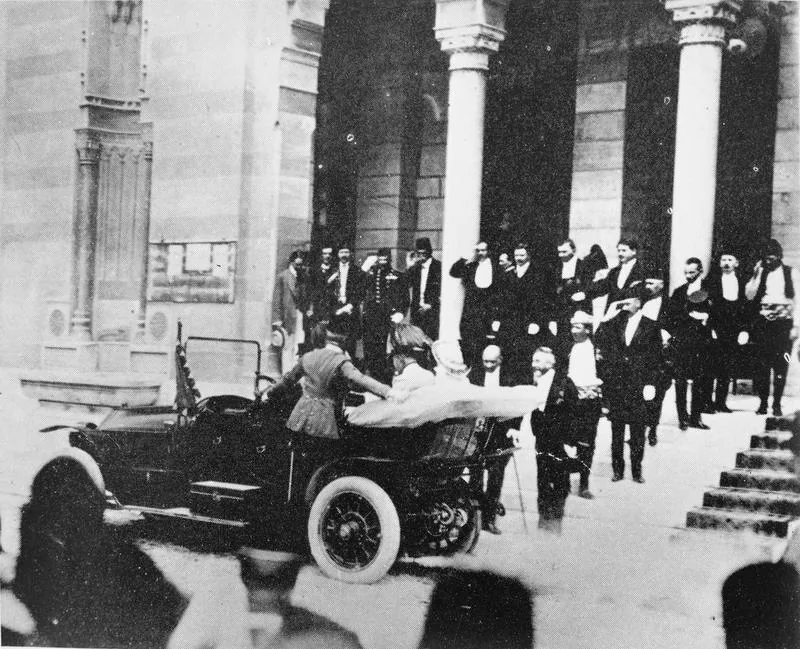
- Present the document (nature, date, place).
- Describe the scene: the car, the people, the buildings.
- What does the photograph tell you about the security around the Archduke?
- Why is it important that the visit took place on June 28, a date with a meaning for Serbs?
- What happened a few minutes later, and what was the consequence?
Hint: June 28 is the anniversary of the battle of Kosovo (1389), a date of national memory for Serbs.
Exercise 11 : A trench on the Somme
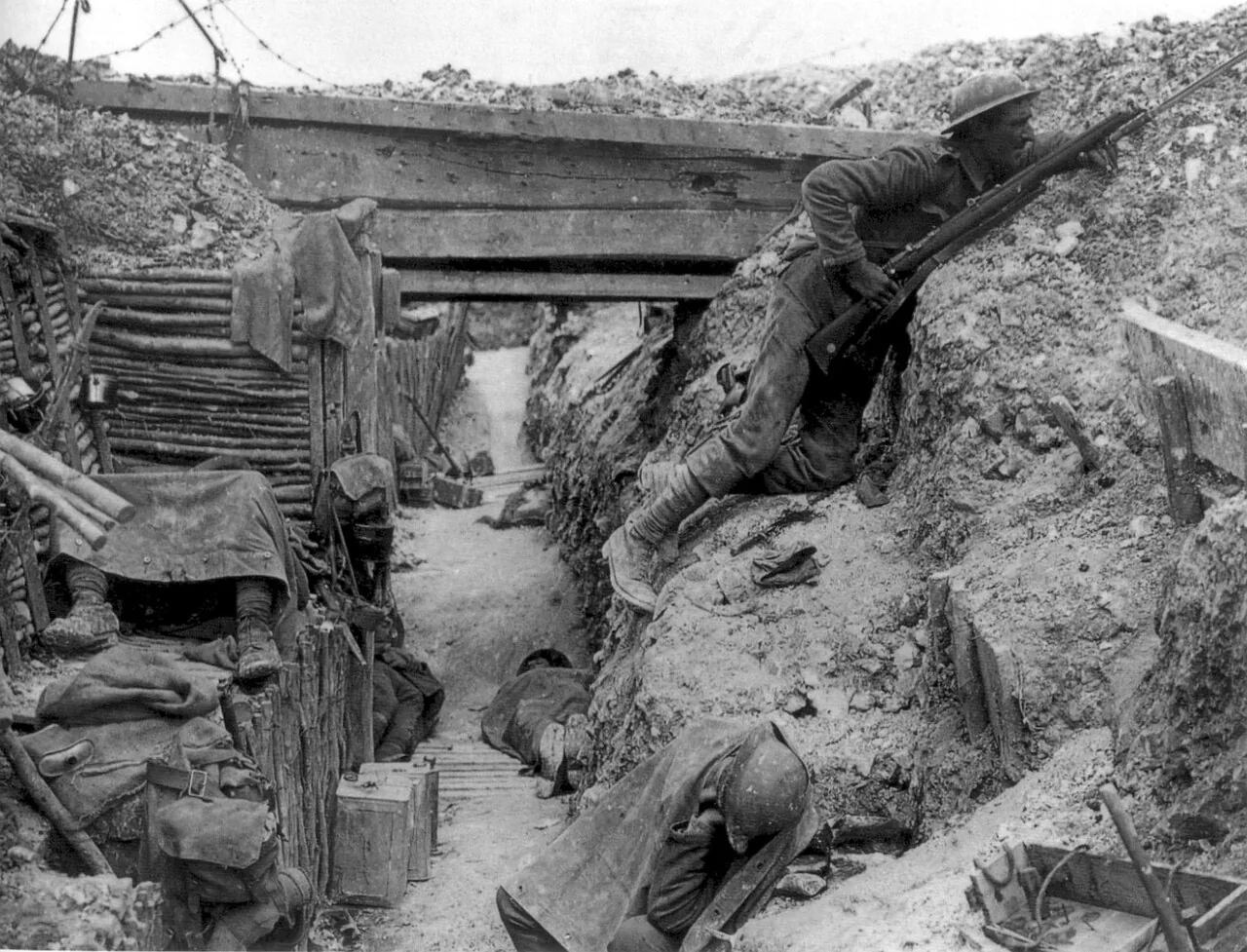
- Present the document (nature, subject, date).
- Describe the trench: its shape, the materials, the soldiers, and their positions.
- What details show the danger and discomfort of life in the trenches?
- Why did attacking across “no man’s land” usually cost so many lives?
- What are the limits of a photograph like this as evidence?
Exercise 12 : A poster of hatred
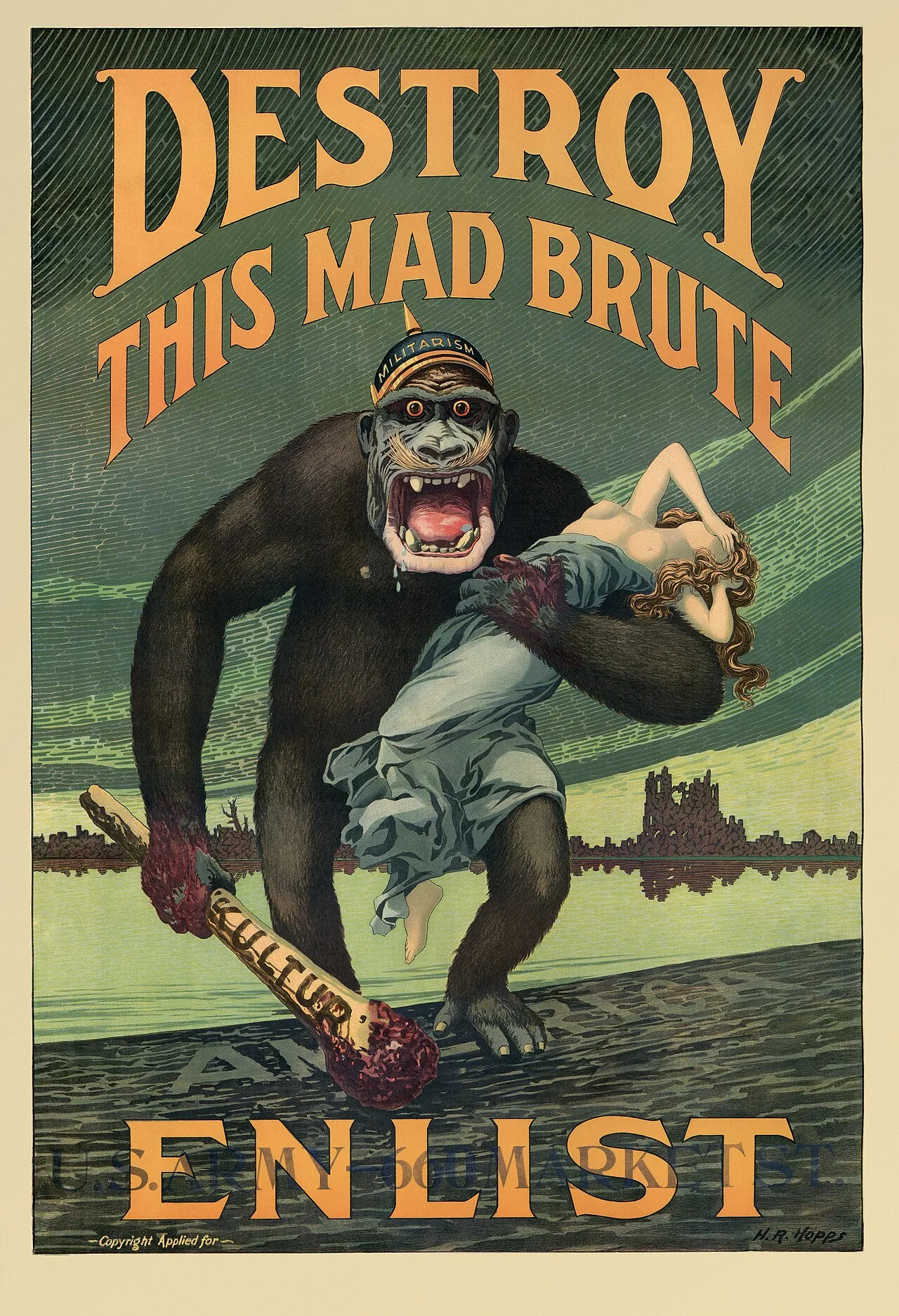
- Present the document (nature, artist, date, country).
- Describe the main figure and the objects. What does the helmet and the word “Kultur” on the club refer to?
- What emotion does the poster try to create? Which details help?
- What does the word “Enlist” at the bottom tell you about the purpose?
- Why is a poster like this better evidence of the views of a government than of the actions of the enemy?
Hint: think of the German invasion of Belgium and the sinking of the Lusitania.
Exercise 13 : Uncle Sam wants you
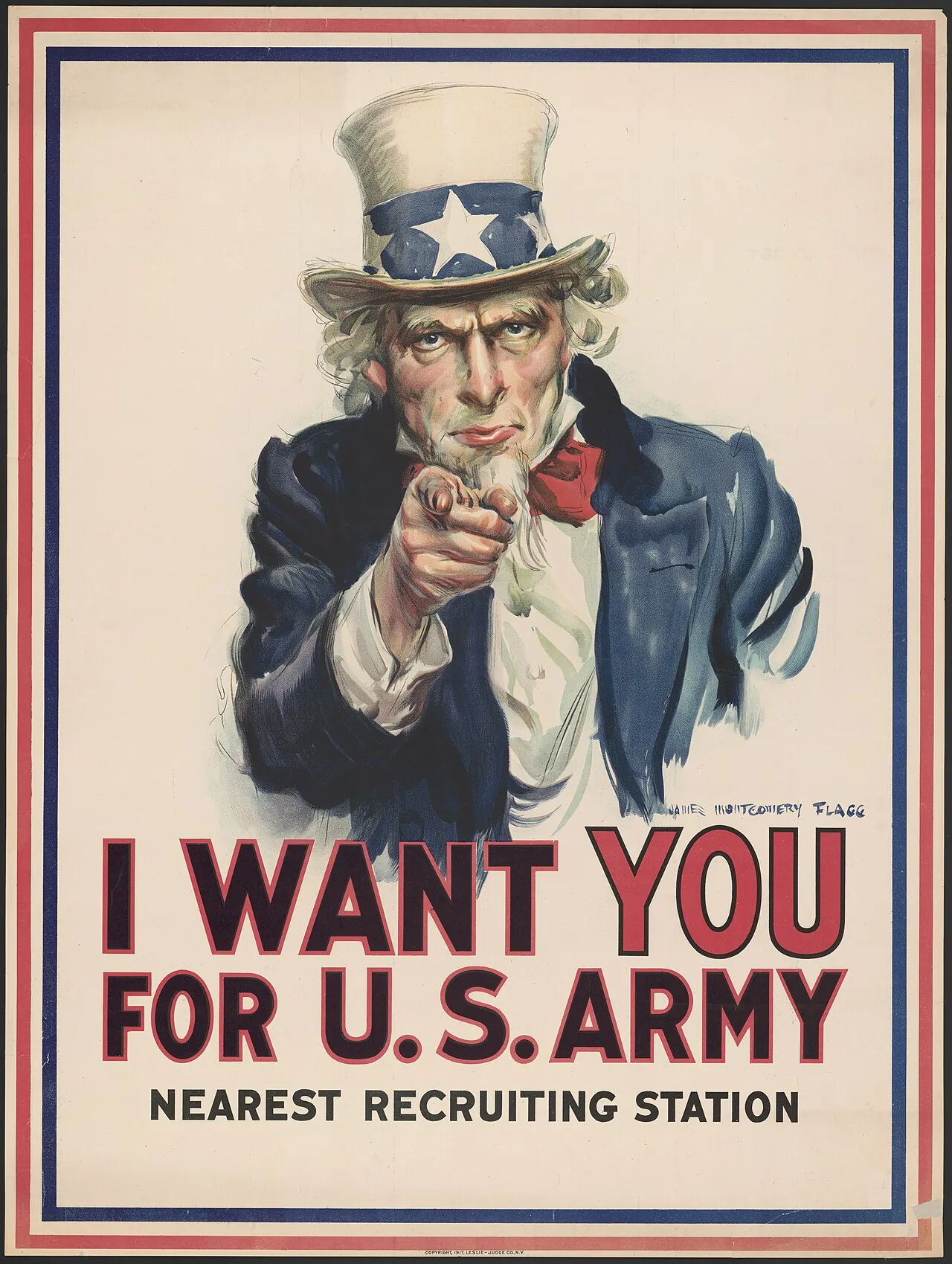
- Present the document (nature, artist, date, country).
- Describe the figure: his clothes, his face, his gesture.
- How does the artist make you feel that the figure is talking to you?
- Why was this poster so widely used? Consider how many soldiers the United States needed after it entered the war.
- Compare this poster with the Hopps poster (“Destroy this mad brute”): which one appeals to emotion by fear and which by duty?
Exercise 14 : Gassed
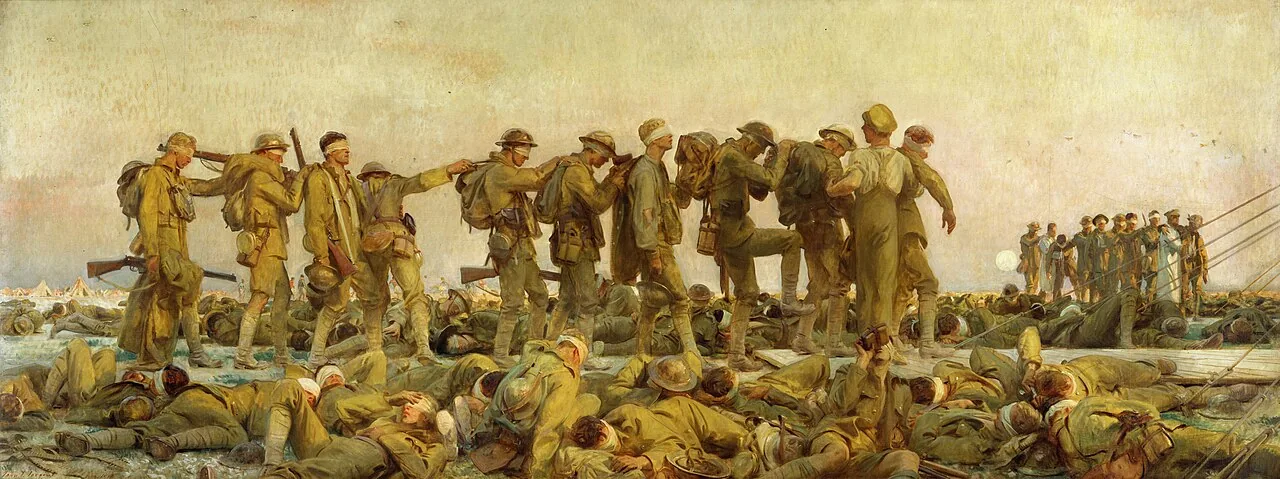
- Present the document (nature, artist, date, place of conservation).
- Describe the line of soldiers and the men lying on the ground.
- What has happened to the soldiers in the line? How do they move?
- Compare this painting with Owen’s poem (Document 2). What do both show about gas?
- Why can a painting made in 1918-1919 be good evidence of what the artist saw but not of the whole war?
Hint: note how the men hold the shoulder of the man in front.
Exercise 15 : The signing in the Hall of Mirrors
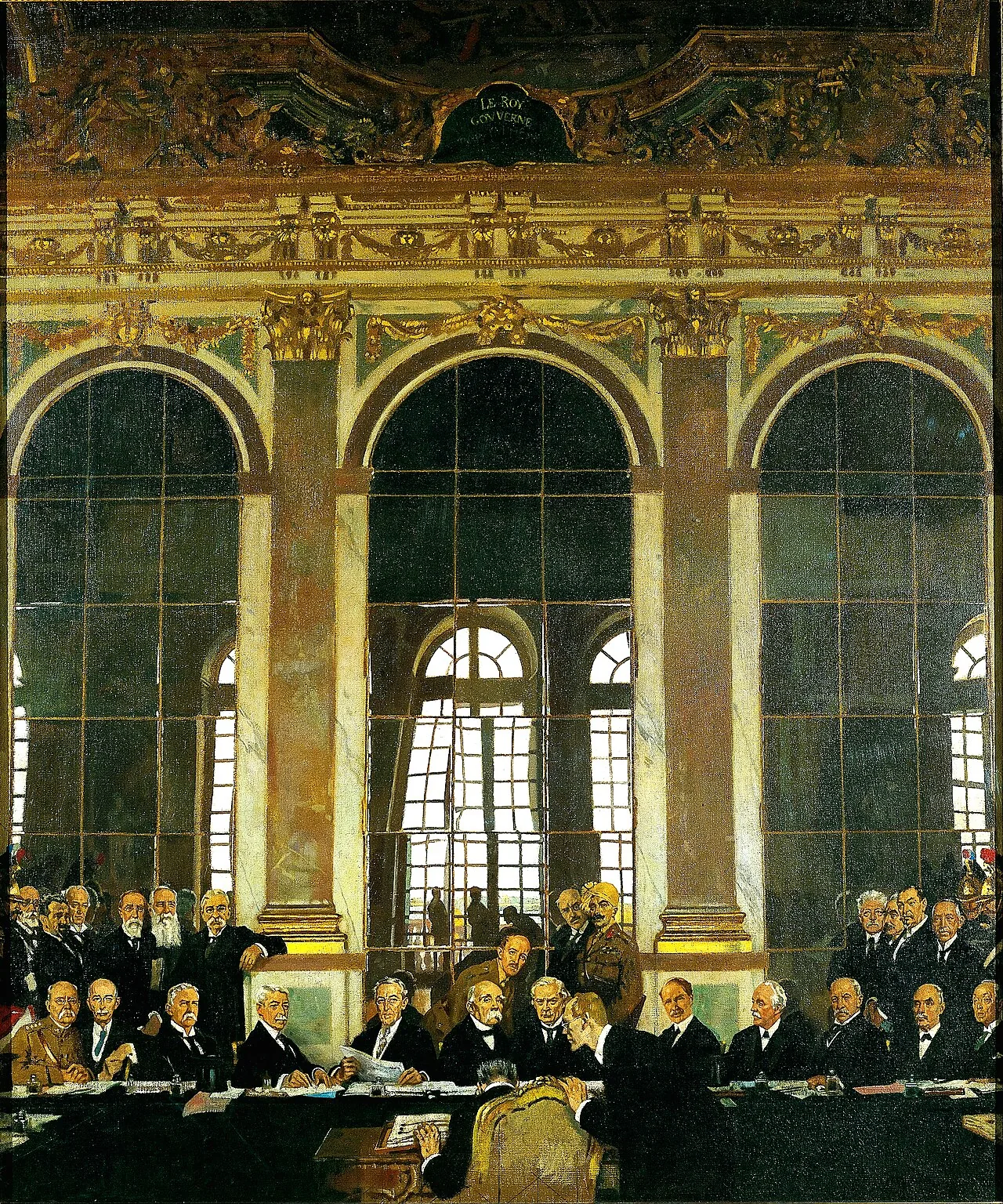
- Present the document (nature, artist, event, date).
- Describe the room: its decoration, the people, and the table.
- Why is the choice of the Hall of Mirrors significant? Compare it with 1871 (Document 1 of the previous chapter).
- What does the painting show about the way the treaty was made?
- Why is a painting of this kind not the same as a photograph as evidence?
Exercise 16 : The cost in numbers
The table gives estimates of military deaths from all causes for the main belligerents. Figures vary among sources, so ranges are shown. Source: reference article World War I casualties, which cites M. Gilbert, the Commonwealth War Graves Commission, and the British War Office.
| Country (1914-1918) | Total military deaths (all causes) |
|---|---|
| Russian Empire | 1,700,000 to 2,254,369 |
| German Empire | 2,037,000 |
| France | 1,357,000 to 1,397,800 |
| Austria-Hungary | 1,200,000 to 1,494,200 |
| United Kingdom (with colonies) | 887,858 (744,000 in combat) |
| Italy | 460,000 to 709,000 |
| Ottoman Empire | 325,000 to 771,844 |
| United States | 116,708 (53,402 in combat) |
- Which country had the highest single figure of military deaths? Which country has the highest upper limit?
- How many more soldiers died in the German Empire than in France, using the lower and the upper figure for France?
- For the United States, how many military deaths were not in combat? What percentage of the total is that (to the nearest percent)?
- Why do the sources give ranges instead of one number?
Hint: for question 3, subtract 53,402 from 116,708, then divide by 116,708.
Exercise 17 : July 1914 on the map
Use the map of Europe in 1914. Colors show the alliance blocs and the numbered dots mark nine cities.
- Name the cities numbered 1 to 9.
- Which city is the place of the assassination, and which is the capital of the state that Austria-Hungary blamed?
- Which two capitals belonged to the Central Powers in August 1914? Which one joined them in the autumn of 1914?
- Which city is the capital of the country whose neutrality was violated on August 4, and which capital then declared war?
- Which blue-colored country had the largest land area, and which city is its capital shown on the map?
Hint: the numbers are listed in the legend order from the lesson: Sarajevo is in Bosnia, east of the Adriatic.
Exercise 18 : The Western Front
Use the map of the Western Front.
- Which countries does the front cross? In which country did the German army march before attacking France?
- In which direction does the red arrow point, and what was its goal?
- Name two places on the map that were the sites of battles in 1916.
- The front ends near Switzerland. Why was it difficult for either side to go around the end of the line?
- Explain why the line moved so little between 1915 and 1917.
Hint: look at the two ends of the front, the North Sea and the Swiss border.
Exercise 19 : Put the events in order
Put these events in chronological order and give the date of each.
- The Zimmermann telegram is sent
- The armistice takes effect
- The battle of the Marne
- The Lusitania is sunk
- Austria-Hungary declares war on Serbia
- The Treaty of Versailles is signed
- The battle of the Somme begins
- The Treaty of Brest-Litovsk is signed
- The United States declares war on Germany
Exercise 20 : Durations
Use the dates in the lesson to calculate each period.
- From the assassination (June 28, 1914) to the Austrian declaration of war (July 28, 1914).
- From the Austrian declaration of war (July 1914) to the armistice (November 1918): give the answer in years and months.
- From the American declaration of war (April 6, 1917) to the armistice (November 11, 1918): give the answer in years and months, approximately.
- From the assassination to the signing of the Treaty of Versailles.
- The fighting at Verdun lasted from February to December 1916. About how many months was this?
Exercise 21 : Guided research: the Armenian genocide
Investigate what happened to the Armenians of the Ottoman Empire in 1915. Use at least two reliable sites, such as the United States Holocaust Memorial Museum, the Library of Congress, a university, or an encyclopedia. Suggested keywords: Armenian genocide 1915 Holocaust Museum, Henry Morgenthau Ottoman Armenians, April 24 1915 Constantinople Armenian intellectuals.
- What happened on April 24, 1915, in Constantinople?
- What was the policy of the Ottoman government toward the Armenian population, and where were they sent?
- What range of estimates do historians give for the number of deaths?
- What did foreign diplomats, such as the American ambassador Henry Morgenthau, report?
- List the sources you used and say why you trust them.
Hint: look for the words “deportation” and “Syrian desert,” and note which sources give estimates with ranges.
Exercise 22 : CER paragraph: the treaty and the peace
Write a Claim, Evidence, Reasoning paragraph that answers: Did the Treaty of Versailles make a lasting peace likely?
- Claim: state your position.
- Evidence: use at least two details from the lesson or from Documents 5 and 6 of the exercises (the Fourteen Points and Article 231).
- Reasoning: explain how the evidence supports your claim.
Hint: think about who negotiated, who was blamed, and who joined the League.
Exercise 23 : SAQ: causes and course
Answer in complete sentences.
- Identify one long-term cause of World War I and explain how it increased the danger of war.
- Explain one reason why the war on the Western Front became a stalemate.
- Explain one reason why the United States entered the war in 1917.
Exercise 24 : True or false? Justify
Say whether each statement is true or false and justify your answer in one sentence.
- Gavrilo Princip assassinated Archduke Franz Ferdinand in Sarajevo in 1914.
- Italy fought for the Central Powers from the beginning of the war.
- Germany invaded Belgium in 1914 as part of the Schlieffen Plan.
- The Zimmermann telegram proposed an alliance between Germany and Mexico.
- The United States joined the League of Nations.
- The armistice of 1918 took effect on November 11.
Exercise 25 : Stimulus-based multiple choice
Use the Zimmermann telegram (Document 1 of these exercises) to answer the questions. Choose the best answer.
We intend to begin on the first of February unrestricted submarine warfare. We shall endeavor in spite of this to keep the United States of America neutral. In the event of this not succeeding, we make Mexico a proposal of alliance on the following basis: make war together, make peace together, generous financial support and an understanding on our part that Mexico is to reconquer the lost territory in Texas, New Mexico, and Arizona. […] Please call the President’s attention to the fact that the ruthless employment of our submarines now offers the prospect of compelling England in a few months to make peace.
Arthur Zimmermann, German Foreign Secretary, telegram to the German ambassador in Washington for transmission to Mexico, January 16, 1917, as decoded and translated by British intelligence (Wikisource).
*endeavor: try.
- Which factor most directly led Germany to send this telegram? (a) the success of the Schlieffen Plan; (b) the decision to resume unrestricted submarine warfare; (c) the Russian Revolution; (d) the Treaty of Brest-Litovsk.
- The message was most likely written to (a) win a Mexican alliance if the United States entered the war; (b) end the war with Britain; (c) persuade Japan to attack Russia; (d) protect German colonies.
- The publication of the telegram in 1917 most directly (a) ended the submarine campaign; (b) helped move American opinion toward war; (c) led to a Mexican invasion of Texas; (d) caused Britain to leave the war.


Quick review: flashcards
Tap a card to see the answer.