


This worksheet on The Interwar Years and Totalitarianism belongs to the World History Grades 9-10 course. Its questions use primary sources, maps and timelines, and they move from basic recall to short writing tasks. Before you start, review the lesson; afterward, try the true or false quiz.
Exercise 1 : Vocabulary of the interwar years
Match each term with its meaning, then use three of the terms in sentences about 1919-1939.
- hyperinflation
- Great Depression
- New Deal
- totalitarianism
- fascism
- Five-Year Plan
- collectivization
- Enabling Act
(a) the combination of programs of relief, recovery, and reform started by Franklin Roosevelt; (b) the law of March 1933 that let the German cabinet make laws without the Reichstag; (c) the forced merging of peasant farms into large state-controlled farms in the USSR; (d) a movement that puts the nation and the state above the individual, glorifies war and a leader, and rejects democracy; (e) prices rising so fast that money loses almost all its value; (f) the worldwide economic crisis that began in 1929; (g) a government that tries to control every part of public and private life; (h) Stalin’s plan, from 1928, for fast development of heavy industry.
Hint: look at the definition boxes in the lesson.
Exercise 2 : Keynes warns of vengeance
Document 1 – John Maynard Keynes (1919)
If we aim deliberately at the impoverishment of Central Europe, vengeance, I dare predict, will not limp. Nothing can then delay for very long that final civil war between the forces of Reaction and the despairing convulsions of Revolution, before which the horrors of the late German war will fade into nothing, and which will destroy, whoever is victor, the civilization and the progress of our generation.
John Maynard Keynes, The Economic Consequences of the Peace (1919), chapter 7 (Project Gutenberg).
*vengeance: revenge. *limp: lag behind; here, be slow to come.
- Present the document (nature, author, date, context).
- What does Keynes say will happen if the Allies aim “deliberately at the impoverishment of Central Europe”?
- Which two forces does he expect to clash?
- Why did the opinion of an economist who had been at the peace conference carry weight?
- What are the limits of this source? Did Keynes know what would happen?
Hint: Keynes is making a prediction, not describing events.
Exercise 3 : A Carthaginian peace?
Document 2 – John Maynard Keynes on the Carthaginian peace (1919)
My purpose in this book is to show that the Carthaginian Peace is not practically right or possible. Although the school of thought from which it springs is aware of the economic factor, it overlooks, nevertheless, the deeper economic tendencies which are to govern the future. The clock cannot be set back. […] You cannot restore Central Europe to 1870 without setting up such strains in the European structure and letting loose such human and spiritual forces as, pushing beyond frontiers and races, will overwhelm not only you and your “guarantees,” but your institutions, and the existing order of your Society.
John Maynard Keynes, The Economic Consequences of the Peace (1919), chapter 3 (Project Gutenberg).
*Carthaginian peace: a peace that destroys the defeated enemy, as Rome destroyed Carthage. *guarantees: security measures demanded by France. *legerdemain: trickery.
- Present the document (nature, author, date).
- What does Keynes claim about the “Carthaginian Peace”? Quote his words.
- What does he say that the school of thought behind this peace overlooks?
- What evidence does he offer for the claim that Europe cannot be restored to 1870?
- Does Keynes provide proof that his predictions were right? Explain.
Exercise 4 : A president on fear and action
Document 3 – Franklin D. Roosevelt, First Inaugural Address (1933)
So, first of all, let me assert my firm belief that the only thing we have to fear is fear itself–nameless, unreasoning, unjustified terror which paralyzes needed efforts to convert retreat into advance. […] This Nation asks for action, and action now. Our greatest primary task is to put people to work. This is no unsolvable problem if we face it wisely and courageously.
Franklin D. Roosevelt, First Inaugural Address, March 4, 1933 (Avalon Project, Yale Law School).
*paralyzes: makes unable to move. *unjustified: without good reason.
- Present the document (nature, speaker, date, context).
- What does Roosevelt say is the main danger?
- What does he say the government should do about unemployment? Quote the sentence.
- How does this speech differ from Hoover’s view that the government should not act directly?
- Explain why the speech helped to calm the country, although it did not itself end the Depression.
Exercise 5 : Stalin and the tempo
Document 4 – Joseph Stalin, speech to industrial managers (1931)
It is sometimes asked whether it is not possible to slow down the tempo somewhat, to put a check on the movement. No, comrades, it is not possible! The tempo must not be reduced! On the contrary, we must increase it as much as is within our powers and possibilities. This is dictated to us by our obligations to the workers and peasants of the U.S.S.R. This is dictated to us by our obligations to the working class of the whole world. To slacken the tempo would mean falling behind. And those who fall behind get beaten. But we do not want to be beaten. No, we refuse to be beaten! […] We are fifty or a hundred years behind the advanced countries. We must make good this distance in ten years. Either we do it, or we shall go under.
Joseph Stalin, “The Tasks of Business Executives,” speech to the First All-Union Conference of Leading Personnel of Socialist Industry, February 4, 1931 (Marxists Internet Archive).
*tempo: speed. *slacken: slow down. *go under: be destroyed.
- Present the document (nature, author, date, audience).
- What does Stalin say about slowing down the tempo? Quote one sentence.
- What reason does he give for speed, in the second part of the passage?
- What does the sentence “those who fall behind get beaten” suggest about how he saw the world?
- What groups were forced to pay the cost of rapid industrialization (use the lesson)?
Hint: think about collectivization and the labor of peasants and workers.
Exercise 6 : Mussolini defines fascism
Document 5 – Mussolini, The Doctrine of Fascism (1932)
Fascism, the more it considers and observes the future and the development of humanity quite apart from political considerations of the moment, believes neither in the possibility nor the utility of perpetual peace. It thus repudiates the doctrine of Pacifism — born of a renunciation of the struggle and an act of cowardice in the face of sacrifice. War alone brings up to its highest tension all human energy and puts the stamp of nobility upon the peoples who have courage to meet it. […] Fascism conceives of the State as an absolute, in comparison with which all individuals or groups are relative, only to be conceived of in their relation to the State.
Benito Mussolini (with Giovanni Gentile), The Doctrine of Fascism, entry in the Enciclopedia Italiana, 1932 (English translation in the Internet Modern History Sourcebook, Fordham University).
*pacifism: opposition to war. *relative: dependent on something else.
- Present the document (nature, author, date, purpose).
- What does Mussolini say about perpetual peace and pacifism?
- How does he describe the relationship between the State and individuals?
- Why is it important to remember that this is the regime’s own explanation of its ideas?
- Which features of totalitarianism mentioned in the lesson can you find in this text?
Exercise 7 : How a law ended democracy
Document 6 – The Enabling Act (March 1933)
Article 1. National laws can be enacted by the Reich Cabinet as well as in accordance with the procedure established in the Constitution. This also applies to the laws referred to in Article 85, Paragraph 2, and in Article 87 of the Constitution. […] Article 2. The national laws enacted by the Reich Cabinet may deviate from the Constitution as long as they do not affect the institution of the Reichstag and the Reichsrat. The powers of the President remain unaffected. […] Article 5. This law becomes effective on the day of its publication. It becomes invalid on April 1, 1937; it also becomes invalid if the present Reich Cabinet is replaced by another.
Law to Remove the Distress of the People and the State (Enabling Act), March 24, 1933, Articles 1, 2, and 5 (English translation in German History in Documents and Images, German Historical Institute Washington).
*Reich Cabinet: the government headed by the chancellor. *deviate: depart from.
- Present the document (nature, date, context).
- Who receives the power to make laws under Article 1?
- What does Article 2 allow the cabinet to do with the constitution? What two things are protected?
- When does the law expire? What could end it earlier?
- Why can a law that never mentions dictatorship still establish one? Use the vote of 444 to 94 and the context of the Reichstag fire.
Hint: remember how the Reichstag fire decree and the arrests of deputies affected the vote.
Exercise 8 : Two readings of the peace
Document 1A – The Treaty of Versailles, Article 231 (1919)
The Allied and Associated Governments affirm and Germany accepts the responsibility of Germany and her allies for causing all the loss and damage to which the Allied and Associated Governments and their nationals have been subjected as a consequence of the war imposed upon them by the aggression of Germany and her allies.
Treaty of Versailles, June 28, 1919, Part VIII (Reparation), Article 231 (Avalon Project, Yale Law School).
Document 1B – Keynes on the peace (1919)
My purpose in this book is to show that the Carthaginian Peace is not practically right or possible. Although the school of thought from which it springs is aware of the economic factor, it overlooks, nevertheless, the deeper economic tendencies which are to govern the future. The clock cannot be set back. […] You cannot restore Central Europe to 1870 without setting up such strains in the European structure and letting loose such human and spiritual forces as, pushing beyond frontiers and races, will overwhelm not only you and your “guarantees,” but your institutions, and the existing order of your Society.
John Maynard Keynes, The Economic Consequences of the Peace (1919), chapter 3 (Project Gutenberg).
*Carthaginian peace: a peace that destroys the defeated enemy.
- Present each document in one sentence.
- What does 1A require Germany to accept?
- What does 1B argue about the consequences of a harsh peace?
- Who might have agreed with 1A and who with 1B in 1919?
- Write two sentences evaluating which document is better evidence of the aims of the victors and which of a critic’s fears.
Exercise 9 : What the State asks of its people
Document 2A – Stalin (1931)
It is sometimes asked whether it is not possible to slow down the tempo somewhat, to put a check on the movement. No, comrades, it is not possible! The tempo must not be reduced! On the contrary, we must increase it as much as is within our powers and possibilities. This is dictated to us by our obligations to the workers and peasants of the U.S.S.R. This is dictated to us by our obligations to the working class of the whole world. To slacken the tempo would mean falling behind. And those who fall behind get beaten. But we do not want to be beaten. No, we refuse to be beaten! […] We are fifty or a hundred years behind the advanced countries. We must make good this distance in ten years. Either we do it, or we shall go under.
Joseph Stalin, “The Tasks of Business Executives,” speech to the First All-Union Conference of Leading Personnel of Socialist Industry, February 4, 1931 (Marxists Internet Archive).
Document 2B – Mussolini (1932)
Fascism, the more it considers and observes the future and the development of humanity quite apart from political considerations of the moment, believes neither in the possibility nor the utility of perpetual peace. It thus repudiates the doctrine of Pacifism — born of a renunciation of the struggle and an act of cowardice in the face of sacrifice. War alone brings up to its highest tension all human energy and puts the stamp of nobility upon the peoples who have courage to meet it. […] Fascism conceives of the State as an absolute, in comparison with which all individuals or groups are relative, only to be conceived of in their relation to the State.
Benito Mussolini (with Giovanni Gentile), The Doctrine of Fascism, entry in the Enciclopedia Italiana, 1932 (English translation in the Internet Modern History Sourcebook, Fordham University).
- Present each document in one sentence (author, date, kind of document).
- What does each leader ask of the citizens? Quote from each.
- Which document speaks more of the nation and war, and which of economic development?
- Find one similarity in the way the two leaders see the individual and the State.
- The two regimes were enemies. Why can a historian still call both totalitarian?
Exercise 10 : Wallpaper made of money
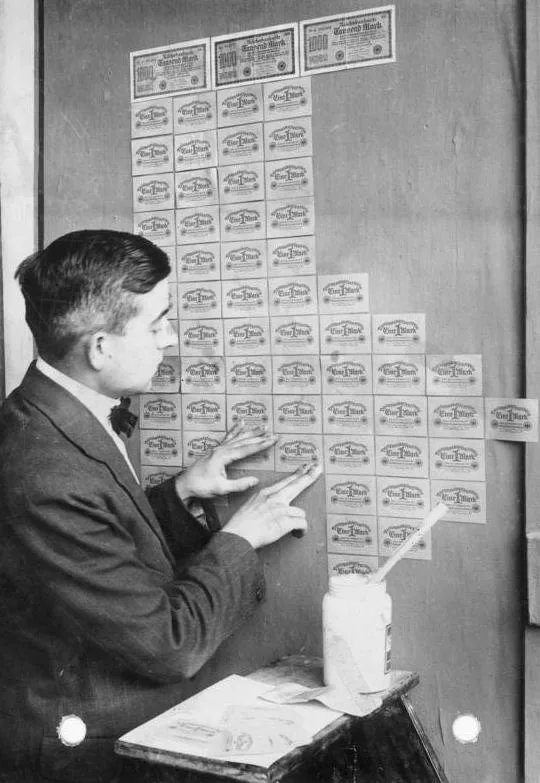
- Present the document (nature, photographer, date, place).
- Describe the scene: the man, the wall, the banknotes.
- What does the scene suggest about the value of German money in 1923?
- What caused the hyperinflation? Use the lesson (reparations, the Ruhr, printing money).
- How might a photograph like this be used by a politician who opposed the republic?
Exercise 11 : The crowd on Wall Street
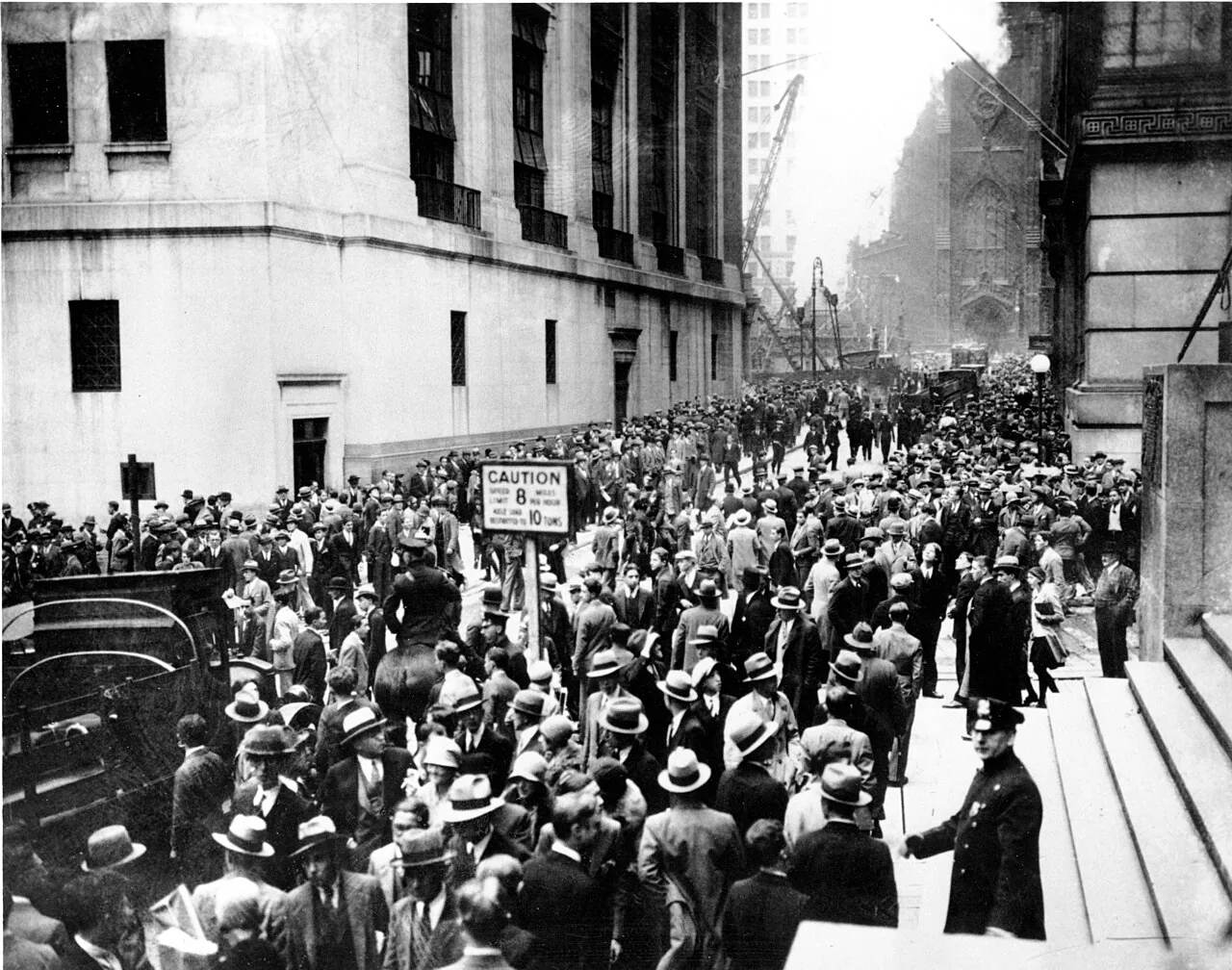
- Present the document (nature, place, date).
- Describe the crowd and the buildings. What does the policeman do?
- What emotions does the photograph suggest?
- What does it not show about the causes of the crash?
- Why did the crash lead to a worldwide depression? Use the lesson.
Exercise 12 : Migrant Mother
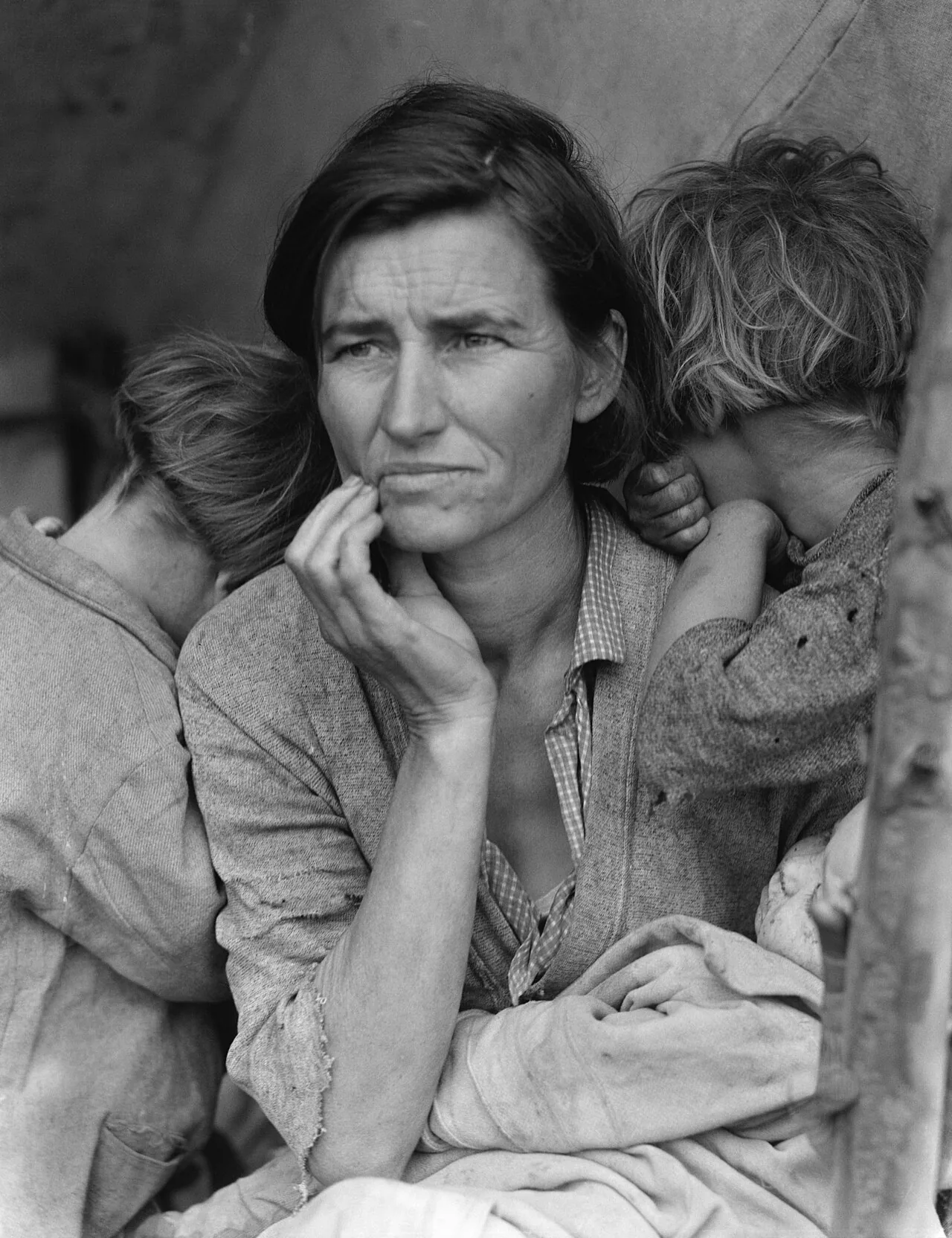
- Present the document (nature, photographer, date, place, agency).
- Describe the woman’s face and posture and the children around her.
- What does the photograph suggest about life in the Depression?
- Why does it matter that the photographer worked for a government agency?
- What other sources would a historian combine with this photograph to understand the experience of migrant workers?
Exercise 13 : A line for soup
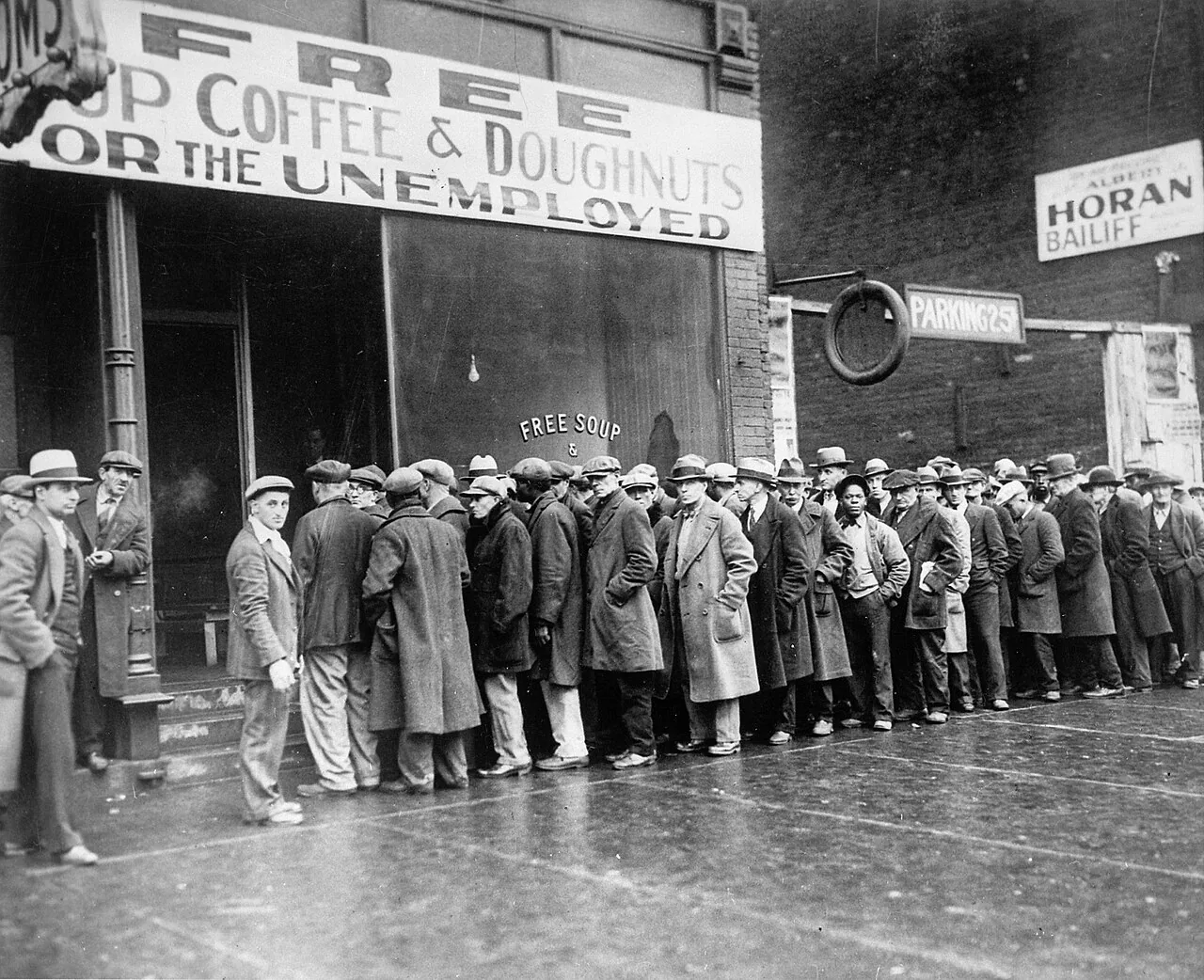
- Present the document (nature, place, date, source).
- Describe the men in the line and the sign above the shop.
- What does the photograph show about unemployment in the winter of 1931?
- Who provided help in the early Depression: the government, or private charity? How did this change under Roosevelt?
- Why are photographs of lines for food common in books about the Depression?
Exercise 14 : A Soviet poster
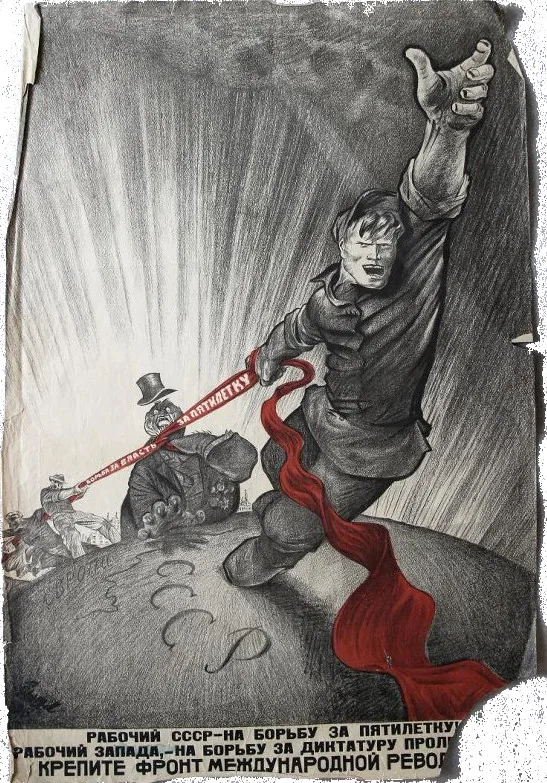
- Present the document (nature, artist, date, country).
- Describe the figures: the worker, the globe, the man in the top hat.
- What do these figures symbolize?
- What does the poster say about the Five-Year Plan: is it presented as a plan or as a struggle?
- Why were posters useful in a country where many people could not read well?
Exercise 15 : The Reichstag burns
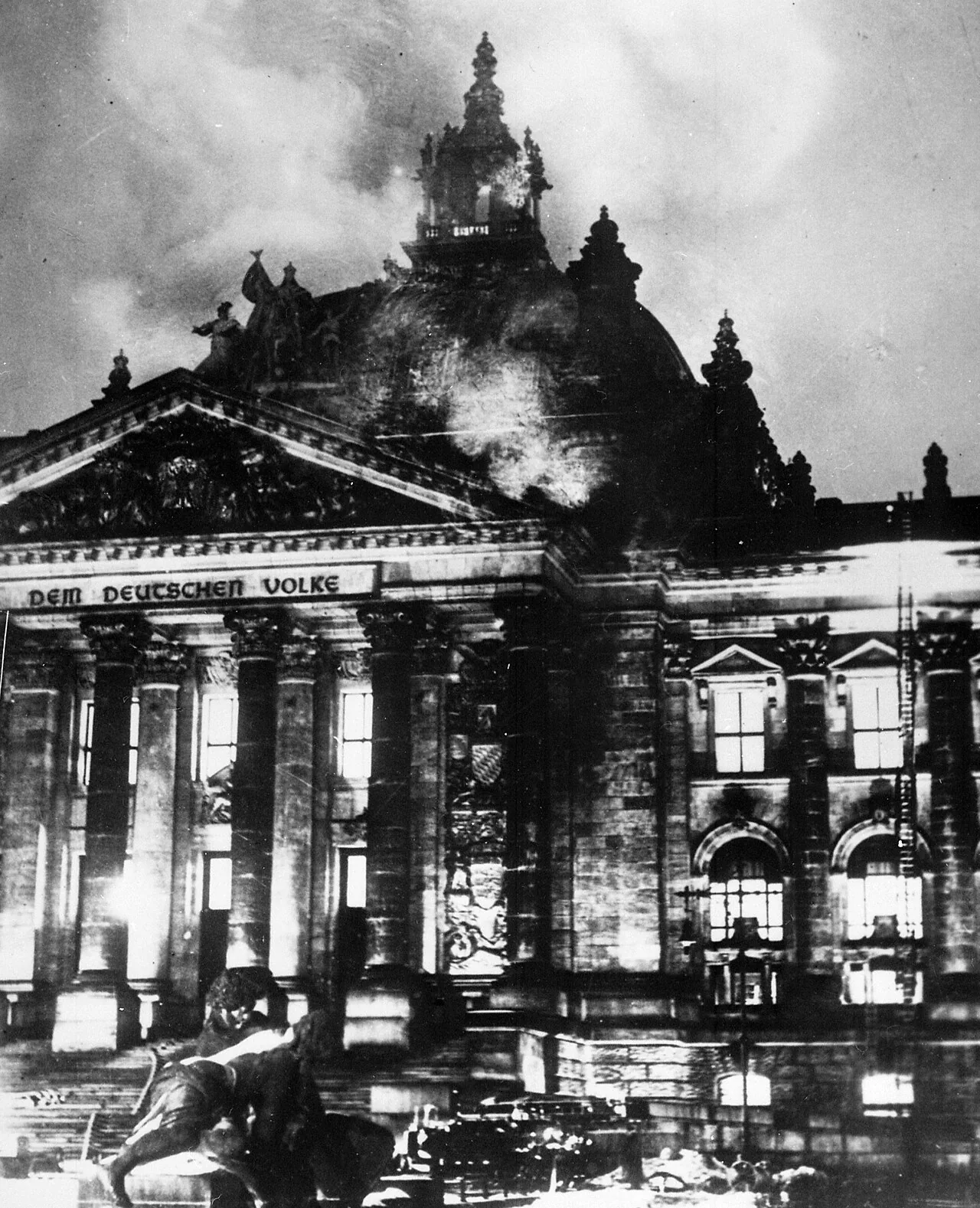
- Present the document (nature, place, date).
- Describe the building and the flames. Read the inscription on the front.
- What did the Nazi government claim had caused the fire?
- What decree followed the fire and what rights did it suspend?
- Why do historians disagree about who started the fire, yet agree that the Nazis used it?
Exercise 16 : A handshake at Potsdam
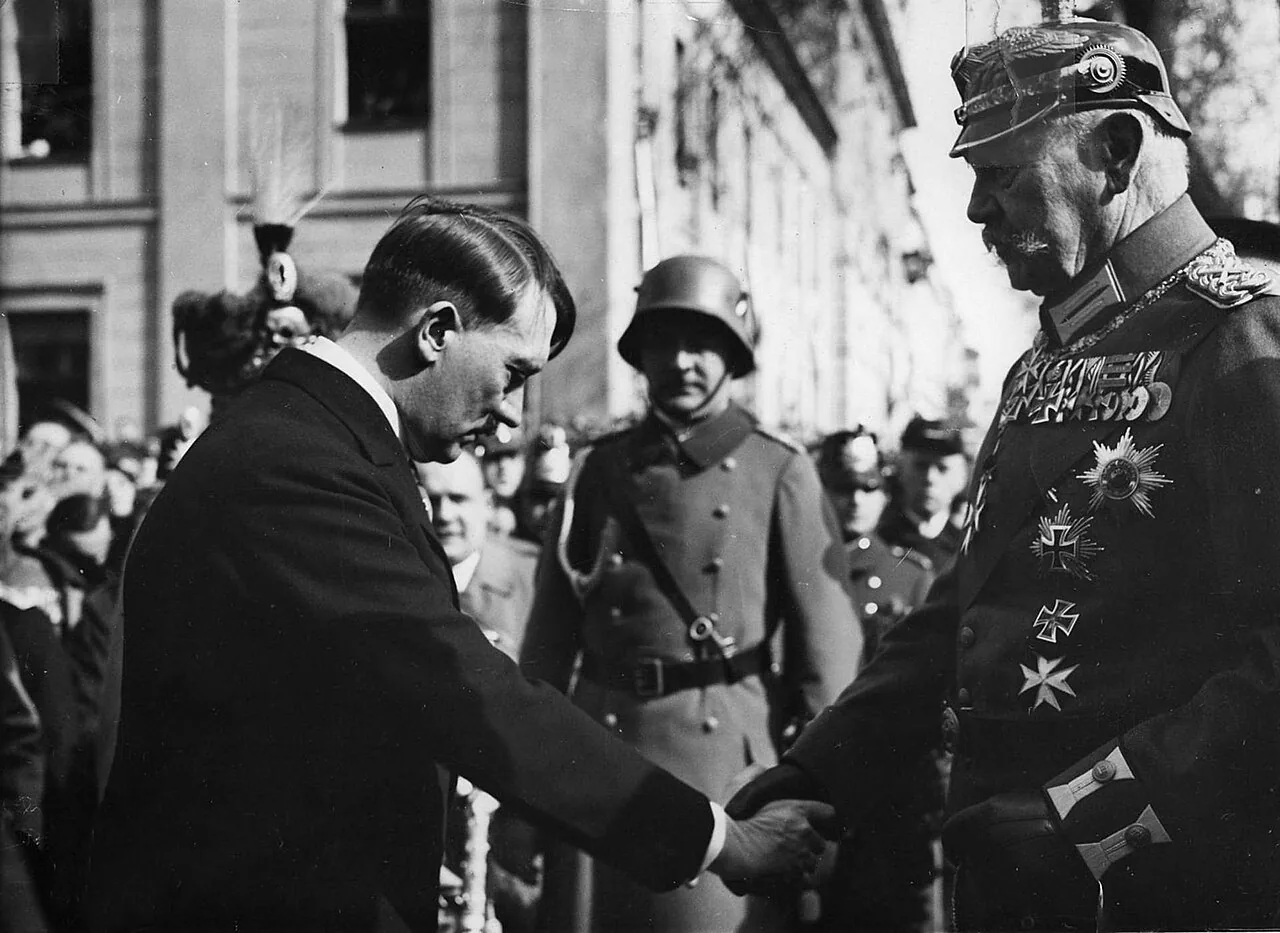
- Present the document (nature, event, date, source).
- Describe the two men: their clothes and their gestures.
- What message did the handshake send to the German public?
- Why was Hindenburg’s presence important for Hitler in 1933?
- What happened two days after this photograph was taken?
Exercise 17 : The Depression in numbers
The table shows the change in four economic indicators between 1929 and 1932. Source: J. Blum, R. Cameron, and T. G. Barnes, The European World: A History, 2nd ed. (1970), as cited in the reference article Great Depression.
| Change 1929-1932 | United States | United Kingdom | France | Germany |
|---|---|---|---|---|
| Industrial production | -46% | -23% | -24% | -41% |
| Wholesale prices | -32% | -33% | -34% | -29% |
| Foreign trade | -70% | -60% | -54% | -61% |
| Unemployment | +607% | +129% | +214% | +232% |
- Which country suffered the largest fall in industrial production, and which the smallest?
- The fall in foreign trade was larger than the fall in production in each country. What does this suggest about the role of trade in the Depression?
- Unemployment in the United States rose by 607 percent. If 1929 unemployment had been 3.2 percent of the workforce, estimate the rate in 1932 (3.2 multiplied by 7.07).
- Which countries had the most similar figures? What might explain it?
- What are the limits of a table that gives only percentages of change?
Hint: an increase of 607 percent means that the new figure is the old one multiplied by 7.07.
Exercise 18 : The rise of the Nazi vote
The table gives the results of the Nazi Party in three Reichstag elections. Source: reference articles on the German federal elections of 1928, 1930, and July 1932, which use official results.
| Reichstag election | Nazi share of the vote | Nazi seats |
|---|---|---|
| May 1928 | 2.6% | 12 |
| September 1930 | 18.3% | 107 |
| July 1932 | 37.3% | 230 |
- By how many percentage points did the Nazi vote rise between 1928 and 1930, and between 1930 and July 1932?
- How many times larger was the Nazi delegation in July 1932 than in 1928? (divide 230 by 12, rounded to the nearest whole number)
- What happened in the world economy between 1928 and 1932? How may that help to explain the numbers?
- The Nazis never won a majority. What does this tell you about how Hitler became chancellor in January 1933?
- Why is it wrong to say that the German people simply “voted for dictatorship”? Use the table and the lesson.
Exercise 19 : Dictatorships and democracies in 1936
Use the map of Europe in 1936 and its legend.
- Name the three totalitarian states and give the color of each.
- Name the capitals marked on the map and say in which country each lies.
- Which two democratic capitals marked on the map are in Western Europe?
- Which large European country was in a civil war in 1936, and what color is it?
- The map shows dictatorships and authoritarian states in much of central, eastern, and southern Europe. What does this suggest about the fate of democracy in the interwar years?
Hint: the legend is in the lower left of the map.
Exercise 20 : Industrial centers of the USSR
Use the map of the Soviet Union in the 1930s. The railway is the Trans-Siberian.
- Name the places numbered 1 to 10: 1 is the capital; 2 is the city called Petrograd until 1924; 6 is a steel city in the Urals.
- Which place is near the new Dnieper dam, and which is a center of oil on the Caspian Sea?
- Why was the Urals region a good place for new steel cities? Think about distance from the western border.
- In what direction does the Trans-Siberian Railway run? Why was it important for the Five-Year Plan?
- Which part of the map includes Ukraine, where the famine of 1932-1933 was severe?
Hint: the Dnieper flows through Ukraine toward the Black Sea.
Exercise 21 : Put the events in order
Put these events in chronological order and give the date of each.
- The Wall Street crash
- The Reichstag fire
- The March on Rome
- The Enabling Act is passed
- The Ruhr is occupied and the hyperinflation begins
- Hitler is appointed chancellor
- Mussolini’s forces invade Ethiopia
- The first Five-Year Plan begins
- The Nuremberg Laws
Exercise 22 : Durations
Use the dates in the lesson to calculate each period.
- From the Treaty of Versailles (1919) to Hitler’s appointment as chancellor (1933).
- From the Wall Street crash (October 1929) to Hitler’s appointment (January 1933): give years and months.
- From the Reichstag fire (February 27, 1933) to the Enabling Act (March 23, 1933): how many days?
- How many years did the Enabling Act run before its first expiry date of April 1, 1937 (from March 24, 1933)?
- From the formation of the USSR (1922) to the Great Purge (1936): how many years?
Exercise 23 : Guided research: the New Deal
Choose two New Deal programs and find out what they did. Use at least two reliable sites, such as the National Archives, the Library of Congress, the Franklin D. Roosevelt Presidential Library, or the Social Security Administration. Suggested keywords: Civilian Conservation Corps National Archives, Tennessee Valley Authority history, Social Security Act 1935, FDIC history 1933.
- Name the two programs and the year each began.
- What problem was each supposed to solve?
- Whom did each program help directly?
- Did either program face criticism or have limits? Give one example.
- List the sources you used and say why you trust them.
Hint: look for words such as “relief,” “recovery,” and “reform.”
Exercise 24 : CER paragraph: the end of democracy in Germany
Write a Claim, Evidence, Reasoning paragraph that answers: What was the most important reason for the collapse of democracy in Germany in 1933?
- Claim: state your position.
- Evidence: use at least two details from the lesson or from the documents and tables of these exercises.
- Reasoning: explain how the evidence supports your claim.
Hint: you may choose the Depression, the weakness of the republic, the use of emergency powers, or a combination.
Exercise 25 : SAQ: depression and dictatorship
Answer in complete sentences.
- Identify one cause of the Great Depression and explain how it spread from the United States to Germany.
- Identify two features shared by totalitarian regimes and give an example of each from a different country.
- Explain one way in which the response of the United States to the Depression differed from that of Germany after 1933.
Exercise 26 : True or false? Justify
Say whether each statement is true or false and justify your answer in one sentence.
- The German hyperinflation took place in 1923.
- The Nazis won a majority of the votes in July 1932.
- The Enabling Act allowed the German cabinet to make laws without the Reichstag.
- Stalin’s Five-Year Plan emphasized light consumer goods.
- Mussolini became prime minister after the March on Rome of 1922.
- The United States was a member of the League of Nations.


Quick review: flashcards
Tap a card to see the answer.