


This worksheet on World War II and the Holocaust belongs to the World History Grades 9-10 course. Its questions use primary sources, maps and timelines, and they move from basic recall to short writing tasks. Before you start, review the lesson; afterward, try the true or false quiz.
Exercise 1 : Vocabulary of World War II
Match each term with its definition.
- Appeasement
- Blitzkrieg
- Axis powers
- Einsatzgruppen
- Genocide
- Lend-Lease
- Ghetto
- Collaboration
A. Germany, Italy, and Japan and their partners. B. A sealed district in which Jews were forced to live. C. Mobile units that shot Jews and others behind the German front. D. A policy of giving way to an aggressor to avoid war. E. Working with an occupier. F. A program sending American supplies to Britain and other allies. G. Lightning war combining tanks and aircraft. H. Acts committed to destroy a group in whole or in part.
Exercise 2 : The goals of the Allies
Document 1 – The Atlantic Charter, 1941
Third, they respect the right of all peoples to choose the form of government under which they will live; and they wish to see sovereign rights and self government restored to those who have been forcibly deprived of them; […] Sixth, after the final destruction of the Nazi tyranny, they hope to see established a peace which will afford to all nations the means of dwelling in safety within their own boundaries, and which will afford assurance that all the men in all lands may live out their lives in freedom from fear and want;
Source: Atlantic Charter, joint declaration of President Franklin D. Roosevelt and Prime Minister Winston Churchill, August 14, 1941 (points 3 and 6). Text: Avalon Project, Yale Law School.
- Present the document (nature, authors, date, setting).
- Which two principles does the text state about governments and peoples?
- What does the text promise for the world after “the final destruction of the Nazi tyranny”?
- Explain why the Charter could be read by colonized peoples as a promise to them.
Exercise 3 : Why the United States went to war
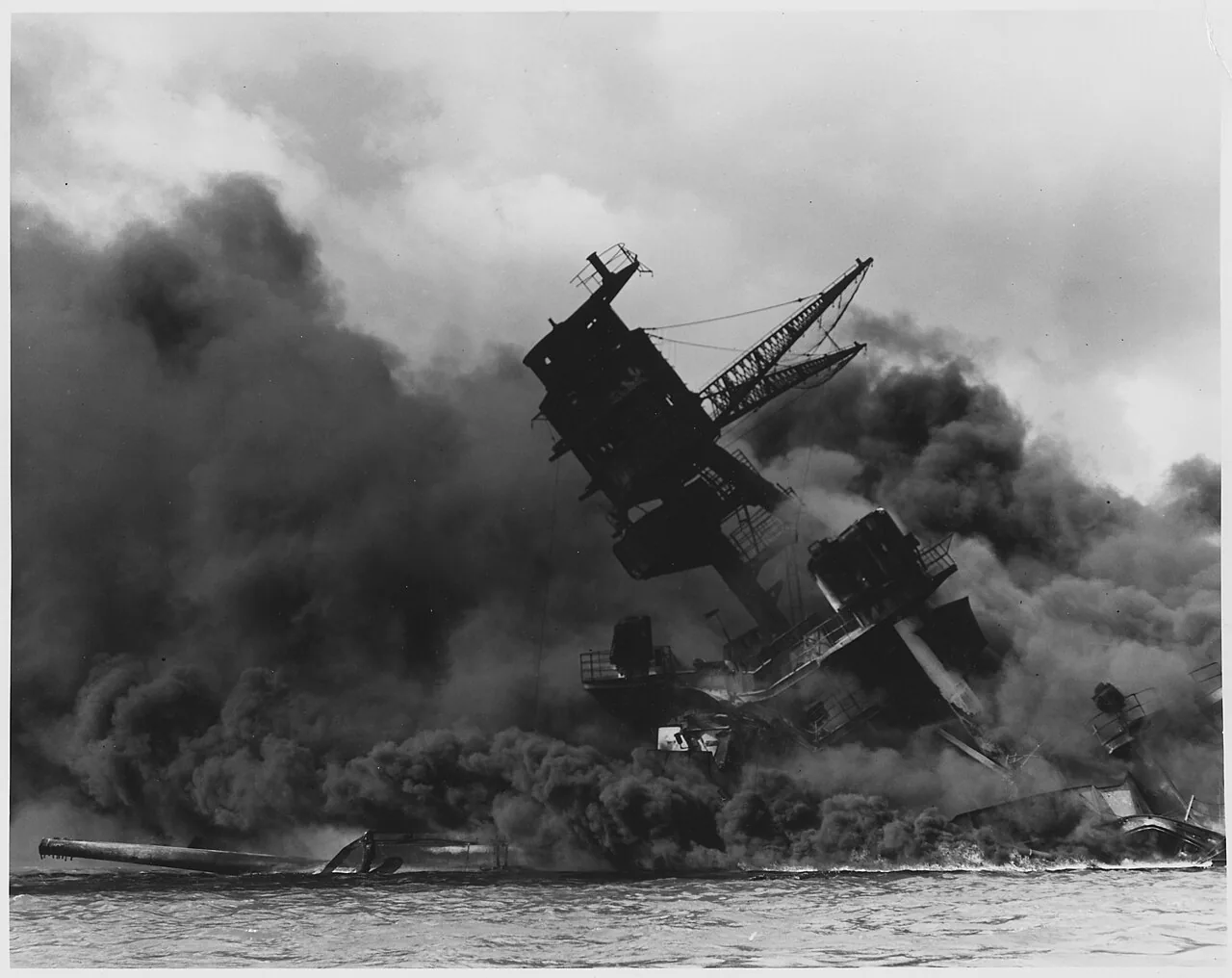
- Present the image (subject, date, place, source).
- Describe what you see in the foreground and background.
- Explain how this event changed the position of the United States in the war.
- Name two countries that declared war on the United States in the days that followed.
Look at the smoke and the angle of the ship.
Exercise 4 : Japan and Germany: two theaters
- Identify the cities numbered 1 (the capital of Japan), 2 (bombed on August 6, 1945), and 3 (bombed on August 9, 1945).
- Name two lands conquered by Japan by mid-1942 that appear on the map.
- Explain why Japan’s conquest of Southeast Asia mattered to its war effort.
Cities (in the order of the map’s points): 1 Tokyo, 2 Hiroshima, 3 Nagasaki, 4 Iwo Jima, 5 Okinawa, 6 Manila, 7 Singapore, 8 Guadalcanal, 9 Nanjing.
Exercise 5 : The Wannsee Conference
Document 2 – The Wannsee Protocol, 1942
Under proper guidance, in the course of the final solution the Jews are to be allocated for appropriate labor in the East. Able-bodied Jews, separated according to sex, will be taken in large work columns to these areas for work on roads, in the course of which action doubtless a large portion will be eliminated by natural causes. The possible final remnant will, since it will undoubtedly consist of the most resistant portion, have to be treated accordingly
Source: Protocol of the Wannsee Conference, January 20, 1942, minutes prepared for Reinhard Heydrich (document NG-2586, English translation). Text: Wikisource.
*Final solution: the Nazi code name for the murder of all European Jews. *Eliminated by natural causes: a euphemism for death from exhaustion and starvation.
- Present the document (nature, date, author or authors, purpose).
- Identify the phrases that describe what is to happen to able-bodied Jews.
- Explain what “treated accordingly” means in this context.
- Why is language like this a problem and a clue for historians?
Exercise 6 : Witness to a massacre
Document 3 – Affidavit of Hermann Graebe, 1945
On October 5, 1942, at the time of my visit to the construction offices in Dubno, my foreman, Hubert Moennikes, living at 21 Aussenmühlenweg, HamburgHaarburg, told me that some Dubno Jews had been shot near the building in three huge ditches about 30 metres long and 3 metres deep. The number of people killed daily was about 1,500. The 5,000 Jews who had lived in Dubno before the Pogrom were all marked for liquidation.
Source: Hermann Friedrich Graebe, sworn affidavit, November 10, 1945, Nuremberg document PS-2992. Text: Internet Modern History Sourcebook, Fordham University.
- Present the document (author, date, nature).
- What did Graebe learn from his foreman?
- How many Jews of Dubno does he say were marked for killing?
- Why is a sworn statement by a German civilian a strong source for a historian?
- What are its limits?
Exercise 7 : The commandant’s testimony
Document 4 – Rudolf Höss at Nuremberg, 1946
The “final solution” of the Jewish question meant the complete extermination of all Jews in Europe. l was ordered to establish extermination facilities at Auschwitz in June 1941. […] I visited Treblinka to find out how they carried out their exterminations.
Source: Rudolf Höss, former commandant of Auschwitz, sworn affidavit, April 5, 1946, Nuremberg document PS-3868 (extract). Text: Internet Modern History Sourcebook, Fordham University.
- Present the document and its author.
- What does Höss say the “final solution” meant?
- When does he say he was ordered to build extermination facilities at Auschwitz?
- Explain why a perpetrator’s testimony must be used with care, and name one way to check it.
Exercise 8 : A police state’s reasoning compared with a prosecutor’s
Document 5 – The Wannsee Protocol (extract)
Under proper guidance, in the course of the final solution the Jews are to be allocated for appropriate labor in the East. Able-bodied Jews, separated according to sex, will be taken in large work columns to these areas for work on roads, in the course of which action doubtless a large portion will be eliminated by natural causes. The possible final remnant will, since it will undoubtedly consist of the most resistant portion, have to be treated accordingly
Source: Protocol of the Wannsee Conference, January 20, 1942, minutes prepared for Reinhard Heydrich (document NG-2586, English translation). Text: Wikisource.
*Final solution: the Nazi code name for the murder of all European Jews. *Eliminated by natural causes: a euphemism for death from exhaustion and starvation.
Document 6 – Jackson at Nuremberg
The wrongs which we seek to condemn and punish have been so calculated, so malignant, and so devastating, that civilization cannot tolerate their being ignored, because it cannot survive their being repeated. […] That four great nations, flushed with victory and stung with injury stay the hand of vengeance and voluntarily submit their captive enemies to the judgment of the law is one of the most significant tributes that Power has ever paid to reason.
Source: Robert H. Jackson, opening statement for the United States, International Military Tribunal, Nuremberg, November 21, 1945. Text: Avalon Project, Yale Law School.
- Present each document.
- What does each document show about how the author sees the Jews, or the law?
- Compare their language: which uses euphemism and which speaks plainly of wrongs?
- Explain what Jackson means when he says the wrongs cannot be allowed to “be repeated.”
Exercise 9 : Two images of Auschwitz
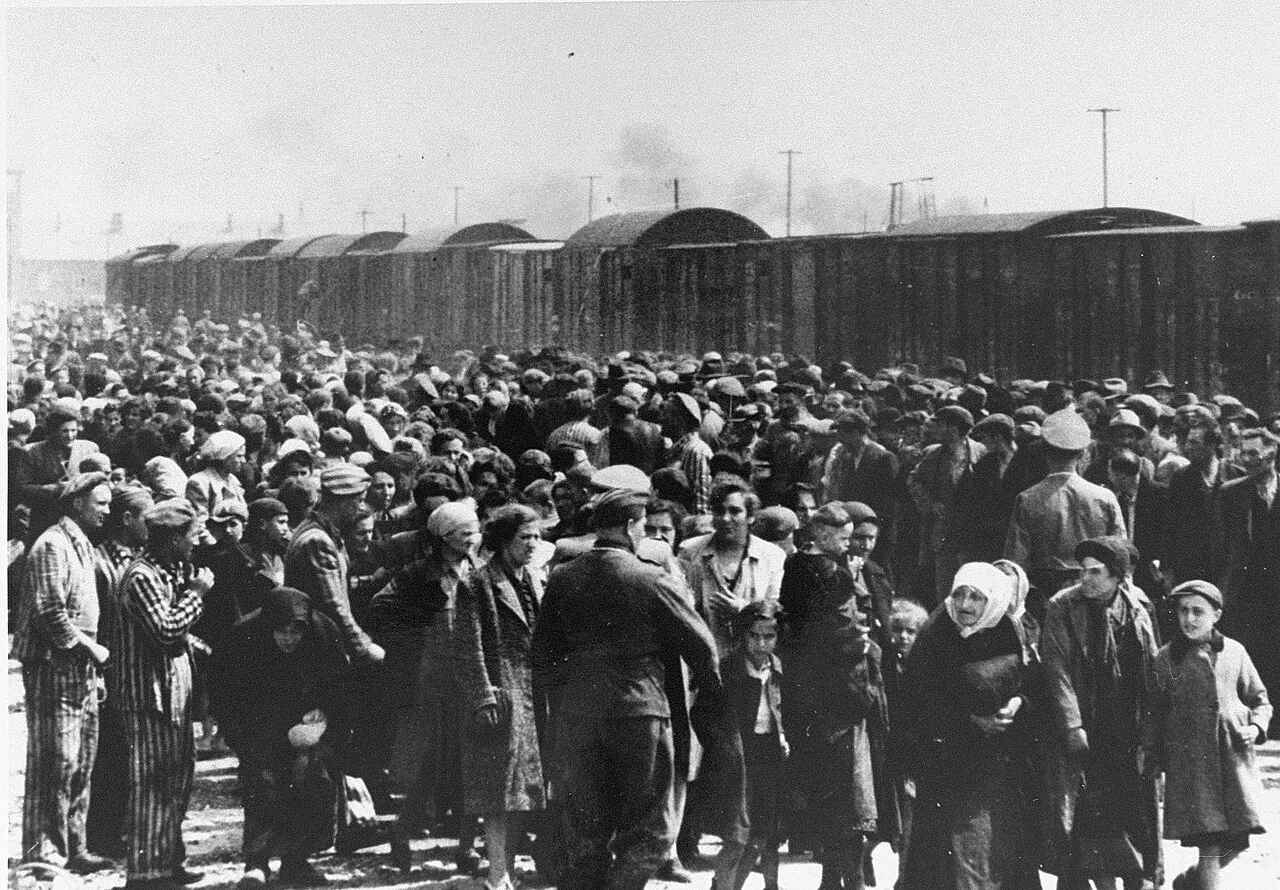
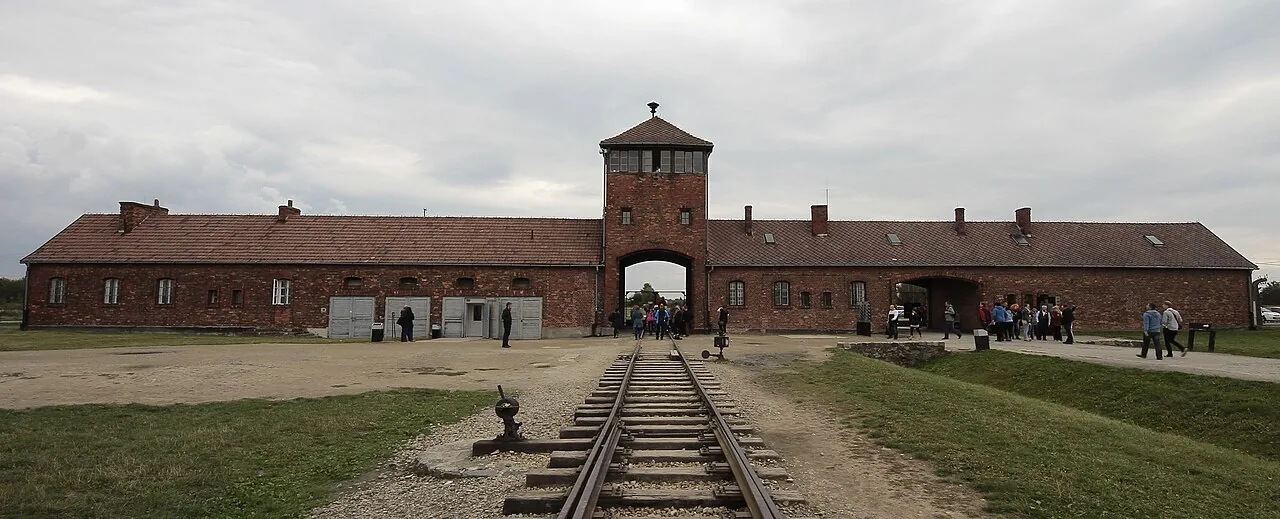
- Present each image.
- What does each one show about the camp?
- Which was made by perpetrators and which by a modern photographer? What difference does that make?
- Why do historians and museums preserve sites like Auschwitz?
Exercise 10 : Hiroshima: a statement and a photograph
Document 7 – Truman, August 6, 1945
SIXTEEN HOURS AGO an American airplane dropped one bomb on Hiroshima, an important Japanese Army base. That bomb had more power than 20,000 tons of T.N.T. It had more than two thousand times the blast power of the British “Grand Slam” which is the largest bomb ever yet used in the history of warfare. The Japanese began the war from the air at Pearl Harbor. They have been repaid many fold. […] It is an atomic bomb. It is a harnessing of the basic power of the universe. The force from which the sun draws its power has been loosed against those who brought war to the Far East.
Source: Harry S. Truman, Statement by the President announcing the use of the atomic bomb at Hiroshima, August 6, 1945. Text: Harry S. Truman Library.
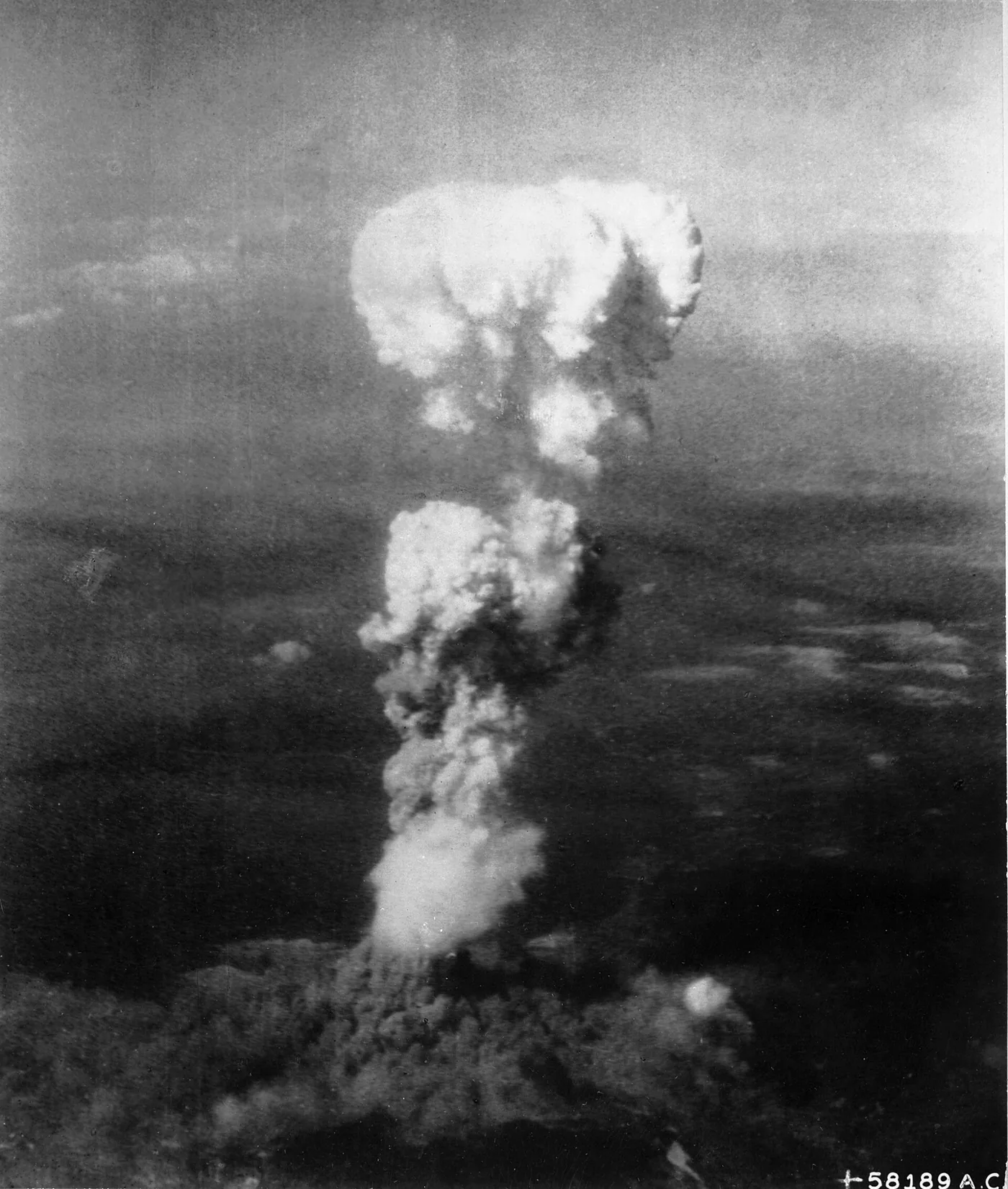
- Present both documents.
- What does Truman emphasize about the bomb?
- What does the photograph show that the statement does not?
- Explain why the photograph was taken from a plane and why that point of view matters.
Exercise 11 : From war aims to Cold War: two promises
Document 8 – The Declaration on Liberated Europe, 1945
To foster the conditions in which the liberated people may exercise these rights, the three governments will jointly assist the people in any European liberated state or former Axis state in Europe where, in their judgment conditions require, (a) to establish conditions of internal peace; (b) to carry out emergency relief measures for the relief of distressed peoples; (c) to form interim governmental authorities broadly representative of all democratic elements in the population and pledged to the earliest possible establishment through free elections of Governments responsive to the will of the people;
Source: Declaration on Liberated Europe, Yalta Conference, February 11, 1945 (published February 13, 1945). Text: Avalon Project, Yale Law School.
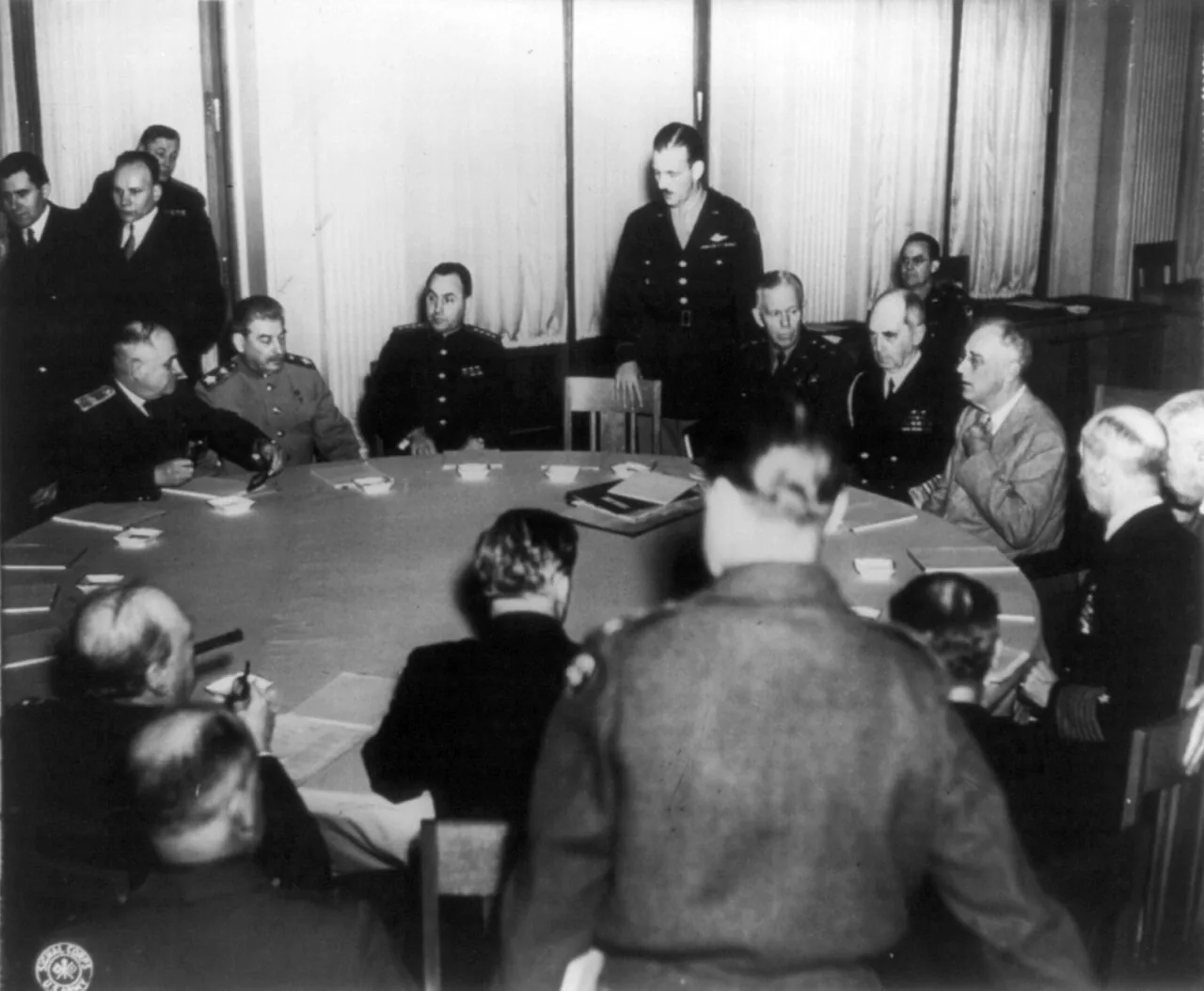
- Present both documents.
- What did the three powers promise for liberated Europe?
- Who is seated around the table in the photograph, according to the caption?
- Explain why this promise became a source of conflict after 1945.
Exercise 12 : The Four Freedoms and the United Nations
Document 9 – Roosevelt’s Four Freedoms, 1941
In the future days, which we seek to make secure, we look forward to a world founded upon four essential human freedoms. The first is freedom of speech and expression-everywhere in the world. The second is freedom of every person to worship God in his way – everywhere in the world. The third is freedom from want-which, translated into world terms, means economic understandings which will secure to every nation a healthy peacetime life for its inhabitants-everywhere in the world. The fourth is freedom from fear-which, translated into world terms, means a world-wide reduction of armaments to such a point and in such a thorough fashion that no nation will be in a position to commit an act of physical aggression against any neighbor – anywhere in the world.
Source: Franklin D. Roosevelt, Annual Message to Congress (the Four Freedoms speech), January 6, 1941. Text: Avalon Project, Yale Law School.
- Present the document.
- Name the four freedoms listed in the extract.
- Which freedoms are about rights inside a country and which about world conditions?
- How does the Declaration by United Nations (January 1, 1942) repeat these ideals? Use the lesson.
Exercise 13 : The Declaration by United Nations
Document 10 – Declaration by United Nations, 1942
Being convinced that complete victory over their enemies is essential to defend life, liberty, independence and religious freedom, and to preserve human rights and justice in their own lands as well as in other lands, and that they are now engaged in a common struggle against savage and brutal forces seeking to subjugate the world,
Source: Declaration by United Nations, signed at Washington, January 1, 1942 (preamble). Text: Avalon Project, Yale Law School.
- Present the document.
- What do the signers say they must achieve through victory?
- Whom do they call the enemy?
- Why is the date of the signing important?
Exercise 14 : The Normandy landings
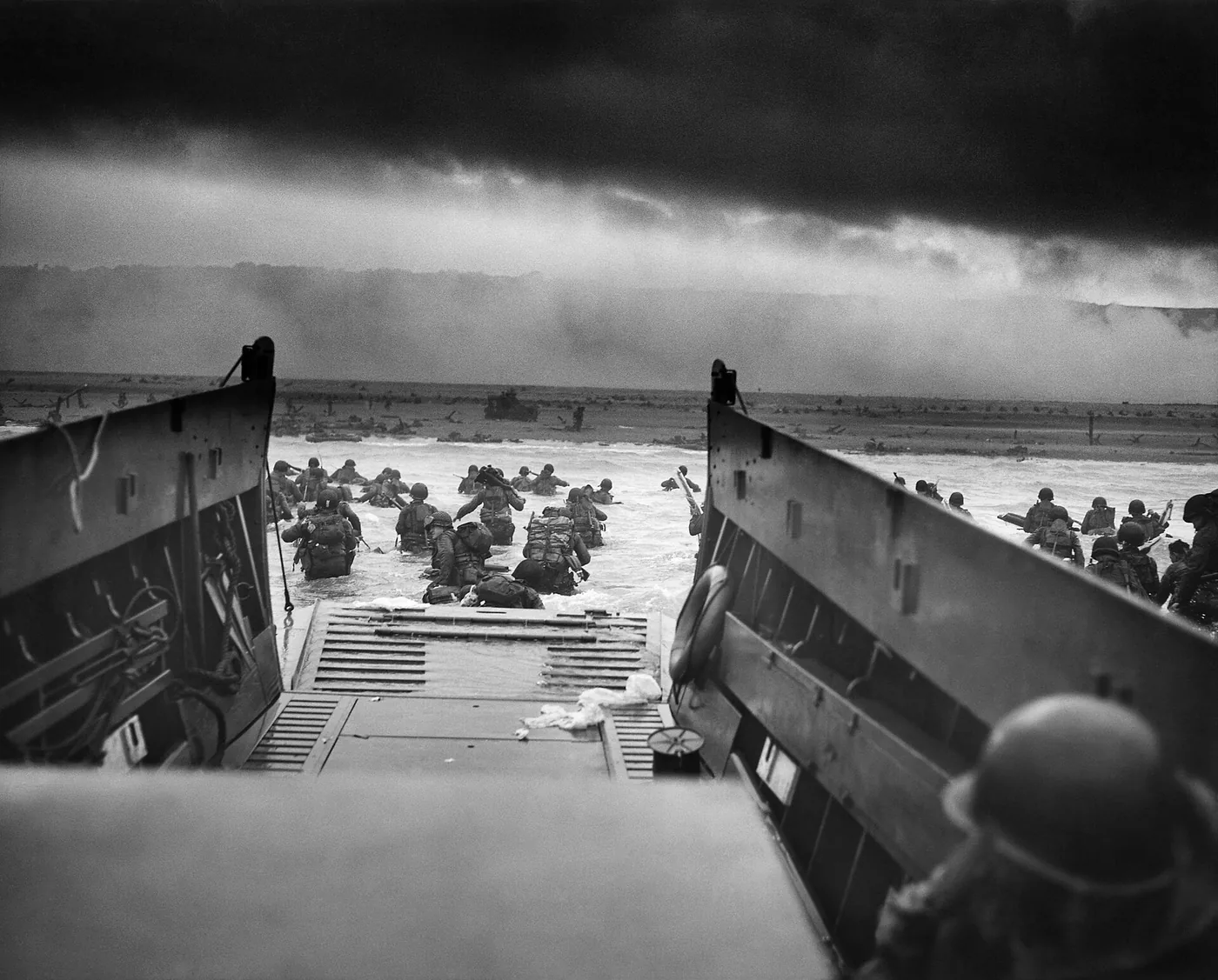
- Present the image (title, photographer, date, place).
- Describe the landing craft and the soldiers.
- Why was the landing in Normandy a turning point?
- What does a photograph like this show, and what can it not show?
Exercise 15 : Reading numbers: victims of the Holocaust
Estimates of Jews murdered at five killing sites.
| Site | Estimated Jewish victims |
|---|---|
| Auschwitz complex | approximately 1,000,000 |
| Treblinka II | approximately 925,000 |
| Belzec | approximately 435,000 |
| Sobibor | at least 167,000 |
| Chelmno | at least 152,000 |
Source: United States Holocaust Memorial Museum, Holocaust Encyclopedia, “Documenting numbers of victims of the Holocaust and Nazi persecution.”
- Which site had the most victims? Which the fewest in the table?
- Add the figures for Treblinka and Belzec. What does the result show?
- Why does the table say “approximately” and “at least”?
- Using the lesson, name the total number of Jews murdered in the Holocaust.
Exercise 16 : Locate the camps and the turning points
Sites in order: 1 Auschwitz, 2 Belzec, 3 Sobibor, 4 Treblinka, 5 Chelmno, 6 Majdanek, 7 Wannsee, 8 Stalingrad, 9 Normandy.
- Which numbers are extermination camps? Which is the site of the January 1942 conference?
- In which present-day country do most of the camps lie?
- Which numbers are turning points of the war? Name the date of each.
Exercise 17 : Order the events
Put the events in chronological order.
- Attack on Pearl Harbor
- Germany invades Poland
- Nuremberg judgments
- Wannsee Conference
- D-Day
- Hiroshima
- Germany invades the USSR
- Surrender at Stalingrad
Exercise 18 : Durations
Use the dates in the lesson.
- How many years separate the German invasion of Poland (1939) from the Japanese surrender (1945)?
- How many days passed between Pearl Harbor (December 7, 1941) and the Declaration by United Nations (January 1, 1942)?
- How many months passed between D-Day (June 6, 1944) and V-E Day (May 8, 1945)?
Exercise 19 : Guided research: the Nuremberg trials
Mini-inquiry. Keywords to type: Nuremberg trial International Military Tribunal defendants verdicts. Reliable sites: the United States Holocaust Memorial Museum (ushmm.org), the Avalon Project (avalon.law.yale.edu), the Library of Congress (loc.gov), the National WWII Museum (nationalww2museum.org). Fill in this sheet:
- Date the trial opened and the city.
- The four powers that supplied judges.
- Three crimes the defendants were charged with.
- Number of death sentences and acquittals.
- One new idea in international law that came from the trial.
Exercise 20 : CER paragraph: why the war became global
Write a Claim-Evidence-Reasoning paragraph (6-8 sentences) answering: Why did a European war become a world war between 1939 and 1941? Use at least two dates and one document from the lesson.
Claim: two decisions of 1941. Evidence: June 22 and December 7. Reasoning: connect the theaters.
Exercise 21 : SAQ: the Holocaust
Answer in complete sentences. (a) Identify one way the Nazi regime persecuted Jews before 1939. (b) Identify one step that moved persecution to mass murder during the war. (c) Explain one reason it was difficult to rescue Jews in occupied Europe.
Exercise 22 : True or false? Justify
Say whether each statement is true or false and justify your answer.
- The Atlantic Charter was signed after the United States entered the war.
- The Wannsee Conference decided for the first time to kill the Jews.
- The Soviet Union declared war on Japan in August 1945.
- Only Jews were persecuted by the Nazi regime.
Exercise 23 : Causes and consequences
Place each item in the right column, cause or consequence of the war in Europe: (1) the Munich Conference, (2) the invasion of Poland, (3) the creation of the United Nations, (4) the Nuremberg trials, (5) the Treaty of Versailles of 1919, (6) the division of Germany into zones.


Quick review: flashcards
Tap a card to see the answer.