


This World History Grades 9-10 lesson covers World War II and the Holocaust, part of the unit “Empires and world wars.” First, read the full lesson with its primary sources, maps and key terms. Then practice with the worksheet, check yourself with the quiz and get ready with the test.
On September 1, 1939, German armies crossed the Polish border. Six years later, in the ruins of Hiroshima and Nagasaki, the same war ended with a new weapon. In between lay the deadliest conflict in history. An estimated 60 to 85 million people died, most of them civilians. They died from Shanghai to Stalingrad, from the Atlantic convoys to the camps of occupied Poland. World War II was more than a clash of armies. It was a struggle over what kind of world would follow. Inside it, the Nazi regime carried out the Holocaust, the systematic murder of about six million Jews.
Guiding question: How did a war that began as German and Japanese aggression become a global conflict, and how did the genocide of the Jews of Europe unfold within it?
1. From aggression to world war, 1931-1941
Aggression goes unchecked
Japan seized Manchuria in 1931 and launched a full-scale invasion of China in 1937. In December 1937 its troops captured the Chinese capital, Nanjing. There they committed mass killings of civilians and prisoners that Chinese and international historians call the Nanjing Massacre. In Europe, Adolf Hitler became chancellor of Germany in 1933. Then he rebuilt the army and occupied the Rhineland in 1936. He annexed Austria in March 1938 and obtained the Sudetenland from Czechoslovakia at the Munich Conference in September 1938. Britain and France, still marked by the losses of World War I, pursued appeasement. They gave way in the hope of avoiding another war. In March 1939 Hitler occupied the rest of Czechoslovakia, and appeasement collapsed.
On August 23, 1939, Germany and the Soviet Union signed a nonaggression pact, whose secret protocol divided Eastern Europe into spheres of influence. Germany invaded Poland on September 1, 1939; the Soviet Union entered from the east on September 17. Britain and France declared war on Germany on September 3. Within weeks its two invaders had divided Poland between them.
Definition: Blitzkrieg
German for “lightning war”: a method of attack that combined tanks, motorized infantry, and aircraft to break through enemy lines quickly and surround the defenders.
Germany conquers Western Europe
In April 1940 Germany occupied Denmark and Norway. In May it attacked the Netherlands, Belgium, and France, and by June 22, 1940, France had signed an armistice. Britain, led since May by Winston Churchill, stood alone. In the summer and autumn of 1940, the Royal Air Force defeated the German air force in the Battle of Britain, so Hitler postponed his plan of invasion. Italy, led by Benito Mussolini, had joined Germany in June 1940. In September Germany, Italy, and Japan signed the Tripartite Pact. Together they formed the Axis powers.
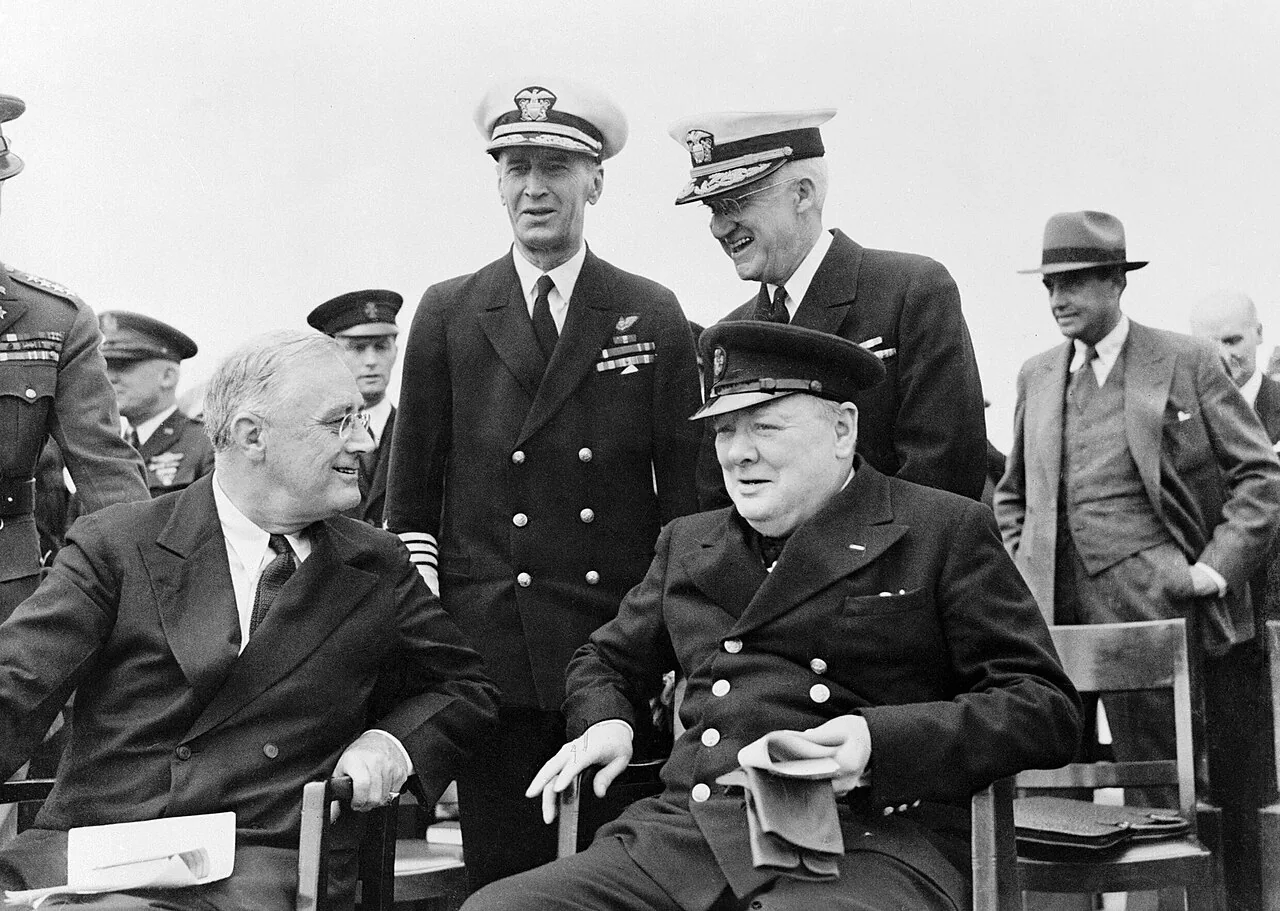
On June 22, 1941, Germany broke its pact and invaded the Soviet Union in the largest land offensive in history. Meanwhile the United States, officially neutral, was drifting toward the Allied side. Congress passed the Lend-Lease Act in March 1941, allowing the president to supply Britain with war materials. In August 1941 Roosevelt and Churchill met off Newfoundland. There they issued the Atlantic Charter, which set out war aims before the United States had entered the war.
Document 1 – The Atlantic Charter, 1941
Third, they respect the right of all peoples to choose the form of government under which they will live; and they wish to see sovereign rights and self government restored to those who have been forcibly deprived of them; […] Sixth, after the final destruction of the Nazi tyranny, they hope to see established a peace which will afford to all nations the means of dwelling in safety within their own boundaries, and which will afford assurance that all the men in all lands may live out their lives in freedom from fear and want;
Source: Atlantic Charter, joint declaration of President Franklin D. Roosevelt and Prime Minister Winston Churchill, August 14, 1941 (points 3 and 6). Text: Avalon Project, Yale Law School.
Commentary. The Charter is a statement of principles, not a treaty. It rejects territorial conquest, promises “self government” to peoples who lost it, and imagines a postwar world “free from fear and want.” Its words echo Roosevelt’s Four Freedoms speech of January 1941 and became a reference point for the United Nations. But they raised a question that Churchill and colonial peoples read differently: did “all peoples” include the peoples of Asia and Africa under European rule? Chapter 9 returns to that question.
The war becomes global
On December 7, 1941, Japanese aircraft attacked the American fleet at Pearl Harbor, Hawaii, and Japanese forces struck the Philippines, Malaya, and Hong Kong. The United States and Britain declared war on Japan the next day. On December 11 Germany and Italy declared war on the United States. In the following months Japan conquered the Philippines, Malaya, Singapore, the Dutch East Indies, and Burma. It presented itself as the liberator of Asia from Western empires, yet it ruled its conquests harshly. By mid-1942 the Axis stood at its height.
On January 1, 1942, twenty-six nations signed the Declaration by United Nations at Washington. They pledged to use all their resources against the Axis and not to make a separate peace. Roosevelt had coined the name “United Nations”, and it would soon be given to a new world organization.
- September 1, 1939 Germany invades Poland; Britain and France declare war
- June 22, 1940 France signs an armistice with Germany
- June 22, 1941 Germany invades the Soviet Union
- December 7, 1941 Japan attacks Pearl Harbor; the United States enters the war
- January 20, 1942 Wannsee Conference
- February 2, 1943 German surrender at Stalingrad
- June 6, 1944 D-Day landings in Normandy
- May 8, 1945 Victory in Europe (V-E Day)
- August 6 and 9, 1945 Atomic bombs on Hiroshima and Nagasaki
- September 2, 1945 Japan signs the surrender
2. The Holocaust
From persecution to mass murder
Antisemitism, hatred of Jews, was the core of Nazi ideology. After 1933 the regime excluded German Jews from public life. The Nuremberg Laws of September 1935 stripped Jews of citizenship and banned marriages between Jews and other Germans. On November 9-10, 1938, the Kristallnacht pogrom destroyed synagogues and Jewish shops throughout Germany and sent some 30,000 Jewish men to concentration camps. The Nazis did not persecute only Jews. They also persecuted Roma and Sinti, people with disabilities, political opponents, Jehovah’s Witnesses, and homosexual men. However, the regime marked only the Jews for total destruction.
Definition: Holocaust
The systematic, state-sponsored persecution and murder of about six million European Jews by Nazi Germany and its allies and collaborators between 1933 and 1945. The Hebrew word Shoah (catastrophe) is also used.
Definition: Genocide
Acts committed with intent to destroy, in whole or in part, a national, ethnic, racial, or religious group. The word was coined by the Polish-Jewish lawyer Raphael Lemkin in 1944 and defined in the UN Genocide Convention of 1948.
The war made the mass murder possible. After the conquest of Poland, Germany forced Jews into sealed ghettos such as those of Warsaw and Łódź. There hunger and disease killed tens of thousands. When Germany invaded the Soviet Union in June 1941, mobile units called Einsatzgruppen followed the army. With police and local collaborators, they shot Jewish men, women, and children at the edge of town. Hermann Graebe, a German engineer, described one such massacre in Ukraine in a sworn statement used at Nuremberg.
The “Final Solution”
On January 20, 1942, fifteen senior Nazi officials and SS leaders met in a villa on Lake Wannsee, in a suburb of Berlin. Reinhard Heydrich, head of the Reich Security Main Office, led the meeting. Heydrich summarized the plan to deport the Jews of Europe to the East. He also listed the Jewish populations of every country, a total he put at over eleven million, including Britain, Ireland, and neutral states that Germany had not conquered. The decision to murder the Jews had come earlier. The conference coordinated the ministries and railways needed to carry it out.
Document 2 – The Wannsee Protocol, 1942
Under proper guidance, in the course of the final solution the Jews are to be allocated for appropriate labor in the East. Able-bodied Jews, separated according to sex, will be taken in large work columns to these areas for work on roads, in the course of which action doubtless a large portion will be eliminated by natural causes. The possible final remnant will, since it will undoubtedly consist of the most resistant portion, have to be treated accordingly
Source: Protocol of the Wannsee Conference, January 20, 1942, minutes prepared for Reinhard Heydrich (document NG-2586, English translation). Text: Wikisource.
*Final solution: the Nazi code name for the murder of all European Jews. *Eliminated by natural causes: a euphemism for death from exhaustion and starvation.
Reading the Wannsee Protocol
Commentary. A clerk wrote the minutes in bureaucratic language. Words such as “evacuation,” “labor in the East,” and “treated accordingly” hide the meaning that other evidence makes plain: those who survived forced labor were to be killed. Only one copy of the minutes, number 16 of 30, survived the war. For this reason historians combine this document with testimony from perpetrators, victims, and witnesses.
The extermination camps
Germany industrialized mass murder in extermination camps in occupied Poland. Chelmno began operating in December 1941, followed by Belzec, Sobibor, and Treblinka, where victims were killed in gas chambers shortly after arrival. Auschwitz-Birkenau combined a forced-labor camp with gas chambers. The United States Holocaust Memorial Museum estimates the number of Jews murdered at each site. About one million died at the Auschwitz complex, about 925,000 at Treblinka, about 435,000 at Belzec, at least 167,000 at Sobibor, and at least 152,000 at Chelmno. Trains from every corner of occupied Europe carried the deportees. As Soviet armies advanced in 1944-1945, the SS marched surviving prisoners westward in death marches; many died on the roads.
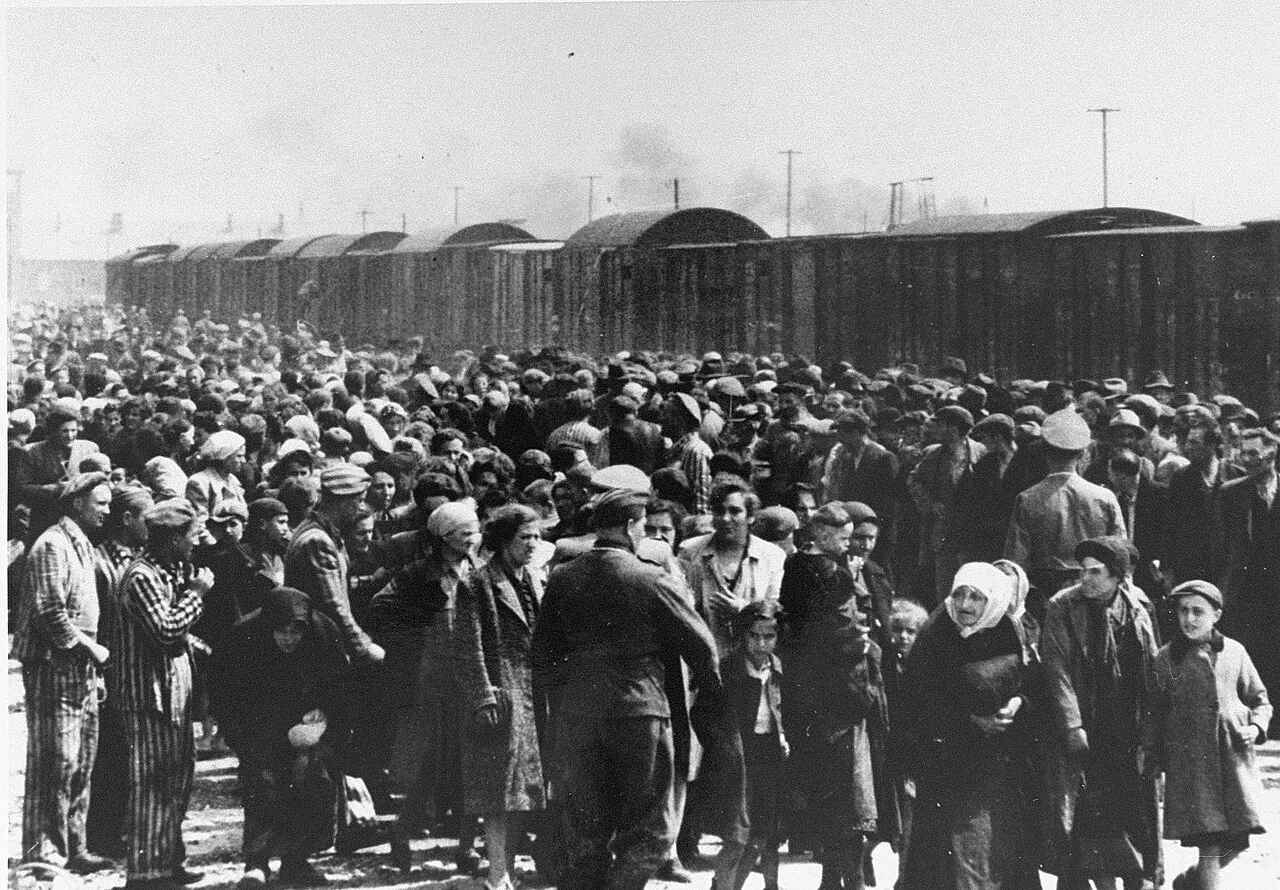
Commentary. The Auschwitz Album is unusual: it is one of the few photographic records made by the perpetrators, taken in May-June 1944 when Jews from Hungary and Subcarpathian Rus arrived. The photographers wanted an orderly record for the camp administration, so the image shows the process, not the terror. A historian must read it against survivors’ testimony. The faces in the crowd remind us that each number in the table of victims was a person.
Resistance, rescue, and the world’s response
Jews resisted in many ways: by keeping schools and archives in the ghettos, by escaping to the forests and joining partisans, and by armed revolt. In April 1943 several hundred poorly armed fighters of the Warsaw Ghetto resisted the final German attempt to deport the ghetto’s remaining population. The uprising lasted nearly a month. Some non-Jews hid or helped Jews at great risk. Denmark smuggled most of its Jewish citizens to Sweden in October 1943. But in most countries the majority looked away. The Allies, who knew of the killings by 1942, did not bomb the camps or make rescue a war aim. The United States admitted far fewer refugees than the number who sought entry.
3. The tide turns, 1942-1945
Turning points
In June 1942 the American navy destroyed four Japanese aircraft carriers at the Battle of Midway, ending Japan’s offensive in the Pacific. In Europe the Red Army surrounded and forced the surrender of the German Sixth Army at Stalingrad on February 2, 1943, after months of street fighting. British forces won at El Alamein, in Egypt, in November 1942, and the Allies invaded Sicily and Italy in 1943. The Soviet Union carried the heaviest burden on land: estimates of its dead range from 20 to 27 million.
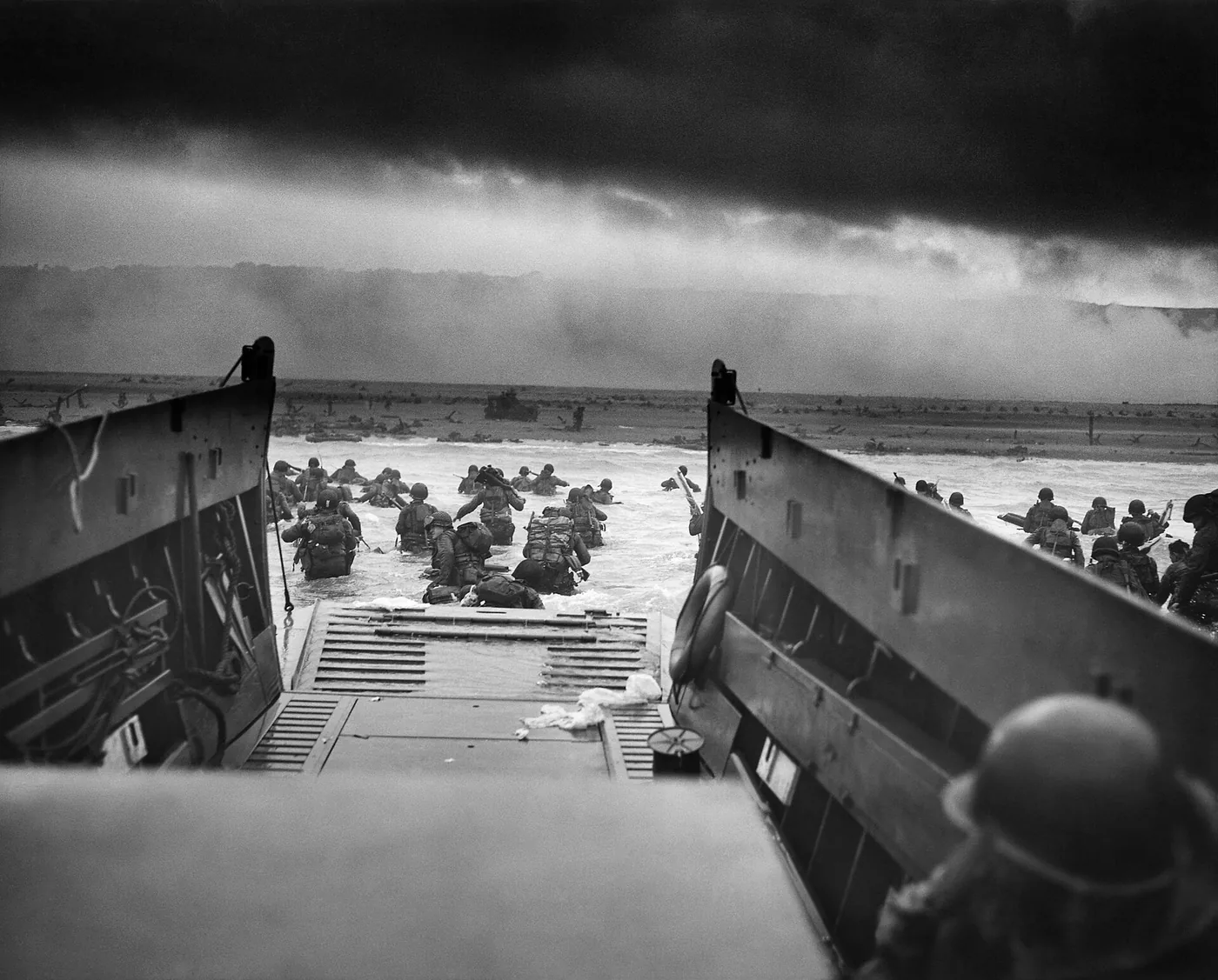
On June 6, 1944, D-Day, the Allies landed on the beaches of Normandy in the largest amphibious invasion in history. In August the Allies liberated Paris. Soviet troops advanced into Poland and Germany from the east, and the Western Allies crossed the Rhine in March 1945. Hitler killed himself on April 30, and Germany surrendered on May 8, 1945.
War on the home front
War mobilized whole societies. In the United States, millions of women, including Black women, took jobs in factories and shipyards, and industry turned out aircraft, ships, and trucks in vast numbers. The government also committed a grave injustice: after Executive Order 9066 of February 19, 1942, more than 100,000 people of Japanese ancestry, most of them American citizens, were removed from the West Coast and held in camps. In 1988 Congress formally apologized and offered payments to survivors. Total war also meant bombing of cities, from London and Coventry to Dresden and Tokyo, in which civilians were the main victims.
The end of the war in the Pacific
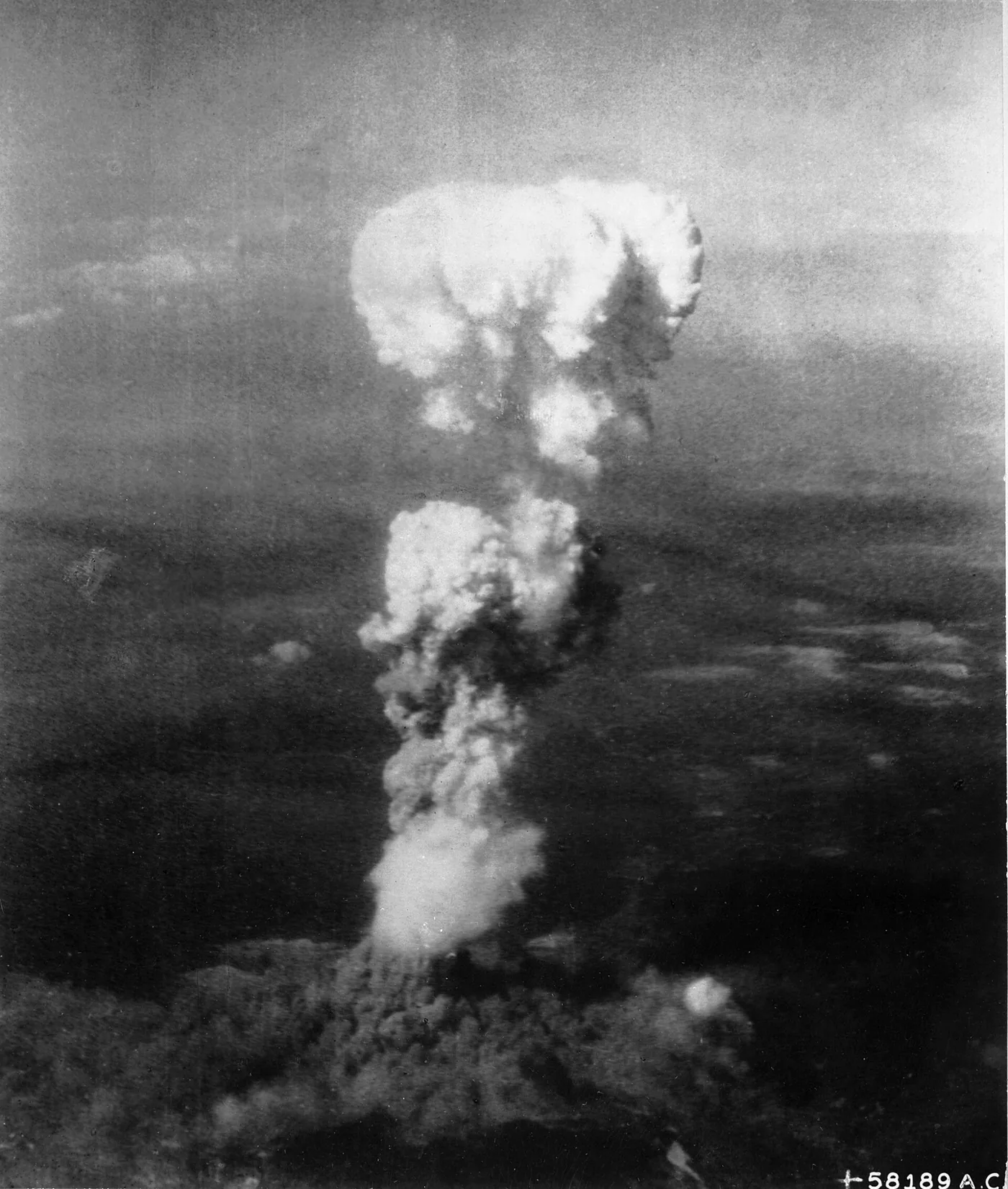
American forces moved island by island toward Japan: Guadalcanal in 1942-1943, Iwo Jima in February-March 1945, and Okinawa from April to June 1945, where fighting killed thousands of soldiers and a large number of Okinawan civilians. In July 1945 the Allies called on Japan to surrender. On August 6 an American B-29 dropped an atomic bomb on Hiroshima; on August 9 a second destroyed Nagasaki. The Soviet Union declared war on Japan on August 8. Combined estimates of those who died by the end of 1945 range from about 150,000 to about 246,000, most of them civilians. Japan announced its surrender on August 15 and signed the instrument on September 2, 1945.
Document 3 – President Truman announces the atomic bomb, 1945
SIXTEEN HOURS AGO an American airplane dropped one bomb on Hiroshima, an important Japanese Army base. That bomb had more power than 20,000 tons of T.N.T. It had more than two thousand times the blast power of the British “Grand Slam” which is the largest bomb ever yet used in the history of warfare. The Japanese began the war from the air at Pearl Harbor. They have been repaid many fold. […] It is an atomic bomb. It is a harnessing of the basic power of the universe. The force from which the sun draws its power has been loosed against those who brought war to the Far East.
Source: Harry S. Truman, Statement by the President announcing the use of the atomic bomb at Hiroshima, August 6, 1945. Text: Harry S. Truman Library.
Commentary. Truman addressed the American public. He emphasizes the power of the weapon and presents the bomb as retribution for Pearl Harbor. He calls Hiroshima “an important Japanese Army base” and does not mention that most of the dead were civilians. Historians still debate whether the bombs were necessary to end the war, whether Soviet entry and the blockade would have forced a surrender, and what role the wish to impress the Soviet Union played. All agree that the bombs opened the nuclear age.
4. Justice, a new order, and the legacy of the war
The victors held trials. At Nuremberg, from November 20, 1945, the International Military Tribunal judged 22 leading Nazis for crimes against peace, war crimes, and crimes against humanity. Judgments on October 1, 1946, sentenced twelve to death, imprisoned seven, and acquitted three. A similar tribunal sat in Tokyo for Japanese leaders. American prosecutor Robert H. Jackson declared that the trial’s purpose was to make sure such wrongs “cannot survive their being repeated.”
Document 4 – The Nuremberg trial
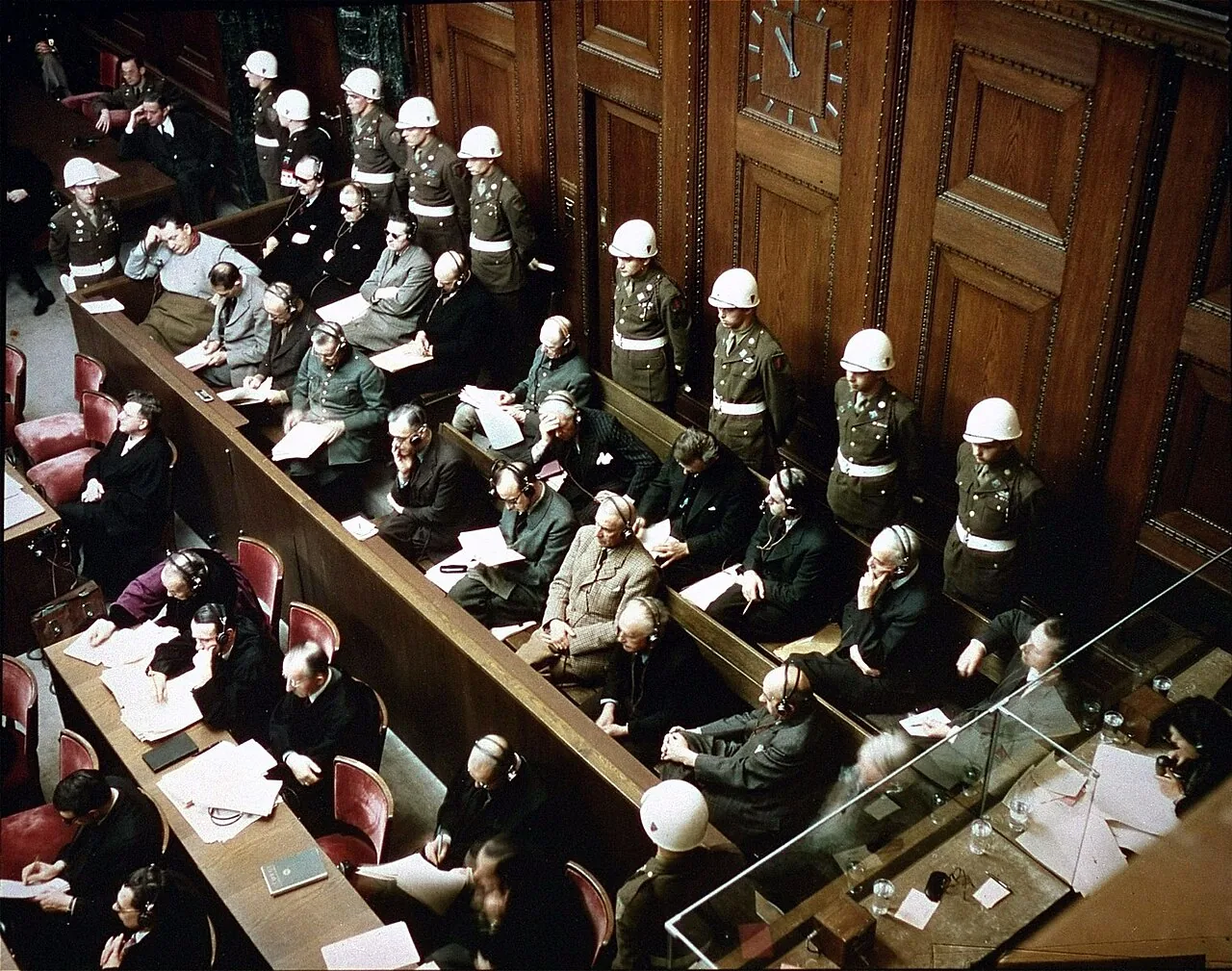
Source: Raymond D’Addario, photograph, 1945-1946; image from Wikimedia Commons, public domain.
Commentary. The color photograph shows the dock: the leading defendants sit on two benches, with military police in white helmets standing behind them. The trial was held in the Palace of Justice in Nuremberg, in the American zone, with judges from the United States, Britain, France, and the Soviet Union. The photograph also shows the large staff of interpreters and lawyers, a sign of how new this proceeding was: the first international trial of a government’s leaders.
The war changed the map. The Yalta Conference of February 1945 and the Potsdam Conference of July-August 1945 divided Germany into four occupation zones and set Poland’s new borders, and the Yalta declaration promised free elections in liberated Europe. These promises were broken in Eastern Europe, as the next chapter shows. In 1945 the United Nations replaced the failed League of Nations.
In 1948 it adopted the Genocide Convention (December 9) and the Universal Declaration of Human Rights (December 10), a direct response to the crimes of the war. Britain and France, though victorious, were weakened, and their empires began to dissolve. The United States and the Soviet Union emerged as superpowers, and the wartime alliance gave way to the Cold War.
Key takeaways
- World War II began in Europe on September 1, 1939, and became global with the German invasion of the USSR (June 1941) and the attack on Pearl Harbor (December 1941).
- The Holocaust was the planned murder of about six million Jews; the Wannsee Conference (January 20, 1942) coordinated deportations to extermination camps such as Treblinka and Auschwitz-Birkenau.
- Turning points: Midway (June 1942), Stalingrad (February 1943), D-Day (June 6, 1944); Germany surrendered May 8, 1945.
- The atomic bombs on Hiroshima and Nagasaki (August 1945) ended the war with Japan and opened the nuclear age.
- Nuremberg, the UN, the Genocide Convention, and the Universal Declaration of Human Rights tried to answer the crimes of the war; the two superpowers soon became rivals.

Quick review: flashcards
Tap a card to see the answer.