


This World History Grades 9-10 lesson covers The Cold War, part of the unit “The modern world.” First, read the full lesson with its primary sources, maps and key terms. Then practice with the worksheet, check yourself with the quiz and get ready with the test.
On the morning of October 16, 1962, President John F. Kennedy looked at U-2 photographs of construction sites in Cuba, ninety miles from Florida. For thirteen days the United States and the Soviet Union stood closer to nuclear war than at any other time in history. Yet the two countries never fought a direct war. The Cold War, which lasted from the late 1940s to 1991, was a contest of power, ideology, and fear fought through alliances, arms races, spying, propaganda, and wars in other countries, and it shaped the lives of people on every continent.
Guiding question: Why did the wartime allies become rivals, how did the superpowers compete without fighting each other directly, and why did the Cold War end peacefully in 1989-1991?
1. The origins of the Cold War, 1945-1949
Allies who did not trust each other
The United States and the Soviet Union had fought on the same side, but they had different systems. The United States was a capitalist democracy; the Soviet Union was a one-party communist state led by Joseph Stalin. Each feared the other: the Soviet Union had been invaded twice from the West in a generation and wanted friendly governments on its borders, while the United States and Britain wanted free elections and open markets in Europe. At Yalta in February 1945 the Allies promised free elections in liberated Europe. By 1948 communists, backed by the Red Army and Soviet police, controlled Poland, Hungary, Romania, Bulgaria, Czechoslovakia, and the Soviet zone of Germany.
Definition: Cold War
The hostile rivalry between the United States and the Soviet Union and their allies from about 1947 to 1991, fought without direct large-scale war between the two superpowers.
Definition: Containment
The American policy, shaped by diplomat George F. Kennan’s 1946 “Long Telegram,” of stopping the spread of Soviet influence without war.
On March 5, 1946, in Fulton, Missouri, with President Truman on the platform, Winston Churchill declared that “an iron curtain has descended across the Continent.” Stalin answered in Pravda that Churchill was a “firebrand of war.”
Document 1 – Churchill’s iron curtain speech, 1946
From Stettin in the Baltic to Trieste in the Adriatic, an iron curtain has descended across the Continent. Behind that line lie all the capitals of the ancient states of Central and Eastern Europe. Warsaw, Berlin, Prague, Vienna, Budapest, Belgrade, Bucharest and Sofia, all these famous cities and the populations around them lie in what I must call the Soviet sphere, and all are subject in one form or another, not only to Soviet influence but to a very high and, in many cases, increasing measure of control from Moscow.
Source: Winston Churchill, “The Sinews of Peace” (the Iron Curtain speech), Westminster College, Fulton, Missouri, March 5, 1946. Text: National Churchill Museum.
Commentary. Churchill, who had led Britain in the war and was then out of office, spoke as a private citizen. He draws a line from Stettin on the Baltic to Trieste on the Adriatic and says that the capitals behind it lie in the “Soviet sphere.” He exaggerates in places, for example by implying that all of Eastern Europe was already a Soviet-controlled police state, but he correctly described a pattern that became fact within two years. Stalin’s reply, which compares Churchill to Hitler, shows how quickly language hardened.
Containment, the Marshall Plan, and a divided Germany
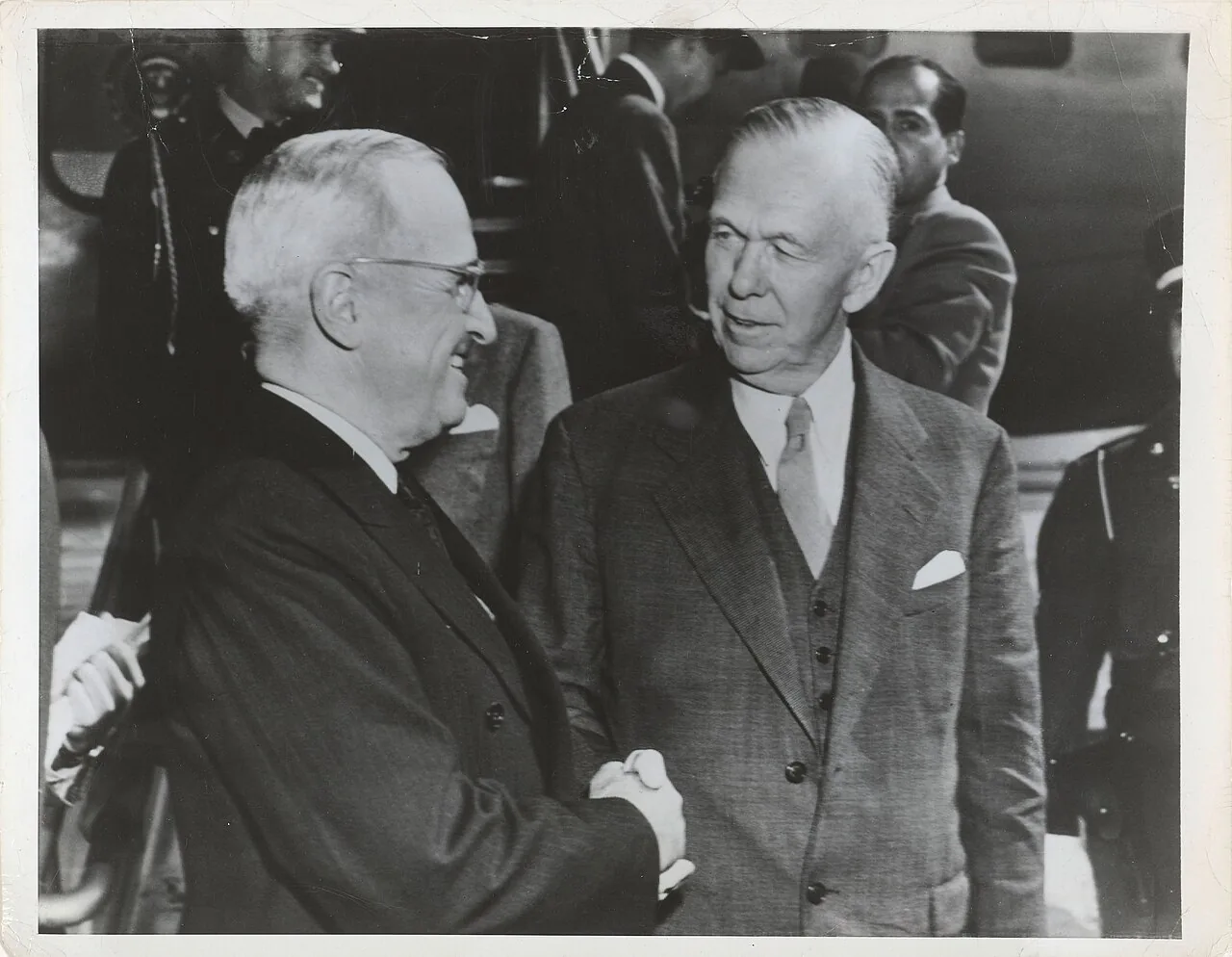
In March 1947 Britain said it could no longer support Greece against a communist-led insurgency or help Turkey. President Truman asked Congress for $400 million for the two countries and declared that the United States must support “free peoples who are resisting attempted subjugation.” This Truman Doctrine pledged American help to governments facing communist pressure. On June 5, 1947, Secretary of State George C. Marshall proposed that the United States help rebuild a ruined Europe. The European Recovery Program, called the Marshall Plan, supplied more than $12 billion over four years to Western Europe. The Soviet Union refused the offer and forbade its satellites from joining.
The Berlin Blockade and NATO
Germany was the first great test. In June 1948 the Western powers introduced a new currency in their zones, and the Soviet Union blockaded West Berlin, an island in East German territory, from June 24, 1948 to May 12, 1949. The Western Allies flew in food and coal in the Berlin Airlift, which lasted into September 1949 and delivered about 2.3 million tons of supplies in some 278,000 flights. In 1949 two German states appeared: the Federal Republic (West Germany) in May and the German Democratic Republic (East Germany) in October. In April 1949 twelve countries signed the North Atlantic Treaty, which created NATO, with Article 5 declaring an attack on one an attack on all.
- March 5, 1946 Churchill’s iron curtain speech
- March 12, 1947 Truman Doctrine
- June 24, 1948 Berlin Blockade begins
- April 4, 1949 NATO treaty signed
- August 29, 1949 First Soviet atomic test
- June 25, 1950 Korean War begins
- May 14, 1955 Warsaw Pact formed
- October 4, 1957 Sputnik launched
- August 13, 1961 Berlin Wall begins to rise
- October 16-28, 1962 Cuban Missile Crisis
- November 9, 1989 The Berlin Wall opens
- December 26, 1991 The Soviet Union dissolves
2. Crises and competition, 1949-1975
Asia: communist victory in China and war in Korea
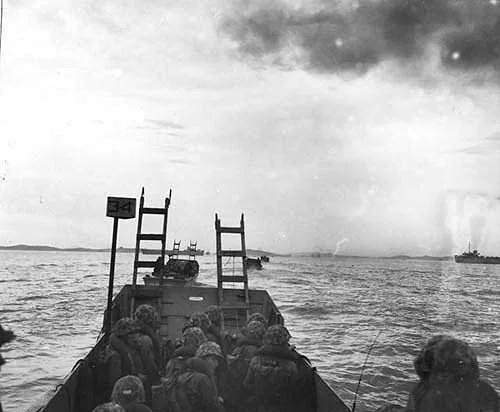
In 1949 the Soviet Union tested its first atomic bomb, ending the American monopoly, and on October 1 Mao Zedong proclaimed the People’s Republic of China. On June 25, 1950, North Korea invaded South Korea. The United Nations, led by the United States, sent troops; American and allied forces landed at Inchon in September 1950 and pushed north, until China entered the war in November. The fighting ended in an armistice on July 27, 1953, near the 38th parallel where it began. Korea stayed divided, and the United States placed troops and bases around the world.
Eastern Europe: reform and repression
Stalin died in March 1953. In February 1956 his successor, Nikita Khrushchev, denounced Stalin’s terror in a secret speech to the Communist Party Congress. Hopes of reform led to a revolt in Hungary in October 1956, which Soviet tanks crushed in November. When Czechoslovak communists under Alexander Dubcek tried to build “socialism with a human face” in the Prague Spring of 1968, Warsaw Pact troops invaded in August. The Warsaw Pact, created in 1955 as an answer to West Germany’s entry into NATO, was used against its own members.
Document 2 – Khrushchev’s secret speech, 1956
Stalin acted not through persuasion, explanation, and patient cooperation with people, but by imposing his concepts and demanding absolute submission to his opinion. Whoever opposed this concept or tried to prove his viewpoint, and the correctness of his position-was doomed to removal from the leading collective and to subsequent moral and physical annihilation.
Source: Nikita S. Khrushchev, secret speech to the Twentieth Congress of the Soviet Communist Party, February 25, 1956. Text: Internet Modern History Sourcebook, Fordham University.
Commentary. The speech was delivered in a closed session on February 25, 1956, but its text leaked to the West. Khrushchev blames Stalin personally for terror and “the concept enemy of the people,” which allowed repression of party members. He does not question the Communist system, and he spoke as one who had served Stalin. The speech shook communist parties worldwide and fed hopes of reform in Poland and Hungary.
The arms race and the space race
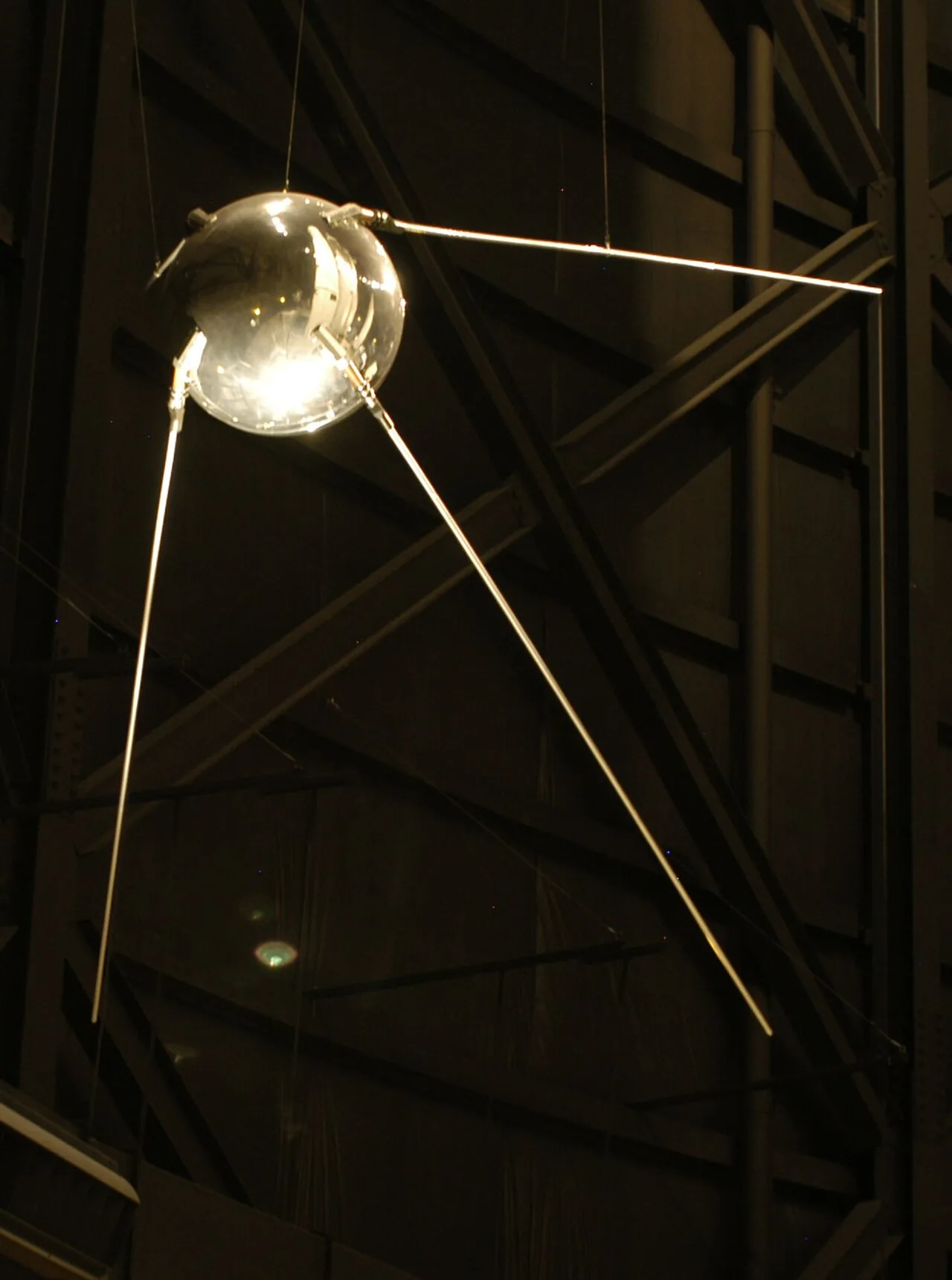
Both superpowers built thousands of nuclear weapons and long-range missiles. On October 4, 1957, the Soviets launched Sputnik 1, the first artificial satellite, which shocked Americans. Congress created NASA in 1958 and increased spending on science education, and the competition culminated in the American Moon landing of July 1969. Fear of nuclear war reached the home front: American schoolchildren practiced “duck and cover,” and families built fallout shelters. In his farewell address in January 1961 President Eisenhower, a general, warned of a “military-industrial complex.”
Berlin and Cuba
Between 1949 and 1961 some 3.5 million people fled East Germany, many through Berlin. On August 13, 1961, East Germany closed the border in Berlin with barbed wire and then built a wall, about 155 kilometers around West Berlin, with guard towers and a death strip. Estimates of the number of people killed trying to cross range from 136 to more than 200. The Wall became the symbol of the division of Europe.
Document 3 – Building the Berlin Wall, 1961
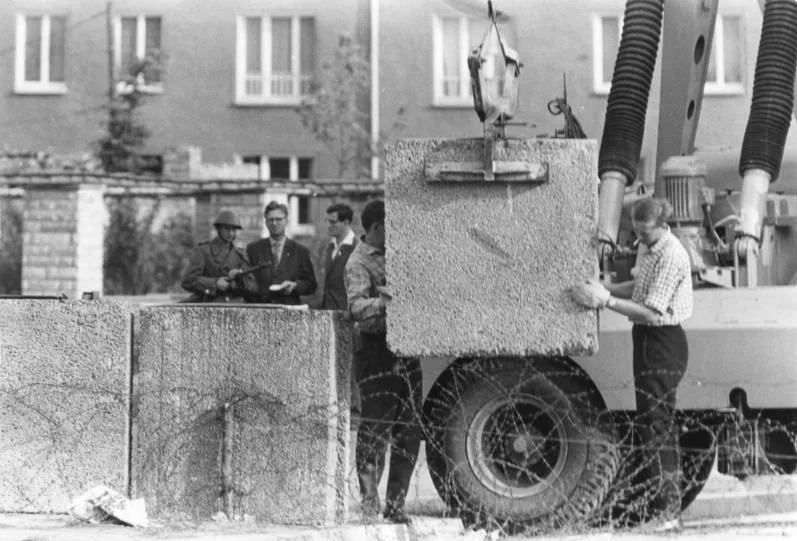
Source: Helmut J. Wolf, photograph, Berlin, August 1961, German Federal Archives; image from Wikimedia Commons.
Commentary. The photograph is of construction, not of the later death strip. A crane lifts a concrete slab while armed men watch and barbed wire still lies in the foreground, which suggests the early days, when the barrier was changing quickly. East Germany called it an “anti-fascist protection wall”; its main purpose was to stop emigration.
In 1959 Fidel Castro took power in Cuba, and in 1961 an American-backed invasion of exiles at the Bay of Pigs failed. In 1962 the Soviets secretly sent medium-range missiles to Cuba. The first R-12 missiles arrived in September, and on October 14 a U-2 plane photographed the sites. On October 22 Kennedy announced a naval “quarantine” of Cuba. After days of tension Khrushchev agreed on October 28 to withdraw the missiles; the United States promised not to invade Cuba and secretly agreed to remove its Jupiter missiles from Turkey.
Document 4 – Kennedy addresses the nation, October 22, 1962
Within the past week unmistakable evidence has established the fact that a series of offensive missile sites is now in preparation on that imprisoned island. The purposes of these bases can be none other than to provide a nuclear strike capability against the Western Hemisphere. […] We will not prematurely or unnecessarily risk the costs of worldwide nuclear war in which even the fruits of victory would be ashes in our mouth-but neither will we shrink from that risk at any time it must be faced.
Source: John F. Kennedy, address to the nation on the Cuban crisis, October 22, 1962. Text: Internet Modern History Sourcebook, Fordham University.
Commentary. Kennedy speaks to the public, not to Khrushchev. He presents the missiles as an offensive threat to the Western Hemisphere and says the United States will accept the risk of nuclear war if needed, but does not choose war at once: the “quarantine” was a limit short of attack. The crisis led to a telephone hotline between Washington and Moscow and to the Limited Test Ban Treaty of August 1963.
Definition: Proxy war
A war in which the superpowers support opposing sides in another country’s conflict instead of fighting each other directly, as in Korea, Vietnam, and Angola.
Vietnam and proxy wars
The superpowers fought through other countries. In Vietnam, the United States aided South Vietnam against communist North Vietnam and sent combat troops in 1965; the war ended for the United States with the Paris Peace Accords of January 1973, and North Vietnam captured Saigon on April 30, 1975. Civil wars in Angola and conflicts in the Middle East drew in both sides, and Chapter 9 shows how decolonization gave the rivalry new battlegrounds.
3. Detente, renewed tension, and the end, 1969-1991
In the 1970s both sides sought to lower the risk of war. President Richard Nixon visited China in February 1972 and signed the SALT I arms-limitation agreement with the Soviet Union in May 1972. In 1975 thirty-five countries signed the Helsinki Final Act, which accepted European borders and affirmed human rights. This period is called detente. It broke down after the Soviet invasion of Afghanistan in December 1979, and President Ronald Reagan, elected in 1980, raised defense spending and spoke of the Soviet Union as an “evil empire.”
In 1985 Mikhail Gorbachev became Soviet leader and began reforms: glasnost (openness) and perestroika (restructuring). Gorbachev and Reagan signed the INF Treaty, eliminating a class of nuclear missiles, in December 1987. In June 1987 Reagan stood at the Brandenburg Gate and challenged Gorbachev to “tear down this wall.” In Poland, the independent trade union Solidarity, founded in 1980, won the partly free elections of June 1989.
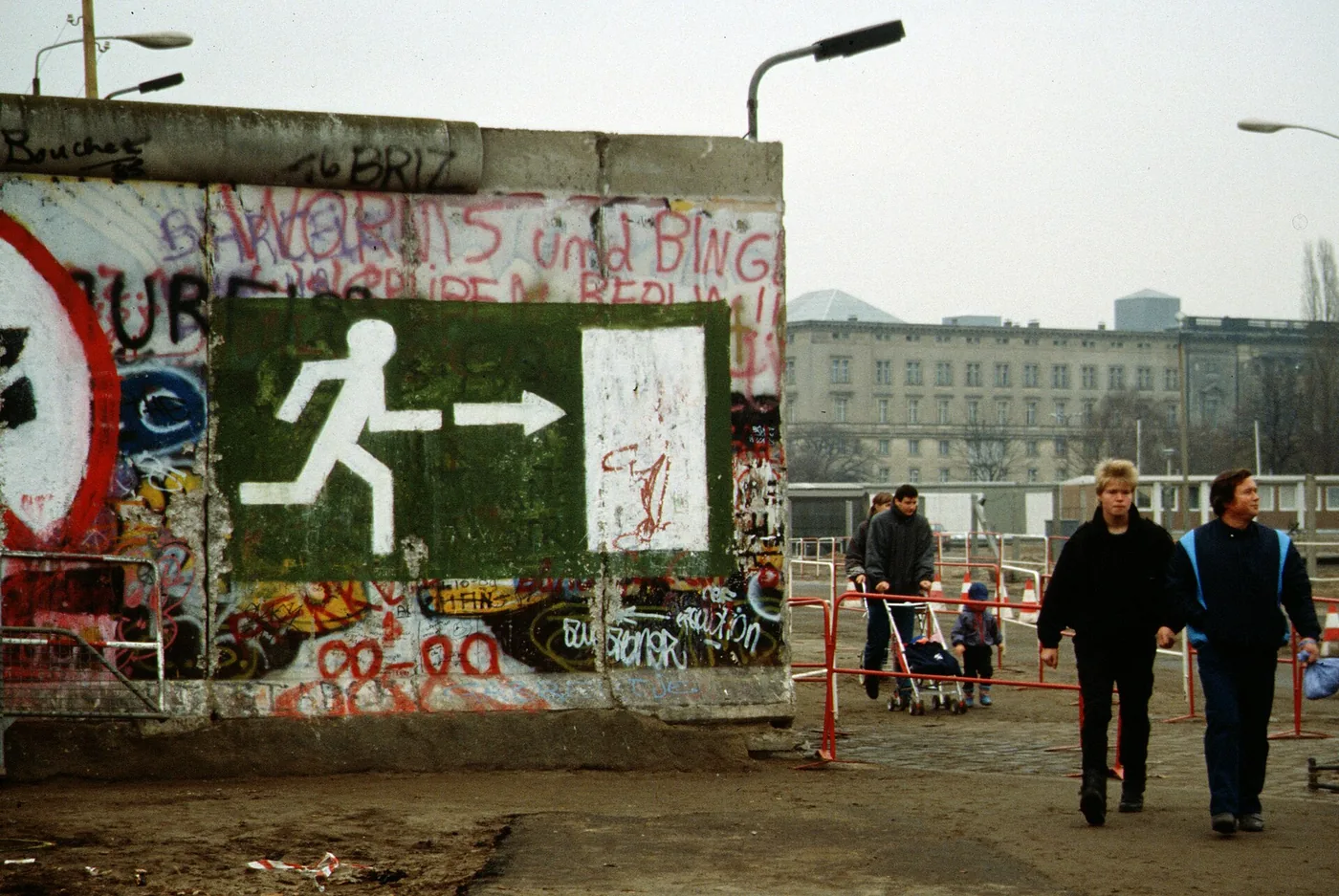
Hungary opened its border with Austria, and thousands of East Germans fled through it. Mass demonstrations followed in East Germany, and on November 9, 1989, the East German government announced that citizens could cross the border; crowds then began crossing the Wall. Germany reunified on October 3, 1990. After a failed coup in August 1991, the republics of the USSR declared independence, and the Soviet Union ceased to exist on December 26, 1991.
Document 5 – Reagan at the Brandenburg Gate, 1987
General Secretary Gorbachev, if you seek peace, if you seek prosperity for the Soviet Union and Eastern Europe, if you seek liberalization: Come here to this gate. Mr. Gorbachev, open this gate. Mr. Gorbachev — Mr. Gorbachev, tear down this wall!
Source: Ronald Reagan, remarks at the Brandenburg Gate, West Berlin, June 12, 1987. Transcript: American Rhetoric.
Commentary. Reagan spoke on the west side of the Wall, within sight of the East German guards, on the 750th anniversary of Berlin. His challenge was addressed to Gorbachev, and it ties openness to peace. Historians debate how much credit American pressure deserves compared with the Soviet economy, Gorbachev’s choices, and the movements of ordinary people in Eastern Europe. The Wall fell two and a half years later, not because the Soviets accepted a demand from the West, but because the East German state lost control.
4. Living in the Cold War
At home, fear of communism led to the Red Scare. Senator Joseph McCarthy claimed from 1950 that communists had infiltrated the government, and the Senate censured him in 1954 after he made charges without proof. In the Soviet Union, the party and police controlled speech, and citizens who criticized the state could be imprisoned. Each side competed in the Third World, supporting governments and rebels; this contest shaped the new nations created by decolonization. The Cold War also left a nuclear legacy: thousands of warheads and treaties to limit them.
Key takeaways
- The Cold War was a rivalry between the United States and the Soviet Union from about 1947 to 1991, fought without direct war between them.
- Containment, the Truman Doctrine, the Marshall Plan, and NATO answered Soviet control of Eastern Europe; the USSR replied with the Warsaw Pact.
- Crises: the Berlin Blockade (1948-1949), Korea (1950-1953), Hungary (1956), the Berlin Wall (1961), Cuba (1962), Vietnam, and Prague (1968).
- Detente in the 1970s eased tension; reforms under Gorbachev, protest movements, and the opening of the Berlin Wall (November 9, 1989) brought the end.
- The Soviet Union dissolved on December 26, 1991, leaving the United States as the sole superpower.

Quick review: flashcards
Tap a card to see the answer.