


This World History Grades 9-10 lesson covers Decolonization and Independence Movements, part of the unit “The modern world.” First, read the full lesson with its primary sources, maps and key terms. Then practice with the worksheet, check yourself with the quiz and get ready with the test.
At the stroke of midnight on August 14-15, 1947, in New Delhi, Jawaharlal Nehru told India’s Constituent Assembly that “at the stroke of the midnight hour, when the world sleeps, India will awake to life and freedom.” Yet the man most responsible for the movement, Mohandas Gandhi, was not in Delhi. He spent the day in Calcutta, fasting and praying for peace between Hindus and Muslims. The same independence had brought the partition of the country and terrible violence. This double event, liberation and division, runs through the history of decolonization. It was one of the most rapid changes in the political map of the world.
Guiding question: Why did the European empires collapse so quickly after 1945, and how did the new nations shape and face the Cold War world?
1. Why the empires ended
In 1939 Britain, France, the Netherlands, Belgium, and Portugal ruled much of Asia and Africa. Within thirty years most of those colonies were independent states. Historians point to several causes that worked together.
Definition: Decolonization
The process by which colonies gained independence from imperial powers, mostly between 1945 and 1975.
Definition: Self-determination
The principle that a people has the right to decide its own political status and form of government.
Nationalism. Educated Asians and Africans, many of whom had studied in Europe, used the ideals of liberty and equality against their rulers. The Indian National Congress was founded in 1885 and the Muslim League in 1906. Colonial peoples had also fought in the world wars and expected a reward. Weakened empires. The Japanese conquests of 1941-1942 showed that European powers could be defeated.
Britain and France emerged from World War II exhausted and in debt. New principles and new superpowers. The Atlantic Charter of 1941 had promised the right of peoples to choose their government. The United Nations Charter spoke of self-determination. The United States and the Soviet Union, both officially opposed to colonialism, courted the new nations, even as they competed for influence in them.
Document 1 – The Atlantic Charter, 1941
Third, they respect the right of all peoples to choose the form of government under which they will live; and they wish to see sovereign rights and self government restored to those who have been forcibly deprived of them;
Source: Atlantic Charter, joint declaration of Franklin D. Roosevelt and Winston Churchill, August 14, 1941 (point 3). Text: Avalon Project, Yale Law School.
Commentary. The third point of the Atlantic Charter speaks of “the right of all peoples to choose the form of government under which they will live” and “sovereign rights and self government restored to those who have been forcibly deprived of them.” Churchill told the House of Commons that it applied to nations under Nazi rule, not to the British Empire. However, nationalists in India and Africa read the words literally. A text can have more than one audience, and the readers who mattered most turned out to be those the authors had not intended.
Definition: Non-alignment
The policy of refusing to join either the Western or the Soviet bloc in the Cold War, followed by India, Yugoslavia, Egypt, Indonesia, and Ghana, among others.
2. India and the partition
Gandhi and the nationalist movement
After World War I, Gandhi turned the Indian National Congress into a mass movement based on satyagraha, nonviolent resistance. In 1930 he challenged the British salt tax and monopoly. On March 12 he set out from his ashram at Sabarmati with 78 volunteers. They walked about 240 miles (about 387 kilometers) to the sea at Dandi, which they reached on April 5-6 after 24 days. Thousands joined along the way. On April 6 he picked up salt from the shore, in violation of the law. Civil disobedience spread across India, and the British jailed more than 60,000 people. In August 1942, during the war, Congress called on Britain to “Quit India”; its leaders were arrested.
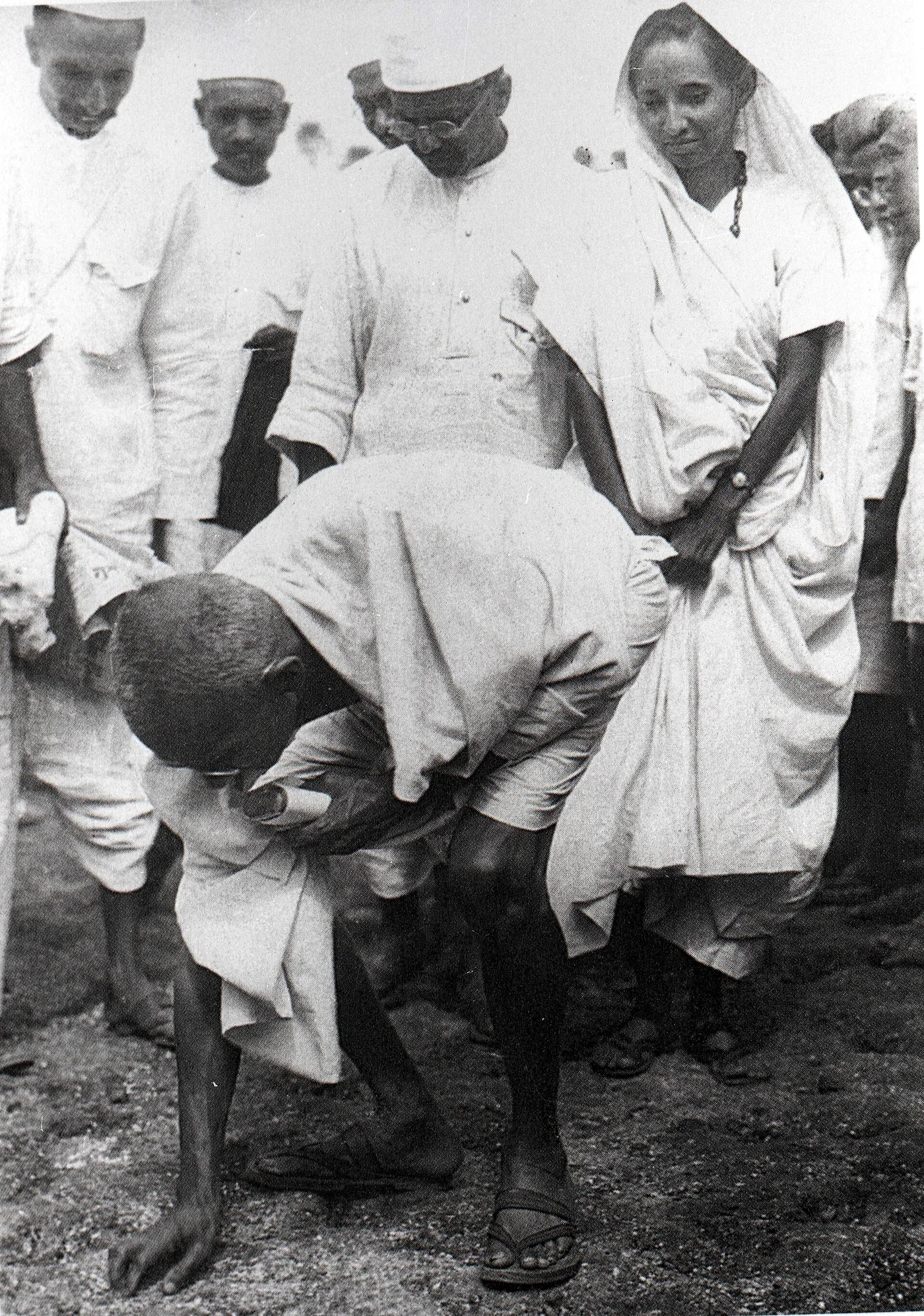
Commentary. Gandhi’s choice of salt was strategic. The tax on salt, which everyone needed, was a burden on the poor and a symbol that every villager could understand. The photograph is simple: a thin man bending to the ground, with followers beside him. Press coverage carried the picture around the world and made the British position hard to defend.
Independence and partition
Britain, exhausted by war and facing unrest, announced in 1946-1947 that it would leave. The Muslim League, led by Muhammad Ali Jinnah, demanded a separate state for Muslims. Congress, led by Gandhi and Nehru, wanted a united India. Talks failed, and violence broke out in Calcutta in August 1946. Lord Mountbatten, the last viceroy, advanced the date of independence to August 1947 and accepted partition. A boundary commission headed by Cyril Radcliffe drew lines through Punjab and Bengal in a few weeks. India and Pakistan, itself divided into West and East Pakistan, became independent on August 15 and August 14, 1947.
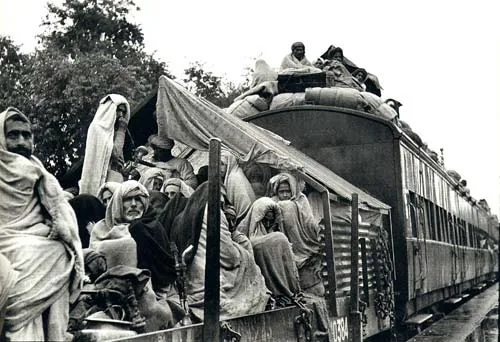
Partition displaced an estimated 12 to 20 million people, among the largest migrations in modern history. The violence killed an estimated 200,000 to 2 million, though estimates vary widely. Hindus and Sikhs fled to India and Muslims to Pakistan; trains arrived full of dead passengers. Gandhi was assassinated on January 30, 1948 by a Hindu extremist who blamed him for appeasing Muslims. Nehru led India as prime minister until 1964. East Pakistan broke away in 1971 as Bangladesh. Burma and Ceylon (Sri Lanka) became independent in 1948.
Document 2 – Nehru, “A Tryst with Destiny,” 1947
Long years ago we made a tryst with destiny, and now the time comes when we shall redeem our pledge, not wholly or in full measure, but very substantially. At the stroke of the midnight hour, when the world sleeps, India will awake to life and freedom. A moment comes, which comes but rarely in history, when we step out from the old to the new, when an age ends, and when the soul of a nation, long supressed, finds utterance. […] The service of India means the service of the millions who suffer. It means the ending of poverty and ignorance and disease and inequality of opportunity. The ambition of the greatest man of our generation has been to wipe every tear from every eye.
Source: Jawaharlal Nehru, “A Tryst with Destiny,” speech to the Constituent Assembly of India, New Delhi, midnight of August 14-15, 1947. Text: Internet Modern History Sourcebook, Fordham University.
Commentary. The speech celebrates the moment but warns of the work ahead. Nehru says freedom brings “responsibility,” and defines the aim as the “ending of poverty and ignorance and disease and inequality of opportunity.” He does not mention partition in the extract, but elsewhere in the speech he refers to the “pains of labour” still being felt. The phrase “wipe every tear from every eye” recalls Gandhi, whom he calls “the greatest man of our generation.”
3. Southeast Asia and the Middle East
In Southeast Asia, the Japanese occupation had broken colonial control, and local leaders declared independence before the Europeans returned. Sukarno proclaimed Indonesia’s independence on August 17, 1945. The Dutch tried to retake the islands in a four-year war. Then, under American and UN pressure, they transferred sovereignty in December 1949. The Philippines became independent from the United States on July 4, 1946.
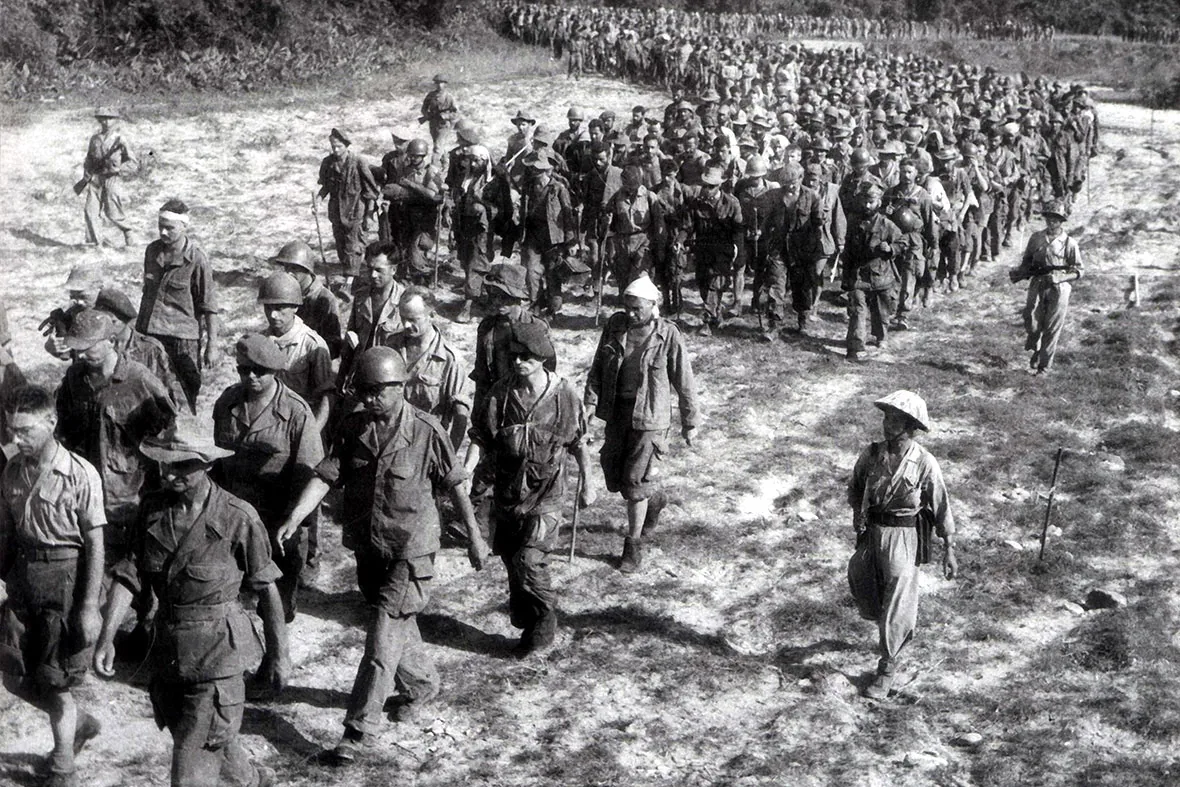
In Vietnam, Ho Chi Minh, leader of the Viet Minh, proclaimed the Democratic Republic of Vietnam in Hanoi on September 2, 1945. He opened with the words of the American Declaration of Independence. France refused to give up Indochina, and the First Indochina War (1946-1954) ended at Dien Bien Phu, where French forces surrendered on May 7, 1954. The Geneva Conference divided Vietnam at the 17th parallel and promised elections in 1956, which were never held. Another war followed, as Chapter 8 showed.
Document 3 – Ho Chi Minh, Vietnamese Declaration of Independence, 1945
“All men are created equal. They are endowed by their Creator with certain inalienable rights; among these are Life, Liberty, and the pursuit of Happiness.” This immortal statement was made in the Declaration of Independence of the United States of America in 1776. In a broader sense, this means: All the peoples on the earth are equal from birth, all the peoples have a right to live, to be happy and free. The Declaration of the French Revolution made in 1791 on the Rights of Man and the Citizen also states: “All men are born free and with equal rights, and must always remain free and have equal rights.” Those are undeniable truths. Nevertheless, for more than eighty years, the French imperialists, abusing the standard of Liberty, Equality, and Fraternity, have violated our Fatherland and oppressed our fellowcitizens. They have acted contrary to the ideals of humanity and justice.
Source: Vietnamese Declaration of Independence, proclaimed by Ho Chi Minh, Hanoi, September 2, 1945. Text: Internet Modern History Sourcebook, Fordham University.
Commentary. Ho Chi Minh quotes the American Declaration of Independence and then the French Declaration of the Rights of Man to accuse France of violating its own ideals. He was a founder of the Vietnamese Communist Party, yet he chose to open with Jefferson’s words, probably to win American support. He did not receive it: the United States, preoccupied with Europe and the Cold War, backed France. The text shows how colonized peoples used the language of the Atlantic revolutions (Chapter 2) against empire.
In the Middle East, Britain ended its mandate in Palestine in 1948. The UN had proposed partition in November 1947, Jewish leaders proclaimed the State of Israel on May 14, 1948, and neighboring Arab states attacked. Many Palestinians fled or were expelled, and the conflict between Israelis and Palestinians has continued. In 1956 Egypt, led by Gamal Abdel Nasser, nationalized the Suez Canal. Britain, France, and Israel attacked, but the United States and the Soviet Union demanded that they withdraw. This marked the end of British and French great-power status.
4. Africa
In sub-Saharan Africa independence came later and faster. The Gold Coast, renamed Ghana, became independent from Britain on March 6, 1957 under Kwame Nkrumah, the first sub-Saharan African colony to win independence from European rule. In 1960, the “Year of Africa,” seventeen colonies became independent: fourteen from France, two from Britain (Nigeria and Somalia), and one from Belgium (the Congo). The British Prime Minister Harold Macmillan spoke of a “wind of change” blowing through the continent in a speech in South Africa in February 1960.
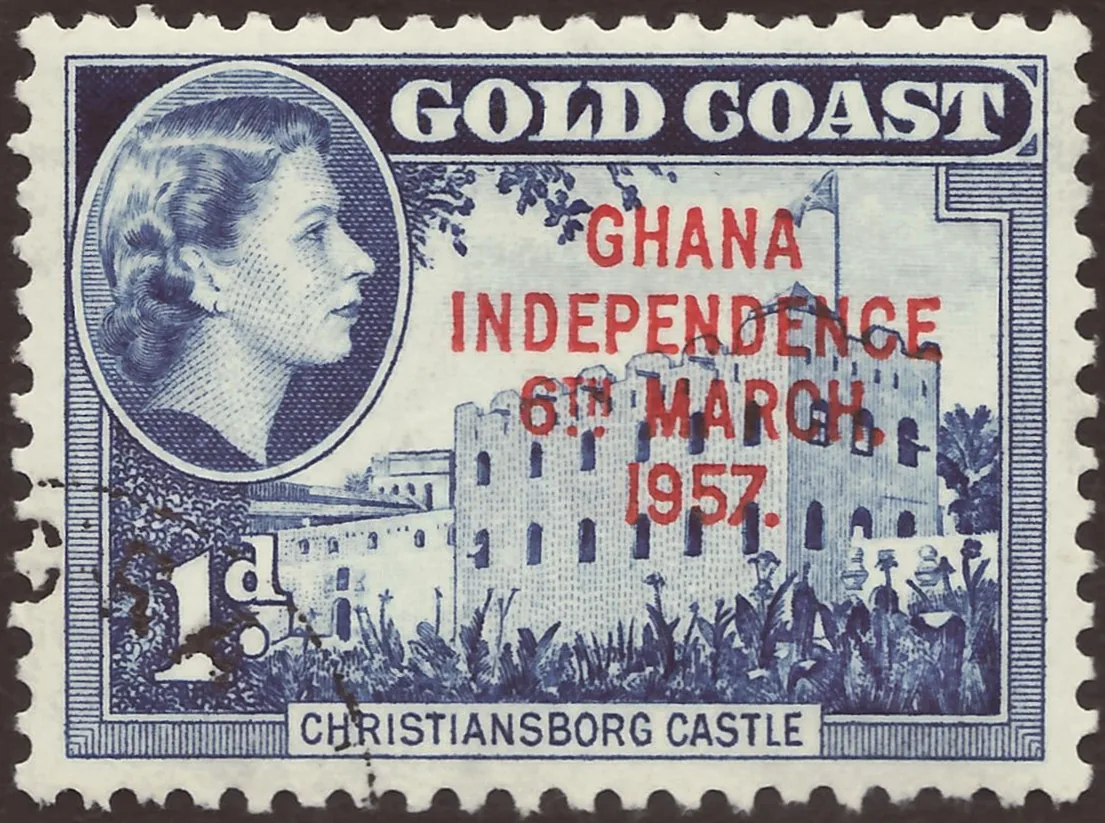
Not every transfer was peaceful. In Algeria, which France considered part of France and where about a million Europeans lived, a war lasted from 1954 to 1962. The Evian Accords of March 1962 led to independence on July 5, 1962. In Kenya, the Mau Mau uprising (1952-1960) was put down brutally by Britain, but independence still came on December 12, 1963. The Belgian Congo became independent on June 30, 1960, and fell almost at once into civil war, in which the Cold War powers intervened.
Portugal, a dictatorship, fought long wars in Angola and Mozambique. The Carnation Revolution of April 1974 in Lisbon led to their independence in 1975. In white-ruled Southern Rhodesia, independence came in 1980 as Zimbabwe; Namibia followed in 1990. South Africa was already independent. There the system of apartheid, a legal segregation by race, ended only with the elections of April 1994 won by Nelson Mandela.
Document 4 – De Gaulle in Algeria, 1958
What must be achieved is the basic transformation of this country, so brave, so alive, but also so full of difficulties and suffering. This means that it is necessary for the living conditions of each man and woman to improve from day to day. This means that, for the benefit of the inhabitants, the resources of the earth and the ability of the elites must be brought to light and developed. This means that children must be taught. This means that all Algeria must have her share in what modern civilization can and must bring to men in terms of well-being and dignity.
Source: Charles de Gaulle, speech at Constantine, Algeria, October 3, 1958 (extract). Text: Internet Modern History Sourcebook, Fordham University.
Commentary. De Gaulle speaks as the head of France’s new government, five months after a crisis over Algeria brought him to power. He promises schools, jobs, equal pay, and land for Muslim farmers, but within a French framework: at that moment he does not offer independence. The speech shows the choice that many empires made, reform instead of independence, and how events overtook it: four years later Algeria was independent.
- August 15, 1947 Independence of India and Pakistan
- September 2, 1945 Ho Chi Minh proclaims Vietnamese independence
- December 27, 1949 Netherlands transfers sovereignty to Indonesia
- May 7, 1954 French defeat at Dien Bien Phu
- April 1955 Bandung Conference
- March 6, 1957 Ghana becomes independent
- 1960 Seventeen African states become independent
- July 5, 1962 Algerian independence
- 1975 Angola and Mozambique become independent
- April 1994 Mandela elected; apartheid ends
5. The Third World, the Cold War, and the legacy
In April 1955, twenty-nine governments of Asia and Africa, five of them sponsors (Burma, India, Indonesia, Pakistan, and Ceylon), met at Bandung, Indonesia, without the great powers. They condemned colonialism and racism, called for economic cooperation, and sought to keep the Cold War out of their regions. Nehru, Nasser, Sukarno, and Zhou Enlai were present. In 1961 Yugoslavia, India, Egypt, Ghana, and Indonesia founded the Non-Aligned Movement. It refused to join NATO or the Warsaw Pact. The label “Third World”, coined in France in 1952 by Alfred Sauvy, referred to countries outside the two blocs; today people more often say “the Global South.”
Document 5 – Sukarno at Bandung, 1955
How can we say it is dead, so long as vast areas of Asia and Africa are unfree. And, I beg of you do not think of colonialism only in the classic form which we of Indonesia, and our brothers in different parts of Asia and Africa, knew. Colonialism has also its modern dress, in the form of economic control, intellectual control, actual physical control by a small but alien community within a nation. It is a skilful and determined enemy, and it appears in many guises. It does not give up its loot easily. Wherever, whenever and however it appears, colonialism is an evil thing, and one which must be eradicated from the earth.
Source: Sukarno, opening address to the Asian-African Conference, Bandung, April 18, 1955 (excerpts). Text: Internet Modern History Sourcebook, Fordham University.
Commentary. Sukarno argues that colonialism has “its modern dress”: economic and intellectual control, not only direct rule. This idea, later called neocolonialism, shaped the thinking of the Non-Aligned Movement. His list of what unites the delegates, “a common detestation of colonialism” and of “racialism,” shows what they hoped to achieve together. The photograph below shows the delegates standing at the opening.
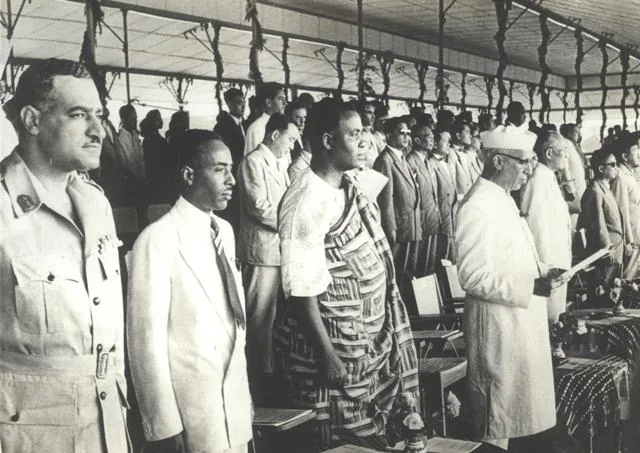
In 1960 the UN General Assembly adopted Resolution 1514, the Declaration on the Granting of Independence to Colonial Countries and Peoples, by 89 votes to none, with 9 abstentions (including the United States, Britain, France, Belgium, Spain, and Portugal). It declared that colonialism was a denial of human rights and that lack of preparation should never be a pretext for delaying independence. UN membership grew from 51 states in 1945 to 99 in 1960 and 193 today.
Independence did not solve every problem. Many new states inherited borders drawn by Europeans that ignored ethnic and linguistic groups, economies built to export raw materials, few trained administrators, and dependence on former rulers. Some became one-party states or military dictatorships. Some, like India, remained democracies. Others, like Vietnam and Angola, were battlegrounds of the Cold War. Still others, like South Korea and Singapore, grew quickly. The legacies of colonialism, including languages, borders, and unequal economic ties, still shape the contemporary world.
Key takeaways
- Decolonization changed the map of the world between 1945 and the 1970s: colonies in Asia and Africa became independent states.
- Causes: nationalist movements, weakened European powers, the principle of self-determination, and rivalry between the United States and the Soviet Union.
- India won independence in 1947 through Gandhi’s nonviolent movement but was divided; partition displaced 12 to 20 million people.
- In Vietnam, Indonesia, and Algeria, independence came through armed struggle; Ghana (1957) and the Year of Africa (1960) opened the African wave.
- The Bandung Conference (1955) and the Non-Aligned Movement sought a path outside the Cold War; UN membership grew from 51 (1945) to 193.

Quick review: flashcards
Tap a card to see the answer.