


This worksheet on The Cold War belongs to the World History Grades 9-10 course. Its questions use primary sources, maps and timelines, and they move from basic recall to short writing tasks. Before you start, review the lesson; afterward, try the true or false quiz.
Exercise 1 : Vocabulary of the Cold War
Match each term with its definition.
- Containment
- Iron curtain
- Satellite state
- NATO
- Warsaw Pact
- Detente
- Glasnost
- Proxy war
A. A relaxation of tension between the superpowers. B. A country controlled by a stronger neighbor. C. The Soviet-led alliance of 1955. D. A war fought in another country by forces backed by the superpowers. E. Gorbachev’s policy of openness. F. The Western alliance of 1949. G. Churchill’s image of the line dividing Europe. H. Stopping the spread of communism without war.
Exercise 2 : The iron curtain
Document 1 – Churchill, 1946
From Stettin in the Baltic to Trieste in the Adriatic, an iron curtain has descended across the Continent. Behind that line lie all the capitals of the ancient states of Central and Eastern Europe. Warsaw, Berlin, Prague, Vienna, Budapest, Belgrade, Bucharest and Sofia, all these famous cities and the populations around them lie in what I must call the Soviet sphere, and all are subject in one form or another, not only to Soviet influence but to a very high and, in many cases, increasing measure of control from Moscow.
Source: Winston Churchill, “The Sinews of Peace” (the Iron Curtain speech), Westminster College, Fulton, Missouri, March 5, 1946. Text: National Churchill Museum.
- Present the document (author, date, place, situation of the author).
- What line does Churchill draw? Name three capitals behind it.
- What does he say about Athens?
- Why might Churchill’s warning be considered both accurate and exaggerated?
Exercise 3 : Two views of the same speech
Document 2 – Churchill, 1946
From Stettin in the Baltic to Trieste in the Adriatic, an iron curtain has descended across the Continent. Behind that line lie all the capitals of the ancient states of Central and Eastern Europe. Warsaw, Berlin, Prague, Vienna, Budapest, Belgrade, Bucharest and Sofia, all these famous cities and the populations around them lie in what I must call the Soviet sphere, and all are subject in one form or another, not only to Soviet influence but to a very high and, in many cases, increasing measure of control from Moscow.
Source: Winston Churchill, “The Sinews of Peace” (the Iron Curtain speech), Westminster College, Fulton, Missouri, March 5, 1946. Text: National Churchill Museum.
Document 3 – Stalin’s reply, 1946
Mr. Churchill now stands in the position of a firebrand of war. And Mr. Churchill is not alone here. He has friends not only in England but also in the United States of America. In this respect, one is reminded remarkably of Hitler and his friends.
Source: Joseph Stalin, reply to Churchill, interview in Pravda, March 14, 1946, as published in The New York Times. Text: Internet Modern History Sourcebook, Fordham University.
- Present each document.
- What does Churchill accuse the Soviets of doing in Eastern Europe?
- How does Stalin describe Churchill?
- Compare the tone of the two texts.
- Explain why each leader addressed a public audience, not only the other government.
Exercise 4 : The Truman Doctrine
Document 4 – Truman, 1947
At the present moment in world history nearly every nation must choose between alternative ways of life. The choice is too often not a free one. One way of life is based upon the will of the majority, and is distinguished by free institutions, representative government, free elections, guarantees of individual liberty, freedom of speech and religion, and freedom from political oppression. The second way of life is based upon the will of a minority forcibly imposed upon the majority. It relies upon terror and oppression, a controlled press and radio; fixed elections, and the suppression of personal freedoms. I believe that it must be the policy of the United States to support free peoples who are resisting attempted subjugation by armed minorities or by outside pressures. […] I believe that we must assist free peoples to work out their own destinies in their own way.
Source: Harry S. Truman, address to a joint session of Congress (the Truman Doctrine), March 12, 1947. Text: Avalon Project, Yale Law School.
- Present the document.
- What two ways of life does Truman describe?
- What policy does he propose, and what means does he name?
- Is this a neutral description? Justify using the text.
Exercise 5 : The Marshall Plan
Document 5 – Marshall, 1947
Our policy is directed not against any country or doctrine but against hunger, poverty, desperation, and chaos. Its purpose should be the revival of a working economy in the world so as to permit the emergence of political and social conditions in which free institutions can exist. […] Any government which maneuvers to block the recovery of other countries cannot expect help from us.
Source: George C. Marshall, address at Harvard University, June 5, 1947. Text: Wikisource.
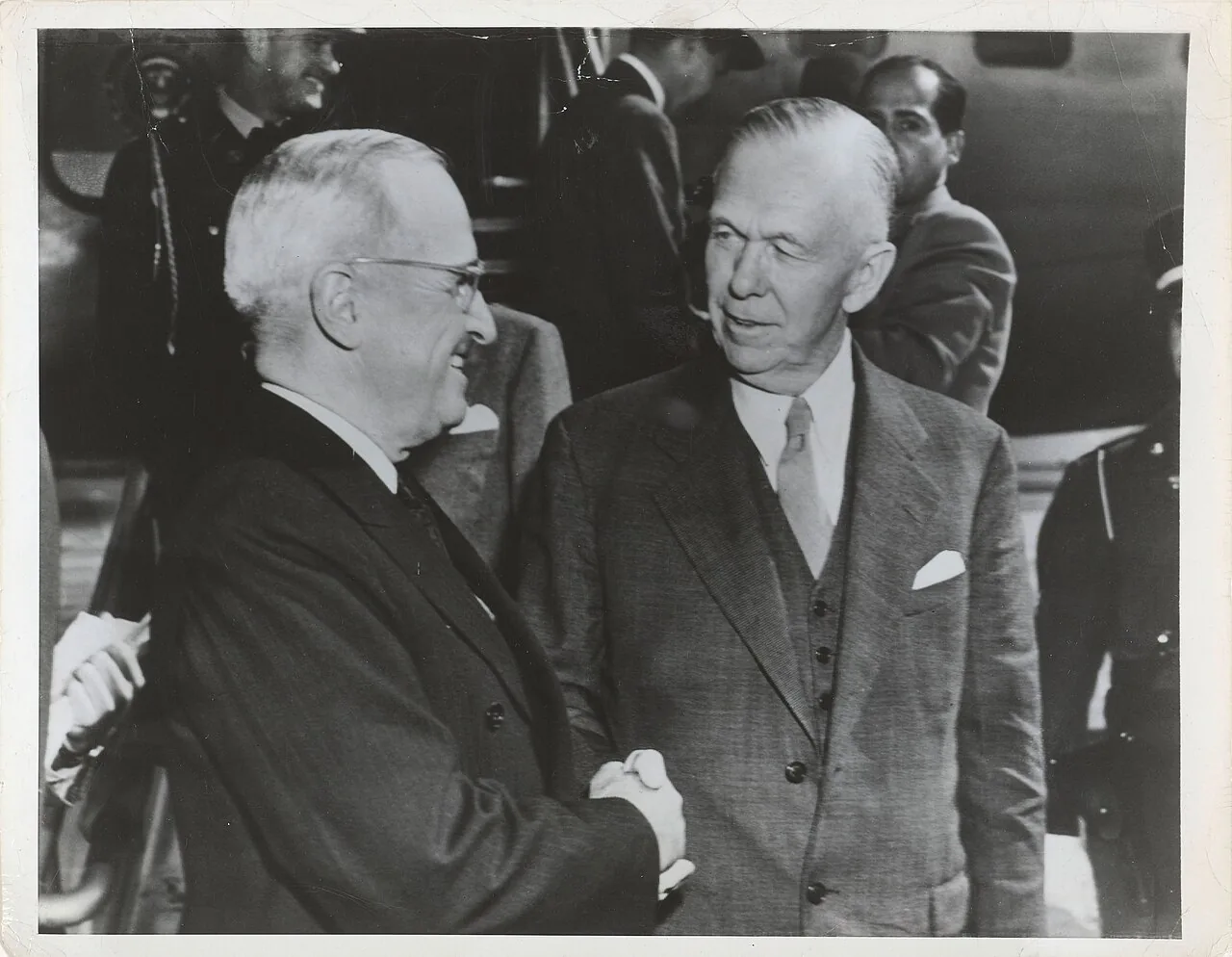
- Present both documents.
- Against what does Marshall say the policy is directed?
- Which governments does he say will not receive help?
- Why did the Soviet Union refuse the Plan?
Exercise 6 : The Berlin Airlift
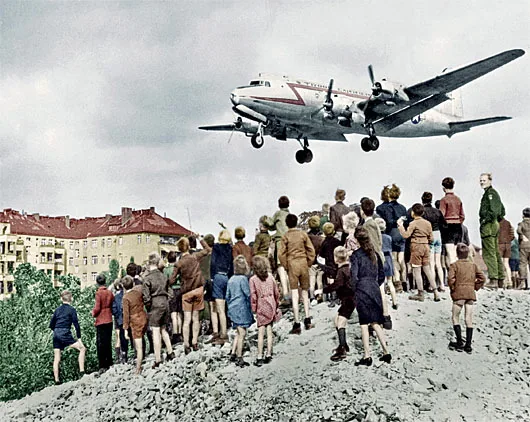
- Present the image (subject, date, place, source).
- Describe the plane, the children, and the setting.
- Explain why the Western powers chose an airlift.
- What did the Airlift show about the superpowers?
Remember that roads, railways, and canals into West Berlin were closed.
Exercise 7 : NATO and the Warsaw Pact
Points: 1 Berlin, 2 Warsaw, 3 Moscow, 4 Prague, 5 Budapest, 6 Belgrade.
- Which numbered cities were capitals of Warsaw Pact states? Which was not a Pact capital but a communist one?
- Which city lay deep inside East Germany but was partly Western?
- Explain why the dashed line is called the “iron curtain.”
Exercise 8 : Article 5 and the idea of collective defense
Document 6 – The North Atlantic Treaty, 1949
The Parties agree that an armed attack against one or more of them in Europe or North America shall be considered an attack against them all, and consequently they agree that, if such an armed attack occurs, each of them, in exercise of the right of individual or collective selfdefence recognised by Article 51 of the Charter of the United Nations, will assist the Party or Parties so attacked by taking forthwith, individually, and in concert with the other Parties, such action as it deems necessary, including the use of armed force, to restore and maintain the security of the North Atlantic area.
Source: North Atlantic Treaty, Washington, April 4, 1949, Article 5. Text: Internet Modern History Sourcebook, Fordham University.
- Present the document.
- What do the members agree to do if one of them is attacked?
- Why did Western Europeans want such a guarantee in 1949?
- Explain how the Warsaw Pact of 1955 was a response.
Exercise 9 : Khrushchev on Stalin
Document 7 – The secret speech, 1956
Stalin acted not through persuasion, explanation, and patient cooperation with people, but by imposing his concepts and demanding absolute submission to his opinion. Whoever opposed this concept or tried to prove his viewpoint, and the correctness of his position-was doomed to removal from the leading collective and to subsequent moral and physical annihilation.
Source: Nikita S. Khrushchev, secret speech to the Twentieth Congress of the Soviet Communist Party, February 25, 1956. Text: Internet Modern History Sourcebook, Fordham University.
- Present the document.
- What does Khrushchev blame Stalin for?
- What does the term “enemy of the people” allow?
- Why was the speech a risk for Khrushchev?
Exercise 10 : The Kitchen Debate and Vienna
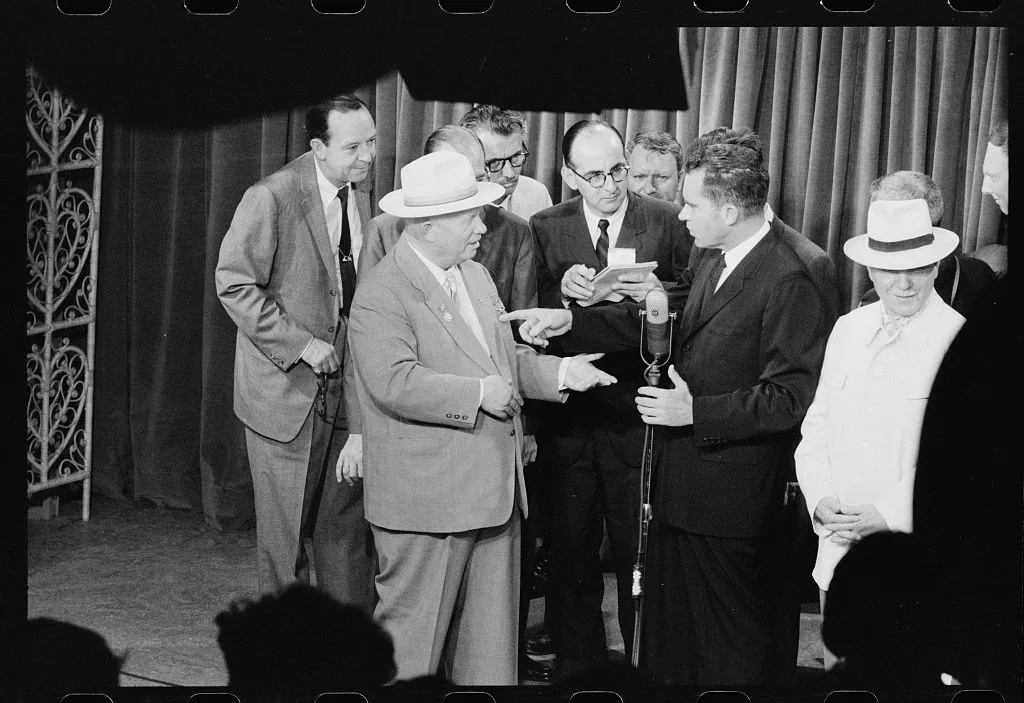
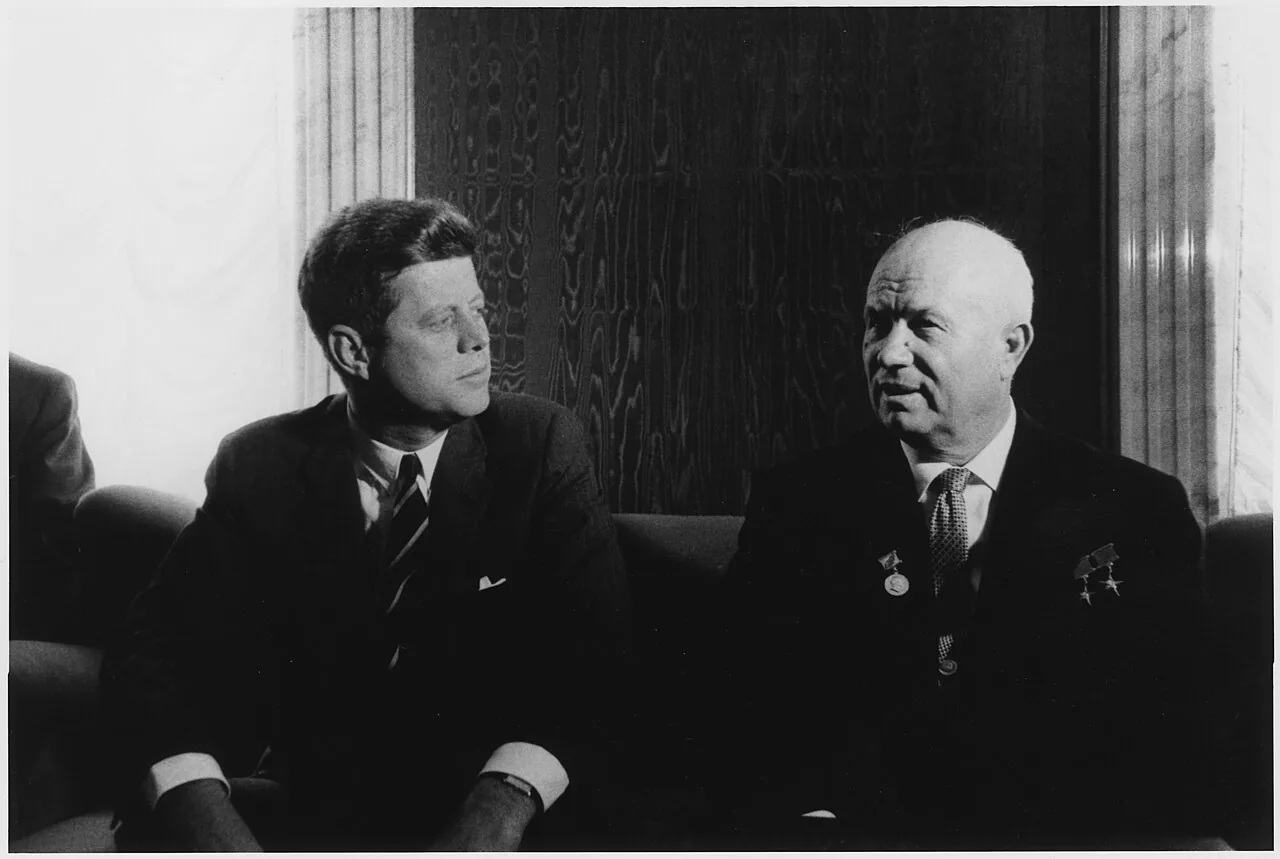
- Present each image.
- Describe the gestures and settings.
- What do they tell about the two kinds of Cold War contacts, a public argument and a private meeting?
- Which is more useful as evidence for the leaders’ real views? Explain.
Exercise 11 : The Sputnik shock
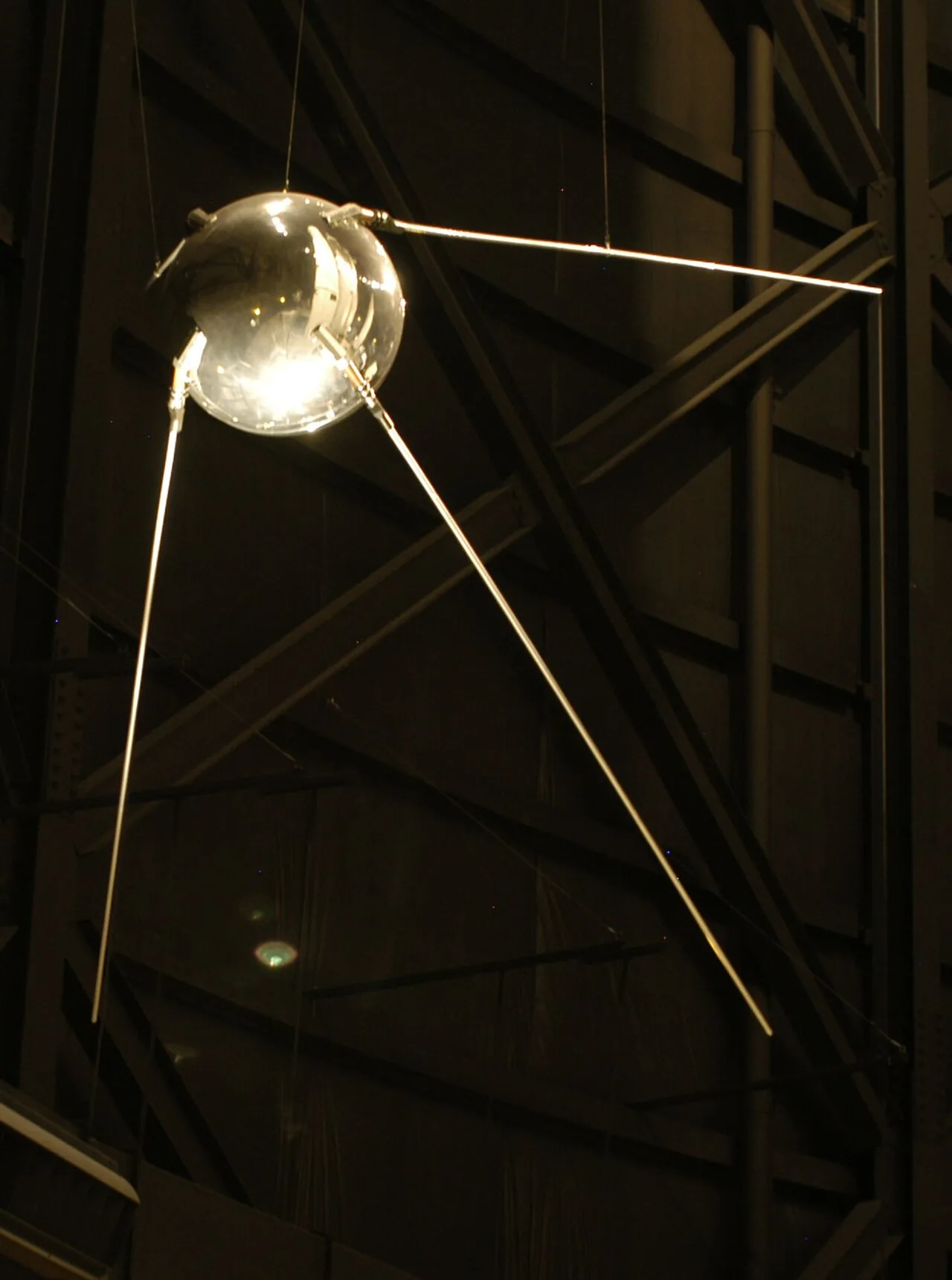
- Present the image.
- Describe what you see.
- Explain why a satellite the size of a beach ball alarmed Americans.
- Name two American responses to Sputnik.
Exercise 12 : Korea
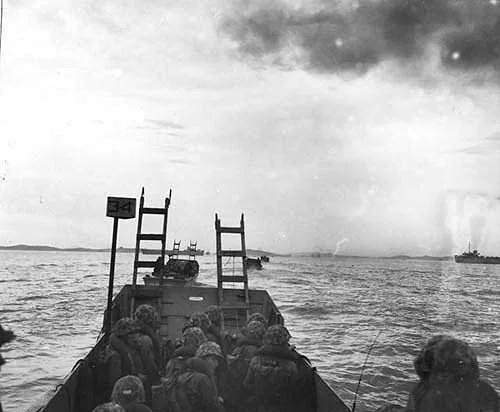
- Present the image.
- Describe what the viewer sees from the landing craft.
- Explain why Korea is considered a Cold War war although it was fought in one country.
- How did the war end?
Exercise 13 : Eisenhower’s warning
Document 8 – Eisenhower, 1961
In the councils of government, we must guard against the acquisition of unwarranted influence, whether sought or unsought, by the militaryindustrial complex. The potential for the disastrous rise of misplaced power exists and will persist. We must never let the weight of this combination endanger our liberties or democratic processes. We should take nothing for granted. Only an alert and knowledgeable citizenry can compel the proper meshing of the huge industrial and military machinery of defense with our peaceful methods and goals, so that security and liberty may prosper together.
Source: Dwight D. Eisenhower, farewell address to the nation, January 17, 1961. Text: Avalon Project, Yale Law School.
- Present the document and explain why the author’s experience matters.
- What danger does he name?
- What does he say citizens must do?
- Explain how the arms race could create the “military-industrial complex.”
Exercise 14 : Cuba: two leaders
Document 9 – Khrushchev on Cuba, 1960
A few days ago the Governor of New York State, Rockefeller, openly called for struggle against the government of Cuba and the Cuban people. He advised that a course directed against Cuba should be taken and that the regime chosen by the people should be stifled through economic blockade. […] The Soviet Union is raising its voice on behalf of, and is offering help to, the people of Cuba who are fighting for their independence.
Source: Nikita S. Khrushchev, speech to the RSFSR Teachers’ Congress on Cuba, Moscow, July 9, 1960. Text: Internet Modern History Sourcebook, Fordham University.
Document 10 – Kennedy on Cuba, 1962
Within the past week unmistakable evidence has established the fact that a series of offensive missile sites is now in preparation on that imprisoned island. The purposes of these bases can be none other than to provide a nuclear strike capability against the Western Hemisphere. […] We will not prematurely or unnecessarily risk the costs of worldwide nuclear war in which even the fruits of victory would be ashes in our mouth-but neither will we shrink from that risk at any time it must be faced.
Source: John F. Kennedy, address to the nation on the Cuban crisis, October 22, 1962. Text: Internet Modern History Sourcebook, Fordham University.
- Present each document.
- How does Khrushchev justify Soviet support for Cuba?
- How does Kennedy describe the missiles?
- Compare what each leader claims to be defending.
Exercise 15 : The Cuban Missile Crisis
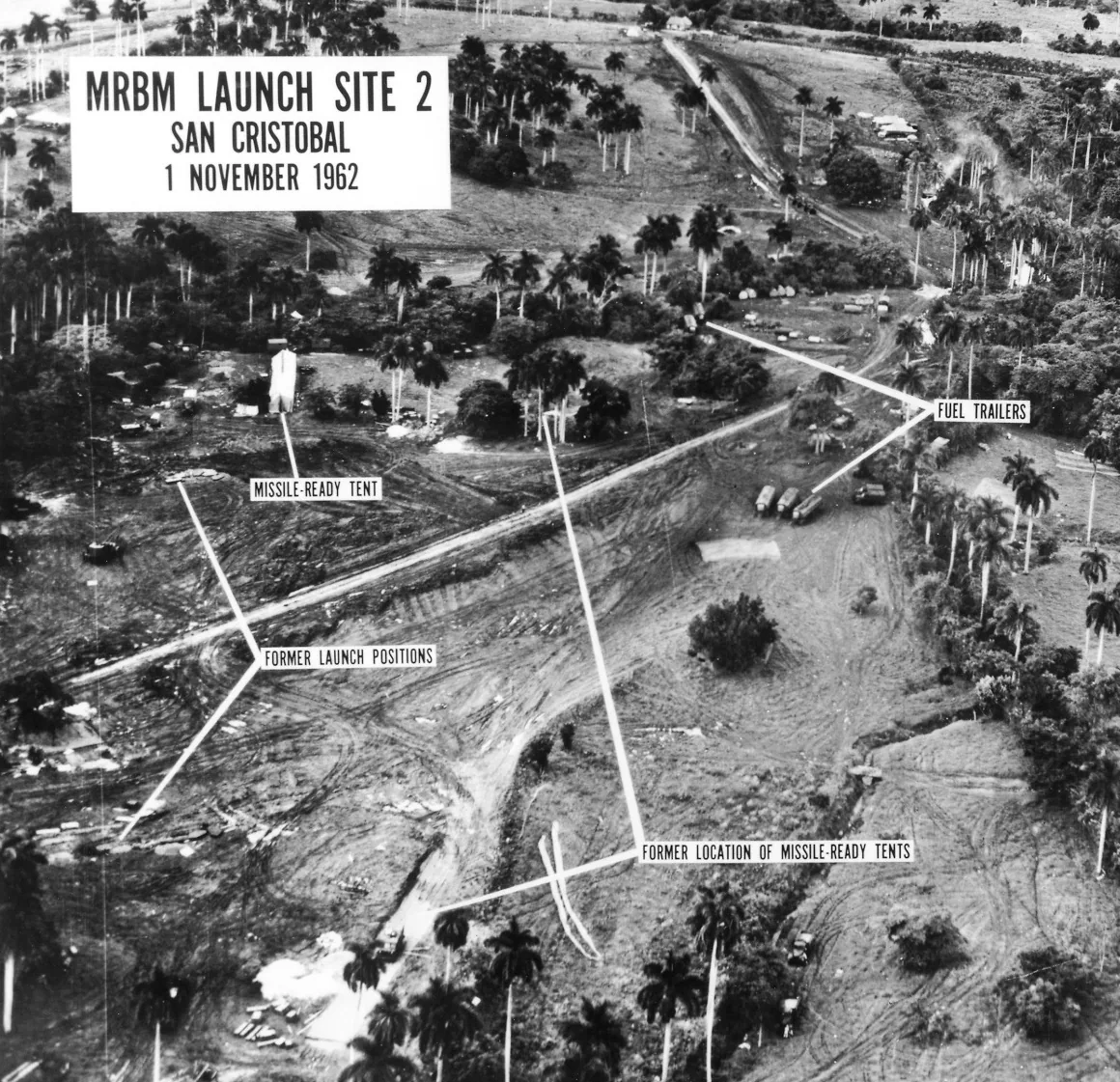
- Present the image.
- What do the labels show?
- Explain why aerial photographs were crucial in October 1962.
- What was the outcome of the crisis?
Exercise 16 : Locate the crisis
Points: 1 Havana, 2 Washington, D.C., 3 Miami, 4 Guantanamo Bay, 5 Cape Canaveral, 6 San Cristobal.
- Which number is the capital of Cuba, and which the American capital?
- About how far is Havana from Washington, according to the map?
- Why did the location of Cuba worry the United States?
Exercise 17 : Reading numbers: the Berlin Wall
| Fact | Figure |
|---|---|
| People who left East Germany, 1949-1961 | about 3.5 million |
| Length of the border around West Berlin | about 155 km |
| People killed at the Wall (estimates) | 136 to more than 200 |
| Berlin Airlift cargo | about 2.3 million tons, 278,000 flights |
Source: Wikipedia, “Berlin Wall” and “Berlin Blockade,” summarizing historians’ estimates.
- Why do the numbers about deaths give a range?
- About what share of East Germans had left before 1961? Use the lesson.
- Explain how the first figure explains the decision of August 1961.
Exercise 18 : Order the events
Put these events in order.
- Cuban Missile Crisis
- Truman Doctrine
- Sputnik
- Fall of the Berlin Wall
- Berlin Blockade begins
- Korean armistice
- Hungarian revolution
- Dissolution of the USSR
Exercise 19 : Durations
- How many years passed between the Berlin Wall’s construction (1961) and its opening (1989)?
- How many days did the Cuban Missile Crisis last (October 16-28, 1962)?
- For how many years did the Berlin Wall stand? (Answer in years and months.)
Exercise 20 : Guided research: Gorbachev and 1989
Mini-inquiry. Keywords: Gorbachev glasnost perestroika 1989 revolutions Berlin Wall. Reliable sites: the National Archives (archives.gov), the Wilson Center Digital Archive (digitalarchive.wilsoncenter.org), the Library of Congress (loc.gov), the Reagan Presidential Library. Fill in the sheet:
- Year Gorbachev became Soviet leader and the two reforms he launched.
- Event that opened the Wall on November 9, 1989.
- Two other countries of Eastern Europe that changed in 1989.
- One reason historians give for why the Soviet Union did not use force in 1989.
Exercise 21 : CER paragraph: why the Cold War ended
Write a Claim-Evidence-Reasoning paragraph (6-8 sentences): Why did the Cold War end between 1989 and 1991? Use two dates and one document.
Think about reform, protest, and economics.
Exercise 22 : SAQ: the arms race
(a) Identify one event that began the arms race between the superpowers. (b) Identify one way the arms race affected ordinary Americans or Soviet citizens. (c) Explain one way the Cuban Missile Crisis changed relations between the superpowers.
Exercise 23 : True or false? Justify
- The Marshall Plan offered aid only to Western Europe.
- The Berlin Wall was built to keep people in East Germany.
- The United States and the Soviet Union fought each other directly in Korea.
- The Soviet Union dissolved in 1989.
Exercise 24 : Causes and consequences
Sort into cause or consequence of the Berlin Wall: (1) emigration from East Germany, (2) the division of Germany into two states, (3) the symbol of a divided Europe, (4) the Berlin Blockade, (5) fall of the East German government in 1989.


Quick review: flashcards
Tap a card to see the answer.