


This World History Grades 9-10 lesson covers The Interwar Years and Totalitarianism, part of the unit “Empires and world wars.” First, read the full lesson with its primary sources, maps and key terms. Then practice with the worksheet, check yourself with the quiz and get ready with the test.
In the autumn of 1923, a loaf of bread in Berlin cost millions of marks, then billions, and some families papered their walls with banknotes because the paper was worth more as wallpaper than as money. Six years later, in October 1929, crowds filled Wall Street as the American stock market collapsed. Within three years millions of workers on both sides of the Atlantic had lost their jobs.
Between those two scenes, and during the years that followed, the hopes for a stable peace after World War I faded. Economic disaster tested democracies, and in several countries people turned to leaders who promised order and national greatness and who destroyed freedom to get it. Historians call the years from 1919 to 1939 the interwar years, and they ended in a second world war.
Guiding question: Why did the peace of 1919 fail to bring stability, and how did economic crisis and new kinds of dictatorship, which we call totalitarian, take hold in the Soviet Union, Italy, and Germany?
1. A fragile peace, 1919-1929
The peace settlement left Europe unsettled. Germany, defeated and blamed for the war, had become a republic, the Weimar Republic. It took its name from the city where its leaders wrote the constitution in 1919. Many Germans hated the treaty and looked for someone to blame. They accused republican politicians of having “stabbed the army in the back.” Reparations were a constant source of conflict.
In January 1923, after Germany fell behind in its deliveries, French and Belgian troops occupied the Ruhr, the center of German coal and steel. German workers responded by refusing to work. The government printed money to pay them. As a result, prices rose at a speed that destroyed the savings of millions of middle-class families. This was the hyperinflation of 1923.
Document 1 – Worthless money
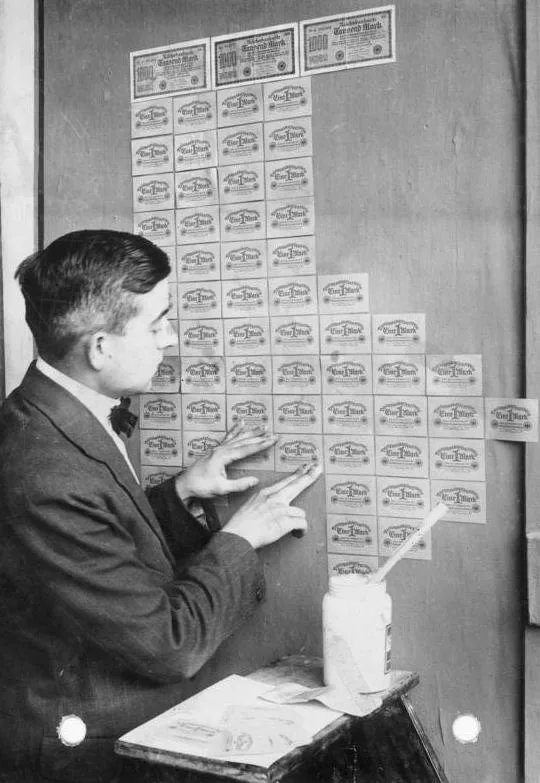
Commentary. The photograph shows a man gluing banknotes to a wall in the way one would apply wallpaper. It is a vivid image of the hyperinflation, but we should read it with care. A photographer took it for the press, and it shows one dramatic moment of a crisis with many sides. The inflation ended in November 1923 when the government issued a new currency, the Rentenmark. But the memory of it, and of savings wiped out, stayed with many Germans for a long time.
The British economist John Maynard Keynes, who had been an adviser at the Paris Peace Conference, resigned and wrote a book against the treaty in 1919.
Document 2 – An economist warns (1919)
If we aim deliberately at the impoverishment of Central Europe, vengeance, I dare predict, will not limp. Nothing can then delay for very long that final civil war between the forces of Reaction and the despairing convulsions of Revolution, before which the horrors of the late German war will fade into nothing, and which will destroy, whoever is victor, the civilization and the progress of our generation.
John Maynard Keynes, The Economic Consequences of the Peace (1919), chapter 7 (Project Gutenberg).
*vengeance: revenge. *limp: lag behind; here, be slow to come. *Reaction and Revolution: Keynes means the extreme right and the extreme left.
Commentary. Keynes argued that to ruin Germany’s economy would ruin Europe, and he predicted violent upheavals. His argument reached many readers, especially in Britain and the United States, and it made many people feel that the treaty was too harsh. Historians still debate whether he was right. Some say that Germany could have paid and that the treaty was not as harsh as Keynes thought, while others agree with him about its political cost. What is certain is that the book shaped opinion in the democracies.
The calm of the 1920s
After 1923 a period of calm followed. Under the Dawes Plan (1924) American banks lent money to Germany, which paid reparations to Britain and France, which paid war debts to the United States. As a result, money circled around the Atlantic. At Locarno in 1925 Germany accepted its western borders, and it joined the League of Nations in 1926.
In 1928 dozens of states, including the United States, Germany, Japan, and Italy, signed the Kellogg-Briand Pact, which renounced war as an instrument of national policy. However, the pact had no means of enforcement. The League of Nations, based in Geneva, had no army of its own, and the United States, whose president had proposed it, was not a member. The recovery of the 1920s depended on American loans and trade, and so it was fragile.
In Russia the Bolsheviks had won a civil war (1918-1921) against their opponents. In 1922 they formed the Union of Soviet Socialist Republics. After the death of Lenin in January 1924, Joseph Stalin, who held the post of general secretary of the Communist Party, defeated his rivals one by one. By the end of the 1920s, he was the unchallenged leader.
2. The Great Depression
The Depression began in the United States. During the 1920s many Americans had bought shares of stock with borrowed money, expecting prices to keep rising. Factories were producing more than consumers could buy. Also, farm prices were low, and many banks were weak. In September 1929 the stock market reached a peak. In October prices fell violently, on “Black Thursday” (October 24) and “Black Tuesday” (October 29).
The Dow Jones average, in fact, lost nearly half of its value in the following weeks. The crash did not by itself cause the Depression, but it destroyed confidence. Banks failed and businesses closed. By 1933 about 9,000 of the 25,000 American banks had gone out of business, and about a quarter of American workers had lost their jobs.
Document 3 – The crash
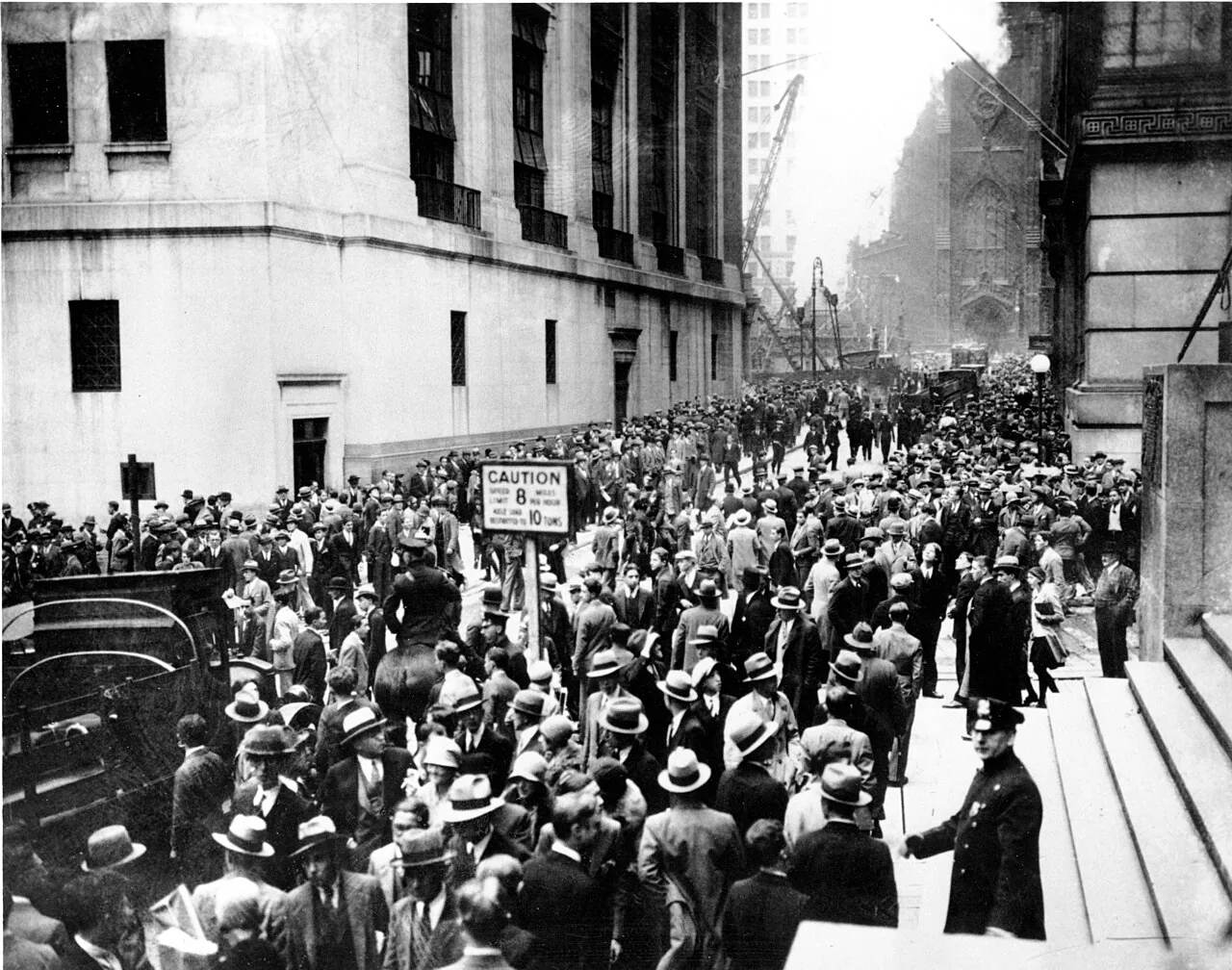
Commentary. The photograph shows a dense crowd on the street outside the Stock Exchange, held back by a policeman. It is typical of press photographs of the crash: it shows anxiety and curiosity, but not the deeper causes of the disaster, such as the weakness of banks and the fall in farm prices.
The crisis spread around the world. First, American banks recalled their loans from Europe, and countries raised tariffs to protect their industries. The United States passed the Smoot-Hawley Tariff in 1930, and others answered in kind. As a result, world trade shrank to about a third of its level four years earlier. Countries that stayed on the gold standard suffered longest, while Britain, which left it in 1931, recovered earlier.
Between 1929 and 1932 industrial production fell by 46 percent in the United States and by 41 percent in Germany, according to a standard study. It fell by smaller amounts in Britain and France. Germany, which depended on American loans, suffered among the hardest blows: by 1932 about a quarter of its workers had no job.
Document 4 – A mother in the Depression
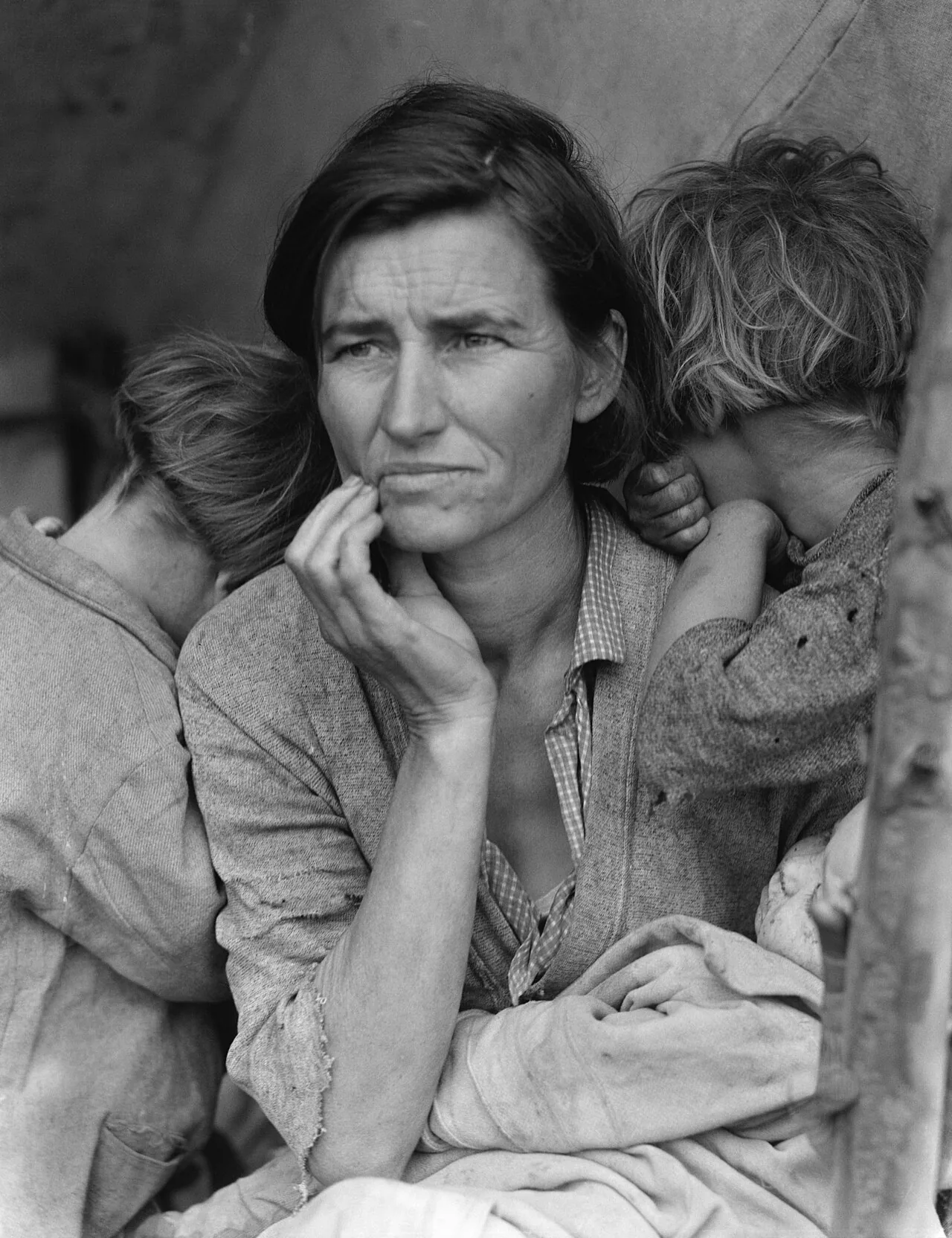
Commentary. Dorothea Lange worked for a government agency, and she meant her photographs to show the need for aid to migrant farm workers. This portrait, taken in 1936, became the best known image of the Depression in the United States. A historian notes that Lange made it for a purpose and that she chose how to frame it; Lange’s captions, and what the subject later said about them, are part of its story.
Democratic governments reacted in different ways. President Herbert Hoover believed that the economy would recover on its own and that relief should come from private charity and local government. Meanwhile, many Americans lived in shantytowns, nicknamed “Hoovervilles,” and stood in lines for food. Then, in the election of 1932, voters chose Franklin D. Roosevelt.
Document 5 – A new president speaks (1933)
So, first of all, let me assert my firm belief that the only thing we have to fear is fear itself–nameless, unreasoning, unjustified terror which paralyzes needed efforts to convert retreat into advance. […] This Nation asks for action, and action now. Our greatest primary task is to put people to work. This is no unsolvable problem if we face it wisely and courageously.
Franklin D. Roosevelt, First Inaugural Address, March 4, 1933 (Avalon Project, Yale Law School).
*unjustified: without good reason. *paralyzes: makes unable to move.
Commentary. Roosevelt spoke on March 4, 1933, when banks were closing across the country. His phrase on fear is famous, and the speech also promised action: the government itself would put people to work. In his first months he closed and reopened the banks under supervision. He also began a series of programs, the New Deal, including the Civilian Conservation Corps, the Tennessee Valley Authority, and the Social Security Act of 1935.
The New Deal did not end the Depression, which lasted until war production began, but it gave relief to millions and strengthened confidence in democratic government. In Britain a National Government took the country off the gold standard, and in France the Popular Front came to power in 1936. In several other countries, however, democracy was weaker.
Definition: Great Depression
The worldwide economic crisis that began in 1929 and lasted through the 1930s, marked by falling production and prices, bank failures, and mass unemployment.
3. What is totalitarianism?
In the 1920s and 1930s, three regimes developed a new form of rule that many historians, and the regimes themselves, called totalitarian. Their leaders wanted not only to control the government but to control the whole of society: the economy, the schools, the press, the arts, and the beliefs of ordinary people.
Definition: totalitarianism
A form of government in which a single party and a single leader try to control every part of public and private life, by propaganda, terror, a secret police, and the suppression of all opposition.
Totalitarian states shared several features: a single party led by a dictator; an official ideology; a cult of the leader; control of the press, radio, and schools; youth organizations; a secret police and the use of terror against real and imagined enemies; and a state that directed the economy. However, they differed in their ideas. Communism in the Soviet Union claimed to speak for the working class and aimed at a classless society. Fascism in Italy glorified the nation and the state. Nazism in Germany added a doctrine of race and antisemitism.
4. Stalin’s Soviet Union
In 1928 Stalin launched the first Five-Year Plan, which set targets for heavy industry, coal, steel, and electric power. He also ended the limited private trade that Lenin had allowed in the 1920s. Workers built entire new cities, such as the steel center of Magnitogorsk in the Urals, and they completed the great Dnieper dam in 1932. As a result, millions of peasants moved to the cities.
In the countryside Stalin ordered collectivization: the state forced peasants to give up their land and animals and to join large state-controlled farms. The state arrested, deported, or killed those who resisted, labeling them kulaks, or rich peasants. Agricultural output fell, and in 1932-1933 a terrible famine struck Ukraine, Kazakhstan, and other regions. Millions of people died, and historians still discuss the extent to which the government’s policies caused and worsened it.
Document 6 – A call for speed (1931)
It is sometimes asked whether it is not possible to slow down the tempo somewhat, to put a check on the movement. No, comrades, it is not possible! The tempo must not be reduced! On the contrary, we must increase it as much as is within our powers and possibilities. This is dictated to us by our obligations to the workers and peasants of the U.S.S.R. This is dictated to us by our obligations to the working class of the whole world. To slacken the tempo would mean falling behind. And those who fall behind get beaten. But we do not want to be beaten. No, we refuse to be beaten! […] We are fifty or a hundred years behind the advanced countries. We must make good this distance in ten years. Either we do it, or we shall go under.
Joseph Stalin, “The Tasks of Business Executives,” speech to the First All-Union Conference of Leading Personnel of Socialist Industry, February 4, 1931 (Marxists Internet Archive).
*tempo: speed. *slacken: slow down. *go under: be destroyed.
Commentary. Stalin gave this speech to factory managers in 1931. He argued that the Soviet Union had to industrialize in ten years because hostile powers surrounded it and that any slowdown would mean defeat. The speech therefore shows the language of urgency and sacrifice used to justify the plan. Ten years later, in June 1941, Germany invaded, and Soviet leaders could point to the speech as a prediction; but the plan also cost millions of lives, and terror enforced it.
Document 7 – A poster for the plan (1930)
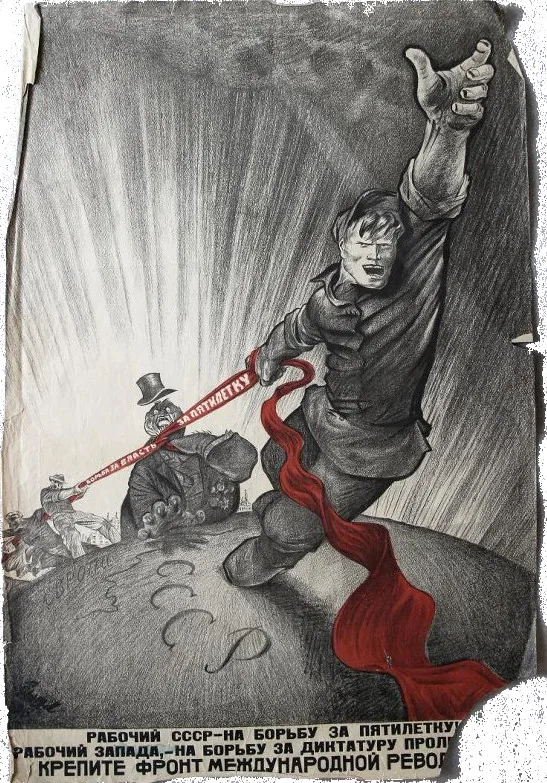
Commentary. The poster shows a muscular worker raising his arm above a globe labeled USSR, while a small capitalist in a top hat tries to pull him back. It conveys the message that the plan was a battle against enemies, at home and abroad. It also shows the style of Soviet propaganda: simple, heroic, and aimed at a population many of whom could not read long texts.
Stalin also used terror against his own party. After the assassination of a Leningrad party leader, Sergei Kirov, in December 1934, he launched the Great Purge. The secret police arrested officials, army officers, and old Bolsheviks, tried them in public show trials, and shot them after confessions, and in 1936-1938 they arrested many more ordinary citizens. The state sent millions to forced labor camps, the Gulag. Stalin also became the object of a cult of personality, and his name and image appeared everywhere.
5. Fascist Italy
Italy had been on the winning side in the war, but it felt cheated by the peace and suffered from unemployment, strikes, and political instability. Benito Mussolini, a former socialist journalist, founded the fascist movement in 1919, and his armed squads, the Blackshirts, attacked socialists and labor unions. In October 1922 the fascists staged the March on Rome. King Victor Emmanuel III, who feared civil war, asked Mussolini to form a government.
In the following years Mussolini used violence, new laws, and censorship to destroy opposition. After the murder of the Socialist deputy Giacomo Matteotti in 1924 he took full responsibility and, by 1925-1926, ruled as a dictator, called Il Duce, the leader. Finally, in 1929 he settled the old quarrel with the Catholic Church in the Lateran Treaty, which created Vatican City.
Document 8 – Mussolini on the State (1932)
Fascism, the more it considers and observes the future and the development of humanity quite apart from political considerations of the moment, believes neither in the possibility nor the utility of perpetual peace. It thus repudiates the doctrine of Pacifism — born of a renunciation of the struggle and an act of cowardice in the face of sacrifice. War alone brings up to its highest tension all human energy and puts the stamp of nobility upon the peoples who have courage to meet it. […] Fascism conceives of the State as an absolute, in comparison with which all individuals or groups are relative, only to be conceived of in their relation to the State.
Benito Mussolini (with Giovanni Gentile), The Doctrine of Fascism, entry in the Enciclopedia Italiana, 1932 (English translation in the Internet Modern History Sourcebook, Fordham University).
*pacifism: opposition to war. *relative: dependent on something else.
Commentary. The text comes from an encyclopedia article that Mussolini wrote with the philosopher Giovanni Gentile to define fascism. It rejects peace and praises war as ennobling. It puts the State above every individual and group. Notice that this is the regime’s own explanation of its ideas, not a description of what it did. A historian compares the claims with the facts, such as censorship, the secret police, and violence against opponents.
Document 9 – The dictator and his followers
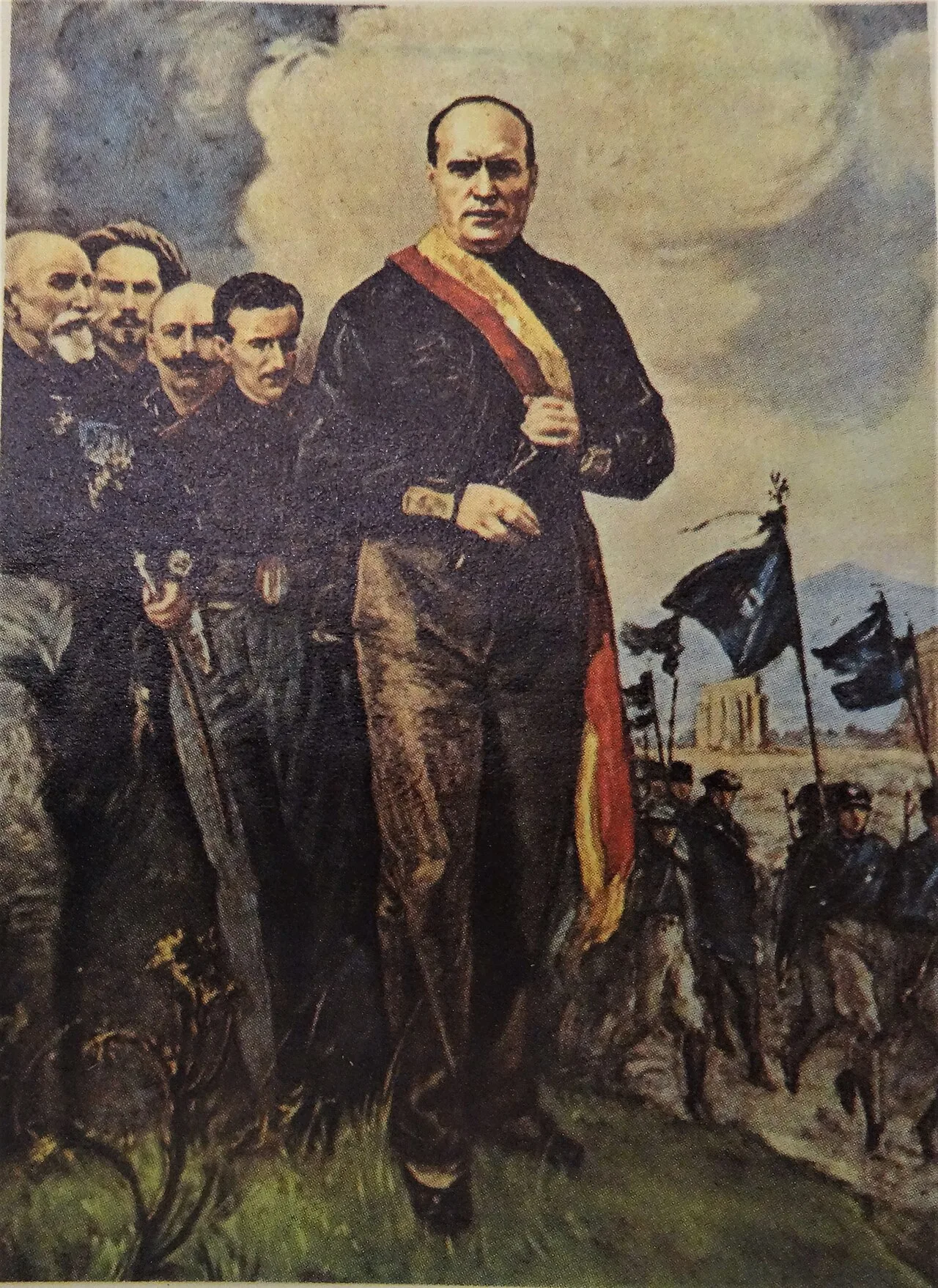
Commentary. The painting shows Mussolini in the center, with his sash, in front of the four leaders of the March on Rome and a column of Blackshirts. It is a work of propaganda. It presents the dictator as a heroic leader and the March on Rome as a glorious revolution, while in fact the king’s decision made him prime minister. Fascist Italy later invaded Ethiopia in October 1935. The League of Nations imposed limited sanctions that did not stop the conquest, which showed the weakness of the League.
Definition: fascism
A political movement that places the nation and the state above the individual, glorifies war and a strong leader, uses violence and propaganda, and rejects democracy and socialism. It began in Italy under Mussolini.
6. Nazi Germany
Adolf Hitler, an Austrian-born veteran of the war, led the National Socialist German Workers’ Party, or Nazi Party. After a failed attempt to seize power in Munich in November 1923, a court sentenced him to prison. There he wrote Mein Kampf, which set out his ideas of racial hatred, anti-Jewish conspiracy theories, and expansion to the east.
For years the party was small: in the elections of 1928 it won 2.6 percent of the vote and 12 seats in the Reichstag. However, the Depression changed this. In 1930 the Nazis won 18.3 percent and 107 seats, and in July 1932 they won 37.3 percent and 230 seats, becoming the largest party. They also promised jobs, national pride, and revenge, and they blamed Jews, Communists, and the republic.
The Nazis never won a majority in a free election. On January 30, 1933, President Paul von Hindenburg, on the advice of conservative politicians who believed they could control Hitler, appointed him chancellor. Then, on the night of February 27, a fire destroyed the Reichstag building. The next day Hitler persuaded Hindenburg to sign a decree that suspended the basic rights of citizens. Police arrested thousands of opponents, especially Communists. In the election of March 5, which took place under pressure, the Nazis won nearly 44 percent.
Document 10 – The Reichstag in flames
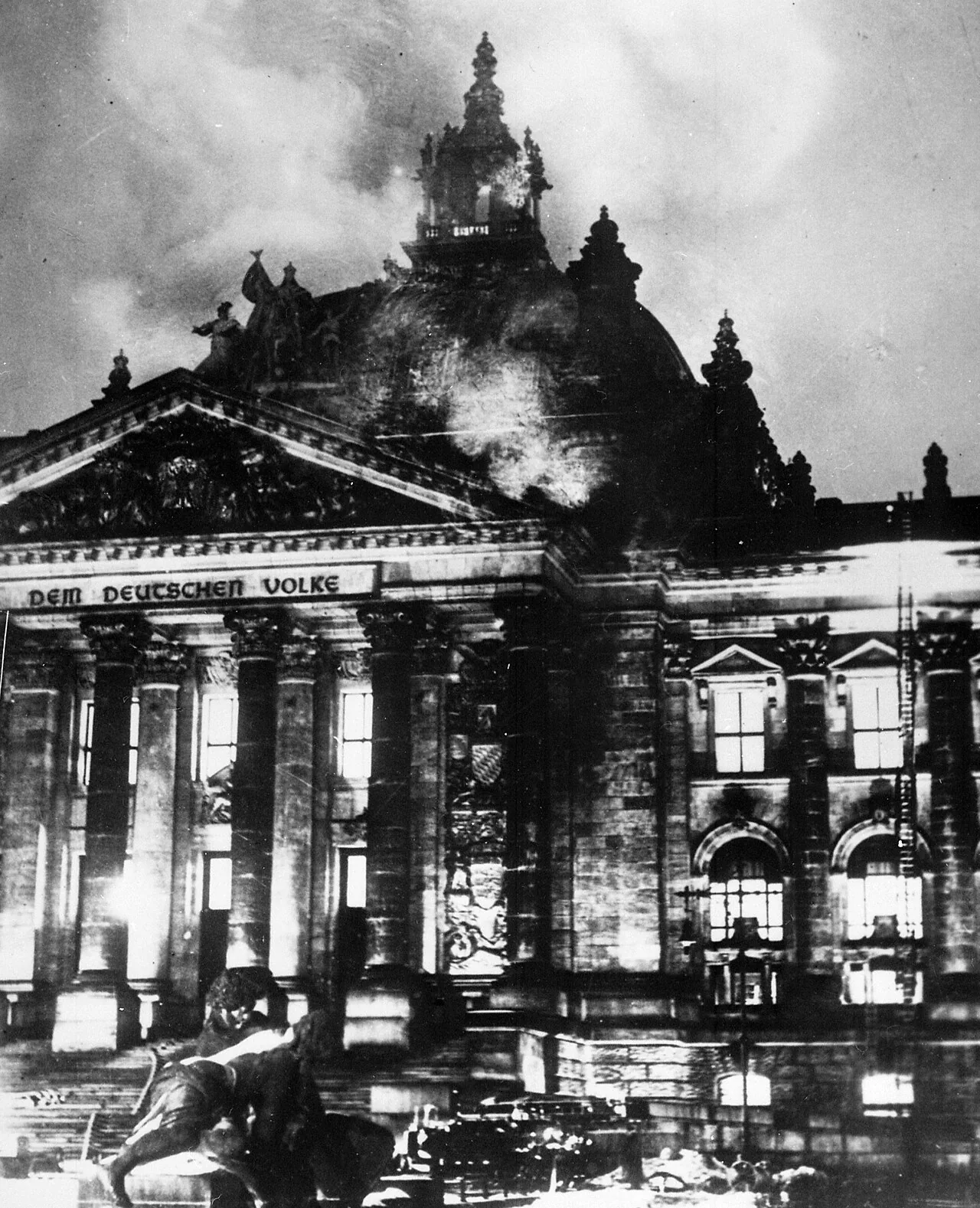
Commentary. The photograph shows the dome of the Reichstag in flames, with the inscription Dem Deutschen Volke (“To the German People”) on the front. Police arrested a Dutch Communist, Marinus van der Lubbe, at the scene, and the government later executed him. Historians still debate whether he acted alone, but what is certain is that the Nazis used the fire to claim that a Communist plot threatened the country and to take emergency powers.
Document 11 – The Enabling Act (1933)
Article 1. National laws can be enacted by the Reich Cabinet as well as in accordance with the procedure established in the Constitution. This also applies to the laws referred to in Article 85, Paragraph 2, and in Article 87 of the Constitution. […] Article 2. The national laws enacted by the Reich Cabinet may deviate from the Constitution as long as they do not affect the institution of the Reichstag and the Reichsrat. The powers of the President remain unaffected. […] Article 5. This law becomes effective on the day of its publication. It becomes invalid on April 1, 1937; it also becomes invalid if the present Reich Cabinet is replaced by another.
Law to Remove the Distress of the People and the State (Enabling Act), March 24, 1933, Articles 1, 2, and 5 (English translation in German History in Documents and Images, German Historical Institute Washington).
*Reich Cabinet: the government headed by the chancellor. *Reichstag, Reichsrat: the two houses of the German legislature. *deviate: depart from.
Commentary. On March 23, 1933, the Reichstag, meeting in an opera house under the guard of armed Nazi units, passed the Enabling Act by 444 votes to 94; only the Social Democrats voted against, because the Nazis had arrested the Communist deputies or the deputies had fled. The law let the cabinet pass laws, even laws that departed from the constitution, without the consent of the Reichstag. It said that it would expire in 1937, but the Nazis renewed it, and in practice it ended democracy. Observe that the text is short, technical, and legal. It never mentions dictatorship. Thus, a document can destroy a constitution without using any dramatic words.
Document 12 – Hitler and Hindenburg at Potsdam
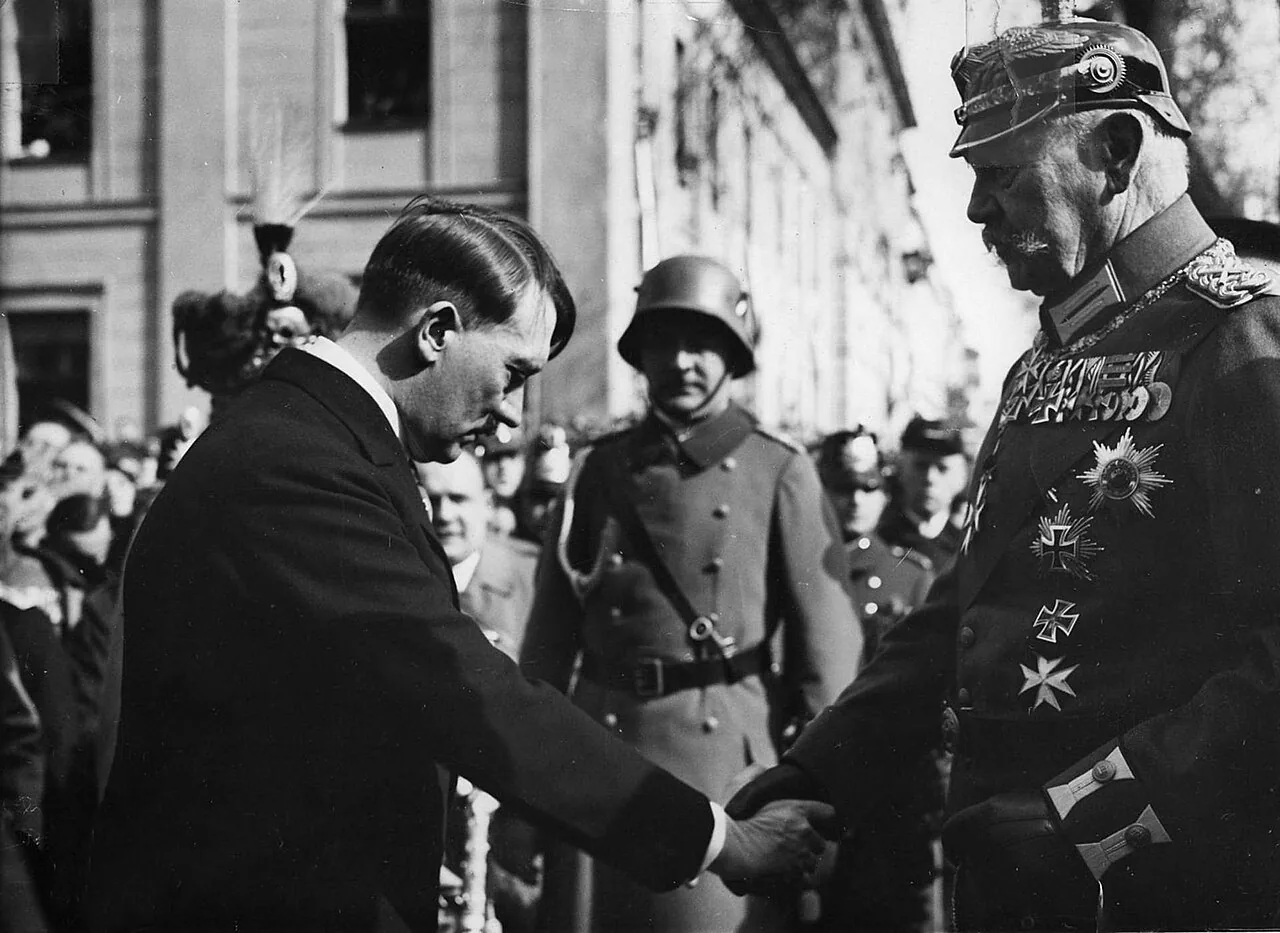
Commentary. The Nazis staged the opening of the new Reichstag at Potsdam, the old Prussian capital, to show that the movement continued the military tradition of the old Germany. Photographers recorded the handshake between the young chancellor and the aged field marshal, and newspapers printed it as a sign of national unity. It was a piece of political theater. In fact, two days later the Reichstag passed the Enabling Act.
In the following months the Nazis banned other parties and trade unions, put the press and radio under the control of the propaganda minister Joseph Goebbels, opened concentration camps, burned books, and placed their own men in every state office. They called this process Gleichschaltung (“coordination”). Then, in June 1934, in the Night of the Long Knives, Hitler had leaders of the SA and other rivals killed.
When Hindenburg died in August 1934, Hitler combined the offices of president and chancellor and became the Führer. From April 1933 the regime excluded Jews from public jobs, and in 1935 the Nuremberg Laws took away the citizenship of Jews and forbade marriage between Jews and other Germans. The persecution of Jews became more severe, and the next chapter will show where it led. Children joined the Hitler Youth, rallies at Nuremberg showed the power of the movement, and rearmament put unemployed workers back to work and prepared for war.
Document 13 – A mass rally
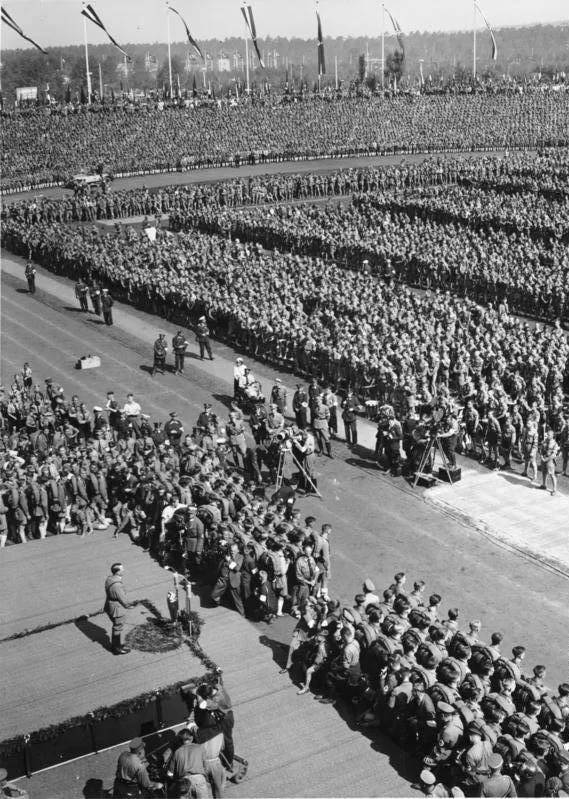
Commentary. The photograph shows the scale of the Nazi rallies: huge ranks of uniformed members, a speaker on a platform, and flags. The Nazis staged the rallies for photographers and film cameras, and the images became part of the regime’s propaganda. They show how the regime wanted people to see it: orderly, disciplined, united behind the leader.
7. Aggression and the failure of collective security
The League of Nations depended on its members to act together, and in the 1930s it failed several tests. In 1931 the Japanese army, acting without clear orders from Tokyo, seized Manchuria in northern China. The League’s investigation condemned Japan, which left the League in 1933. Italy conquered Ethiopia in 1935-1936. Then, in March 1936, Hitler sent troops into the Rhineland, which the Treaty of Versailles had demilitarized; France and Britain did not respond with force.
In 1936 a civil war began in Spain after a military revolt against the republic. Germany and Italy helped General Franco, while the Soviet Union supported the republican side. The democracies, weakened by the Depression and by the memory of the last war, hoped that concessions would satisfy the dictators. The next chapter shows how that hope failed.
- 1919 Weimar constitution; Treaty of Versailles
- 1922 March on Rome; Soviet Union formed
- 1923 Ruhr occupied; German hyperinflation
- October 1929 Wall Street crash
- 1928-1932 First Five-Year Plan in the USSR
- January 30, 1933 Hitler becomes chancellor
- March 23, 1933 Enabling Act
- 1935 Nuremberg Laws; Italy invades Ethiopia
- 1936 Rhineland remilitarized; Spanish Civil War begins
Key takeaways
- The peace of 1919 left Germany bitter and Europe dependent on American loans; the hyperinflation of 1923 and the Ruhr crisis showed how fragile the order was. Keynes warned that a harsh peace would be dangerous.
- The Wall Street crash of 1929 began the Great Depression, which spread through loans, tariffs, and falling trade; about a quarter of American and German workers lost their jobs.
- Democracies reacted differently: the United States chose the New Deal; in Germany the crisis helped the Nazis rise from 2.6 percent of the vote in 1928 to 37.3 percent in July 1932.
- Totalitarian states sought to control the whole of society through one party, one leader, propaganda, and terror.
- Stalin imposed rapid industrialization and collectivization and the terror of the Great Purge; Mussolini created the fascist dictatorship in Italy; Hitler used the Reichstag fire and the Enabling Act of 1933 to destroy democracy.
- In the 1930s Japan, Italy, and Germany broke the rules of the League of Nations, and the democracies did not stop them.

Quick review: flashcards
Tap a card to see the answer.