



This AP US History lesson covers APUSH Period 9: 1980-Present, part of the unit “APUSH periods.” First, read the full lesson with its primary sources, maps and key terms. Then practice with the worksheet, check yourself with the quiz and get ready with the test.
On June 12, 1987, President Ronald Reagan stood in front of the Brandenburg Gate in West Berlin. He was a few yards from a concrete wall that split the city, and he spoke across it. Two and a half years later, on the night of November 9, 1989, thousands of East Germans walked through the opened border. Berliners climbed on the wall with hammers. Within two years the Soviet Union itself had disappeared.
Then, on a clear morning in September 2001, terrorists attacked the nation that had “won” the Cold War on its own soil. AP US History Period 9 (1980 to the present) follows a country that experienced the end of its great rival and a long technological and economic transformation. It also lived through two wars in the Middle East, the worst financial crisis since the 1930s, and a pandemic. Meanwhile, its political life grew steadily more polarized.
The AP themes in this period are Politics and Power (PCE), America in the World (WOR), and Work, Exchange, and Technology (WXT). The others are Social Structures (SOC) and American and National Identity (NAT). Because the period is recent, historians have not yet reached agreement about many events. Learn the facts, and be careful to separate facts from arguments, a skill the AP exam also tests.
Guiding question: How did the end of the Cold War, the attacks of September 11, 2001, and economic and technological change reshape the role of the United States at home and in the world after 1980?
1. The conservative turn and the end of the Cold War, 1980-1991
The Reagan Revolution
The troubles of the 1970s (inflation, unemployment, the Iran hostage crisis) opened the way for a conservative movement. This movement had been growing since the 1960s. It combined business leaders who wanted lower taxes and less regulation and Southern and Western voters who resented federal power. It also included religious conservatives organized in groups such as the Moral Majority (1979). Its leader was Ronald Reagan, a former actor and governor of California, who defeated Jimmy Carter in 1980. In his inaugural address he declared that “government is not the solution to our problem; government is the problem.”
Document 1 – Reagan’s first inaugural address, 1981
In this present crisis, government is not the solution to our problem; government is the problem. From time to time, we have been tempted to believe that society has become too complex to be managed by self-rule, that government by an elite group is superior to government for, by, and of the people. But if no one among us is capable of governing himself, then who among us has the capacity to govern someone else?
Source: Ronald Reagan, first inaugural address, January 20, 1981; text from the Avalon Project, Yale Law School.
*elite: a small group with power. *self-rule: self-government.
Commentary. Reagan was speaking to an economy in crisis. The sentence is often quoted without its first words, “in this present crisis.” He did not propose to abolish government, but to reduce its role in the economy and to return power to individuals and states. The passage also expresses a trust in the common citizen, which is a traditional American theme. Contrast it with Wilson’s 1913 statement and with Roosevelt’s speech of 1933, which saw government as the solution.
Document 2 – Taking the oath, 1981
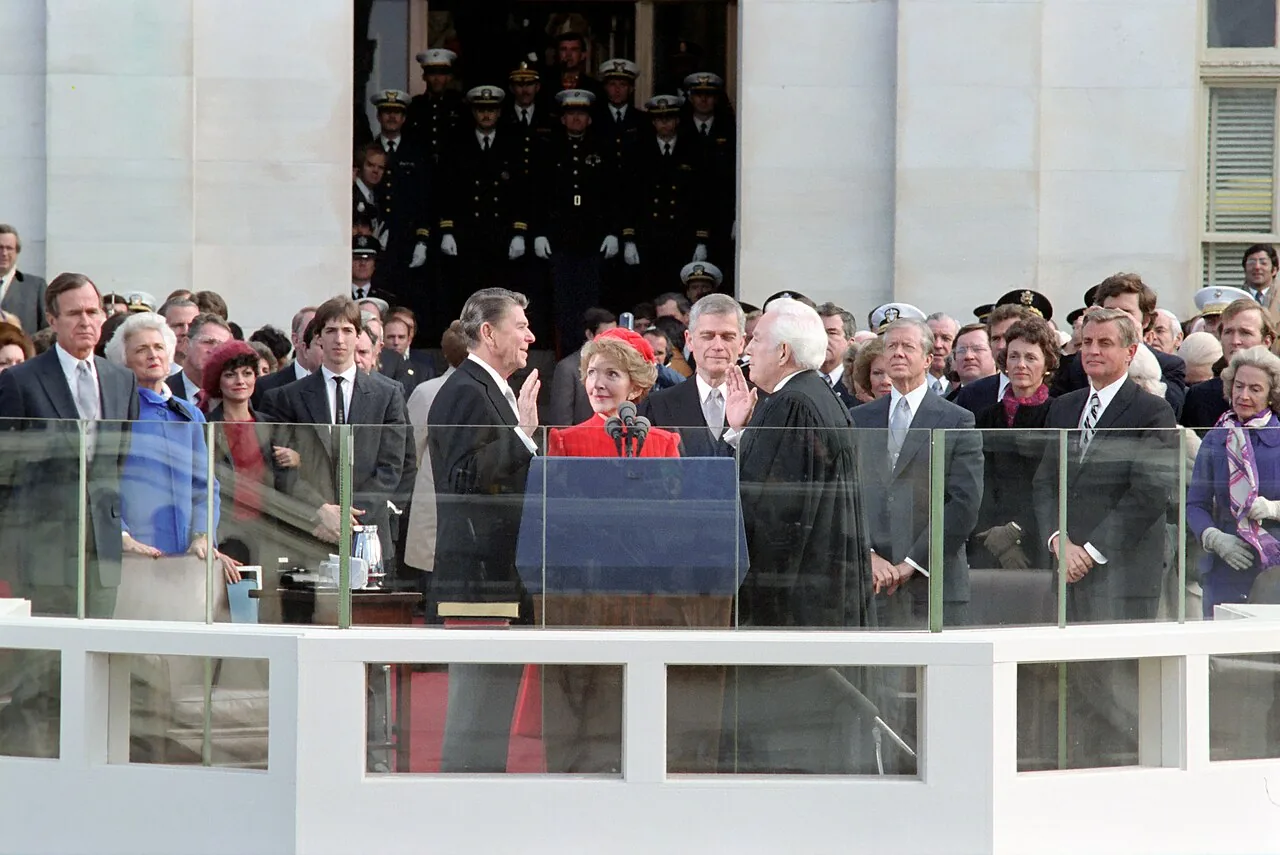
Source: White House Photographic Office, January 20, 1981 (image on Wikimedia Commons).
The photograph shows the oath of office in front of the Capitol, with the Reagan family and other officials in winter clothing. Notice the setting. For the first time the ceremony took place on the west front of the Capitol, facing the National Mall. This choice made the inauguration more of a public event.
Reagan’s program had four main parts. The Economic Recovery Tax Act of 1981 cut income taxes and lowered the top rate from 70 to 50 percent. It was based on “supply-side” theory that lower taxes would increase investment and growth. His administration reduced regulation and cut spending on many domestic programs. In August 1981, he fired more than eleven thousand striking air traffic controllers, which weakened the labor movement.
And he built up the military, sharply increasing defense spending. Together, tax cuts and military spending caused large federal deficits. The economy suffered a deep recession in 1981-1982, then grew strongly for the rest of the decade. However, inequality increased. The AIDS epidemic, first recognized in 1981, was slow to receive a federal response.
Definition: supply-side economics
the theory that cutting taxes, especially on businesses and high earners, increases investment and production and therefore, over time, tax revenue. Critics called it “trickle-down” economics.
The Cold War ends
Reagan began with a hard line. He called the Soviet Union an “evil empire” (1983), supported anti-communist forces in Afghanistan, Nicaragua, and Angola. He also announced a research program for a missile defense, the Strategic Defense Initiative (1983). A scandal grew from this policy: Iran-Contra, revealed in November 1986. Administration officials had secretly sold arms to Iran. They used the profits to fund the Contra rebels in Nicaragua, in spite of a congressional ban.
The rise to power in 1985 of Mikhail Gorbachev, who introduced glasnost (openness) and perestroika (restructuring), changed the situation. Reagan met Gorbachev in Geneva (1985) and in Reykjavik (1986). In December 1987 they signed the INF Treaty, the first agreement to destroy an entire class of nuclear missiles. In Berlin in June 1987, Reagan challenged Gorbachev to prove his sincerity.
Document 3 – “Tear down this wall,” 1987
There is one sign the Soviets can make that would be unmistakable, that would advance dramatically the cause of freedom and peace. General Secretary Gorbachev, if you seek peace, if you seek prosperity for the Soviet Union and Eastern Europe, if you seek liberalization: Come here to this gate! Mr. Gorbachev, open this gate! Mr. Gorbachev, tear down this wall!
Source: Ronald Reagan, remarks at the Brandenburg Gate, West Berlin, June 12, 1987; text from the Ronald Reagan Presidential Library.
*liberalization: loosening of state control.
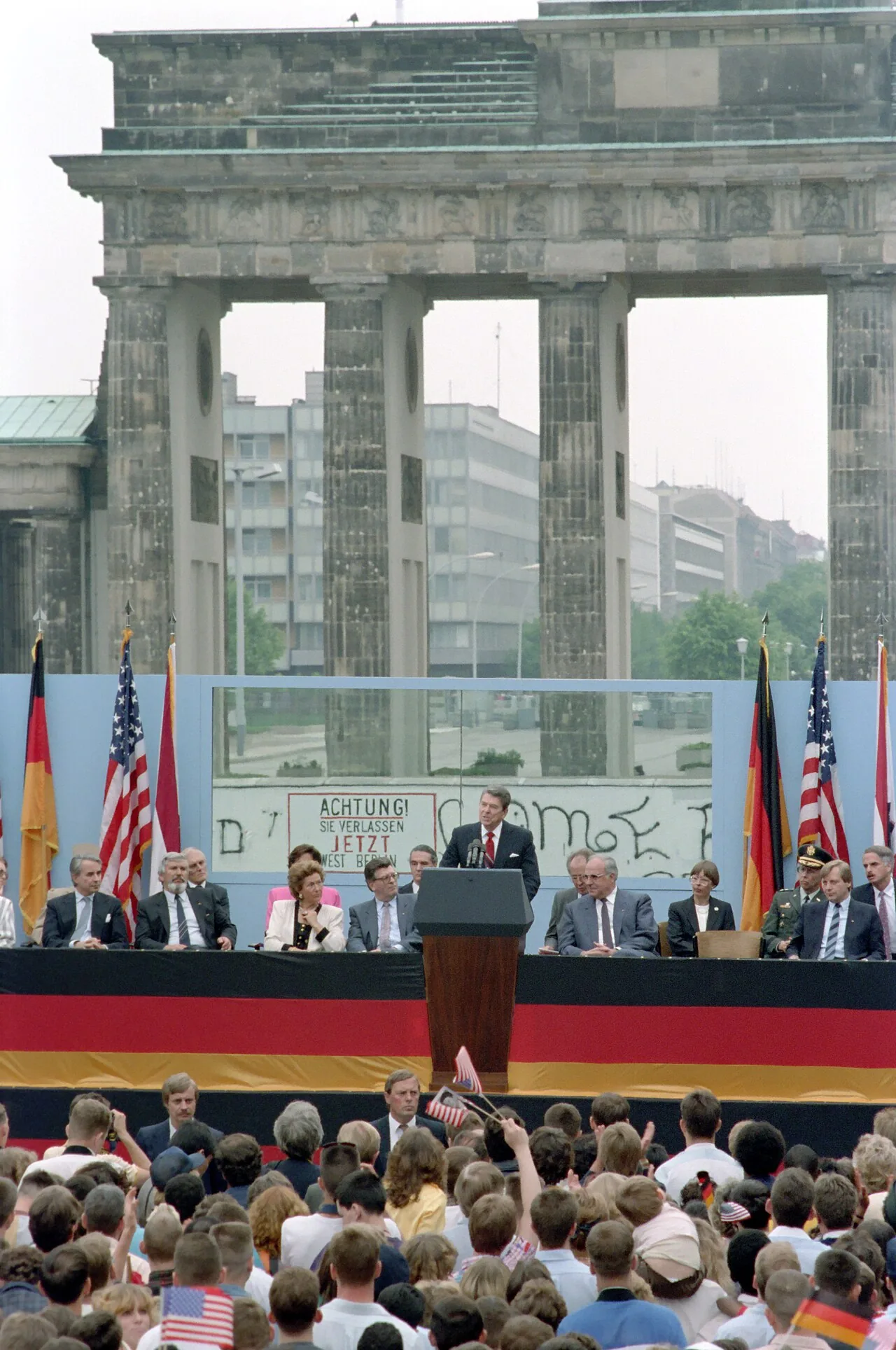
Commentary. The speech addressed a German audience and Gorbachev, and it ties “freedom and security” together. Some of Reagan’s aides, including the State Department, wanted the sentence removed, fearing that it would be too provocative. Historians still debate how much it contributed to the end of the Cold War. Most stress the economic weakness of the Soviet system, Gorbachev’s reforms, and the courage of people in Eastern Europe. They treat American pressure as one factor among several.
Document 4 – Reagan and Gorbachev at Reykjavik, 1986
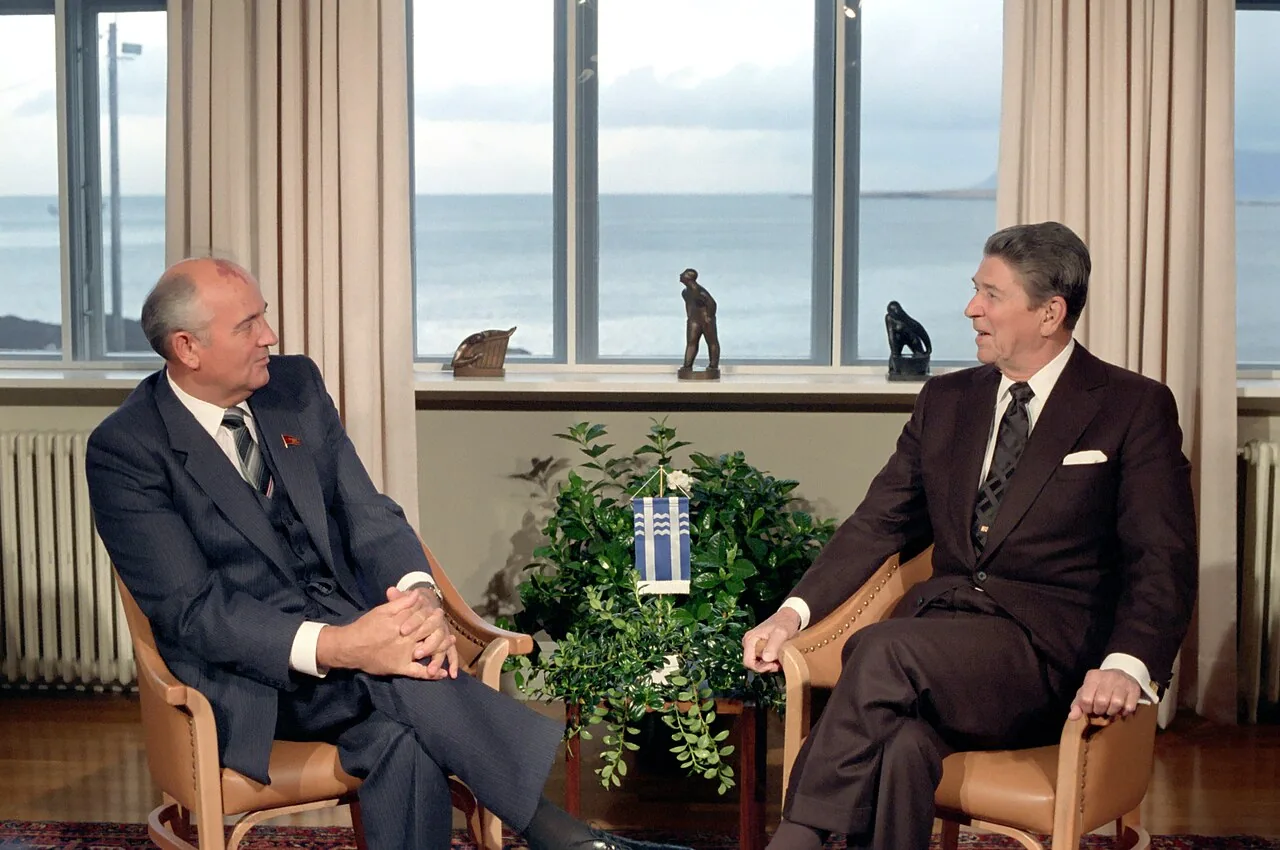
Source: White House Photographic Office, October 1986 (image on Wikimedia Commons).
The two men sit in armchairs in a room overlooking the sea. The Reykjavik summit ended without an agreement because Reagan would not give up the missile defense. However, the proposals discussed there, including deep cuts in nuclear weapons, prepared the INF Treaty of the following year.
In 1989, communist governments fell in Eastern Europe. Poland held semi-free elections in June, and Hungary opened its border with Austria. East Germans left through Hungary and then demonstrated in Leipzig and other cities. On November 9, 1989, the East German government opened the border in Berlin. Germany was reunified on October 3, 1990, with the support of President George H. W. Bush, and the Soviet Union dissolved in December 1991.
Document 5 – The Wall is open, 1989
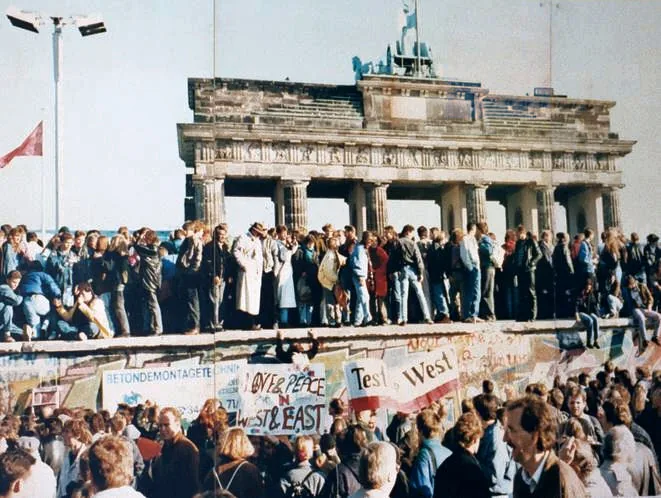
Source: unknown photographer, November 1989, Wikimedia Commons (CC BY-SA 3.0).
Young people stand on the top of the wall in front of the Brandenburg Gate; graffiti covers the western side. The wall, built in 1961 to stop East Germans from leaving, had killed some who tried to cross it. The celebration was spontaneous and peaceful, which made it a powerful image of the end of the division of Europe.
Document 6 – The Challenger disaster, 1986
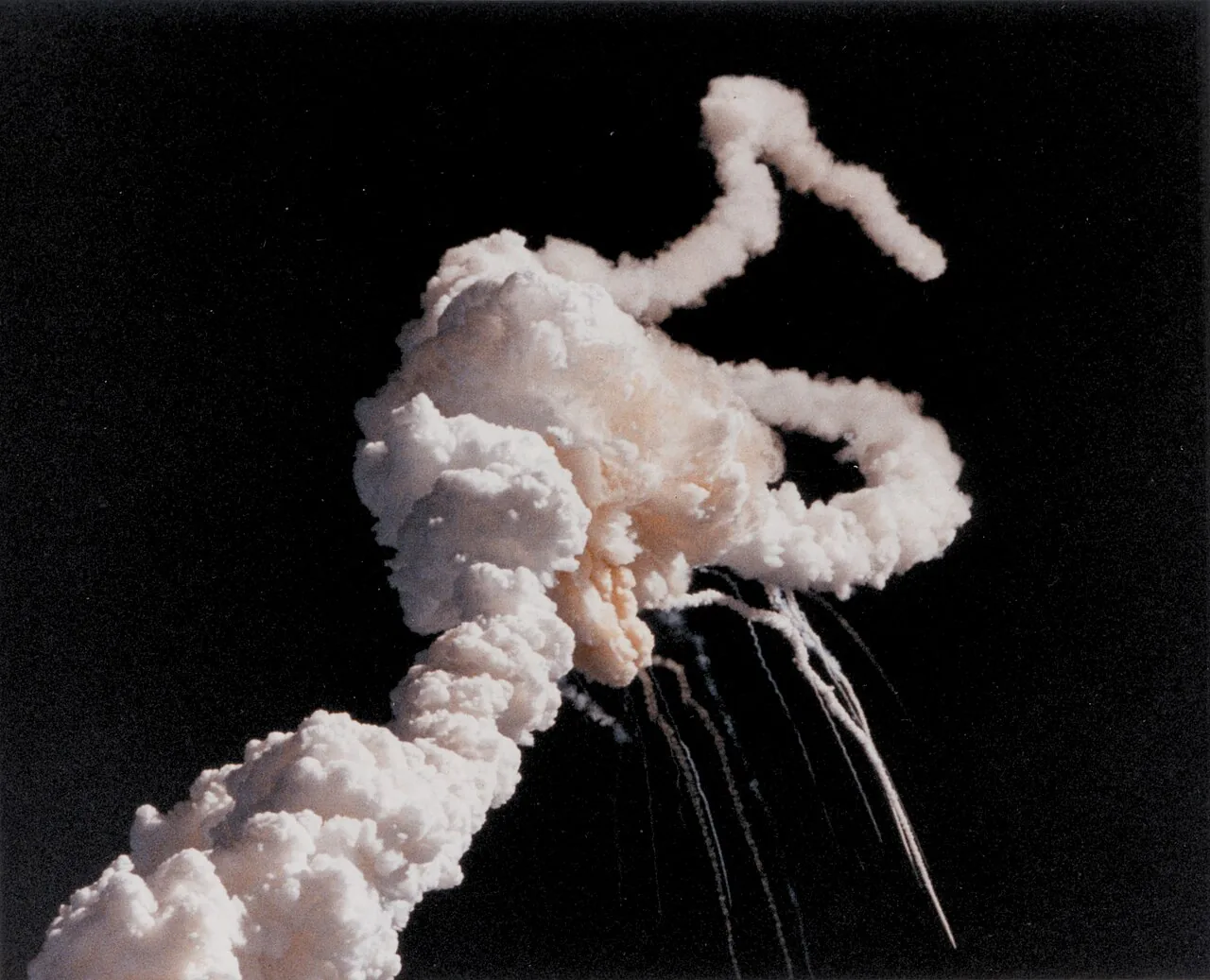
Source: Kennedy Space Center, NASA, January 28, 1986 (image on Wikimedia Commons).
The explosion killed seven astronauts, including Christa McAuliffe, a teacher who was to have taught lessons from space. The disaster, watched live by millions of schoolchildren, questioned the confidence of the space program. A presidential commission blamed a failed rubber seal and weak safety management at NASA.
Key takeaways
- The conservative movement elected Reagan in 1980 and cut taxes, reduced regulation, and increased defense spending; deficits and inequality grew.
- Reagan combined a military buildup with negotiations with Gorbachev (INF Treaty, 1987).
- The Berlin Wall fell in November 1989, Germany was reunified in 1990, and the Soviet Union ended in December 1991.
2. A new world order and the economy of the 1990s
After the Cold War, President George H. W. Bush spoke of a “new world order.” The test came in the Persian Gulf. On August 2, 1990, Iraq under Saddam Hussein invaded and occupied Kuwait. Bush assembled a broad coalition with the backing of the United Nations and sent hundreds of thousands of troops to Saudi Arabia. He obtained the authorization of Congress in January 1991 (the Senate voted 52 to 47). The air war began on January 17, 1991. A ground offensive, from February 24 to 28, drove the Iraqi army from Kuwait in about a hundred hours. Bush stopped short of invading Iraq, and Saddam remained in power.
At home, Bush signed the Americans with Disabilities Act (ADA) on July 26, 1990. It is one of the most important civil rights laws since 1964. It banned discrimination against people with disabilities in employment, public services, and public accommodations, and required reasonable access. The law came after a long campaign by disability rights activists. Some of them crawled up the steps of the Capitol in 1990 to dramatize the lack of access.
Document 7 – The Americans with Disabilities Act, 1990
(1) physical or mental disabilities in no way diminish a person’s right to fully participate in all aspects of society, yet many people with physical or mental disabilities have been precluded from doing so because of discrimination; […] (2) historically, society has tended to isolate and segregate individuals with disabilities, and, despite some improvements, such forms of discrimination against individuals with disabilities continue to be a serious and pervasive social problem;
Source: Americans with Disabilities Act of 1990, section 12101, findings; text from ADA.gov, U.S. Department of Justice.
*precluded: prevented. *pervasive: spread widely.
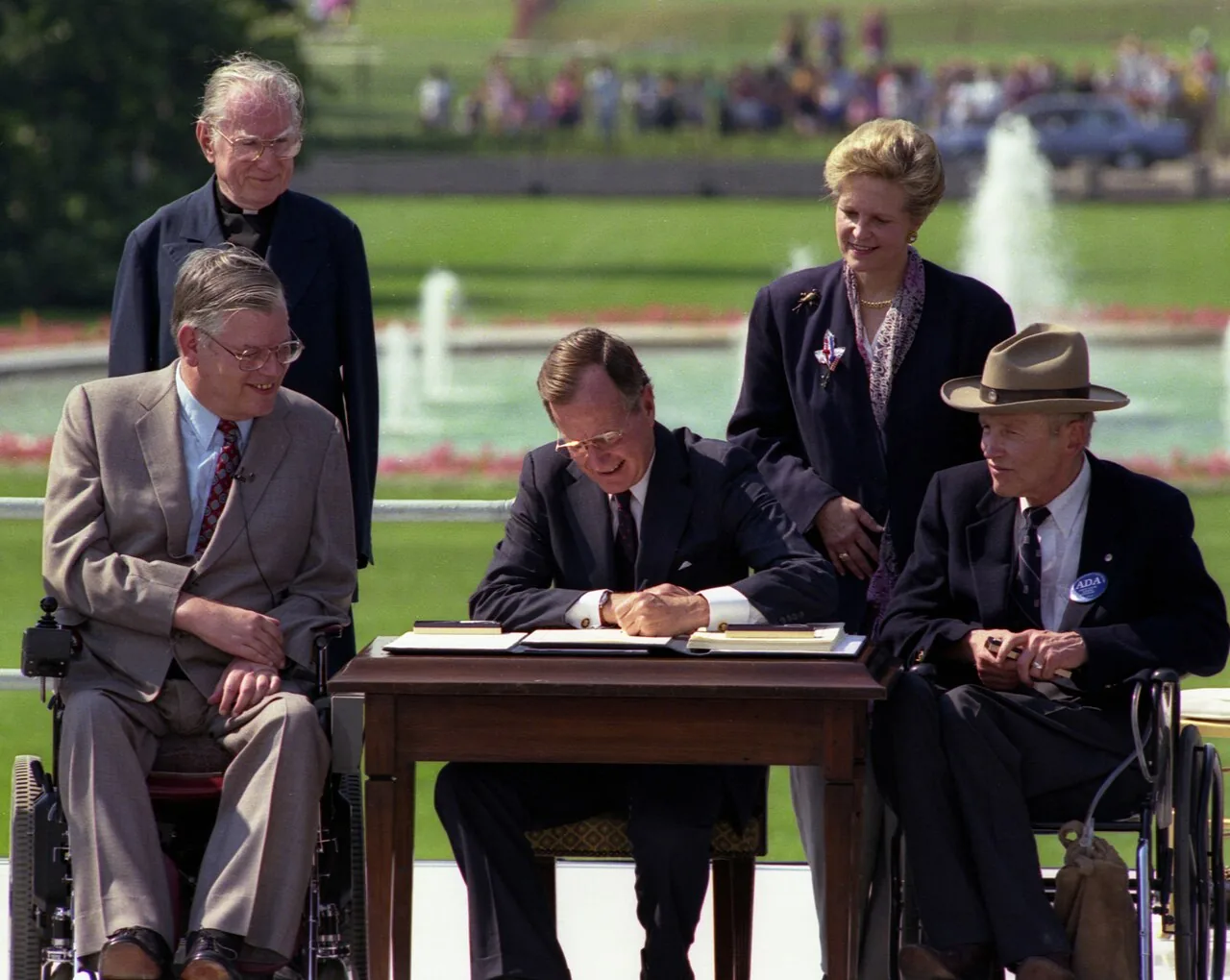
Commentary. Congress began the law with findings, a statement of the problems it meant to address. Notice the comparison of disability with other forms of discrimination, by race, sex, religion, and age. This places the law in the tradition of the civil rights movement. The photograph shows the signing ceremony on the White House lawn, with advocates beside the president. It reminds us that laws are often the result of movements.
The economy slowed in 1990-1991. Bush, who had broken his pledge not to raise taxes, lost the election of 1992 to Bill Clinton, the Democratic governor of Arkansas. Clinton campaigned on the economy. Clinton called himself a “New Democrat.” He raised taxes on high incomes in 1993 and pushed Congress to approve the North American Free Trade Agreement (NAFTA, effective 1994).
However, he failed to pass national health insurance. In the congressional election of 1994, Republicans led by Newt Gingrich and his “Contract with America” won control of both houses of Congress for the first time in forty years. Clinton and the Republicans then cooperated in the welfare reform law of 1996. It ended the federal guarantee of aid to poor families and set time limits.
Document 8 – “The era of big government is over,” 1996
We know big government does not have all the answers. We know there’s not a program for every problem. We have worked to give the American people a smaller, less bureaucratic government in Washington. And we have to give the American people one that lives within its means. The era of big government is over. […] But we cannot go back to the time when our citizens were left to fend for themselves. Instead, we must go forward as one America, one nation working together to meet the challenges we face together. Self-reliance and teamwork are not opposing virtues; we must have both.
Source: William J. Clinton, State of the Union address, January 23, 1996; text from the Clinton White House archives.
*fend: take care of oneself. *self-reliance: depending on one’s own efforts.
Commentary. Clinton speaks to a Republican Congress after the 1994 losses. The first part accepts a theme of the conservatives (the limits of government), while the second rejects the idea that citizens should be “left to fend for themselves.” This is called “triangulation,” the attempt to take a position between the two parties. Compare the statement with Reagan’s inaugural address of 1981: both show that the idea of limited government had become part of the mainstream by the 1990s.
Technology and the economy in the 1990s
The 1990s were a period of technological and economic change. The World Wide Web (1991), the first browsers, and the “dot-com” boom brought the Internet into homes and businesses, and the economy grew for a record ten years before a recession in 2001, with budget surpluses between 1998 and 2001. Americans also confronted domestic terrorism and violence: in April 1995 a truck bomb destroyed the federal building in Oklahoma City and killed 168 people.
The House impeached Clinton in December 1998 for lying under oath about a relationship with a White House intern, and the Senate acquitted him in February 1999. In foreign policy, the United States took part in NATO operations in Bosnia (1995) and Kosovo (1999) and stayed out of the genocide in Rwanda (1994).
Definition: globalization
the growing integration of the world economy through trade, investment, communications, and migration. In the United States it brought cheaper goods and new export markets but also the loss of many manufacturing jobs.
Globalization
Trade agreements and new technologies sped globalization. NAFTA and China’s entry into the World Trade Organization (2001), supported by the United States, expanded trade, lowered prices for consumers, and moved many factories to Mexico and Asia. Manufacturing employment in the “Rust Belt” of the Midwest declined, and the political effects of the change continued to be felt in later elections.
Key takeaways
- The Persian Gulf War (1991) showed American military power and the use of coalitions; Bush stopped at the border of Iraq.
- The ADA (1990) extended civil rights protection to people with disabilities.
- Clinton’s presidency combined moderate policies (NAFTA, welfare reform) with a booming economy driven by technology; the 1994 elections began a long period of partisan competition.
3. September 11 and the war on terror
On the morning of September 11, 2001, nineteen hijackers belonging to the al Qaeda network of Osama bin Laden seized four airliners. Two were flown into the towers of the World Trade Center in New York, which collapsed; one hit the Pentagon; and one, Flight 93, crashed in a field in Pennsylvania after passengers tried to take back control. Nearly three thousand people died. It was the deadliest attack on American soil.
Document 9 – Smoke over Manhattan, September 11, 2001
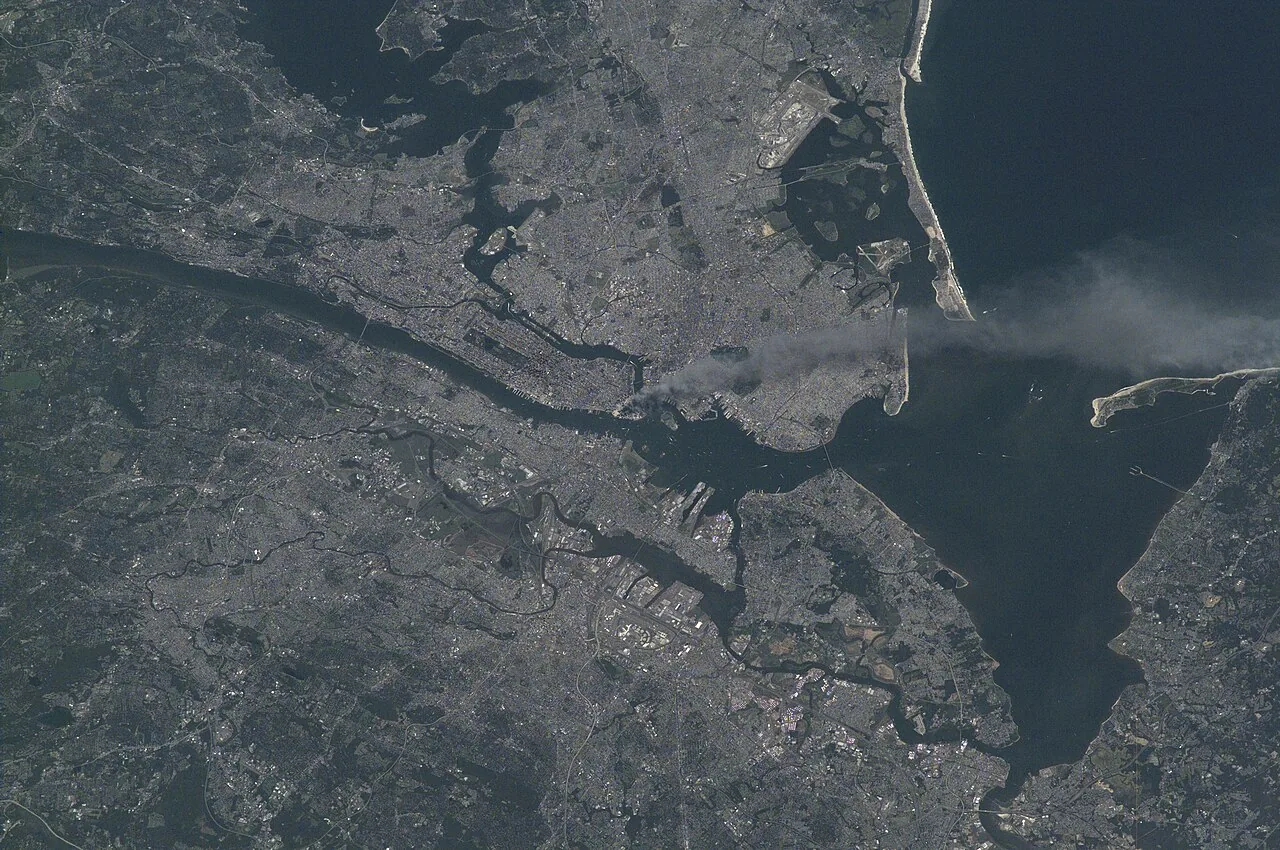
Source: NASA, Expedition 3 crew, September 11, 2001 (image on Wikimedia Commons).
Astronauts aboard the International Space Station photographed the dark plume stretching from the southern tip of Manhattan across the harbor. The picture gives a sense of the scale of the event and shows how global communications carried the images immediately around the world.
Document 10 – The ruins, September 14, 2001
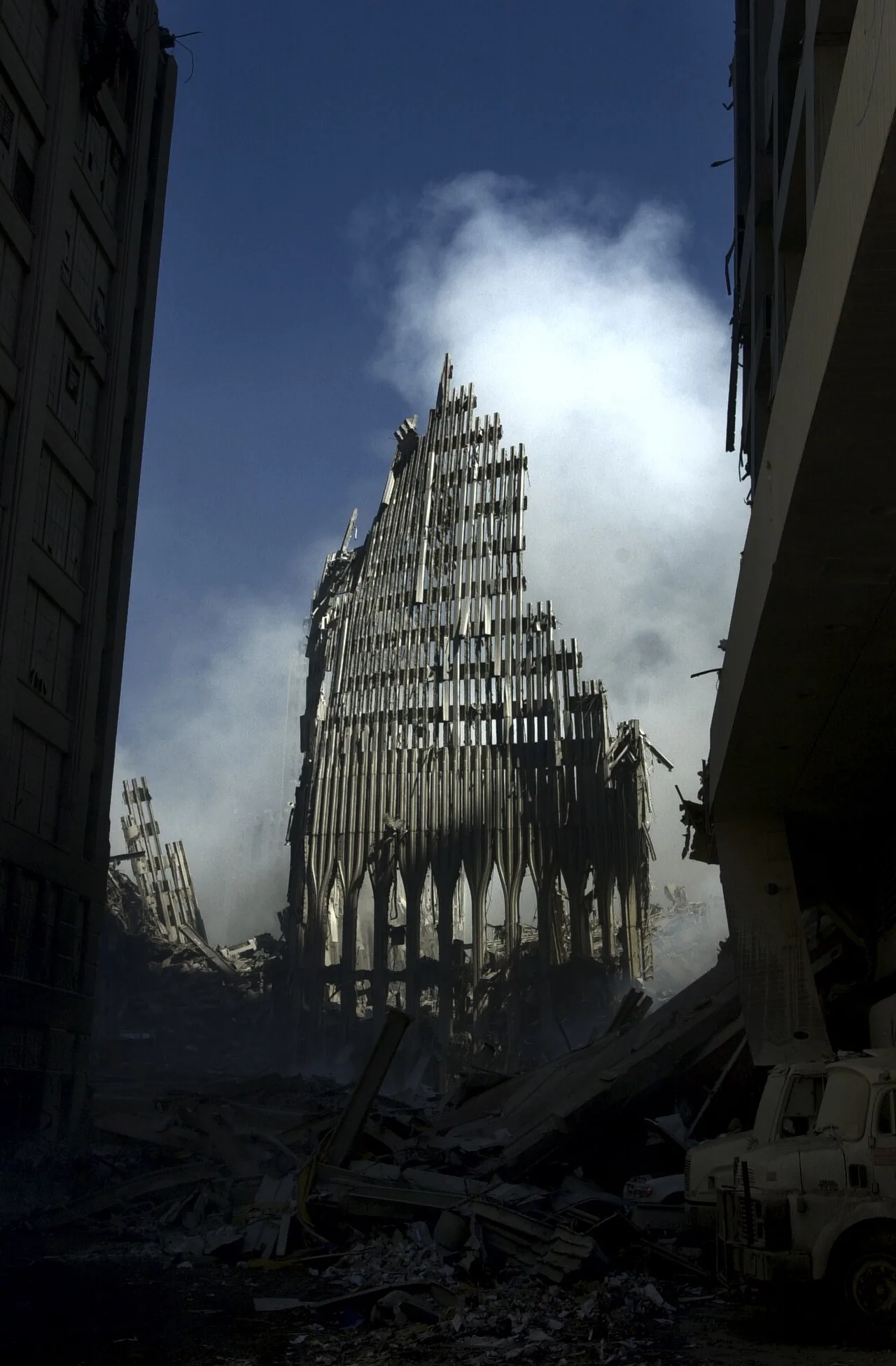
Source: Preston Keres, U.S. Navy, September 14, 2001 (image on Wikimedia Commons).
The steel facade of one of the towers rises out of smoke and debris. Rescuers worked for months on the site. Remember that images like this one were used both to mourn and to build support for the military response.
President George W. Bush addressed Congress on September 20 and announced a “war on terror.” Congress passed the Authorization for Use of Military Force (AUMF) on September 18, with only one dissenting vote, and the USA PATRIOT Act in October, which expanded the surveillance powers of the government. Congress then created a new Department of Homeland Security in 2002. In October 2001, the United States attacked Afghanistan, whose Taliban government sheltered al Qaeda, and by December the Taliban had been driven from Kabul and Kandahar.
Document 11 – Bush addresses Congress, 2001
Americans are asking, why do they hate us? They hate what we see right here in this chamber — a democratically elected government. Their leaders are self-appointed. They hate our freedoms — our freedom of religion, our freedom of speech, our freedom to vote and assemble and disagree with each other. They want to overthrow existing governments in many Muslim countries, such as Egypt, Saudi Arabia, and Jordan. They want to drive Israel out of the Middle East. They want to drive Christians and Jews out of vast regions of Asia and Africa. These terrorists kill not merely to end lives, but to disrupt and end a way of life.
Source: George W. Bush, address to a joint session of Congress and the American people, September 20, 2001; text from the White House archives.
Document 12 – The Authorization for Use of Military Force, 2001
That the President is authorized to use all necessary and appropriate force against those nations, organizations, or persons he determines planned, authorized, committed, or aided the terrorist attacks that occurred on September 11, 2001, or harbored such organizations or persons, in order to prevent any future acts of international terrorism against the United States by such nations, organizations or persons.
Source: Authorization for Use of Military Force, Public Law 107-40, September 18, 2001, section 2(a); text from the U.S. Government Publishing Office (govinfo.gov).
*authorized: given the legal power to do something.
Commentary. Bush defines the enemy as an extremist network, not a state, and he presents the conflict as a defense of freedom. The AUMF is brief and has no geographic limit or time limit. It has been used by several presidents to justify military operations in many countries and has become a subject of debate about the balance between Congress and the executive. As for sources, the speech is a political statement and the legal text shows what Congress actually authorized.
In March 2003, the United States and a coalition invaded Iraq on the grounds that Saddam Hussein had weapons of mass destruction and ties to terrorism. Baghdad fell in April and Saddam was captured in December 2003, but no stockpiles of banned weapons were found, and an insurgency and sectarian violence followed. In 2007 President Bush sent more troops (the “surge”), and the last American combat forces left in December 2011.
In Afghanistan, the Taliban returned, and a war that lasted twenty years ended when the United States withdrew its last troops on August 30, 2021, after the Taliban had retaken Kabul. Bin Laden himself was killed by American forces in Pakistan on May 2, 2011. The wars cost the lives of thousands of Americans and many more civilians, and they raised lasting questions about the limits of American power, executive authority, and civil liberties, among them the detention of prisoners at Guantanamo Bay.
Key takeaways
- The attacks of September 11, 2001, killed nearly 3,000 people and changed American foreign and security policy.
- Congress authorized force against those responsible (AUMF), passed the Patriot Act, and created the Department of Homeland Security.
- The wars in Afghanistan (2001-2021) and Iraq (2003-2011) raised debates about presidential power, civil liberties, and the limits of American power.
4. Economy, politics, and society in the twenty-first century
The presidential election of 2000 was decided by 537 votes in Florida and by the Supreme Court in Bush v. Gore (December 12, 2000), which stopped a recount. Bush cut taxes in 2001 and 2003, signed the No Child Left Behind Act (2002), and added a prescription drug benefit to Medicare (2003). His administration was criticized for the slow federal response to Hurricane Katrina, which struck the Gulf Coast on August 29, 2005, flooded most of New Orleans, and caused more than 1,300 deaths, most of them in Louisiana.
Document 13 – New Orleans after Katrina, 2005
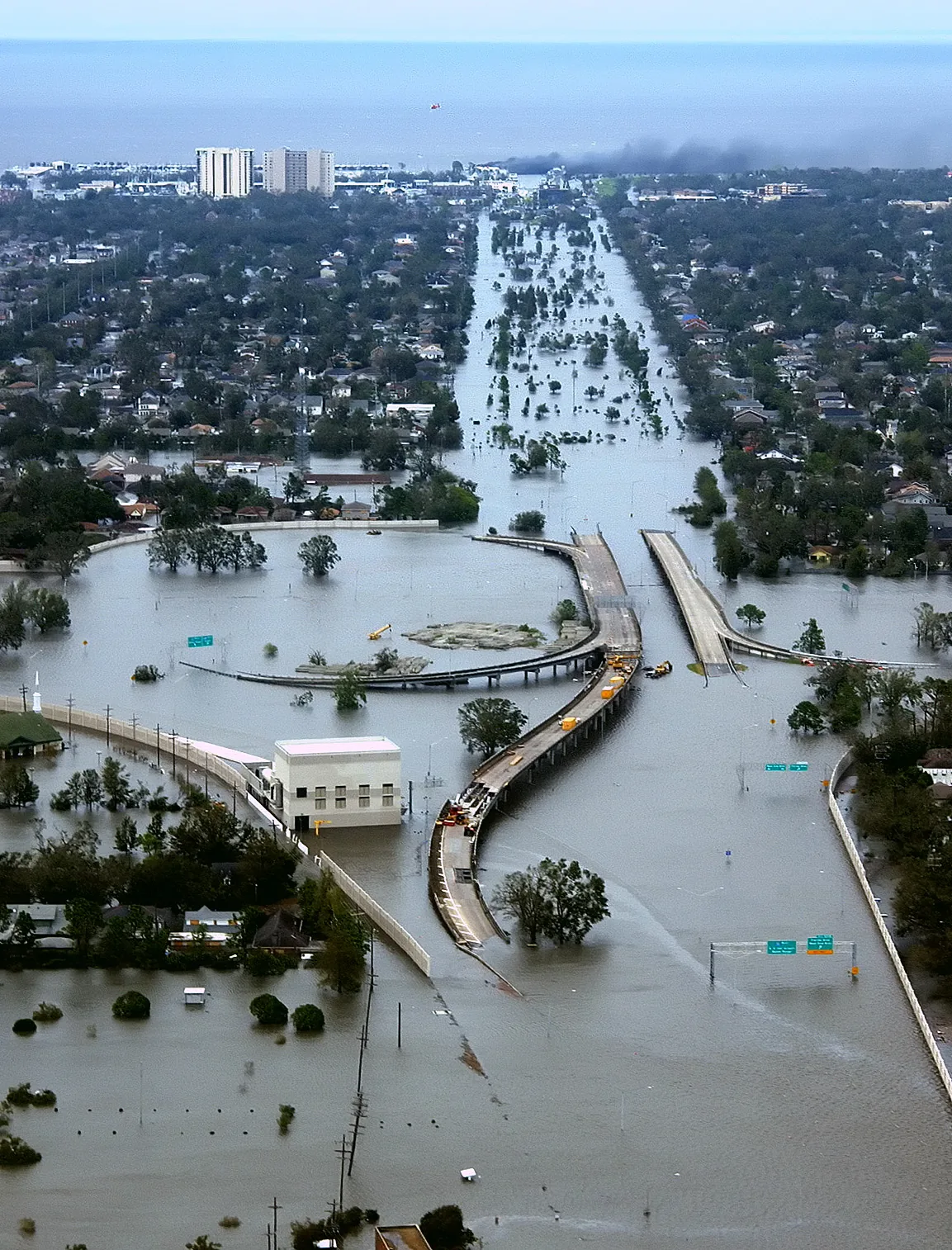
Source: AP photograph by Kyle Niemi, U.S. Coast Guard, August 2005 (image on Wikimedia Commons).
The aerial view shows flooded neighborhoods and a flooded highway interchange. The failure of the levees, built by the Army Corps of Engineers, caused most of the flooding. Many of those who could not evacuate were poor and Black, which made the disaster a symbol of racial and economic inequality.
The most serious economic event of the period was the financial crisis of 2007-2009. A housing boom, fed by easy credit and by complex financial products based on subprime mortgages, collapsed; banks failed or needed rescue, and Lehman Brothers went bankrupt on September 15, 2008. Congress authorized the Troubled Asset Relief Program of $700 billion to stabilize the financial system. Unemployment rose from 4.7 percent in November 2007 to a peak of 10 percent in October 2009: the Great Recession was the worst since the Great Depression.
Document 14 – The unemployment rate, 2007-2009
| Date | U.S. unemployment rate |
|---|---|
| November 2007 | 4.7% |
| October 2009 (peak) | 10% |
| May 2016 | 4.7% |
Source: as summarized at https://en.wikipedia.org/wiki/Great_Recession_in_the_United_States, citing the Bureau of Labor Statistics.
The table shows that the unemployment rate more than doubled in two years and took until 2016 to return to its earlier level.
In November 2008, voters elected Barack Obama, the first African American president, who took office during the crisis. His administration passed the American Recovery and Reinvestment Act, a stimulus of about $787 billion (2009), rescued General Motors and Chrysler, and obtained the Dodd-Frank Wall Street Reform Act (2010).
The Patient Protection and Affordable Care Act of March 2010 extended health insurance to millions of Americans, and it divided the country: it was passed without Republican votes and led to the Tea Party movement and to a Republican House in 2010. The Supreme Court’s decision in Citizens United (2010) removed limits on independent political spending by corporations and unions, and in Obergefell v. Hodges (2015) the Court ruled that same-sex couples have a constitutional right to marry.
Document 15 – Obama’s inaugural address, 2009
Today I say to you that the challenges we face are real. They are serious and they are many. They will not be met easily or in a short span of time. But know this America: They will be met. On this day, we gather because we have chosen hope over fear, unity of purpose over conflict and discord.
Source: Barack Obama, inaugural address, January 20, 2009; text from the Obama White House archives.
Commentary. Obama speaks in the middle of a financial crisis and two wars. He admits that the challenges are “real,” and he appeals to “hope over fear,” a phrase which recalls Roosevelt’s inaugural address of 1933. Place it in context: it was delivered to a huge crowd on the Mall by the first Black president, and it was meant to promise unity at a time of growing partisan conflict.
Polarized politics
Politics became more polarized. The parties sorted themselves by ideology and region, and Americans increasingly lived in communities and consumed media that supported their views, a trend accelerated by cable news and social networks that began with Facebook (2004) and the iPhone (2007). Donald Trump won the election of 2016 after a campaign that stressed immigration, trade, and distrust of established institutions; his administration cut taxes in 2017 and appointed three Supreme Court justices.
The 2020s
In 2020, the COVID-19 pandemic, declared a national emergency in March, led to hundreds of thousands of deaths, to a sudden recession, and to the CARES Act, a $2.2 trillion relief law. Joe Biden won the election of November 2020; on January 6, 2021, a mob attacked the Capitol while Congress was certifying the result.
In Dobbs v. Jackson Women’s Health Organization (2022), the Supreme Court overruled Roe v. Wade and returned the regulation of abortion to the states. The election of November 2024 returned Donald Trump to the presidency in January 2025. Historians who write about this period will have access to sources that we do not yet have; for now, take care to describe events accurately and to represent the arguments of each side fairly.
Definition: political polarization
the growing division of the two major parties and of voters into opposed camps, with fewer members of each party sharing views with the other. Political scientists measure it by votes in Congress and by surveys of voters.
Document 16 – The United States population, 1980-2020
| Year | Population of the United States (census) |
|---|---|
| 1980 | 226,545,805 |
| 1990 | 248,709,873 |
| 2000 | 281,421,906 |
| 2010 | 308,745,538 |
| 2020 | 331,449,281 |
Source: U.S. Census Bureau, decennial census counts (as tabulated at https://en.wikipedia.org/wiki/Demographic_history_of_the_United_States).
The population grew by about 105 million in forty years, largely because of immigration after the 1965 law and continuing births. The largest decade increase was 1990-2000 (about 32.7 million); the two smallest were 1980-1990 (about 22.2 million) and 2010-2020 (about 22.7 million).
- 1980 Ronald Reagan is elected president.
- 1987 Reagan speaks at the Brandenburg Gate; the INF Treaty is signed.
- 1989 The Berlin Wall falls.
- 1990 The Americans with Disabilities Act is signed.
- 1991 The Gulf War; the Soviet Union dissolves.
- 1994 NAFTA takes effect; Republicans win Congress.
- 2001 Attacks of September 11; the AUMF is passed.
- 2008 Financial crisis; Barack Obama is elected.
- 2010 The Affordable Care Act is signed.
- 2020 The COVID-19 pandemic; the presidential election.
Key takeaways
- The conservative turn of 1980 changed the debate about the role of government in taxes, regulation, and welfare.
- The Cold War ended between 1989 and 1991, leaving the United States as the strongest power.
- September 11, 2001, led to wars in Afghanistan and Iraq and to a debate about executive power and civil liberties.
- The financial crisis of 2008, the Affordable Care Act, the pandemic of 2020, and growing polarization shaped domestic politics.
- Globalization and the digital revolution transformed work and communication and produced both growth and economic dislocation.

Quick review: flashcards
Tap a card to see the answer.