


This AP US History lesson covers APUSH Period 8: 1945-1980, part of the unit “APUSH periods.” First, read the full lesson with its primary sources, maps and key terms. Then practice with the worksheet, check yourself with the quiz and get ready with the test.
On June 24, 1948, the Soviet Union cut every road, rail line, and canal that led from West Germany into the western sectors of Berlin. About two million people in the western sectors had food for roughly a month. President Truman refused to withdraw. For eleven months American, British, and French aircraft flew food and coal into the city. Sometimes a plane landed every few minutes. The blockade failed.
It was the first great test of what came to be known as the Cold War. This contest between the United States and the Soviet Union shaped American life for the next four decades. At home the same years saw a prosperous suburban society and the great movement for civil rights. They also saw a bitter war in Vietnam and a presidential resignation. AP US History Period 8 (1945-1980) asks how these developments are connected.
The main themes are Politics and Power (PCE), America in the World (WOR), and Social Structures (SOC). Others are American and National Identity (NAT) and Work, Exchange, and Technology (WXT). The period ends with the election of 1980, a turning point that opens Period 9.
Guiding question: How did the Cold War and the struggle for civil rights reshape American government and society? How did they change ideas of freedom between 1945 and 1980?
1. The Cold War begins, 1945-1953
From alliance to confrontation
The United States and the Soviet Union had fought Germany together, but they distrusted each other. Their meetings at Yalta (February 1945) and Potsdam (July 1945) left open the future of Europe. Meanwhile, the Red Army occupied most of Eastern Europe, where communist governments soon took control. In 1946 Winston Churchill warned in Fulton, Missouri, that an “iron curtain” had descended across the continent. George Kennan, a diplomat in Moscow, wrote that the Soviet Union was expansionist and could be stopped only by firm and patient resistance. This became the policy of containment.
Definition: containment
the American strategy of the Cold War, first described by George Kennan in 1946-1947. It aimed at preventing the spread of communism by diplomatic, economic, and military pressure. It did not try to roll back communist governments where they already ruled.
The first test came in Greece and Turkey, where Britain could no longer afford to support the governments. On March 12, 1947, Truman asked Congress for $400 million in aid and declared a doctrine of support for “free peoples.” In June 1947, Secretary of State George Marshall proposed a program to rebuild Western Europe. Congress passed the European Recovery Program in 1948. It eventually transferred about $13 billion to sixteen or seventeen countries, in the hope that prosperity would defeat communism. The Soviet Union refused to take part and organized its own bloc.
Document 1 – The Truman Doctrine, 1947
I believe that it must be the policy of the United States to support free peoples who are resisting attempted subjugation by armed minorities or by outside pressures. I believe that we must assist free peoples to work out their own destinies in their own way. I believe that our help should be primarily through economic and financial aid which is essential to economic stability and orderly political processes. […] The world is not static, and the status quo is not sacred. But we cannot allow changes in the status quo in violation of the Charter of the United Nations by such methods as coercion, or by such subterfuges as political infiltration.
Source: Harry S. Truman, address to a joint session of Congress, March 12, 1947 (the Truman Doctrine); text from the Avalon Project, Yale Law School.
*subjugation: conquest and control. *status quo: the existing state of affairs. *subterfuges: tricks.
Commentary. Truman speaks in general terms, not only about Greece and Turkey: the United States will support “free peoples who are resisting attempted subjugation.” Historians point out that the speech presents the world as a struggle between two ways of life. Truman’s advisers thought this description necessary to win over a Congress that was reluctant to spend money abroad. The doctrine committed the United States to a global policy in peacetime for the first time.
Document 2 – Selling the Marshall Plan
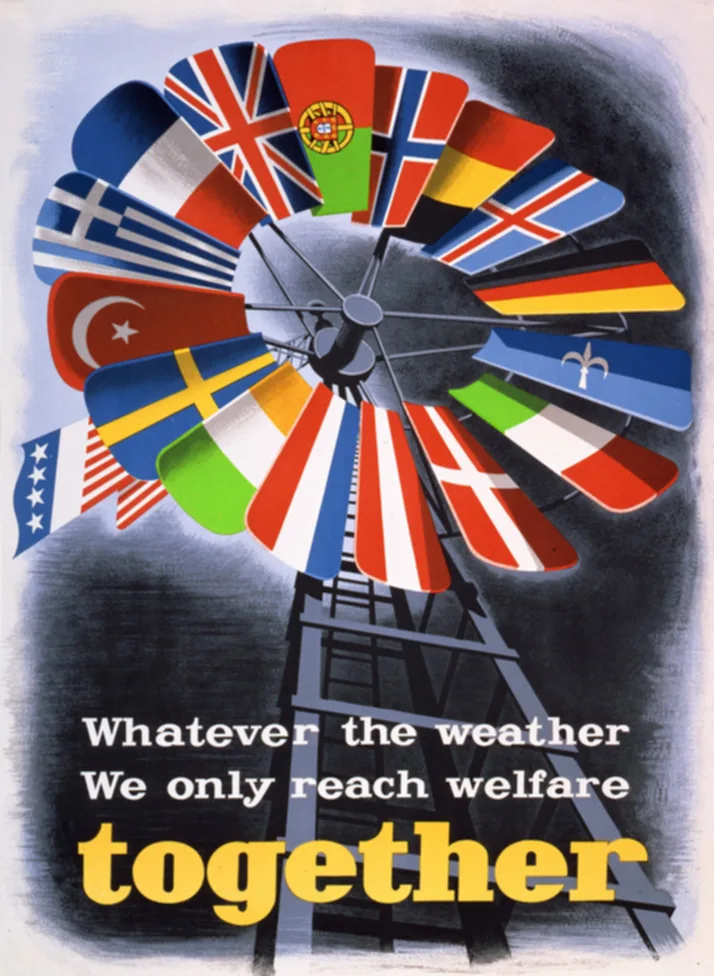
Source: E. Spreckmeester, Economic Cooperation Administration, about 1950 (image on Wikimedia Commons).
The poster was made for European audiences, not for Americans. The windmill, a Dutch symbol, turns with the flags of the member nations, including the flag of the United States at the lower left. It presents the plan as a joint effort rather than American charity. Note how the message of prosperity through cooperation contrasts with the military language of Document 1.
The confrontation hardened. The Berlin blockade (1948-1949) ended in a victory for the West. In April 1949 the United States and eleven partners founded the North Atlantic Treaty Organization (NATO). It was the first peacetime military alliance in American history. The Soviet Union exploded an atomic bomb in 1949, and communists won the civil war in China the same year. NSC-68, a secret policy paper of 1950, called for a large expansion of the American military.
Document 3 – The Berlin Airlift, 1948-1949
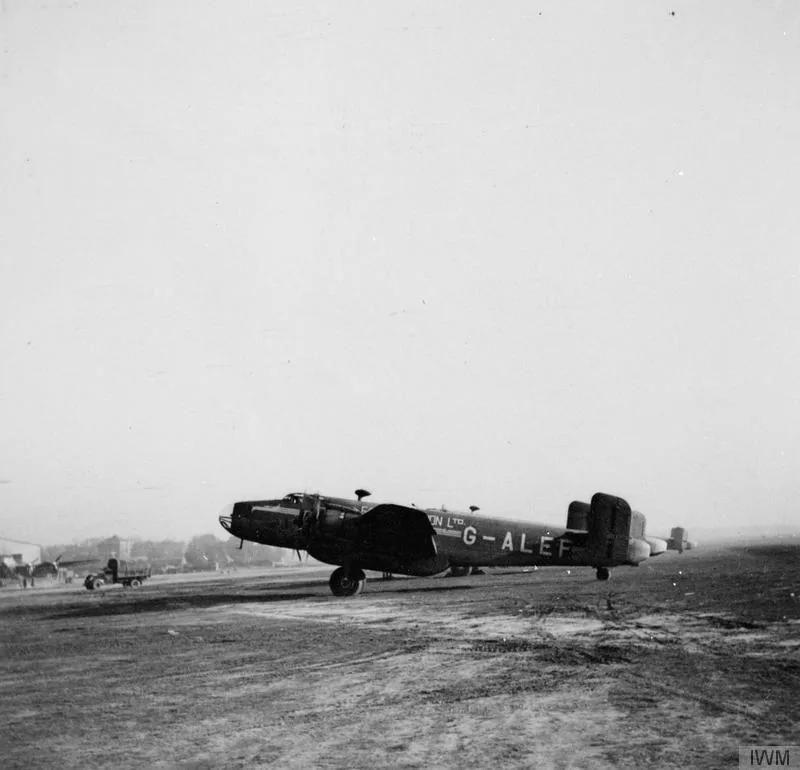
Source: Imperial War Museums, 1948-1949 (image on Wikimedia Commons).
The photograph shows one of the aircraft that flew into Berlin. At the height of the airlift, planes landed at a rate of about one per minute at Berlin’s airfields. The Soviets did not shoot them down, because doing so would have meant war. The airlift also changed German attitudes: West Germans, who had been enemies in 1945, were now partners.
War in Korea and the Red Scare
On June 25, 1950, North Korean forces crossed the 38th parallel and invaded South Korea. Truman, without asking Congress for a declaration of war, sent American troops under United Nations authority. General Douglas MacArthur’s landing at Inchon in September then drove the North Koreans back. When UN forces pushed toward the Chinese border, China entered the war in November. The front then returned to near the 38th parallel. Truman relieved MacArthur in April 1951 after the general publicly criticized the policy of limited war. An armistice signed on July 27, 1953, ended the fighting without a peace treaty. The war cost about 36,500 American dead or missing.
The fear of communism also shaped domestic politics. Truman created a loyalty program for federal employees in 1947. Meanwhile, the House Un-American Activities Committee investigated Hollywood and the government. The conviction of Alger Hiss in 1950 and the Rosenbergs’ execution for atomic espionage in 1953 seemed to confirm the fears. In February 1950, Senator Joseph McCarthy of Wisconsin claimed to have a list of communists in the State Department. For nearly five years he attacked officials and critics with little evidence. The Senate censured him in December 1954. McCarthyism became a name for accusations made without proof.
Definition: McCarthyism
the practice of accusing people of disloyalty or communism without proof, named for Senator Joseph McCarthy. More broadly, it is the climate of fear and suspicion of the early 1950s.
Key takeaways
- Containment, the Truman Doctrine, the Marshall Plan, and NATO defined American policy toward the Soviet Union.
- The Berlin Airlift (1948-1949) and the Korean War (1950-1953) showed that the Cold War could become hot.
- The Red Scare of the late 1940s and early 1950s limited civil liberties at home.
2. Affluence, suburbs, and the space race, 1945-1960
The economy that had been mobilized for war boomed after it. The GI Bill (1944) gave veterans money for college and low-cost home loans. Millions of young couples married and had children: the “baby boom.” William Levitt built the first mass-produced suburb at Levittown, New York, in 1947, using the methods of assembly-line production. His firm and others sold houses by the thousands, but usually only to whites.
The federal government subsidized the suburbs with mortgage insurance and, after the Federal-Aid Highway Act of 1956, with a 41,000-mile system of interstate highways. Television, refrigerators, and automobiles became part of ordinary life. Cities lost residents and tax income to the suburbs. Black Americans, shut out of many neighborhoods by discrimination, were left in older urban districts.
Document 4 – A planned suburb
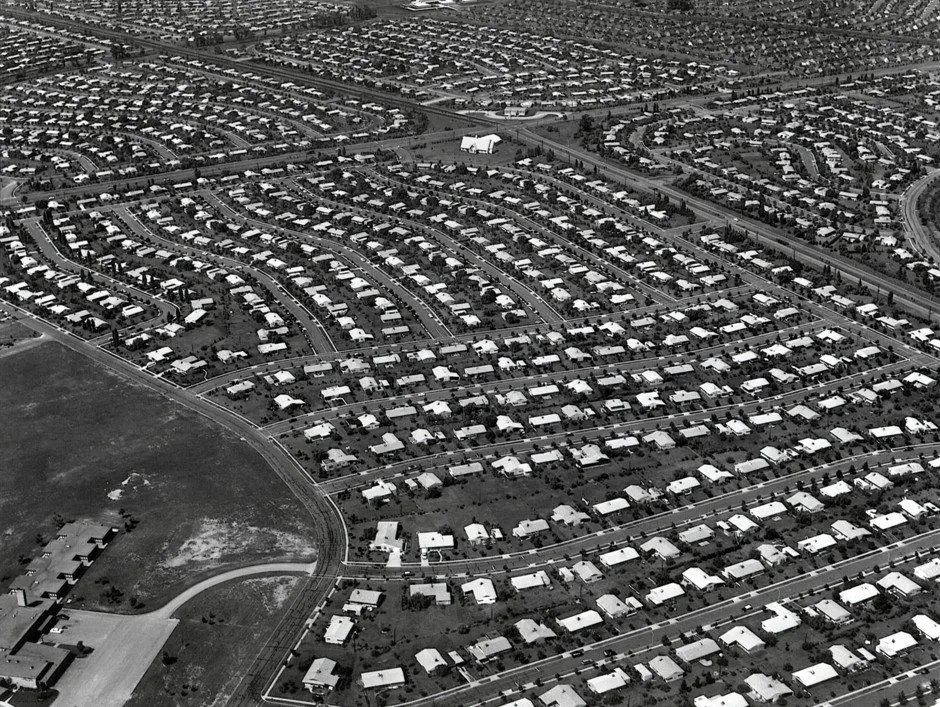
Source: aerial photograph of Levittown, Pennsylvania, 1950s (image on Wikimedia Commons).
The pattern of curving streets and nearly identical houses shows the standardization that kept costs low. Levitt’s contracts at first barred sales to African Americans. The Supreme Court had already declared such covenants unenforceable in 1948. Still, the builder and the banks found ways to exclude them.
Document 5 – The United States population, 1940-1980
| Year | Population of the United States (census) |
|---|---|
| 1940 | 132,164,569 |
| 1950 | 151,325,798 |
| 1960 | 179,323,175 |
| 1970 | 203,211,926 |
| 1980 | 226,545,805 |
Source: U.S. Census Bureau, decennial census counts (as tabulated at https://en.wikipedia.org/wiki/Demographic_history_of_the_United_States).
The population grew by about 94 million in forty years. The largest decade increase was 1950-1960 (about 28 million), the peak of the baby boom.
President Dwight Eisenhower (1953-1961) governed in the center. He ended the Korean War, accepted the New Deal, and built the interstate highways. However, he also relied on a nuclear-weapons strategy known as “massive retaliation.” In addition, he used the CIA to remove unfriendly governments in Iran (1953) and Guatemala (1954). In 1957 the Soviet Union launched Sputnik, the first artificial satellite. Americans feared they had fallen behind. Congress responded with the National Defense Education Act (1958), which funded science and language teaching. It also created NASA (1958). In his farewell address Eisenhower, a general, warned about the influence of what he called the military-industrial complex.
Document 6 – Eisenhower’s warning, 1961
In the councils of government, we must guard against the acquisition of unwarranted influence, whether sought or unsought, by the militaryindustrial complex. The potential for the disastrous rise of misplaced power exists and will persist. We must never let the weight of this combination endanger our liberties or democratic processes. We should take nothing for granted. Only an alert and knowledgeable citizenry can compel the proper meshing of the huge industrial and military machinery of defense with our peaceful methods and goals, so that security and liberty may prosper together.
Source: Dwight D. Eisenhower, farewell address to the nation, January 17, 1961; text from the Avalon Project, Yale Law School.
*acquisition: gaining. *unwarranted: not justified. *meshing: fitting together.
Commentary. Eisenhower was one of the most respected military leaders in the country. He said that a permanent armaments industry was new in American experience and carried dangers for democracy. Notice that he does not call for disarmament: he says that only an “alert and knowledgeable citizenry” can keep security and liberty together. The speech is often quoted by critics of defense spending; remember that it came from a president who had himself increased the nuclear arsenal.
Document 7 – Sputnik, 1957
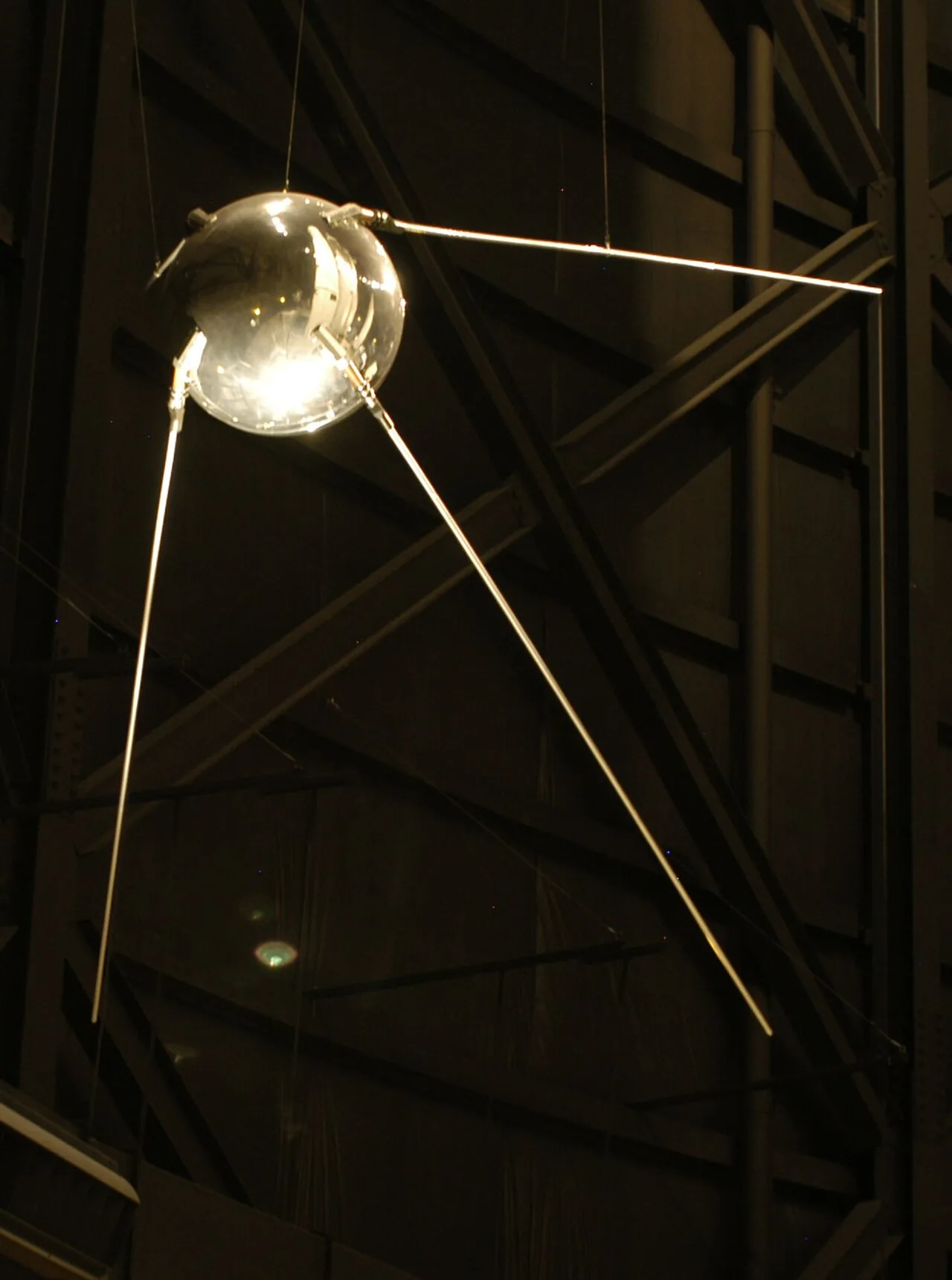
Source: U.S. Air Force photograph of a replica, 1957 satellite (image on Wikimedia Commons).
The real Sputnik was a polished metal sphere about the size of a beach ball with four long antennas. It beeped on radio frequencies that amateurs could receive. It did little scientifically, but it proved that the Soviet Union had rockets able to carry a warhead across the world. The American reaction shows how technology and the Cold War were linked.
The space race led to Apollo 11, when Neil Armstrong and Edwin “Buzz” Aldrin landed on the Moon on July 20, 1969. President Kennedy had set this goal in 1961.
Document 8 – On the Moon, 1969
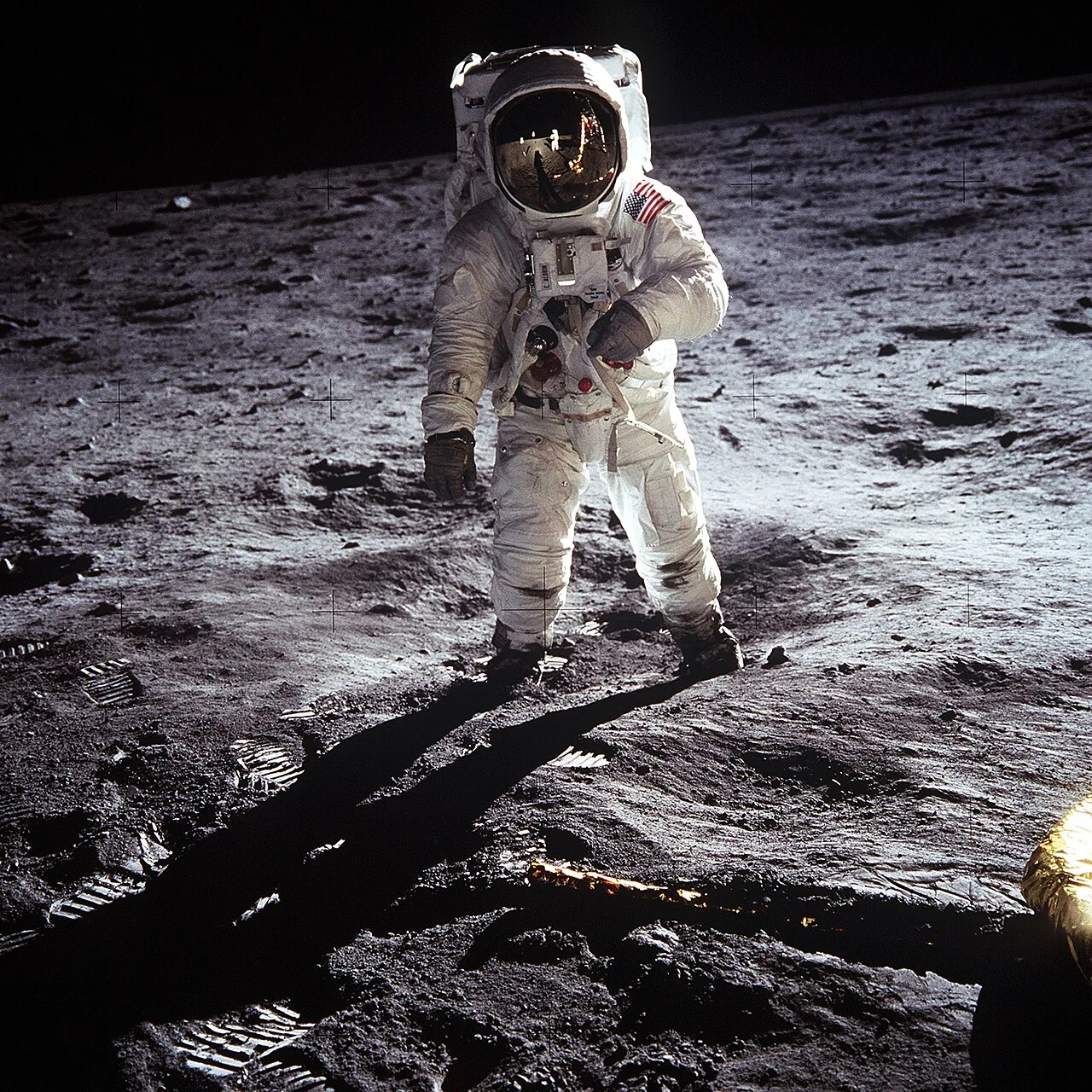
Source: Neil A. Armstrong, July 20, 1969, NASA (image on Wikimedia Commons).
Armstrong took the picture, and he is visible only as a small reflection in Aldrin’s visor. The mission was a technical triumph and a Cold War victory. However, it was paid for by a large federal program that employed hundreds of thousands of people.
Key takeaways
- Postwar prosperity, the GI Bill, and federal highway and housing policy created suburban America, but discrimination limited the access of African Americans.
- Sputnik (1957) led to new federal support for education and science and to NASA.
- Eisenhower warned of the influence of the military-industrial complex in 1961.
3. The civil rights movement, 1948-1968
Courts, boycotts, and school integration
African Americans had long fought for equality. World War II strengthened their demand, because many had served in a segregated army fighting for freedom. In 1948 Truman ordered the desegregation of the armed forces (Executive Order 9981). The NAACP’s Legal Defense Fund, led by Thurgood Marshall, attacked segregation in the courts. On May 17, 1954, the Supreme Court decided unanimously in Brown v. Board of Education that separate public schools were “inherently unequal.” A second decision in 1955 ordered desegregation “with all deliberate speed,” a phrase that gave Southern officials room for delay.
Document 9 – Brown v. Board of Education, 1954
To separate them from others of similar age and qualifications solely because of their race generates a feeling of inferiority as to their status in the community that may affect their hearts and minds in a way unlikely ever to be undone. […] We conclude that, in the field of public education, the doctrine of “separate but equal” has no place. Separate educational facilities are inherently unequal. Therefore, we hold that the plaintiffs and others similarly situated for whom the actions have been brought are, by reason of the segregation complained of, deprived of the equal protection of the laws guaranteed by the Fourteenth Amendment.
Source: Chief Justice Earl Warren, opinion of the Court, Brown v. Board of Education of Topeka, 347 U.S. 483, May 17, 1954; text from the National Archives (archives.gov).
*generates: produces. *Fourteenth Amendment: the 1868 amendment guaranteeing citizens equal protection of the laws.
Document 10 – The Southern Manifesto, 1956
The unwarranted decision of the Supreme Court in the public school cases is now bearing the fruit always produced when men substitute naked power for established law. The Founding Fathers gave us a Constitution of checks and balances because they realized the inescapable lesson of history that no man or group of men can be safely entrusted with unlimited power. They framed this Constitution with its provisions for change by amendment in order to secure the fundamentals of government against the dangers of temporary popular passion or the personal predilections of public officeholders. We regard the decisions of the Supreme Court in the school cases as a clear abuse of judicial power.
Source: Declaration of Constitutional Principles (the Southern Manifesto), read in Congress in March 1956 by Southern members of Congress; text from Wikisource.
*substitute naked power for established law: replace law with sheer force. *abuse of judicial power: judges acting beyond their authority.
Commentary. Warren’s opinion relies on social science as well as law, and it argues that segregation harms the “hearts and minds” of children. The Southern Manifesto, signed by most Southern members of Congress, called the decision an abuse of judicial power and encouraged resistance. Placed side by side, they show the central constitutional argument of the 1950s: whether the Court was protecting equal rights or overstepping its authority. Resistance took many forms, including the closing of public schools in some places.
In Montgomery, Alabama, Rosa Parks, a seamstress and officer of the local NAACP, refused to give up her bus seat to a white passenger on December 1, 1955, and was arrested. Black residents, led by a young minister, Martin Luther King Jr., boycotted the buses for 381 days, until the Supreme Court ruled the bus segregation unconstitutional. In 1957, nine Black students tried to enter Central High School in Little Rock, Arkansas. Governor Orval Faubus used the National Guard to keep them out, and President Eisenhower, who disliked federal pressure on the states but would not let a governor defy a court order, sent the 101st Airborne Division to escort the students.
Document 11 – Rosa Parks is fingerprinted, 1956
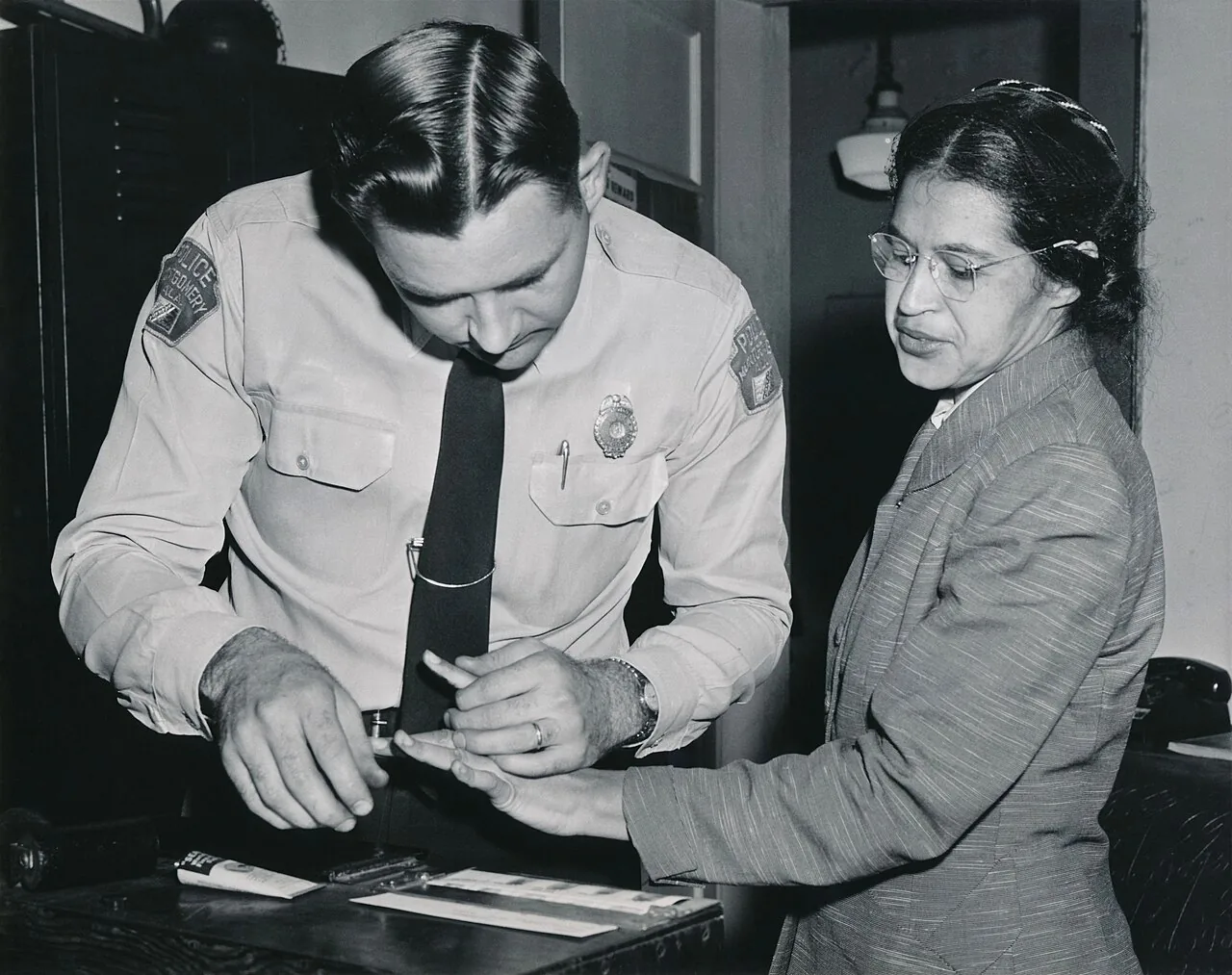
Source: photograph, February 22, 1956, Montgomery, Alabama (image on Wikimedia Commons).
This photograph is often described as showing Parks after her arrest in December 1955, but the caption on file gives the date of February 1956, when she was one of about ninety boycott leaders charged under an Alabama anti-boycott law. Check the date and caption of a picture before using it as evidence.
Document 12 – Elizabeth Eckford, Little Rock, 1957
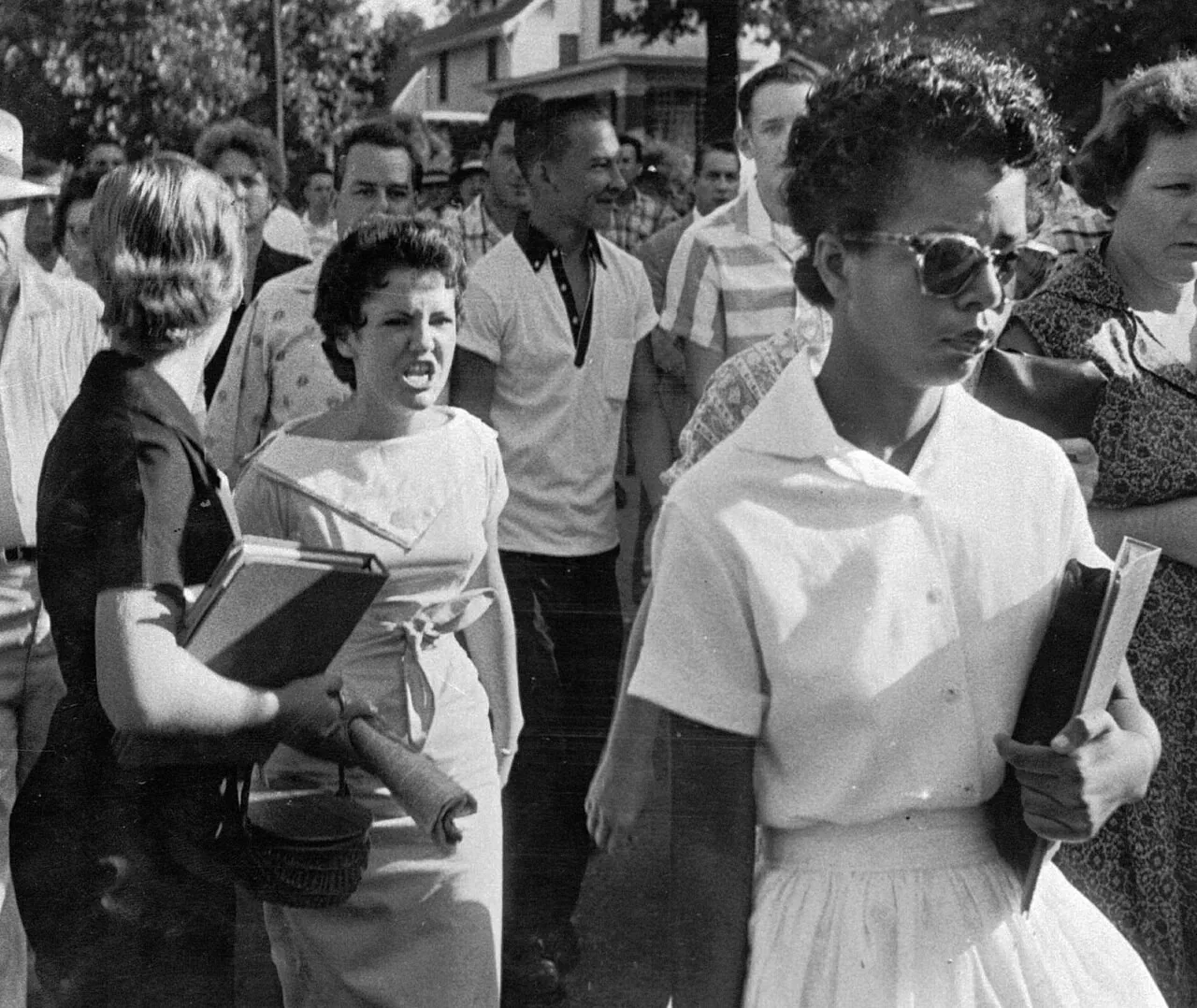
Source: Ira Wilmer Counts Jr., September 4, 1957 (image on Wikimedia Commons).
Elizabeth Eckford, fifteen years old, walks alone to the school while members of the crowd shout behind her. She had no way of knowing that the other eight students had been told to meet elsewhere. The photograph appeared in newspapers around the world and affected opinion, including that of other countries during the Cold War, since segregation was a propaganda weapon for the Soviet Union.
Direct action and federal law
In 1960, four Black college students sat down at a whites-only lunch counter in Greensboro, North Carolina, and the sit-in movement spread across the South. Students formed the Student Nonviolent Coordinating Committee (SNCC), and in 1961 Freedom Riders, Black and white, rode buses through the South to challenge segregated bus stations and were beaten in Alabama. In 1963 King led demonstrations in Birmingham, where police used dogs and fire hoses against children, and Americans saw the scenes on television. On August 28, 1963, about a quarter of a million people marched on Washington for jobs and freedom, and King delivered his “I Have a Dream” speech at the Lincoln Memorial.
Document 13 – The March on Washington, 1963
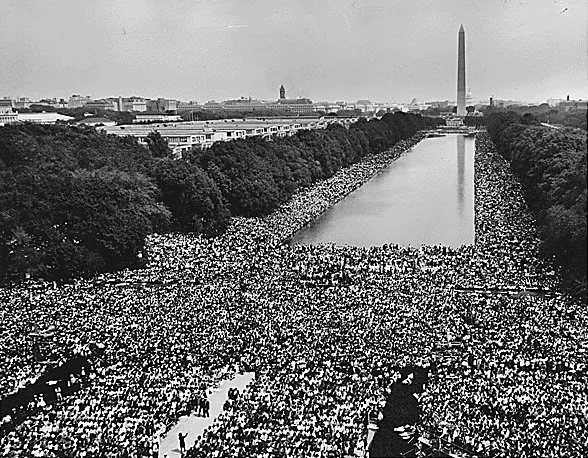
Source: U.S. Information Agency, August 28, 1963 (image on Wikimedia Commons).
The aerial view shows the crowd along both sides of the Reflecting Pool, with the Washington Monument at the end. President Kennedy supported the march only after initial doubts, and the organizers, including A. Philip Randolph and Bayard Rustin, had planned it for months. The size and the peaceful character of the crowd helped build support for the civil rights bill.
After Kennedy’s assassination in November 1963, President Lyndon Johnson pushed through the Civil Rights Act of 1964, which banned discrimination in public accommodations and employment and gave the federal government power to cut off funds to segregated schools. In the summer of 1964, volunteers registered voters in Mississippi in the Freedom Summer, and three were murdered. In March 1965, civil rights marchers in Selma, Alabama, were beaten by state troopers on “Bloody Sunday” (March 7), and Johnson went before Congress to ask for a voting rights law. The Voting Rights Act of August 1965 banned literacy tests and allowed federal examiners to register voters; Black registration in the South rose sharply in the following years.
Document 14 – “We Shall Overcome,” 1965
There is no Negro problem. There is no Southern problem. There is no Northern problem. There is only an American problem. And we are met here tonight as Americans–not as Democrats or Republicans–we are met here as Americans to solve that problem. […] But even if we pass this bill, the battle will not be over. What happened in Selma is part of a far larger movement which reaches into every section and State of America. It is the effort of American Negroes to secure for themselves the full blessings of American life. Their cause must be our cause too. Because it is not just Negroes, but really it is all of us, who must overcome the crippling legacy of bigotry and injustice. And we shall overcome.
Source: Lyndon B. Johnson, special message to Congress on voting rights (“We Shall Overcome”), March 15, 1965; text from the American Presidency Project, University of California, Santa Barbara.
*overcome: defeat a difficulty. *bigotry: intolerance of other groups.
Document 15 – Marching from Selma, 1965
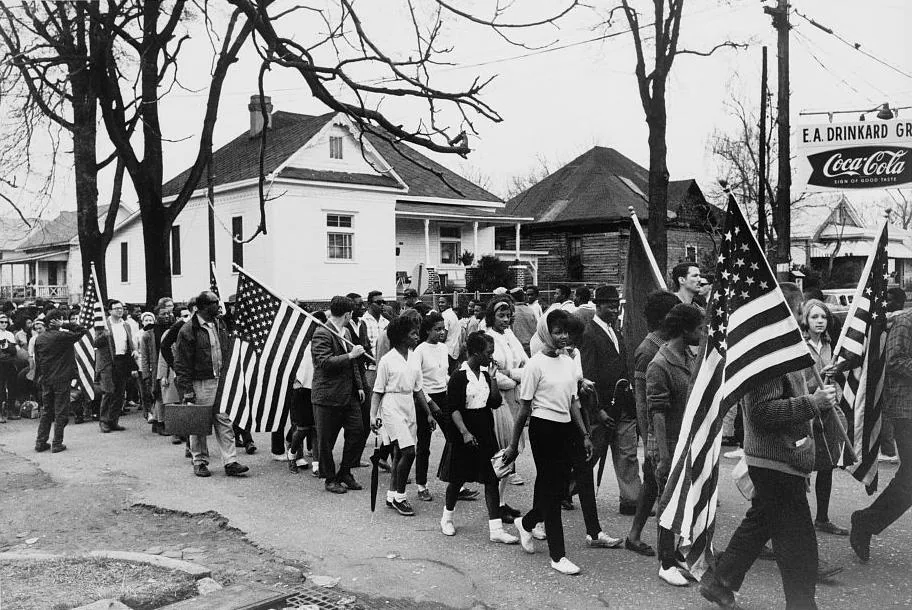
Source: Peter Pettus, March 1965, Library of Congress (image on Wikimedia Commons).
The marchers carry American flags and walk along a road in Alabama. Johnson had sent troops to protect the third march, which reached Montgomery on March 25. Notice the use of the national flag: the marchers claimed the national symbols for their cause.
The movement then changed. Malcolm X, a Nation of Islam minister, argued for Black pride and self-defense and was murdered in February 1965. Younger activists such as Stokely Carmichael called for “Black Power.” Riots in Los Angeles (Watts, 1965), Detroit, and Newark showed the anger of northern Black communities. King, who turned toward economic issues and opposed the Vietnam War, was assassinated in Memphis on April 4, 1968, and the Fair Housing Act of 1968 was passed a week later.
Other groups used the civil rights model: women organized the National Organization for Women (1966) after Betty Friedan’s The Feminine Mystique (1963), Cesar Chavez organized farm workers (1962), Native Americans formed the American Indian Movement (1968), gay men and lesbians resisted a police raid at the Stonewall Inn in New York in 1969, and environmentalists, inspired by Rachel Carson’s Silent Spring (1962), won the first Earth Day and the Environmental Protection Agency (1970).
Key takeaways
- Brown v. Board of Education (1954) overturned Plessy for public schools; massive resistance and gradualism slowed integration.
- Boycotts, sit-ins, and marches built support for the Civil Rights Act (1964) and the Voting Rights Act (1965).
- The movement inspired women, Latinos, Native Americans, gay men and lesbians, and environmentalists to demand change.
4. Vietnam, the Great Society, and a crisis of confidence, 1960-1980
Kennedy, Johnson, and the Cold War at its peak
John F. Kennedy, elected in 1960, promised a New Frontier and a more active foreign policy. His inaugural address pledged that the United States would “pay any price, bear any burden” to defend liberty. He created the Peace Corps (1961), but the invasion of Cuba at the Bay of Pigs in April 1961 by exiles trained by the CIA failed. In June, Khrushchev tested him in Vienna, and in August East Germany built the Berlin Wall to stop its people from leaving.
Document 16 – Kennedy’s inaugural address, 1961
Let every nation know, whether it wishes us well or ill, that we shall pay any price, bear any burden, meet any hardship, support any friend, oppose any foe, in order to assure the survival and the success of liberty. […] And so, my fellow Americans: ask not what your country can do for you–ask what you can do for your country.
Source: John F. Kennedy, inaugural address, January 20, 1961; text from the Avalon Project, Yale Law School.
Document 17 – Kennedy and Khrushchev in Vienna, 1961
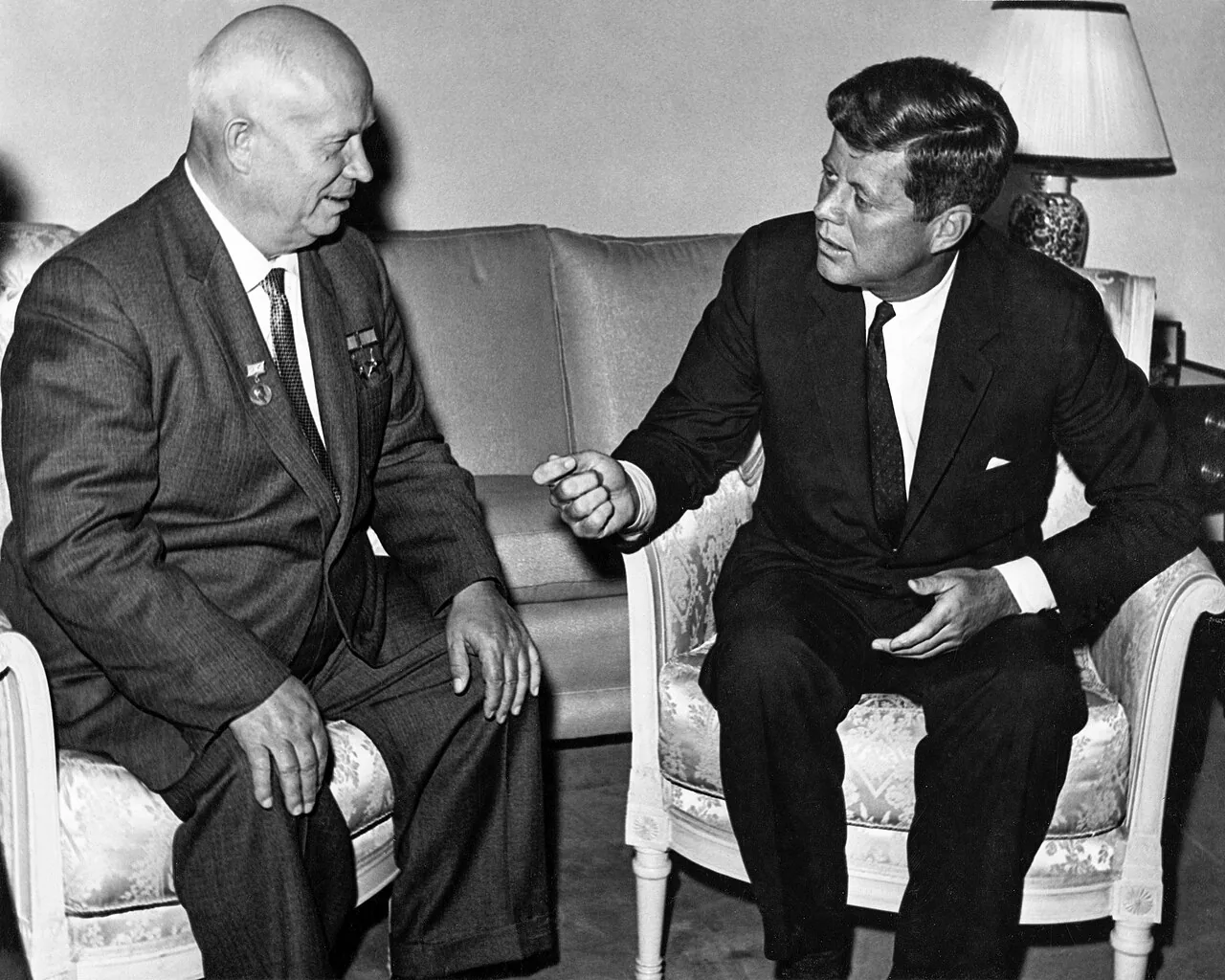
Source: U.S. Department of State, John F. Kennedy Presidential Library, June 1961 (image on Wikimedia Commons).
The two leaders talk in chairs in the Soviet embassy residence. The meeting went badly for Kennedy, who said afterward that Khrushchev had been rough with him. The photograph is posed for the press; it is evidence of the diplomacy, not of what was said.
In October 1962 an American U-2 plane photographed Soviet nuclear missile sites under construction in Cuba. Kennedy announced a naval “quarantine” of the island on October 22, and for thirteen days the world was closer to nuclear war than it has ever been. Khrushchev agreed to withdraw the missiles; Kennedy pledged not to invade Cuba and, secretly, to remove American missiles from Turkey. The crisis led to a telephone “hot line” between Washington and Moscow and the Limited Test Ban Treaty (1963).
Document 18 – The missiles in Cuba, 1962
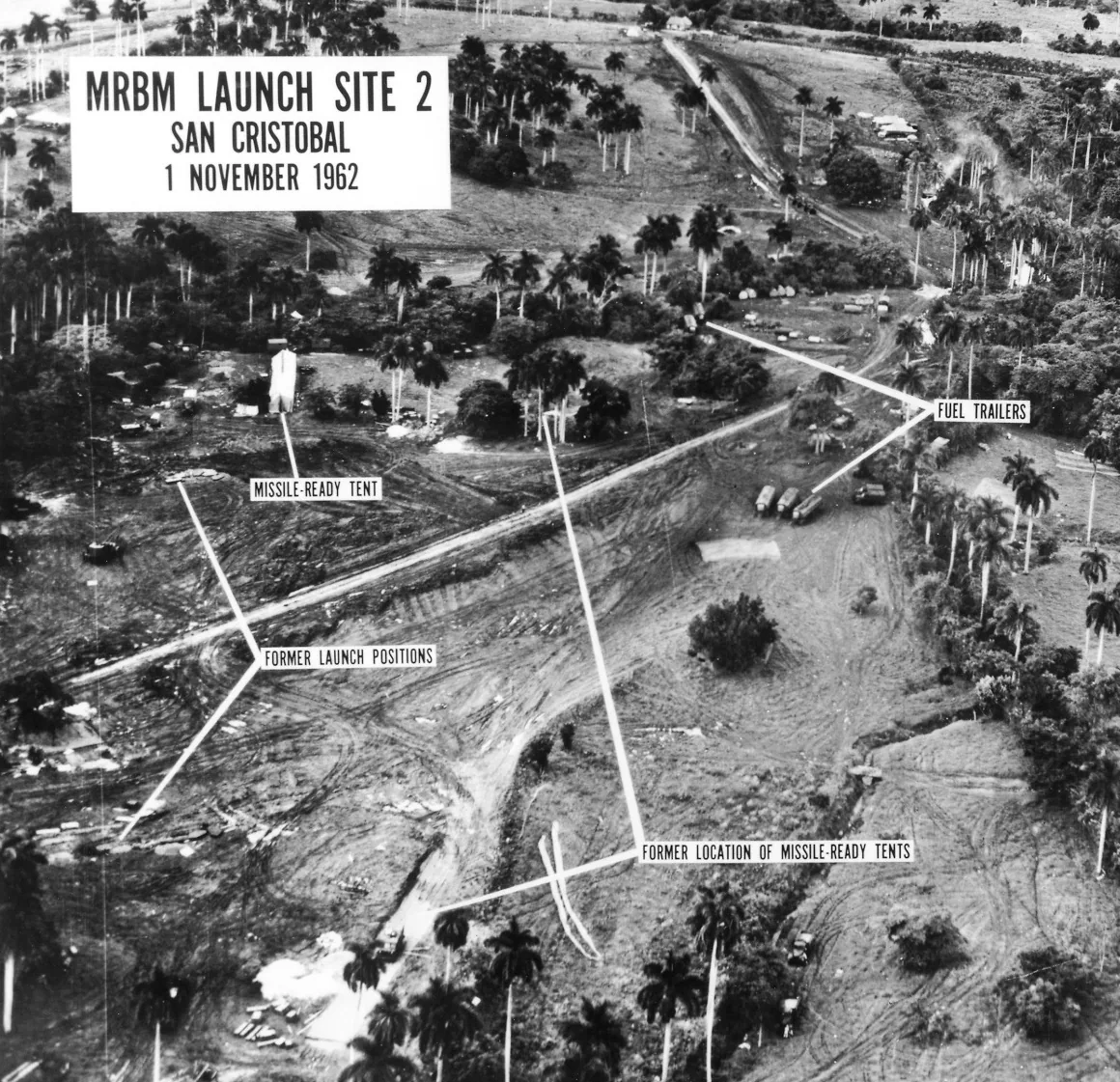
Source: U.S. reconnaissance photograph, San Cristobal, Cuba, November 1, 1962 (image on Wikimedia Commons).
The labels were added by American intelligence analysts to identify the launch positions, missile-ready tents, and fuel trailers. The photograph is a good example of a document made for decision makers: the Kennedy administration also showed photographs of this type at the United Nations to persuade other nations.
After Kennedy was assassinated in Dallas on November 22, 1963, Lyndon Johnson launched the Great Society: a War on Poverty (1964), Medicare and Medicaid (1965), federal aid to education (1965), and the Immigration and Nationality Act of 1965, which ended the national-origins quotas of the 1920s and led to a large increase in immigration from Asia and Latin America. Johnson’s own landslide victory in 1964 gave him the votes in Congress to pass them.
Definition: Great Society
the name given to the domestic program of President Lyndon Johnson (1963-1969): civil rights laws, the War on Poverty, Medicare and Medicaid, aid to education, and other measures to reduce poverty and racial injustice.
Vietnam
The United States had supported France in Indochina and, after the French defeat at Dien Bien Phu in 1954, supported the anticommunist government of South Vietnam against the communist North. In August 1964, after reports of attacks on American destroyers in the Gulf of Tonkin, Congress passed the Gulf of Tonkin Resolution by a vote of 416 to 0 in the House and 88 to 2 in the Senate.
Johnson used it as authority to send combat troops: Marines landed at Da Nang in March 1965, and bombing of the North began. By 1968 more than half a million Americans were in Vietnam. The Viet Cong and North Vietnamese Army launched the Tet Offensive in January 1968; it was a military defeat for them but a political blow to the American public, who had been told that the war was being won. Johnson announced on March 31, 1968, that he would not run again.
Document 19 – The Gulf of Tonkin Resolution, 1964
That the Congress approves and supports the determination of the President, as Commander in Chief, to take all necessary measures to repel any armed attack against the forces of the United States and to prevent further aggression. Section 2. The United States regards as vital to its national interest and to world peace the maintenance of international peace and security in southeast Asia. Consonant with the Constitution of the United States and the Charter of the United Nations and in accordance with its obligations under the Southeast Asia Collective Defense Treaty, the United States is, therefore, prepared, as the President determines, to take all necessary steps, including the use of armed force, to assist any member or protocol state of the Southeast Asia Collective Defense Treaty requesting assistance in defense of its freedom.
Source: Southeast Asia Resolution (Gulf of Tonkin Resolution), Public Law 88-408, August 7, 1964; text from the Avalon Project, Yale Law School.
*protocol state: a state covered by the protocol of the Southeast Asia Treaty (including South Vietnam). *aggression: attack.
Commentary. The resolution does not mention a declaration of war; it approves “all necessary measures” and the use of “armed force” at the President’s determination. Congress later repealed it in 1971. Critics said that it had given up Congress’s constitutional war power. The War Powers Resolution (1973), passed over Nixon’s veto, tried to restore a role for Congress.
The war divided Americans. Antiwar protests grew on campuses, and a “counterculture” challenged the values of the older generation. Richard Nixon, elected in 1968, promised “peace with honor.” He began “Vietnamization,” the withdrawal of American troops while South Vietnamese forces took over, and widened the war to Cambodia in 1970; at Kent State University in Ohio, National Guard troops killed four students on May 4, 1970.
The Pentagon Papers, a secret history of the war leaked in 1971, showed that officials had misled the public. The Twenty-sixth Amendment (1971) gave the vote to 18-year-olds, and the Paris Peace Accords (January 1973) removed American forces. Saigon fell to the North on April 30, 1975. More than 58,000 Americans died in the war, and millions of Vietnamese.
Watergate and the 1970s
Nixon was also a skilled diplomat. He opened relations with China in 1972 and signed the first Strategic Arms Limitation Treaty (SALT I) with the Soviet Union, a policy called détente. At home, however, his aides organized a break-in at the Democratic National Committee headquarters in the Watergate complex in June 1972, and Nixon helped cover it up. Congress, the press, and a Senate committee investigated, and the discovery of secret White House tapes led to the Supreme Court decision in United States v. Nixon (July 1974), which ordered the President to turn them over. Facing impeachment, Nixon resigned on August 9, 1974, the only president to do so. His successor, Gerald Ford, pardoned him a month later.
Definition: détente
the easing of tensions between the United States and the Soviet Union in the 1970s, marked by arms control treaties (SALT I, 1972), the visits of Nixon to Beijing and Moscow, and increased trade.
Document 20 – Nixon announces his resignation, 1974
I have never been a quitter. To leave office before my term is completed is abhorrent to every instinct in my body. But as President, I must put the interests of America first. America needs a full-time President and a full-time Congress, particularly at this time with problems we face at home and abroad. To continue to fight through the months ahead for my personal vindication would almost totally absorb the time and attention of both the President and the Congress in a period when our entire focus should be on the great issues of peace abroad and prosperity without inflation at home. Therefore, I shall resign the Presidency effective at noon tomorrow.
Source: Richard M. Nixon, address to the nation announcing his decision to resign, August 8, 1974; text from the American Presidency Project, University of California, Santa Barbara.
*vindication: proof of innocence.
Document 21 – Nixon leaves the White House, 1974
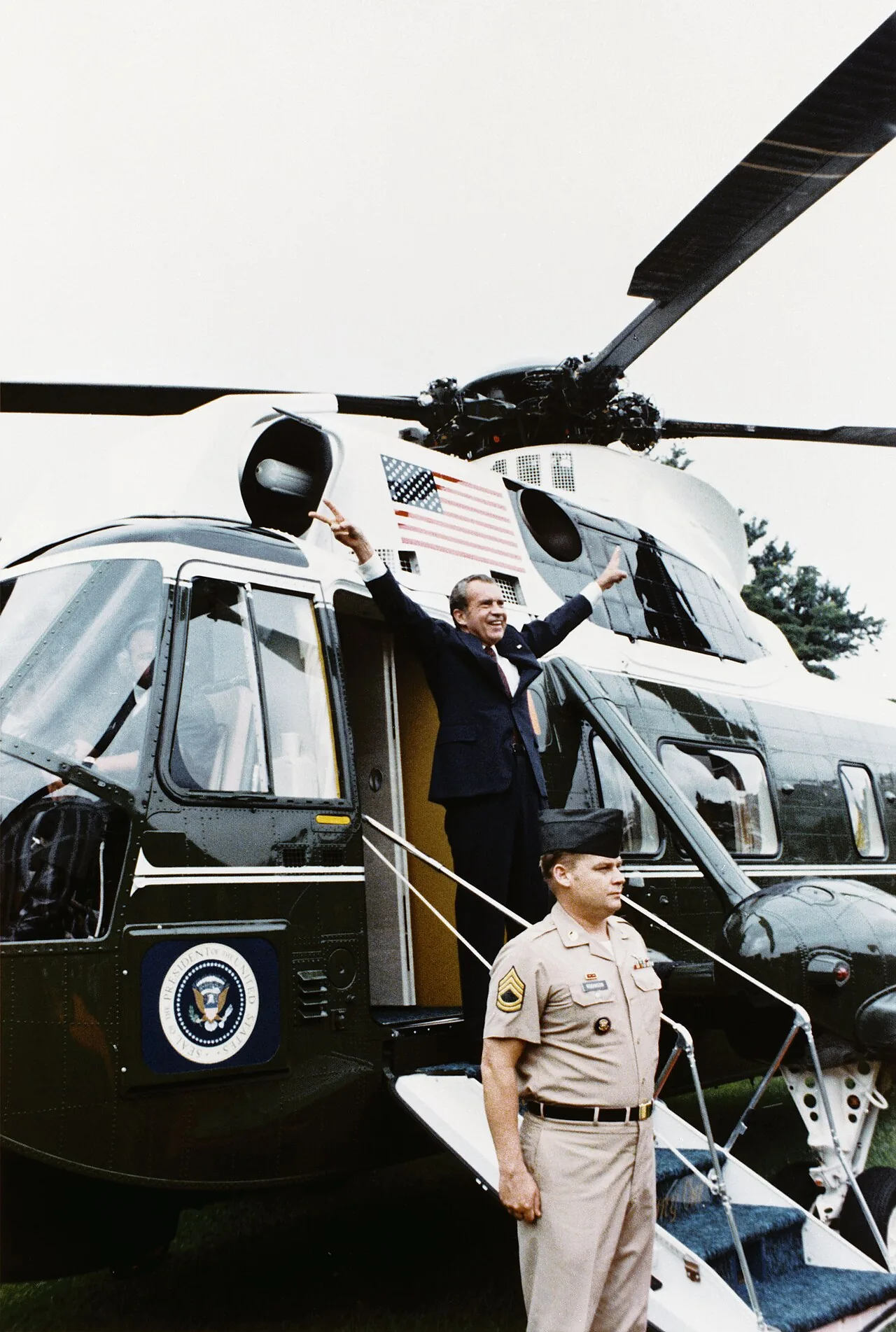
Source: White House photograph, August 9, 1974 (image on Wikimedia Commons).
Nixon waves from the door of the helicopter. The picture was taken by a White House photographer. Notice that he does not mention the crimes in his speech of the day before: he cites only the interests of the country. Compare the wording with the facts given in the lesson.
The 1970s were also a decade of economic troubles. The Arab oil embargo of October 1973 raised energy prices and led to long lines at gas stations, and inflation and unemployment rose together, a combination called stagflation. Jimmy Carter, elected in 1976, brokered the Camp David Accords between Egypt and Israel (1978) but was hurt by the economy and by the Iran hostage crisis: Iranian students seized the American embassy in Tehran on November 4, 1979, and held 52 Americans for 444 days. The Soviet invasion of Afghanistan in December 1979 ended détente. In the election of 1980 Ronald Reagan won by a large margin, and a new era began.
- 1947 The Truman Doctrine and the Marshall Plan.
- 1950-1953 The Korean War; McCarthyism at its height.
- 1954 Brown v. Board of Education.
- 1957 Little Rock Central High School; Sputnik.
- 1963 The March on Washington; Kennedy is assassinated.
- 1964-1965 The Civil Rights Act, the Gulf of Tonkin Resolution, and the Voting Rights Act.
- 1968 The Tet Offensive; King is assassinated; Nixon is elected.
- 1973 The Paris Peace Accords; the oil embargo begins.
- 1974 Nixon resigns after Watergate.
- 1979-1980 The Iran hostage crisis begins; Reagan is elected.
Key takeaways
- Containment shaped American foreign policy: the Truman Doctrine, the Marshall Plan, NATO, the Korean War, and the Cuban Missile Crisis.
- The civil rights movement used courts, boycotts, marches, and federal law to end legal segregation (Brown 1954; Civil Rights Act 1964; Voting Rights Act 1965).
- The Great Society expanded the role of government, while the Vietnam War undermined trust in it; Watergate led to Nixon’s resignation (1974).
- Economic troubles of the 1970s and the Iran hostage crisis opened the way to the conservative turn of 1980.

Quick review: flashcards
Tap a card to see the answer.