


This AP US History test covers APUSH Period 8: 1945-1980. Like a classroom assessment, it includes documents to analyze, knowledge questions and a short writing task. To prepare, review the lesson first, then practice with the worksheet.
Time : 90 min
This test follows the AP format. Part 1 (question 1) tests knowledge; Part 2 (questions 2-6) asks you to use the documents; Part 3 (questions 7-8) contains a short-answer question and a long essay. Total: 100 points. Read each document and its source line before you answer.
Document 1 – Document A – The Truman Doctrine, 1947
I believe that it must be the policy of the United States to support free peoples who are resisting attempted subjugation by armed minorities or by outside pressures. I believe that we must assist free peoples to work out their own destinies in their own way. I believe that our help should be primarily through economic and financial aid which is essential to economic stability and orderly political processes. […] The world is not static, and the status quo is not sacred. But we cannot allow changes in the status quo in violation of the Charter of the United Nations by such methods as coercion, or by such subterfuges as political infiltration.
Source: Harry S. Truman, address to a joint session of Congress, March 12, 1947 (the Truman Doctrine); text from the Avalon Project, Yale Law School.
*subjugation: conquest and control. *status quo: the existing state of affairs.
Harry S. Truman, address to Congress, March 12, 1947.
Document 2 – Document B – Little Rock, 1957
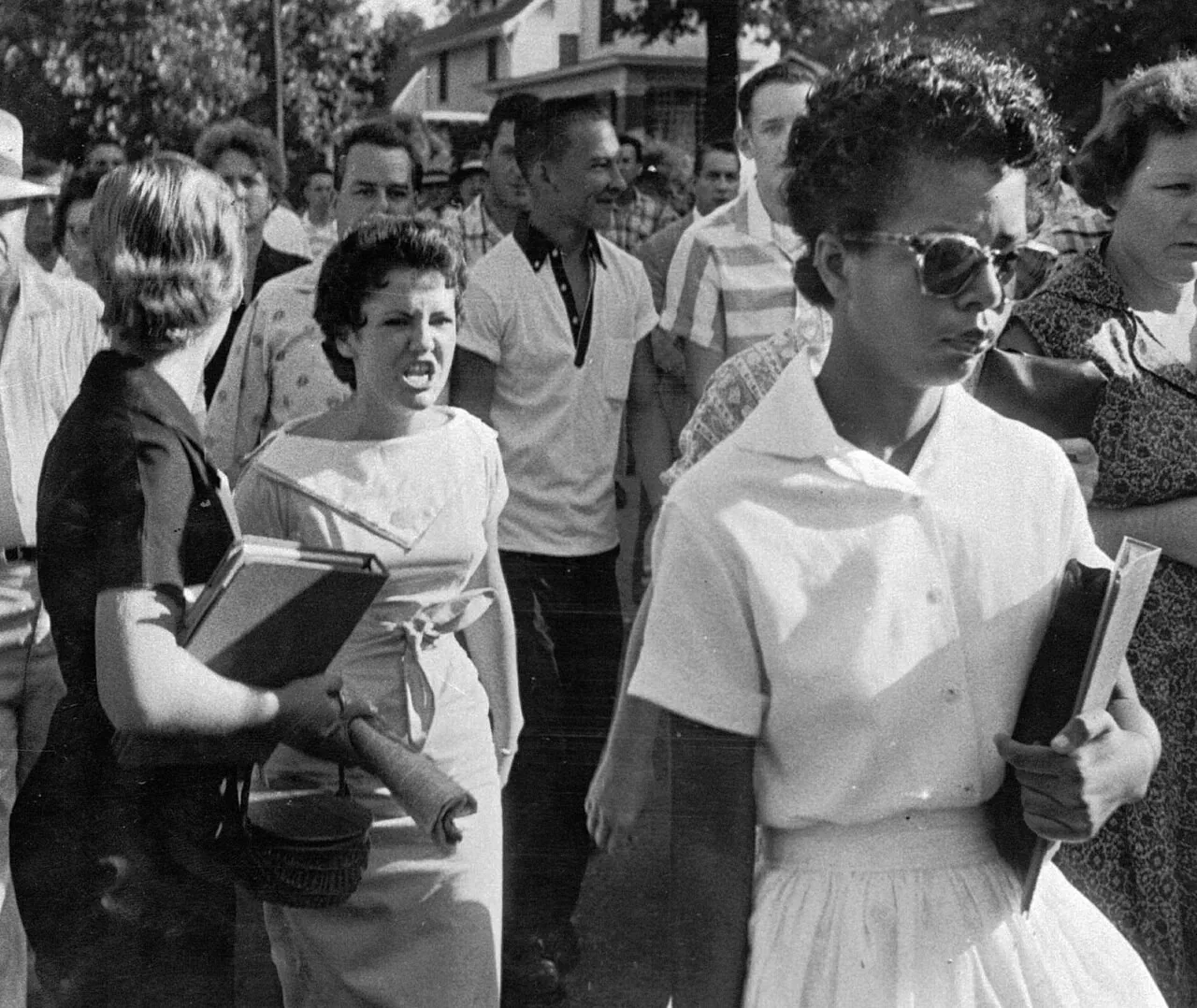
Source: Ira Wilmer Counts Jr., September 4, 1957.
Photograph by Ira Wilmer Counts Jr., 1957.
Document 3 – Document C – Cold War Europe
Map drawn from Natural Earth data; the line and the arrows are schematic.
Document 4 – Document D – Population of the United States, 1940-1980
| Year | Population (census) |
|---|---|
| 1940 | 132,164,569 |
| 1950 | 151,325,798 |
| 1960 | 179,323,175 |
| 1970 | 203,211,926 |
| 1980 | 226,545,805 |
Source: U.S. Census Bureau, decennial census counts.
U.S. Census Bureau.
Document 5 – Document E – The Gulf of Tonkin Resolution, 1964
That the Congress approves and supports the determination of the President, as Commander in Chief, to take all necessary measures to repel any armed attack against the forces of the United States and to prevent further aggression. Section 2. The United States regards as vital to its national interest and to world peace the maintenance of international peace and security in southeast Asia. Consonant with the Constitution of the United States and the Charter of the United Nations and in accordance with its obligations under the Southeast Asia Collective Defense Treaty, the United States is, therefore, prepared, as the President determines, to take all necessary steps, including the use of armed force, to assist any member or protocol state of the Southeast Asia Collective Defense Treaty requesting assistance in defense of its freedom.
Source: Southeast Asia Resolution (Gulf of Tonkin Resolution), Public Law 88-408, August 7, 1964; text from the Avalon Project, Yale Law School.
*protocol state: a state covered by the protocol of the Southeast Asia treaty.
Southeast Asia Resolution, Public Law 88-408, August 7, 1964.
Questions
- (Part 1) Define containment and explain how the Truman Doctrine and the Marshall Plan put it into practice. (10 pts)
- (Part 2, Document A) Explain Truman’s purpose in the speech and give one later example of the policy he announced. (10 pts)
- (Part 2, Document C) Describe what the map shows about Europe in the Cold War and explain why Berlin was a flashpoint. (10 pts)
- (Part 2, Document B) Describe the context of the photograph and explain the role of the federal government in the events at Little Rock. (10 pts)
- (Part 2, Document D) Calculate the decade with the largest population increase and explain how the population trend affected American society. (10 pts)
- (Part 2, Document E) Explain how the resolution increased presidential power and describe one response by Congress after the war. (10 pts)
- (Part 3, SAQ) Explain ONE similarity and ONE difference between the strategies of the civil rights movement in the 1950s and those of the early 1960s. (10 pts)
- (Part 3, LEQ) Evaluate the extent to which the Vietnam War and Watergate changed Americans’ trust in their government between 1964 and 1980. Use specific evidence. (30 pts)


Quick review: flashcards
Tap a card to see the answer.