


This AP US History test covers APUSH Period 7: 1890-1945. Like a classroom assessment, it includes documents to analyze, knowledge questions and a short writing task. To prepare, review the lesson first, then practice with the worksheet.
Time : 90 min
This test follows the AP format. Part 1 (question 1) tests knowledge; Part 2 (questions 2-5) asks you to use the documents; Part 3 (questions 6-8) contains two short-answer questions and a long essay. Total: 100 points. Read each document and its source line before you answer.
Document 1 – Document A – The Fourteen Points, 1918
I. Open covenants of peace, openly arrived at, after which there shall be no private international understandings of any kind but diplomacy shall proceed always frankly and in the public view. […] XIV. A general association of nations must be formed under specific covenants for the purpose of affording mutual guarantees of political independence and territorial integrity to great and small states alike.
Source: Woodrow Wilson, address to Congress on the Fourteen Points, January 8, 1918; text from the Avalon Project, Yale Law School.
*covenants: formal agreements. *territorial integrity: the right of a state to keep its borders.
Woodrow Wilson, address to Congress, January 8, 1918.
Document 2 – Document B – “Migrant Mother,” 1936
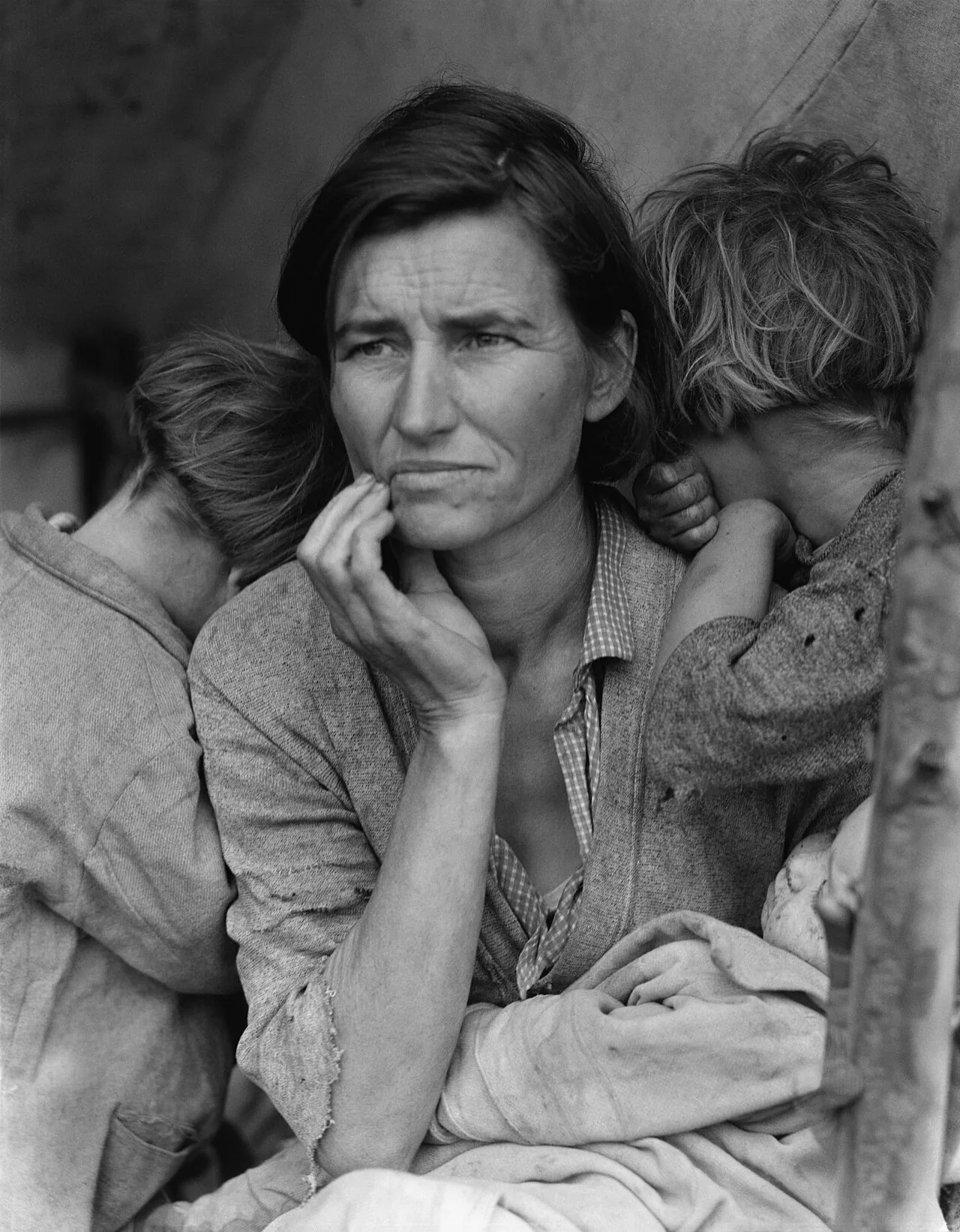
Source: Dorothea Lange, March 1936, Library of Congress.
Dorothea Lange, 1936.
Document 3 – Document C – The war in Europe, 1942-1945
Map drawn from Natural Earth data; arrows are schematic.
Document 4 – Document D – Key figures of the Depression
| Indicator | Figure |
|---|---|
| Unemployment rate, 1933 (peak) | about 25% |
| Unemployment rate, 1940 | about 15% |
| Banks failed by 1933 | 9,000 of 25,000 |
Source: as summarized at https://en.wikipedia.org/wiki/Great_Depression.
Economic history summaries of the Great Depression.
Document 5 – Document E – Justice Murphy dissenting, 1944
I dissent, therefore, from this legalization of racism. Racial discrimination in any form and in any degree has no justifiable part whatever in our democratic way of life. It is unattractive in any setting but it is utterly revolting among a free people who have embraced the principles set forth in the Constitution of the United States.
Source: Justice Frank Murphy, dissenting opinion, Korematsu v. United States, 323 U.S. 214 (1944); Legal Information Institute, Cornell Law School.
*kin: related.
Korematsu v. United States, 323 U.S. 214 (1944), dissent.
Questions
- (Part 1) Define Progressivism and explain two reforms of the Progressive Era (laws, amendments, or court decisions). (10 pts)
- (Part 2, Document A) Explain the purpose of the Fourteen Points and identify one reason why the United States did not join the League of Nations. (10 pts)
- (Part 2, Documents B and D) Use the photograph and the table to explain how the Great Depression affected American families, and explain one federal response. (10 pts)
- (Part 2, Document C) Describe the sequence of Allied operations in the Mediterranean and in France shown on the map, and explain one reason for this order. (10 pts)
- (Part 2, Document E) Explain Justice Murphy’s argument and the historical context of the decision he criticizes. (10 pts)
- (Part 3, SAQ) Explain ONE continuity and ONE change in the role of the United States in the world between 1898 and 1945. (10 pts)
- (Part 3, SAQ) Compare the experiences of TWO groups on the American home front during World War II (women, African Americans, or Japanese Americans). (10 pts)
- (Part 3, LEQ) Evaluate the extent to which the role of the federal government in the economy changed between 1900 and 1945. Use specific evidence. (30 pts)


Quick review: flashcards
Tap a card to see the answer.