


This AP US History lesson covers APUSH Period 7: 1890-1945, part of the unit “APUSH periods.” First, read the full lesson with its primary sources, maps and key terms. Then practice with the worksheet, check yourself with the quiz and get ready with the test.
In 1906 a young socialist writer named Upton Sinclair went to the Chicago stockyards. He wanted to write a novel about the suffering of immigrant workers. The public missed his message and read only about the food: spoiled meat, rats, and filth. President Theodore Roosevelt read the book, ordered an inspection, and signed new laws within months. The episode shows a change that took place between 1890 and 1945.
Americans began to ask their national government to regulate the economy, protect consumers, and lead in the world. In those fifty-five years the country saw reform movements, an overseas empire, a world war, and a decade of prosperity. Then came the worst economic collapse in its history. A second world war followed and made the United States the strongest nation on earth.
AP US History Period 7 (1890-1945) covers a period of great change in the role of government. The main themes are Politics and Power (PCE), America in the World (WOR), and Social Structures (SOC). Others are Work, Exchange, and Technology (WXT) and American and National Identity (NAT). The period ends with the end of World War II in 1945.
Guiding question: How did the federal government’s role at home and in the world change between 1890 and 1945? How did those changes affect different groups of Americans?
1. The Progressive Era: reform at home
The rapid industrialization of the Gilded Age left many problems. They included unsafe workplaces, unsanitary tenements, corrupt politics, huge monopolies, and children at work in factories. Reformers believed that society could and should be improved. They formed what is known as the Progressive movement, which was strongest between about 1900 and 1917. Progressives were not a single party. They included middle-class professionals, social workers, journalists, ministers, and politicians in both major parties. Their causes included cleaner government, labor laws, consumer protection, women’s suffrage, and, for some, prohibition.
Definition: Progressivism
a broad reform movement of the early twentieth century. It sought to use government action, expert knowledge, and public pressure to correct the problems of industrial society.
Journalists known as muckrakers exposed abuse. For example, Ida Tarbell wrote a history of Standard Oil (1904), Lincoln Steffens attacked city corruption, and Sinclair published The Jungle (1906). Photographers did the same. Lewis Hine photographed children in mills and mines. He worked for the National Child Labor Committee and wanted to press for laws against child labor.
Document 1 – A novel about the meatpacking industry, 1906
There was never the least attention paid to what was cut up for sausage; there would come all the way back from Europe old sausage that had been rejected, and that was moldy and white—it would be dosed with borax and glycerine, and dumped into the hoppers, and made over again for home consumption. […] There would be meat stored in great piles in rooms; and the water from leaky roofs would drip over it, and thousands of rats would race about on it.
Source: Upton Sinclair, The Jungle, 1906, chapter 14 (novel); Project Gutenberg.
*borax and glycerine: chemical preservatives. *hoppers: funnel-shaped containers that fed the sausage machines.
Commentary. Sinclair wanted to win sympathy for workers. He later said, “I aimed at the public’s heart, and by accident I hit it in the stomach.” The novel is fiction, and some details were exaggerated, but government inspectors confirmed many of the conditions. Congress passed the Meat Inspection Act and the Pure Food and Drug Act in June 1906. Compare what the author wanted (a political movement for workers) with what the public did (demanded clean food). This is a good example of how a source can have effects its author did not intend.
Document 2 – A child in a cotton mill, 1909
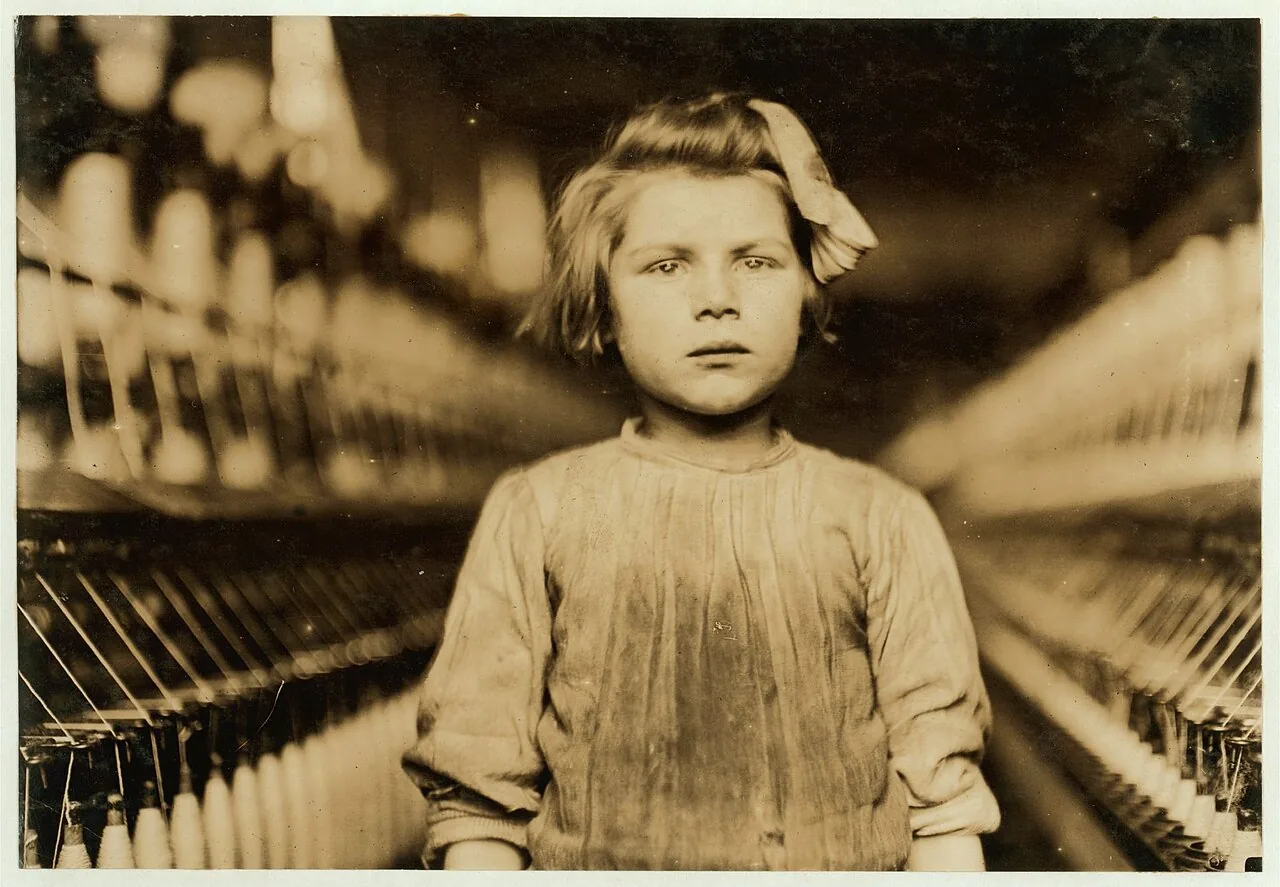
Source: Lewis W. Hine for the National Child Labor Committee, 1909, Library of Congress (image on Wikimedia Commons).
Hine often posed as a salesman or inspector to enter the mills and wrote down the children’s ages and names. The photograph shows a small girl, standing in front of machines that were dangerous for fingers and lungs. It was published to persuade the public to support laws. It is therefore evidence of what reformers wanted people to see, though the conditions were real.
Reform at the national level
Reform produced important results. At the national level, President Theodore Roosevelt (1901-1909) promised a Square Deal. He mediated the anthracite coal strike of 1902 instead of sending troops against the miners. He also used the Sherman Act against the Northern Securities railroad combination. The Supreme Court upheld the breakup in 1904. In addition, he supported consumer protection and the creation of national parks and forests.
President Woodrow Wilson (1913-1921) signed the Federal Reserve Act (1913), which created a central banking system. He also signed the Clayton Antitrust Act and the Federal Trade Commission Act (1914). Four constitutional amendments reflected Progressive goals. The Sixteenth (1913) created the income tax, and the Seventeenth (1913) provided for direct election of senators. The Eighteenth (1919) prohibited alcohol, and the Nineteenth (1920) gave women the vote.
States and cities were also active. They passed minimum-wage and maximum-hour laws for women, workers’ compensation, and child labor laws, and many adopted the initiative, referendum, and recall. In 1911 a fire at the Triangle Shirtwaist Factory in New York killed 146 workers, mainly young immigrant women. Exits were locked, and the tragedy led to new fire and safety laws.
Document 3 – The Triangle fire, 1911
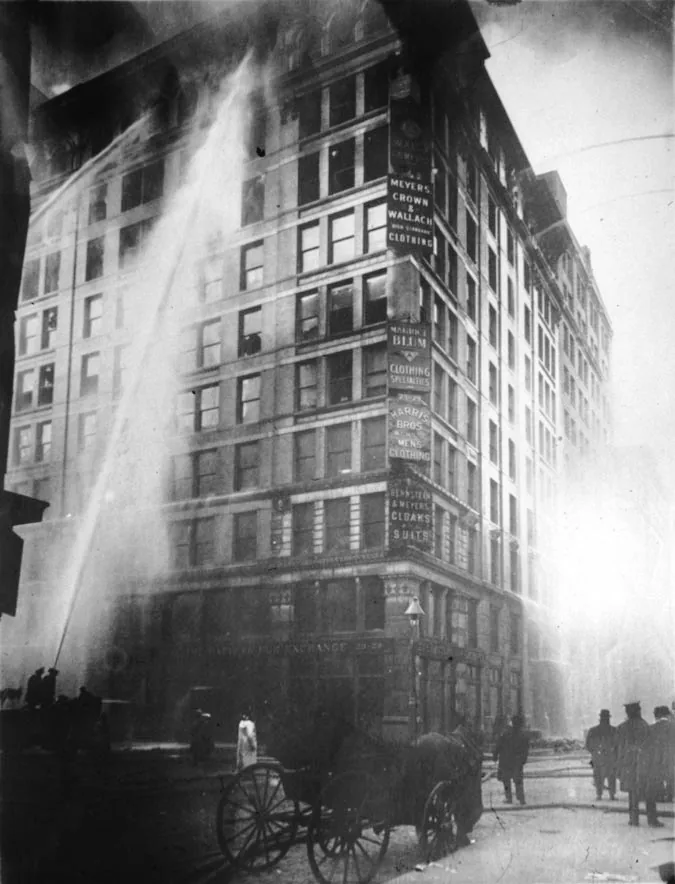
Source: photograph of March 25, 1911, New York (image on Wikimedia Commons).
The picture shows the hoses of the fire department reaching toward the upper floors of the building. The ladders could not reach higher than the sixth floor, while the factory was on the eighth, ninth, and tenth. Public mourning after the fire strengthened the unions and the reform politicians who then wrote New York’s factory laws.
Progressivism had limits. Most reformers accepted racial segregation or ignored it. Woodrow Wilson, a Southerner, allowed several federal departments to segregate their workers in 1913. African Americans organized their own movement. W. E. B. Du Bois and others founded the National Association for the Advancement of Colored People (NAACP) in 1909. Also, the Great Migration, which began in the First World War, carried hundreds of thousands of Black Southerners to northern cities.
Document 4 – Wilson on the duties of government, 1913
Nor have we studied and perfected the means by which government may be put at the service of humanity, in safeguarding the health of the Nation, the health of its men and its women and its children, as well as their rights in the struggle for existence. This is no sentimental duty. The firm basis of government is justice, not pity. These are matters of justice. […] There can be no equality or opportunity, the first essential of justice in the body politic, if men and women and children be not shielded in their lives, their very vitality, from the consequences of great industrial and social processes which they can not alter, control, or singly cope with.
Source: Woodrow Wilson, First Inaugural Address, March 4, 1913; text from the Avalon Project, Yale Law School.
*constituent parts: members; the people who make up a society. *singly: alone.
Commentary. Wilson criticized a country that had “studied as perhaps no other nation” production but not the human cost. In his inaugural address he also declared that government must protect the health and security of its people. “The firm basis of government is justice, not pity.” This is a clear statement of the Progressive belief that government is responsible for social welfare. This view was opposed to the laissez-faire thinking of the Gilded Age. Note, however, the audience and the date. Wilson’s party had just taken control of Congress and the presidency for the first time in two decades.
- 1906 The Jungle is published; Congress passes the Meat Inspection Act and the Pure Food and Drug Act.
- 1913 The Sixteenth and Seventeenth Amendments are ratified; the Federal Reserve is created.
- 1914 The Panama Canal opens; World War I begins in Europe.
- 1917 The United States enters World War I.
- 1920 The Nineteenth Amendment gives women the vote.
- 1929 The stock market crashes in October.
- 1933 Franklin Roosevelt takes office and begins the New Deal.
- 1935 Social Security Act and National Labor Relations (Wagner) Act.
- 1941 Japan attacks Pearl Harbor on December 7; the United States enters World War II.
- 1945 Germany surrenders in May; Japan surrenders after the atomic bombs in August and September.
Key takeaways
- Progressives used government to address the problems of industrialization: Square Deal, New Freedom, regulatory laws, and four constitutional amendments.
- Muckrakers and photographers shaped public opinion; the Triangle fire (1911) led to safety laws.
- Progressive reform often overlooked or accepted segregation; African Americans formed the NAACP (1909).
2. Empire, the Caribbean, and World War I
America as a world power
The war of 1898 gave the United States overseas territory, and it kept it. In the Philippines, Filipino nationalists under Emilio Aguinaldo resisted American rule in a war (1899-1902) that cost many Filipino lives. In 1899 Secretary of State John Hay sent the Open Door notes. They asked the great powers to keep China open to all nations’ trade. President Theodore Roosevelt believed in a strong navy and an active foreign policy. He sent the Great White Fleet around the world in 1907-1909.
Latin America was the first area of American power. After helping Panama break away from Colombia in 1903, the United States obtained the right to build and control a canal. The canal opened in 1914. In 1904 Roosevelt added a corollary to the Monroe Doctrine. The United States would act as an “international police power” in the Western Hemisphere. Presidents Taft and Wilson used troops and bankers to protect American investments in Nicaragua, Haiti, the Dominican Republic, and Mexico.
Definition: Roosevelt Corollary
Theodore Roosevelt’s 1904 statement that the United States could intervene in the affairs of Latin American countries that were unstable or failed to pay their debts. The aim was to keep European powers out.
Document 5 – The Roosevelt Corollary, 1904
All that this country desires is to see the neighboring countries stable, orderly, and prosperous. Any country whose people conduct themselves well can count upon our hearty friendship. If a nation shows that it knows how to act with reasonable efficiency and decency in social and political matters, if it keeps order and pays its obligations, it need fear no interference from the United States. Chronic wrongdoing, or an impotence which results in a general loosening of the ties of civilized society, may in America, as elsewhere, ultimately require intervention by some civilized nation, and in the Western Hemisphere the adherence of the United States to the Monroe Doctrine may force the United States, however reluctantly, in flagrant cases of such wrongdoing or impotence, to the exercise of an international police power.
Source: Theodore Roosevelt, annual message to Congress, December 6, 1904 (the Roosevelt Corollary to the Monroe Doctrine); text from Wikisource.
*impotence: weakness. *ties of civilized society: orderly government and law.
Commentary. Roosevelt presents intervention as a duty and as a last resort, and he offers friendship to countries that “keep order and pay their obligations.” Latin American governments saw the policy as a claim to dominate them. The document explains why U.S. Marines went to Haiti in 1915, to the Dominican Republic in 1916, and several times to Nicaragua.
Document 6 – Roosevelt and the Panama Canal, 1906
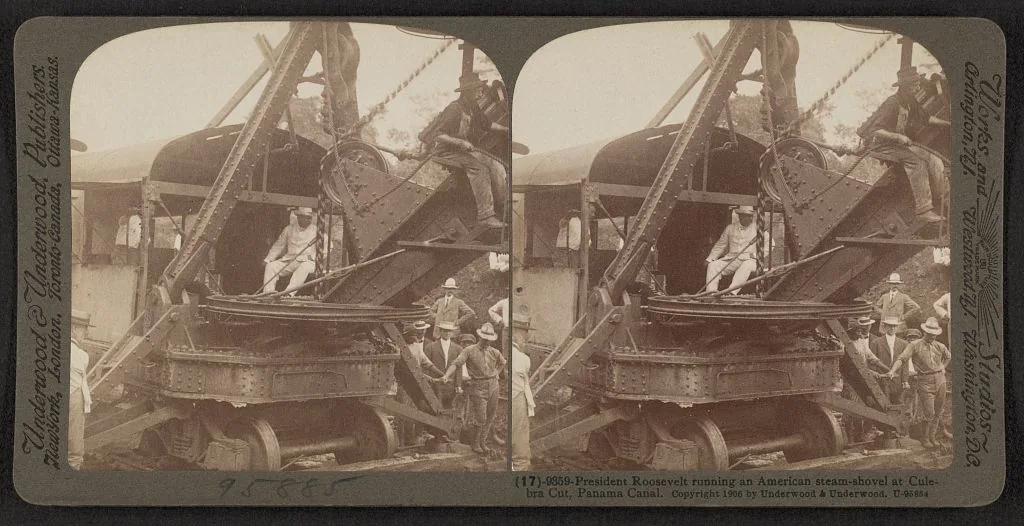
Source: stereograph, 1906, Library of Congress (image on Wikimedia Commons).
Roosevelt, in a white suit, sits at the controls of a huge steam shovel at Culebra Cut. Such stereographs were popular souvenirs. The image shows how the president wished to be seen, as a man of action who built a canal. It also shows the scale of the machines. The thousands of workers who died of disease and accidents, most of them West Indians, are absent from the picture.
The road to war and the home front, 1914-1918
When war broke out in Europe in August 1914, President Wilson called on Americans to be neutral “in thought as well as in action.” But American banks lent money to the Allies, and German submarine warfare enraged the public. In May 1915 a German submarine sank the British liner Lusitania and killed more than 120 Americans.
Germany promised to limit its attacks but, in January 1917, announced unrestricted submarine warfare. At the same time the British gave the United States an intercepted telegram from German Foreign Minister Arthur Zimmermann to Mexico. It proposed an alliance and offered Mexico its lost territories in Texas, New Mexico, and Arizona. On April 2, 1917, Wilson asked Congress for a declaration of war, and Congress voted for it on April 6.
Document 7 – Wilson before Congress, April 1917
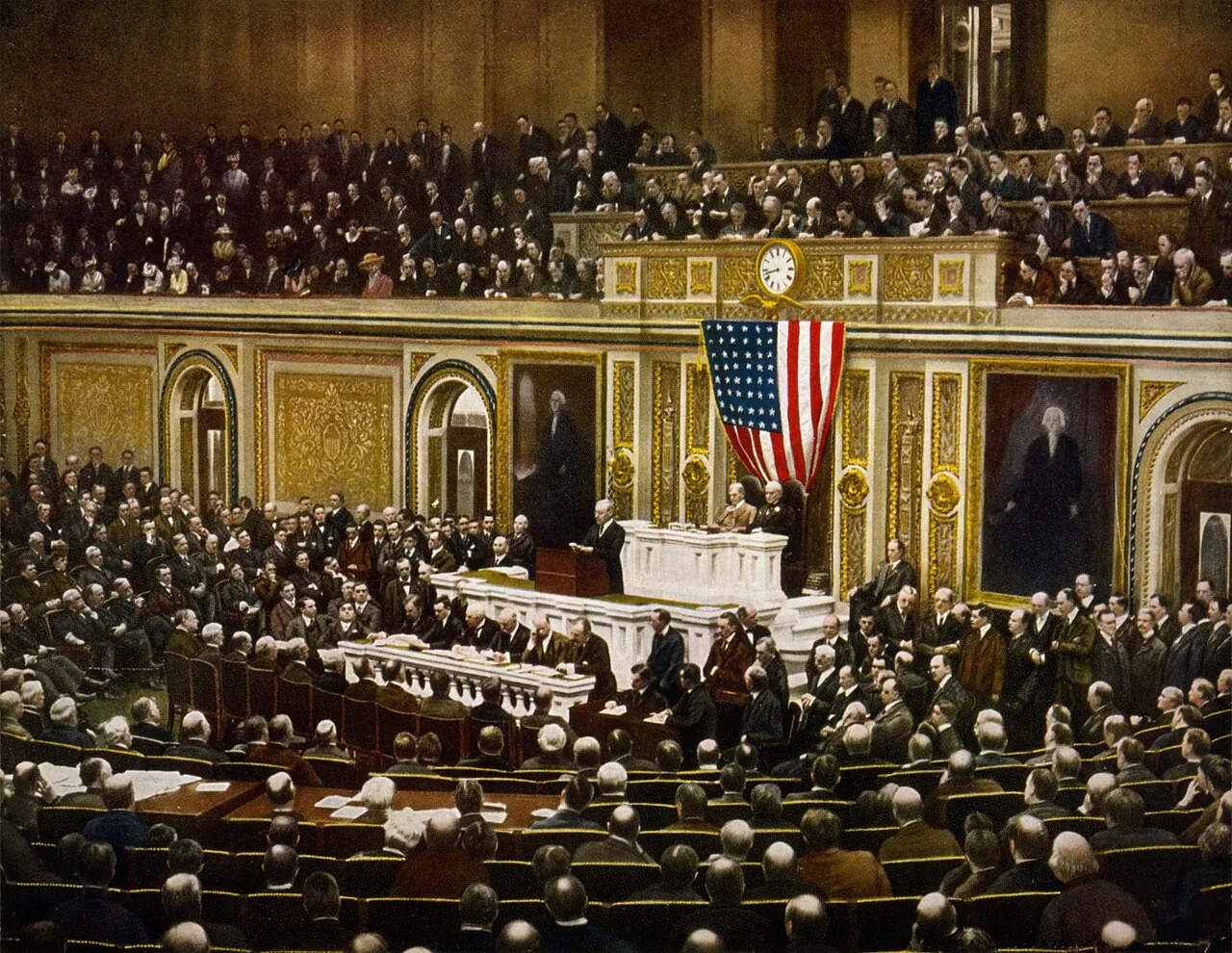
Source: Library of Congress image (colorized), April 2, 1917 (image on Wikimedia Commons).
The picture shows the House chamber crowded with members and guests; the president is at the rostrum in front of the flag. In his speech, Wilson said that “the world must be made safe for democracy.” This phrase gave a moral meaning to a war entered for reasons of national security and neutral rights.
The war required mobilization on an unprecedented scale. The Selective Service Act (1917) drafted millions of men. About two million American soldiers, the American Expeditionary Forces under General John J. Pershing, reached Europe. Their arrival in 1918 helped stop the last German offensives and then helped drive the Germans back in the Meuse-Argonne campaign. The war ended with an armistice on November 11, 1918. At home, federal agencies such as the War Industries Board directed production. Meanwhile, the Committee on Public Information, led by George Creel, ran a huge propaganda campaign.
The war also threatened civil liberties. Congress passed the Espionage Act (1917) and the Sedition Act (1918). These laws made it a crime to interfere with the draft or to criticize the war effort, and about two thousand people were prosecuted. Socialist leader Eugene V. Debs was sentenced to ten years for an antiwar speech. In Schenck v. United States (1919) the Supreme Court unanimously upheld a conviction under the Espionage Act. Justice Holmes wrote that speech can be limited if it creates a “clear and present danger.”
Document 8 – The “clear and present danger” test, 1919
The question in every case is whether the words used are used in such circumstances and are of such a nature as to create a clear and present danger that they will bring about the substantive evils that Congress has a right to prevent. It is a question of proximity and degree. […] When a nation is at war many things that might be said in time of peace are such a hindrance to its effort that their utterance will not be endured so long as men fight and that no Court could regard them as protected by any constitutional right.
Source: Justice Oliver Wendell Holmes Jr., opinion of the Court, Schenck v. United States, 249 U.S. 47 (1919); Legal Information Institute, Cornell Law School.
*substantive evils: harms that Congress has the power to prevent. *utterance: speech.
Commentary. Charles Schenck, secretary of the Socialist Party in Philadelphia, mailed leaflets that urged draftees to resist. Holmes did not say that speech is unprotected in wartime; he said that its protection depends on “proximity and degree.” The standard he created, “clear and present danger,” was later used in the opposite way in cases that protected speech. In 1919, however, it supported the conviction.
Wilson’s peace and the American reply
In January 1918, Wilson presented the Fourteen Points, a program for a just peace. It included open diplomacy, freedom of the seas, free trade, a reduction of arms, self-determination for peoples of Europe, and a League of Nations. At the Paris Peace Conference in 1919, he had to compromise with Britain and France, who wanted to punish Germany. The Treaty of Versailles, signed in June 1919, imposed heavy penalties on Germany and created the League of Nations.
In the United States, Republican senators led by Henry Cabot Lodge objected to membership in the League. In particular, Article 10 would take away Congress’s right to declare war. Wilson refused to compromise and suffered a stroke in October 1919. The Senate rejected the treaty in November 1919 and March 1920. The United States never joined the League.
Document 9 – The Fourteen Points, 1918
I. Open covenants of peace, openly arrived at, after which there shall be no private international understandings of any kind but diplomacy shall proceed always frankly and in the public view. […] XIV. A general association of nations must be formed under specific covenants for the purpose of affording mutual guarantees of political independence and territorial integrity to great and small states alike.
Source: Woodrow Wilson, address to Congress on the Fourteen Points, January 8, 1918; text from the Avalon Project, Yale Law School.
*covenants: formal agreements. *territorial integrity: the right of a state to keep its borders.
Commentary. The first and the last of the points are the most famous. The first calls for open diplomacy, in answer to the secret treaties that had helped lead Europe to war. The last proposes a “general association of nations,” the idea of the League. The Fourteen Points show the hopes of Wilsonian idealism, but the final peace fell far short, and the Senate’s refusal showed that many Americans preferred to avoid commitments abroad.
3. The 1920s, the Great Depression, and the New Deal
After the war, the country experienced a short Red Scare (1919-1920). The fear of communism and of immigrant radicals led to raids and deportations led by Attorney General A. Mitchell Palmer. Nativism produced the Immigration Act of 1924. It set quotas by national origin that favored northern and western Europe and virtually ended Asian immigration. The 1920s were also a decade of cultural conflict.
It brought Prohibition, the revival of the Ku Klux Klan, and the Scopes trial (1925) over the teaching of evolution. In the Harlem Renaissance, Black writers, artists, and musicians, among them Langston Hughes and Duke Ellington, made Harlem a center of American culture. Mass production, led by Henry Ford’s assembly line, made the automobile common. Radios, movies, and installment buying created a consumer culture.
The prosperity was uneven, and it depended on credit and on a stock market that rose on speculation. On October 24, 1929, share prices began to collapse. By the end of the next week they had lost a large part of their value. The crash did not alone cause the Great Depression. The Depression also resulted from weak banks, falling farm prices, international debt, and a fall in consumer spending. Still, the crash started a spiral of closed banks and lost jobs. By 1933 about one worker in four was unemployed, about one-third of farmers had lost their land, and 9,000 of the 25,000 banks in the country had failed.
Document 10 – Key figures of the Depression
| Indicator | Figure |
|---|---|
| U.S. unemployment rate, 1933 (peak) | about 25% |
| U.S. unemployment rate, 1940 | about 15% |
| Banks that failed by 1933 | 9,000 of 25,000 |
| Dow Jones Industrial Average, fall of 1929 | from 381 to 198 in about two months |
Source: figures as summarized at https://en.wikipedia.org/wiki/Great_Depression (unemployment rate of 25% in 1933 and about 15% in 1940; 9,000 of 25,000 banks; the Dow from 381 to 198), citing economic histories of the period.
President Herbert Hoover believed that voluntary action and business leadership would solve the crisis. He accepted some federal action, such as the Reconstruction Finance Corporation (1932), but resisted direct relief, and his image was damaged when the Army drove the Bonus Army of veterans from Washington in 1932. In November 1932, voters elected Franklin D. Roosevelt, who promised a “New Deal.” In his inaugural address he told the country that “the only thing we have to fear is fear itself” and promised that the government would put people to work.
Document 11 – Roosevelt’s first inaugural address, 1933
So, first of all, let me assert my firm belief that the only thing we have to fear is fear itself–nameless, unreasoning, unjustified terror which paralyzes needed efforts to convert retreat into advance. […] Our greatest primary task is to put people to work. This is no unsolvable problem if we face it wisely and courageously. It can be accomplished in part by direct recruiting by the Government itself, treating the task as we would treat the emergency of a war, but at the same time, through this employment, accomplishing greatly needed projects to stimulate and reorganize the use of our natural resources.
Source: Franklin D. Roosevelt, First Inaugural Address, March 4, 1933; text from the Avalon Project, Yale Law School.
*unreasoning: without reason. *paralyzes: makes unable to move.
Commentary. Roosevelt delivered the speech on March 4, 1933, when banks were closing across the country. His call for confidence is less famous than his promise of direct government action: “Our greatest primary task is to put people to work.” He compared the effort to a war, which prepared Americans to accept a much larger role for the federal government.
The two phases of the New Deal
The New Deal came in two phases. In the First Hundred Days of 1933, Congress passed the Emergency Banking Act and the Glass-Steagall Act (which created the Federal Deposit Insurance Corporation), and created the Civilian Conservation Corps (CCC), the Agricultural Adjustment Administration (AAA), the National Recovery Administration (NRA), and the Tennessee Valley Authority (TVA). The Securities and Exchange Commission (1934) regulated Wall Street.
In 1935 the Second New Deal added the Works Progress Administration (WPA), which gave jobs to millions, the Wagner Act, which protected the right to organize unions, and the Social Security Act, which created old-age pensions and unemployment insurance. The Supreme Court struck down the NRA (1935) and the AAA (1936), and Roosevelt’s attempt in 1937 to add justices to the Court (the “court-packing” plan) failed. A recession in 1937-1938 showed that recovery was incomplete; unemployment was still about 15% in 1940, and the economy recovered fully only with the war.
Definition: New Deal
the name given to the programs of Franklin D. Roosevelt in the 1930s for relief, recovery, and reform, which greatly expanded the role of the federal government in the economy and in social welfare.
Who the New Deal left out
The New Deal helped many people, but not everyone equally. Agricultural and domestic workers, most of them Black or Latino, were left out of Social Security at first. Farm programs often benefited landowners more than tenants and sharecroppers. In the Plains, drought and bad farming methods turned much of Oklahoma, Texas, and Kansas into the Dust Bowl, and hundreds of thousands of people moved west, especially to California. Photographers of the Farm Security Administration, among them Dorothea Lange and Arthur Rothstein, documented their lives.
Document 12 – “Migrant Mother,” 1936
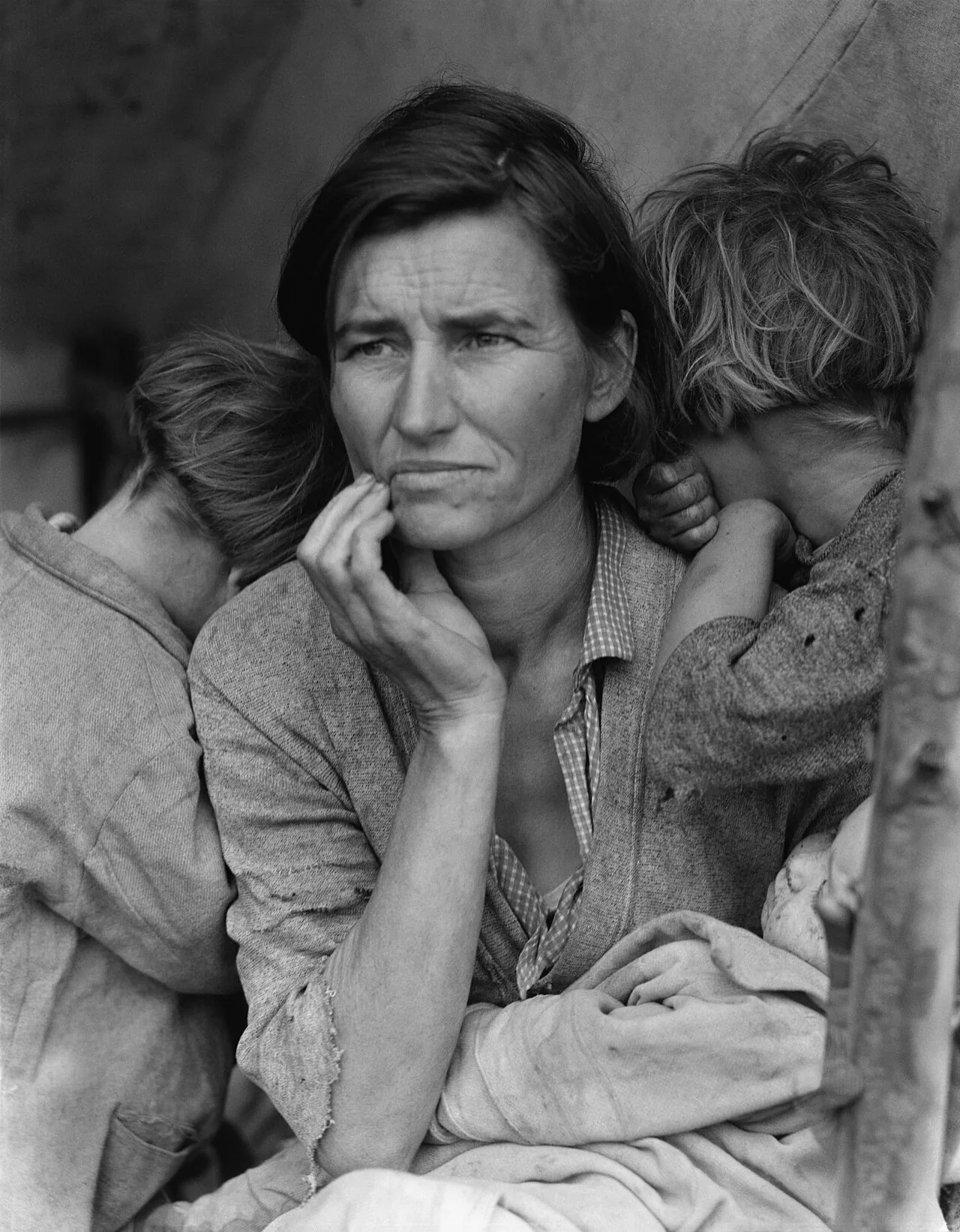
Source: Dorothea Lange, March 1936, Library of Congress (image on Wikimedia Commons).
Lange photographed a mother of seven in a camp of pea pickers whose crop had frozen. The image became the best-known photograph of the Depression. Government photographers worked to build support for relief programs; so, as with Hine’s pictures, the choice of the subject and of the angle had a purpose.
Document 13 – A child in the Dust Bowl, 1936
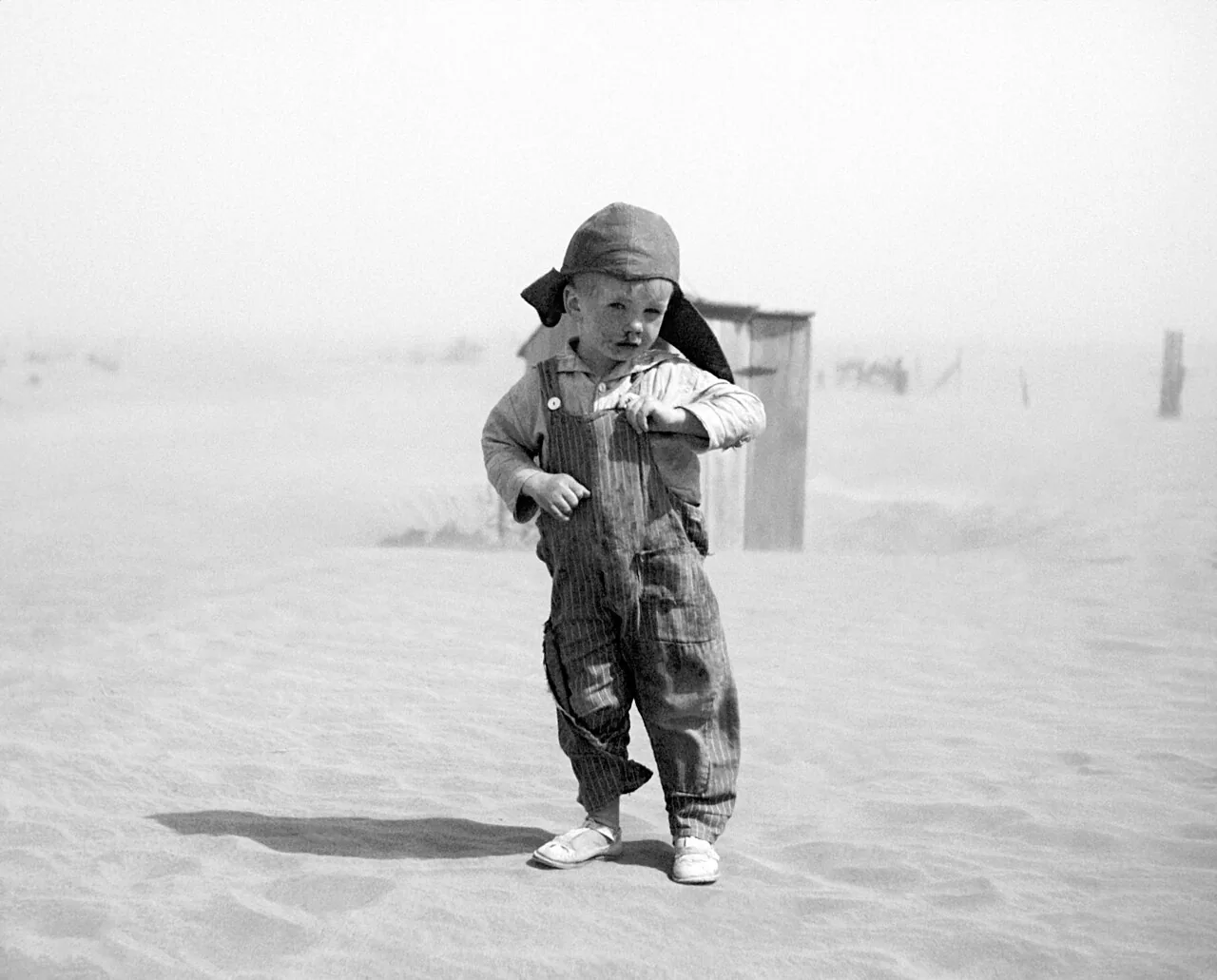
Source: Arthur Rothstein, April 1936, Library of Congress (image on Wikimedia Commons).
A small boy in overalls walks across a field that has been covered with drifted dust, with an outhouse in the distance. Rothstein was criticized for moving a cow skull to improve another photograph in the same series, a reminder that photographs are not neutral records.
Key takeaways
- World War I brought the United States into world affairs and brought about a large increase in federal power, as well as the suppression of dissent (Schenck, 1919).
- The Senate rejected the Treaty of Versailles and the League of Nations; the 1920s brought prosperity, cultural conflict, and immigration quotas (1924).
- The Great Depression (unemployment about 25% in 1933) led to the New Deal: relief, recovery, and reform, including Social Security (1935).
4. World War II: the home front and the world
From neutrality to war
In the 1930s, many Americans, disillusioned by World War I, wanted to stay out of foreign wars, and Congress passed Neutrality Acts (1935-1939). As Germany, Italy, and Japan expanded, Roosevelt gradually helped Britain: he traded old destroyers for bases (1940) and signed the Lend-Lease Act (March 1941), which allowed the United States to supply the Allies without immediate payment.
In August 1941, Roosevelt and Churchill issued the Atlantic Charter. The United States also cut off oil and scrap metal sales to Japan after it invaded Indochina. On December 7, 1941, Japanese aircraft attacked the American naval base at Pearl Harbor, Hawaii, and killed about 2,400 Americans. Congress declared war on Japan the next day, and Germany and Italy declared war on the United States days later.
Document 14 – Pearl Harbor, December 7, 1941
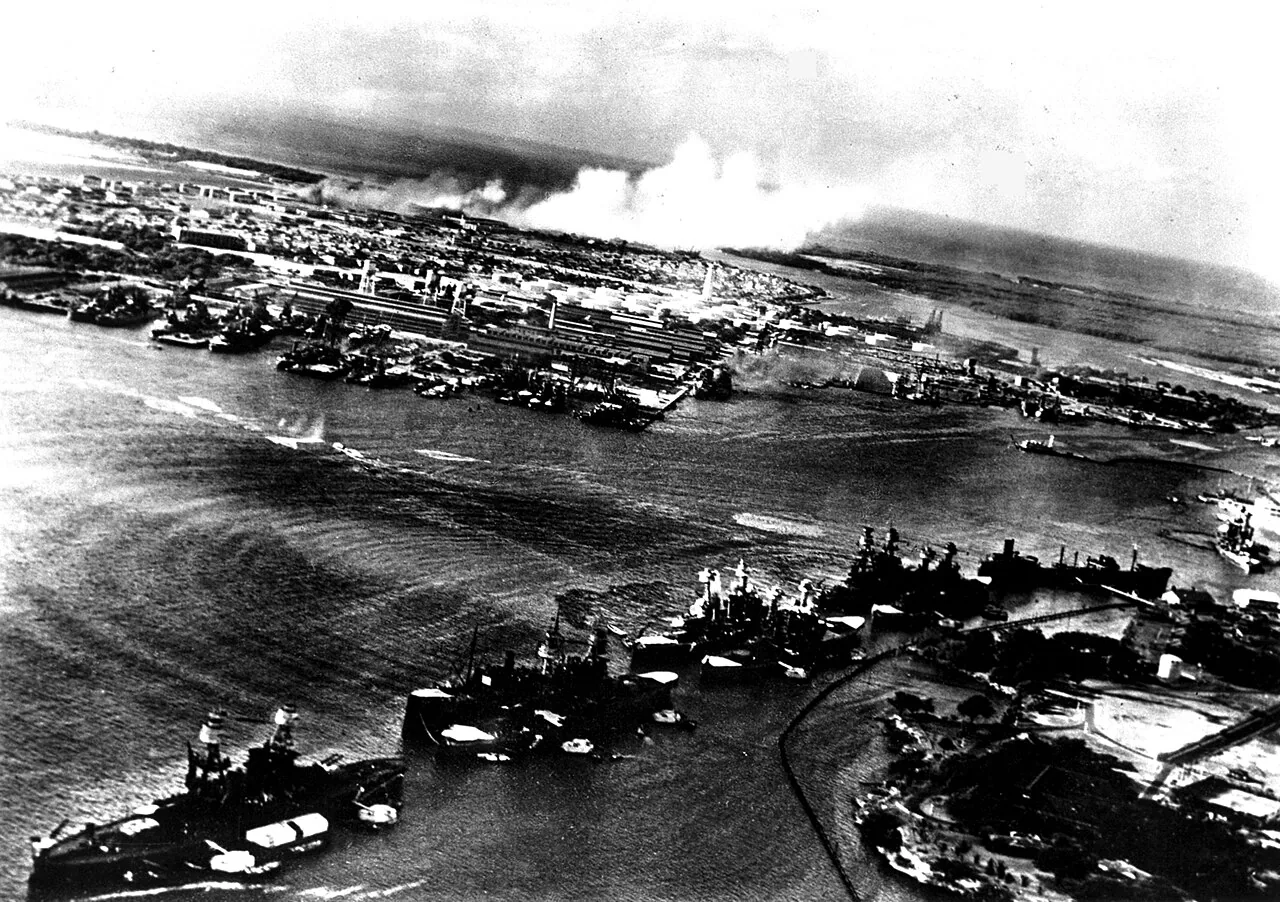
Source: U.S. government photograph, December 7, 1941 (image on Wikimedia Commons).
The aerial photograph shows the harbor and the ships, with columns of smoke. The attack destroyed or damaged eight battleships, but the aircraft carriers were at sea, which was important for the war that followed.
Fighting the war
Roosevelt and Churchill agreed on a “Europe first” strategy. American forces landed in North Africa in November 1942 (Operation Torch), in Sicily in July 1943, and in Italy in September 1943. On June 6, 1944, the largest amphibious invasion in history landed more than 150,000 Allied troops on the beaches of Normandy, and American, British, and Canadian troops drove through France. The Germans counterattacked in the Battle of the Bulge in December 1944 and were defeated. Meanwhile, the Soviet army, which had already destroyed much of the German army on the Eastern Front, advanced from the east, and Germany surrendered on May 8, 1945, after Roosevelt’s death on April 12.
The Pacific and the atomic bomb
In the Pacific, the Navy stopped the Japanese advance at the Battle of Midway in June 1942, and American forces then “island-hopped” toward Japan: Guadalcanal, Saipan, Leyte Gulf, Iwo Jima, Okinawa. The cost was very high, and American planners expected an invasion of Japan to be bloodier still. The Manhattan Project, a secret program of the American, British, and Canadian governments, developed the atomic bomb.
President Harry Truman, who had taken office on April 12, 1945, approved its use. A bomb was dropped on Hiroshima on August 6 and another on Nagasaki on August 9, 1945, and the Soviet Union entered the war against Japan on August 8. Japan announced its surrender on August 15 and signed the formal surrender on September 2, 1945. Historians still debate whether the bombs were necessary to end the war.
The home front
War production ended the Depression. Factories turned out ships, tanks, and aircraft; unemployment fell to very low levels; and millions of Americans moved to defense centers on the West Coast and in the North. Women entered the workforce in large numbers, the “Rosies” of wartime posters, and many left their jobs when the veterans returned. African Americans protested against discrimination in defense plants: when A. Philip Randolph threatened a march on Washington in 1941, Roosevelt issued Executive Order 8802, which banned discrimination in defense industries and created a Fair Employment Practices Committee. The “Double V” campaign called for victory over fascism abroad and over racism at home. In 1944 the GI Bill provided education and housing loans to veterans.
Document 15 – Women in the war economy
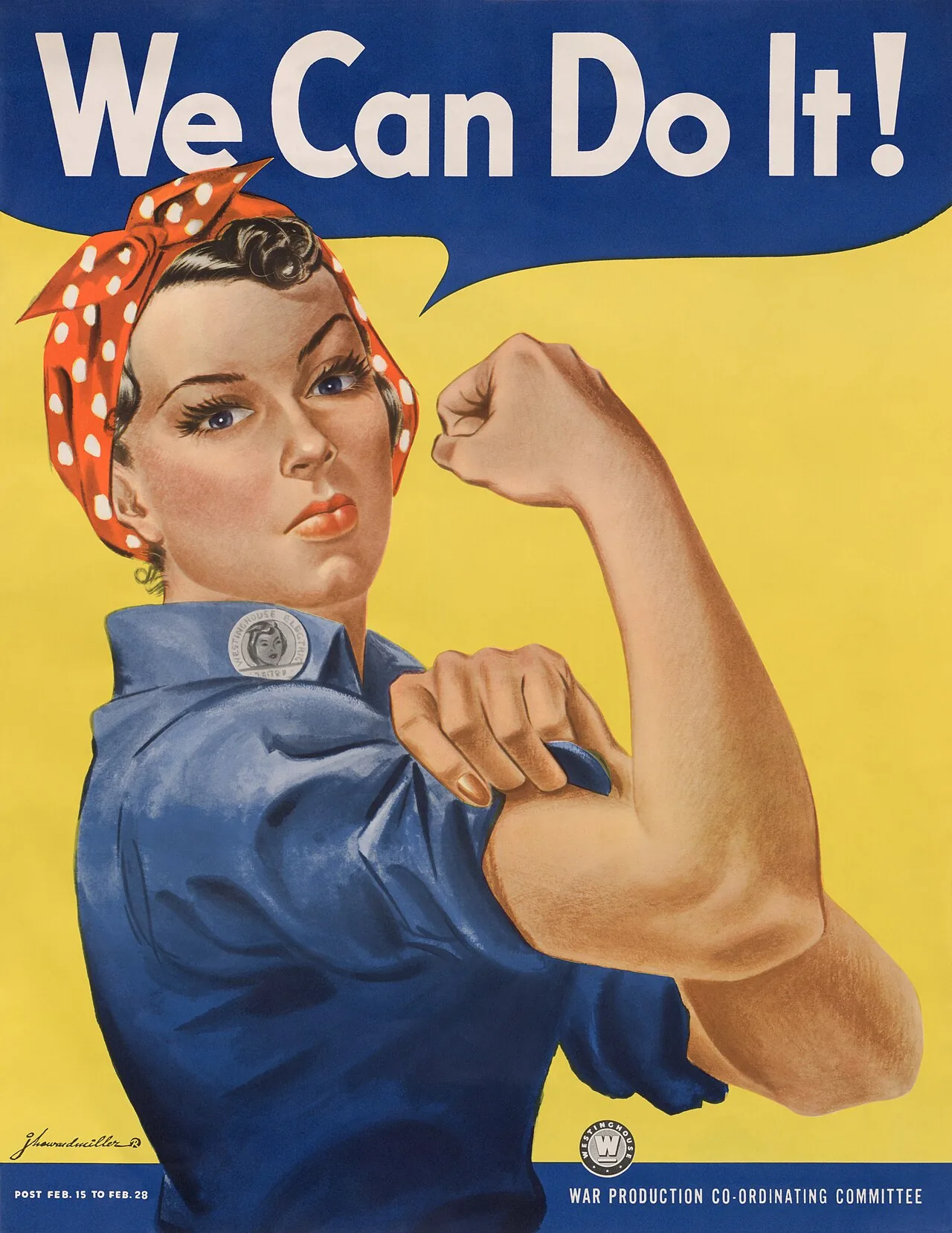
Source: J. Howard Miller, 1943, National Archives (image on Wikimedia Commons).
The poster was one of a series made for Westinghouse to encourage morale and discipline among its workers; it was displayed for only about two weeks in 1943, inside Westinghouse plants. It became famous only decades later, when the woman it shows was identified with “Rosie the Riveter.” The image is evidence of how the government and industry wanted women to see wartime work: as strong, patriotic, and temporary.
Fear and prejudice also shaped the home front. After Pearl Harbor, military officers and politicians from the West Coast demanded the removal of people of Japanese ancestry. On February 19, 1942, Roosevelt signed Executive Order 9066, which authorized the military to designate areas from which any person could be excluded. The military used it to force about 112,000 people of Japanese descent, about 70,000 of them American citizens, out of the West Coast and into camps inland, with no charge and no trial. In Korematsu v. United States (1944) the Supreme Court upheld the exclusion by a vote of 6 to 3. In 1988 Congress apologized and paid $20,000 to each surviving internee.
Document 16 – Executive Order 9066, 1942
Now, Therefore, by virtue of the authority vested in me as President of the United States, and Commander in Chief of the Army and Navy, l hereby authorized and direct the Secretary of War, and the Military Commanders whom he may from time to time designate, whenever he or any designated Commander deem such action necessary or desirable to prescribe military areas in such places and of such extent as he or the appropriate Military Commander may determine, from which any or all persons may be excluded, and with respect to which, the right of any person to enter, remain in, or leave shall be subject to whatever restriction the Secretary of War or the appropriate Military Commander may impose in his discretion.
Source: Executive Order 9066, signed by President Franklin D. Roosevelt, February 19, 1942; text from Wikisource.
*military areas: zones designated by the Army from which people could be removed.
Document 17 – Awaiting evacuation, 1942
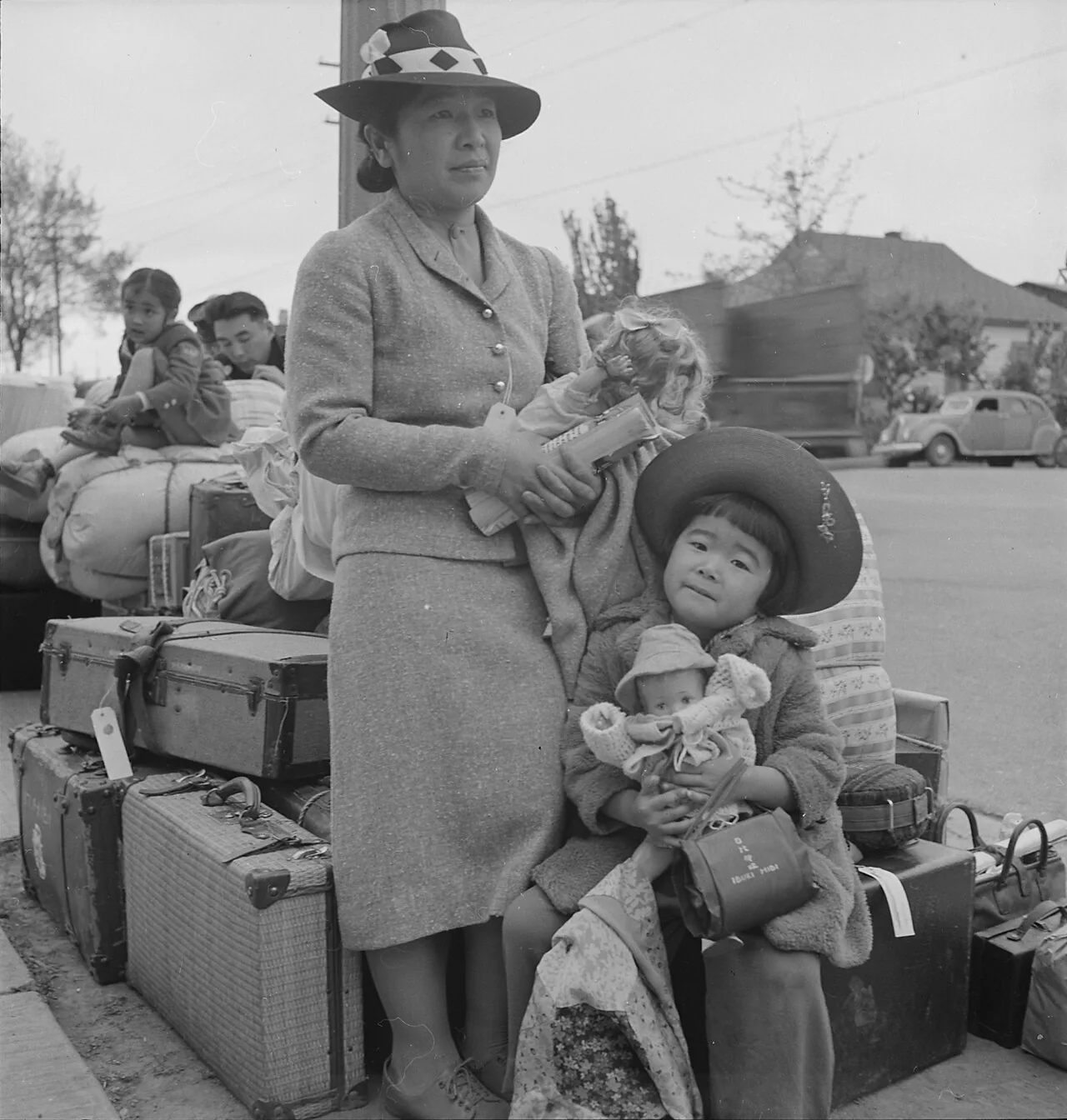
Source: photograph for the War Relocation Authority, Hayward, California, May 1942, National Archives (image on Wikimedia Commons).
A woman in a hat and a suit holds a child while a girl sits beside her on piles of luggage; others wait behind them. Families were allowed to bring only what they could carry. Note that the order itself does not mention Japanese Americans: it speaks of “military areas,” and the exclusion of a particular group was implemented through later orders.
Document 18 – The Court and the dissent in Korematsu, 1944
Compulsory exclusion of large groups of citizens from their homes, except under circumstances of direst emergency and peril, is inconsistent with our basic governmental institutions. But when under conditions of modern warfare our shores are threatened by hostile forces, the power to protect must be commensurate with the threatened danger.
Source: Justice Hugo Black, opinion of the Court, Korematsu v. United States, 323 U.S. 214 (1944); Legal Information Institute, Cornell Law School.
*commensurate: equal in size or degree.
I dissent, therefore, from this legalization of racism. Racial discrimination in any form and in any degree has no justifiable part whatever in our democratic way of life. It is unattractive in any setting but it is utterly revolting among a free people who have embraced the principles set forth in the Constitution of the United States.
Source: Justice Frank Murphy, dissenting opinion, Korematsu v. United States, 323 U.S. 214 (1944); Legal Information Institute, Cornell Law School.
*kin: related.
Commentary. Justice Black said that the exclusion of citizens from their homes is justified only in “direst emergency and peril,” and found such a threat. Justice Murphy answered that the order was a “legalization of racism.” In 2018, in a different case, Chief Justice Roberts wrote that Korematsu “was gravely wrong the day it was decided.” The United States also did too little for the victims of the Holocaust: in 1939 the refugee ship St. Louis was turned away from Cuba and the United States, and the government created the War Refugee Board only in 1944.
Document 19 – The United States population, 1900-1940
| Year | Population of the United States (census) |
|---|---|
| 1900 | 76,212,168 |
| 1910 | 92,228,496 |
| 1920 | 106,021,537 |
| 1930 | 123,202,624 |
| 1940 | 132,164,569 |
Source: U.S. Census Bureau, decennial census counts (as tabulated at https://en.wikipedia.org/wiki/Demographic_history_of_the_United_States).
The population grew by about 56 million in forty years, but the growth slowed after the immigration quotas of the 1920s and the low birth rate of the Depression: the increase in the 1930s (about 9 million) was the smallest of the four decades.
Key takeaways
- The United States entered World War II after Pearl Harbor (December 7, 1941) and fought in two theaters; Germany surrendered in May 1945 and Japan in August-September 1945.
- The war ended the Depression, drew women and African Americans into new jobs, and made the federal government stronger.
- Civil liberties were violated by the internment of about 112,000 people of Japanese descent under Executive Order 9066; the Supreme Court upheld it in Korematsu (1944).

Quick review: flashcards
Tap a card to see the answer.