



This AP US History lesson covers APUSH Period 6: 1865-1898, part of the unit “APUSH periods.” First, read the full lesson with its primary sources, maps and key terms. Then practice with the worksheet, check yourself with the quiz and get ready with the test.
On May 10, 1869, a golden spike was driven into a railroad tie at Promontory Summit, Utah, and a telegraph operator tapped out a single word to the nation: “Done.” Within a generation, the country that the railroads had joined was unrecognizable. Steel mills glowed along the Monongahela, wheat from Kansas fed factory towns in Massachusetts, and ships brought millions of immigrants to a country whose largest cities now towered above tenements.
In the same years, the federal government broke the power of the Plains nations, the Republican promise of equal rights for freed people collapsed in the South, and angry farmers built a political party to challenge the bankers. AP US History Period 6 (1865-1898) is the story of an economy that changed faster than the political system could manage, and of the groups who won or lost in the process.
The College Board organizes the period around several themes: Work, Exchange, and Technology (WXT), Migration and Settlement (MIG), Politics and Power (PCE), Geography and the Environment (GEO), and Social Structures (SOC). Keep them in mind as you read, because AP questions usually combine two of them, for example how a new technology (WXT) changed where people lived (MIG).
Guiding question: How did industrialization, westward expansion, and mass immigration transform the United States between 1865 and 1898, and who gained or lost power in the process?
1. The industrial economy: Work, Exchange, and Technology
Railroads, steel, and the national market
Railroads were the first big business of the age and the engine of everything else. The federal government gave the companies millions of acres of public land and loans under the Pacific Railway Act of 1862, and the Union Pacific and Central Pacific lines met in 1869. Other lines followed: the Northern Pacific (1883), the Santa Fe, and the Southern Pacific.
The lines needed enormous quantities of iron, coal, and timber, and so they created demand for other industries. They also created a national market. Chicago meatpackers could ship beef to Boston in refrigerated cars, and a farmer in Nebraska could sell wheat to buyers in Liverpool. In 1883 the railroads adopted four standard time zones so that their schedules would make sense, an example of private business reshaping daily life before the government acted.
Steel became the symbol of the age after the Bessemer process made it cheap in the 1860s and 1870s. Andrew Carnegie, a Scottish immigrant who started as a telegraph clerk, built the largest steel business in the country around Pittsburgh. Other inventions opened new industries: Alexander Graham Bell patented the telephone in 1876, Thomas Edison’s laboratory at Menlo Park produced a practical incandescent lamp in 1879, and electric power soon spread through the cities. Skyscrapers with steel frames, beginning with the Home Insurance Building in Chicago (1885), and great engineering works such as the Brooklyn Bridge (1883) showed what the new materials could do.
Big business and its critics
Entrepreneurs competed ruthlessly, and the winners built enormous firms. Carnegie practiced vertical integration: he bought the iron mines, coal fields, ships, and railroads that supplied his mills, so that he controlled each step from raw material to finished steel. John D. Rockefeller of Standard Oil used horizontal integration: he bought or drove out competing refiners until his company controlled most of the country’s oil refining. In 1882 his lawyers organized the Standard Oil Trust, and the word trust came to mean any giant combination that limited competition.
Definition: vertical integration
a business strategy in which one company controls every stage of making a product, from raw materials to transportation and sale. Carnegie Steel is the standard example.
Definition: horizontal integration
a business strategy in which one company buys or eliminates its competitors in the same industry in order to control the market. Standard Oil is the standard example.
Social Darwinism and the Gospel of Wealth
Defenders of big business argued that competition rewarded the fittest. Social Darwinism, a set of ideas borrowed from the English writer Herbert Spencer, applied the language of evolution to society and held that wealth showed merit and poverty showed failure. Carnegie, in his essay “Wealth” (1889, later called the Gospel of Wealth), told the rich that they had a duty to give away their fortunes for the public good, and he funded more than two thousand public libraries. Critics answered that the new corporations had too much power. Newspapers called the great capitalists “robber barons,” a label that historians now treat as one-sided but that captures how many people felt.
Definition: Social Darwinism
the application of Charles Darwin’s idea of natural selection to human society, used in the Gilded Age to justify competition, great fortunes, and opposition to government aid for the poor.
Government began to respond slowly. Farmers and small shippers complained that railroads charged more where they faced no competition, and Congress passed the Interstate Commerce Act (1887), which created the Interstate Commerce Commission, the first federal agency to regulate private business. In 1890 it passed the Sherman Antitrust Act, which outlawed contracts and combinations “in restraint of trade.” Enforcement in the 1890s was weak, and courts used the law against unions as often as against corporations.
Document 1 – The Sherman Antitrust Act, 1890
Every contract, combination in the form of trust or otherwise, or conspiracy, in restraint of trade or commerce among the several States, or with foreign nations, is hereby declared to be illegal. […] Every person who shall monopolize, or attempt to monopolize, or combine or conspire with any other person or persons, to monopolize any part of the trade or commerce among the several States, or with foreign nations, shall be deemed guilty of a misdemeanor
Source: Sherman Antitrust Act, July 2, 1890, sections 1 and 2; text from Wikisource.
*monopolize: take control of a market so that no one else can compete. *misdemeanor: a lesser crime than a felony.
Commentary. The law is short and broad. It does not mention particular companies or define “restraint of trade,” so the courts had to decide what it meant. In United States v. E. C. Knight (1895) the Supreme Court read it narrowly and let a sugar trust stand, while in 1894 the government used the act to win an injunction against railroad strikers. The Sherman Act therefore shows both the new willingness of the federal government to regulate business and the limits of that willingness in the Gilded Age.
Workers organize
Industrial work was dangerous, and wages were low. Many workers labored ten or twelve hours a day, six days a week, and lost their jobs in each depression, such as the Panic of 1873 and the Panic of 1893. Machines also reduced the need for skilled craftsmen. Workers responded by forming unions. The Knights of Labor (1869) tried to organize all workers, skilled or not, and campaigned for an eight-hour day. The American Federation of Labor (1886), led by Samuel Gompers, organized skilled workers by craft and concentrated on practical goals: higher wages, shorter hours, and the right to bargain.
Strikes were violent. In the Great Railroad Strike of 1877, workers who had seen their pay cut walked off the job, and President Hayes sent federal troops to end it. In May 1886, someone threw a bomb at a labor rally in Haymarket Square in Chicago, killing police officers, and eight anarchists were convicted despite weak evidence; four were hanged.
At Homestead, Pennsylvania, in July 1892, workers at Carnegie’s mill fought a battle with hired Pinkerton guards, and the state militia then broke the strike. In 1894 the Pullman Strike, led by Eugene V. Debs of the American Railway Union, stopped railroad traffic across the country until the federal government obtained a court order and sent troops. The pattern was clear: when strikes threatened business, government usually sided with employers.
Document 2 – The Homestead strike on a magazine cover
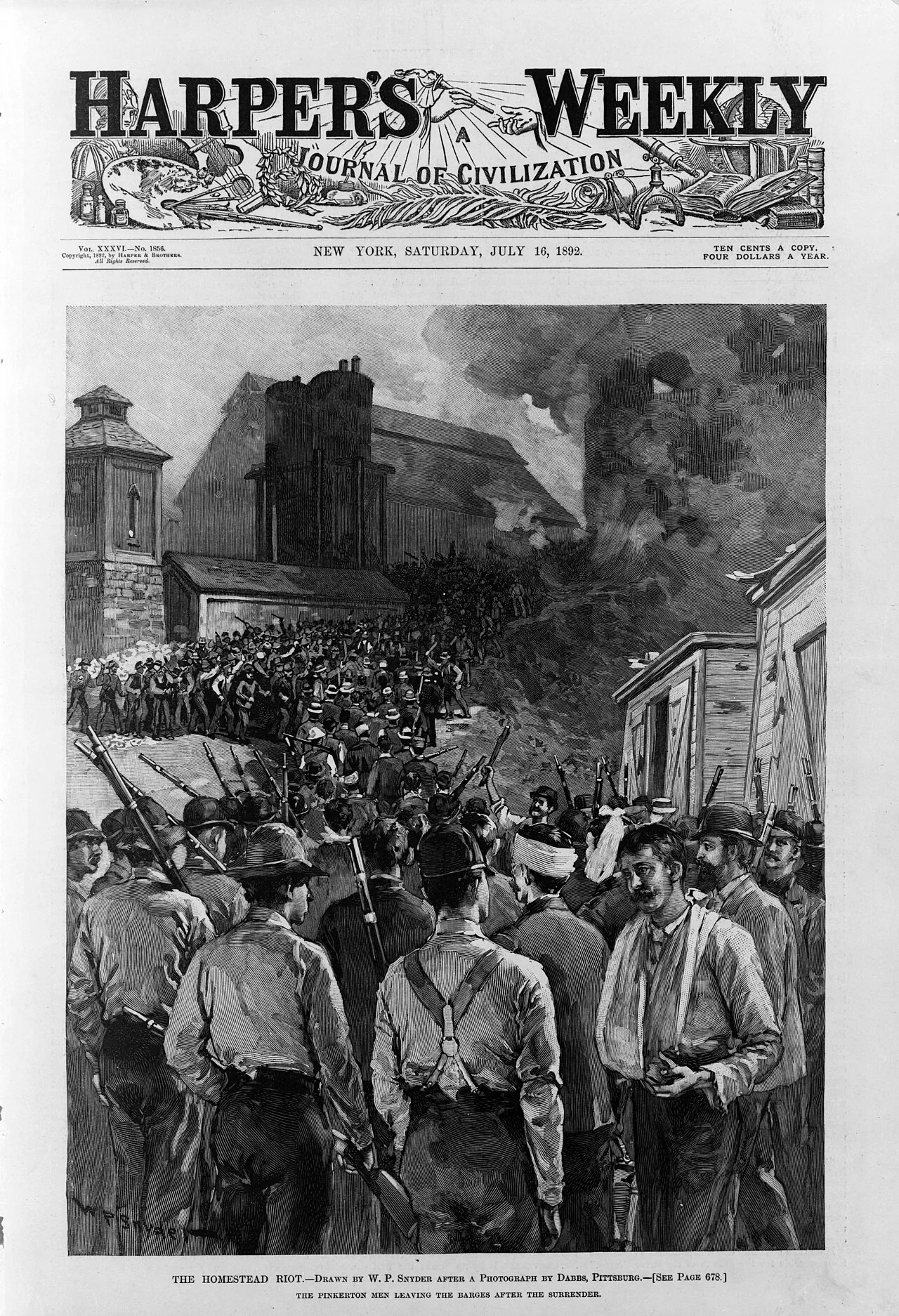
Source: Harper’s Weekly, July 16, 1892, Library of Congress (image on Wikimedia Commons).
The artist shows workers in work clothes, some armed, gathered in front of the mill after the fight with the Pinkertons. The magazine was mainstream and generally pro-business, yet it gave the workers a dignified and serious look. Compare the picture with Carnegie’s own essay on wealth: the same man was celebrated as a philanthropist and attacked as an employer.
Key takeaways
- Railroads, steel, oil, and electricity built a national industrial economy after 1865.
- Business leaders used vertical and horizontal integration; the Sherman Antitrust Act (1890) was the first federal attempt to limit monopolies.
- Unions such as the Knights of Labor and the AFL grew, but major strikes (1877, 1886, 1892, 1894) were usually defeated with the help of courts, militias, or federal troops.
2. The West and Native Americans: Geography and Settlement
Settlers on the plains
The railroads advertised cheap land in the West, and the federal government encouraged settlement. The Homestead Act of 1862 offered 160 acres free to any settler who farmed the land for five years. Settlers included native-born families from the Midwest, newly freed African Americans (the “Exodusters” who moved to Kansas in 1879), and immigrants from Germany, Scandinavia, and Russia. On the treeless plains they built houses out of sod and fought drought, grasshoppers, and blizzards.
The new steel plow, barbed wire, windmills, and mechanical reapers made large-scale farming possible. Farmers became commercial producers who depended on railroads to ship and on banks to lend, which gave them a stake in distant prices they could not control. Mining camps in Colorado, Nevada, and the Black Hills and the cattle drives from Texas to railheads in Kansas, such as Abilene, were other parts of the story that Hollywood later made famous.
Document 3 – A home made of grass
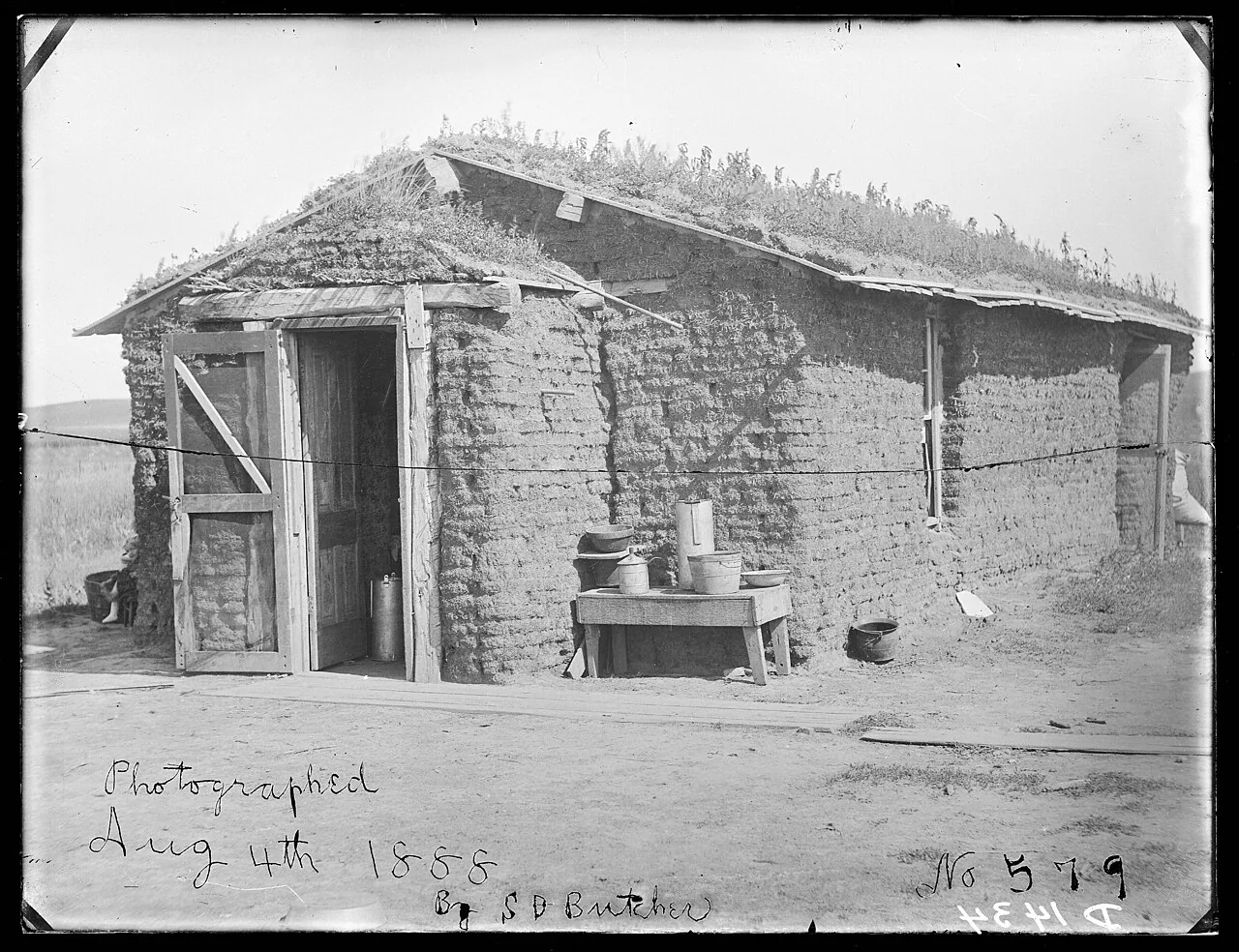
Source: Solomon D. Butcher, Custer County, Nebraska, 1880s, Library of Congress (image on Wikimedia Commons).
Butcher traveled the Nebraska plains and photographed families outside their homes, usually at their request. Such pictures were a form of pride: they told relatives in the East that the family had a house and a future. They also show how little timber the plains provided. The house has thick walls that held heat in winter and kept it out in summer, but it also leaked in heavy rain.
Native Americans and federal policy
For the Plains nations, such as the Lakota, Cheyenne, Arapaho, and Comanche, settlement meant the destruction of their way of life. Hunters and railroad crews slaughtered the buffalo, the base of the Plains economy, until the herds were nearly gone in the 1880s. The Army fought a long series of wars to force Native peoples onto reservations: the Sand Creek massacre of Cheyenne and Arapaho by Colorado militia in 1864, the Lakota and Cheyenne victory over Lieutenant Colonel Custer at the Little Bighorn in 1876, and the pursuit of the Nez Perce under Chief Joseph, who surrendered in 1877 only forty miles from Canada.
By 1890 military resistance had ended. At Wounded Knee, South Dakota, on December 29, 1890, soldiers of the Seventh Cavalry, the regiment that had lost at the Little Bighorn, opened fire on a camp of Lakota who were being disarmed, killing well over a hundred men, women, and children and some soldiers. The Army called it a battle; later Americans and the Lakota called it a massacre.
Document 4 – The aftermath of Wounded Knee
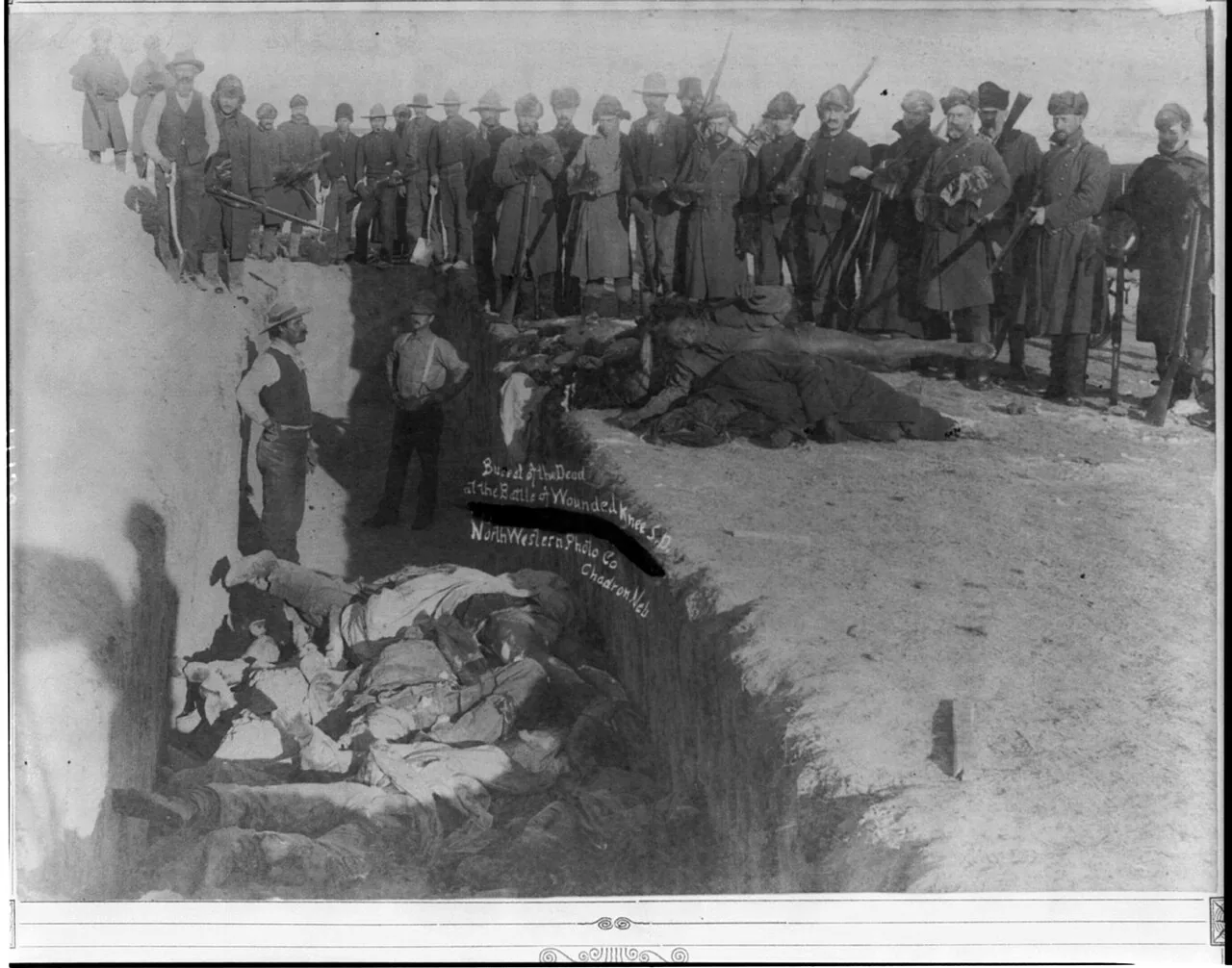
Source: photograph, South Dakota, January 1891, Library of Congress (image on Wikimedia Commons).
A group of soldiers and civilians stands at the edge of a mass grave. The picture was taken by an outsider for a public that wanted to see the last Indian battle. It tells us little about the Lakota point of view, but it records how many people died and how they were buried in a trench in winter.
Federal policy after the wars aimed at assimilation, the idea that Native peoples should give up their cultures and live like white farmers. The Dawes Act of 1887 divided reservation land into individual allotments of 160 acres or less and offered citizenship to those who accepted. The remaining land was declared surplus and sold to white settlers, and Native nations lost a large share of the land they had held in 1887. Boarding schools such as the Carlisle Indian Industrial School in Pennsylvania (founded 1879) cut hair, forbade native languages, and taught trades, with the stated aim, in the founder’s words, to “kill the Indian, and save the man.”
Definition: assimilation
the policy of forcing a minority people to adopt the language, religion, and customs of the majority. In the 1880s federal officials used the allotment of land and boarding schools to assimilate Native Americans.
Document 5 – The Dawes Act, 1887
That in all cases where any tribe or band of Indians has been, or shall hereafter be, located upon any reservation created for their use, either by treaty stipulation or by virtue of an act of Congress or executive order setting apart the same for their use, the President of the United States be, and he hereby is, authorized, whenever in his opinion any reservation or any part thereof of such Indians is advantageous for agricultural and grazing purposes, to cause said reservation, or any part thereof, to be surveyed, or resurveyed if necessary, and to allot the lands in said reservation in severalty to any Indian located thereon in quantities as follows: To each head of a family, one-quarter of a section; To each single person over eighteen years of age, one-eighth of a section;
Source: General Allotment Act (Dawes Act), February 8, 1887, section 1; text from Wikisource.
*in severalty: to individuals instead of to the tribe. *section: a square mile of land (640 acres).
Commentary. The act authorizes the President to survey a reservation and divide it among individuals; a head of a family gets one-quarter of a section (160 acres). Reformers called this a path to citizenship and prosperity. In practice, the plan ignored the communal land traditions of many nations and the poor farming quality of many allotments, and it opened the “surplus” to purchase. Sourcing note: the act was written by non-Native lawmakers and reformers, so it shows the goals of the government, not the views of Native peoples.
Document 6 – The frontier thesis, 1893
Up to our own day American history has been in a large degree the history of the colonization of the Great West. The existence of an area of free land, its continuous recession, and the advance of American settlement westward, explain American development. […] And now, four centuries from the discovery of America, at the end of a hundred years of life under the Constitution, the frontier has gone, and with its going has closed the first period of American history.
Source: Frederick Jackson Turner, “The Significance of the Frontier in American History,” paper read to the American Historical Association, Chicago, July 12, 1893; Wikisource.
Commentary. Turner, a historian at the University of Wisconsin, argued that the frontier made Americans democratic and individualistic. His paper responded to the 1890 census, which reported that unsettled land no longer formed a clear frontier line. Later historians criticized the thesis for ignoring Native peoples, Mexicans, women, and the role of government and railroads, but it shaped the way Americans thought about their past for decades.
Key takeaways
- The Homestead Act, railroads, and new farm technology brought millions of settlers to the Great Plains.
- Federal policy toward Native Americans moved from war and removal to assimilation: the Dawes Act (1887) and boarding schools.
- Wounded Knee (1890) ended armed resistance, and the 1890 census was read as the end of the frontier.
3. Immigration, cities, and nativism: Migration and Social Structures
Between 1865 and 1898, the United States took in many millions of immigrants. Until the 1880s most came from northern and western Europe, mainly Britain, Ireland, Germany, and Scandinavia. Beginning in the 1880s, more came from southern and eastern Europe: Italians, Poles, Slovaks, Greeks, and Jews fleeing persecution in the Russian empire. Chinese workers had arrived in California since the gold rush, and Japanese immigration began in the 1880s. Most settled in industrial cities, where factories needed labor. Immigrants and their children made up a majority of the population in many northern cities. The federal government opened an immigration station on Ellis Island in New York harbor on January 1, 1892.
Document 7 – Arrival: Ellis Island
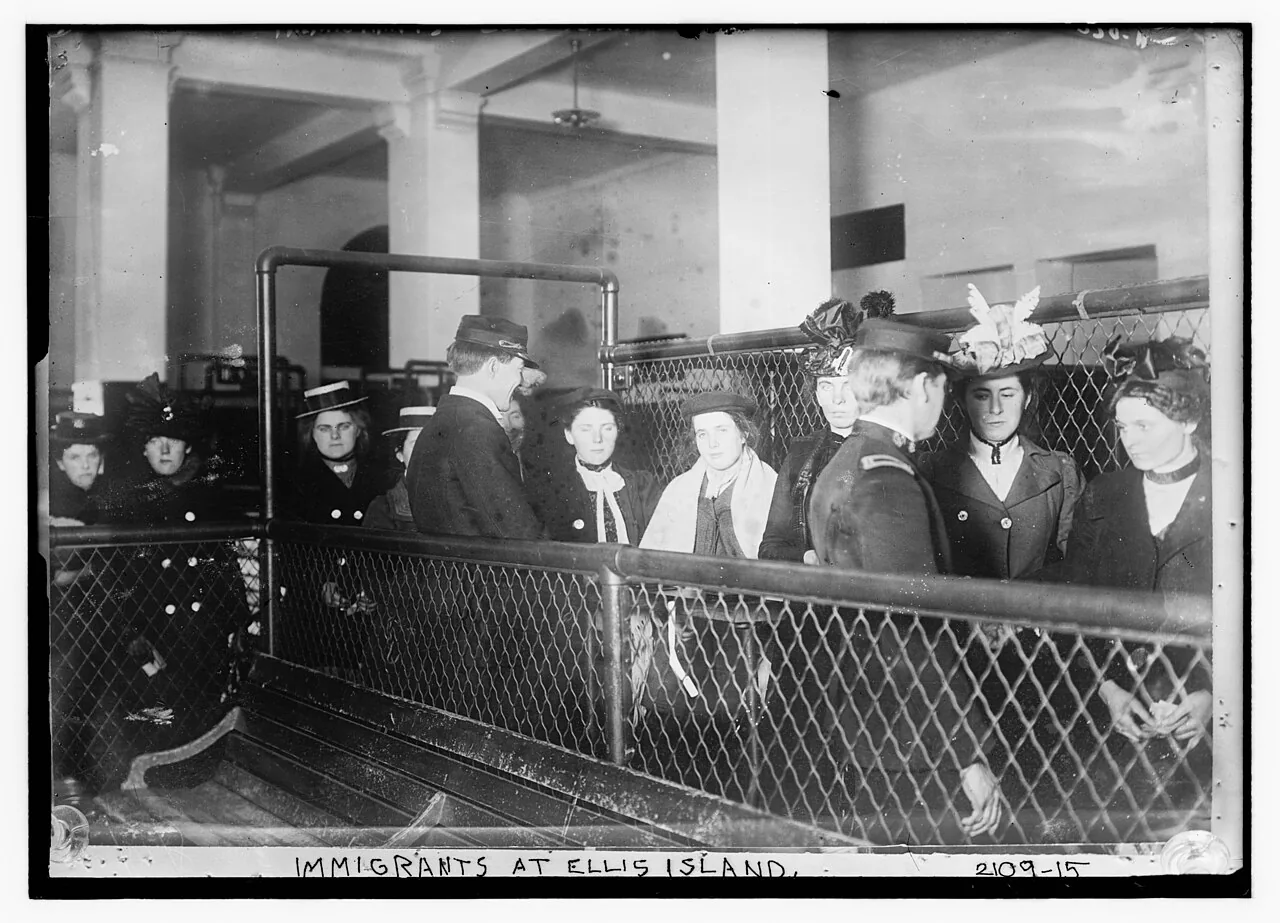
Source: Bain News Service, about 1900-1910, Library of Congress (image on Wikimedia Commons).
The photograph shows an inspection room, with iron rails that guided immigrants toward doctors and clerks. Officers checked for disease and asked about money and work. Most immigrants passed within hours, and only a small share were turned back for health or legal reasons.
Cities grew explosively and unevenly. Workers lived in tenements, multistory buildings with dark airless rooms, and a single apartment might hold a family and boarders. Streets in the poorest districts were crowded and dirty. Jacob Riis, a Danish immigrant and newspaper reporter, photographed these conditions with a flash and published How the Other Half Lives in 1890. Middle-class reformers began to act. Jane Addams founded Hull House in Chicago in 1889, a settlement house that offered classes, child care, and a gathering place for neighborhood families. Many Protestant ministers preached a Social Gospel, the idea that Christians must work to improve society, not only to save souls.
Document 8 – “How the Other Half Lives,” 1890
Long ago it was said that “one half of the world does not know how the other half lives.” That was true then. It did not know because it did not care. The half that was on top cared little for the struggles, and less for the fate of those who were underneath, so long as it was able to hold them there and keep its own seat. There came a time when the discomfort and crowding below were so great, and the consequent upheavals so violent, that it was no longer an easy thing to do, and then the upper half fell to inquiring what was the matter. Information on the subject has been accumulating rapidly since, and the whole world has had its hands full answering for its old ignorance.
Source: Jacob A. Riis, How the Other Half Lives: Studies Among the Tenements of New York, 1890, chapter 1; Project Gutenberg.
Commentary. Riis was a reformer and a persuader, and his book was meant to shock the comfortable readers of the “upper half.” He blames “greed and reckless selfishness” for the crowding. The passage is a good source for how reformers explained the slums, but his tone is also paternalistic and he often repeated ethnic stereotypes. His photographs were taken with flash powder, which meant that the people in them were usually surprised.
Document 9 – Riis photographs Bandits’ Roost
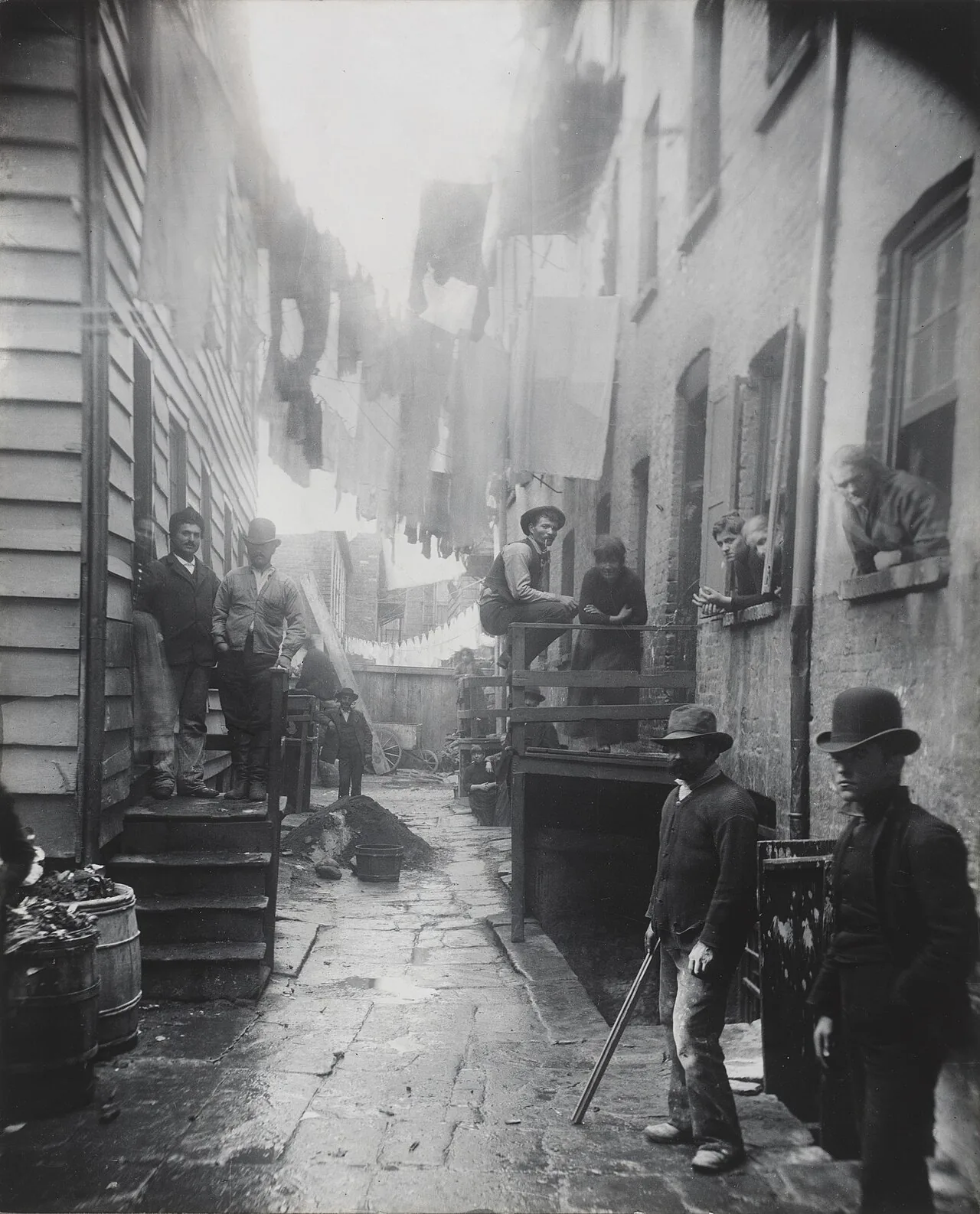
Source: Jacob A. Riis, 1888, Museum of the City of New York (image on Wikimedia Commons).
The photograph shows an alley in Mulberry Bend, a district in lower Manhattan that Riis described as the worst in the city. The men on the right look at the camera with suspicion. Riis used pictures like this one in lectures to win support for tearing down the tenements; the city later replaced the district with a park.
Political machines and reform
Big-city politics was run by political machines, organizations led by a boss that traded services and jobs for votes. Tammany Hall in New York, led before 1873 by William M. “Boss” Tweed, helped immigrants find work, housing, and food in exchange for loyalty, and it also stole millions from the city. Reformers sought to replace the machines with professional administration. At the national level, the Pendleton Civil Service Act (1883), passed after President Garfield was assassinated by a man who had been denied a federal job, began to replace the spoils system with merit exams for some federal jobs.
Nativism, the fear and hostility toward immigrants, grew along with immigration. Many Americans in the West blamed Chinese workers for low wages. In 1882 Congress passed the Chinese Exclusion Act, the first federal law to bar immigrants because of their nationality. It suspended the immigration of Chinese laborers for ten years, and Congress renewed it in 1892 and later made it permanent. The law also forbade Chinese immigrants from becoming naturalized citizens. At the same time, the Statue of Liberty (dedicated 1886) and Emma Lazarus’s sonnet “The New Colossus” offered a different image of the nation as a refuge for the poor of every land.
Definition: nativism
the belief that native-born inhabitants deserve privileges over immigrants, often expressed in demands to restrict immigration. Nativism targeted Chinese workers in the 1870s and 1880s and southern and eastern Europeans in the 1890s.
Document 10 – The Chinese Exclusion Act, 1882
Whereas, in the opinion of the Government of the United States the coming of Chinese laborers to this country endangers the good order of certain localities within the territory thereof: Therefore, Be it enacted by the Senate and House of Representatives of the United States of America in Congress assembled, That from and after the expiration of ninety days next after the passage of this act, and until the expiration of ten years next after the passage of this act, the coming of Chinese laborers to the United States be, and the same is hereby, suspended; and during such suspension it shall not be lawful for any Chinese laborer to come, or, having so come after the expiration of said ninety days, to remain within the United States.
Source: Chinese Exclusion Act, May 6, 1882, 22 Stat. 58, section 1; text from Wikisource.
*laborers: the act applied to workers, not to merchants, students, or diplomats. *suspended: halted for a time.
Document 11 – A cartoon against exclusion, 1880
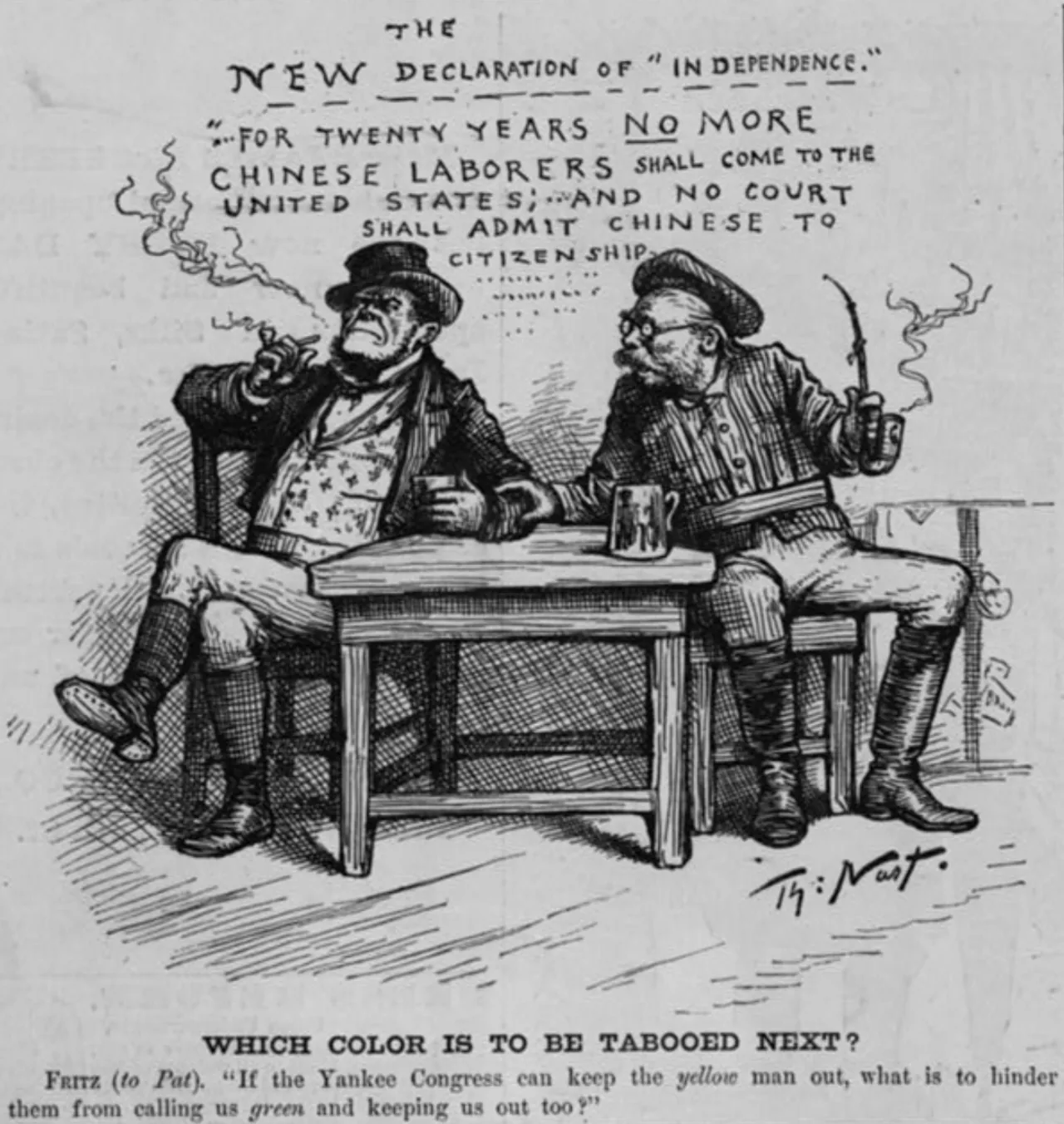
Source: Thomas Nast, Harper’s Weekly, 1880, Library of Congress (image on Wikimedia Commons).
Nast, the best-known political cartoonist of the age, had also attacked Boss Tweed. Here two men, apparently an Irish immigrant and a German immigrant, relax with beer under a mock “declaration of independence” that excludes the Chinese. The cartoon makes the point that earlier immigrants were turning against newcomers and asks who will be shut out next. Some Americans in 1880, including Nast, opposed exclusion, but Congress still passed the Act two years later.
Document 12 – “The New Colossus,” 1883
Not like the brazen giant of Greek fame, With conquering limbs astride from land to land; Here at our sea-washed, sunset gates shall stand A mighty woman with a torch, whose flame Is the imprisoned lightning, and her name Mother of Exiles. From her beacon-hand Glows world-wide welcome; her mild eyes command The air-bridged harbor that twin cities frame. “Keep, ancient lands, your storied pomp!” cries she With silent lips. “Give me your tired, your poor, Your huddled masses yearning to breathe free, The wretched refuse of your teeming shore. Send these, the homeless, tempest-tost to me, I lift my lamp beside the golden door!
Source: Emma Lazarus, “The New Colossus,” sonnet written in 1883 for a fund-raising auction for the Statue of Liberty pedestal; Wikisource.
*brazen: made of bronze. *tempest-tost: thrown about by storms.
Commentary. Lazarus, a New York poet of Jewish descent who helped refugees from Russian pogroms, wrote the poem for an auction to raise money for the statue’s pedestal. It was not displayed on the statue until 1903. Notice the contrast with the Chinese Exclusion Act of only a year earlier: American attitudes toward immigrants were divided, and both documents are evidence of the period.
Key takeaways
- Immigration shifted toward southern and eastern Europe and Asia, and immigrants settled mainly in industrial cities.
- Cities faced crowding and disease; reformers such as Riis and Addams pushed for change, while political machines gave newcomers services in return for votes.
- Nativism produced the first nationality-based immigration law, the Chinese Exclusion Act (1882).
4. Politics, Populism, and the color line: Politics and Power
The Gilded Age
Mark Twain and Charles Dudley Warner named the era the Gilded Age (1873) because it was gold on the surface and cheap underneath. National politics was evenly balanced and corrupt. Presidential elections were close and turnout was high, but the parties were most active in tariff, currency, and patronage disputes, and neither confronted the new inequality directly. Republicans were strongest in the North and among Union veterans, and Democrats in the South and in immigrant wards of northern cities.
The most important economic issue was the money supply. Prices fell for most of the period, so farmers and debtors who had borrowed money found it harder to repay. Many wanted the government to coin silver, which would increase the money in circulation and raise prices. Bankers and business leaders favored the gold standard. After the Panic of 1893, which brought the worst depression the country had yet seen, the debate became bitter.
The farmers’ revolt
Southern and Western farmers formed the Farmers’ Alliance in the 1880s to buy supplies together and to store crops. They then entered politics as the People’s Party, or Populists. At Omaha in 1892 the party adopted a platform that called for a graduated income tax, government ownership of railroads and the telegraph, the direct election of senators, and the free coinage of silver at a ratio of 16 to 1. The Populist presidential candidate, James B. Weaver, won about one million votes and carried several Western states.
In 1896 the Democrats chose William Jennings Bryan, who electrified the convention with his “Cross of Gold” speech, and the Populists, divided, also endorsed him. Republican William McKinley, backed by business money and a strong campaign run by Mark Hanna, won. Populism faded, but most of its ideas, including the income tax and direct election of senators, became law in the Progressive Era.
Definition: Populism
the political movement of farmers in the South and West in the 1890s, organized as the People’s Party, that demanded federal action against banks and railroads, free coinage of silver, and a graduated income tax.
Document 13 – The Omaha Platform, 1892
Corruption dominates the ballot-box, the Legislatures, the Congress, and touches even the ermine of the bench. The people are demoralized; most of the States have been compelled to isolate the voters at the polling places to prevent universal intimidation and bribery. The newspapers are largely subsidized or muzzled, public opinion silenced, business prostrated, homes covered with mortgages, labor impoverished, and the land concentrating in the hands of capitalists. The urban workmen are denied the right to organize for self-protection, imported pauperized labor beats down their wages, a hireling standing army, unrecognized by our laws, is established to shoot them down, and they are rapidly degenerating into European conditions. […] The fruits of the toil of millions are boldly stolen to build up colossal fortunes for a few, unprecedented in the history of mankind; and the possessors of those, in turn, despise the republic and endanger liberty.
Source: Preamble of the platform of the People’s (Populist) Party, adopted at Omaha, Nebraska, July 4, 1892; text from Wikisource.
*the ballot-box: the system of voting. *hireling standing army: private armed guards such as the Pinkertons.
Commentary. The preamble is angry and apocalyptic. It blames corruption, concentrated wealth, and a “hireling standing army” (a reference to private guards such as the Pinkertons at Homestead) for the plight of ordinary people. Notice that the Populists attacked both parties. Historians debate whether Populists were forward-looking reformers or defenders of an agricultural past; the platform contains both a demand for new government powers and a nostalgia for the independent farmer.
Document 14 – A cartoon about Bryan, 1896
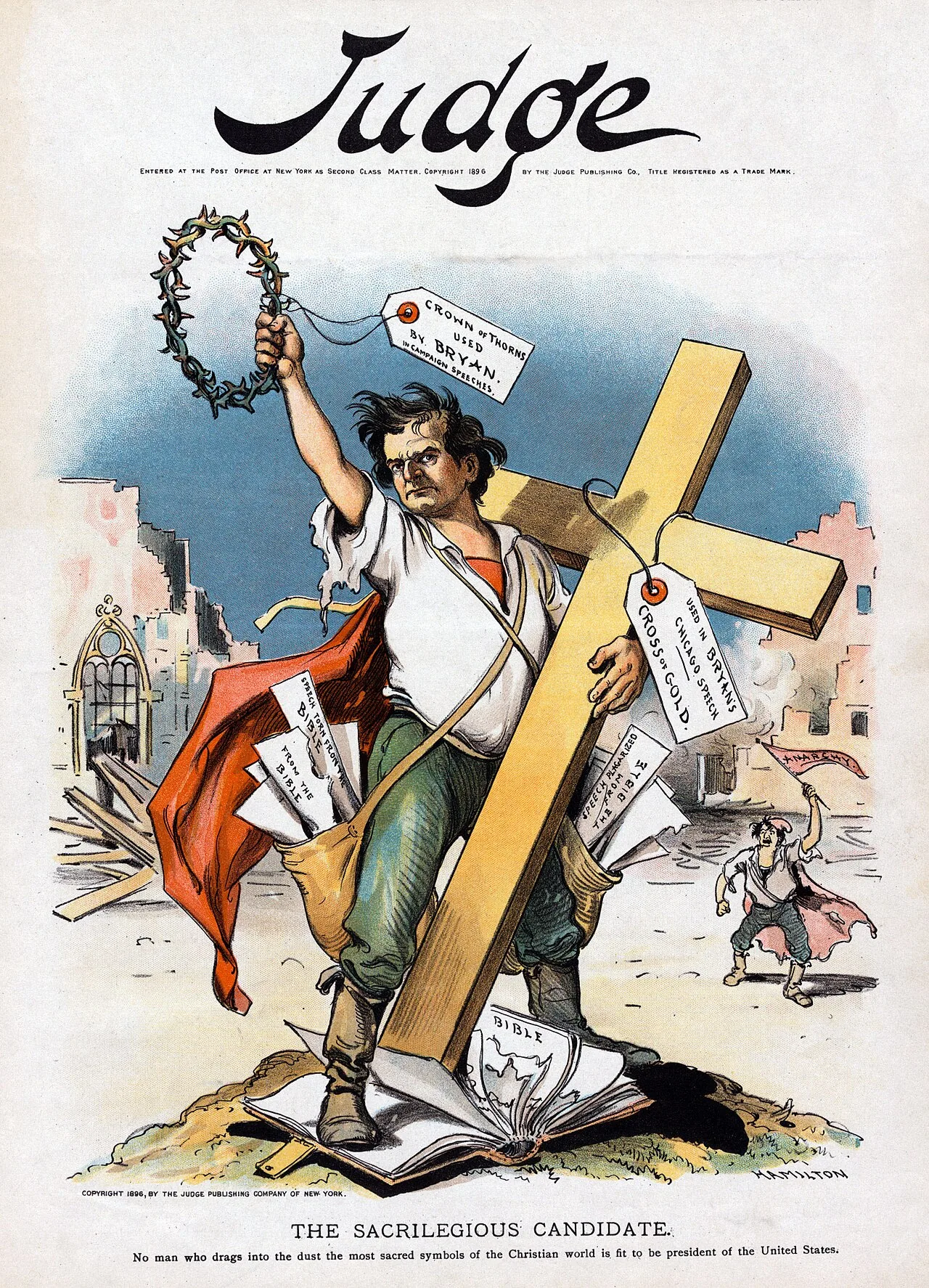
Source: Judge, 1896, Library of Congress (image on Wikimedia Commons).
The cartoon belongs to the Republican side of the 1896 campaign, which accused Bryan of reckless radicalism. His speech had ended with the words “You shall not crucify mankind upon a cross of gold,” and the cartoonist turns the metaphor against him by showing him as a man who exploits sacred symbols. Use the cartoon to illustrate how the campaign was fought, not as evidence of what Bryan meant.
The end of Reconstruction and the rise of Jim Crow
Reconstruction ended in 1877, when President Hayes withdrew the last federal troops from the South as part of the Compromise of 1877 that settled the disputed election of 1876. White Democrats, calling themselves Redeemers, regained control of every Southern state. African Americans did not lose the vote at once, but violence and intimidation by groups such as the Ku Klux Klan and the White League, and then new state laws, steadily pushed them out of politics. Mississippi’s constitution of 1890 introduced a poll tax and literacy test; other states followed with grandfather clauses that exempted whites whose ancestors had voted. By 1900 most Black men in the Deep South could not vote.
At the same time, Southern states passed laws that separated the races in schools, railroad cars, and public places. These Jim Crow laws were defended as “separate but equal.” In 1892 Homer Plessy, a New Orleans man of mixed ancestry chosen by a local civil rights group to test the state’s Separate Car Act, sat in a whites-only railroad car and was arrested. In Plessy v. Ferguson (1896), the Supreme Court ruled 7 to 1 that the Louisiana law did not violate the Fourteenth Amendment so long as the facilities were equal. Justice John Marshall Harlan wrote a lone dissent.
Definition: Jim Crow
the system of laws and customs, mostly in the South, that segregated the races and denied African Americans political and economic equality from the 1870s to the 1960s. The name comes from a minstrel-show character.
Document 15 – The Court’s reasoning in Plessy, 1896
If this be so, it is not by reason of anything found in the act, but solely because the colored race chooses to put that construction upon it. The argument necessarily assumes that if, as has been more than once the case, and is not unlikely to be so again, the colored race should become the dominant power in the state legislature, and should enact a law in precisely similar terms, it would thereby relegate the white race to an inferior position.
Source: Justice Henry Billings Brown, opinion of the Court, Plessy v. Ferguson, 163 U.S. 537 (1896); Legal Information Institute, Cornell Law School.
*construction: interpretation. *relegate: assign to a lower position.
Document 16 – Harlan’s dissent, 1896
But in view of the constitution, in the eye of the law, there is in this country no superior, dominant, ruling class of citizens. There is no caste here. Our constitution is color-blind, and neither knows nor tolerates classes among citizens. In respect of civil rights, all citizens are equal before the law. The humblest is the peer of the most powerful.
Source: Justice John Marshall Harlan, dissenting opinion, Plessy v. Ferguson, 163 U.S. 537 (1896); Legal Information Institute, Cornell Law School.
*caste: a rigid class system based on birth. *guarantied: guaranteed.
Commentary. Justice Brown argued that segregation did not imply inferiority unless Black people “chose” to read it that way, and he treated the laws as a matter of social custom that courts could not change. Harlan, a Kentuckian and former slaveholder, answered that “our constitution is color-blind.” Yet even Harlan did not say that all races were equal in every way, a reminder to read dissents critically too. Plessy remained the law of the land until Brown v. Board of Education in 1954.
Black leaders disagreed about how to respond. Booker T. Washington, the founder of Tuskegee Institute, urged African Americans to focus on education, farming, and business and to accept segregation for the time being, a position critics called the Atlanta Compromise. Ida B. Wells, a journalist from Memphis, investigated lynchings and demanded federal action. W. E. B. Du Bois, a Harvard-trained scholar, argued in 1903 that Washington’s approach gave up political rights too easily.
Document 17 – Washington addresses a white audience, 1895
To those of my race who depend on bettering their condition in a foreign land or who underestimate the importance of cultivating friendly relations with the Southern white man, who is their next-door neighbor, I would say: “Cast down your bucket where you are” — cast it down in making friends in every manly way of the people of all races by whom we are surrounded. […] In all things that are purely social, we can be as separate as the fingers, yet one as the hand in all things essential to mutual progress.
Source: Booker T. Washington, address at the Cotton States and International Exposition, Atlanta, September 18, 1895 (later called the Atlanta Compromise); text from Wikisource.
*cast down your bucket: use what is close at hand.
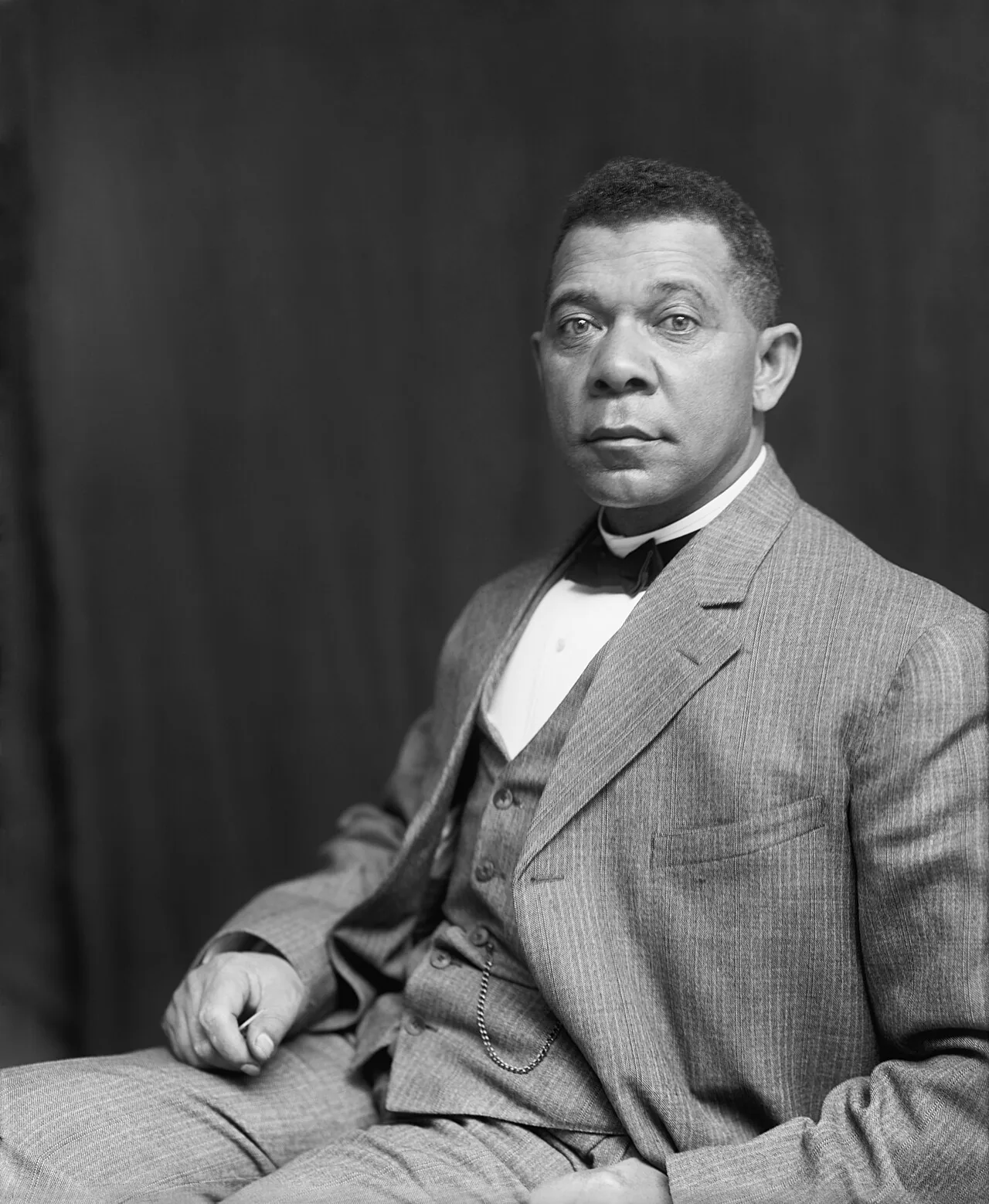
Commentary. Washington spoke at the Cotton States Exposition in Atlanta to an audience that was mostly white. His famous “fingers and hand” image reassured them that Black Southerners would not demand social equality. He also offered white employers Black workers who were “patient, faithful, law-abiding.” Many Black newspapers praised the speech at first, and later critics accused him of accepting inequality. Consider the audience and purpose when you analyze it.
5. The United States looks outward: America in the World
After the Civil War, the country was busy with development at home, but a few leaders already looked abroad. Secretary of State William Seward bought Alaska from Russia in 1867 for $7.2 million, a purchase critics called “Seward’s Folly.” American planters and missionaries in Hawaii grew rich in sugar, and in 1893 they overthrew Queen Liliuokalani with the help of U.S. Marines.
Captain Alfred Thayer Mahan argued in The Influence of Sea Power upon History (1890) that a great nation needs a strong navy and overseas bases, and the Navy began to build modern steel warships. Business leaders wanted foreign markets for the surplus from American farms and factories, and the closing of the frontier (Turner) suggested to some that the nation must find new frontiers abroad.
The war with Spain
The break came in Cuba. Cubans had risen against Spanish rule, and American newspapers, especially the rival papers of Joseph Pulitzer and William Randolph Hearst, printed lurid stories of Spanish cruelty, a style called yellow journalism. In February 1898 the battleship USS Maine blew up in Havana harbor, killing more than 250 sailors. A study led by Admiral Hyman Rickover in the 1970s concluded that a coal fire was the likeliest cause, and the cause is still debated, but at the time Americans blamed Spain. Congress declared war in April 1898 and, in the Teller Amendment, promised not to annex Cuba. The war lasted about four months.
Victory and new possessions
Admiral George Dewey destroyed the Spanish fleet in Manila Bay on May 1; American troops, including Theodore Roosevelt’s Rough Riders and Black regiments, took Santiago, Cuba, in July. In December 1898 the Treaty of Paris gave the United States Puerto Rico, Guam, and the Philippines, for which it paid Spain $20 million. Cuba became independent under American supervision, and Congress annexed Hawaii in July 1898.
The debate over empire
The debate over the Philippines divided the nation. Imperialists argued that the United States had a duty to civilize the islands and that other powers would seize them if it did not. The Anti-Imperialist League, which included Mark Twain, Andrew Carnegie, and former President Cleveland, argued that taking colonies betrayed the principle of self-government. The Senate approved the treaty by a narrow margin in February 1899, and a war against Filipino nationalists followed. The nation that had once defined itself against empire now ruled an empire of its own.
- 1869 The Union Pacific and Central Pacific railroads meet at Promontory Summit, Utah.
- 1877 Federal troops leave the South; the Great Railroad Strike spreads across the country.
- 1882 Congress passes the Chinese Exclusion Act.
- 1886 Haymarket bombing in Chicago; the American Federation of Labor is founded.
- 1887 The Dawes Act divides Indian reservations into individual allotments.
- 1890 The Sherman Antitrust Act is passed; Wounded Knee ends armed Indian resistance.
- 1892 Homestead strike; the Populists adopt the Omaha Platform.
- 1894 The Pullman Strike is ended by federal troops.
- 1896 Plessy v. Ferguson; McKinley defeats Bryan.
- 1898 The Spanish-American War; the United States annexes Hawaii.
Document 18 – The United States population, 1860-1900
| Year | Population of the United States (census) |
|---|---|
| 1860 | 31,443,321 |
| 1870 | 38,558,371 |
| 1880 | 50,189,209 |
| 1890 | 62,979,766 |
| 1900 | 76,212,168 |
Source: U.S. Census Bureau, decennial census counts for 1860-1900 (as tabulated at https://en.wikipedia.org/wiki/Demographic_history_of_the_United_States).
The population more than doubled in forty years, from about 31 million to about 76 million, because of high birth rates and immigration. Those numbers explain the growth of cities and the demand for workers, housing, and food described in this lesson.
Key takeaways
- Industrialization created a national market, great fortunes, and new unions; the government began to regulate business (Interstate Commerce Act 1887, Sherman Act 1890) but weakly.
- The West was settled through railroads and the Homestead Act at the expense of Native Americans, who faced war, reservations, and forced assimilation.
- Immigration and urbanization produced new problems and new reform movements; nativism led to the Chinese Exclusion Act (1882).
- Farmers organized the Populist Party (1892); the election of 1896 ended the movement as an independent force.
- Reconstruction ended in 1877; Jim Crow laws and disenfranchisement were upheld by Plessy v. Ferguson (1896).
- The Spanish-American War (1898) gave the United States overseas possessions and began a debate over imperialism.

Quick review: flashcards
Tap a card to see the answer.