



This AP US History test covers APUSH Period 6: 1865-1898. Like a classroom assessment, it includes documents to analyze, knowledge questions and a short writing task. To prepare, review the lesson first, then practice with the worksheet.
Time : 90 min
This test follows the AP format. Part 1 (questions 1-2) tests knowledge; Part 2 (questions 3-6) asks you to use the documents; Part 3 (questions 7-8) is a short-answer question and a long essay. Total: 100 points. Read each document and its source line before you answer.
Document 1 – Document A – The Populist preamble, 1892
Corruption dominates the ballot-box, the Legislatures, the Congress, and touches even the ermine of the bench. The people are demoralized; most of the States have been compelled to isolate the voters at the polling places to prevent universal intimidation and bribery. The newspapers are largely subsidized or muzzled, public opinion silenced, business prostrated, homes covered with mortgages, labor impoverished, and the land concentrating in the hands of capitalists. The urban workmen are denied the right to organize for self-protection, imported pauperized labor beats down their wages, a hireling standing army, unrecognized by our laws, is established to shoot them down, and they are rapidly degenerating into European conditions. […] The fruits of the toil of millions are boldly stolen to build up colossal fortunes for a few, unprecedented in the history of mankind; and the possessors of those, in turn, despise the republic and endanger liberty.
Source: Preamble of the platform of the People’s (Populist) Party, adopted at Omaha, Nebraska, July 4, 1892; text from Wikisource.
*hireling standing army: private armed guards.
People's Party platform, Omaha, July 4, 1892.
Document 2 – Document B – The Homestead strike, 1892
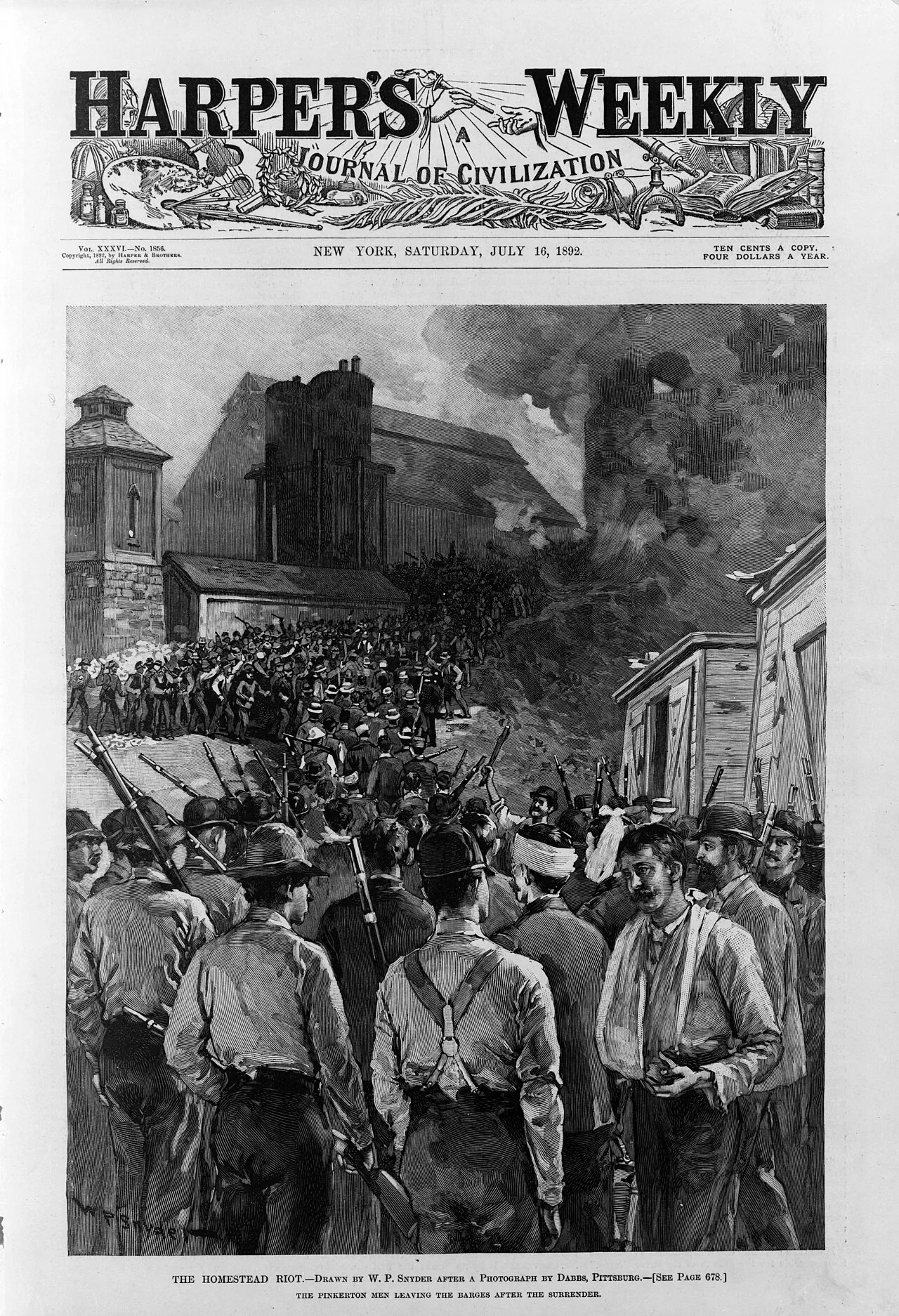
Source: Harper’s Weekly, July 16, 1892, Library of Congress.
Harper's Weekly, July 16, 1892.
Document 3 – Document C – Industrial centers of the 1890s
Map drawn from Natural Earth data; dots mark the cities named in the lesson.
Document 4 – Document D – Population of the United States, 1860-1900
| Year | Population (census) |
|---|---|
| 1860 | 31,443,321 |
| 1870 | 38,558,371 |
| 1880 | 50,189,209 |
| 1890 | 62,979,766 |
| 1900 | 76,212,168 |
Source: U.S. Census Bureau, decennial census counts.
U.S. Census Bureau.
Document 5 – Document E – Justice Harlan dissenting, 1896
But in view of the constitution, in the eye of the law, there is in this country no superior, dominant, ruling class of citizens. There is no caste here. Our constitution is color-blind, and neither knows nor tolerates classes among citizens. In respect of civil rights, all citizens are equal before the law. The humblest is the peer of the most powerful.
Source: Justice John Marshall Harlan, dissenting opinion, Plessy v. Ferguson, 163 U.S. 537 (1896); Legal Information Institute, Cornell Law School.
*caste: a rigid class system.
Plessy v. Ferguson, 163 U.S. 537 (1896), dissent.
Questions
- (Part 1) Define vertical integration and horizontal integration. Give one example of each from the Gilded Age. (10 pts)
- (Part 1) Explain two reasons why railroads were important to economic and social change between 1865 and 1898. (10 pts)
- (Part 2, Document A) Identify two grievances of the Populists and explain how each relates to the economy of the 1890s. (10 pts)
- (Part 2, Document B) Describe the event in the image. Explain why government and the courts usually sided with employers in labor conflicts in this period. (10 pts)
- (Part 2, Documents C and D) Using the map and the table, explain one cause and one consequence of the concentration of people in industrial cities. (10 pts)
- (Part 2, Document E) Explain how Justice Harlan’s dissent challenges the majority’s view in Plessy v. Ferguson, and compare it with Booker T. Washington’s approach to segregation in 1895. (10 pts)
- (Part 3, SAQ) Explain ONE continuity and ONE change in federal policy toward Native Americans between 1865 and 1898. (10 pts)
- (Part 3, LEQ) Evaluate the extent to which the Gilded Age (1865-1898) was a period of progress for ordinary Americans. Use specific evidence. (30 pts)


Quick review: flashcards
Tap a card to see the answer.