


This worksheet on APUSH Period 8: 1945-1980 belongs to the AP US History course. Its questions use primary sources, maps and timelines, and they move from basic recall to short writing tasks. Before you start, review the lesson; afterward, try the true or false quiz.
Exercise 1 : Vocabulary of the Cold War era
Match each term with its meaning. Then use two of the terms in a sentence.
- Containment
- McCarthyism
- Massive resistance
- Great Society
- Détente
- Stagflation
- Vietnamization
- Military-industrial complex
(a) the easing of tensions with the Soviet Union in the 1970s; (b) the alliance of the armed forces and defense industries that Eisenhower warned about; (c) accusations of disloyalty made without proof; (d) the shifting of the fighting in Vietnam to South Vietnamese forces; (e) the policy of preventing the spread of communism; (f) Southern efforts to defy desegregation after Brown; (g) the programs of Lyndon Johnson to fight poverty and discrimination; (h) high inflation together with high unemployment.
Exercise 2 : The Truman Doctrine
Document 1 – Truman, March 12, 1947
I believe that it must be the policy of the United States to support free peoples who are resisting attempted subjugation by armed minorities or by outside pressures. I believe that we must assist free peoples to work out their own destinies in their own way. I believe that our help should be primarily through economic and financial aid which is essential to economic stability and orderly political processes. […] The world is not static, and the status quo is not sacred. But we cannot allow changes in the status quo in violation of the Charter of the United Nations by such methods as coercion, or by such subterfuges as political infiltration.
Source: Harry S. Truman, address to a joint session of Congress, March 12, 1947 (the Truman Doctrine); text from the Avalon Project, Yale Law School.
*subjugation: conquest and control. *subterfuges: tricks.
- Present the document (nature, author, date, context).
- Which peoples does Truman say the United States will support?
- What kind of help does he propose?
- Explain why Truman used general language and not only the example of Greece and Turkey.
- Name one later American action that followed the logic of this speech.
Exercise 3 : Eisenhower's farewell warning
Document 2 – Eisenhower, January 17, 1961
In the councils of government, we must guard against the acquisition of unwarranted influence, whether sought or unsought, by the militaryindustrial complex. The potential for the disastrous rise of misplaced power exists and will persist. We must never let the weight of this combination endanger our liberties or democratic processes. We should take nothing for granted. Only an alert and knowledgeable citizenry can compel the proper meshing of the huge industrial and military machinery of defense with our peaceful methods and goals, so that security and liberty may prosper together.
Source: Dwight D. Eisenhower, farewell address to the nation, January 17, 1961; text from the Avalon Project, Yale Law School.
*acquisition: gaining. *unwarranted: not justified.
- Present the document (nature, author, date, context).
- What does Eisenhower warn against?
- What does he say is the only safeguard?
- Eisenhower was a five-star general. Explain how that affects the weight of his warning.
- Give one piece of evidence from the 1950s that shows the growth of what he describes.
Exercise 4 : Brown and the Southern Manifesto
Document 3 – Brown v. Board of Education, 1954
To separate them from others of similar age and qualifications solely because of their race generates a feeling of inferiority as to their status in the community that may affect their hearts and minds in a way unlikely ever to be undone. […] We conclude that, in the field of public education, the doctrine of “separate but equal” has no place. Separate educational facilities are inherently unequal. Therefore, we hold that the plaintiffs and others similarly situated for whom the actions have been brought are, by reason of the segregation complained of, deprived of the equal protection of the laws guaranteed by the Fourteenth Amendment.
Source: Chief Justice Earl Warren, opinion of the Court, Brown v. Board of Education of Topeka, 347 U.S. 483, May 17, 1954; text from the National Archives (archives.gov).
*generates: produces.
Document 4 – The Southern Manifesto, 1956
The unwarranted decision of the Supreme Court in the public school cases is now bearing the fruit always produced when men substitute naked power for established law. The Founding Fathers gave us a Constitution of checks and balances because they realized the inescapable lesson of history that no man or group of men can be safely entrusted with unlimited power. They framed this Constitution with its provisions for change by amendment in order to secure the fundamentals of government against the dangers of temporary popular passion or the personal predilections of public officeholders. We regard the decisions of the Supreme Court in the school cases as a clear abuse of judicial power.
Source: Declaration of Constitutional Principles (the Southern Manifesto), read in Congress in March 1956 by Southern members of Congress; text from Wikisource.
*naked power: sheer force.
- Present each document (author, date, nature).
- How does Warren explain why segregation harms children?
- What accusation do the authors of the Manifesto make against the Court?
- Compare the two documents: how do they differ in the meaning they give to the Constitution?
- Explain one way in which Southern resistance slowed integration.
Exercise 5 : “We Shall Overcome”
Document 5 – Lyndon Johnson, March 15, 1965
There is no Negro problem. There is no Southern problem. There is no Northern problem. There is only an American problem. And we are met here tonight as Americans–not as Democrats or Republicans–we are met here as Americans to solve that problem. […] But even if we pass this bill, the battle will not be over. What happened in Selma is part of a far larger movement which reaches into every section and State of America. It is the effort of American Negroes to secure for themselves the full blessings of American life. Their cause must be our cause too. Because it is not just Negroes, but really it is all of us, who must overcome the crippling legacy of bigotry and injustice. And we shall overcome.
Source: Lyndon B. Johnson, special message to Congress on voting rights (“We Shall Overcome”), March 15, 1965; text from the American Presidency Project, University of California, Santa Barbara.
*overcome: defeat a difficulty.
- Present the document (nature, author, date, context).
- What does Johnson mean by saying that “there is only an American problem”?
- Why do you think he used the words of the movement’s anthem, “we shall overcome”?
- Name two events of early 1965 that led to this speech.
- What law followed?
Exercise 6 : The Gulf of Tonkin Resolution
Document 6 – The Southeast Asia Resolution, 1964
That the Congress approves and supports the determination of the President, as Commander in Chief, to take all necessary measures to repel any armed attack against the forces of the United States and to prevent further aggression. Section 2. The United States regards as vital to its national interest and to world peace the maintenance of international peace and security in southeast Asia. Consonant with the Constitution of the United States and the Charter of the United Nations and in accordance with its obligations under the Southeast Asia Collective Defense Treaty, the United States is, therefore, prepared, as the President determines, to take all necessary steps, including the use of armed force, to assist any member or protocol state of the Southeast Asia Collective Defense Treaty requesting assistance in defense of its freedom.
Source: Southeast Asia Resolution (Gulf of Tonkin Resolution), Public Law 88-408, August 7, 1964; text from the Avalon Project, Yale Law School.
*protocol state: a state covered by the protocol of the SEATO treaty.
- Present the document (nature, author, date, context).
- What power does the resolution give the President?
- What is missing from the text that a declaration of war would contain?
- Explain how Johnson used the resolution in 1965.
- Explain one effect of the resolution on relations between Congress and the President.
Exercise 7 : Kennedy and Khrushchev
Document 7 – Kennedy’s inaugural address, 1961
Let every nation know, whether it wishes us well or ill, that we shall pay any price, bear any burden, meet any hardship, support any friend, oppose any foe, in order to assure the survival and the success of liberty. […] And so, my fellow Americans: ask not what your country can do for you–ask what you can do for your country.
Source: John F. Kennedy, inaugural address, January 20, 1961; text from the Avalon Project, Yale Law School.
Document 8 – The missiles in Cuba, 1962
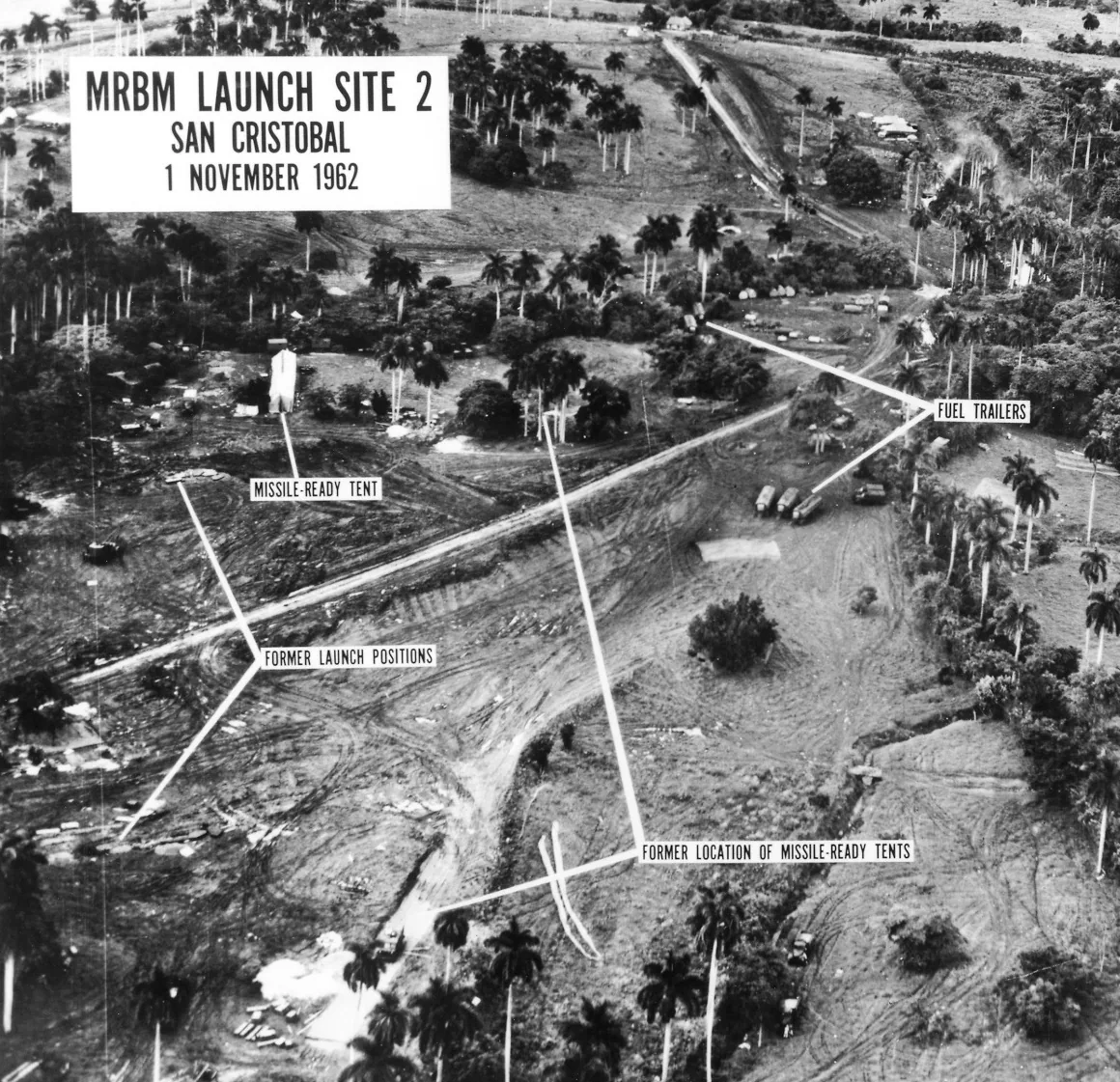
Source: U.S. reconnaissance photograph, San Cristobal, Cuba, November 1, 1962.
- Present each document.
- What promise does Kennedy make in the text?
- What does the photograph show and why was it important?
- Compare the two documents: how did Kennedy’s promise face a real test in October 1962?
- Describe how the crisis ended.
Exercise 8 : Nixon leaves office
Document 9 – Nixon, August 8, 1974
I have never been a quitter. To leave office before my term is completed is abhorrent to every instinct in my body. But as President, I must put the interests of America first. America needs a full-time President and a full-time Congress, particularly at this time with problems we face at home and abroad. To continue to fight through the months ahead for my personal vindication would almost totally absorb the time and attention of both the President and the Congress in a period when our entire focus should be on the great issues of peace abroad and prosperity without inflation at home. Therefore, I shall resign the Presidency effective at noon tomorrow.
Source: Richard M. Nixon, address to the nation announcing his decision to resign, August 8, 1974; text from the American Presidency Project, University of California, Santa Barbara.
*vindication: proof of innocence. *abhorrent: hateful.
- Present the document (nature, author, date, context).
- What reason does Nixon give for resigning?
- What does the speech not mention? Use the lesson.
- Explain two events that made his position impossible.
- What did Ford do in September 1974, and why was it controversial?
Exercise 9 : The Marshall Plan poster
Document 10 – A Marshall Plan poster
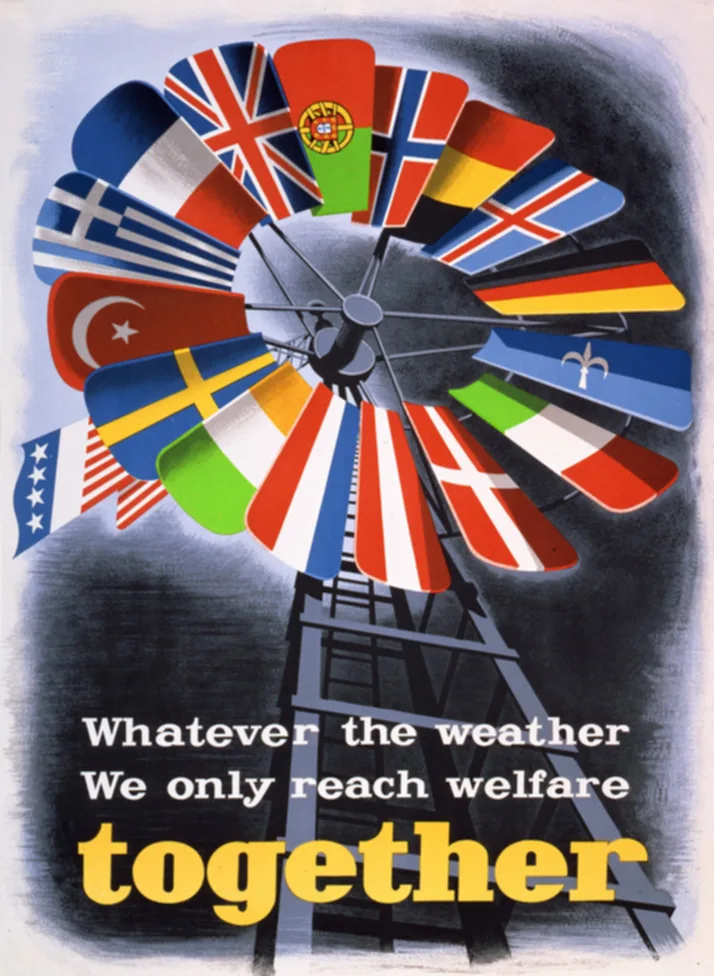
Source: E. Spreckmeester, Economic Cooperation Administration, about 1950.
- Present the document (nature, artist, date, audience).
- Describe the central image and the slogan.
- What message does the poster send about the relationship among the countries?
- Explain how the Marshall Plan served both economic and Cold War goals.
Exercise 10 : The Berlin Airlift
Document 11 – An airlift aircraft, 1948-1949
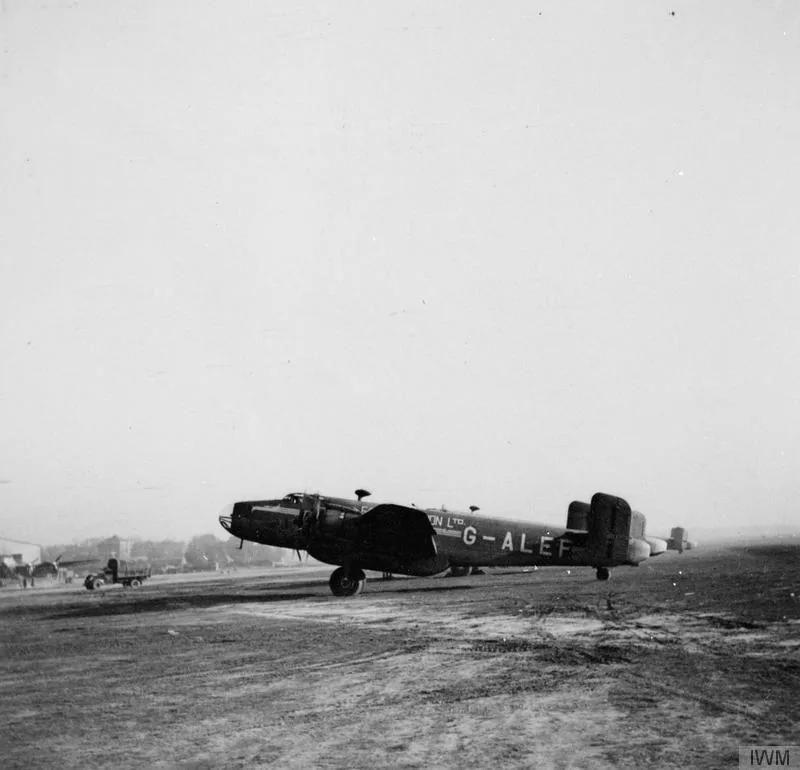
Source: Imperial War Museums, 1948-1949.
- Present the document (nature, source, date, place).
- Describe what you see.
- Why did the Soviet Union blockade Berlin in June 1948?
- Explain why the airlift counted as a Western success.
Exercise 11 : Levittown: a suburb of the 1950s
Document 12 – Levittown, Pennsylvania
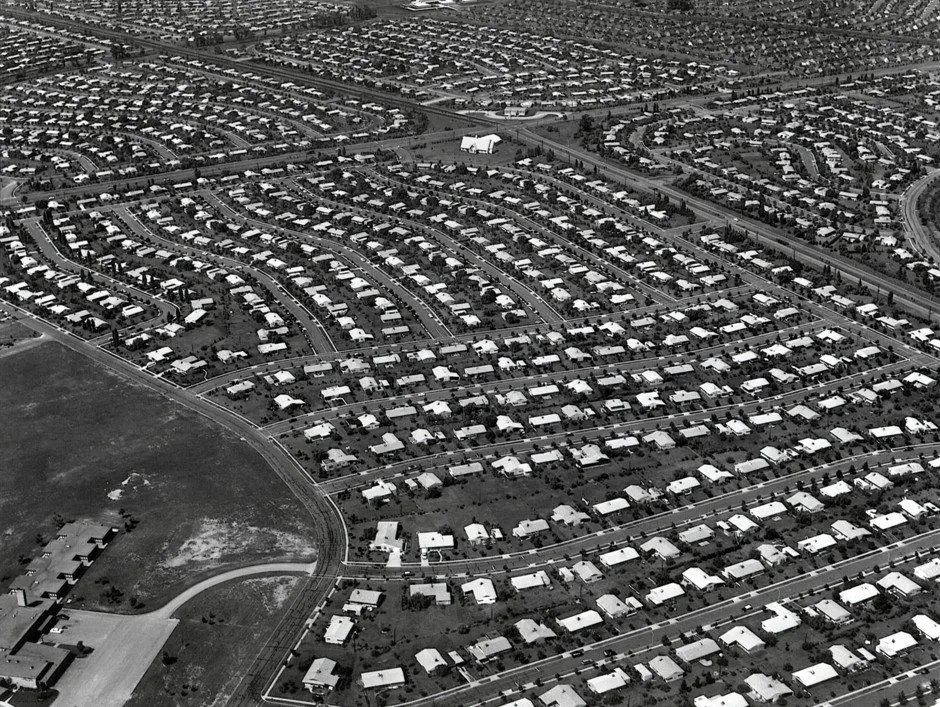
Source: aerial photograph, 1950s.
- Present the document (nature, place, date).
- Describe the pattern of the streets and houses.
- Explain two federal policies that made suburbs like this possible.
- Explain one group that was excluded and how.
Exercise 12 : Sputnik and its effects
Document 13 – A replica of Sputnik 1
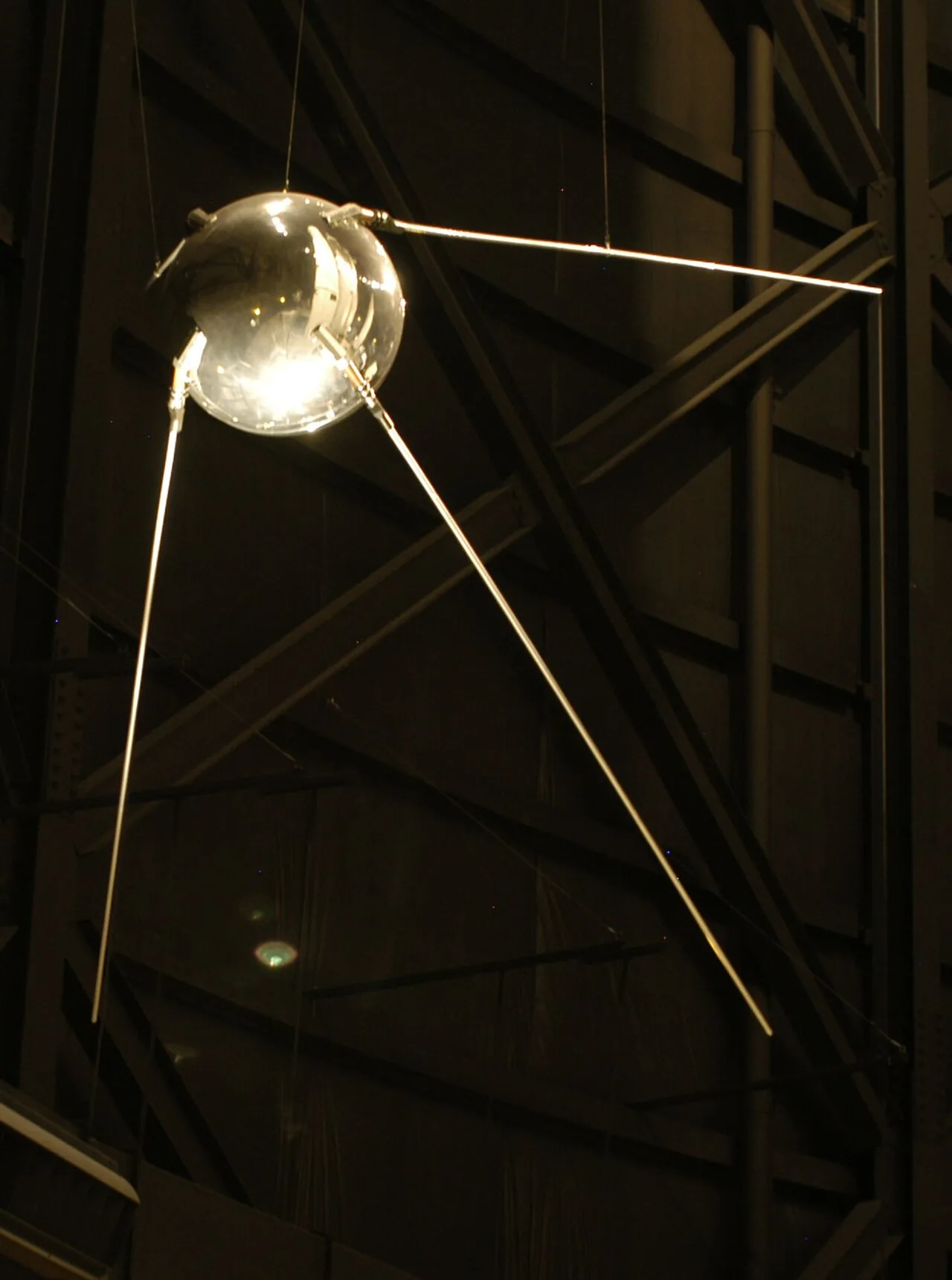
Source: U.S. Air Force photograph of a replica.
- Present the document (nature, date, subject).
- Describe the object.
- Explain why Americans were alarmed by the launch on October 4, 1957.
- Explain two American responses.
Exercise 13 : Rosa Parks and the boycott
Document 14 – Rosa Parks, 1956
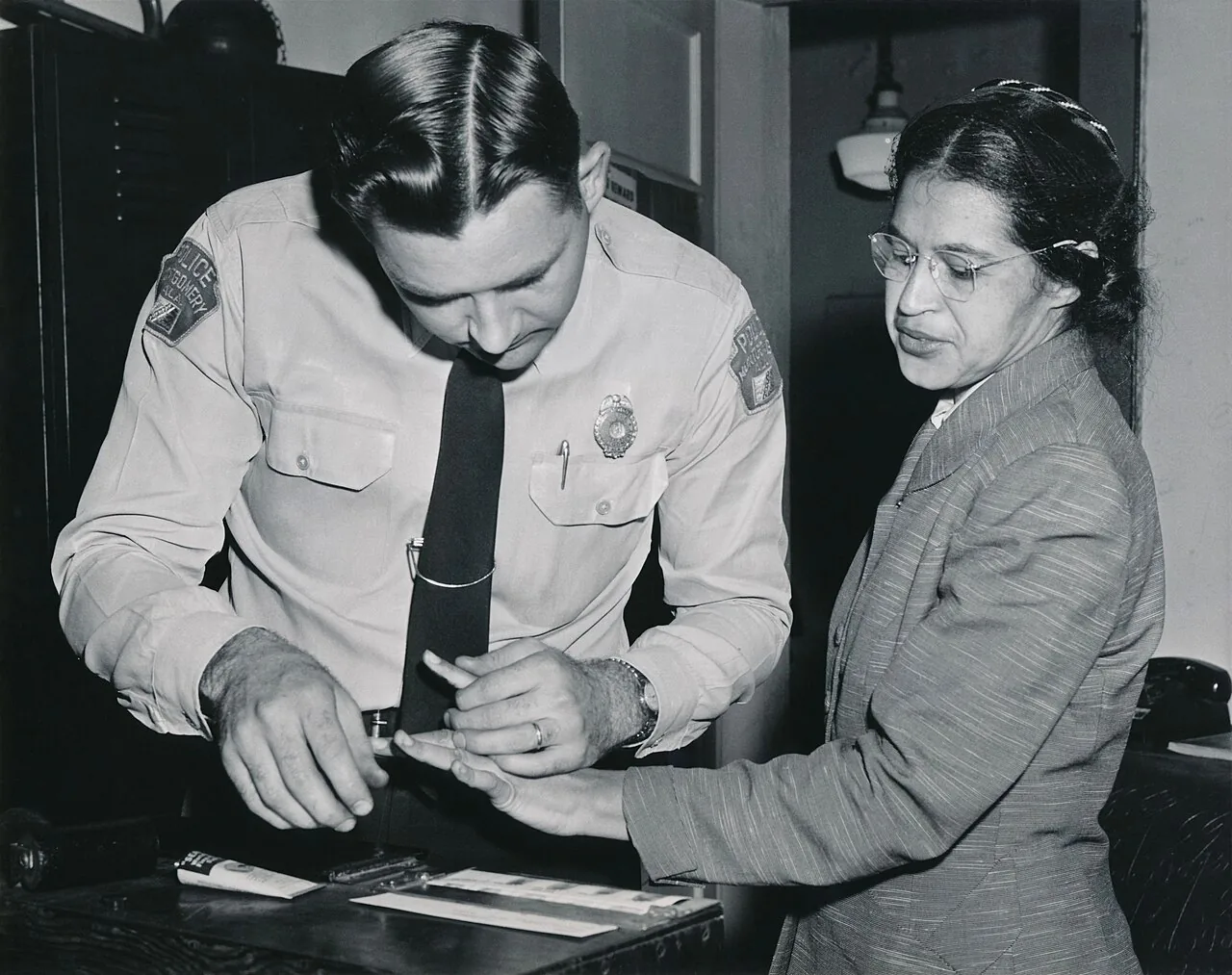
Source: photograph, February 22, 1956, Montgomery, Alabama.
- Present the document (nature, date, place, caption).
- Describe the two people and the setting.
- Explain why the date in the caption matters.
- Explain how the Montgomery bus boycott ended.
Exercise 14 : Little Rock, 1957
Document 15 – Elizabeth Eckford, September 4, 1957
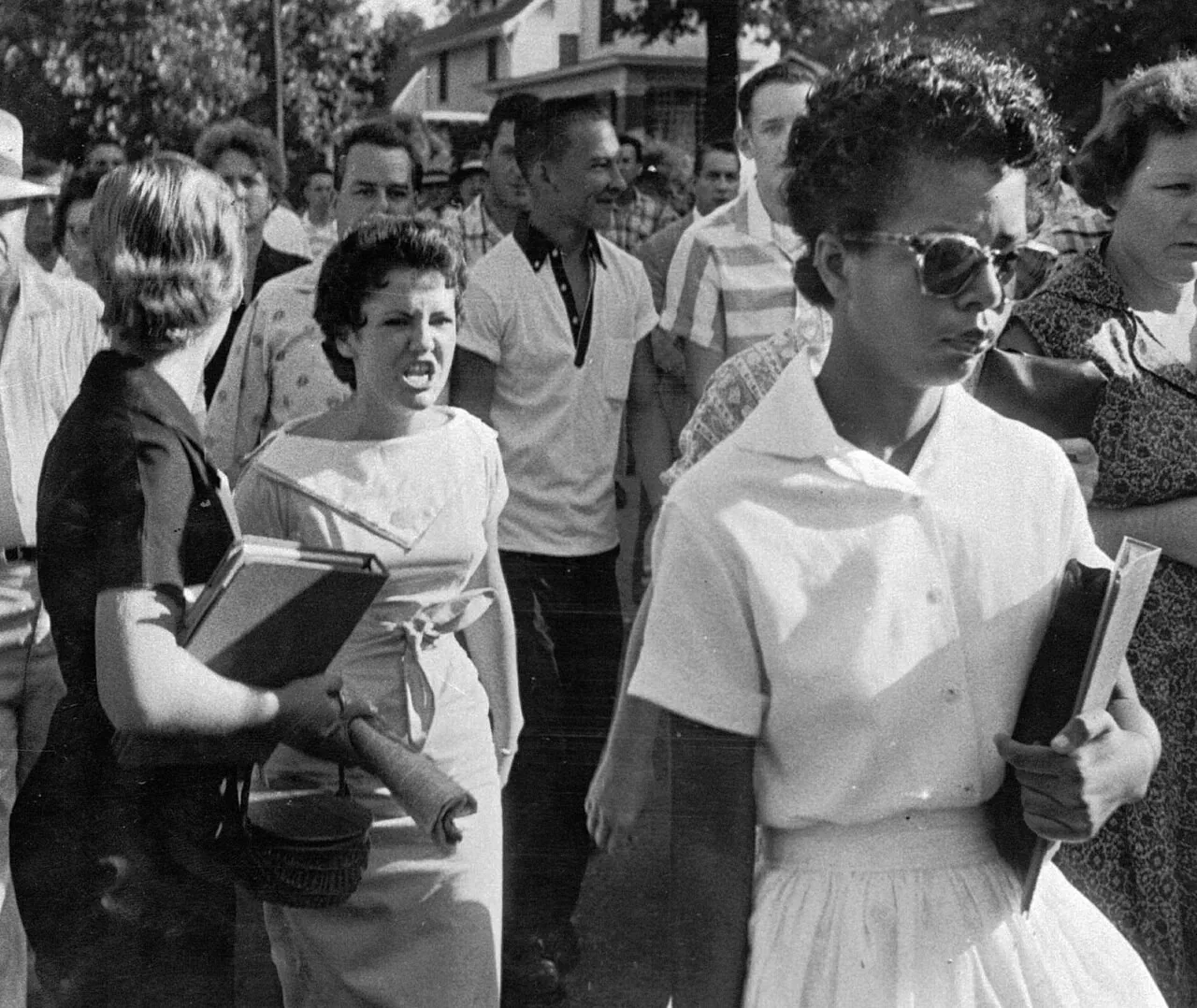
Source: Ira Wilmer Counts Jr., 1957.
- Present the document (nature, photographer, date, place).
- Describe the central figure and the crowd.
- Explain what happened at Central High School in September 1957.
- Why did the photograph have an effect on foreign opinion?
Exercise 15 : The March on Washington
Document 16 – August 28, 1963
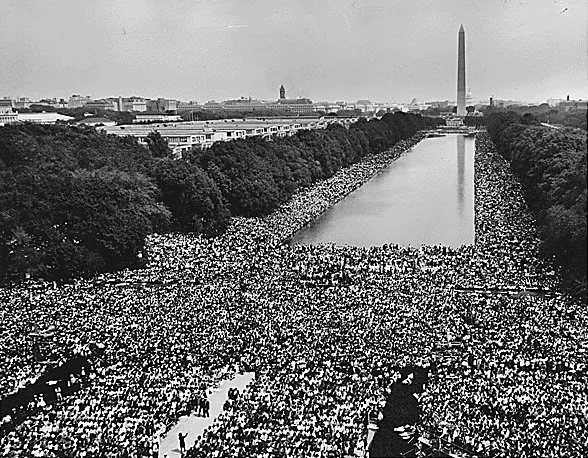
Source: U.S. Information Agency, August 28, 1963.
- Present the document (nature, source, date, place).
- Describe the scene.
- What did the organizers demand?
- Explain the effect the march had on the civil rights bill.
Exercise 16 : Marching from Selma
Document 17 – Selma to Montgomery, 1965
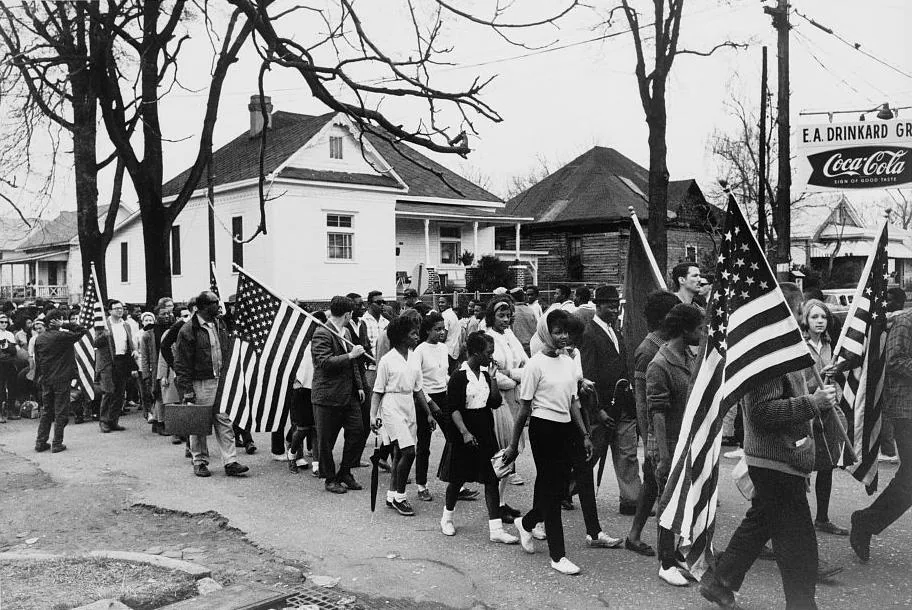
Source: Peter Pettus, March 1965, Library of Congress.
- Present the document (nature, photographer, date, place).
- Describe the people and what they carry.
- Explain why the marchers started in Selma.
- Explain the political result of the marches.
Exercise 17 : Reading the population table
Document 18 – Population of the United States
| Year | Population |
|---|---|
| 1940 | 132,164,569 |
| 1950 | 151,325,798 |
| 1960 | 179,323,175 |
| 1970 | 203,211,926 |
| 1980 | 226,545,805 |
Source: U.S. Census Bureau, decennial census.
- Calculate the increase in each decade, in millions.
- Which decade shows the largest increase?
- Explain how this fits the history of the 1950s.
- Explain one effect of the 1965 Immigration Act on the 1970s and later.
Exercise 18 : Reading Map 3: civil rights sites
- Which dot marks the city where the Supreme Court case that overturned “separate but equal” in schools began?
- Name two Alabama cities on the map.
- Which dot marks the site of the 1963 mass demonstration for jobs and freedom?
- Explain how two of the events show the use of different strategies by the movement.
Exercise 19 : Reading Map 4: the war in Vietnam
- Which line divided North and South Vietnam after 1954?
- Which dot marks the French defeat of 1954?
- Through which countries did the Ho Chi Minh Trail run, and why did this matter?
- Which dot marks the city that fell on April 30, 1975?
Exercise 20 : Sequencing 1945-1980
Put the events in order and group them as Cold War, Civil Rights, or Vietnam and Watergate.
- Gulf of Tonkin Resolution
- Brown v. Board of Education
- Berlin Airlift begins
- Voting Rights Act
- Cuban Missile Crisis
- Nixon resigns
- Sputnik launched
- Montgomery bus boycott begins
Exercise 21 : Durations and turning points
- How many years passed between the Truman Doctrine and the fall of Saigon?
- How many years separate Plessy (1896) from Brown (1954)?
- How many days did the Cuban Missile Crisis last, according to the usual count?
- Which one event do you consider the most important turning point of the period? Defend your choice in two sentences.
Exercise 22 : Guided research: the Greensboro sit-ins
Mini-inquiry: how did four students start a movement?
- Search with the keywords Greensboro sit-in 1960 Woolworth and SNCC founded 1960.
- Use reliable sites: the Smithsonian National Museum of American History, the Library of Congress, the National Archives, and the International Civil Rights Center and Museum; use Wikipedia only to find sources.
- Fill in a card: date, place, names of the four students, the demand, how the protest spread, and the outcome at the Woolworth’s counter.
- Write four sentences on why nonviolent direct action was effective.
Exercise 23 : Short answer: the Cold War at home (SAQ)
Source – Eisenhower’s farewell address, 1961
In the councils of government, we must guard against the acquisition of unwarranted influence, whether sought or unsought, by the militaryindustrial complex. The potential for the disastrous rise of misplaced power exists and will persist. We must never let the weight of this combination endanger our liberties or democratic processes. We should take nothing for granted. Only an alert and knowledgeable citizenry can compel the proper meshing of the huge industrial and military machinery of defense with our peaceful methods and goals, so that security and liberty may prosper together.
Source: Dwight D. Eisenhower, farewell address to the nation, January 17, 1961; text from the Avalon Project, Yale Law School.
Answer parts (a), (b), and (c) in complete sentences.
- (a) Identify ONE development of the 1950s that Eisenhower may have had in mind.
- (b) Explain ONE way in which the Cold War affected domestic politics in the late 1940s and 1950s.
- (c) Explain ONE way in which the Cold War affected the civil rights movement.
Exercise 24 : Stimulus-based multiple choice
Source – The Gulf of Tonkin Resolution, 1964
That the Congress approves and supports the determination of the President, as Commander in Chief, to take all necessary measures to repel any armed attack against the forces of the United States and to prevent further aggression. Section 2. The United States regards as vital to its national interest and to world peace the maintenance of international peace and security in southeast Asia. Consonant with the Constitution of the United States and the Charter of the United Nations and in accordance with its obligations under the Southeast Asia Collective Defense Treaty, the United States is, therefore, prepared, as the President determines, to take all necessary steps, including the use of armed force, to assist any member or protocol state of the Southeast Asia Collective Defense Treaty requesting assistance in defense of its freedom.
Source: Southeast Asia Resolution (Gulf of Tonkin Resolution), Public Law 88-408, August 7, 1964; text from the Avalon Project, Yale Law School.
Choose the best answer for each question.
- The resolution was passed in response to
(A) the Tet Offensive
(B) reported attacks on U.S. destroyers off North Vietnam
(C) the fall of Saigon
(D) the Cuban Missile Crisis - Which later development most directly reflected a reaction to the use of this resolution?
(A) The Twenty-fourth Amendment
(B) The War Powers Resolution of 1973
(C) The Marshall Plan
(D) The Civil Rights Act of 1964 - The resolution is best seen as an example of
(A) an increase in presidential power in foreign policy
(B) a limit on executive power
(C) a treaty with South Vietnam
(D) a declaration of war
Exercise 25 : DBQ practice: freedom and security in the Cold War
Prompt: Evaluate the extent to which the Cold War influenced the American government’s actions and American society between 1945 and 1975.
Document A – Truman, 1947
I believe that it must be the policy of the United States to support free peoples who are resisting attempted subjugation by armed minorities or by outside pressures. I believe that we must assist free peoples to work out their own destinies in their own way. I believe that our help should be primarily through economic and financial aid which is essential to economic stability and orderly political processes. […] The world is not static, and the status quo is not sacred. But we cannot allow changes in the status quo in violation of the Charter of the United Nations by such methods as coercion, or by such subterfuges as political infiltration.
Source: Harry S. Truman, address to a joint session of Congress, March 12, 1947 (the Truman Doctrine); text from the Avalon Project, Yale Law School.
Document B – Eisenhower, 1961
In the councils of government, we must guard against the acquisition of unwarranted influence, whether sought or unsought, by the militaryindustrial complex. The potential for the disastrous rise of misplaced power exists and will persist. We must never let the weight of this combination endanger our liberties or democratic processes. We should take nothing for granted. Only an alert and knowledgeable citizenry can compel the proper meshing of the huge industrial and military machinery of defense with our peaceful methods and goals, so that security and liberty may prosper together.
Source: Dwight D. Eisenhower, farewell address to the nation, January 17, 1961; text from the Avalon Project, Yale Law School.
Document C – The Gulf of Tonkin Resolution, 1964
That the Congress approves and supports the determination of the President, as Commander in Chief, to take all necessary measures to repel any armed attack against the forces of the United States and to prevent further aggression. Section 2. The United States regards as vital to its national interest and to world peace the maintenance of international peace and security in southeast Asia. Consonant with the Constitution of the United States and the Charter of the United Nations and in accordance with its obligations under the Southeast Asia Collective Defense Treaty, the United States is, therefore, prepared, as the President determines, to take all necessary steps, including the use of armed force, to assist any member or protocol state of the Southeast Asia Collective Defense Treaty requesting assistance in defense of its freedom.
Source: Southeast Asia Resolution (Gulf of Tonkin Resolution), Public Law 88-408, August 7, 1964; text from the Avalon Project, Yale Law School.
- For each document, write one sentence of sourcing (point of view or purpose and its effect on usefulness).
- Write a thesis with a line of reasoning.
- Give two pieces of outside evidence.
- Write one sentence of complexity.
Exercise 26 : LEQ practice: the civil rights movement
Prompt: Evaluate the extent to which the federal government was responsible for the success of the civil rights movement between 1948 and 1968.
- Write a thesis.
- List three pieces of evidence, each a specific fact.
- Explain how each piece supports the thesis or complicates it.
- Add a sentence that shows complexity.
Think of the courts, Congress, and presidents, but also of the movement’s own organizations and the effect of television.
Exercise 27 : Who is who? People of 1945-1980
Identify each person and give one fact about the role he or she played.
- Harry Truman
- Joseph McCarthy
- Earl Warren
- Rosa Parks
- Martin Luther King Jr.
- Lyndon Johnson
- Richard Nixon
- Jimmy Carter
Exercise 28 : True or false? Justify
Decide whether each statement is true or false and correct the false ones.
- The Marshall Plan gave economic aid to Western Europe.
- The Korean War ended with a peace treaty in 1953.
- Brown v. Board of Education (1954) was decided unanimously.
- The Civil Rights Act of 1964 came before the Voting Rights Act of 1965.
- Congress declared war on North Vietnam in 1964.
- Nixon was convicted of crimes related to Watergate and imprisoned.


Quick review: flashcards
Tap a card to see the answer.