


This Grade 7 Medieval and Early Modern World lesson covers Imperial China: Tang, Song and Ming, part of the unit “Empires and faiths.” First, read the full lesson with its primary sources, maps and key terms. Then practice with the worksheet, check yourself with the quiz and get ready with the test.
In the year 868 printers made a Buddhist scroll called the Diamond Sutra from carved wooden blocks. Its last lines say that a man named Wang Jie made it on a certain day. He made it “for universal free distribution” in honor of his parents. Someone sealed the scroll in a cave near Dunhuang. People found it there in 1900, and it is the oldest dated printed book that has survived.
More than five hundred years before Johannes Gutenberg set up his press in Germany, China already had paper, printing, gunpowder, and the compass. It also had the largest and best-organized cities in the world. During the nine centuries of Tang, Song, and Ming rule, China had one of the most advanced civilizations on Earth. Emperors ruled it, scholars ran it, and farmers fed it. Its goods, ideas, and inventions traveled across Asia and then to Europe.
Guiding question: How did the Tang, Song, and Ming dynasties govern a vast empire, and how did Chinese inventions, trade, and culture shape China and the wider world?
1. The rule of dynasties
Chinese history is often told as a series of dynasties, or ruling families. Each began when a strong leader brought order after a period of war. Then it declined when taxes became heavy, officials grew corrupt, and rebellions and invasions began. Chinese thinkers explained this cycle with the idea of the Mandate of Heaven. Heaven gave the right to rule to a just emperor and took it away from a bad one.
After the fall of the Han dynasty in 220 CE, China stayed divided for almost four hundred years. The short-lived Sui dynasty reunited it in 589. Its emperor built the first sections of the Grand Canal, which linked the Yellow River in the north with the Yangtze valley in the south. As a result, rice and troops could move by water. The Sui fell in 618, and a general who had rebelled founded the Tang.
Definition: Dynasty
A series of rulers from the same family. In China, people also use the dynasty names, such as Tang, Song, and Ming, to name periods of history.
Definition: Mandate of Heaven
The Chinese belief that Heaven gives a ruler the right to govern as long as he rules justly. People saw floods, famine, and rebellion as signs that a dynasty had lost the mandate.
2. The Tang dynasty (618-907)
A golden age
The Tang emperors ruled from Chang’an (modern Xi’an), a planned city of straight streets and walled districts. Perhaps a million people lived there, and it was the largest city in the world at that time. The second Tang emperor, Taizong (626-649), expanded the empire to the west, into the oases of Central Asia along the Silk Road. He also established a strong government of officials who passed examinations.
Under the Tang, Empress Wu Zetian became the only woman in Chinese history to rule as emperor in her own name. She ruled from 690 to 705. The empire reached its height under Emperor Xuanzong (712-756), who built up a brilliant court of poets and musicians. In 755 the general An Lushan rebelled, and the eight-year civil war that followed weakened the dynasty. Local military governors became powerful, and in 907 they removed the last Tang emperor.
The Tang was a cosmopolitan age. Merchants from Persia, Central Asia, and Arabia lived in Chang’an, and the Tang allowed foreign faiths to build temples. Buddhism, which had come from India, became very popular. The monk Xuanzang traveled to India in 629-645 and brought back hundreds of scriptures. The emperor welcomed a priest of the Church of the East, who came in 635.
Document 1 – A foreign religion in Chang’an
In the year of our Lord 635 he arrived at Chang-an; the Emperor sent his Prime Minister, Duke Fang Hiuen-ling; who, carrying the official staff to the west border, conducted his guest into the interior; the sacred books were translated in the imperial library, the sovereign investigated the subject in his private apartments; when becoming deeply impressed with the rectitude and truth of the religion, he gave special orders for its dissemination.
Source: the Nestorian Tablet (Xi’an stele), set up in the Tang capital in 781 CE by a priest of the Church of the East, on the arrival of the Syrian priest Olopun in 635; English translation in Charles F. Horne, ed., The Sacred Books and Early Literature of the East, vol. XII (1917), Internet East Asian History Sourcebook, Fordham University.
*Chang-an: Chang’an, the Tang capital (now Xi’an). *the Emperor: Taizong (626-649). *dissemination: spreading.
Commentary. The Nestorian Tablet is a stone slab about ten feet high. It dates from 781, and people found it near Xi’an in the 17th century. Christians of the Church of the East set it up. They wanted to tell the story of their welcome in China. The text suggests that the Tang emperor was curious about foreign ideas and allowed them to spread. But believers wrote it, so it presents events in a favorable light. The tablet also records an imperial edict, and historians treat it as evidence of the openness of Tang China.
Poetry, printing, and invention
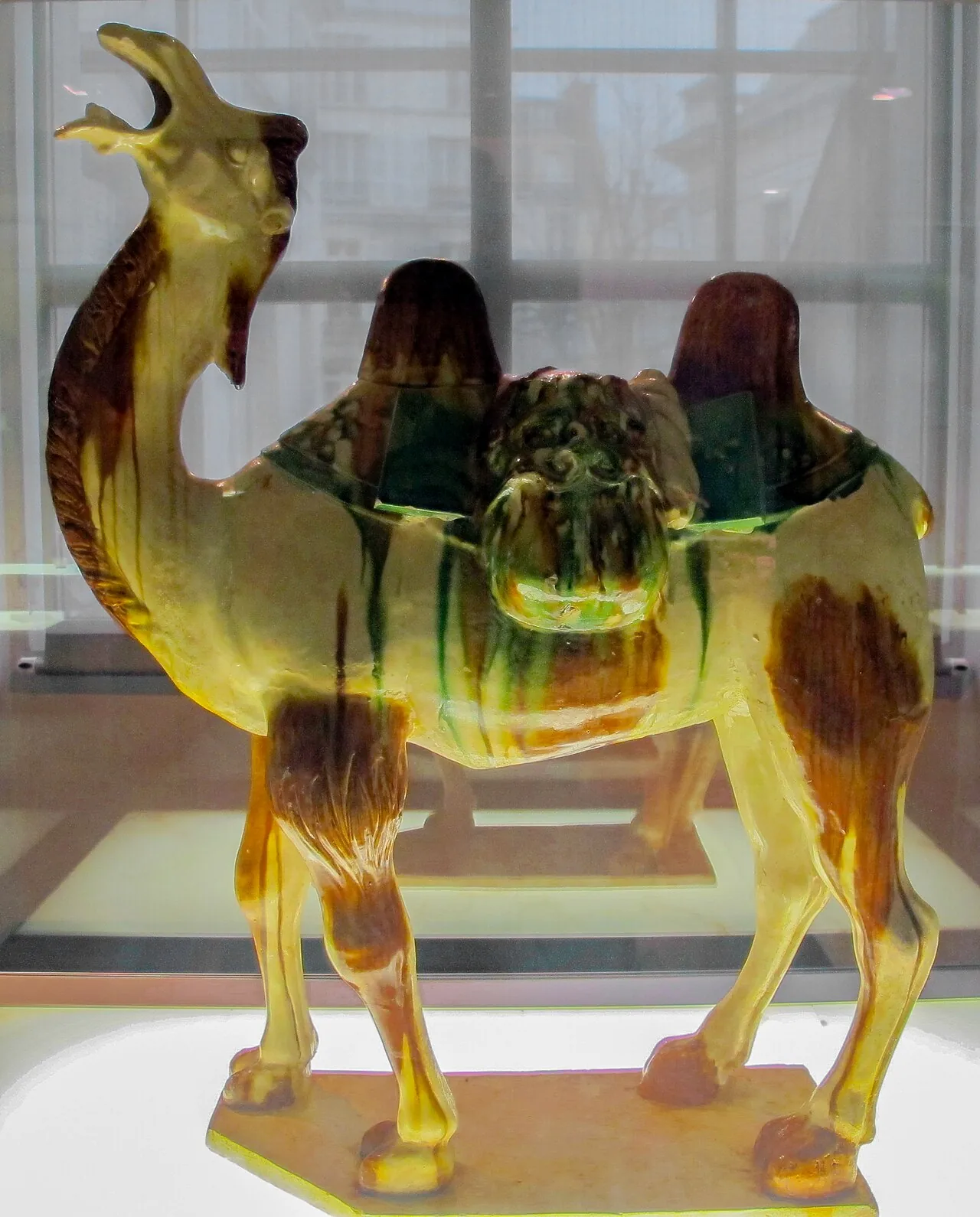
The Tang is remembered as the age of poetry. Li Bai (701-762) wrote wild and imaginative poems about wine, the moon, and friendship. Du Fu (712-770) wrote about the suffering of ordinary people in war. Thousands of Tang poems survive, and educated Chinese people still memorize many of them. Tang artists made sculptures of horses and camels. Potters invented porcelain, a hard, thin, glass-like pottery, and it became the great Chinese export. Printers used carved wooden blocks to make Buddhist texts and calendars, and tea became a favorite drink. Alchemists who were looking for a medicine of immortality found an explosive mixture of saltpeter, sulfur, and charcoal. We call it gunpowder.
Document 2 – A Tang poem
While my hair was still cut straight across my forehead
I played about the front gate, pulling flowers.
You came by on bamboo stilts, playing horse;
You walked about my seat, playing with blue plums.
And we went on living in the village of Chokan:
Two small people, without dislike or suspicion.
At fourteen I married My Lord you.
I never laughed, being bashful.
Lowering my head, I looked at the wall.
Called to, a thousand times, I never looked back.
At fifteen I stopped scowling,
I desired my dust to be mingled with yours
Forever and forever and forever.
…
At sixteen you departed,
You went into far Ku-to-en, by the river of swirling eddies,
And you have been gone five months.
Source: Li Bai (Li Po, 701-762), The River-Merchant’s Wife: A Letter (Tang dynasty poem, originally Changgan xing), translated by Ezra Pound in Cathay (1915), from the notes of Ernest Fenollosa; text from Wikisource.
*Chokan: Changgan, a village near the Yangtze River. *My Lord: a polite way for a wife to address her husband. *Ku-to-en: Qutang, a dangerous gorge on the Yangtze.
Commentary. Li Bai wrote this poem in the form of a letter from the wife of a merchant who travels far up the Yangtze River. Her voice tells the story of her life from childhood to marriage and shows how trade separated families. The American poet Ezra Pound made the translation in 1915 from rough notes. It is a free version, so the details of the Chinese words are different. The poem is valuable because it shows the life of a merchant family and the importance of river trade.
3. The Song dynasty (960-1279)
Reunification and civil government
After more than fifty years of division, General Zhao Kuangyin took the throne in 960 and founded the Song dynasty. Its capital was at Kaifeng on the Yellow River plain. The Song emperors were determined to keep generals from seizing power. They put civil officials in charge of the army and made the civil service examination the main road to office. Candidates studied the Confucian classics, The examination had several levels, and copying the papers kept the examiner from knowing the identity of the writer.
A farmer’s son who passed could become a high official, In reality, however, most candidates came from families that could afford years of schooling. Song thinkers, such as Zhu Xi (1130-1200), combined Confucian ideas with Buddhist and Daoist ideas in a movement called Neo-Confucianism. It later shaped the exams and the thinking of educated Chinese for centuries.
Definition: Civil service examination
A system of tests on the Confucian classics and on government, used to select officials. Expanded under the Tang and Song, it made scholars, and not nobles or generals, the leaders of Chinese government.
An economic revolution
The Song period saw one of the great leaps in economic history. A fast-ripening rice from Vietnam (called Champa rice) reached China in the early 11th century. It allowed two harvests a year in the south. The population grew to about 100 million. Iron and steel production rose, and Chinese ironworkers used coal and large bellows. Bi Sheng invented movable type printing about 1040, making characters from baked clay, and printed books became common.
Navigators began to use the magnetic compass, and armies used gunpowder in fire arrows, bombs, and early guns. Merchants in Sichuan began to use paper money, and in the 1020s the government started to issue it. Overseas trade grew in the ports of Quanzhou and Guangzhou. Large Chinese ships with watertight compartments carried silk, porcelain, and tea to Southeast Asia, India, and the Middle East.
Document 3 – A city of the Song
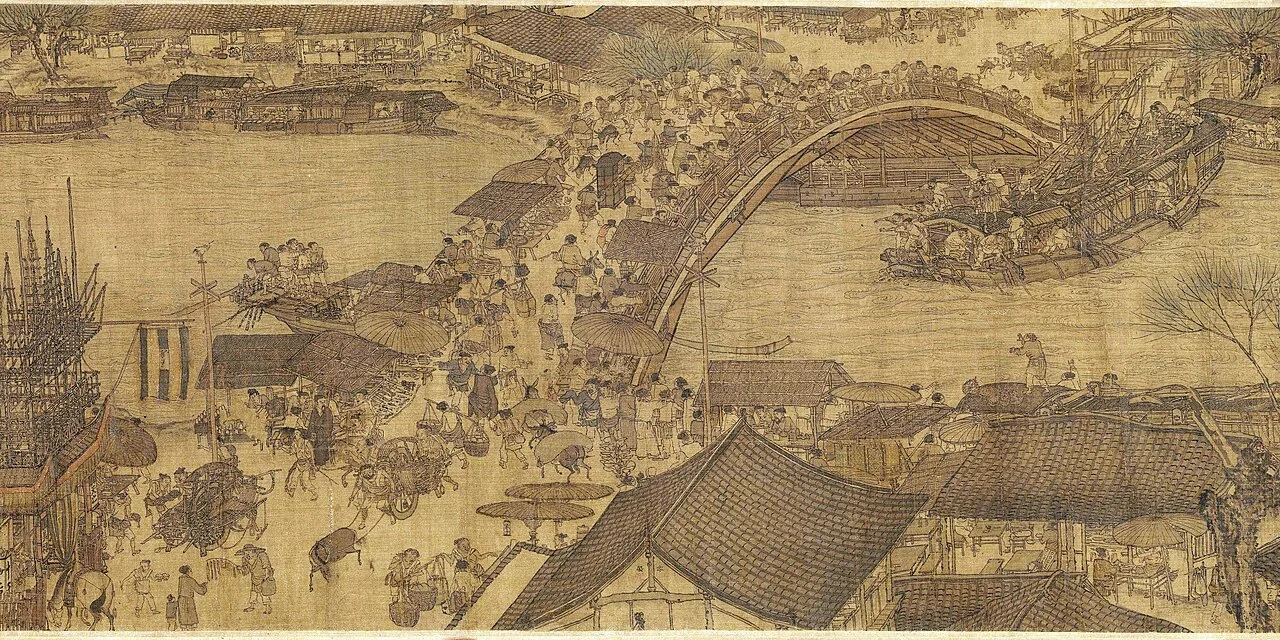
Source: handscroll attributed to Zhang Zeduan, Northern Song, early 12th century; Palace Museum, Beijing; reproduction, Wikimedia Commons.
Commentary. The scroll, nearly 17 feet long, shows people of all classes on the streets, canal boats, shops, and a famous arched bridge. A court artist painted it, so it presents an ideal view of a prosperous capital. But it is full of details about daily life that official histories leave out. It shows that Song cities had a lively commercial life. Markets and shops were open even in the evening.
The Song dynasty was a time of military weakness. The Song emperors paid tribute to the northern neighbors, the Liao and the Western Xia. In 1127 the Jurchen, from Manchuria, captured Kaifeng and took two emperors prisoner. A prince escaped to the south and re-established the dynasty in Hangzhou, which began the Southern Song (1127-1279). From there the Song continued to flourish in trade and the arts until 1279. Then the Mongols under Kublai Khan completed the conquest and founded the Yuan dynasty. The Venetian traveler Marco Polo, who visited China in the late 13th century, described Hangzhou, which he called Kinsay.
Document 4 – The city of Hangzhou
First and foremost, then, the document stated the city of Kinsay to be so great that it hath an hundred miles of compass. And there are in it twelve thousand bridges of stone, for the most part so lofty that a great fleet could pass beneath them. […] Inside the city there is a Lake which has a compass of some 30 miles and all round it are erected beautiful palaces and mansions, of the richest and most exquisite structure that you can imagine, belonging to the nobles of the city.
Source: Marco Polo, The Travels, about 1298, on Kinsay (Hangzhou), capital of the Southern Song until 1276; translated by Henry Yule, The Book of Ser Marco Polo, 3rd ed. revised by Henri Cordier (London, 1903), vol. II; editorial notes omitted; Internet Medieval Sourcebook, Fordham University.
*Kinsay: Hangzhou. *compass: circuit, circumference. *edifice: building.
Commentary. Marco Polo says he is quoting a written report. The queen of the defeated Song had sent it to the Mongol conqueror. He admired the city, with its stone bridges and its lake surrounded by palaces. His figures are almost certainly exaggerated (the circuit of a hundred miles and twelve thousand bridges). Some scholars even doubt that he went to China at all. But descriptions by Chinese writers agree that Hangzhou was a very large and rich city.
4. The Ming dynasty (1368-1644)
A peasant becomes emperor
The Mongol Yuan dynasty ruled China from 1271 to 1368, and then floods, famines, and uprisings weakened it. A peasant-born rebel leader named Zhu Yuanzhang, who had once been a beggar and a Buddhist novice, defeated rival armies and drove the Mongols out. In 1368 he took the title of the Hongwu emperor and founded the Ming (“bright”) dynasty. Its capital was at Nanjing. He rebuilt the economy by resettling farmers, repairing irrigation, and planting millions of trees. He was also a harsh ruler who punished officials severely and took power away from the chief ministers.
Document 5 – The first Ming emperor announces his rule
Since the Sung dynasty had lost the throne and Heaven had cut off their sacrifice, the Yuan [Mongol] dynasty had risen from the desert to enter and rule over Zhongguo [China] for more than a hundred years, when Heaven, wearied of their misgovernment and debauchery, thought also fit to turn their fate to ruin, and the affairs of Zhongguo were in a state of disorder for eighteen years. […] We have, in the west, subdued the king of Han, Ch’en Yu-liang; We have, in the east, bound the king of Wu, Chang Shih-ch’eng; We have, in the south, subdued Min and Yueh [Fukien and Kuang-tung], and conquered Pa and Shu [Sze-chuan]; We have, in the north, established order in Yu and Yen [Chih-li]; We have established peace in the Empire, and restored the old boundaries of Zhongguo.
Source: Manifesto of the Hongwu emperor (Zhu Yuanzhang), the first Ming emperor, sent to the Byzantine emperor in 1372; translated by Friedrich Hirth, China and the Roman Orient (Shanghai and Hong Kong, 1885), as edited in the Internet East Asian History Sourcebook, Fordham University.
*Sung: Song. *Zhongguo: the “Middle Kingdom,” China. *debauchery: wicked and wasteful living. *Yuan: the Mongol dynasty.
Commentary. A European priest carried this letter in 1372 to the Byzantine emperor, whom the Chinese called “Fu-lin.” The emperor describes the end of Mongol rule as the will of Heaven, and he calls himself a peasant who has become the ruler of China. The text shows how the first Ming emperor used the idea of the Mandate of Heaven to explain his success. It also told foreign rulers of the new dynasty.
Beijing, the Forbidden City, and the Great Wall
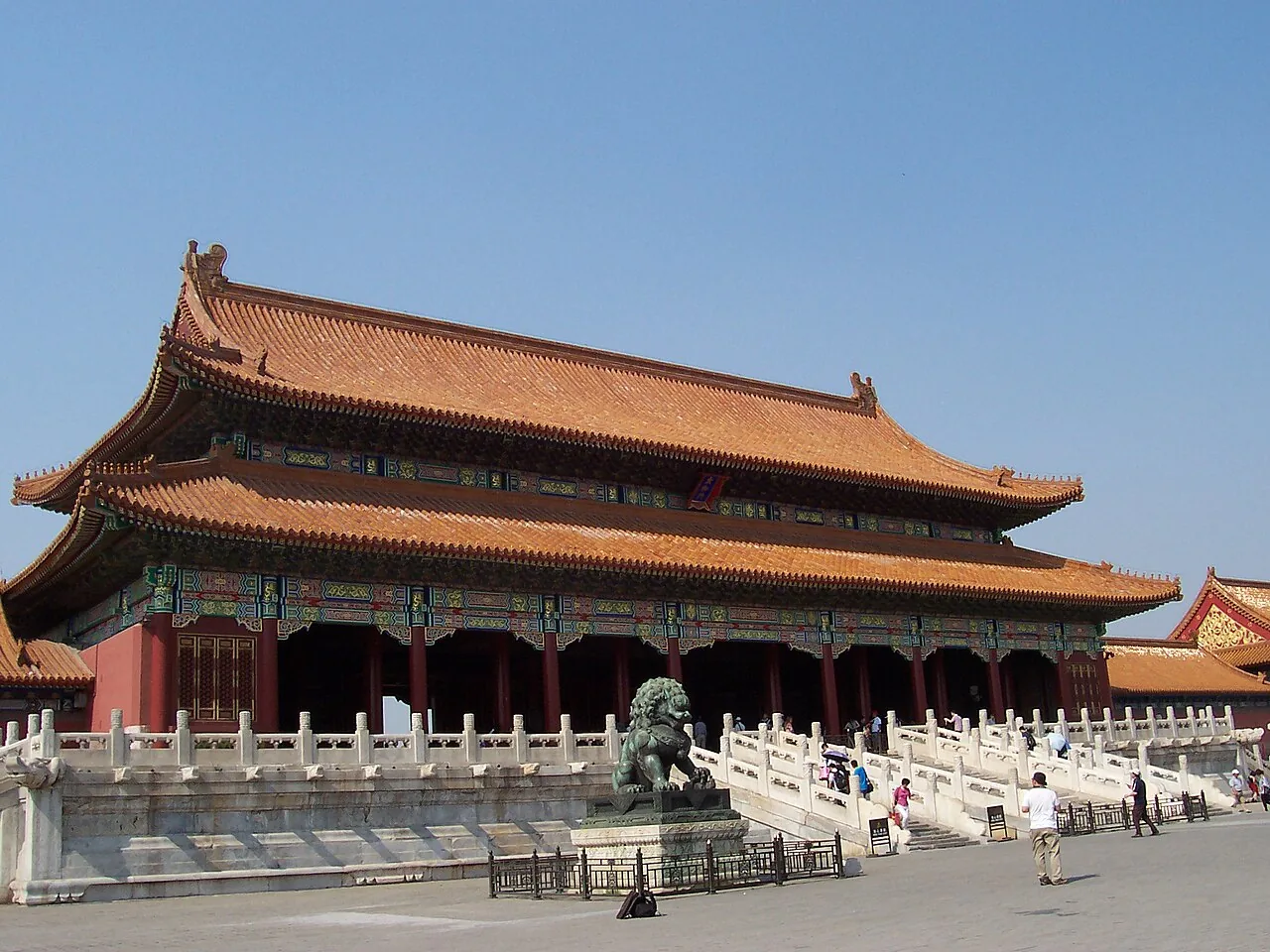
The Hongwu emperor’s son, Yongle (1402-1424), took the throne from his nephew by force. He moved the capital north to Beijing, near the frontier with the Mongols. In 1406-1420 he built the Forbidden City, an enormous palace of halls, courtyards, and gardens, covering about 180 acres. Ordinary people could not enter it. He also ordered the compilation of the Yongle Encyclopedia, which gathered thousands of works. He repaired the Grand Canal, so that grain from the south could reach the capital. Later Ming emperors fought the Mongols by rebuilding and extending the Great Wall in brick and stone. Most of the wall visible today dates from the Ming.
The voyages of Zheng He
Yongle also sent great fleets overseas. Between 1405 and 1433 the admiral Zheng He, a Muslim eunuch from Yunnan who had served the emperor, led seven expeditions. They went to Southeast Asia, India, the Persian Gulf, and the east coast of Africa. According to Chinese records, the first fleet had more than sixty large “treasure ships” and about 28,000 men. Historians debate the exact size of the ships, but they were much larger than any European ship of that time. The fleets carried silk, porcelain, and tea. They brought back gifts, spices, and exotic animals such as giraffes. They also persuaded many rulers to send tribute to China. The goal was prestige and trade, and not conquest or settlement.
After Yongle died, the government halted the voyages. The expeditions were costly, and the Confucian officials at court thought them wasteful. The Mongol threat on the northern frontier also worried the government more. In 1433 the last voyage ended. In the following century Portuguese and other Europeans reached the coast of China in smaller ships.
Porcelain, silver, and decline
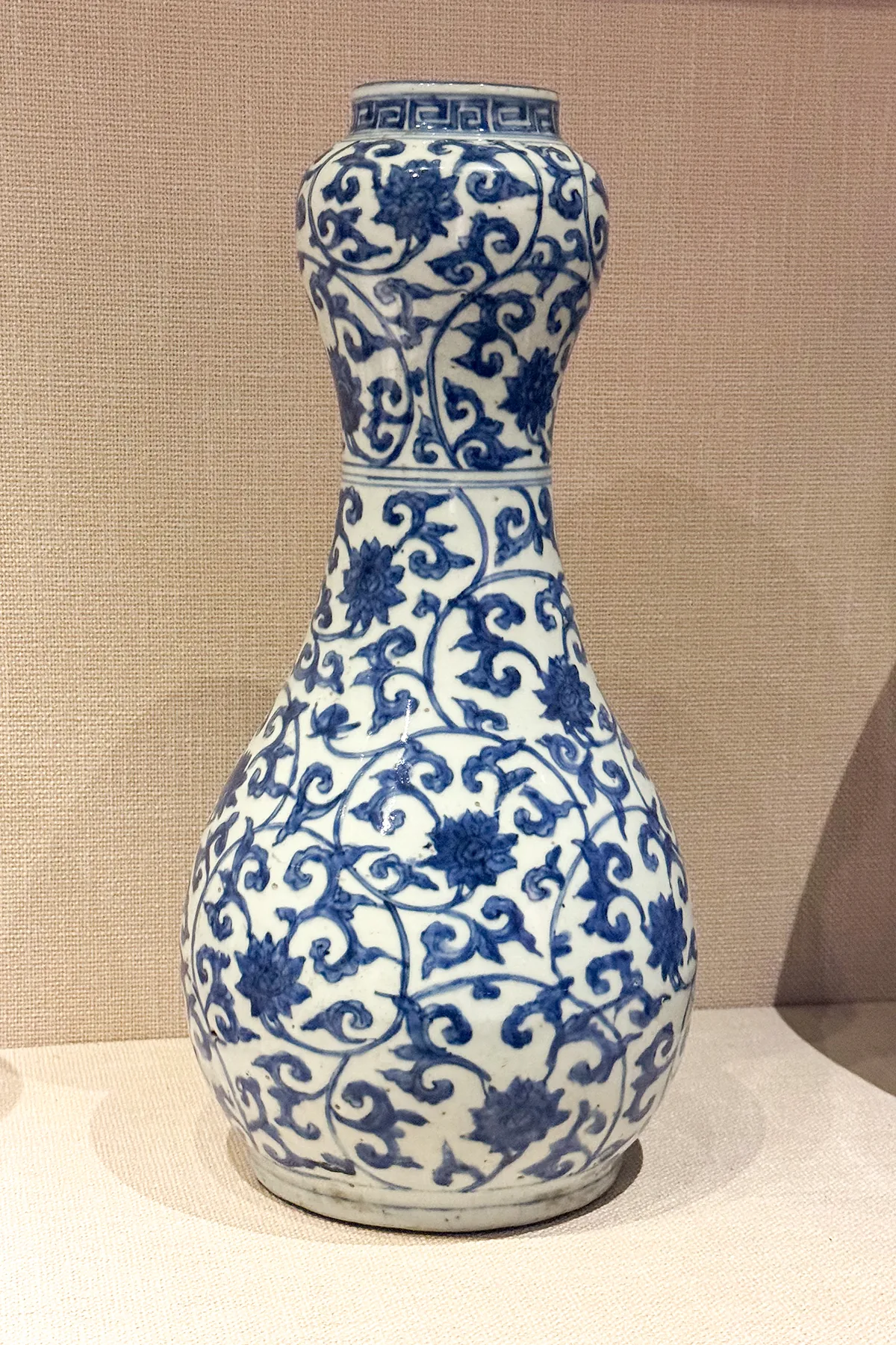
Ming craftsmen made the famous blue-and-white porcelain, decorated with cobalt-blue designs, in the great kilns of Jingdezhen. Merchants exported it across Asia and to Europe. After about 1570, silver from Spanish America and Japan flowed into China in exchange for silk and porcelain, and the economy became more commercial. But in the 17th century the dynasty declined. Emperors withdrew from government, eunuchs and officials fought each other, taxes rose, and floods and famine caused rebellions. In 1644 the rebel leader Li Zicheng captured Beijing, and the last Ming emperor hanged himself. Then the Manchus from the northeast entered the capital and founded the Qing dynasty.
5. Society and ideas
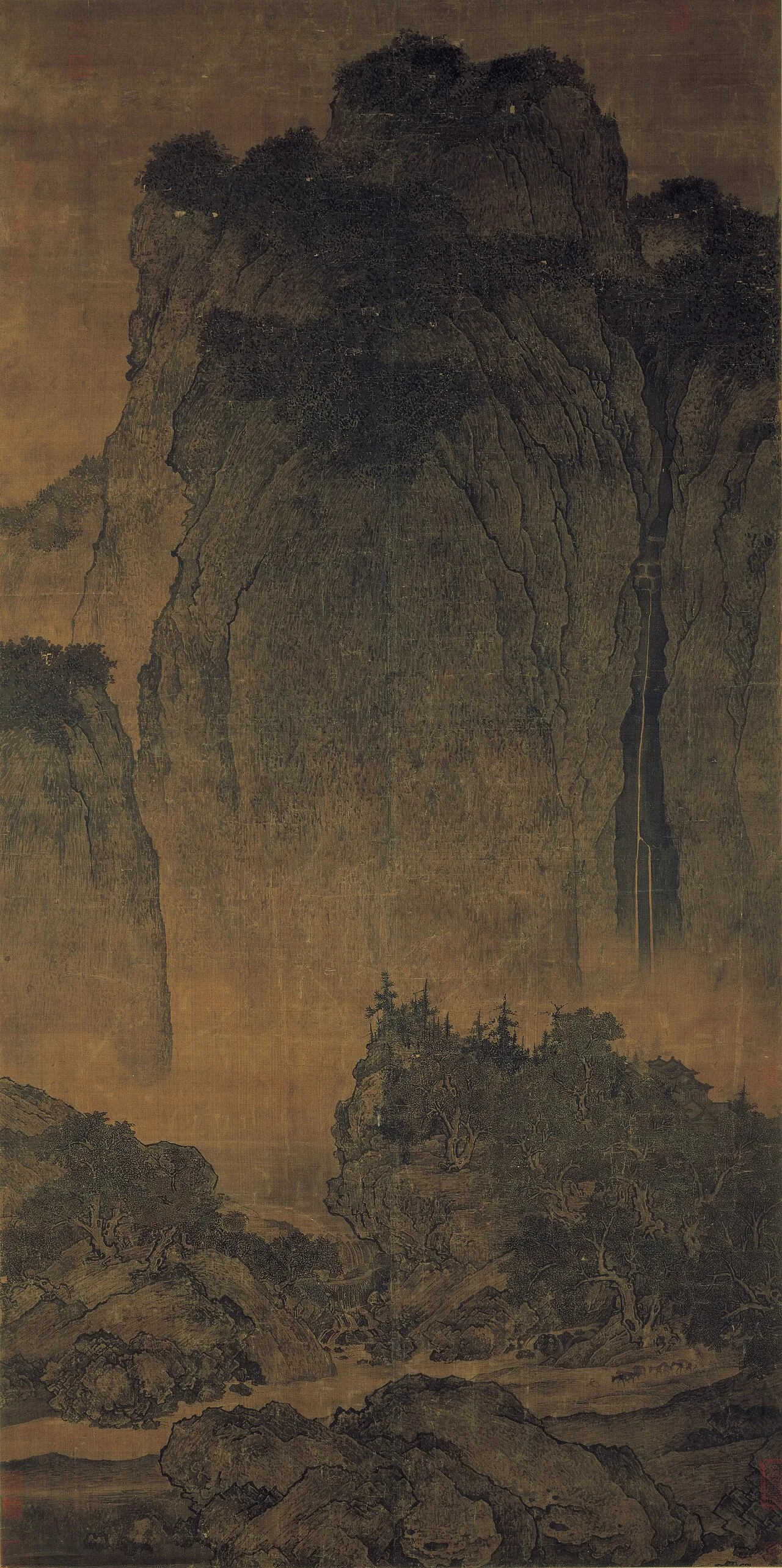
The ideas of Confucius, a thinker who lived about 500 BCE, organized Chinese society. He taught that a stable society depends on respect, duty, and good example. Children owed obedience to their parents, wives to husbands, and subjects to the ruler. The ruler had to care for the people. Society had four groups: scholars, farmers, artisans, and merchants. Scholars had the highest rank, and merchants the lowest, even though some became very rich. Most people were peasants who rented or owned small plots of land and paid taxes in grain, silver, and labor. Buddhism and Daoism also shaped belief and art. Song painters made landscapes in which mountains and mist dwarf small human figures.
These dynasties had a lasting effect on the world. Chinese paper, printing, gunpowder, and the compass spread across Eurasia, often through the Muslim world and the Mongol empire. They changed warfare, learning, and navigation in Europe. Chinese silk, tea, and porcelain became sought-after goods. Later, Europeans who built their own civil services studied China’s system of choosing officials by examination.
- 589 The Sui dynasty reunifies China
- 618 The Tang dynasty begins
- 690-705 Wu Zetian rules as emperor
- 868 The oldest dated printed book is made
- 907 The Tang dynasty ends
- 960 The Song dynasty begins
- 1127 The Jurchen capture Kaifeng; the Southern Song begins
- 1279 The Mongols complete the conquest of the Song
- 1368 The Ming dynasty begins
- 1405-1433 The voyages of Zheng He
- 1420 The Forbidden City is finished
- 1644 The Ming dynasty ends
Key takeaways
- Chinese dynasties rose and fell in a cycle explained by the Mandate of Heaven.
- The Tang (618-907) was a cosmopolitan golden age of poetry, trade on the Silk Road, and a great capital at Chang’an.
- The Song (960-1279) had a flourishing economy, civil service examinations, and inventions such as movable type, the compass, gunpowder weapons, and paper money.
- The Ming (1368-1644) rebuilt China after the Mongols, built the Forbidden City in Beijing, rebuilt the Great Wall, and sent Zheng He’s fleets overseas from 1405 to 1433.
- Confucian ideas and the examination system shaped society and government.
- Chinese inventions and goods, such as paper, printing, gunpowder, the compass, silk, and porcelain, changed the wider world.

Quick review: flashcards
Tap a card to see the answer.