


This worksheet on Imperial China: Tang, Song and Ming belongs to the Grade 7 Medieval and Early Modern World course. Its questions use primary sources, maps and timelines, and they move from basic recall to short writing tasks. Before you start, review the lesson; afterward, try the true or false quiz.
Exercise 1 : Vocabulary of imperial China
Match each term to its meaning, then use three of the terms in sentences of your own.
- Dynasty
- Mandate of Heaven
- Civil service examination
- Grand Canal
- Porcelain
- Silk Road
Meanings: (a) a test for choosing government officials; (b) a family of rulers; (c) the belief that Heaven gives a just ruler the right to rule; (d) trade routes between China and the West; (e) a hard, fine pottery made in China; (f) a waterway linking northern and southern China.
Exercise 2 : The arrival of a foreign faith
Document 1 – A foreign religion in Chang’an
In the year of our Lord 635 he arrived at Chang-an; the Emperor sent his Prime Minister, Duke Fang Hiuen-ling; who, carrying the official staff to the west border, conducted his guest into the interior; the sacred books were translated in the imperial library, the sovereign investigated the subject in his private apartments; when becoming deeply impressed with the rectitude and truth of the religion, he gave special orders for its dissemination.
Source: the Nestorian Tablet (Xi’an stele), set up in the Tang capital in 781 CE by a priest of the Church of the East, on the arrival of the Syrian priest Olopun in 635; English translation in Charles F. Horne, ed., The Sacred Books and Early Literature of the East, vol. XII (1917), Internet East Asian History Sourcebook, Fordham University.
*Chang-an: Chang’an, the Tang capital (now Xi’an). *the Emperor: Taizong (626-649). *dissemination: spreading.
- Present the document (nature, author, date, context). Who wrote the tablet?
- Who was Olopun, and when did he arrive?
- How did the emperor treat him?
- What did the emperor do after he studied the religion?
- Why must a historian be careful with a text written by believers?
Exercise 3 : An edict of tolerance
Document 1 – The edict of 638
Right principles have no invariable name, holy men have no invariable station; instruction is established in accordance with the locality, with the object of benefiting the people at large. The greatly virtuous Olopun, of the kingdom of Syria, has brought his sacred books and images from that distant part, and has presented them at our chief capital. Having examined the principles of this religion, we find them to be purely excellent and natural; investigating its originating source, we find it has taken its rise from the establishment of important truths; its ritual is free from perplexing expressions, its principles will survive when the framework is forgot; it is beneficial to all creatures; it is advantageous to mankind. Let it be published throughout the Empire, and let the proper authority build a Syrian church in the capital
Source: imperial edict of 638 CE as quoted on the Nestorian Tablet (781 CE); English translation in Charles F. Horne, ed., The Sacred Books and Early Literature of the East, vol. XII (1917), Internet East Asian History Sourcebook, Fordham University.
*invariable: unchanging. *Syrian church: here, a church of the Church of the East (Nestorian Christians). *rectitude: moral correctness.
- Present the document (nature, date, context).
- What reason does the edict give for allowing the new religion?
- What does it order the authorities to build?
- What does the edict show about the attitude of the Tang government toward foreign religions?
- Why is it valuable to find this edict in a text written by foreigners?
Exercise 4 : A poem of the Yangtze
Document 1 – A Tang poem
While my hair was still cut straight across my forehead
I played about the front gate, pulling flowers.
You came by on bamboo stilts, playing horse;
You walked about my seat, playing with blue plums.
And we went on living in the village of Chokan:
Two small people, without dislike or suspicion.
At fourteen I married My Lord you.
I never laughed, being bashful.
Lowering my head, I looked at the wall.
Called to, a thousand times, I never looked back.
At fifteen I stopped scowling,
I desired my dust to be mingled with yours
Forever and forever and forever.
…
At sixteen you departed,
You went into far Ku-to-en, by the river of swirling eddies,
And you have been gone five months.
Source: Li Bai (Li Po, 701-762), The River-Merchant’s Wife: A Letter (Tang dynasty poem, originally Changgan xing), translated by Ezra Pound in Cathay (1915), from the notes of Ernest Fenollosa; text from Wikisource.
*Chokan: Changgan, a village near the Yangtze River. *My Lord: a polite way for a wife to address her husband. *Ku-to-en: Qutang, a dangerous gorge on the Yangtze.
- Present the document (nature, author, date, translator). Why does the translator matter?
- Who is speaking in the poem?
- Describe the stages of her life that the poem mentions.
- What does the poem tell us about the life of merchant families?
- Why can a poem be a useful source for a historian?
Exercise 5 : The greatest city in the world?
Document 1 – The city of Hangzhou
First and foremost, then, the document stated the city of Kinsay to be so great that it hath an hundred miles of compass. And there are in it twelve thousand bridges of stone, for the most part so lofty that a great fleet could pass beneath them. […] Inside the city there is a Lake which has a compass of some 30 miles and all round it are erected beautiful palaces and mansions, of the richest and most exquisite structure that you can imagine, belonging to the nobles of the city.
Source: Marco Polo, The Travels, about 1298, on Kinsay (Hangzhou), capital of the Southern Song until 1276; translated by Henry Yule, The Book of Ser Marco Polo, 3rd ed. revised by Henri Cordier (London, 1903), vol. II; editorial notes omitted; Internet Medieval Sourcebook, Fordham University.
*Kinsay: Hangzhou. *compass: circuit, circumference. *edifice: building.
- Present the document (nature, author, date, context).
- What does Marco Polo say about the size of the city?
- Which feature of the city does he describe in the center?
- What reasons do you have to doubt some of his figures?
- How could you check his report?
Exercise 6 : Silk and fire
Document 1 – Life in Hangzhou
The houses of the city are provided with lofty towers of stone in which articles of value are stored for fear of fire; for most of the houses themselves are of timber, and fires are very frequent in the city. […] Both men and women are fair and comely, and for the most part clothe themselves in silk, so vast is the supply of that material, both from the whole district of Kinsay, and from the imports by traders from other provinces.
Source: Marco Polo, The Travels, about 1298, on Kinsay (Hangzhou); translated by Henry Yule, revised by Henri Cordier (London, 1903), vol. II, Internet Medieval Sourcebook, Fordham University.
*Idolaters: Marco Polo’s word for people who were not Christians, Jews, or Muslims. *comely: attractive. *timber: wood.
- Present the document (nature, author, date, context).
- Why do the houses of the city have stone towers?
- What do people wear, and why is silk so common?
- What does the text suggest about trade in Hangzhou?
- Which sentence could a historian check against Chinese sources?
Exercise 7 : A peasant becomes emperor
Document 1 – The first Ming emperor
Since the Sung dynasty had lost the throne and Heaven had cut off their sacrifice, the Yuan [Mongol] dynasty had risen from the desert to enter and rule over Zhongguo [China] for more than a hundred years, when Heaven, wearied of their misgovernment and debauchery, thought also fit to turn their fate to ruin, and the affairs of Zhongguo were in a state of disorder for eighteen years. […] We have, in the west, subdued the king of Han, Ch’en Yu-liang; We have, in the east, bound the king of Wu, Chang Shih-ch’eng; We have, in the south, subdued Min and Yueh [Fukien and Kuang-tung], and conquered Pa and Shu [Sze-chuan]; We have, in the north, established order in Yu and Yen [Chih-li]; We have established peace in the Empire, and restored the old boundaries of Zhongguo.
Source: Manifesto of the Hongwu emperor (Zhu Yuanzhang), the first Ming emperor, sent to the Byzantine emperor in 1372; translated by Friedrich Hirth, China and the Roman Orient (Shanghai and Hong Kong, 1885), as edited in the Internet East Asian History Sourcebook, Fordham University.
*Sung: Song. *Zhongguo: the “Middle Kingdom,” China. *debauchery: wicked and wasteful living. *Yuan: the Mongol dynasty.
- Present the document (nature, author, date, context).
- How does the author describe himself?
- Why does he say that the Yuan dynasty fell?
- Name two regions or rulers that he says he subdued.
- To whom was the letter sent, and why did he send it?
Exercise 8 : Two views of a Song city
Document 2A – The city of Hangzhou
First and foremost, then, the document stated the city of Kinsay to be so great that it hath an hundred miles of compass. And there are in it twelve thousand bridges of stone, for the most part so lofty that a great fleet could pass beneath them. […] Inside the city there is a Lake which has a compass of some 30 miles and all round it are erected beautiful palaces and mansions, of the richest and most exquisite structure that you can imagine, belonging to the nobles of the city.
Source: Marco Polo, The Travels, about 1298, on Kinsay (Hangzhou), capital of the Southern Song until 1276; translated by Henry Yule, The Book of Ser Marco Polo, 3rd ed. revised by Henri Cordier (London, 1903), vol. II; editorial notes omitted; Internet Medieval Sourcebook, Fordham University.
*Kinsay: Hangzhou. *compass: circuit, circumference. *edifice: building.
Document 2B – A city on a scroll
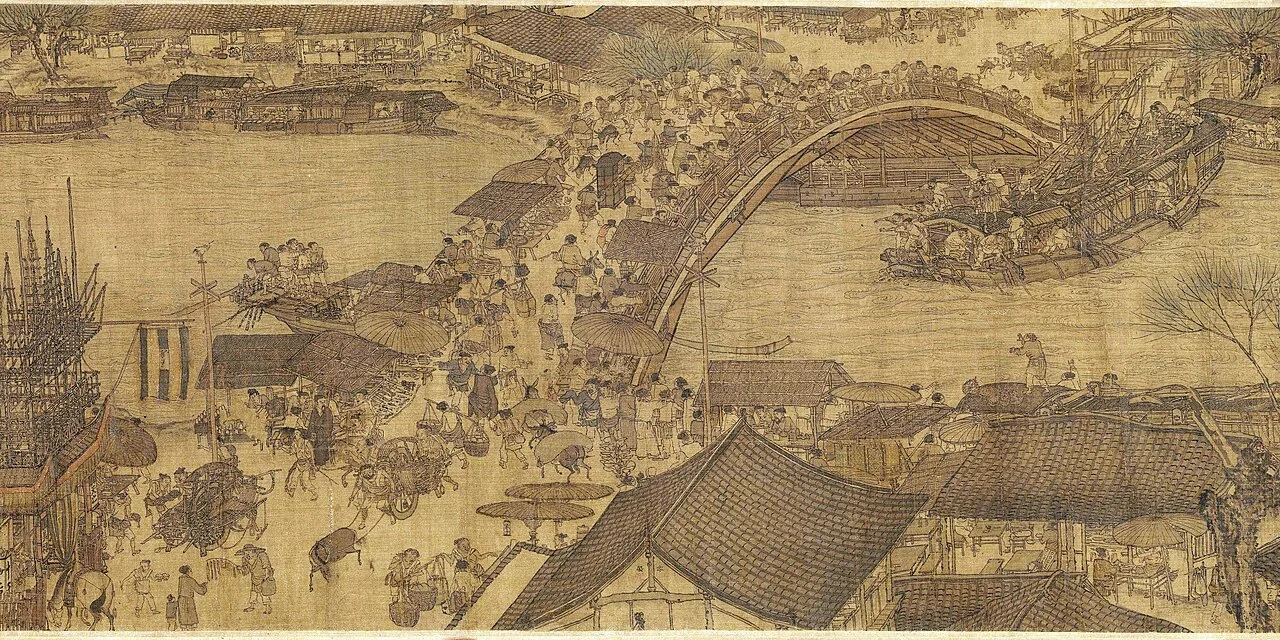
- Present each document (nature, author, date).
- What do both documents show about the importance of water in the city?
- What does 2A mention that you cannot see in 2B, and the other way round?
- Who made each document and for whom?
- Which one is more reliable as evidence of daily life? Justify your answer.
Exercise 9 : Two emperors, two messages
Document 2A – Tang China and a foreign religion
In the year of our Lord 635 he arrived at Chang-an; the Emperor sent his Prime Minister, Duke Fang Hiuen-ling; who, carrying the official staff to the west border, conducted his guest into the interior; the sacred books were translated in the imperial library, the sovereign investigated the subject in his private apartments; when becoming deeply impressed with the rectitude and truth of the religion, he gave special orders for its dissemination.
Source: the Nestorian Tablet (Xi’an stele), set up in the Tang capital in 781 CE by a priest of the Church of the East, on the arrival of the Syrian priest Olopun in 635; English translation in Charles F. Horne, ed., The Sacred Books and Early Literature of the East, vol. XII (1917), Internet East Asian History Sourcebook, Fordham University.
*Chang-an: Chang’an, the Tang capital (now Xi’an). *the Emperor: Taizong (626-649). *dissemination: spreading.
Document 2B – The first Ming emperor
Since the Sung dynasty had lost the throne and Heaven had cut off their sacrifice, the Yuan [Mongol] dynasty had risen from the desert to enter and rule over Zhongguo [China] for more than a hundred years, when Heaven, wearied of their misgovernment and debauchery, thought also fit to turn their fate to ruin, and the affairs of Zhongguo were in a state of disorder for eighteen years. […] We have, in the west, subdued the king of Han, Ch’en Yu-liang; We have, in the east, bound the king of Wu, Chang Shih-ch’eng; We have, in the south, subdued Min and Yueh [Fukien and Kuang-tung], and conquered Pa and Shu [Sze-chuan]; We have, in the north, established order in Yu and Yen [Chih-li]; We have established peace in the Empire, and restored the old boundaries of Zhongguo.
Source: Manifesto of the Hongwu emperor (Zhu Yuanzhang), the first Ming emperor, sent to the Byzantine emperor in 1372; translated by Friedrich Hirth, China and the Roman Orient (Shanghai and Hong Kong, 1885), as edited in the Internet East Asian History Sourcebook, Fordham University.
*Sung: Song. *Zhongguo: the “Middle Kingdom,” China. *debauchery: wicked and wasteful living. *Yuan: the Mongol dynasty.
- Present each document (author, date, context).
- How does the Tang emperor treat the foreign visitor in 2A?
- How does the Ming emperor present himself to foreign rulers in 2B?
- What do both documents suggest about the contact between China and other lands?
- Write two sentences that compare the two dynasties’ attitudes to the outside world.
Exercise 10 : A Tang camel
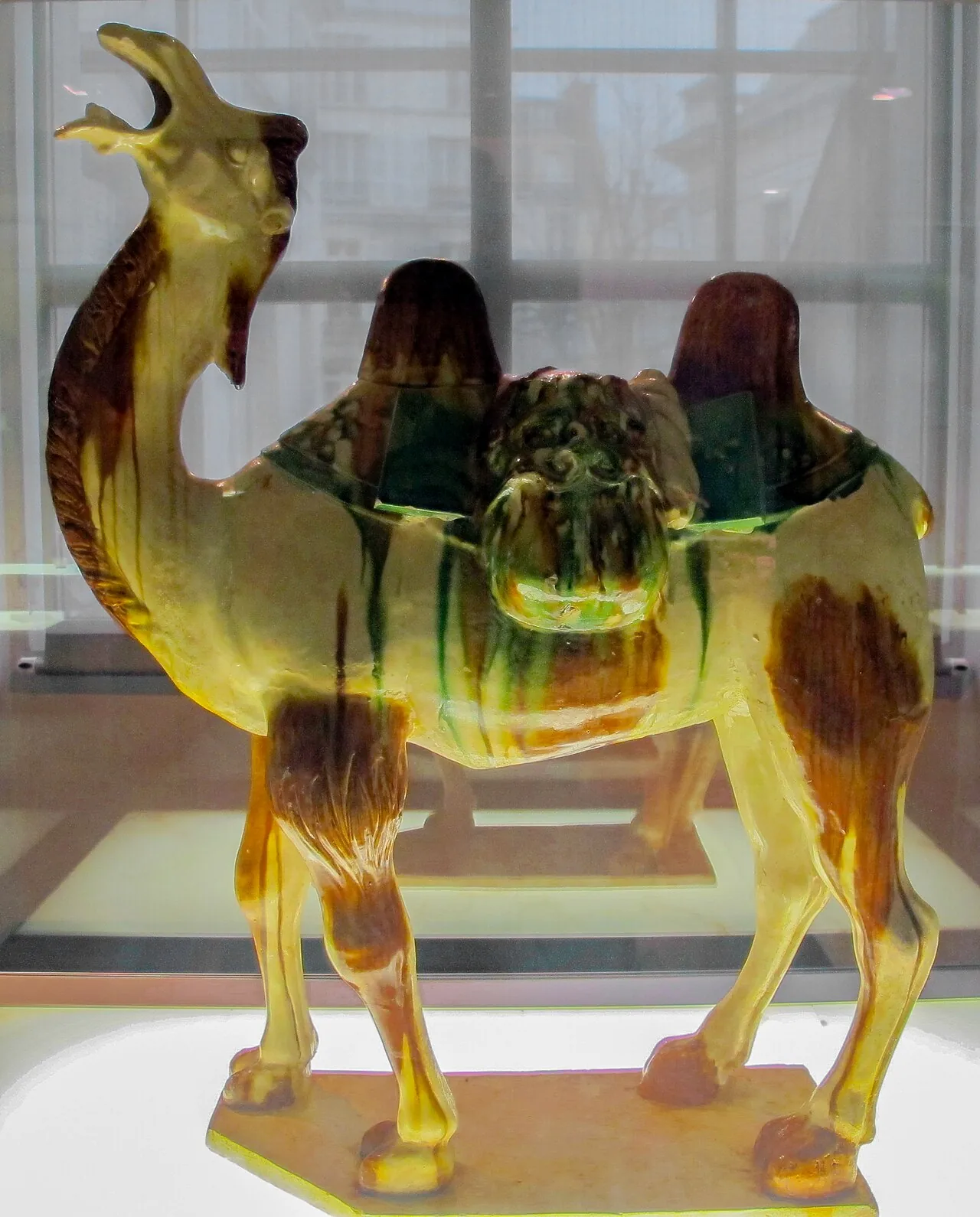
- Present the document (nature, date, place).
- Describe the camel: its pose, its colors, and its glaze.
- Why were such figures placed in tombs?
- What does a camel tell us about trade in Tang times?
- Why must we be careful when we use an object from a tomb as evidence about daily life?
Exercise 11 : Along the River
- Present the document (nature, date, place).
- Describe the bridge, the boats, and the people.
- What does the scene tell you about trade in a Song city?
- The painter worked for the court. How could this affect his picture?
- What can a historian learn from this painting that written records often leave out?
Exercise 12 : The Forbidden City
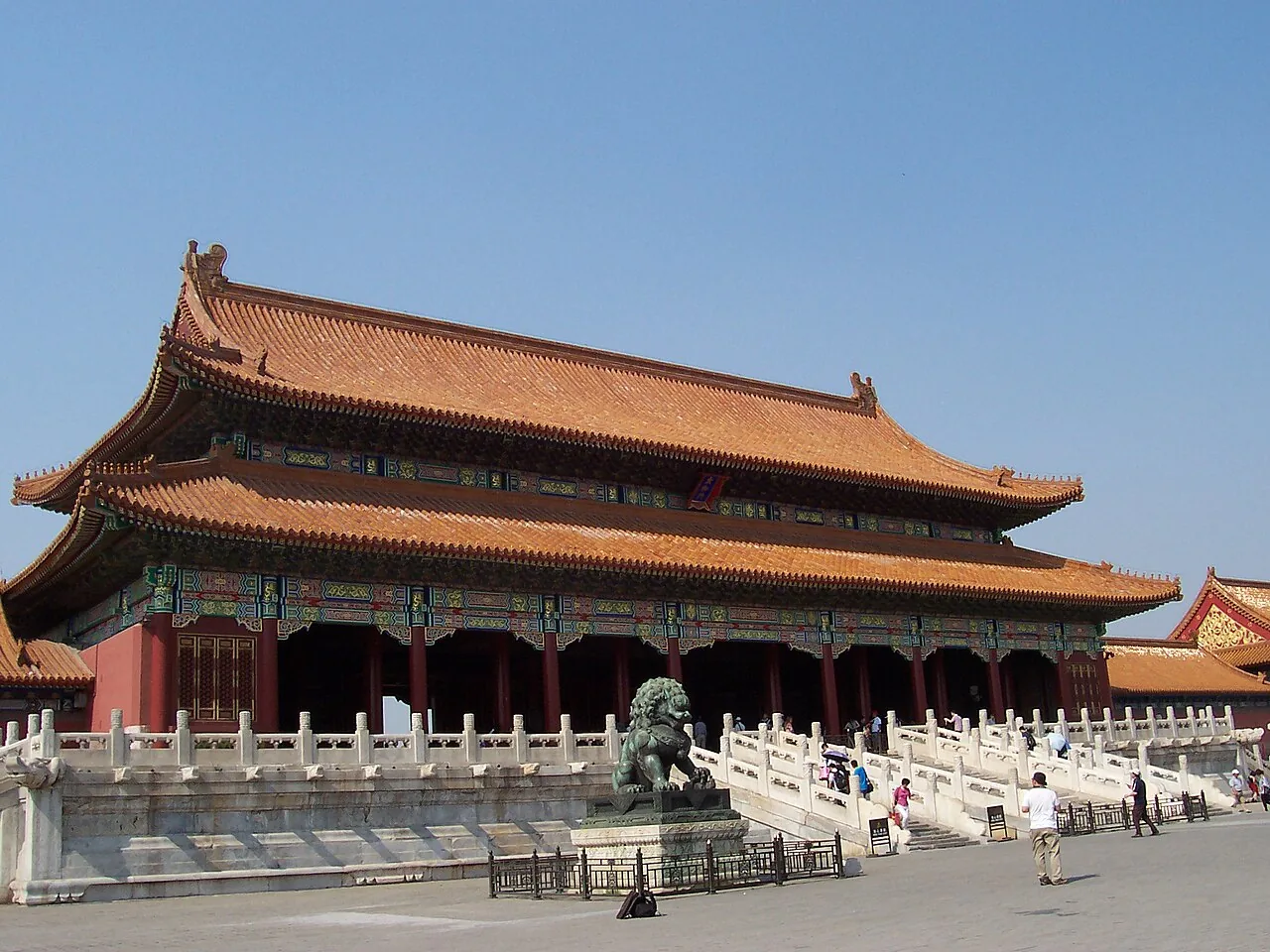
- Present the document (nature, date, place).
- Describe the building: the roof, the columns, the stairs, and the guardian figure.
- Why did the Yongle emperor build a vast palace in Beijing?
- What does the architecture say about the power of the emperor?
- Why was the palace called “Forbidden”?
Exercise 13 : A Ming vase
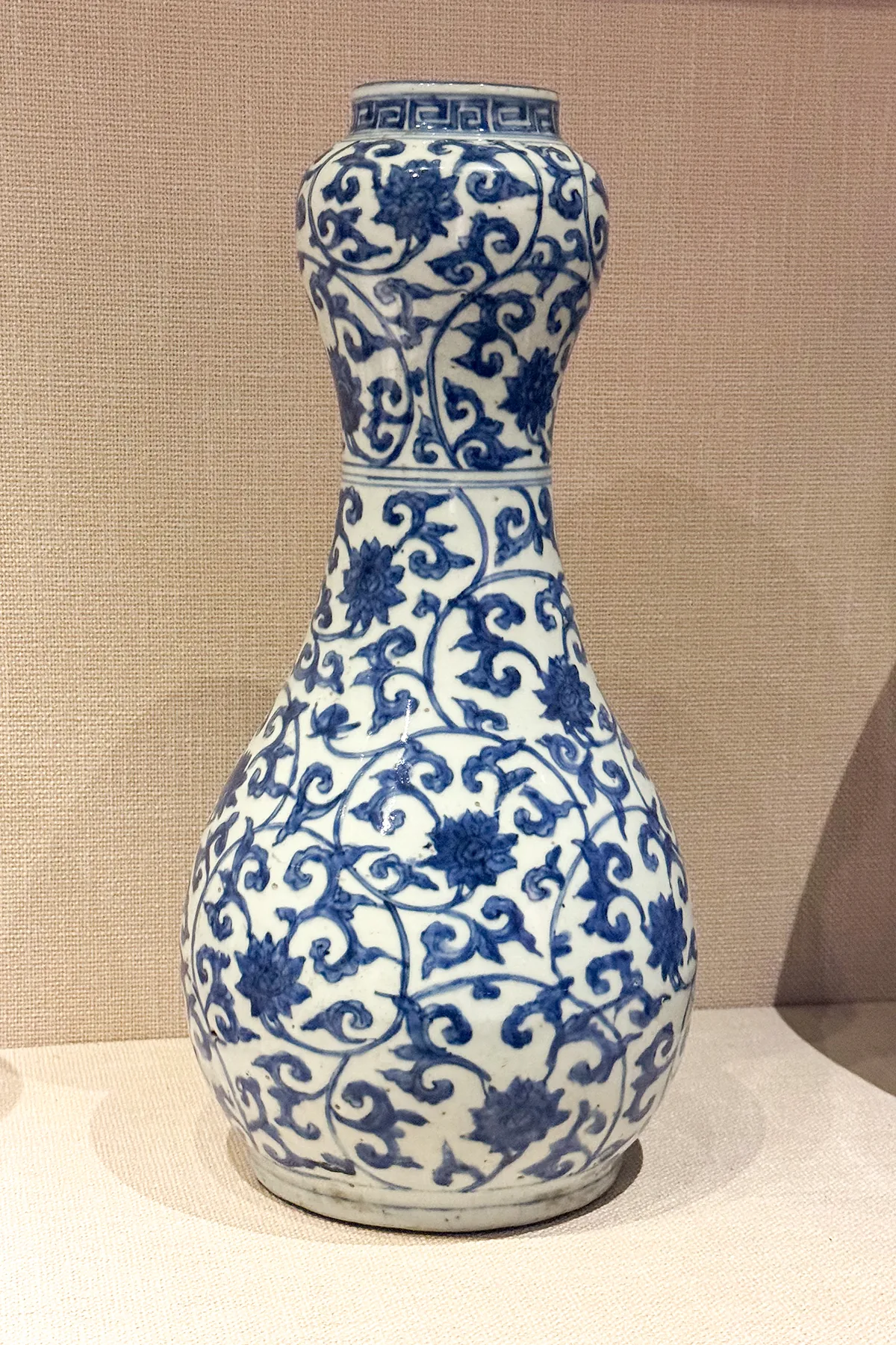
- Present the document (nature, date, place).
- Describe the vase: its shape, colors, and patterns.
- Why was blue-and-white porcelain popular in other countries?
- What does it tell us about Ming trade?
- Why is a vase a source, even though it has no writing?
Exercise 14 : A Song landscape
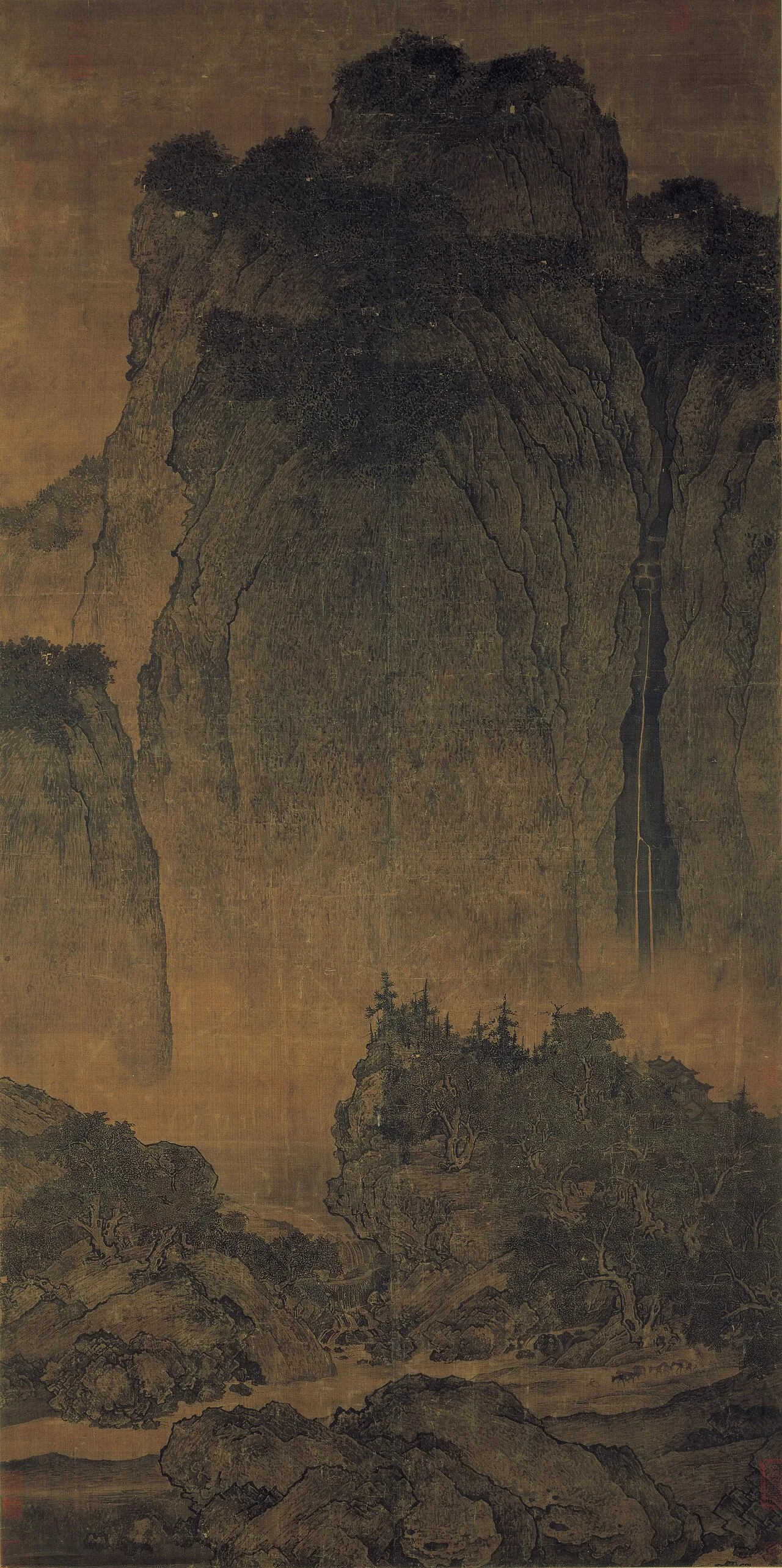
- Present the document (nature, date, place).
- Describe the painting: what dominates the scene, and where are the travelers?
- What attitude toward nature does the painting show?
- Which ideas from Daoism or Confucianism might have influenced such landscapes?
- Why might rulers and scholars collect such paintings?
Exercise 15 : Dynasties by the numbers
Document 1 – Chinese dynasties after the Han
| Dynasty | Dates (CE) | Main capitals |
|---|---|---|
| Tang | 618-907 | Chang’an |
| Song | 960-1279 | Kaifeng, then Hangzhou |
| Yuan (Mongol) | 1271-1368 | Dadu (Beijing) |
| Ming | 1368-1644 | Nanjing, then Beijing |
Source: dates as given in reference works such as The Cambridge History of China and Encyclopædia Britannica. Table prepared for this unit.
- How many years did the Tang dynasty last?
- How many years did the Song dynasty last?
- How many years separated the end of the Tang from the beginning of the Song?
- How many years did the Ming dynasty last?
- Which dynasty was the shortest, and what does that suggest?
Exercise 16 : Locate imperial China
- Match the numbers to these names: Beijing, Chang’an, Dunhuang, Guangzhou, Hangzhou, Kaifeng, Kashgar, Luoyang, Nanjing.
- Which city was the capital of the Tang?
- Which two cities were capitals of the Ming?
- Which city lies at the western end of the map, on the Silk Road?
Hint: the Yellow River and the Yangtze flow from west to east; Hangzhou and Nanjing are near the lower Yangtze.
Exercise 17 : The voyages of Zheng He
- Where did the voyages begin?
- Name three places in India, Arabia, or Africa that the fleets visited.
- Which ocean did the fleets cross?
- What did the fleets carry from China, and what did they bring back?
- Give two reasons why the voyages were stopped.
Exercise 18 : Order the events
Put these events in order from earliest to latest and write the date next to each.
- The Song dynasty begins
- Zheng He’s first voyage
- The Tang dynasty begins
- The Ming dynasty ends
- The Jurchen capture Kaifeng
- The Mongols complete the conquest of the Song
Exercise 19 : How long between events?
Calculate each time span.
- From the beginning of the Tang (618) to the printing of the oldest dated book (868).
- From the beginning of the Song (960) to the capture of Kaifeng (1127).
- From Zheng He’s first voyage (1405) to his last (1433).
- From the end of the Song (1279) to the beginning of the Ming (1368).
Exercise 20 : Guided research: the Forbidden City
Find out about the Forbidden City in Beijing. Use at least two reliable sites, such as UNESCO, Britannica, the Palace Museum, or the Metropolitan Museum of Art. Suggested keywords: Forbidden City UNESCO, Yongle emperor Forbidden City built, Palace Museum Beijing history.
- When was the Forbidden City built, and by which emperor?
- How big is it, and what are its main halls?
- Which dynasties used it as their palace?
- Which sites did you use, and why do you trust them?
Hint: look for the dates, the size in acres or hectares, and how the palace is used today.
Exercise 21 : CER paragraph: China’s inventions
Write a Claim, Evidence, Reasoning paragraph that answers: Which Chinese invention of the Tang and Song periods had the greatest effect on the world?
- Claim: state your position.
- Evidence: use at least two details from the lesson or the documents.
- Reasoning: explain how the evidence supports your claim.
Hint: choose printing, gunpowder, the compass, paper money, or another, and explain its effects on communication, war, or trade.
Exercise 22 : SAQ: the Song dynasty
Answer in complete sentences.
- Identify two inventions or technologies of the Song period.
- Explain one reason why the Song population grew quickly.
- Explain one effect of the civil service examination on Chinese government.
Exercise 23 : True or false? Justify
Decide whether each statement is true or false, and justify your answer.
- The Tang capital was Beijing.
- Zheng He led seven voyages to the Indian Ocean.
- The Forbidden City was built by the Song dynasty.
- The Mongols ruled China as the Yuan dynasty before the Ming.
Exercise 24 : Causes and consequences: the end of the Ming
Complete the chain and explain each link.
- Cause: Ming emperors lose interest in government and officials fight each other. Effect: ______.
- Effect of famine and high taxes in the 1620s-1640s: ______.
- Effect of the capture of Beijing in 1644: ______.
- Later consequence: ______.


Quick review: flashcards
Tap a card to see the answer.