


This worksheet on Medieval Japan belongs to the Grade 7 Medieval and Early Modern World course. Its questions use primary sources, maps and timelines, and they move from basic recall to short writing tasks. Before you start, review the lesson; afterward, try the true or false quiz.
Exercise 1 : Vocabulary of medieval Japan
Match each term to its meaning, then use three of the terms in sentences of your own.
- Samurai
- Shogun
- Bakufu
- Regent
- Daimyo
- Kana
Meanings: (a) the military government of a shogun; (b) a person who rules in the name of a young or weak ruler; (c) a Japanese phonetic script; (d) a professional warrior who served a lord; (e) the military ruler of Japan; (f) a powerful regional lord of the late Middle Ages.
Exercise 2 : The rules of Prince Shotoku
Document 1 – The Seventeen-Article Constitution
Harmony is to be valued, and an avoidance of wanton opposition to be honoured. All men are influenced by class-feelings, and there are few who are intelligent. Hence there are some who disobey their lords and fathers, or who maintain feuds with the neighbouring villages. But when those above are harmonious and those below are friendly, and there is concord in the discussion of business, right views of things spontaneously gain acceptance […] When you receive the Imperial commands, fail not scrupulously to obey them. The lord is Heaven, the vassal is Earth. Heaven overspreads, and Earth upbears. When this is so, the four seasons follow their due course, and the powers of Nature obtain their efficacy. If the Earth attempted to overspread, Heaven would simply fall in ruin. Therefore is it that when the lord speaks, the vassal listens; when the superior acts, the inferior yields compliance.
Source: Prince Shotoku, Seventeen-Article Constitution (Articles I and III), 604 CE, in Nihongi: Chronicles of Japan from the Earliest Times to A.D. 697, translated by W. G. Aston (London, 1896), vol. 2, pp. 129-130. Text checked at archive.org/details/nihongi2asto.
*fealty: loyalty. *wanton: senseless. *efficacy: working power. *vassal: a subject who serves a lord.
- Present the document (nature, author, date, context).
- According to Article I, what does the author value most, and why?
- Whom does the author compare to Heaven and to Earth in Article III?
- What kind of country does the author want?
- Why is it not a “constitution” in the modern sense?
Exercise 3 : A court lady’s notebook
Document 2 – The Pillow Book
It is very tiresome when a lover who is leaving one at dawn says that he must look for a fan or pocket-book that he left somewhere about the room last night. As it is still too dark to see anything, he goes fumbling about all over the place, knocking into everything and muttering to himself, ‘How very odd!’ When at last he finds the pocket-book he crams it into his dress with a great rustling of the pages; or if it is a fan he has lost, he swishes it open and begins flapping it about, so that when he finally takes his departure, instead of experiencing the feelings of regret proper to such an occasion, one merely feels irritated at his clumsiness.
Source: Sei Shonagon, The Pillow-Book, about 1002, translated by Arthur Waley, The Pillow-Book of Sei Shonagon (1928). Text checked at archive.org/details/pillowbookofseis0000arth_v1i4.
*tiresome: annoying. *pocket-book: a small notebook.
- Present the document (nature, author, date, context).
- What does the author complain about?
- What does the passage tell us about courtship and rooms at night in Heian Japan?
- Why can this text not tell us about the life of a farmer?
Think about who wrote it and where she lived.
Exercise 4 : The bell of Gion
Document 3 – The opening of The Tale of the Heike
The sound of the bell of Gionshoja echoes the impermanence of all things. The hue of the flowers of the teak tree declares that they who flourish must be brought low. Yea, the proud ones are but for a moment, like an evening dream in springtime. The mighty are destroyed at the last, they are but as the dust before the wind. If thou ask concerning the rulers of other countries far off; Choko of Shin, Ono of Kan, Shui of Ryo, Rokuzan of To, all these, not following in the paths of the government of all the King and Emperors who went before them, sought pleasure only; not entering into council nor heeding the disorders of their Country, having no knowledge of the affliction of their people, they did not endure, but perished utterly.
Source: The Tale of the Heike (Heike Monogatari), Book 1, chapter 1 (Gion Shoja), 13th century, translated by A. L. Sadler, Transactions of the Asiatic Society of Japan, vol. 46, part 2 (Tokyo, 1918). Text checked at archive.org/details/TheHeikeMonogatari.
*Gionshoja: the Gion Shoja, a Buddhist monastery in India where the Buddha preached. *teak: here, the sal tree, under which the Buddha is said to have died. *Choko, Ono, Shui, Rokuzan: rulers and ministers of China who were destroyed by their own pride.
- Present the document (nature, date, context).
- Which two images show that nothing lasts?
- Which rulers does the author use as examples, and what happened to them?
- What lesson does the author want to teach about the Taira?
- Why is a literary work not always reliable evidence for historians?
Exercise 5 : The death of an emperor
Document 4 – Antoku at Dan-no-ura
And thus comforting him, and binding his long hair up in his dove coloured robe, blinded with tears the child-Sovereign put his beautiful little hands together and turned first to the east to say farewell to the deity of Ise and to Sho-Hachimangu, and then to the west and repeated the Nembutsu, after which the Nii-Dono, holding him tightly in her arms and saying consolingly “In the depths of the Ocean we have a Capital” sank with him at last beneath the waves.
Source: The Tale of the Heike, the death of Emperor Antoku at Dan-no-ura (1185), 13th century, translated by A. L. Sadler, Transactions of the Asiatic Society of Japan, vol. 49, part 1 (Tokyo, 1921). Text checked at archive.org/details/TheHeikeMonogatari.
*Nii-Dono: the Lady Nii, grandmother of the child emperor. *Nembutsu: a Buddhist prayer to Amida Buddha. *Ise: the great Shinto shrine. *Sho-Hachimangu: Hachiman, the god of war.
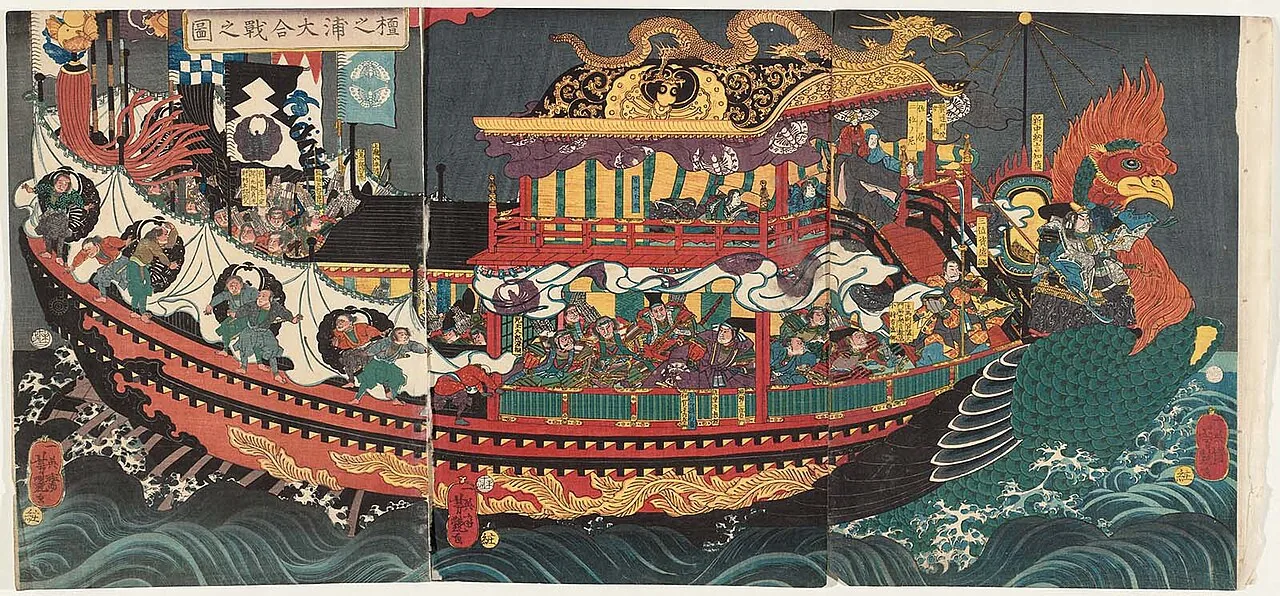
- Present the document (nature, date, context).
- Who is the child-Sovereign, and who holds him?
- To which gods and Buddha does he pray?
- What does the author tell us about the religion of the time?
- Look at the print. How does the artist show the importance of the battle?
Exercise 6 : The night attack
Document 5 – The fight at Mikusa
That night at about eight o’clock Yoshitsune summoned to him Doi-no-Jiro Sanehira, and said to him: “The Heike are only about three ri distant from us: they are encamped on the western slope of Mikusayama with a large force; shall we attack them by night or to-morrow?” […] When this order was given to the soldiers, however, they said each to his neighbour: “How dark it is what are we to do in this darkness?” “How about torches then?” suggested Yoshitsune. “So it must be”; replied Doi, and they set fire to all the houses of Onohara and then to all the trees and brushwood on the plain and on the mountain slopes, so that it became as bright as day.
Source: The Tale of the Heike, the fight at Mikusa (1184), 13th century, translated by A. L. Sadler, Transactions of the Asiatic Society of Japan, vol. 49, part 1 (Tokyo, 1921). Text checked at archive.org/details/TheHeikeMonogatari.
*ri: an old Japanese measure of distance, about 2.4 miles. *Heike: the Taira clan. *Yoshitsune: Minamoto no Yoshitsune, the general of the Minamoto army.
- Present the document (nature, date, context).
- Who gives the orders, and to whom does he speak?
- How does the Minamoto army solve the problem of the darkness?
- What does the passage show about how samurai fought?
- Why would a historian also want a source written by an enemy of the Minamoto?
Exercise 7 : Chipangu in the eyes of a traveler
Document 6 – Marco Polo on the invasion
For this purpose he sent two of his Barons with a great navy, and a great force of horse and foot. These Barons were able and valiant men, one of them called ABACAN and the other VONSAINCHIN, and they weighed with all their company from the ports of Zayton and Kinsay, and put out to sea. They sailed until they reached the Island aforesaid, and there they landed, and occupied the open country and the villages, but did not succeed in getting possession of any city or castle […] And it came to pass that there arose a north wind which blew with great fury, and caused great damage along the coasts of that Island, for its harbours were few. It blew so hard that the Great Kaan’s fleet could not stand against it.
Source: Marco Polo, The Travels, Book 3, chapters 2-3 (written about 1298), translated by Henry Yule, The Book of Ser Marco Polo, 3rd ed. (London, 1903), vol. 2. Text checked at gutenberg.org/ebooks/12410.
*Chipangu: Japan. *Cublay: Kublai Khan. *Kaan: khan, emperor. *Zayton and Kinsay: the Chinese ports of Quanzhou and Hangzhou.
- Present the document (nature, author, date).
- Who sent the expedition, and where did the ships leave from?
- What happened to the invaders?
- Which parts of the story are confirmed by Japanese sources, and which are not?
- Why is it important that Marco Polo did not visit Japan himself?
Exercise 8 : Warriors then and later
Document 7A – The fight at Mikusa (13th century)
That night at about eight o’clock Yoshitsune summoned to him Doi-no-Jiro Sanehira, and said to him: “The Heike are only about three ri distant from us: they are encamped on the western slope of Mikusayama with a large force; shall we attack them by night or to-morrow?” […] When this order was given to the soldiers, however, they said each to his neighbour: “How dark it is what are we to do in this darkness?” “How about torches then?” suggested Yoshitsune. “So it must be”; replied Doi, and they set fire to all the houses of Onohara and then to all the trees and brushwood on the plain and on the mountain slopes, so that it became as bright as day.
Source: The Tale of the Heike, the fight at Mikusa (1184), 13th century, translated by A. L. Sadler, Transactions of the Asiatic Society of Japan, vol. 49, part 1 (Tokyo, 1921). Text checked at archive.org/details/TheHeikeMonogatari.
*ri: an old Japanese measure of distance, about 2.4 miles. *Heike: the Taira clan. *Yoshitsune: Minamoto no Yoshitsune, the general of the Minamoto army.
Document 7B – The code of the knights (1900)
Bushido, then, is the code of moral principles which the knights were required or instructed to observe. It is not a written code; at best it consists of a few maxims handed down from mouth to mouth or coming from the pen of some well-known warrior or savant. More frequently it is a code unuttered and unwritten, possessing all the more the powerful sanction of veritable deed, and of a law written on the fleshly tablets of the heart.
Source: Inazo Nitobe, Bushido: The Soul of Japan (first published 1900; Tokyo, 1908 edition), chapter 1. Text checked at archive.org/details/bushido-the-soul-of-japan-inazo-nitobe.
*knights: here, the samurai. *savant: a scholar.
- Present each document (author, date, context).
- What does 7A show about how a medieval commander behaved?
- What does 7B say about the nature of bushido?
- How do the two documents differ in time and purpose?
- Write two sentences that explain why a historian should not use 7B alone to describe medieval samurai.
Exercise 9 : A story and a painting of the same war
Document 8A – The invasion in Marco Polo’s book
For this purpose he sent two of his Barons with a great navy, and a great force of horse and foot. These Barons were able and valiant men, one of them called ABACAN and the other VONSAINCHIN, and they weighed with all their company from the ports of Zayton and Kinsay, and put out to sea. They sailed until they reached the Island aforesaid, and there they landed, and occupied the open country and the villages, but did not succeed in getting possession of any city or castle […] And it came to pass that there arose a north wind which blew with great fury, and caused great damage along the coasts of that Island, for its harbours were few. It blew so hard that the Great Kaan’s fleet could not stand against it.
Source: Marco Polo, The Travels, Book 3, chapters 2-3 (written about 1298), translated by Henry Yule, The Book of Ser Marco Polo, 3rd ed. (London, 1903), vol. 2. Text checked at gutenberg.org/ebooks/12410.
*Chipangu: Japan. *Cublay: Kublai Khan. *Kaan: khan, emperor. *Zayton and Kinsay: the Chinese ports of Quanzhou and Hangzhou.
Document 8B – A scroll painted for a samurai
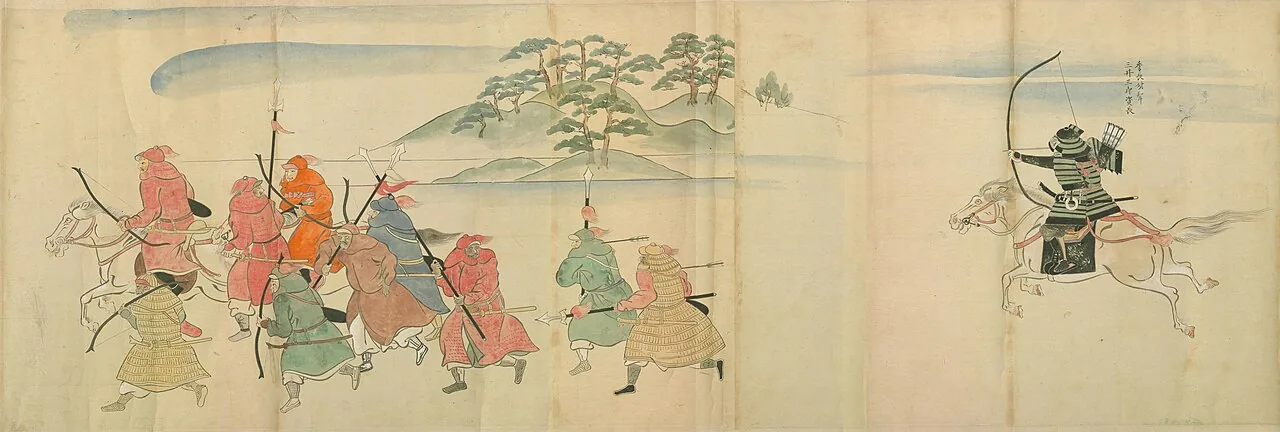
- Present each document.
- Who ordered the scroll, and why was it made?
- What does the picture show that Polo’s text does not?
- Who tells the story from the point of view of the winners in Japan, and who from the Mongol side?
- Explain in two sentences why historians need both.
Exercise 10 : A samurai and the Mongols
- Present the document (nature, author, date, location).
- Describe the two groups of soldiers.
- What weapons do you see?
- Why did a samurai pay for such a scroll?
Exercise 11 : Takezaki Suenaga in battle
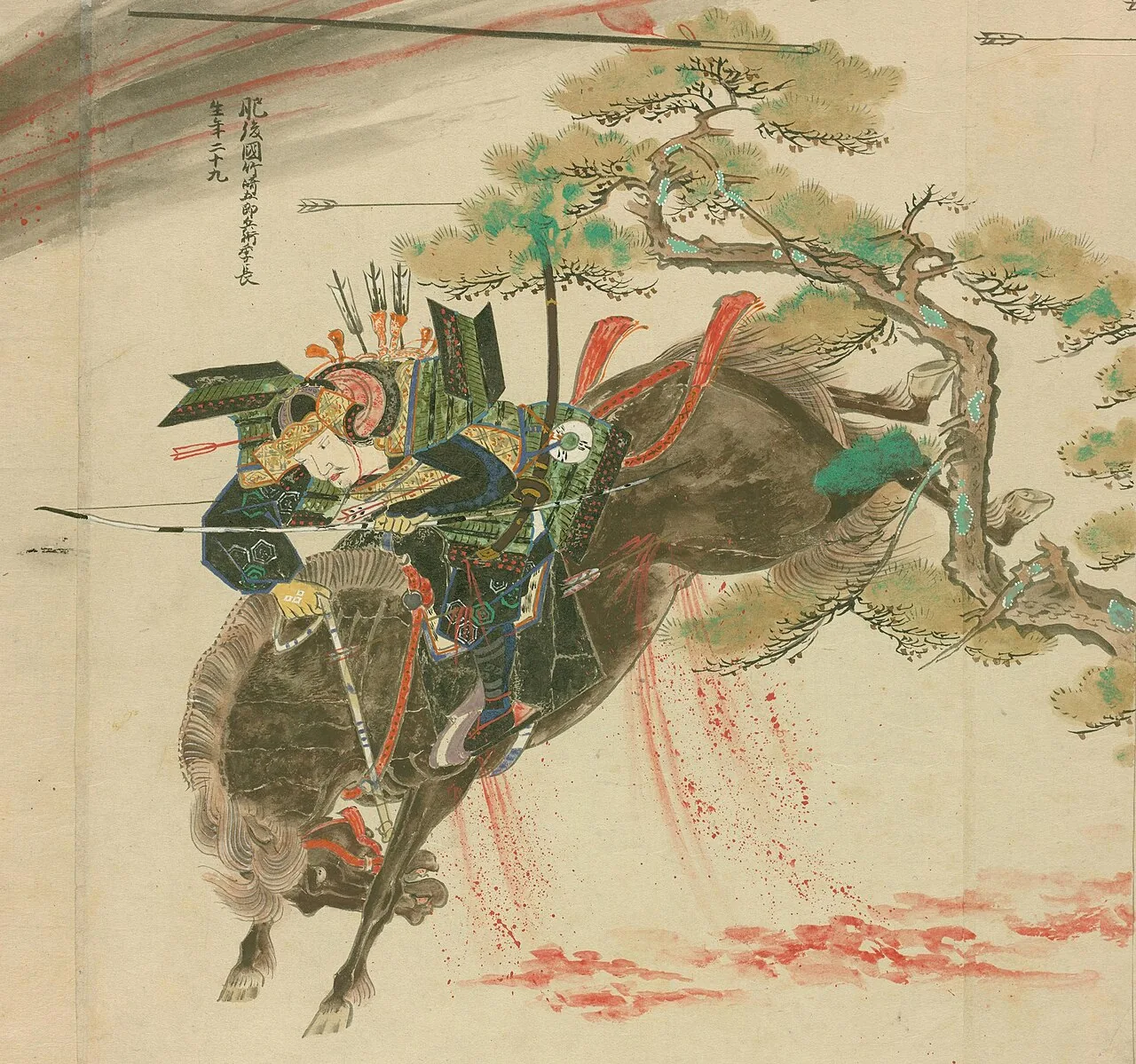
- Present the document.
- Describe the rider’s armor and equipment.
- What dangers are shown around him?
- What does the picture suggest about the way samurai wanted to be remembered?
Exercise 12 : The sea battle of 1185
- Present the document, including its date.
- What do you notice about the ship and the people on board?
- Why can this print not be used as a witness of the battle itself?
- What can it tell a historian about Japan in the 19th century?
Exercise 13 : Japan by periods
Study the table, which gives the main periods of Japanese history from the Nara period to the early Tokugawa period.
| Period | Dates | Center of power | Who held real power |
|---|---|---|---|
| Nara | 710-794 | Nara | Emperor and court |
| Heian | 794-1185 | Kyoto | Fujiwara regents, then warrior clans |
| Kamakura | 1185-1333 | Kamakura | Shoguns and Hojo regents |
| Muromachi (Ashikaga) | 1336-1573 | Kyoto | Ashikaga shoguns, then daimyo |
| Tokugawa (Edo) | 1603-1868 | Edo | Tokugawa shoguns |
Source: dates as given in standard reference works, such as the Cambridge History of Japan.
- How many years did the Heian period last?
- Which period lasted the longest?
- Which two periods had their center of power in Kyoto?
- What happened to the center of power in 1185?
Exercise 14 : Locate medieval Japan
- Match the numbers to these names: Nara, Kyoto, Kamakura, Edo, Hakata Bay, Dan-no-ura, Himeji.
- Which city was the capital of the emperors from 794?
- Where did Yoritomo set up his bakufu?
- Which place lies closest to Korea?
Hint: Kyushu is the southwestern island; Kamakura and Edo are on the coast of the Pacific Ocean in the east.
Exercise 15 : The Mongol invasions
- Match the numbers to these names: Masan (Korea), Tsushima, Iki, Hakata Bay, Imari Bay.
- From which country did the 1274 fleet leave, and which islands did it pass?
- Which route came from southern China?
- Why was northern Kyushu the target of both invasions?
Hint: look for the closest points between Korea and Japan.
Exercise 16 : Order the events
Put these events in order from earliest to latest and write the date next to each.
- The second Mongol invasion
- The battle of Dan-no-ura
- Prince Shotoku issues his constitution
- Tokugawa Ieyasu becomes shogun
- The capital moves to Kyoto
- Ashikaga Takauji becomes shogun
Exercise 17 : How long between events?
Calculate how many years passed between the following events, and name the century of each date.
- Yoritomo becomes shogun (1192) and the fall of Kamakura (1333)
- The first Mongol invasion (1274) and the second (1281)
- The move to Heian-kyo (794) and the battle of Dan-no-ura (1185)
- The Onin War begins (1467) and Tokugawa Ieyasu becomes shogun (1603)
Exercise 18 : Guided research: The Tale of Genji
Find out about The Tale of Genji. Use at least two reliable sites, such as the British Library, the Metropolitan Museum of Art, Britannica, or the Tokugawa Art Museum. Suggested keywords: Tale of Genji Murasaki Shikibu, Genji Monogatari illustrated handscroll, Heian court literature.
- Who wrote it, and when?
- How long is it, and what is it about?
- What is the oldest illustrated version, and where is it kept?
- Which sites did you use, and why do you trust them?
Hint: look for the number of chapters and for the date of the oldest picture scrolls.
Exercise 19 : CER paragraph: why the samurai rose
Write a Claim, Evidence, Reasoning paragraph that answers: What was the most important reason why warriors took power from the imperial court?
- Claim: state your position.
- Evidence: use at least two details from the lesson or the documents.
- Reasoning: explain how the evidence supports your claim.
Hint: you can choose the weakness of the court, private estates, or the strength of the clans, and use the Genpei War.
Exercise 20 : SAQ: Kamakura and the Mongols
Answer in complete sentences.
- Identify two ways the Kamakura samurai defended Japan against the Mongols.
- Explain one reason why the victory did not make the shogunate stronger.
- Explain one effect of the kamikaze on Japanese memory of the invasions.
Exercise 21 : True or false? Justify
Say whether each statement is true or false and justify your answer with one fact.
- The Heian court was in Nara.
- The shogun ruled in the emperor’s name from Kamakura.
- The Mongol invasion of 1274 succeeded in conquering Kyushu.
- Bushido was a law written down by the first shogun.
Exercise 22 : Causes and consequences: the end of the Kamakura shogunate
Complete the chain of causes and consequences. Write one or two sentences for each link.
- Cause: the Mongol invasions of 1274 and 1281
- Immediate consequence: the cost of defense and the lack of rewards
- Result: unhappiness among the gokenin
- Final consequence: the events of 1333


Quick review: flashcards
Tap a card to see the answer.