


This worksheet on Feudal Europe and the Medieval Church belongs to the Grade 7 Medieval and Early Modern World course. Its questions use primary sources, maps and timelines, and they move from basic recall to short writing tasks. Before you start, review the lesson; afterward, try the true or false quiz.
Exercise 1 : Vocabulary of medieval Europe
Match each term to its meaning, then use three of the terms in sentences of your own.
- Feudalism
- Vassal
- Fief
- Serf
- Manor
- Tithe
Meanings: (a) a peasant bound to the land of a lord; (b) a land grant held in return for service; (c) a lord’s estate with its village and fields; (d) a tenth of one’s income given to the Church; (e) a man who held land from a lord and promised him loyalty; (f) a system of land and loyalty between lords and vassals.
Exercise 2 : Duties of vassal and lord
Document 1 – Fulbert of Chartres, 1020
He who swears fealty to his lord ought always to have these six things in memory; what is harmless, safe, honorable, useful, easy, practicable. […] However, that the faithful vassal should avoid these injuries is proper, but not for this does he deserve his holding; for it is not sufficient to abstain from evil, unless what is good is done also. It remains, therefore, that in the same six things mentioned above he should faithfully counsel and aid his lord, if he wishes to be looked upon as worthy of his benefice and to be safe concerning the fealty which he has sworn.
Source: Fulbert, bishop of Chartres, letter to William, duke of Aquitaine, 1020, “On Feudal Obligations,” Internet Medieval Sourcebook, Fordham University (sourcebooks.fordham.edu/source/fulbert1.asp).
*fealty: the oath of loyalty of a vassal. *benefice: a grant of land, or fief, held in return for service. *vassal: a man who held land from a lord and owed him service.
- Present the document (nature, author, date, context).
- What six things must a vassal keep in mind?
- Is it enough for a vassal to avoid doing harm? Explain.
- What does the author say about the lord?
- Why can a letter by a bishop not tell us how often these rules were followed?
Exercise 3 : The law and the king
Document 2 – Magna Carta, 1215
39. No freeman shall be taken, or imprisoned, or disseized, or outlawed, or exiled, or in any way harmed—nor will we go upon or send upon him—save by the lawful judgment of his peers or by the law of the land. 40. To none will we sell, to none deny or delay, right or justice.
Source: Magna Carta, 1215, clauses 39 and 40 (clause numbers added by later editors), translated in Ernest F. Henderson, Select Historical Documents of the Middle Ages (London, 1892). Text checked at archive.org/details/selecthistorical0000erne.
*disseized: deprived of property. *outlawed: placed outside the protection of the law. *peers: equals, people of the same rank.
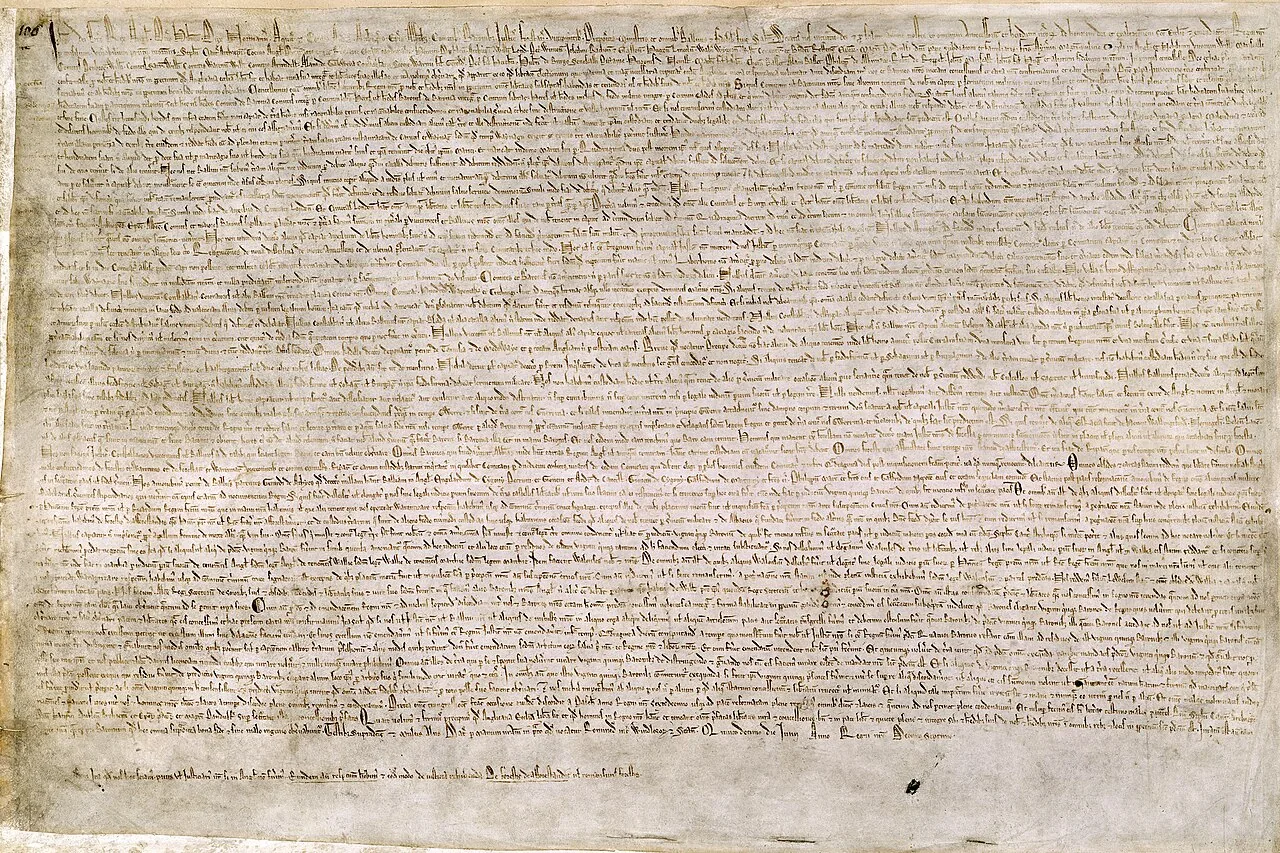
- Present the document (nature, date, context).
- What protection does clause 39 give a freeman?
- What does clause 40 promise?
- Who were the “peers” at that time?
- Explain why the charter limited the power of King John.
Exercise 4 : A king at the castle gate
Document 3 – Gregory VII on Canossa, 1077
[…] he came at length of his own accord, with a few followers, showing nothing of hostility or boldness, to the town of Canossa where we were tarrying. And there, having laid aside all the belongings of royalty, wretchedly, with bare feet and clad in wool, he continued for three days to stand before the gate of the castle. Nor did he desist from imploring with many tears the aid and consolation of the apostolic mercy.
Source: Pope Gregory VII, letter to the German princes about the penance of Henry IV at Canossa, 1077, in Ernest F. Henderson, Select Historical Documents of the Middle Ages (London, 1892). Text checked at archive.org/details/selecthistorical0000erne.
*apostolic mercy: the pardon of the pope. *Canossa: the castle in northern Italy where the pope was staying. *the belongings of royalty: crown, robes, and attendants.
- Present the document (nature, author, date, context).
- What did Henry IV do at Canossa?
- How long did he wait?
- What did the onlookers think of the pope’s strictness?
- Why would Henry’s supporters tell this story in a different way?
Exercise 5 : A day in the monastery
Document 4 – The Rule of St. Benedict, about 530
Idleness is the enemy of the soul. And therefore, at fixed times, the brothers ought to be occupied in manual labour; and again, at fixed times, in sacred reading. […] There shall certainly be appointed one or two elders, who shall go round the monastery at the hours in which the brothers are engaged in reading, and see to it that no troublesome brother chance to be found who is open to idleness and trifling, and is not intent on his reading; being not only of no use to himself, but also stirring up others.
Source: Benedict of Nursia, Rule, chapter 48, about 530; excerpts in the Internet Medieval Sourcebook, Fordham University (sourcebooks.fordham.edu/halsall/source/rul-benedict.asp).
*manual labour: work with the hands. *troublesome: here, disturbing others.
- Present the document (nature, author, date).
- What does the author call idleness?
- What two activities should fill the monks’ day?
- What does the abbot do to prevent idleness?
- What does the rule suggest about the work of monks in medieval Europe?
Exercise 6 : The call to the Crusade
Document 5 – Urban II at Clermont, 1095
For your brethren who live in the east are in urgent need of your help, and you must hasten to give them the aid which has often been promised them. For, as the most of you have heard, the Turks and Arabs have attacked them and have conquered the territory of Romania [the Greek empire] as far west as the shore of the Mediterranean and the Hellespont, which is called the Arm of St. George. They have occupied more and more of the lands of those Christians, and have overcome them in seven battles […] All who die by the way, whether by land or by sea, or in battle against the pagans, shall have immediate remission of sins.
Source: Urban II’s speech at the Council of Clermont, 1095, as remembered by Fulcher of Chartres, who may have been present; Internet Medieval Sourcebook, Fordham University (sourcebooks.fordham.edu/source/urban2-fulcher.asp).
*Romania: the Greek (Byzantine) empire. *Hellespont: the Dardanelles strait. *pagans: here, the pope’s word for the Turks and Arabs.
- Present the document (nature, author, date, context).
- What help does the pope ask for, and for whom?
- What does he say the Turks and Arabs have done?
- What reward does he promise?
- Why must a historian be careful with a speech that was written down years later?
Exercise 7 : Boccaccio and the plague
Document 6 – The plague in Florence, 1348
[…] towards the beginning of the spring of the said year the doleful effects of the pestilence began to be horribly apparent by symptoms that shewed as if miraculous […] Not such were they as in the East, where an issue of blood from the nose was a manifest sign of inevitable death; but in men and women alike it first betrayed itself by the emergence of certain tumours in the groin or the armpits, some of which grew as large as a common apple, others as an egg, some more, some less, which the common folk called gavoccioli. From the two said parts of the body this deadly gavocciolo soon began to propagate and spread itself in all directions indifferently.
Source: Giovanni Boccaccio, The Decameron, introduction, written about 1349-1353, translated by J. M. Rigg (London, 1903). Text checked at archive.org/details/decameron01boccuoft.
*gavoccioli: swellings, called buboes in medicine. *tumours: swellings. *the East: Asia.
- Present the document (nature, author, date).
- What first sign of the disease does Boccaccio describe?
- How does he say this plague was different from the plague in the East?
- What does the text suggest about how fast the disease spread?
- Why can the author be trusted on the symptoms but less on the number of deaths?
Exercise 8 : Oath and duty
Document 8A – Fulbert of Chartres, 1020
He who swears fealty to his lord ought always to have these six things in memory; what is harmless, safe, honorable, useful, easy, practicable. […] However, that the faithful vassal should avoid these injuries is proper, but not for this does he deserve his holding; for it is not sufficient to abstain from evil, unless what is good is done also. It remains, therefore, that in the same six things mentioned above he should faithfully counsel and aid his lord, if he wishes to be looked upon as worthy of his benefice and to be safe concerning the fealty which he has sworn.
Source: Fulbert, bishop of Chartres, letter to William, duke of Aquitaine, 1020, “On Feudal Obligations,” Internet Medieval Sourcebook, Fordham University (sourcebooks.fordham.edu/source/fulbert1.asp).
*fealty: the oath of loyalty of a vassal. *benefice: a grant of land, or fief, held in return for service. *vassal: a man who held land from a lord and owed him service.
Document 8B – An oath in the Bayeux Tapestry
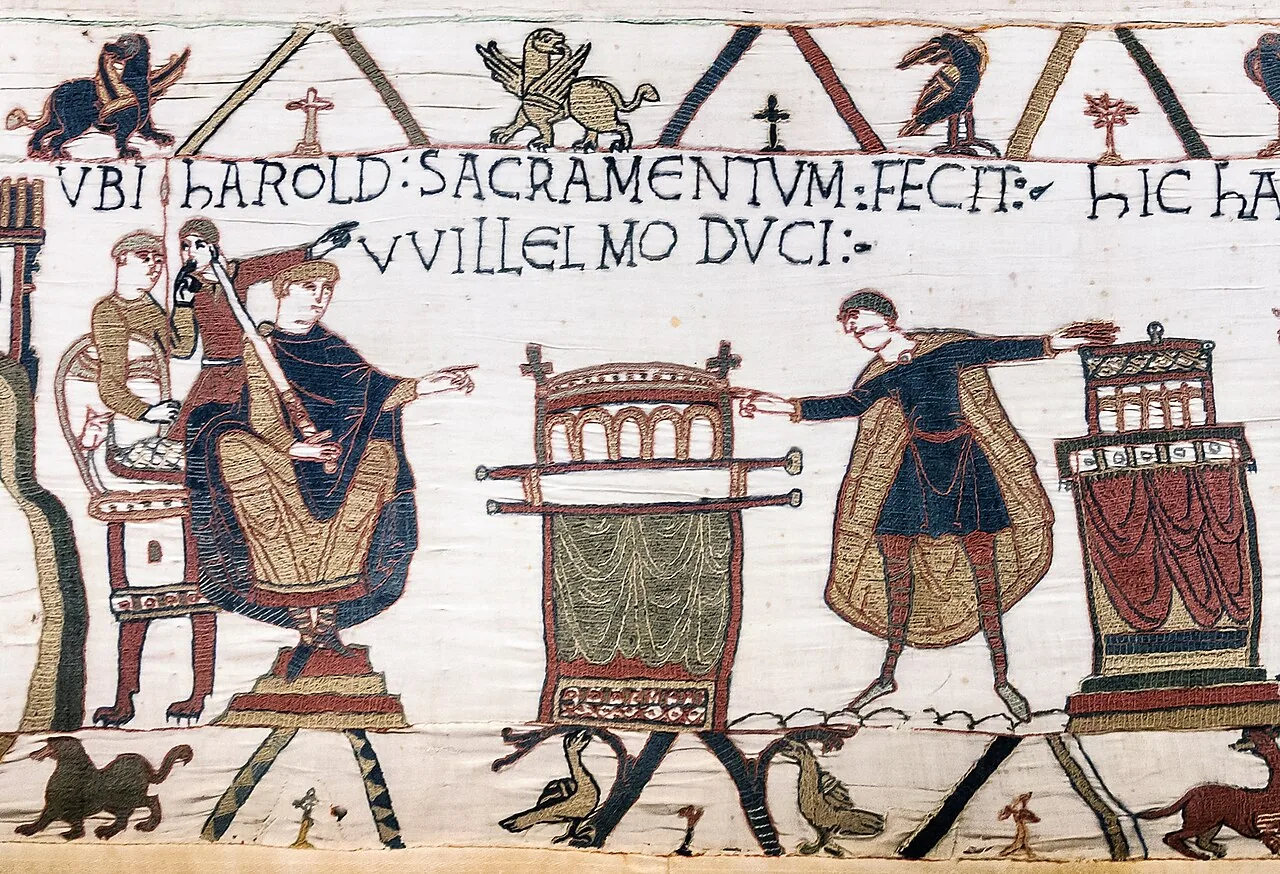
- Present each document.
- What does Fulbert say a vassal owes?
- Describe what Harold does in the tapestry.
- How does the picture help us understand the oath described in the letter?
- Write two sentences that compare the two sources.
Exercise 9 : Two versions of Canossa
Document 9A – Gregory VII, 1077
[…] he came at length of his own accord, with a few followers, showing nothing of hostility or boldness, to the town of Canossa where we were tarrying. And there, having laid aside all the belongings of royalty, wretchedly, with bare feet and clad in wool, he continued for three days to stand before the gate of the castle. Nor did he desist from imploring with many tears the aid and consolation of the apostolic mercy.
Source: Pope Gregory VII, letter to the German princes about the penance of Henry IV at Canossa, 1077, in Ernest F. Henderson, Select Historical Documents of the Middle Ages (London, 1892). Text checked at archive.org/details/selecthistorical0000erne.
*apostolic mercy: the pardon of the pope. *Canossa: the castle in northern Italy where the pope was staying. *the belongings of royalty: crown, robes, and attendants.
Document 9B – Henry IV and his intercessors
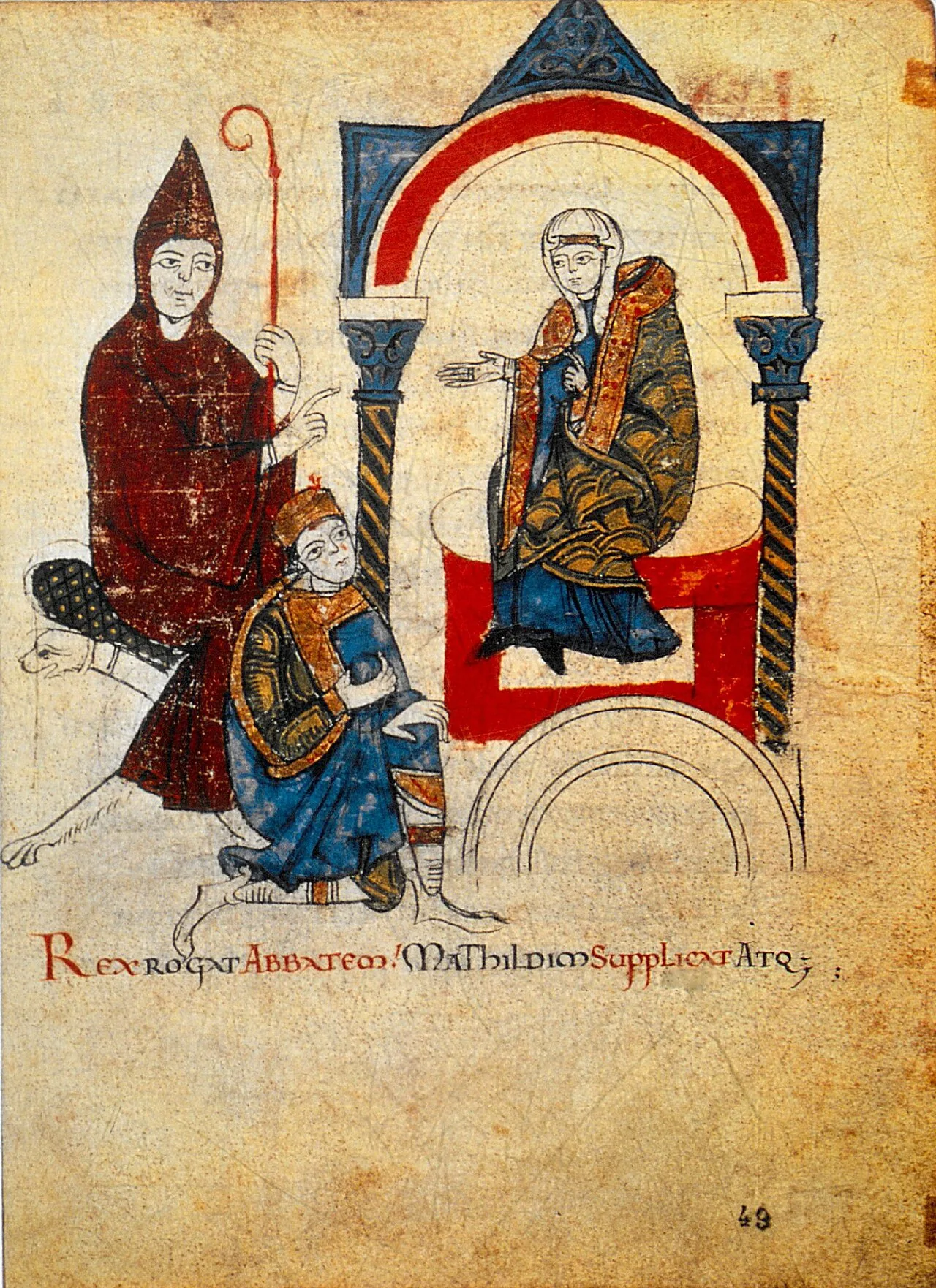
- Present each document.
- Who tells the story in 9A, and what does he emphasize?
- Whom does the artist show in 9B?
- Who asks for forgiveness for the king?
- Explain in two sentences how the two documents differ in point of view.
Exercise 10 : Duties of the lord, then and later
Document 10A – Fulbert of Chartres, 1020
He who swears fealty to his lord ought always to have these six things in memory; what is harmless, safe, honorable, useful, easy, practicable. […] However, that the faithful vassal should avoid these injuries is proper, but not for this does he deserve his holding; for it is not sufficient to abstain from evil, unless what is good is done also. It remains, therefore, that in the same six things mentioned above he should faithfully counsel and aid his lord, if he wishes to be looked upon as worthy of his benefice and to be safe concerning the fealty which he has sworn.
Source: Fulbert, bishop of Chartres, letter to William, duke of Aquitaine, 1020, “On Feudal Obligations,” Internet Medieval Sourcebook, Fordham University (sourcebooks.fordham.edu/source/fulbert1.asp).
*fealty: the oath of loyalty of a vassal. *benefice: a grant of land, or fief, held in return for service. *vassal: a man who held land from a lord and owed him service.
Document 10B – Magna Carta, 1215
39. No freeman shall be taken, or imprisoned, or disseized, or outlawed, or exiled, or in any way harmed—nor will we go upon or send upon him—save by the lawful judgment of his peers or by the law of the land. 40. To none will we sell, to none deny or delay, right or justice.
Source: Magna Carta, 1215, clauses 39 and 40 (clause numbers added by later editors), translated in Ernest F. Henderson, Select Historical Documents of the Middle Ages (London, 1892). Text checked at archive.org/details/selecthistorical0000erne.
*disseized: deprived of property. *outlawed: placed outside the protection of the law. *peers: equals, people of the same rank.
- Present each document.
- Which obligations does a lord have in 10A?
- Which obligations does the king have in 10B?
- What is the difference between a personal promise and a rule written in a charter?
- Write two sentences that explain how the two documents show the idea of limits on power.
Exercise 11 : The grape harvest
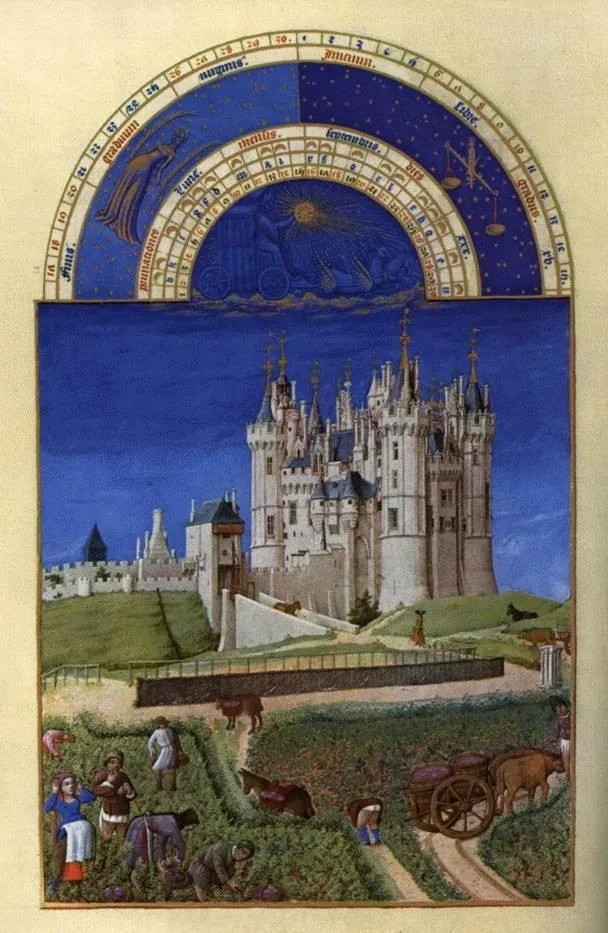
- Present the document (nature, date, location).
- Describe the people at work and the building in the background.
- What does the picture show about the relationship between lord and peasants?
- Why is it not a photograph of everyday life?
Exercise 12 : Burying the dead of Tournai
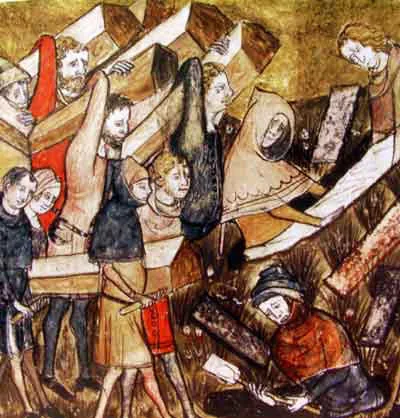
- Present the document.
- Describe what the people are doing.
- What does the picture tell us about the effect of the plague on a town?
- Why is this picture useful even though it is not a photograph?
Exercise 13 : The west front of Chartres
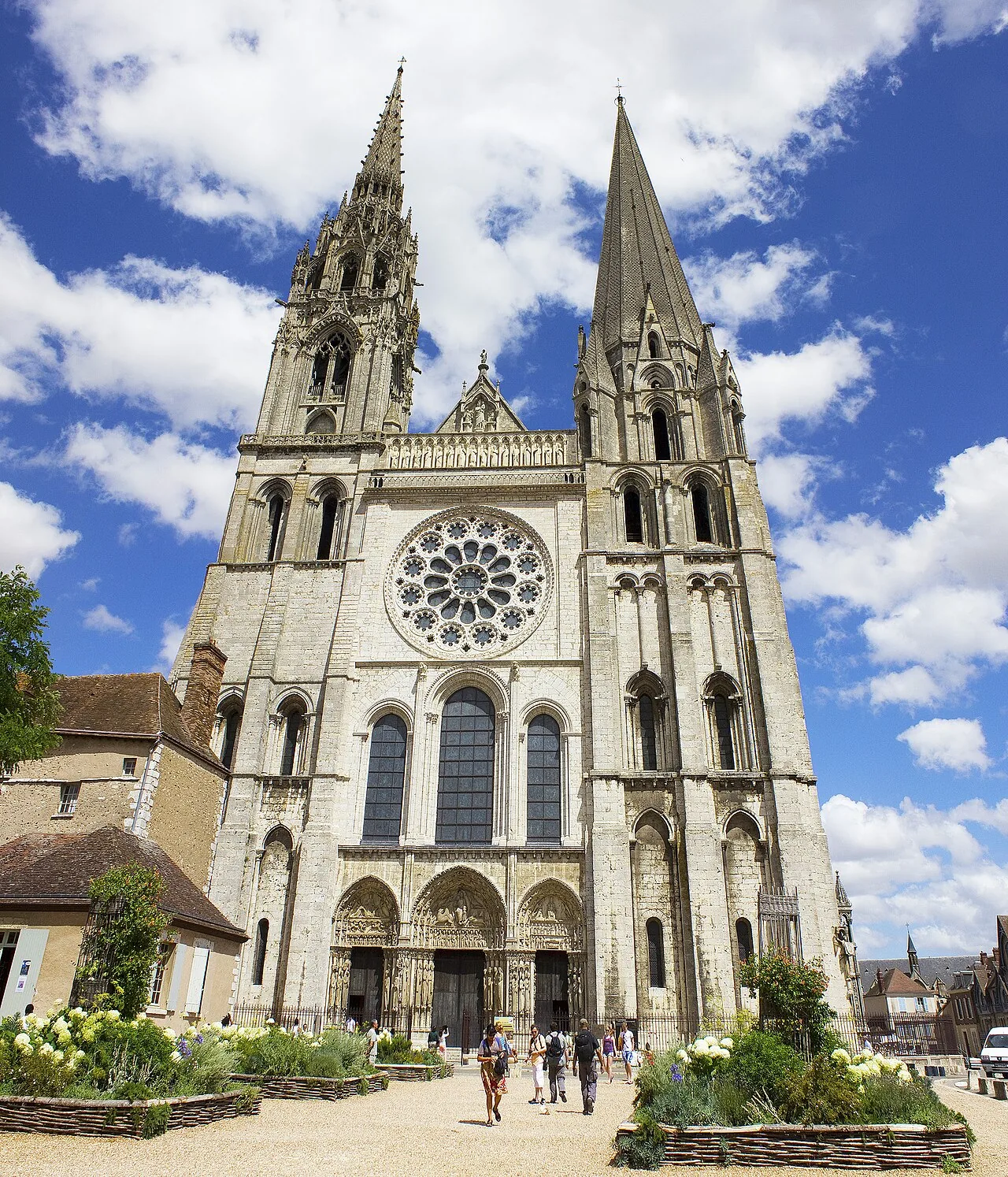
- Present the document.
- Describe the shape of the building and its two towers.
- Which features are typical of Gothic churches?
- Why was it important for a town to have a cathedral?
Exercise 14 : The Crusades by the numbers
Study the table, which gives the main crusades.
| Crusade | Dates | Main event |
|---|---|---|
| First | 1096-1099 | Crusaders capture Jerusalem (1099) |
| Second | 1147-1149 | Crusade fails to take Damascus |
| Third | 1189-1192 | Richard I and Philip II face Saladin; Jerusalem stays in Muslim hands |
| Fourth | 1202-1204 | Crusaders plunder Constantinople (1204) |
| Fall of Acre | 1291 | Last crusader stronghold in the Holy Land is lost |
Source: dates as given in standard reference works, such as the Oxford History of the Crusades.
- How many years passed between the capture of Jerusalem and the fall of Acre?
- Which crusade went to a Christian city instead of to the Holy Land?
- In which crusade did Saladin’s forces face Richard I?
- What does the table show about the success of the crusades after the first?
Exercise 15 : Locate medieval Europe
- Match the numbers to these names: London, Hastings, Paris, Chartres, Cluny, Aachen, Canossa, Rome, Clermont, Constantinople.
- Which city was the seat of the pope?
- Where did William of Normandy win in 1066?
- Which city was the capital of the Byzantine empire, to which the crusaders were sent?
Hint: Rome is in the middle of Italy; Constantinople is at the far southeast of the map, on the strait to the Black Sea.
Exercise 16 : The spread of the Black Death
- Match the numbers to these names: Caffa, Constantinople, Messina, Genoa, Marseille, Florence, Paris, London.
- From which sea did the plague come to Europe?
- Through which Mediterranean island did it enter Italy?
- Why did the plague travel along trade routes?
Hint: Caffa is a port on the Black Sea; follow the arrows to the west.
Exercise 17 : Order the events
Put these events in order from earliest to latest and write the date next to each.
- Magna Carta
- The Council of Clermont
- The battle of Hastings
- The Black Death reaches Messina
- Henry IV at Canossa
- Charlemagne is crowned emperor
Exercise 18 : How long between events?
Calculate how many years passed between the following events, and name the century of each date.
- The battle of Hastings (1066) and Magna Carta (1215)
- The Council of Clermont (1095) and the capture of Jerusalem (1099)
- Magna Carta (1215) and the Black Death in Messina (1347)
- The Black Death in Messina (1347) and the Peasants’ Revolt (1381)
Exercise 19 : Guided research: Domesday Book
Find out about Domesday Book. Use at least two reliable sites, such as the National Archives (UK), the British Library, Britannica, or the BBC. Suggested keywords: Domesday Book National Archives, William the Conqueror survey 1086, Great Domesday Little Domesday.
- Who ordered the survey, and when?
- What questions did the commissioners ask?
- How many places are recorded, and where is the book kept today?
- Which sites did you use, and why do you trust them?
Hint: look for the number of places and for the names of the two volumes.
Exercise 20 : CER paragraph: kings or Church?
Write a Claim, Evidence, Reasoning paragraph that answers: In the Middle Ages, who held more power over everyday life, the king or the Church?
- Claim: state your position.
- Evidence: use at least two details from the lesson or the documents.
- Reasoning: explain how the evidence supports your claim.
Hint: think about the tithe, the courts, schools, excommunication, and what the king could and could not do.
Exercise 21 : SAQ: feudal society
Answer in complete sentences.
- Identify two groups of people who attacked Europe in the 800s and 900s.
- Explain one reason why feudalism developed.
- Explain one way that the Black Death changed life for peasants.
Exercise 22 : True or false? Justify
Say whether each statement is true or false and justify your answer with one fact.
- A serf could leave the manor whenever he wanted.
- Pope Gregory VII excommunicated King Henry IV.
- Magna Carta was signed in 1066.
- The Black Death reached Europe from Asia by ship.
Exercise 23 : Causes and consequences: the end of serfdom
Complete the chain of causes and consequences. Write one or two sentences for each link.
- Cause: the Black Death of 1347-1351
- Immediate consequence: a shortage of workers
- Result: peasants demand higher wages and freedom
- Final consequence: the Peasants’ Revolt and the decline of serfdom


Quick review: flashcards
Tap a card to see the answer.