


This Grade 7 Medieval and Early Modern World lesson covers Feudal Europe and the Medieval Church, part of the unit “Medieval Europe and Asia.” First, read the full lesson with its primary sources, maps and key terms. Then practice with the worksheet, check yourself with the quiz and get ready with the test.
In January 1077, in the cold and snow of the Italian mountains, a king stood barefoot outside the gate of a castle. He was Henry IV, ruler of Germany and the most powerful monarch in western Europe. Inside the castle was Pope Gregory VII, who had excommunicated him, which meant that the Church had cut him off and that his own nobles were free to rebel.
For three days, according to the pope, Henry waited in the cold and begged to be forgiven. The scene at Canossa shows two of the great forces of the Middle Ages, kings and popes, and it shows how deeply religion shaped politics. In this chapter you will study how people organized medieval Europe, from the king and the lords down to the peasants who grew the food, and how the Catholic Church guided almost every part of life.
Guiding question: How did feudalism and the Catholic Church organize life in medieval Europe, and how did kings, lords, peasants, and popes share power or struggle over it?
1. Feudalism: a society built on promises
Why feudalism appeared
When the empire of Charlemagne fell apart in the 9th century, Europe became unsafe. Vikings sailed up the rivers from the north, Magyars rode in from the east, and Muslim raiders attacked from the south. Kings could not protect everyone, so people looked to the strongest local men, who had castles and armed horsemen. In return for protection, people gave these lords their loyalty and work. Historians call this system of mutual promises, which lasted from about 800 to about 1300, feudalism.
Definition: Feudalism
A system of government and land holding in medieval Europe in which a lord gave land, called a fief, to a vassal in return for loyalty and military service.
The feudal pyramid
Power looked like a pyramid. At the top stood the king, who in theory owned all the land. He gave large territories to great lords, such as dukes and counts, who became his vassals. They in turn gave smaller pieces of land, called fiefs, to knights, who promised to fight for them. At the bottom were the peasants, who did not hold fiefs but worked the land. A vassal knelt, put his hands between the hands of his lord, and swore an oath of fealty. Bishops and abbots also held fiefs, so the Church was a part of the system.
Document 1 – The duties of vassal and lord
He who swears fealty to his lord ought always to have these six things in memory; what is harmless, safe, honorable, useful, easy, practicable. […] However, that the faithful vassal should avoid these injuries is proper, but not for this does he deserve his holding; for it is not sufficient to abstain from evil, unless what is good is done also. It remains, therefore, that in the same six things mentioned above he should faithfully counsel and aid his lord, if he wishes to be looked upon as worthy of his benefice and to be safe concerning the fealty which he has sworn.
Source: Fulbert, bishop of Chartres, letter to William, duke of Aquitaine, 1020, “On Feudal Obligations,” Internet Medieval Sourcebook, Fordham University (sourcebooks.fordham.edu/source/fulbert1.asp).
*fealty: the oath of loyalty of a vassal. *benefice: a grant of land, or fief, held in return for service. *vassal: a man who held land from a lord and owed him service.
Commentary. Fulbert was bishop of Chartres, a school town in France, and he wrote this letter in 1020 to the Duke of Aquitaine, who had asked him what a vassal owed. The text shows that the bargain went both ways. The vassal must not harm his lord and must give him counsel and aid. The lord must treat the vassal in the same way. This is an official from the Church describing an ideal, so it does not tell us how often the rules were kept.
Definition: Vassal and fief
A vassal is a man who swore loyalty to a lord and received land in return. A fief was the land he held from his lord.
Knights and castles
The knight was a mounted soldier in heavy armor who fought with sword, lance, and shield. A boy from a noble family began as a page at about the age of seven, became a squire at about fourteen, and might be knighted at about twenty-one. Knights had to follow a code of behavior called chivalry, which taught them to be brave, to defend the Church, and to protect women and the weak, although many knights did not live up to it. Lords lived in castles, first wooden towers on a mound surrounded by a fence, and later great stone fortresses with thick walls, towers, and a moat, which they used for defense and as centers of government.
2. The manor: life of the peasants
Most people in the Middle Ages, about nine out of ten, were peasants who lived in small villages. The basic unit of the economy was the manor, an estate that included the lord’s house, a village, fields, pastures, and woods. Some peasants were free and paid rent.
Most were serfs, who had to stay on the land: they could not leave the manor, marry, or sell their land without the lord’s permission. In return the lord gave them a house, strips of land to farm, and protection. Serfs worked on the lord’s fields for several days each week and paid him part of their crop. They also gave a tenth of their produce, a tax called the tithe, to the Church.
Definition: Manor and serf
A manor was a lord’s estate with its village and farmland. A serf was a peasant who farmed the lord’s land and could not leave the manor without permission.
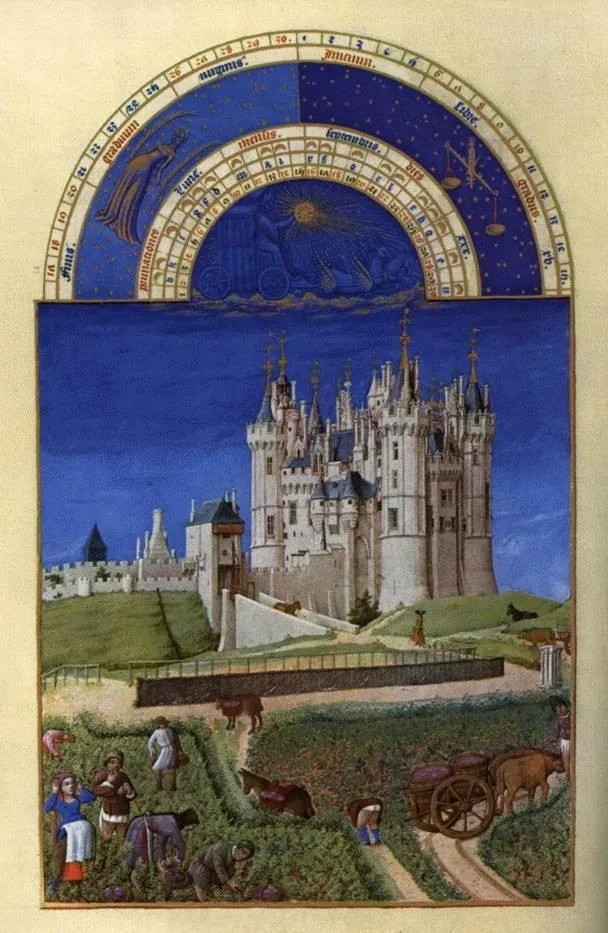
Farming methods slowly improved. Peasants used the heavy iron plow and the horse collar, built water mills, and from about 800 used the three-field system, in which one field was planted in the fall, another in the spring, and a third was left to rest. With better yields, the population of Europe roughly doubled between about 1000 and 1300. Life remained hard. Houses were small and smoky, the diet was mostly bread and vegetables, and a bad harvest could mean famine. The calendar page below shows peasants working in the vineyards, with the lord’s castle rising behind them.
3. The Catholic Church
A church for all of Europe
In western Europe almost everyone was a member of the Catholic Church. It was led by the pope in Rome, who ruled over bishops, and the bishops ruled over priests. In every village the church was the center of community life, where priests baptized, married, and buried the villagers. The Church taught that people could gain salvation through the sacraments and good works. It collected the tithe, owned large estates, ran the schools and hospitals, and had its own courts and its own law, called canon law. Its most powerful weapon was excommunication, which cut a person off from the sacraments, and an interdict, which closed the churches in a whole region.
Monks, friars, and cathedrals
Monks and nuns lived apart from the world in monasteries and convents. About the year 530 Benedict of Nursia wrote a rule for monks in Italy that became the model for western monasteries. Monks prayed, farmed, and copied books by hand, and the monasteries preserved much of the learning of ancient times. The monastery of Cluny, founded in 910 in France, led a reform that made monasteries more disciplined. In the early 13th century two new orders of friars, the Franciscans and the Dominicans, went to live among ordinary people in the towns, owning nothing and preaching and teaching.
Document 2 – The rule of the monks
Idleness is the enemy of the soul. And therefore, at fixed times, the brothers ought to be occupied in manual labour; and again, at fixed times, in sacred reading. […] There shall certainly be appointed one or two elders, who shall go round the monastery at the hours in which the brothers are engaged in reading, and see to it that no troublesome brother chance to be found who is open to idleness and trifling, and is not intent on his reading; being not only of no use to himself, but also stirring up others.
Source: Benedict of Nursia, Rule, chapter 48, about 530; excerpts in the Internet Medieval Sourcebook, Fordham University (sourcebooks.fordham.edu/halsall/source/rul-benedict.asp).
*manual labour: work with the hands. *troublesome: here, disturbing others.
Commentary. Benedict wrote for a community that lived together under an abbot. His rule balances prayer, reading, and work. The passage on idleness shows how seriously he took the daily schedule and why monasteries became centers of farming and copying. Like most rules, it describes how monks were supposed to live, and some monasteries followed it more closely than others.
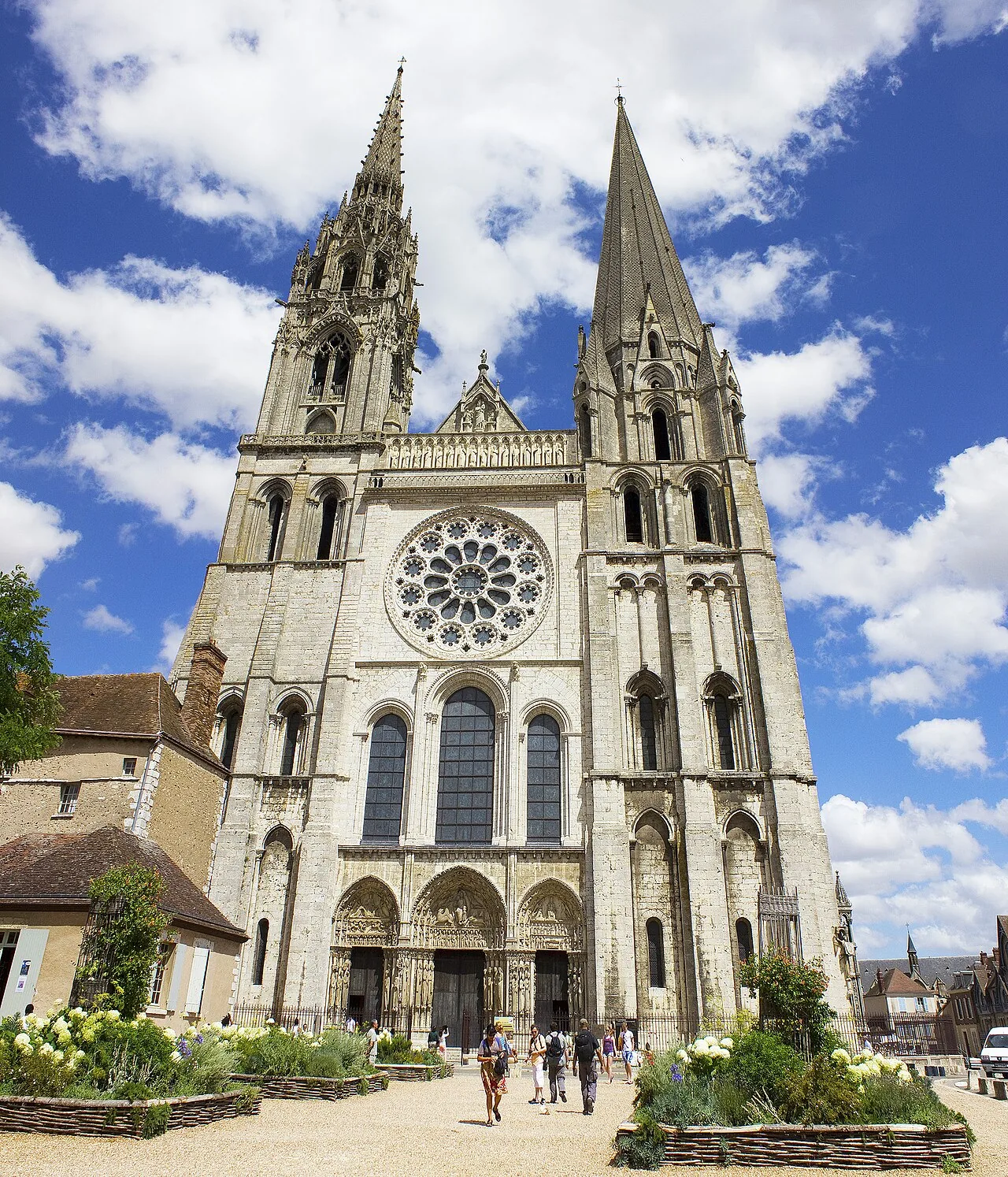
The wealth and faith of the age went into the great churches. From the 1100s builders developed the Gothic style, with pointed arches, ribbed vaults, and flying buttresses outside the walls that allowed tall walls with large windows of stained glass. Builders began Notre-Dame in Paris in 1163 and rebuilt Chartres after a fire in 1194. Thousands of people worked on a cathedral, and it took generations to finish. A cathedral was a house of worship, a meeting hall, and a pride of the town.
4. Popes, kings, and crusaders
The quarrel over bishops
Kings and popes both claimed to be the chief authority on earth. The quarrel grew sharp over the question of who should appoint bishops, because bishops held great fiefs and served the king as officials. Pope Gregory VII (pope 1073-1085) declared that only the pope could name them and could even remove an emperor. Henry IV answered in 1076 by declaring the pope deposed, and Gregory replied by excommunicating him.
Henry’s nobles took the chance to turn against him, and in the winter of 1077 he crossed the Alps and went to Canossa, where he did penance and was forgiven. Henry soon recovered his strength. The struggle ended only in 1122 with the Concordat of Worms, in which the pope invested bishops with their religious office and the emperor with their lands.
Document 3 – The penance at Canossa
[…] he came at length of his own accord, with a few followers, showing nothing of hostility or boldness, to the town of Canossa where we were tarrying. And there, having laid aside all the belongings of royalty, wretchedly, with bare feet and clad in wool, he continued for three days to stand before the gate of the castle. Nor did he desist from imploring with many tears the aid and consolation of the apostolic mercy.
Source: Pope Gregory VII, letter to the German princes about the penance of Henry IV at Canossa, 1077, in Ernest F. Henderson, Select Historical Documents of the Middle Ages (London, 1892). Text checked at archive.org/details/selecthistorical0000erne.
*apostolic mercy: the pardon of the pope. *Canossa: the castle in northern Italy where the pope was staying. *the belongings of royalty: crown, robes, and attendants.
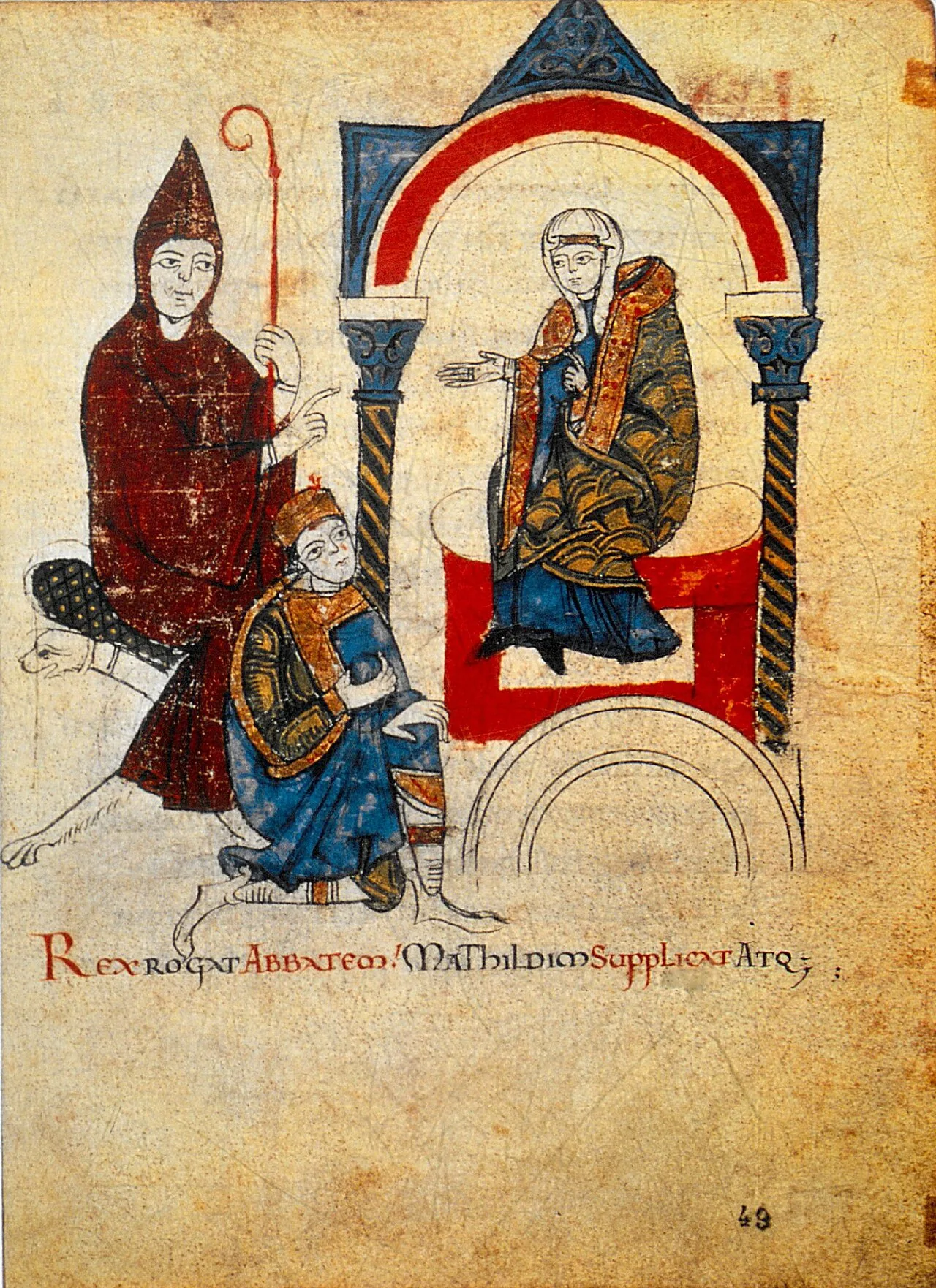
Commentary. The text is a letter from Gregory VII to the German princes, in which he explains why he forgave Henry. It tells the story from the pope’s point of view and stresses the king’s humility. Henry’s supporters told the story differently, and a monk who admired Countess Matilda, the owner of the castle, made the picture about forty years later.
The Crusades
In 1095 the Byzantine emperor Alexios asked the pope for soldiers against the Seljuk Turks, who had taken most of Asia Minor. At the Council of Clermont in France, Pope Urban II called for a holy war to help the eastern Christians and to take Jerusalem, and he promised that those who died on the journey would have their sins forgiven. Thousands of knights, nobles, and poor people took the cross.
Faith, hope for land, and the wish for adventure motivated them. The First Crusade took Jerusalem in July 1099, and the crusaders killed many of its Muslim and Jewish inhabitants. On their way, some crusaders also attacked Jewish communities in the Rhineland in 1096. The crusaders founded states in Syria and Palestine, which Muslim rulers slowly regained. Saladin recaptured Jerusalem in 1187, and the last crusader stronghold, Acre, fell in 1291.
Document 4 – The pope calls the crusade
For your brethren who live in the east are in urgent need of your help, and you must hasten to give them the aid which has often been promised them. For, as the most of you have heard, the Turks and Arabs have attacked them and have conquered the territory of Romania [the Greek empire] as far west as the shore of the Mediterranean and the Hellespont, which is called the Arm of St. George. They have occupied more and more of the lands of those Christians, and have overcome them in seven battles […] All who die by the way, whether by land or by sea, or in battle against the pagans, shall have immediate remission of sins.
Source: Urban II’s speech at the Council of Clermont, 1095, as remembered by Fulcher of Chartres, who may have been present; Internet Medieval Sourcebook, Fordham University (sourcebooks.fordham.edu/source/urban2-fulcher.asp).
*Romania: the Greek (Byzantine) empire. *Hellespont: the Dardanelles strait. *pagans: here, the pope’s word for the Turks and Arabs.
Commentary. Several people wrote down Urban’s sermon after the success of the First Crusade, and the versions differ. Fulcher of Chartres was probably at the council, but he wrote years later, after Jerusalem had been won. The speech must be read carefully, because the writer already knew how the story ended.
The Crusades had lasting effects. They increased trade between Italian cities like Venice and Genoa and the eastern Mediterranean, they brought new goods and ideas to Europe, and they left a long memory of bitterness between Christians and Muslims. In 1204 the Fourth Crusade did not reach Jerusalem but attacked and plundered Constantinople, a Christian city, which deeply weakened the Byzantine empire.
England and the law
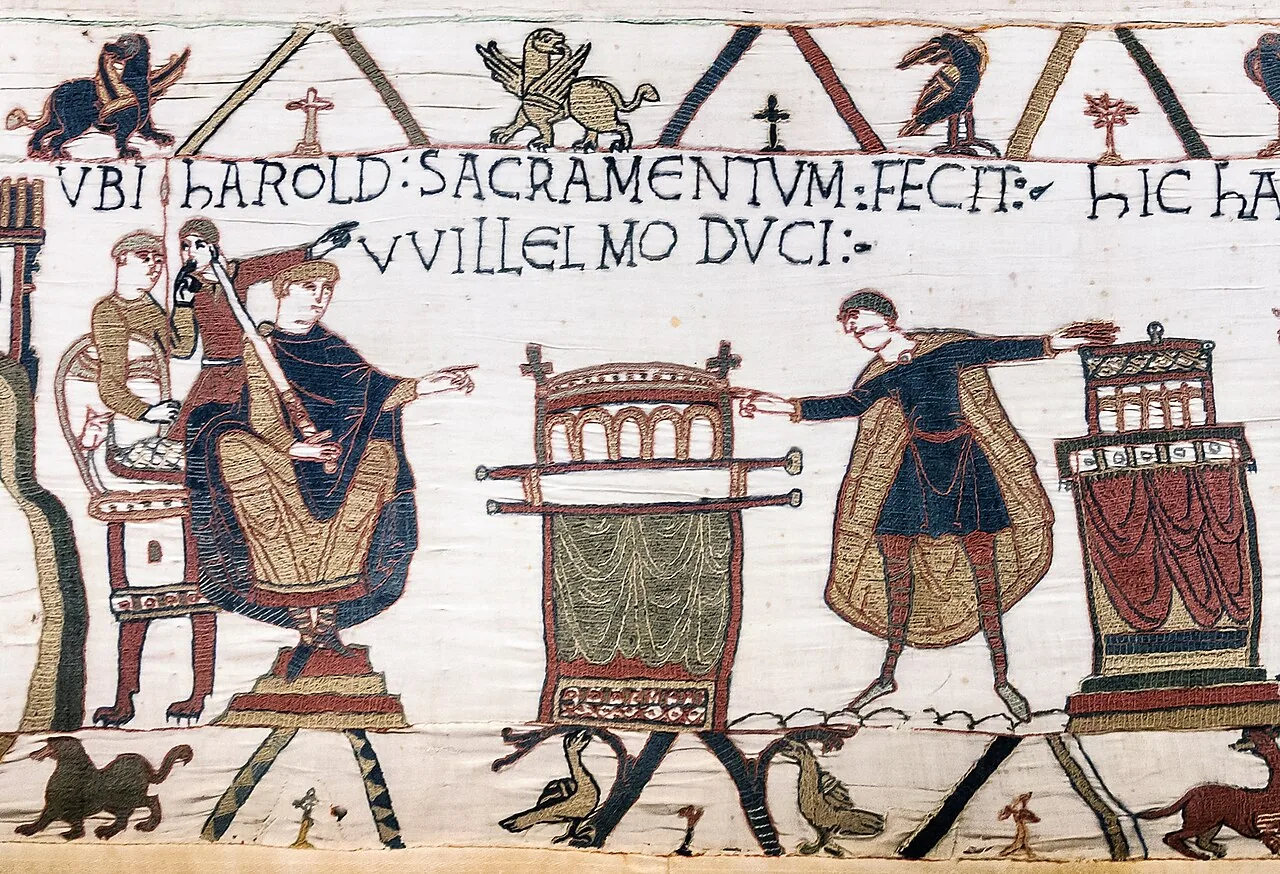
In 1066 Duke William of Normandy defeated King Harold at Hastings and became king of England. To learn what his new kingdom was worth, he ordered a survey in 1086 and had the results collected in Domesday Book. William’s successors were strong kings, but in 1215 the barons rose against King John, who had taxed them heavily and lost his lands in France.
On June 15 at Runnymede, near London, John put his seal on Magna Carta, the “Great Charter.” It was a feudal document that protected the rights of the barons and the Church, but it also said that the king himself must obey the law. The pope soon annulled it, but it was reissued several times and became a symbol of limits on royal power.
Document 5 – Magna Carta
39. No freeman shall be taken, or imprisoned, or disseized, or outlawed, or exiled, or in any way harmed—nor will we go upon or send upon him—save by the lawful judgment of his peers or by the law of the land. 40. To none will we sell, to none deny or delay, right or justice.
Source: Magna Carta, 1215, clauses 39 and 40 (clause numbers added by later editors), translated in Ernest F. Henderson, Select Historical Documents of the Middle Ages (London, 1892). Text checked at archive.org/details/selecthistorical0000erne.
*disseized: deprived of property. *outlawed: placed outside the protection of the law. *peers: equals, people of the same rank.
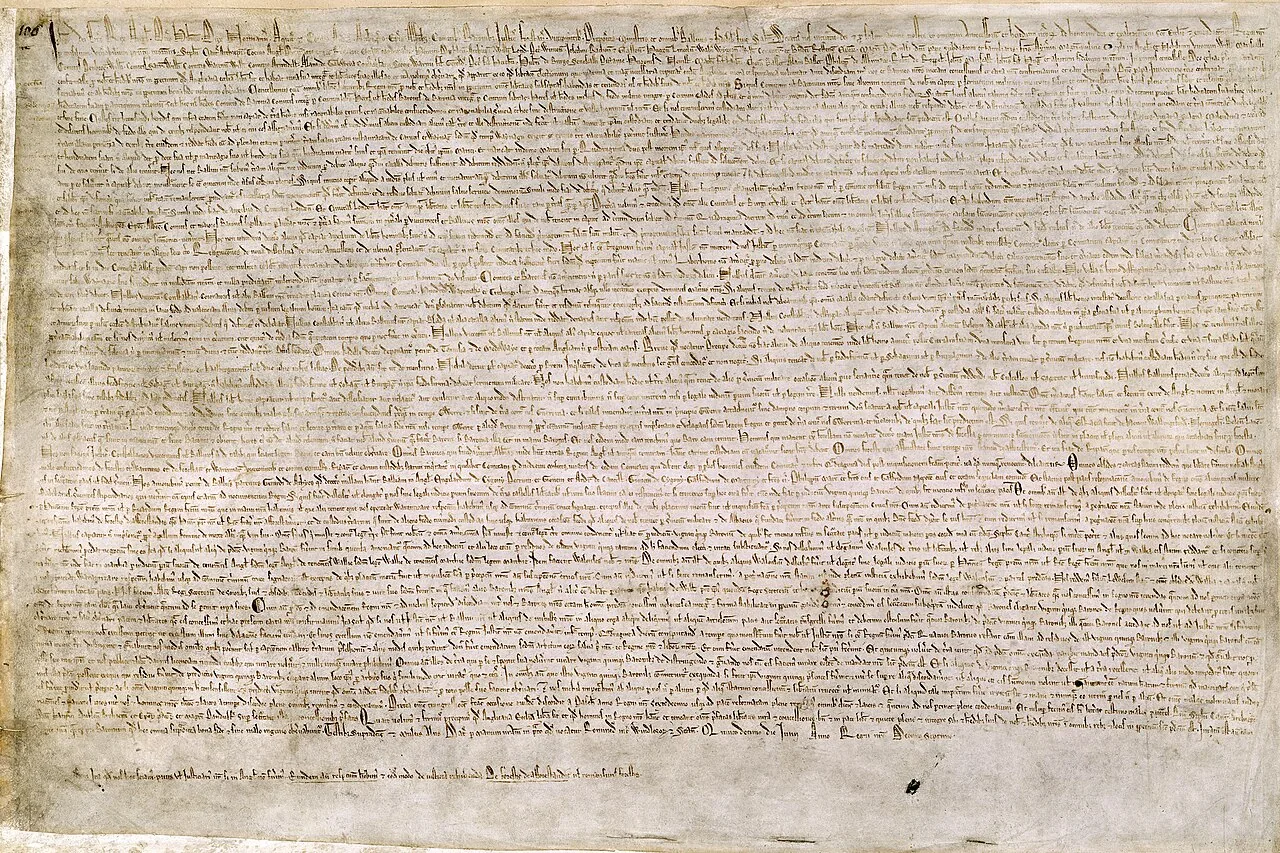
Commentary. The clauses protect “freemen,” a minority in 1215, and the “peers” who would judge them were fellow nobles. Over centuries, readers extended the words to all people, which is why the clauses became famous. The charter shows how barons and kings bargained over the limits of power.
5. Towns, trade, and the Black Death
From about 1000, towns grew along trade routes, and merchants and craftsmen formed guilds to control prices and quality. Townspeople paid their lords for charters of freedom, and in many places peasants who fled to a town for a year and a day were free. Universities appeared in Bologna, Paris, and Oxford by about 1200, and scholars debated theology and law. Europe in 1300 was richer and more populated than ever, but the land was crowded and the climate grew colder, and a great famine struck in 1315-1317.
Then came the plague. It reached Europe in October 1347, when Genoese ships arrived at Messina in Sicily from the Black Sea port of Caffa with sailors who were dying. In the following months it spread through Italy, France, and England, along the trade routes. People called it the Great Mortality, and later writers called it the Black Death. Doctors did not know the cause, which was a bacterium carried by fleas on rats. Modern estimates say that between a third and a half of the people of Europe died by 1351. Many people blamed sinners, foreigners, or Jews, and mobs attacked Jewish communities in several cities.
Document 6 – The plague in Florence
[…] towards the beginning of the spring of the said year the doleful effects of the pestilence began to be horribly apparent by symptoms that shewed as if miraculous […] Not such were they as in the East, where an issue of blood from the nose was a manifest sign of inevitable death; but in men and women alike it first betrayed itself by the emergence of certain tumours in the groin or the armpits, some of which grew as large as a common apple, others as an egg, some more, some less, which the common folk called gavoccioli. From the two said parts of the body this deadly gavocciolo soon began to propagate and spread itself in all directions indifferently.
Source: Giovanni Boccaccio, The Decameron, introduction, written about 1349-1353, translated by J. M. Rigg (London, 1903). Text checked at archive.org/details/decameron01boccuoft.
*gavoccioli: swellings, called buboes in medicine. *tumours: swellings. *the East: Asia.
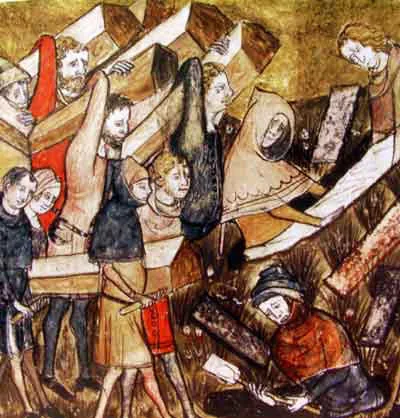
Commentary. Boccaccio was an Italian writer who lived in Florence. The introduction to his Decameron describes the plague of 1348, and he draws on what he saw and was told. He stresses the physical signs and the fear of the survivors. His account is vivid, but it is the view of an educated Italian who tells it as an introduction to a book of stories.
The effects were enormous. With so many workers dead, those who survived could ask for higher wages, lords had trouble finding labor, and serfdom began to weaken in western Europe. When governments tried to hold wages down, peasants rebelled, as in France in 1358 and in England in the Peasants’ Revolt of 1381. The Church lost some prestige because prayers did not stop the plague. Europe slowly recovered, but it was a changed society.
- 800 Charlemagne is crowned emperor
- 910 The monastery of Cluny is founded
- 1066 William of Normandy wins the battle of Hastings
- 1077 Henry IV does penance at Canossa
- 1095 Urban II calls the First Crusade at Clermont
- 1099 The crusaders take Jerusalem
- 1194 Fire destroys much of Chartres cathedral; rebuilding begins
- 1215 King John seals Magna Carta
- 1291 Acre, the last crusader stronghold, falls
- 1347 The Black Death reaches Europe
- 1381 The Peasants’ Revolt in England
Key takeaways
- Feudalism was a system of mutual promises between lords and vassals, built on land, loyalty, and military service.
- Most people were peasants, and many were serfs who lived on manors and owed work to their lords and the tithe to the Church.
- The Catholic Church guided daily life, ran schools and hospitals, built Gothic cathedrals, and had its own law and its own weapon of excommunication.
- Popes and kings struggled over power, as at Canossa in 1077, and the Crusades, which began in 1095, joined the energy of the Church and the knights.
- In England, Domesday Book (1086) and Magna Carta (1215) show a strong monarchy and the first limits on it.
- The Black Death (1347-1351) killed a third to a half of Europe, raised wages, and helped end serfdom.

Quick review: flashcards
Tap a card to see the answer.