


This Grade 7 Medieval and Early Modern World lesson covers The Mongol Empire, part of the unit “Medieval Europe and Asia.” First, read the full lesson with its primary sources, maps and key terms. Then practice with the worksheet, check yourself with the quiz and get ready with the test.
In the spring of 1206, on a grassy plain near the Onon River in what is now Mongolia, chiefs from many tribes gathered under white banners. They proclaimed a man named Temujin their supreme ruler, Genghis Khan. He was about forty-four years old. Seventy-five years later, his grandsons and great-grandsons ruled lands from Korea to Hungary and from Siberia to the Persian Gulf. It was the largest land empire in history, covering roughly nine million square miles at its height. Its horsemen destroyed cities and killed thousands of people, and its peace opened roads between East and West. In this chapter you will study how the Mongols rose, fought, and ruled, and how they changed the world.
Guiding question: How did a people of the steppe build the largest land empire in history, and what effects did Mongol conquest and Mongol peace have on Asia and Europe?
1. The rise of Genghis Khan
People of the steppe
The Mongols came from the steppe, the great belt of grassland that stretches across Asia from Manchuria to Hungary. The land is too dry and too cold for farming. So the people were nomads who followed their herds of sheep, goats, horses, cattle, and camels from one pasture to the next. They lived in round felt tents called gers, drank mare’s milk, and learned to ride before they could walk. Boys learned to shoot a bow from a galloping horse. The Mongols were divided into tribes and clans that raided and fought each other. A strong leader was called a khan.
Definition: Nomad
A person who moves from place to place with herds of animals instead of living in one village or town. The nomads of the Asian steppe lived by herding and horse riding.
Temujin becomes Genghis Khan
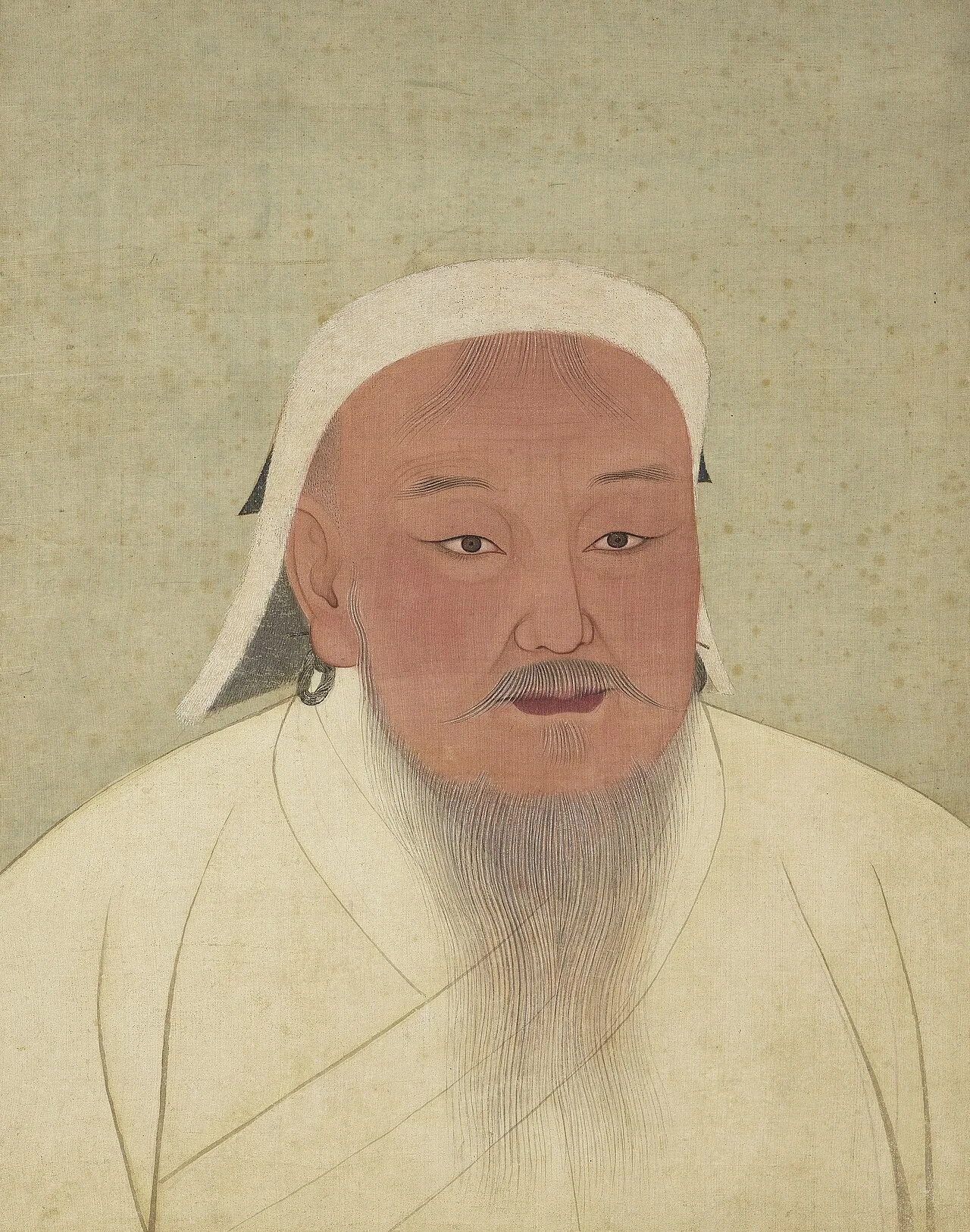
Temujin was born about 1162 into a family of minor chiefs. His father was poisoned when he was a boy. The family was abandoned and lived on roots and small game. As a young man he gathered followers, made alliances, and defeated rival tribes one by one. Often he broke the old rule that conquered tribes must be wiped out and instead added them to his own people.
In 1206 a great assembly called a kurultai gave him the title Genghis Khan. Most scholars translate it as “universal ruler.” He then reorganized the Mongols into units based on loyalty and ability rather than on clan. He also ordered a written alphabet for the Mongol language and a code of law known as the Yassa.
Document 1 – How the Tartars chose a king
Some time after the migration of the Tartars to this place, and about the year of our Lord 1162, they proceeded to elect for their king a man named Chingis-khan, one of approved integrity, great wisdom, commanding eloquence, and eminent for his valor. He began his reign with so much justice and moderation, that he was beloved and revered as their deity rather than their sovereign; and as the fame of his great and good qualities spread over that part of the world, all the Tartars, however dispersed, placed themselves under his command.
Source: Marco Polo, Travels, Book 1, chapter 45 (written about 1298), translated by William Marsden (1818), Internet Medieval Sourcebook, Fordham University (sourcebooks.fordham.edu/halsall/source/mpolo44-46.asp).
*Chingis-khan: Genghis Khan. *Tartars: Mongols. *integrity: honesty. *valor: bravery.
Commentary. Marco Polo wrote this account in about 1298, some seventy years after Genghis’s death, from stories that he heard in Asia. He gets the general outline right: the Mongols were herders who chose a ruler of great ability and fame who united them. But he gives the wrong date (1162 is about the year of Temujin’s birth, not of his election, which was in 1206). He also confuses the facts about the earlier ruler he calls Un-khan, who was not Prester John. The text is useful as a European view of the Mongols but not as an exact record.
2. The Mongol army and the conquests
A deadly army
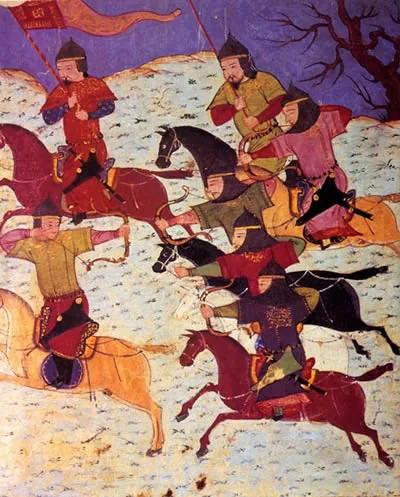
The Mongol army was the best of its time. Every man between about fifteen and sixty was a warrior. Each fighter had several horses so that he could change mounts and ride great distances in a day. The soldiers fought with a short composite bow, made of wood, horn, and sinew. It was powerful enough to shoot arrows more than a hundred yards. The army was organized in groups of ten, one hundred, one thousand, and ten thousand, and discipline was strict.
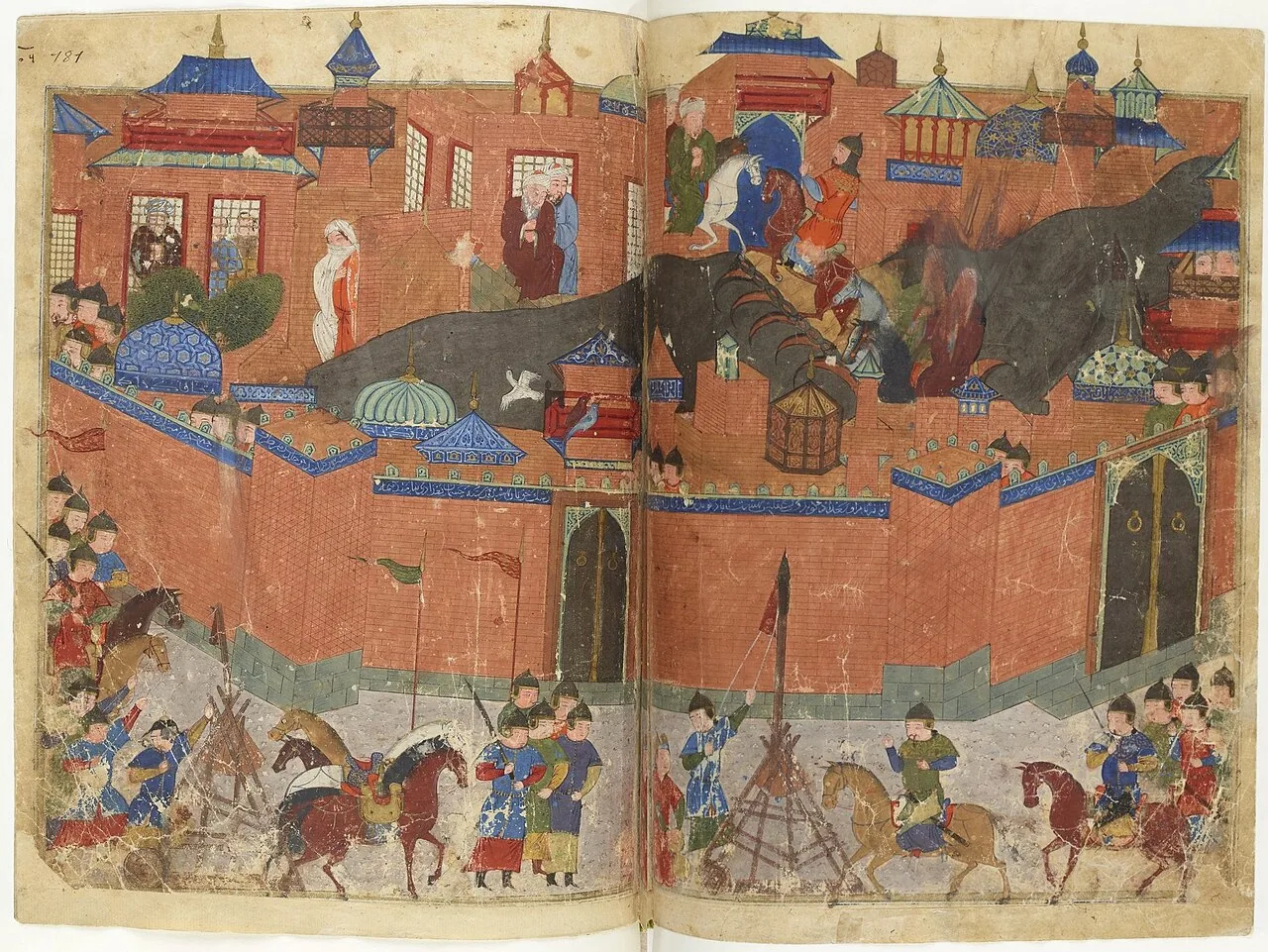
Commanders used scouts and spies and kept in touch by messengers and flags. They also used tricks such as a feigned retreat to draw enemies out of strong positions. When they met walled cities, they hired Chinese and Muslim engineers who built catapults and siege engines. They also used terror. Cities that resisted were often destroyed and their people killed, while cities that gave up quickly were usually spared.
Definition: Composite bow
A bow made of layers of wood, horn, and sinew glued together. It was short enough to be used on horseback but could shoot arrows with great power.
Conquest in every direction
Genghis Khan first attacked northern China, ruled by the Jin dynasty, and took its capital, near modern Beijing, in 1215. Then the Mongols turned west. In 1219 the shah of Khwarazm, who ruled Central Asia and Iran, killed Mongol merchants and envoys. The Mongols answered with an invasion. They took Bukhara and Samarkand in 1220 and destroyed the cities of Merv and Nishapur the next year. Chroniclers gave enormous numbers for the dead, and modern historians think these numbers are exaggerated. But there is no doubt that Central Asia suffered a terrible blow. Genghis died in 1227 while campaigning in northern China, and the empire went on growing.
His son Ogedei, the second great khan, built a capital at Karakorum about 1235. Under him, his nephew Batu and the general Subutai crossed Russia and burned the city of Kiev in 1240. In 1241 they defeated armies of Poles and Germans at Legnica and of Hungarians a few days later. Then, in 1242, they withdrew, probably because Ogedei had died and the leaders wanted to choose a successor. In 1258 Hulagu, a grandson of Genghis, captured Baghdad, the capital of the Abbasid caliphs, and killed the caliph. The Mongols were stopped for the first time in 1260 at Ain Jalut in Palestine. There a Muslim army of the Mamluks of Egypt defeated them.
Document 2 – A European monk describes the Tartars
Swarming like locusts over the face of the earth, they have brought terrible devastation to the eastern parts (of Europe), laying them waste with fire and carnage. After having passed through the land of the Saracens, they have razed cities, cut down forests, overthrown fortresses, pulled up vines, destroyed gardens, killed townspeople and peasants […] They are without human laws, know no comforts, are more ferocious than lions or bears, have boats made of ox-hides which ten or twelve of them own in common; they are able to swim or manage a boat, so that they can cross the largest and swiftest rivers without let or hindrance, drinking turbid and muddy water when blood fails them (as a beverage). They have one-edged swords and daggers, are wonderful archers, spare neither age, nor sex, nor condition.
Source: Matthew Paris, Chronica Majora, entry for the year 1240, as translated in Edward G. Browne, A Literary History of Persia, vol. 3 (Cambridge, 1920), pp. 6-8. Text checked at archive.org/details/literaryhistoryo03brow.
*Tartars: the Mongols; Europeans linked the name to Tartarus, the underworld of Greek myth. *Saracens: the word used by medieval Europeans for Muslims. *razed: leveled to the ground.
Commentary. Matthew Paris was an English monk of St. Albans who kept a chronicle. He never saw a Mongol, and his sources were rumors and letters from Europeans who had heard of the attacks on Russia and Hungary. The text shows fear and ignorance: he thinks that the Mongols come from Tartarus, the underworld, and that they drink blood. It is useful as evidence of what Europeans felt, but it is not an accurate description of the Mongols.
3. The Mongol peace
After the conquests the Mongols ruled their huge lands with remarkable order. The empire was soon too big for one ruler. After the death of the great khan Mongke in 1259 it split into four parts, called khanates. The Yuan khanate in China and Mongolia, ruled by Kublai Khan, was the richest. The Golden Horde ruled Russia from the Volga. The Chagatai khanate held Central Asia, and the Ilkhanate held Persia and Iraq. Mongol rulers hired talented people from all conquered lands, such as Chinese officials, Persian secretaries, and European craftsmen. The Mongols usually allowed religious freedom, and in their courts lived Buddhists, Muslims, Christians, and followers of shamanism.
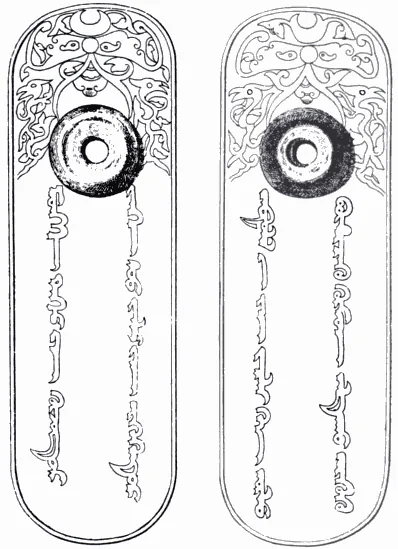
The Mongols also created a safe road system in the 1200s and 1300s. Historians call it the Pax Mongolica, the Mongol peace. A messenger system called the yam had relay stations with fresh horses along the main roads. Travelers with a paiza, a metal tablet of authority, could get food, horses, and shelter. Merchants could cross Asia from the Black Sea to China with less danger from bandits than before. Silk, spices, porcelain, and paper flowed west; horses, silver, and Central Asian goods flowed east. Along with goods went ideas and inventions, such as gunpowder weapons, printing, and paper money. These spread from China toward Persia and Europe.
Definition: Pax Mongolica
The “Mongol peace,” the period in the 1200s and 1300s when Mongol rule made trade and travel across Asia safer than before.
Document 3 – The palace at Karakorum
[…] master William the Parisian had made for him a great silver tree, and at its roots are four lions of silver, each with a conduit through it, and all belching forth white milk of mares. And four conduits are led inside the tree to its tops, which are bent downward, and on each of these is also a gilded serpent, whose tail twines round the tree. And from one of these pipes flows wine, from another caracosmos, or clarified mare’s milk, from another bal, a drink made with honey, and from another rice mead, which is called terracina; and for each liquor there is a special silver bowl at the foot of the tree to receive it.
Source: William of Rubruck, report of his journey to the Mongols, 1253-1255, translated by W. W. Rockhill, The Journey of William of Rubruck to the Eastern Parts of the World (Hakluyt Society, London, 1900), p. 208. Text checked at archive.org/details/journeyofwilliam00ruys_0.
*caracosmos: kumiss, fermented mare’s milk. *terracina: rice wine. *master William the Parisian: William Boucher, a goldsmith from Paris who worked at the Mongol court.
Commentary. William of Rubruck was a Flemish friar sent by King Louis IX of France to the Mongols. He reached Karakorum in 1254. He writes as an eyewitness. The details of a silver tree built by a Parisian goldsmith show that the khans hired craftsmen from Europe. But he was a missionary who wanted to convert the khan, and he describes the Mongols with curiosity and some disapproval. His report was valuable to historians because it is a careful description by a visitor.
4. Kublai Khan and the Yuan dynasty
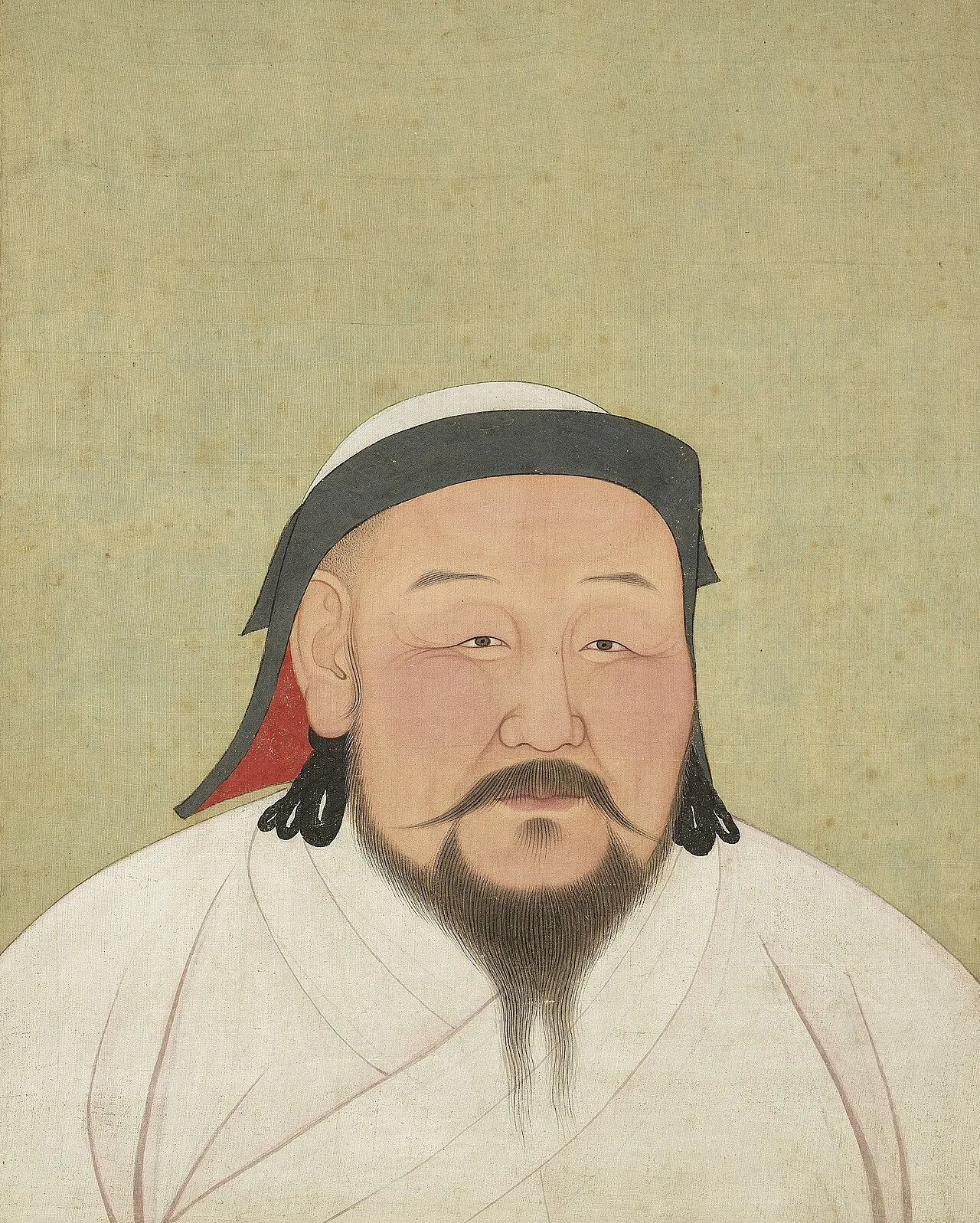
Kublai Khan, a grandson of Genghis, became great khan in 1260. He moved his capital from Karakorum to a new city, called Khanbaliq, “the city of the khan.” It stood on the site of modern Beijing. In 1271 he took the Chinese dynastic name Yuan. In 1279 his armies finished the conquest of the Song dynasty in southern China. For the first time, foreigners ruled all of China.
Kublai tried to rule as a Chinese emperor and kept many Chinese customs. But he gave the highest offices to Mongols and to foreigners, such as Persians and Central Asians, and not to Chinese scholars. He built roads and canals, supported trade, and used paper money. His armies attacked Japan twice, in 1274 and 1281, and the invasions of Vietnam, Burma, and Java had mixed results.
Document 4 – Money made of bark
He makes them take of the bark of a certain tree, in fact of the Mulberry Tree, the leaves of which are the food of the silkworms,–these trees being so numerous that whole districts are full of them. What they take is a certain fine white bast or skin which lies between the wood of the tree and the thick outer bark, and this they make into something resembling sheets of paper, but black […] With these pieces of paper, made as I have described, he causes all payments on his own account to be made; and he makes them to pass current universally over all his kingdoms and provinces and territories, and whithersoever his power and sovereignty extends. And nobody, however important he may think himself, dares to refuse them on pain of death.
Source: Marco Polo, Travels, Book 2, chapter 24 (written about 1298), translated by Henry Yule, The Book of Ser Marco Polo, 3rd ed. (London, 1903), vol. 1. Text checked at gutenberg.org/ebooks/10636.
*Cambaluc: Khanbaliq, the Mongol capital, now Beijing. *tornesel and groat: small coins of Europe. *bast: the inner bark of a tree.
Commentary. Marco Polo, a merchant from Venice, spent many years in Asia and served Kublai Khan. He wrote his book with a writer named Rustichello while a prisoner in Genoa. His description of paper money is accurate in outline: the Yuan government issued paper notes and forced people to accept them. But Polo thinks that it is a kind of magic (“alchemy”). He never mentions that the Chinese had used paper money since the Song dynasty. Later governments printed too many notes and prices rose, which damaged trust in paper money.
5. Decline and legacy
By about 1300, the Mongol empire was weakening. The khanates fought each other, and rulers in Persia and Central Asia became Muslims. In China the Yuan rulers lost the support of the people as taxes rose, floods ruined fields, and paper money lost its value. A rebellion led by a peasant named Zhu Yuanzhang drove the Mongols out in 1368 and began the Ming dynasty. In Russia the Golden Horde collected tribute from the Russian princes until 1480, when Ivan III refused to pay.
The Mongol legacy
The Mongols left a mixed legacy. Their conquests destroyed cities, canals, and libraries and killed many people. They left lands such as Iraq and parts of Central Asia poorer for a long time. But the Mongol peace linked the continents. It carried Chinese inventions to the west and Persian astronomers and doctors to the east. It also brought Europe the news of China that Marco Polo and others wrote.
Some historians believe that the trade routes of the Mongol world helped the plague bacterium that caused the Black Death to travel from Asia to the Black Sea. From there it reached Europe in 1347, although the early history of the plague is still debated. In Russia, the period of Mongol control, called the “Tatar yoke,” helped make Moscow the leading Russian city.
- 1206 Temujin is proclaimed Genghis Khan
- 1215 The Mongols capture the Jin capital in northern China
- 1220 The Mongols take Bukhara and Samarkand
- 1227 Genghis Khan dies
- 1235 Karakorum becomes the capital
- 1240 The Mongols burn Kiev
- 1241 The Mongols defeat Poles, Germans, and Hungarians
- 1258 The Mongols capture Baghdad
- 1260 The Mamluks defeat the Mongols at Ain Jalut; Kublai becomes great khan
- 1271 Kublai Khan founds the Yuan dynasty
- 1279 The Mongols complete the conquest of the Song
- 1368 The Ming dynasty replaces the Yuan
- 1480 The Golden Horde’s rule over Russia ends
Key takeaways
- The Mongols were nomads of the steppe who were united by Genghis Khan in 1206.
- Their army was fast, disciplined, and organized, using mounted archers, siege engineers, and terror.
- Mongol conquests reached from Korea to Hungary and destroyed cities such as Bukhara, Kiev, and Baghdad.
- After Mongke died in 1259 the empire split into four khanates: the Yuan, the Golden Horde, the Chagatai, and the Ilkhanate.
- The Pax Mongolica made trade and travel safer across Asia and carried goods and ideas between East and West.
- Kublai Khan founded the Yuan dynasty in China (1271), but the Mongols lost China in 1368 and the empire faded.

Quick review: flashcards
Tap a card to see the answer.