


This Grade 7 Medieval and Early Modern World test covers The Mongol Empire. Like a classroom assessment, it includes documents to analyze, knowledge questions and a short writing task. To prepare, review the lesson first, then practice with the worksheet.
Time : 50 min
The test has three parts: knowledge (32 points), documents (48 points), and a written argument (20 points). Answer in complete sentences and cite the documents.
Document 1 – The Mongol Empire
Schematic map prepared for this unit; borders approximate.
Document 2 – Kublai Khan
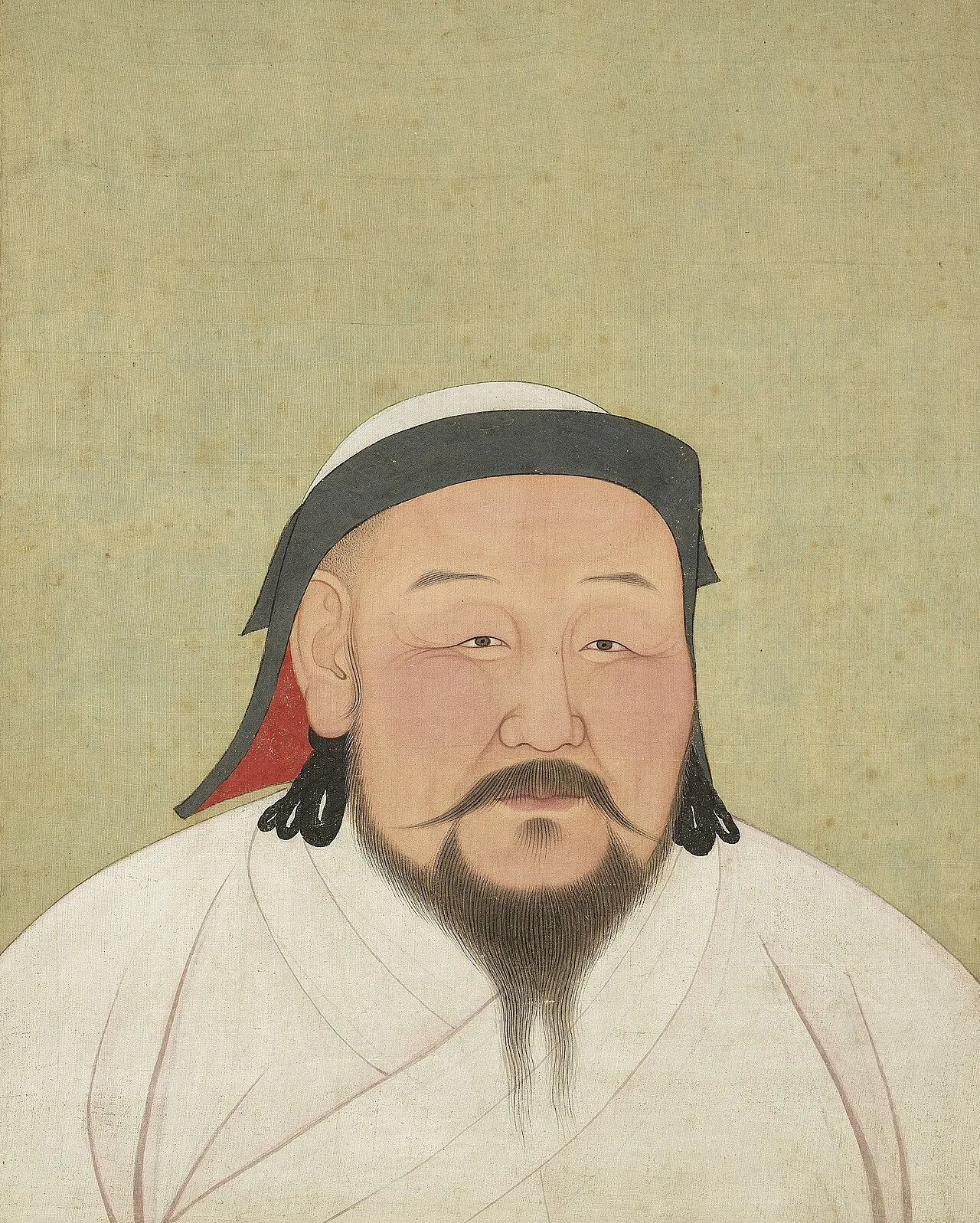
Wikimedia Commons; National Palace Museum, Taipei.
Document 3 – Paper money in the Mongol Empire
He makes them take of the bark of a certain tree, in fact of the Mulberry Tree, the leaves of which are the food of the silkworms,–these trees being so numerous that whole districts are full of them. What they take is a certain fine white bast or skin which lies between the wood of the tree and the thick outer bark, and this they make into something resembling sheets of paper, but black […] With these pieces of paper, made as I have described, he causes all payments on his own account to be made; and he makes them to pass current universally over all his kingdoms and provinces and territories, and whithersoever his power and sovereignty extends. And nobody, however important he may think himself, dares to refuse them on pain of death.
Source: Marco Polo, Travels, Book 2, chapter 24 (written about 1298), translated by Henry Yule, The Book of Ser Marco Polo, 3rd ed. (London, 1903), vol. 1. Text checked at gutenberg.org/ebooks/10636.
*Cambaluc: Khanbaliq, the Mongol capital, now Beijing. *tornesel and groat: small coins of Europe. *bast: the inner bark of a tree.
Marco Polo, <em>Travels</em>, Book 2, chapter 24, translated by Henry Yule (1903).
Document 4 – Key dates
- 1206 Temujin is proclaimed Genghis Khan.
- 1220 The Mongols take Bukhara and Samarkand.
- 1240 The Mongols burn Kiev.
- 1258 The Mongols capture Baghdad.
- 1271 Kublai founds the Yuan dynasty.
- 1279 The Song are conquered.
- 1368 The Ming drive out the Mongols.
Dates as given in standard reference works such as the Cambridge History of Inner Asia.
Questions
- Part 1 – Knowledge. Define nomad, khan, and Pax Mongolica. (12 pts)
- Part 1. Document 1: name the capital of the Mongol Empire shown on the map, the khanate that ruled Persia and Iraq, and the city captured by Hulagu in 1258. (12 pts)
- Part 1. Name two reasons why the Mongol army was so successful and explain one of them. (8 pts)
- Part 2 – Documents. Document 2: present the document, describe what you see, and explain what the portrait suggests about how the Yuan court wanted Kublai to be seen. (14 pts)
- Part 2. Document 3: present the document, say how the paper money is made, and explain what it shows about the power of the khan. (14 pts)
- Part 2. Document 4: calculate how many years passed between 1206 and 1258, between 1258 and 1279, and between 1279 and 1368. (10 pts)
- Part 2. Using Document 3, Document 4, and the lesson, explain two ways in which Mongol rule helped trade and travel across Asia. (10 pts)
- Part 3 – Written argument. How did the Mongols build and rule their empire, and how did it change Asia and Europe? Write a paragraph or two with a claim, at least two pieces of evidence from the documents or the lesson, and your reasoning. (20 pts)


Quick review: flashcards
Tap a card to see the answer.