


This Grade 7 Medieval and Early Modern World test covers Feudal Europe and the Medieval Church. Like a classroom assessment, it includes documents to analyze, knowledge questions and a short writing task. To prepare, review the lesson first, then practice with the worksheet.
Time : 50 min
The test has three parts: knowledge (32 points), documents (48 points), and a written argument (20 points). Answer in complete sentences and cite the documents.
Document 1 – Medieval Europe
Schematic map prepared for this unit.
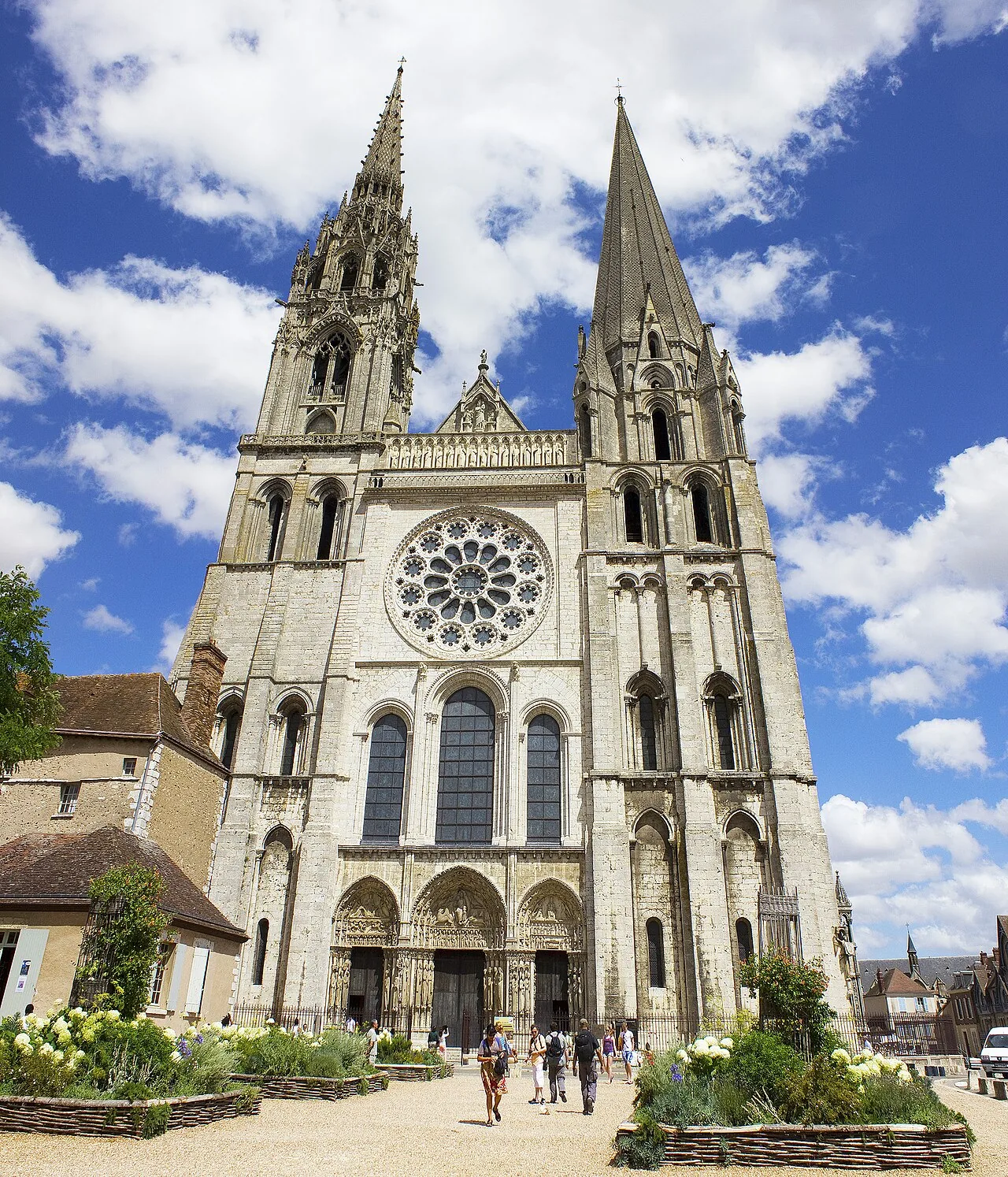
Document 2 – Chartres Cathedral
Wikimedia Commons.
Document 3 – Fulbert on feudal duties
He who swears fealty to his lord ought always to have these six things in memory; what is harmless, safe, honorable, useful, easy, practicable. […] However, that the faithful vassal should avoid these injuries is proper, but not for this does he deserve his holding; for it is not sufficient to abstain from evil, unless what is good is done also. It remains, therefore, that in the same six things mentioned above he should faithfully counsel and aid his lord, if he wishes to be looked upon as worthy of his benefice and to be safe concerning the fealty which he has sworn.
Source: Fulbert, bishop of Chartres, letter to William, duke of Aquitaine, 1020, “On Feudal Obligations,” Internet Medieval Sourcebook, Fordham University (sourcebooks.fordham.edu/source/fulbert1.asp).
*fealty: the oath of loyalty of a vassal. *benefice: a grant of land, or fief, held in return for service. *vassal: a man who held land from a lord and owed him service.
Letter of Fulbert of Chartres to the duke of Aquitaine, 1020 (Internet Medieval Sourcebook, Fordham University).
Document 4 – Key dates
- 800 Charlemagne is crowned emperor.
- 1066 Battle of Hastings.
- 1077 Henry IV does penance at Canossa.
- 1095 Urban II calls the First Crusade.
- 1215 Magna Carta.
- 1347 The Black Death reaches Europe.
- 1381 The Peasants’ Revolt.
Dates as given in standard reference works such as the Cambridge Medieval History.
Questions
- Part 1 – Knowledge. Define feudalism, serf, and excommunication. (12 pts)
- Part 1. Document 1: name the city where the pope lived, the English town near which William won in 1066, and the town where Henry IV did penance. (12 pts)
- Part 1. Name two features of Gothic cathedrals and explain one of them. (8 pts)
- Part 2 – Documents. Document 2: present the document, describe what you see, and explain why a town spent so much money on a cathedral. (14 pts)
- Part 2. Document 3: present the document, say what a vassal must do, and explain what the lord must do in return. (14 pts)
- Part 2. Document 4: calculate how many years passed between 800 and 1066, between 1077 and 1215, and between 1347 and 1381. (10 pts)
- Part 2. Using Document 3, Document 4, and the lesson, explain two ways in which the Church and the kings competed for power. (10 pts)
- Part 3 – Written argument. How did feudalism and the Catholic Church organize medieval European society? Write a paragraph or two with a claim, at least two pieces of evidence from the documents or the lesson, and your reasoning. (20 pts)


Quick review: flashcards
Tap a card to see the answer.