


This Grade 7 Medieval and Early Modern World test covers The Americas: Maya, Aztec and Inca. Like a classroom assessment, it includes documents to analyze, knowledge questions and a short writing task. To prepare, review the lesson first, then practice with the worksheet.
Time : 50 min
The test has three parts: knowledge (32 points), documents (48 points), and a written argument (20 points). Answer in complete sentences and cite the documents.
Document 1 – Cortés marches to Tenochtitlan
Map prepared for this unit from Natural Earth coastlines; boundaries are approximate.
Document 2 – The founding of Tenochtitlan
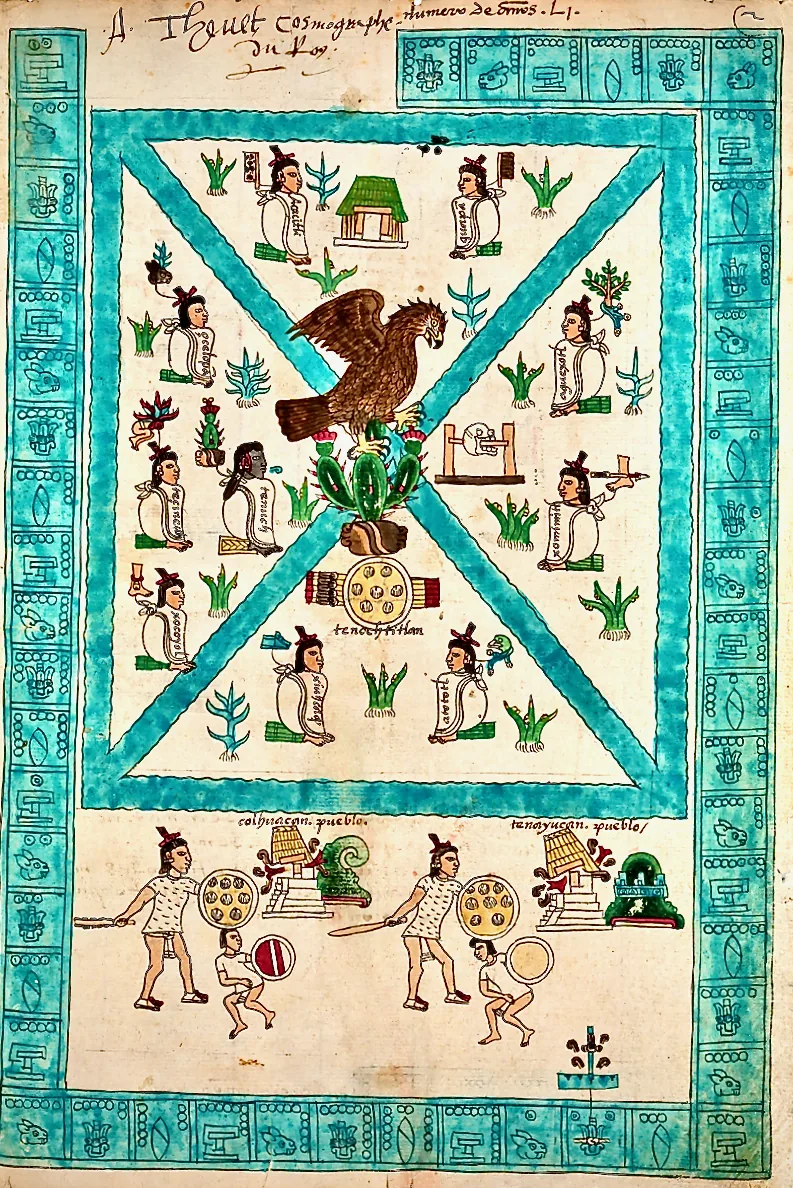
Codex Mendoza, first page, about 1541, Bodleian Library, Oxford.
Document 3 – The city in 1520
This great city of Temixtitan is built on the salt lake, and from the mainland to the city is a distance of two leagues, from any side from which you enter. It has four approaches by means of artificial causeways, two cavalry lances in width. The city is as large as Seville or Cordoba. […] Its streets (I speak of the principal ones) are very broad and straight, some of these, and all the others, are one half land, and the other half water on which they go about in canoes.
Source: Hernán Cortés, Second Letter to Emperor Charles V, 30 October 1520, on Tenochtitlan; translated by J. Bayard Morris, ed. in Letters of Cortés, tr. F. A. MacNutt (New York, 1908).
*Temixtitan: Tenochtitlan. *Seville, Córdoba: large cities of Spain.
Hernán Cortés, Second Letter to Charles V, 1520.
Document 4 – Key dates
- 1325 Tenochtitlan founded (traditional date)
- 1428 Triple Alliance
- 1519 Cortés lands in Mexico
- 1521 Fall of Tenochtitlan
- 1532 Pizarro at Cajamarca
- 1533 Atahualpa executed
Dates from reference works; the founding date is traditional.
Questions
- Part 1 – Knowledge. Define tribute, chinampa, and quipu. (12 pts)
- Part 1. Document 1: name the city the arrow points to, name the Gulf coast city where the route begins, and say what the green area shows. (12 pts)
- Part 1. Name two achievements of the Maya and explain one of them. (8 pts)
- Part 2 – Documents. Document 2: present the document, say what the eagle on the cactus stands for, and explain why historians must use this source carefully. (14 pts)
- Part 2. Document 3: present the document, say how the writer describes the city and its approaches, and explain how this helps us understand why the Spaniards were impressed. (14 pts)
- Part 2. Document 4: calculate how many years passed between 1325 and 1521, between 1519 and 1521, and between 1521 and 1533. (10 pts)
- Part 2. Using Document 1, Document 4, and the lesson, explain two reasons why Cortés could conquer an empire of millions with a few hundred men. (10 pts)
- Part 3 – Written argument. Compare the Aztec and Inca empires: how did each govern its people, and what weaknesses did each have when the Spaniards arrived? Write a paragraph or two with a claim, at least two pieces of evidence, and your reasoning. (20 pts)


Quick review: flashcards
Tap a card to see the answer.