


This worksheet on The Americas: Maya, Aztec and Inca belongs to the Grade 7 Medieval and Early Modern World course. Its questions use primary sources, maps and timelines, and they move from basic recall to short writing tasks. Before you start, review the lesson; afterward, try the true or false quiz.
Exercise 1 : Vocabulary of the early Americas
Define each term in one sentence, then use it in a sentence about the Maya, the Aztec, or the Inca.
- city-state
- chinampa
- tribute
- quipu
- conquistador
- mit’a
Hint: look at the lesson’s definition boxes and the sections on the Aztec and the Inca.
Exercise 2 : Arriving at Tenochtitlan
Document 1 – Arriving at Tenochtitlan
The next day, in the morning, we arrived at a broad Causeway, and continued our march towards Iztapalapa, and when we saw so many cities and villages built in the water and other great towns on dry land and that straight and level causeway going towards Mexico, we were amazed and said that it was like the enchantments they tell of in the legend of Amadis, on account of the great towers and cues and buildings rising from the water, and all built of masonry.
Source: Bernal Díaz del Castillo, The True History of the Conquest of New Spain, written about 1568 by a soldier of Cortés, describing the entry into the Valley of Mexico in November 1519; translated by A. P. Maudslay (Hakluyt Society, 1908-1916), vol. 2.
*cues: temples. *Amadis: a hero of a Spanish medieval romance of chivalry.
- Present the document (nature, author, date, context).
- What did the Spanish soldiers see as they marched along the causeway?
- To what did they compare the sight, and why?
- What does the author say about the buildings?
- Bernal Díaz wrote this about fifty years after the events. How might that affect his account?
Exercise 3 : The great market
Document 2 – Cortés describes the market of Tenochtitlan
Each kind of merchandise is sold in its respective street, and they do not mix their kinds of merchandise of any species; thus they preserve perfect order. Everything is sold by a kind of measure, and, until now, we have not seen anything sold by weight. There is in this square a very large building, like a Court of Justice, where there are always ten or twelve persons, sitting as judges, and delivering their decisions upon all cases which arise in the markets. There are other persons in the same square who go about continually among the people, observing what is sold, and the measures used in selling, and they have been seen to break some which were false.
Source: Hernán Cortés, Second Letter to Emperor Charles V, 30 October 1520, on Tenochtitlan; translated by J. Bayard Morris, ed. in Letters of Cortés, tr. F. A. MacNutt (New York, 1908).
*Court of Justice: a law court.
- Present the document.
- List two things that show the market was well organized.
- What officials did Cortés notice, and what did they do?
- Cortés wanted to impress the emperor of Spain. How might this affect his description?
- What does this document suggest about the Aztec economy and government?
Exercise 4 : Knots that kept the books
Document 3 – How Inca officials reported to the Sapa Inca
The way of making these reports to the Ynca, or to those of his Supreme Council, was by means of knots, made on cords of various colours, by which means the signification was made out, as by letters. The knots of such and such colours denoted that such and such crimes had been punished, and small threads of various colours attached to the thicker cords signified the punishment that had been inflicted, and in this way they supplied the want of letters.
Source: Garcilaso de la Vega, el Inca, Royal Commentaries of the Incas, Part I (Lisbon, 1609), on government records; translated by Clements R. Markham (Hakluyt Society, 1869-1871).
*Ynca: Inca (the ruler).
- Present the document (nature, author, date, context). Why can the author claim to know Inca customs?
- How did officials report to the Inca ruler?
- What did the colors of the cords and threads show?
- What does the author mean by “they supplied the want of letters”?
- Garcilaso was writing in Spain fifty years after the conquest. Why should we check his claims?
Exercise 5 : The town of Cajamarca
Document 4 – A Spanish secretary describes Cajamarca
This town which is the principal place in the valley, is situated on the skirts of a mountain, and there is a league of open plain in front of it. Two rivers flow through the valley, which is level, and well peopled, and surrounded by mountains. The town had two thousand inhabitants. At its entrance there were two bridges, because two rivers flow past. The plaza is larger than any in Spain, surrounded by a wall, and entered by two doorways which open upon the streets of the town. The houses are more than two hundred paces in length, and very well built, being surrounded by strong walls, three times the height of a man.
Source: Francisco de Xerez, secretary of Pizarro, True Account of the Conquest of Peru (Seville, 1534), on the town of Cajamarca in 1532; translated by Clements R. Markham (Hakluyt Society, 1872).
- Present the document.
- Describe the town according to the author.
- Which details show that Cajamarca was an important and well-built place?
- What event took place in this plaza in November 1532?
- The author was secretary to Francisco Pizarro. What bias might he have?
Exercise 6 : Where the Inca came from
Document 5 – An Inca legend of origin
Seeing the human race in the condition I have described, had compassion upon them, and sent down from heaven to the earth a son and daughter to instruct them in the knowledge of our Father the Sun, that they might adore Him, and adopt Him as their God; also to give them precepts and laws by which to live as reasonable and civilised men.
Source: Garcilaso de la Vega, el Inca, Royal Commentaries of the Incas, Part I (1609), the origin legend told to the author by an Inca uncle; translated by Clements R. Markham (Hakluyt Society).
*Ynca: Inca. *compassion: pity.
- Present the document. Who told the story to the author?
- Whom did the Sun send down to Earth, and why?
- What did the Sun’s children teach the people?
- How does the legend support the Inca ruler’s claim to power?
- Why can a legend be useful to a historian even if it is not literally true?
Exercise 7 : Two markets, two witnesses
Document 6A – Cortés
Each kind of merchandise is sold in its respective street, and they do not mix their kinds of merchandise of any species; thus they preserve perfect order. Everything is sold by a kind of measure, and, until now, we have not seen anything sold by weight. There is in this square a very large building, like a Court of Justice, where there are always ten or twelve persons, sitting as judges, and delivering their decisions upon all cases which arise in the markets. There are other persons in the same square who go about continually among the people, observing what is sold, and the measures used in selling, and they have been seen to break some which were false.
Source: Hernán Cortés, Second Letter to Emperor Charles V, 30 October 1520, on Tenochtitlan; translated by J. Bayard Morris, ed. in Letters of Cortés, tr. F. A. MacNutt (New York, 1908).
Document 6B – Bernal Díaz
When we arrived at the great market place, called Tlaltelolco, we were astounded at the number of people and the quantity of merchandise that it contained, and at the good order and control that was maintained, for we had never seen such a thing before. […] In this way one could see every sort of merchandise that is to be found in the whole of New Spain, placed in arrangement in the same manner as they do in my own country, which is Medina del Campo, where they hold the fairs, where each line of booths has its particular kind of merchandise, and so it is in this great market.
Source: Bernal Díaz del Castillo, The True History of the Conquest of New Spain, ch. XCII, on the market of Tlatelolco, 1519; translated by A. P. Maudslay (Hakluyt Society).
*Medina del Campo: a Spanish town famous for its fairs.
- Present each document (nature, author, date).
- What do both authors say about the order in the market?
- Which details does only one author mention?
- To what does each author compare the market, and why?
- What do the two documents show about how the Spaniards understood Aztec society?
Exercise 8 : The Inca world through two voices
Document 7A – Xerez on Cajamarca (Spanish soldier)
This town which is the principal place in the valley, is situated on the skirts of a mountain, and there is a league of open plain in front of it. Two rivers flow through the valley, which is level, and well peopled, and surrounded by mountains. The town had two thousand inhabitants. At its entrance there were two bridges, because two rivers flow past. The plaza is larger than any in Spain, surrounded by a wall, and entered by two doorways which open upon the streets of the town. The houses are more than two hundred paces in length, and very well built, being surrounded by strong walls, three times the height of a man.
Source: Francisco de Xerez, secretary of Pizarro, True Account of the Conquest of Peru (Seville, 1534), on the town of Cajamarca in 1532; translated by Clements R. Markham (Hakluyt Society, 1872).
Document 7B – Garcilaso on the Inca state (Inca-Spanish writer)
The way of making these reports to the Ynca, or to those of his Supreme Council, was by means of knots, made on cords of various colours, by which means the signification was made out, as by letters. The knots of such and such colours denoted that such and such crimes had been punished, and small threads of various colours attached to the thicker cords signified the punishment that had been inflicted, and in this way they supplied the want of letters.
Source: Garcilaso de la Vega, el Inca, Royal Commentaries of the Incas, Part I (Lisbon, 1609), on government records; translated by Clements R. Markham (Hakluyt Society, 1869-1871).
*Ynca: Inca.
- Present each document (author, date, point of view).
- What does each author admire in Inca civilization?
- In what ways do their points of view differ?
- Which text is better evidence about Inca government? Which one about Inca towns? Explain.
- Why is it useful to compare a conqueror’s account and a native writer’s account?
Exercise 9 : A Maya pyramid
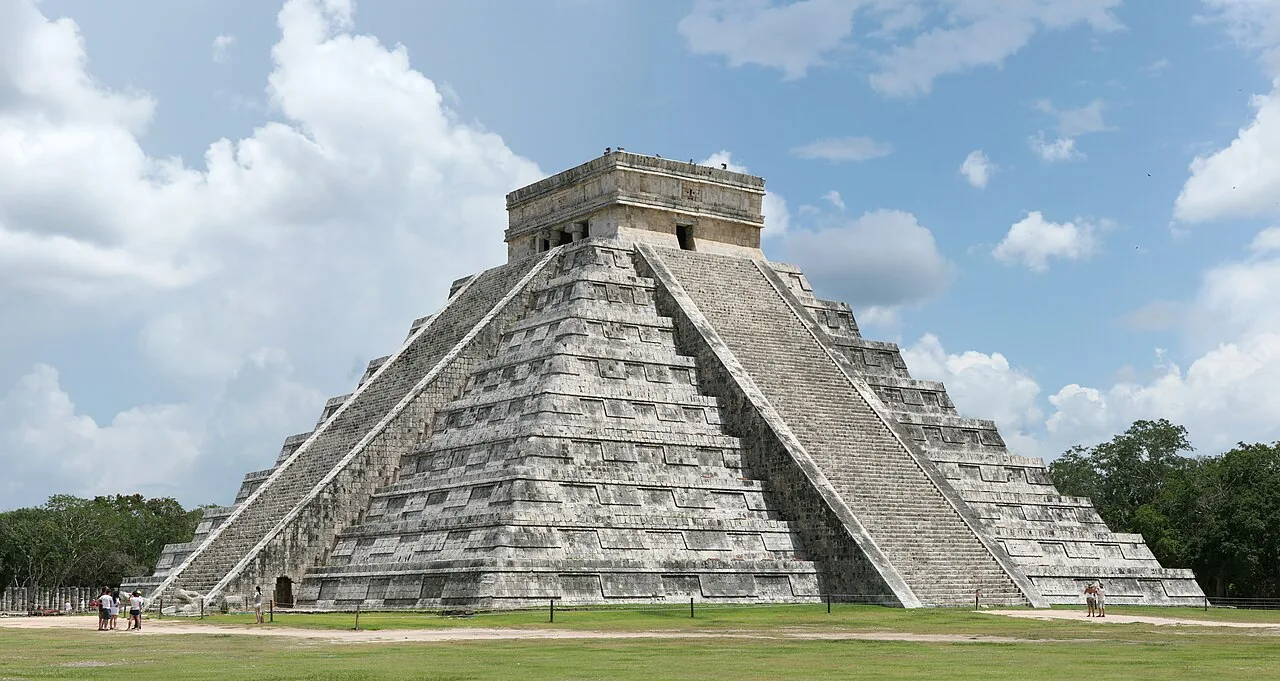
- Present the document (nature, date, place).
- Describe the building: its shape, its stairways, and the temple at the top.
- What does the size of the building tell you about Maya society?
- This pyramid is also a calendar: it has 365 steps in all. Why would a ruler build a monument like this?
- Name two other sources a historian could use to learn about the Maya.
Exercise 10 : Founding a city
Document 2 – The founding of Tenochtitlan
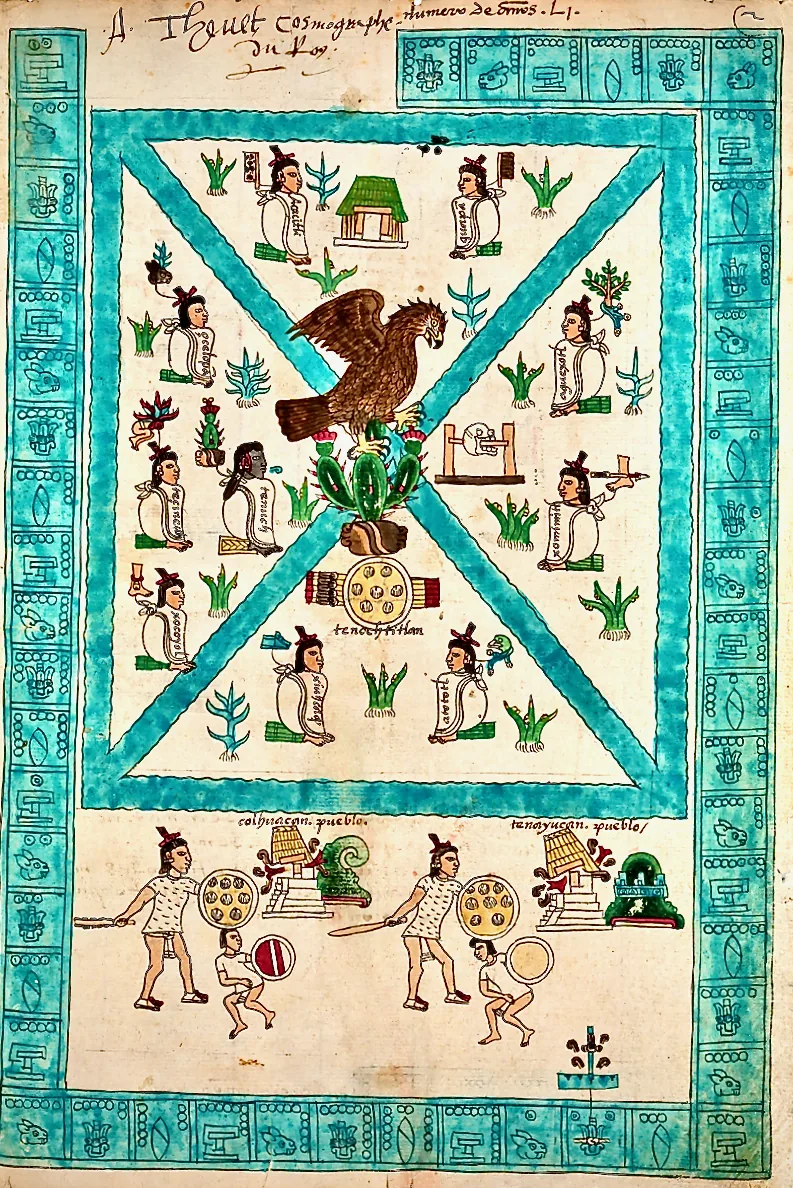
- Present the document (nature, date, place of conservation).
- What stands at the center of the page? What does it mean?
- What does the blue cross represent?
- What do the figures at the bottom of the page show?
- Why should we be careful when we use a book made for the Spanish authorities?
Exercise 11 : An Inca estate in the clouds
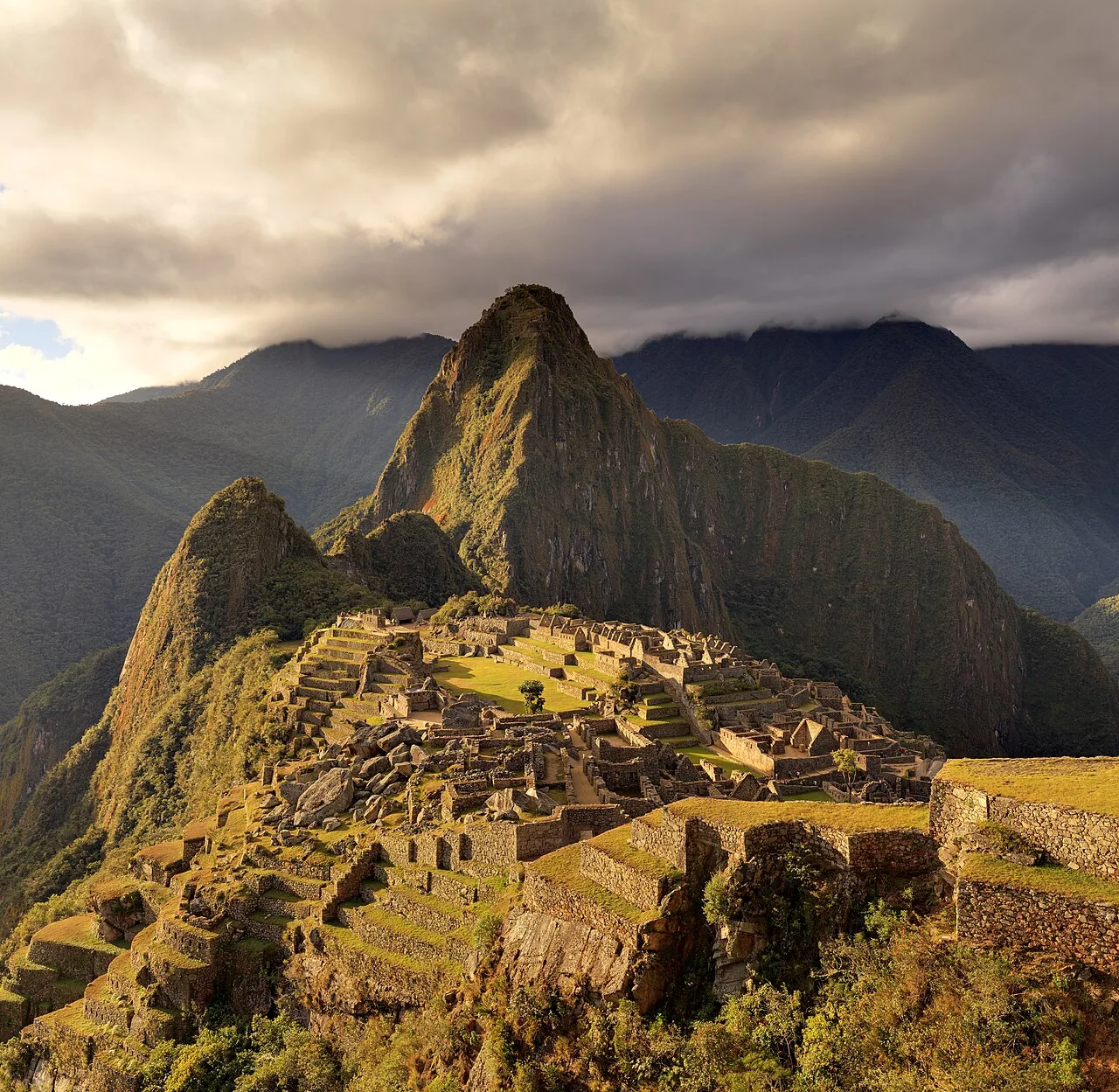
- Present the document (nature, date, place).
- Describe the site: the setting, the terraces, and the buildings.
- Why did the Inca build terraces on steep slopes?
- How did the Inca cut and fit stones without mortar?
- Machu Picchu is not mentioned in the Spanish sources of the 1500s. What does that suggest about the Spaniards’ knowledge of the empire?
Exercise 12 : The sacred precinct
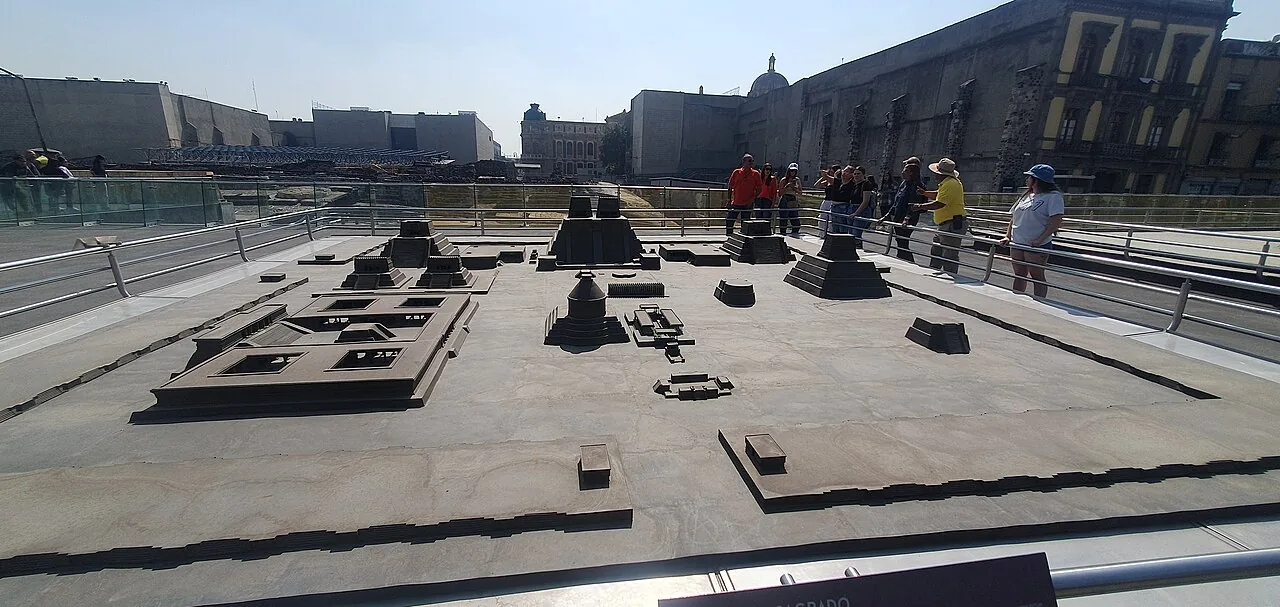
- Present the document (nature, date, place).
- What can you see in the model? Where is the largest building?
- Why is a model useful to a historian when the real city was destroyed?
- What does the Templo Mayor tell us about Aztec religion and power?
- What are the limits of a modern model?
Exercise 13 : Three civilizations by the numbers
Document 8 – Maya, Aztec, and Inca
| Civilization | Heartland | Main period (CE) | Main center |
|---|---|---|---|
| Maya (Classic period) | Southern Mexico, Guatemala, Belize | 250-900 | Tikal |
| Aztec Empire (Triple Alliance) | Central Mexico | 1428-1521 | Tenochtitlan |
| Inca Empire | Andes, from Ecuador to Chile | 1438-1533 | Cusco |
Source: dates as given in reference works such as The Cambridge History of the Native Peoples of the Americas and Encyclopædia Britannica; start dates of the Inca are approximate. Table prepared for this unit.
- How many years did the Classic Maya period last, according to the table?
- How many years did the Aztec Triple Alliance last?
- How many years did the Inca Empire last?
- Which empire lasted longest? Which two empires ruled at the same time?
- Tenochtitlan was founded about 1325. How many years passed between its founding and its fall in 1521?
Exercise 14 : Locate Mesoamerica
- Match the numbers to these names: Chichen Itza, Copan, Monte Albán, Palenque, Tenochtitlan, Tikal, Veracruz.
- Which cities lie inside the green (Maya) area?
- Which city was the capital of the Aztec?
- Cortés landed on the coast at Veracruz. In which direction did he march to reach Tenochtitlan?
Hint: Veracruz is on the Gulf coast; Tenochtitlan lies inland to the west, in the high valley.
Exercise 15 : Locate the Inca Empire
- Match the numbers to these names: Cajamarca, Cusco, Lima, Quito, Santiago.
- Which city was the capital of the Inca Empire?
- Which city lies at the northern end of the empire, and which at the southern end?
- Why was a road system so important for the Inca?
Hint: the Inca capital is in the mountains, not on the coast.
Exercise 16 : Order the events
Put these events in the right order from the earliest to the latest, and give the year (or the approximate year) of each.
- Cortés lands in Mexico
- The Mexica found Tenochtitlan
- Pizarro captures Atahualpa
- Pachacuti begins Inca conquests
- Tenochtitlan falls to the Spaniards
- The Triple Alliance is formed
Exercise 17 : How long between events?
Use the timeline in the lesson to answer.
- How many years between the founding of Tenochtitlan (about 1325) and the Triple Alliance (1428)?
- How many years between the arrival of Cortés (1519) and the fall of Tenochtitlan (1521)?
- How many years between the fall of Tenochtitlan and the capture of Atahualpa (1532)?
- In which century did the Spaniards conquer both empires? Which century began with the year 1501?
Exercise 18 : Guided research: Machu Picchu
Find out about Machu Picchu. Use at least two reliable sites, such as UNESCO, Britannica, the Smithsonian, or the National Geographic Society. Suggested keywords: Machu Picchu UNESCO, Pachacuti Machu Picchu royal estate, Hiram Bingham 1911 Machu Picchu.
- When was Machu Picchu built, and for which ruler?
- At what altitude is it, and in which country?
- Who brought it to world attention in 1911?
- Which sites did you use, and why do you trust them?
Hint: look for dates, altitude in feet or meters, and the name of the explorer.
Exercise 19 : CER paragraph: Tenochtitlan
Write one paragraph that answers the question: Was Tenochtitlan a well-organized city? Use the CER method: a claim, two pieces of evidence from Documents 1, 2, or 6A, and your reasoning.
Hint: use the markets, the officials, the causeways, and the number of people.
Exercise 20 : SAQ: the Inca state
Answer in three parts. (a) Identify one way in which the Inca government kept records. (b) Explain one way in which the Inca used roads to rule the empire. (c) Explain one reason why the Inca Empire fell to the Spaniards.
Exercise 21 : True or false? Justify
Say whether each statement is true or false, and justify your answer in one sentence.
- The Maya formed a single large empire ruled from Tikal.
- The Inca had a writing system like the Maya.
- Cortés defeated the Aztec with the help of thousands of native allies.
- Smallpox helped the Spanish conquest.
- The Aztec Empire was governed mainly by tribute from conquered towns.
Exercise 22 : Causes and consequences: the Spanish conquest
Copy the table and sort these items into causes and consequences of the fall of the Aztec Empire: smallpox; alliance with Tlaxcala; Spanish rule in New Spain; heavy tribute demanded by the Aztec; destruction of Tenochtitlan; Moctezuma’s capture. Then write two sentences that connect two of the causes.


Quick review: flashcards
Tap a card to see the answer.