


This worksheet on The Renaissance and the Reformation belongs to the Grade 7 Medieval and Early Modern World course. Its questions use primary sources, maps and timelines, and they move from basic recall to short writing tasks. Before you start, review the lesson; afterward, try the true or false quiz.
Exercise 1 : Vocabulary of the Renaissance and the Reformation
Define each term in one sentence, then use it in a sentence about the Renaissance or the Reformation.
- humanism
- patron
- movable type
- indulgence
- Protestant
- seminary
Hint: look at the lesson’s definition boxes and the commentaries.
Exercise 2 : Luther questions indulgences
Document 1 – Luther questions indulgences
27. They preach man who say that so soon as the penny jingles into the money-box, the soul flies out [of purgatory]. 28. It is certain that when the penny jingles into the money-box, gain and avarice can be increased, but the result of the intercession of the Church is in the power of God alone. […] 32. They will be condemned eternally, together with their teachers, who believe themselves sure of their salvation because they have letters of pardon. […] 36. Every truly repentant Christian has a right to full remission of penalty and guilt, even without letters of pardon.
Source: Martin Luther, Ninety-Five Theses (the Disputation on the Power and Efficacy of Indulgences), Wittenberg, October 31, 1517, theses 27, 28, 32, and 36; translation by C. M. Jacobs, in Works of Martin Luther (Philadelphia, 1915), reprinted on Wikisource.
*indulgence: a document from the pope that was said to reduce the punishment for sins. *intercession: prayer on behalf of others. *purgatory: in Catholic belief, a place of cleansing after death.
- Present the document (nature, author, date, context).
- What does Luther say about people who preach that the soul flies out of purgatory when a coin drops in the box?
- What does thesis 28 say that money can increase?
- According to thesis 36, what does a repentant Christian receive?
- Does Luther attack the pope in these theses? Explain.
Exercise 3 : The Prince
Document 2 – Machiavelli on fear and love
Upon this a question arises: whether it be better to be loved than feared or feared than loved? It may be answered that one should wish to be both, but, because it is difficult to unite them in one person, it is much safer to be feared than loved, when, of the two, either must be dispensed with. Because this is to be asserted in general of men, that they are ungrateful, fickle, false, cowardly, covetous, and as long as you succeed they are yours entirely; they will offer you their blood, property, life, and children, as is said above, when the need is far distant; but when it approaches they turn against you.
Source: Niccolò Machiavelli, The Prince, ch. XVII, written in 1513 and published in 1532; translated by W. K. Marriott (1908), Project Gutenberg.
*dispensed with: done without.
- Present the document (nature, author, date, context).
- What question does Machiavelli ask?
- What is his answer, and what reasons does he give?
- What does this show about how he looks at politics?
- Why do you think many readers were shocked by this book?
Exercise 4 : The Praise of Folly
Document 3 – Erasmus on churchmen
Nor are Princes by themselves in their manner of life, since Popes, Cardinals, and Bishops have so diligently follow’d their steps, that they’ve almost got the start of ’em. […] Nor do they so much as remember their name, or what the word Bishop signifies; to wit, Labour, Care and Trouble. But in racking to gather moneys they truly act the part of Bishops.
Source: Desiderius Erasmus, The Praise of Folly, written in 1509 and first printed in 1511; English translation by John Wilson (1668), reprinted by the Clarendon Press, Oxford, 1913.
*Albe, Miters, Crosier: the white robe, pointed hats, and staff of a bishop. *Suffragans: assistant bishops.
- Present the document. Who is speaking in the book?
- What do Popes, Cardinals, and Bishops imitate, according to the text?
- What does the word Bishop mean, according to Erasmus?
- What do the bishops do instead of caring for their flock?
- Erasmus remained a Catholic. How does this change the way we read his criticism?
Exercise 5 : Questions of the laity
Document 4 – Luther repeats the questions of ordinary people
82. To wit:—”Why does not the pope empty purgatory, for the sake of holy love and of the dire need of the souls that are there, if he redeems an infinite number of souls for the sake of miserable money with which to build a Church? The former reasons would be most just; the latter is most trivial. […] 86. Again:—”Why does not the pope, whose wealth is to-day greater than the riches of the richest, build just this one church of St. Peter with his own money, rather than with the money of poor believers?”
Source: Martin Luther, Ninety-Five Theses, Wittenberg, 1517, theses 82 and 86 (the “Again” theses give questions he said lay people were asking); translation by C. M. Jacobs, reprinted on Wikisource.
*laity: ordinary church members who are not priests.
- Present the document.
- What first question is asked about purgatory?
- What does the second question ask about the pope’s wealth?
- Why do you think Luther wrote these as questions asked by lay people?
- Why would such questions spread quickly after the invention of printing?
Exercise 6 : The king becomes head of the Church
Document 5 – The Act of Supremacy, 1534
Albeit the king’s majesty justly and rightfully is and ought to be the supreme head of the church of England, and so is recognised by the clergy of this realm in their convocations, yet nevertheless, for corroboration and confirmation thereof, and for increase of virtue in Christ’s religion within this realm of England, and to repress and extirp all errors, heresies, and other enormities and abuses heretofore used in the same: […] be it enacted by authority of this present parliament, that the king our sovereign lord, his heirs and successors, kings of this realm, shall be taken, accepted, and reputed the only supreme head in earth of the church of England, called Anglicana Ecclesia. […]
Source: Act of Supremacy, passed by the English Parliament in 1534, in The Statutes Relating to the Ecclesiastical and Eleemosynary Institutions of England (London, 1845), reprinted on Wikisource; spelling modernized in part.
*extirp: to root out. *Anglicana Ecclesia: the Church of England.
- Present the document.
- What title does the law give to the king?
- What reasons does the law give for the change?
- Why did Henry VIII want the pope’s authority removed?
- Why would this law have been useful to Parliament and the king?
Exercise 7 : The Council of Trent
Document 6 – The Catholic Church trains its priests
the holy synod ordains, that all cathedral, metropolitan, and other churches greater than these, shall be bound, each according to the measure of its means and the extent of the diocese, to maintain, to educate religiously, and to instruct in ecclesiastical discipline, a certain number of youths of their city and diocese, or, if [that number] cannot there be found, of that province, in a college to be chosen by the bishop for this purpose near the said churches […] And it wishes that the children of the poor be principally selected; though it does not however exclude those of the more wealthy, provided they be maintained at their own expense, and carry before them a desire of serving God and the Church.
Source: Council of Trent, Session XXIII, July 15, 1563, decree on reform, chapter 18, on seminaries; translated by Theodore Alois Buckley, The Canons and Decrees of the Council of Trent (London, 1851).
*synod: council. *ecclesiastical: of the Church.
- Present the document.
- What does the council require every cathedral church to do?
- Which boys does it wish to select first?
- Why would better-educated priests help the Catholic Church?
- Is this decree a reaction to the Protestant Reformation? Explain.
Exercise 8 : Two critics of the Church
Document 7A – Erasmus
Nor are Princes by themselves in their manner of life, since Popes, Cardinals, and Bishops have so diligently follow’d their steps, that they’ve almost got the start of ’em. […] Nor do they so much as remember their name, or what the word Bishop signifies; to wit, Labour, Care and Trouble. But in racking to gather moneys they truly act the part of Bishops.
Source: Desiderius Erasmus, The Praise of Folly, written in 1509 and first printed in 1511; English translation by John Wilson (1668), reprinted by the Clarendon Press, Oxford, 1913.
Document 7B – Luther
82. To wit:—”Why does not the pope empty purgatory, for the sake of holy love and of the dire need of the souls that are there, if he redeems an infinite number of souls for the sake of miserable money with which to build a Church? The former reasons would be most just; the latter is most trivial. […] 86. Again:—”Why does not the pope, whose wealth is to-day greater than the riches of the richest, build just this one church of St. Peter with his own money, rather than with the money of poor believers?”
Source: Martin Luther, Ninety-Five Theses, Wittenberg, 1517, theses 82 and 86 (the “Again” theses give questions he said lay people were asking); translation by C. M. Jacobs, reprinted on Wikisource.
- Present each document (author, date, form).
- What does each author criticize?
- How do their tones differ?
- Both remained devout Christians at this time. What do they want?
- Which author led to a break with the Church, and which did not? Why?
Exercise 9 : Two answers to the crisis
Document 8A – England, 1534
Albeit the king’s majesty justly and rightfully is and ought to be the supreme head of the church of England, and so is recognised by the clergy of this realm in their convocations, yet nevertheless, for corroboration and confirmation thereof, and for increase of virtue in Christ’s religion within this realm of England, and to repress and extirp all errors, heresies, and other enormities and abuses heretofore used in the same: […] be it enacted by authority of this present parliament, that the king our sovereign lord, his heirs and successors, kings of this realm, shall be taken, accepted, and reputed the only supreme head in earth of the church of England, called Anglicana Ecclesia. […]
Source: Act of Supremacy, passed by the English Parliament in 1534, in The Statutes Relating to the Ecclesiastical and Eleemosynary Institutions of England (London, 1845), reprinted on Wikisource; spelling modernized in part.
Document 8B – The Catholic Church, 1563
the holy synod ordains, that all cathedral, metropolitan, and other churches greater than these, shall be bound, each according to the measure of its means and the extent of the diocese, to maintain, to educate religiously, and to instruct in ecclesiastical discipline, a certain number of youths of their city and diocese, or, if [that number] cannot there be found, of that province, in a college to be chosen by the bishop for this purpose near the said churches […] And it wishes that the children of the poor be principally selected; though it does not however exclude those of the more wealthy, provided they be maintained at their own expense, and carry before them a desire of serving God and the Church.
Source: Council of Trent, Session XXIII, July 15, 1563, decree on reform, chapter 18, on seminaries; translated by Theodore Alois Buckley, The Canons and Decrees of the Council of Trent (London, 1851).
- Present each document.
- Who makes the decision in each case, and who is affected?
- What problem does each document try to solve?
- Which document gives more power to a king? Which gives more to bishops?
- Explain why historians call both documents part of “reformations.”
Exercise 10 : Creation on a ceiling
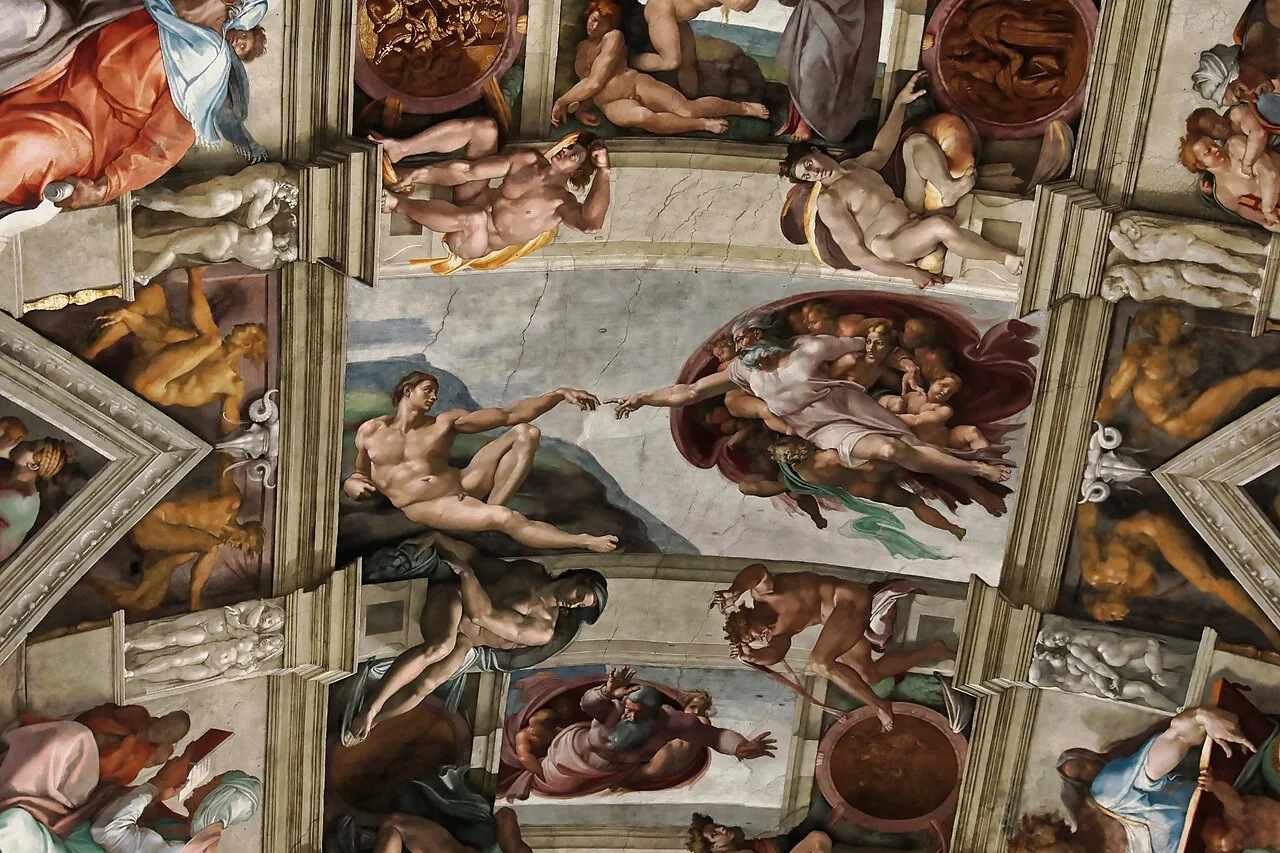
- Present the document (nature, artist, date, place).
- Describe what you see at the center of the ceiling.
- What Renaissance interests can you find in the painting?
- Who was the patron, and why does it matter?
- Name another Renaissance artwork and say how it is similar or different.
Exercise 11 : A printed Bible
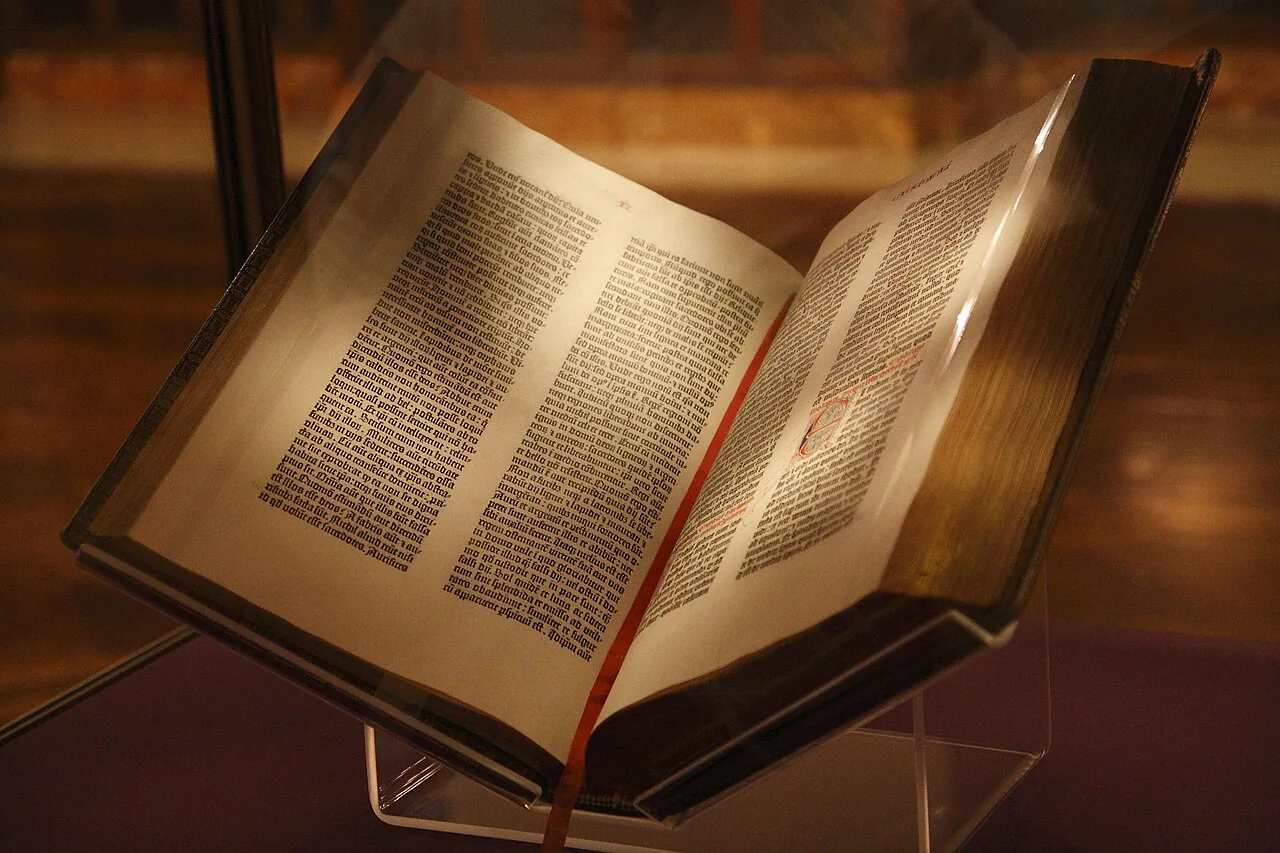
- Present the document (nature, date, place of conservation).
- Describe the page: how is the text arranged?
- Why is this Bible called a landmark?
- How did printing change the way books were made and sold?
- How could printing help reformers such as Luther?
Exercise 12 : A humanist at work
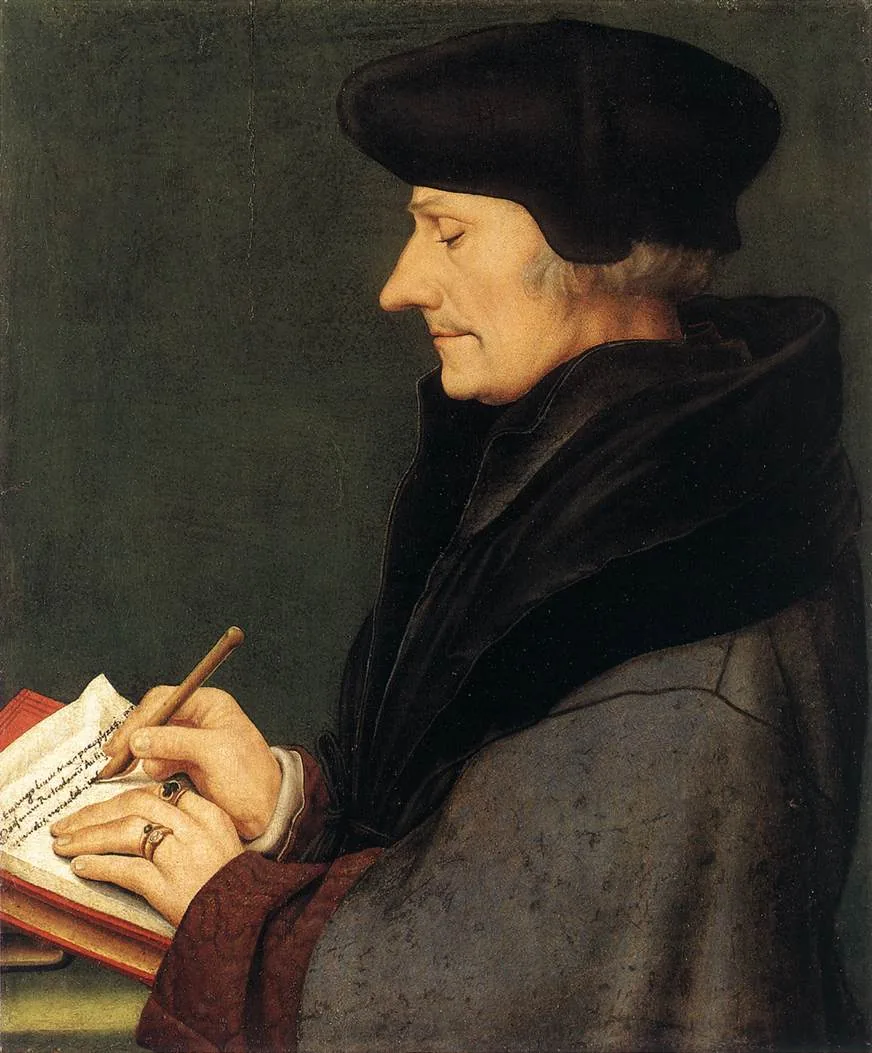
- Present the document (nature, artist, date, place).
- Describe the scholar: his clothing, his hands, and his activity.
- What does the portrait suggest about the importance of writing?
- Erasmus helped to produce a Greek New Testament in 1516. Why was this important to humanists?
- What are the limits of a portrait as evidence?
Exercise 13 : Philosophers in a Renaissance hall
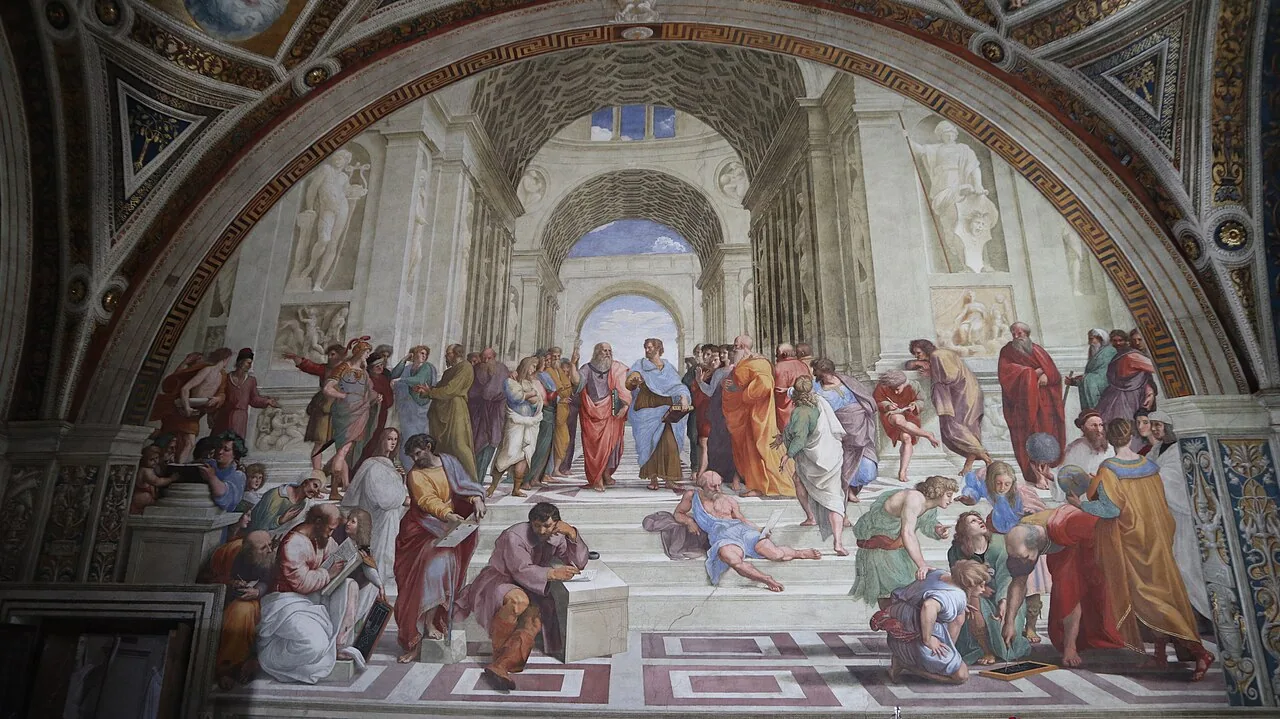
- Present the document (nature, artist, date, place).
- Describe the setting: the architecture and the figures.
- Why did Raphael paint ancient Greek thinkers in a Vatican room?
- Which Renaissance ideas does this painting show?
- How does this painting differ from the Sistine ceiling?
Exercise 14 : Spread of the printing press
Document 9 – First presses in five cities
| City | Year (approx.) |
|---|---|
| Mainz | 1450 |
| Rome | 1467 |
| Venice | 1469 |
| Paris | 1470 |
| Westminster (London) | 1476 |
Source: dates as given in reference works such as The Printing Revolution in Early Modern Europe, by Elizabeth Eisenstein, and Encyclopædia Britannica. Years are approximate for Mainz; the table was prepared for this unit.
- How many years after Mainz did Rome get a press?
- How many years after Mainz did Paris get one?
- How many years separated the arrival of printing in Venice and in Westminster?
- Which of the five cities got a press last?
Exercise 15 : Locate Renaissance Italy
- Match the numbers to these names: Florence, Milan, Naples, Rome, Venice.
- Which city is a seat of the pope?
- Which city lies on the Adriatic coast?
- Why was Italy a good place for the Renaissance to begin?
Hint: Venice stands in a lagoon at the head of the Adriatic Sea.
Exercise 16 : Locate the Reformation
- Match the numbers to these names: Geneva, London, Rome, Trent, Wittenberg, Worms.
- In which city did Luther post or send his theses?
- Which city was the seat of the Catholic Church?
- In which city did the Council of Trent meet?
Hint: Wittenberg is in Saxony; Trent is in the Alps, south of Germany.
Exercise 17 : Order the events
Put these events in order from the earliest to the latest, and give the year of each.
- Luther’s Ninety-Five Theses
- The Act of Supremacy
- The Peace of Augsburg
- Gutenberg’s press in Mainz (about)
- The Council of Trent begins
- Machiavelli writes The Prince
Exercise 18 : How long between events?
Use the timeline in the lesson to answer.
- How many years between Gutenberg’s press (about 1450) and Luther’s theses (1517)?
- How many years did the Council of Trent last (1545-1563)?
- How many years between the Ninety-Five Theses and the Peace of Augsburg?
- In which century was the Act of Supremacy passed?
Exercise 19 : Guided research: the Medici
Find out about the Medici family of Florence. Use at least two reliable sites, such as Britannica, the Metropolitan Museum of Art, the Uffizi Galleries, or the Khan Academy. Suggested keywords: Medici family Florence Britannica, Lorenzo de Medici patron of the arts, Medici bank.
- What was the source of the Medici’s wealth?
- Name two artists or scholars whom they supported.
- Which Medici became popes?
- Which sites did you use, and why do you trust them?
Hint: look for the Medici bank, Cosimo, Lorenzo the Magnificent, and Leo X.
Exercise 20 : CER paragraph: the printing press
Write one paragraph that answers the question: Did the printing press help the Reformation spread? Use the CER method: a claim, two pieces of evidence from the lesson or the documents, and your reasoning.
Hint: use the Ninety-Five Theses, the Bible in German, and the speed of printing.
Exercise 21 : SAQ: the Reformation
Answer in three parts. (a) Identify one criticism that Luther made of the Church. (b) Explain one way in which the printing press helped Luther. (c) Explain one reason why a German prince might support Luther.
Exercise 22 : True or false? Justify
Say whether each statement is true or false, and justify your answer in one sentence.
- The Renaissance began in Italy.
- Luther wanted to destroy Christianity.
- Gutenberg invented printing in China.
- The Council of Trent ordered seminaries for training priests.
- Henry VIII broke with the pope because of a doctrinal quarrel, as Luther had done.
Exercise 23 : Causes and consequences: the Reformation
Copy the table and sort these items into causes and consequences of the Protestant Reformation: sale of indulgences; the printing press; the Peace of Augsburg; wars of religion; princes who wanted Church lands; the Council of Trent. Then write two sentences that connect two of the items.


Quick review: flashcards
Tap a card to see the answer.