


This worksheet on The Age of Exploration and the Scientific Revolution belongs to the Grade 7 Medieval and Early Modern World course. Its questions use primary sources, maps and timelines, and they move from basic recall to short writing tasks. Before you start, review the lesson; afterward, try the true or false quiz.
Exercise 1 : Vocabulary of exploration and science
Define each term in one sentence, then use it in a sentence about exploration or science.
- caravel
- astrolabe
- Columbian Exchange
- heliocentric
- scientific method
- Treaty of Tordesillas
Hint: look at the lesson’s definition boxes and the commentaries.
Exercise 2 : Landing in the Bahamas
Document 1 – Columbus lands in the Bahamas
The Admiral called upon the two Captains, and the rest of the crew who landed, as also to Rodrigo de Escovedo notary of the fleet, and Rodrigo Sanchez, of Segovia, to bear witness that he before all others took possession (as in fact he did) of that island for the King and Queen his sovereigns. […] As I saw that they were very friendly to us, and perceived that they could be much more easily converted to our holy faith by gentle means than by force, I presented them with some red caps, and strings of beads to wear upon the neck, and many other trifles of small value, wherewith they were much delighted, and became wonderfully attached to us.
Source: Christopher Columbus, Journal of the First Voyage, October 11-12, 1492, as summarized by Bartolomé de las Casas and translated into English; Internet Medieval Sourcebook, Fordham University (the passage in quotation marks gives the Admiral’s own words).
*Admiral: Columbus. *Lucayos: the Bahamas. *Guanahani: the island Columbus renamed San Salvador.
- Present the document (nature, author, date, context).
- Who went ashore with Columbus, and what did he carry?
- What did Columbus do on the island?
- What reasons does he give for giving the islanders presents?
- The original journal is lost and we have only a summary by Las Casas. How should this affect our use of the source?
Exercise 3 : What did Columbus think of the islanders?
Document 2 – Columbus describes the Taíno
It appears to me, that the people are ingenious, and would be good servants and I am of opinion that they would very readily become Christians, as they appear to have no religion. They very quickly learn such words as are spoken to them. If it please our Lord, I intend at my return to carry home six of them to your Highnesses, that they may learn our language. I saw no beasts in the island, nor any sort of animals except parrots.
Source: Christopher Columbus, Journal of the First Voyage, entry of October 11-13, 1492 (the words of the Admiral as recorded by Las Casas); English translation, Internet Medieval Sourcebook, Fordham University.
*Highnesses: Ferdinand and Isabella.
- Present the document.
- What qualities does Columbus find in the people he met?
- What does he think they would become, and why?
- What does Columbus plan to do when he returns to Spain?
- What is the point of view of the writer, and how does it shape what he writes?
Exercise 4 : Spices and rubies at Calicut
Document 3 – The Portuguese arrive in India, 1498
The first greeting that he received was in these words: “May the Devil take thee! What brought you hither?” They asked what he sought so far away from home, and he told them that we came in search of Christians and of spices. […] He said that the King of Portugal would not consent to their doing so, and they said he did the right thing. After this conversation they took him to their lodgings and gave him wheaten bread and honey. […] A lucky venture, a lucky venture! Plenty of rubies, plenty of emeralds! You owe great thanks to God, for having brought you to a country holding such riches!
Source: Álvaro Velho (attributed), A Journal of the First Voyage of Vasco da Gama, 1497-1499, entries for May 20-21, 1498; translated by E. G. Ravenstein (Hakluyt Society, 1898).
*Moors: Muslims of North Africa. *convict: one of the convicts carried on the ships.
- Present the document.
- Who first spoke to the Portuguese in Calicut, and how did they greet them?
- What did the Portuguese say they were looking for?
- What does the merchant say about the riches of India?
- What does this episode show about Indian Ocean trade before the Portuguese?
Exercise 5 : Crossing the Pacific
Document 4 – Pigafetta describes hunger at sea
Wednesday, the twenty-eighth of November, 1520, we came forth out of the said strait, and entered into the Pacific sea, where we remained three months and twenty days without taking in provisions or other refreshments, and we only ate old biscuit reduced to powder, and full of grubs, and stinking from the dirt which the rats had made on it when eating the good biscuit, and we drank water that was yellow and stinking. […] We also ate the ox hides which were under the main-yard, so that the yard should not break the rigging.
Source: Antonio Pigafetta, The First Voyage Round the World by Magellan, account of the crossing of the Pacific in 1520-1521; translated by Lord Stanley of Alderley (Hakluyt Society, 1874).
*strait: Strait of Magellan. *main-yard: a large beam holding the main sail.
- Present the document (nature, author, date).
- How long did the crossing of the Pacific last, according to Pigafetta?
- What did the crew eat and drink?
- Why did they put ox hides under the main-yard?
- Why is the witness of Pigafetta valuable, although he wrote for a patron?
Exercise 6 : Galileo and the Bible
Document 5 – A scientist writes to a duchess
With regard to this argument, I think in the first place that it is very pious to say and prudent to affirm that the holy Bible can never speak untruth—whenever its true meaning is understood. But I believe nobody will deny that it is often very abstruse, and may say things which are quite different from what its bare words signify. Hence in expounding the Bible if one were always to confine oneself to the unadorned grammatical meaning, one might fall into error. Not only contradictions and propositions far from true might thus be made to appear in the Bible, but even grave heresies and follies. […] These propositions uttered by the Holy Ghost were set down in that manner by the sacred scribes in order to accommodate them to the capacities of the common people, who are rude and unlearned.
Source: Galileo Galilei, Letter to the Grand Duchess Christina of Tuscany, 1615; translation in Stillman Drake, Discoveries and Opinions of Galileo, as posted in the Internet Modern History Sourcebook, Fordham University.
*abstruse: hard to understand. *expounding: explaining.
- Present the document (nature, author, date, context).
- What does Galileo say about the truth of the Bible?
- What mistake does he say people make when reading it?
- What examples does he give of the Bible speaking in human terms?
- Why was this letter dangerous for Galileo?
Exercise 7 : Newton’s rules of reasoning
Document 6 – Newton on how to reason
We are to admit no more causes of natural things than such as are both true and sufficient to explain their appearances. To this purpose the philosophers say that Nature does nothing in vain, and more is in vain when less will serve; for Nature is pleased with simplicity, and affects not the pomp of superfluous causes. […] Therefore to the same natural effects we must, as far as possible, assign the same causes. […] We are certainly not to relinquish the evidence of experiments for the sake of dreams and vain fictions of our own devising; nor are we to recede from the analogy of Nature, which uses to be simple, and always consonant to itself.
Source: Isaac Newton, Mathematical Principles of Natural Philosophy (1687), Book III, “Rules of Reasoning in Philosophy,” Rules I-III; translated by Andrew Motte (1729), American edition of 1846.
*superfluous: unnecessary.
- Present the document.
- What does Rule I tell a scientist to avoid?
- What does Rule II say about similar effects?
- What does Rule III say about experiments?
- How does this document show the idea of the scientific method?
Exercise 8 : Two first contacts
Document 7A – Columbus in the Bahamas
It appears to me, that the people are ingenious, and would be good servants and I am of opinion that they would very readily become Christians, as they appear to have no religion. They very quickly learn such words as are spoken to them. If it please our Lord, I intend at my return to carry home six of them to your Highnesses, that they may learn our language. I saw no beasts in the island, nor any sort of animals except parrots.
Source: Christopher Columbus, Journal of the First Voyage, entry of October 11-13, 1492 (the words of the Admiral as recorded by Las Casas); English translation, Internet Medieval Sourcebook, Fordham University.
Document 7B – Da Gama at Calicut
The first greeting that he received was in these words: “May the Devil take thee! What brought you hither?” They asked what he sought so far away from home, and he told them that we came in search of Christians and of spices. […] He said that the King of Portugal would not consent to their doing so, and they said he did the right thing. After this conversation they took him to their lodgings and gave him wheaten bread and honey. […] A lucky venture, a lucky venture! Plenty of rubies, plenty of emeralds! You owe great thanks to God, for having brought you to a country holding such riches!
Source: Álvaro Velho (attributed), A Journal of the First Voyage of Vasco da Gama, 1497-1499, entries for May 20-21, 1498; translated by E. G. Ravenstein (Hakluyt Society, 1898).
- Present each document (author, date, place).
- How did the local people receive the Europeans in each case?
- What did the Europeans want in each place?
- In which case did the Europeans meet people who already knew about Europe? Explain.
- What do the two documents show about the difference between the Americas and the Indian Ocean world?
Exercise 9 : Faith and evidence
Document 8A – Galileo, 1615
With regard to this argument, I think in the first place that it is very pious to say and prudent to affirm that the holy Bible can never speak untruth—whenever its true meaning is understood. But I believe nobody will deny that it is often very abstruse, and may say things which are quite different from what its bare words signify. Hence in expounding the Bible if one were always to confine oneself to the unadorned grammatical meaning, one might fall into error. Not only contradictions and propositions far from true might thus be made to appear in the Bible, but even grave heresies and follies. […] These propositions uttered by the Holy Ghost were set down in that manner by the sacred scribes in order to accommodate them to the capacities of the common people, who are rude and unlearned.
Source: Galileo Galilei, Letter to the Grand Duchess Christina of Tuscany, 1615; translation in Stillman Drake, Discoveries and Opinions of Galileo, as posted in the Internet Modern History Sourcebook, Fordham University.
Document 8B – Newton, 1687
We are to admit no more causes of natural things than such as are both true and sufficient to explain their appearances. To this purpose the philosophers say that Nature does nothing in vain, and more is in vain when less will serve; for Nature is pleased with simplicity, and affects not the pomp of superfluous causes. […] Therefore to the same natural effects we must, as far as possible, assign the same causes. […] We are certainly not to relinquish the evidence of experiments for the sake of dreams and vain fictions of our own devising; nor are we to recede from the analogy of Nature, which uses to be simple, and always consonant to itself.
Source: Isaac Newton, Mathematical Principles of Natural Philosophy (1687), Book III, “Rules of Reasoning in Philosophy,” Rules I-III; translated by Andrew Motte (1729), American edition of 1846.
- Present each document.
- What does each author say about the use of reason?
- Which one speaks mainly about the Bible, and which about experiments?
- What do they have in common about the study of nature?
- Why was Galileo punished but Newton honored?
Exercise 10 : A Portuguese secret map
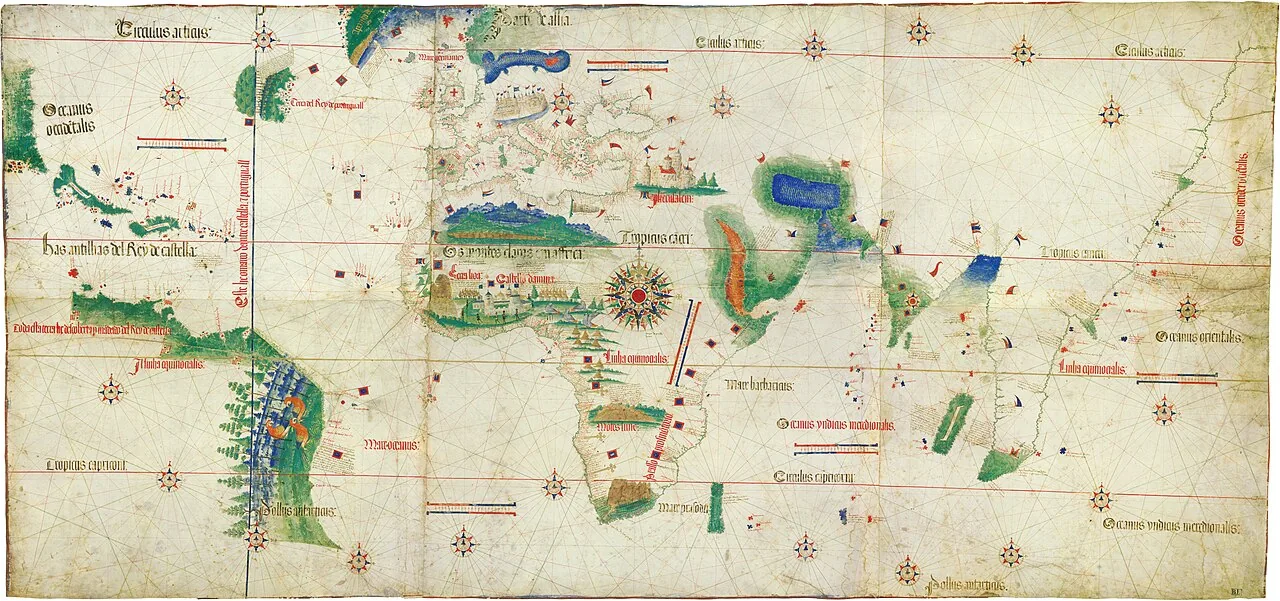
- Present the document (nature, date, place of conservation).
- Which lands can you recognize on the map?
- What does the vertical line show?
- Why did Portugal keep maps like this secret?
- What are the limits of a map as evidence?
Exercise 11 : The Moon through a telescope
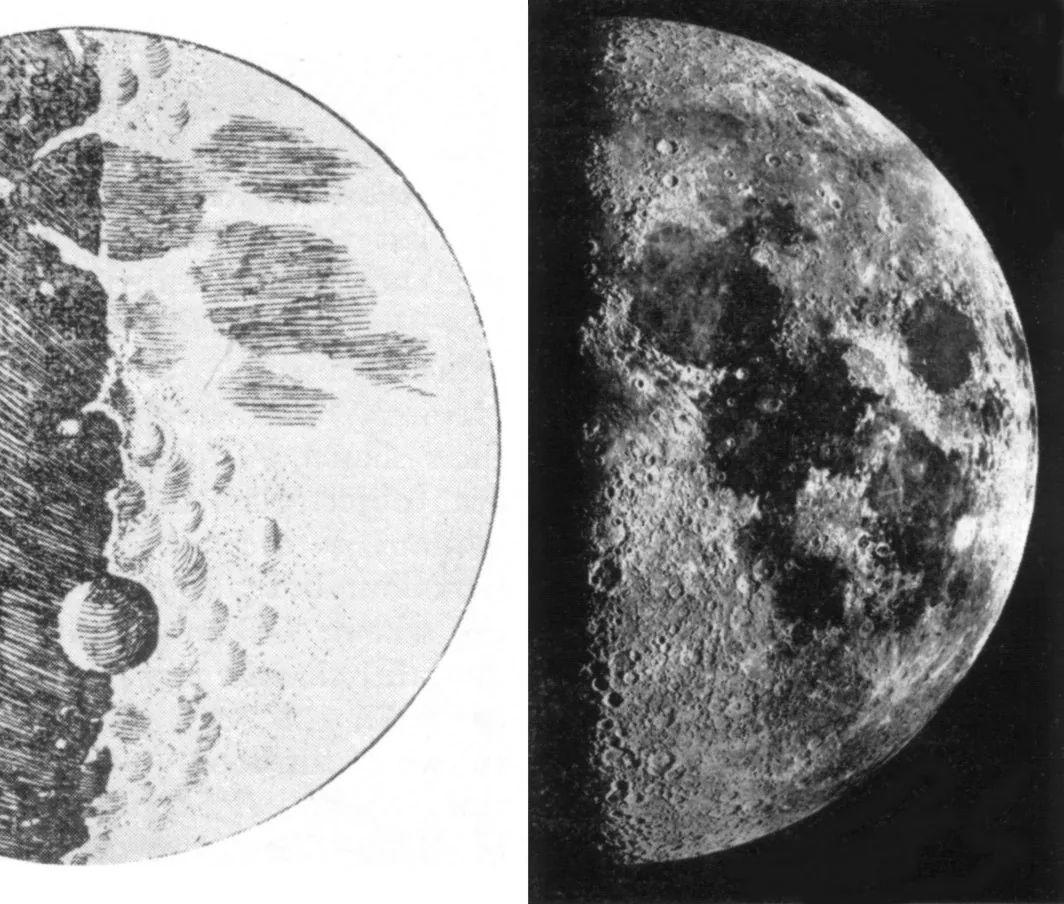
- Present the document (nature, author, date).
- Describe the drawing on the left and the photograph on the right.
- What did the Moon seem to be made of before Galileo?
- What did Galileo’s drawing show that was new?
- Why was an image important to prove his point?
Exercise 12 : A ship of 1492
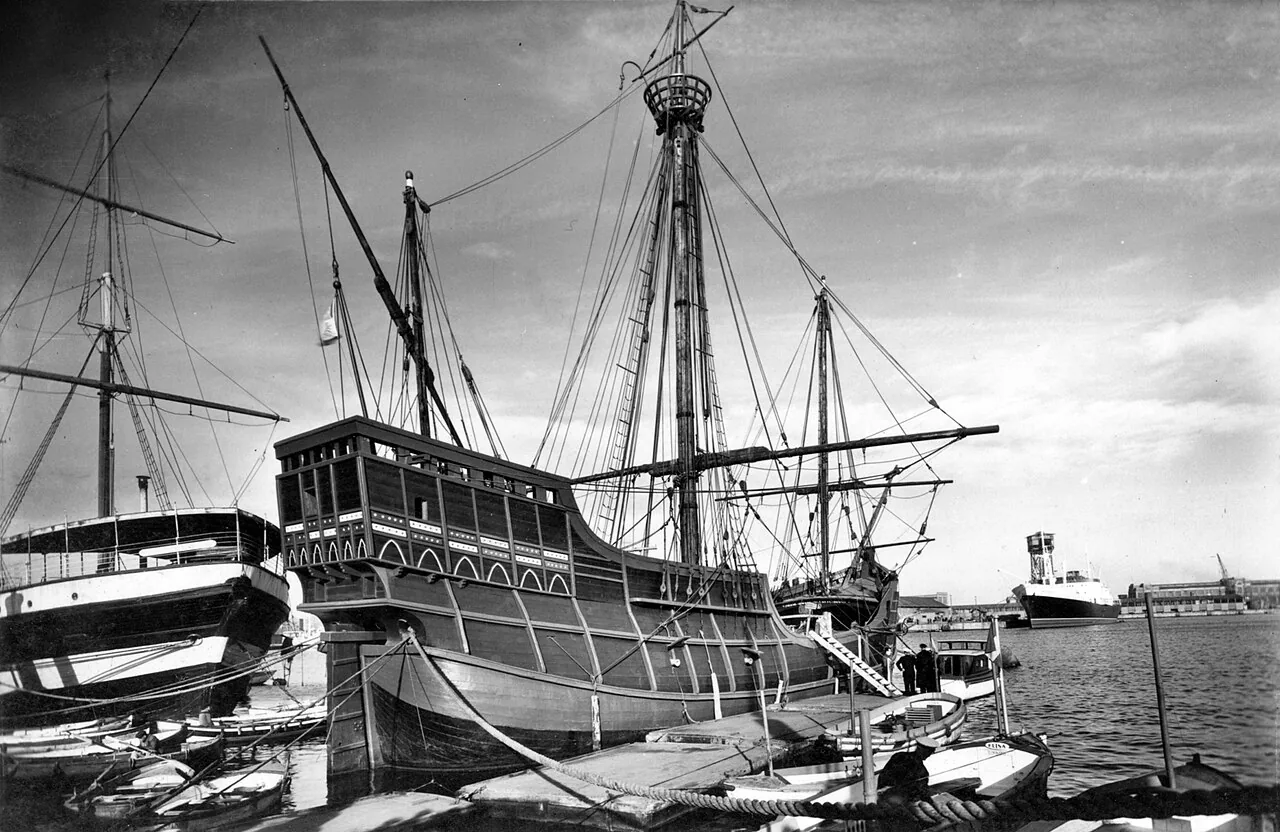
- Present the document (nature, subject, place).
- Describe the ship: its masts, sails, and hull.
- Why was it hard to live on such a ship for many weeks?
- What difference does a replica make as evidence?
- Which tools helped sailors find their way on board?
Exercise 13 : Naming a continent
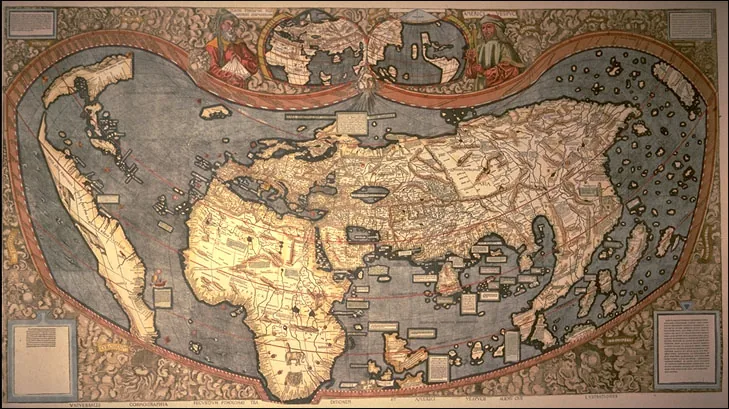
- Present the document (nature, author, date).
- Describe what you see: the shapes of the lands and the border decoration.
- What name does the map put on the New World, and for whom?
- Why was it important to have a world map that showed the Americas?
- Compare it with the Cantino map: what is new in this map?
Exercise 14 : Voyages by the numbers
Document 9 – Three famous voyages
| Leader | Left Europe | Main result | Year of main result |
|---|---|---|---|
| Columbus | 1492 | Reached the Bahamas | 1492 |
| Vasco da Gama | 1497 | Reached Calicut, India | 1498 |
| Magellan and Elcano | 1519 | Returned to Spain after sailing around the world | 1522 |
Source: dates as given in reference works such as Encyclopædia Britannica and the Cambridge History of Latin America. Table prepared for this unit.
- How many years separate the departure of Columbus and that of da Gama?
- How many years did da Gama take to reach India from his departure?
- How many years did the voyage of Magellan and Elcano last?
- How many years after Columbus’s landing did the first voyage around the world end?
Exercise 15 : Voyages of exploration
- Match the numbers to these names: Cape of Good Hope, Cape Verde Islands, Calicut, Lisbon, San Salvador, Strait of Magellan.
- Which port did da Gama reach in India?
- Which place did Columbus reach in 1492?
- Why was rounding the Cape of Good Hope important for Portugal?
Hint: Calicut is on the western coast of India.
Exercise 16 : The line of Tordesillas
- Which side of the line belonged to Spain, and which to Portugal?
- On which side of the line is most of Brazil?
- On which side of the line is San Salvador?
- Why do you think the Cape Verde Islands were used as the starting point for measuring the line?
Hint: the line is drawn from north to south, west of the islands.
Exercise 17 : Order the events
Put these events in order from the earliest to the latest, and give the year of each.
- Galileo is tried by the Inquisition
- Columbus reaches the Bahamas
- Newton publishes the Principia
- Da Gama reaches Calicut
- Copernicus publishes his Sun-centered theory
- Magellan’s last ship returns to Spain
Exercise 18 : How long between events?
Use the timeline in the lesson to answer.
- How many years between Dias (1488) and da Gama’s arrival in India (1498)?
- How many years between the Treaty of Tordesillas (1494) and Cantino’s map (1502)?
- How many years between Copernicus (1543) and Newton’s Principia (1687)?
- In which century did Galileo publish Sidereus Nuncius?
Exercise 19 : Guided research: Galileo’s trial
Find out about the trial of Galileo in 1633. Use at least two reliable sites, such as Britannica, the Museo Galileo in Florence, the Smithsonian, or the Vatican Observatory. Suggested keywords: Galileo trial 1633 Inquisition, Galileo Dialogue Concerning the Two Chief World Systems, Galileo Museo Galileo.
- Which book led to the trial?
- What was he forced to do?
- What happened to him afterwards?
- Which sites did you use, and why do you trust them?
Hint: look for the title of the 1632 book, the word “abjure,” and house arrest.
Exercise 20 : CER paragraph: Galileo and the telescope
Write one paragraph that answers the question: Did the telescope change how people understood the universe? Use the CER method: a claim, two pieces of evidence from the lesson or the documents, and your reasoning.
Hint: use the Moon, the moons of Jupiter, and the reaction of the Church.
Exercise 21 : SAQ: exploration
Answer in three parts. (a) Identify one reason why Portugal and Spain sent explorers across the ocean. (b) Explain one way in which new technology helped sailors. (c) Explain one effect of the voyages on Native Americans.
Exercise 22 : True or false? Justify
Say whether each statement is true or false, and justify your answer in one sentence.
- Columbus believed he had reached Asia.
- Magellan himself completed the voyage around the world.
- The Treaty of Tordesillas gave Brazil to Portugal.
- Galileo used a telescope to study the Moon.
- Newton showed that the same laws govern the heavens and the Earth.
Exercise 23 : Causes and consequences: the voyages
Copy the table and sort these items into causes and consequences of the voyages of exploration: demand for spices; the caravel and the compass; the Columbian Exchange; the Atlantic slave trade; the fall of Constantinople in 1453; the death of many Native Americans from disease. Then write two sentences that connect two of the items.


Quick review: flashcards
Tap a card to see the answer.