


This Grade 7 Medieval and Early Modern World test covers The Age of Exploration and the Scientific Revolution. Like a classroom assessment, it includes documents to analyze, knowledge questions and a short writing task. To prepare, review the lesson first, then practice with the worksheet.
Time : 50 min
The test has three parts: knowledge (32 points), documents (48 points), and a written argument (20 points). Answer in complete sentences and cite the documents.
Document 1 – The line of 1494
Map prepared for this unit from Natural Earth coastlines.
Document 2 – The Moon seen by Galileo
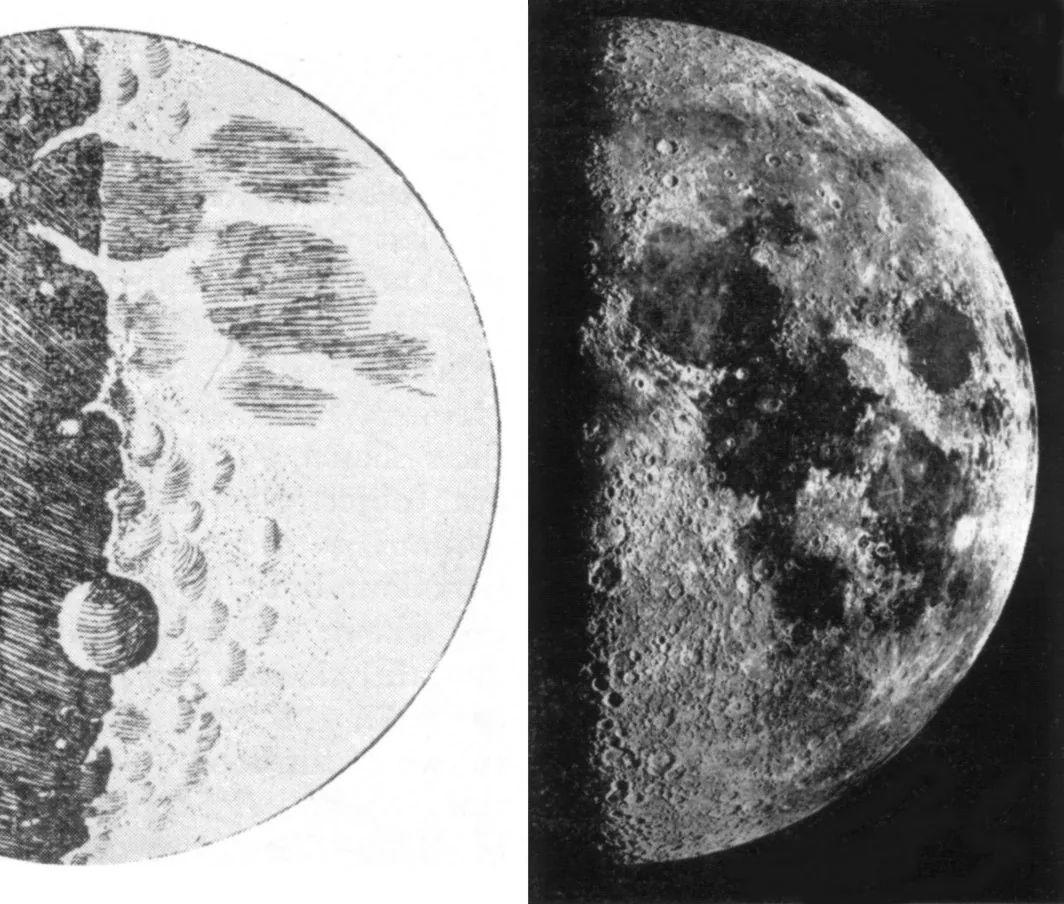
Galileo Galilei, Sidereus Nuncius, 1610 (reproduction beside a modern photograph).
Document 3 – Crossing the Pacific
Wednesday, the twenty-eighth of November, 1520, we came forth out of the said strait, and entered into the Pacific sea, where we remained three months and twenty days without taking in provisions or other refreshments, and we only ate old biscuit reduced to powder, and full of grubs, and stinking from the dirt which the rats had made on it when eating the good biscuit, and we drank water that was yellow and stinking. […] We also ate the ox hides which were under the main-yard, so that the yard should not break the rigging.
Source: Antonio Pigafetta, The First Voyage Round the World by Magellan, account of the crossing of the Pacific in 1520-1521; translated by Lord Stanley of Alderley (Hakluyt Society, 1874).
*strait: Strait of Magellan.
Antonio Pigafetta, The First Voyage Round the World by Magellan, tr. Lord Stanley of Alderley (1874).
Document 4 – Key dates
- 1488 Dias rounds the southern tip of Africa
- 1492 Columbus reaches the Bahamas
- 1494 Treaty of Tordesillas
- 1498 Da Gama reaches Calicut
- 1522 Magellan’s last ship returns
- 1543 Copernicus publishes his theory
- 1610 Galileo publishes Sidereus Nuncius
Dates from reference works.
Questions
- Part 1 – Knowledge. Define Columbian Exchange, heliocentric, and scientific method. (12 pts)
- Part 1. Document 1: say what the dashed line shows, name the two countries that signed the treaty, and tell which of the two received Brazil. (12 pts)
- Part 1. Name two goods that came from the Americas to Europe and two that went from Europe to the Americas. (8 pts)
- Part 2 – Documents. Document 2: present the document, describe what the drawing shows, and explain why it was important evidence for Galileo. (14 pts)
- Part 2. Document 3: present the document, say what the crew ate and drank, and explain what it shows about the dangers of exploration. (14 pts)
- Part 2. Document 4: calculate how many years passed between 1488 and 1498, between 1492 and 1522, and between 1543 and 1610. (10 pts)
- Part 2. Using Document 1, Document 4, and the lesson, explain two ways in which the voyages changed life in the Americas. (10 pts)
- Part 3 – Written argument. Which had the greater effect on the world, the voyages of exploration or the Scientific Revolution? Write a paragraph or two with a claim, at least two pieces of evidence, and your reasoning. (20 pts)


Quick review: flashcards
Tap a card to see the answer.