


This Grade 7 Medieval and Early Modern World test covers The Renaissance and the Reformation. Like a classroom assessment, it includes documents to analyze, knowledge questions and a short writing task. To prepare, review the lesson first, then practice with the worksheet.
Time : 50 min
The test has three parts: knowledge (32 points), documents (48 points), and a written argument (20 points). Answer in complete sentences and cite the documents.
Document 1 – Printing presses before 1480
Map prepared for this unit from Natural Earth coastlines; dates from reference works.
Document 2 – A painting by Raphael
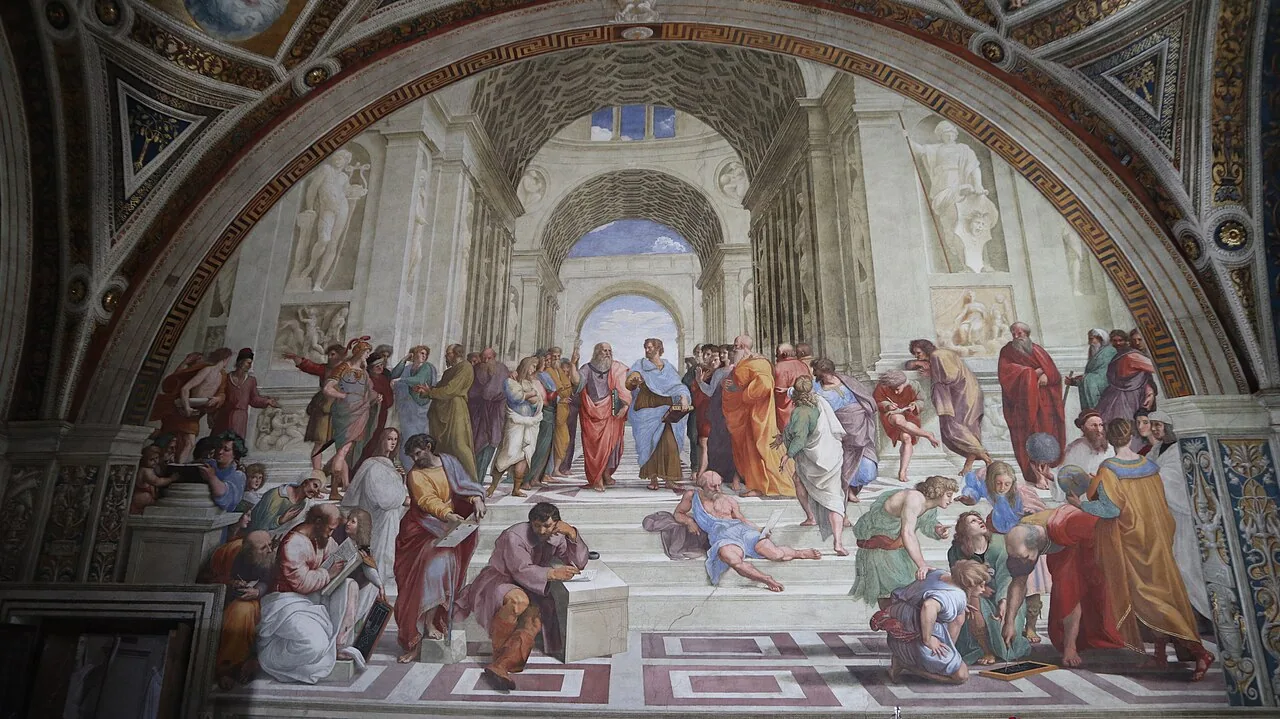
Raphael, The School of Athens, about 1509-1511, Vatican Palace.
Document 3 – A critic of churchmen
Nor are Princes by themselves in their manner of life, since Popes, Cardinals, and Bishops have so diligently follow’d their steps, that they’ve almost got the start of ’em. […] Nor do they so much as remember their name, or what the word Bishop signifies; to wit, Labour, Care and Trouble. But in racking to gather moneys they truly act the part of Bishops.
Source: Desiderius Erasmus, The Praise of Folly, written in 1509 and first printed in 1511; English translation by John Wilson (1668), reprinted by the Clarendon Press, Oxford, 1913.
*Albe, Miters, Crosier: the robe, hat, and staff of a bishop.
Erasmus, The Praise of Folly, 1511.
Document 4 – Key dates
- c. 1450 Gutenberg’s press in Mainz
- 1508-1512 Michelangelo paints the Sistine ceiling
- 1513 Machiavelli writes The Prince
- 1517 Luther’s Ninety-Five Theses
- 1534 Act of Supremacy
- 1563 End of the Council of Trent
Dates from reference works.
Questions
- Part 1 – Knowledge. Define Renaissance, humanism, and indulgence. (12 pts)
- Part 1. Document 1: name the first city to have a press and the last one on the map, and give the dates. (12 pts)
- Part 1. Name two Renaissance artists and one work by each. (8 pts)
- Part 2 – Documents. Document 2: present the document, describe what you see, and explain what it shows about Renaissance ideas. (14 pts)
- Part 2. Document 3: present the document, say what Erasmus criticizes, and explain why he is called a humanist critic rather than a Protestant. (14 pts)
- Part 2. Document 4: calculate how many years passed between 1450 and 1517, between 1517 and 1534, and between 1534 and 1563. (10 pts)
- Part 2. Using Document 1, Document 4, and the lesson, explain two ways in which printing changed Europe. (10 pts)
- Part 3 – Written argument. Why did the Reformation divide Christian Europe? Write a paragraph or two with a claim, at least two pieces of evidence from the documents or the lesson, and your reasoning. (20 pts)


Quick review: flashcards
Tap a card to see the answer.