


This Grade 7 Medieval and Early Modern World lesson covers The Renaissance and the Reformation, part of the unit “A new age.” First, read the full lesson with its primary sources, maps and key terms. Then practice with the worksheet, check yourself with the quiz and get ready with the test.
In 1517 a university professor in a small German town wrote ninety-five arguments about the sale of church pardons. Within two months, printers had copied his list in several cities, and people across Germany were reading it. The professor, Martin Luther, did not plan to split the Church. Yet his act set off a religious movement that divided Western Europe for centuries. His success owed a great deal to the printing press and to new habits of questioning. Rulers who saw their own interests in religious change also helped him. All of these belong to the age that historians call the Renaissance, a French word meaning “rebirth.”
Guiding question: How did the Renaissance and the printing press change how Europeans thought, and why did the Reformation divide Christian Europe?
1. The Renaissance begins in Italy
Why Italy?
The Renaissance began in Italy in the 1300s and spread north over the next two centuries. Italy had ruins of ancient Rome all around, and its writers and artists were proud of that past. Italy also had wealth. Cities such as Venice and Genoa grew rich on trade with the eastern Mediterranean. Florence, in turn, grew rich on wool and banking. Northern Italy was not one kingdom.
Instead, it was a patchwork of city-states: republics such as Venice and Florence, duchies such as Milan, and the Papal States ruled by the pope. Rich merchants and rulers paid for art, books, and buildings to show their power and taste. The most famous family was the Medici, bankers who ruled Florence for much of the 1400s and 1500s. Lorenzo de’ Medici, who led the city from 1469 to 1492, supported artists such as Botticelli and the young Michelangelo.
Definition: Renaissance
A period of European history, from about 1300 to 1600, when scholars and artists revived interest in the ideas and art of ancient Greece and Rome and developed new ways of seeing the world.
Humanism
The scholars of the Renaissance studied the Greek and Latin writers of antiquity for their own sake and for what they said about human life. Historians call them humanists. The poet Petrarch (1304-1374), often called the first humanist, searched monasteries for lost Latin manuscripts. Humanists did not reject Christianity. Most were devout believers. But they asked questions about how to live well in this world. They asked about citizenship, education, and history, and they taught that the individual was capable of great things. They also wanted to read old texts in their original languages. As a result, they compared copies, corrected mistakes, and asked what an author had really meant.
Definition: Humanism
A Renaissance movement that stressed the study of classical literature, history, and ethics, and the worth and abilities of human beings.
Art and architecture
Renaissance artists studied nature and mathematics. They discovered linear perspective, a way of drawing so that flat surfaces look deep. They also studied anatomy to paint and carve the human body accurately. In 1436 Filippo Brunelleschi finished the great dome of the cathedral of Florence, using ideas from Roman building. Leonardo da Vinci (1452-1519) painted the Last Supper and the Mona Lisa. He also filled notebooks with drawings of anatomy, machines, and plants. Michelangelo (1475-1564) carved the statue of David between 1501 and 1504. Later he painted the ceiling of the Sistine Chapel in Rome between 1508 and 1512. Raphael (1483-1520) painted calm and graceful scenes, among them the School of Athens.
Document 2 – The Sistine Chapel ceiling
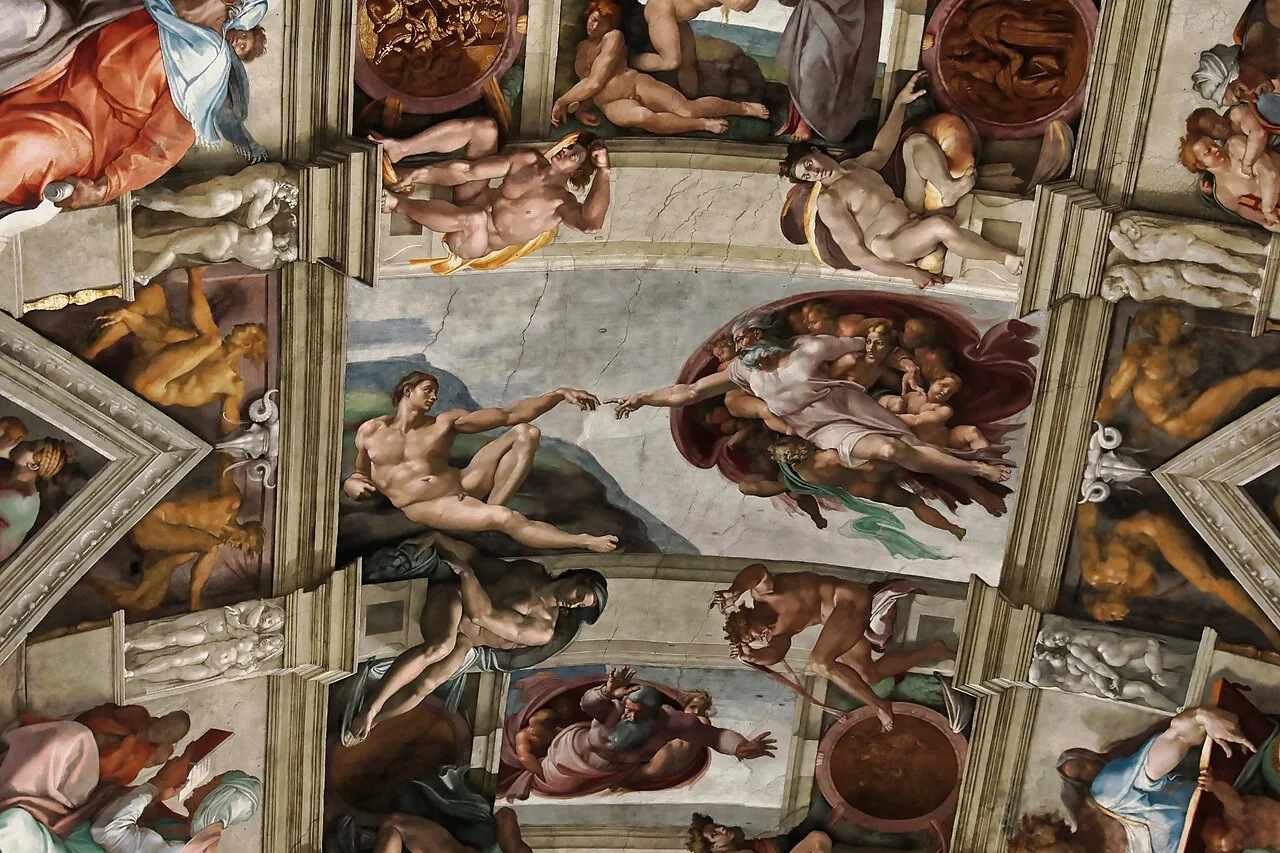
Commentary. Pope Julius II hired Michelangelo, who thought of himself as a sculptor, to paint the ceiling of the pope’s chapel. Michelangelo worked on scaffolding for four years and painted scenes from the book of Genesis. At the center, God reaches toward Adam, who appears as a strong, beautiful human body. The ceiling combines a Christian subject, the Creation, with the Renaissance interest in the human body and in ancient sculpture. Notice that the patron was the pope himself: the Church was among the greatest patrons of Renaissance art.
New ideas about power
The Renaissance also changed how people thought about politics. In 1513 the Florentine diplomat Niccolò Machiavelli, who had lost his job after the Medici came back to power, wrote The Prince. It is a handbook for rulers that looks at what rulers actually do rather than what they should do. Moreover, it advises them to be ready to act harshly when the safety of the state depends on it. Many readers reacted with shock, and the name “Machiavellian” became a word for cunning politics. In northern Europe, humanists such as Erasmus of Rotterdam (about 1466-1536) and Thomas More used humor and learning. They criticized the greed of the powerful and the failings of churchmen.
2. The printing press
Until the 1400s scribes copied every book by hand, which took months and made books expensive. About 1450 a goldsmith named Johannes Gutenberg in Mainz, Germany, built a press. It used movable metal type, letters cast separately and set in rows, and an oil-based ink. His great Bible, printed about 1455, shows how beautiful early printing could be. The new technology spread quickly. By 1500 there were presses in more than two hundred European towns, and printers had produced millions of books.
Document 3 – A Gutenberg Bible
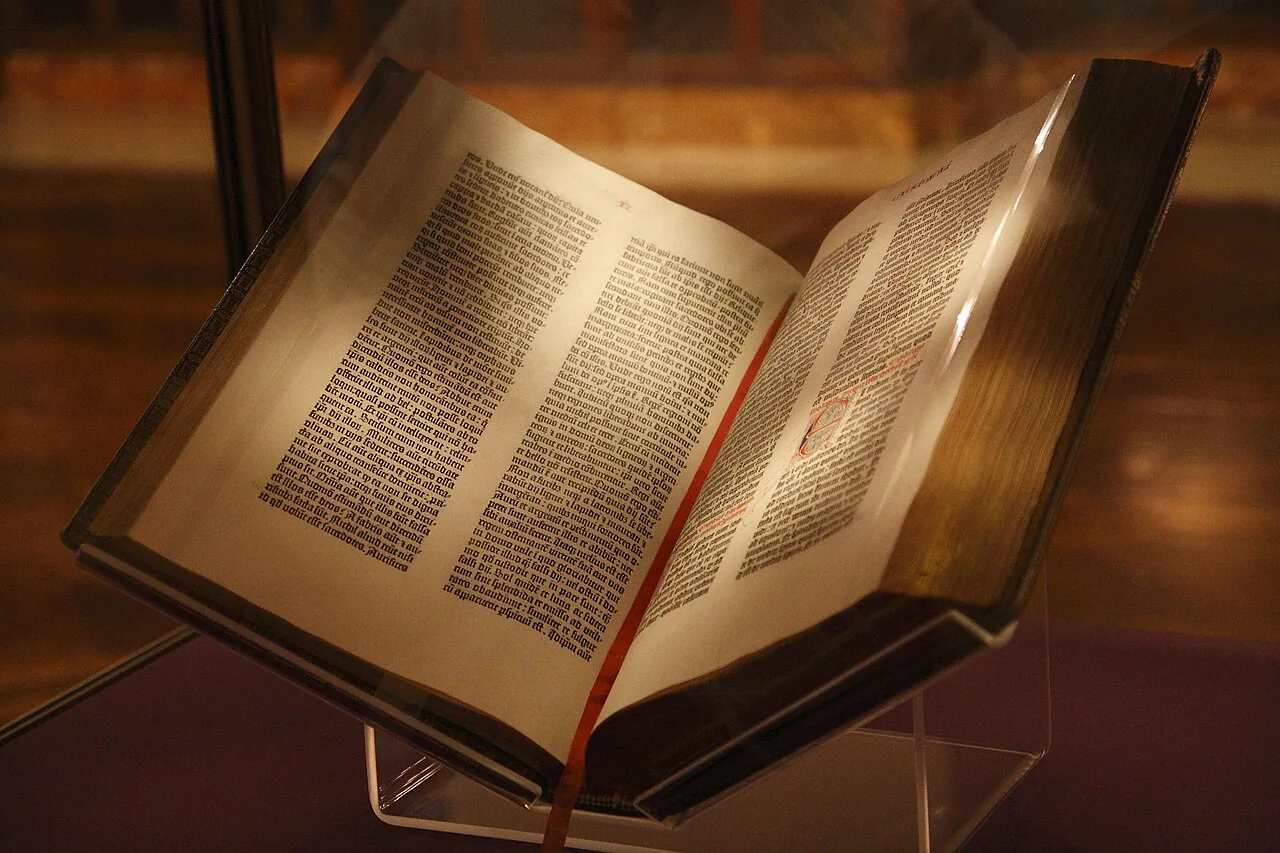
Commentary. The page has two columns of black Gothic type that imitates the handwriting of scribes. However, artists added the initial letters and borders by hand in color. The first printed books copied the look of manuscripts. Gutenberg’s invention made books cheaper and let ideas, news, and arguments travel far faster than ever before. As a result, scholars could compare identical texts, students could own books, and writers could reach thousands of readers. Reformers would use printing to spread their message.
3. The Protestant Reformation
Luther and the indulgences
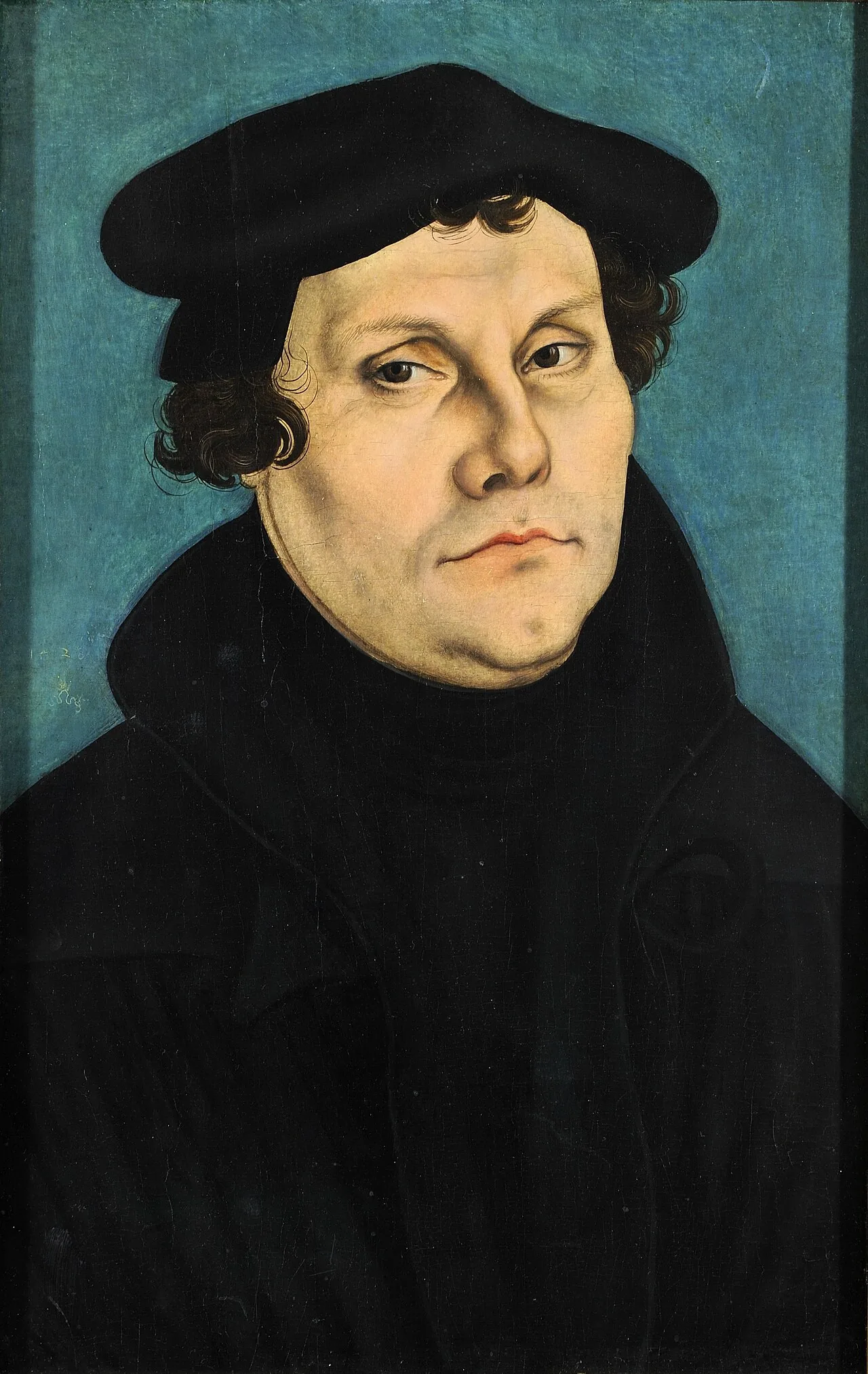
By 1500 many Christians thought that the Church needed reform. Some priests were poorly trained. Some bishops were wealthy men who cared more about power than about their flock, and popes spent large sums on art and wars. One scandal especially angered Martin Luther (1483-1546), a monk and professor of theology at the University of Wittenberg in Saxony. Pope Leo X was raising money to rebuild St. Peter’s Basilica in Rome by selling indulgences. A preacher named Johann Tetzel was selling them near Wittenberg. On October 31, 1517, Luther sent his Ninety-Five Theses to the archbishop of Mainz. According to tradition, he also posted them on a church door in Wittenberg.
Document 1 – Luther questions indulgences
27. They preach man who say that so soon as the penny jingles into the money-box, the soul flies out [of purgatory]. 28. It is certain that when the penny jingles into the money-box, gain and avarice can be increased, but the result of the intercession of the Church is in the power of God alone. […] 32. They will be condemned eternally, together with their teachers, who believe themselves sure of their salvation because they have letters of pardon. […] 36. Every truly repentant Christian has a right to full remission of penalty and guilt, even without letters of pardon.
Source: Martin Luther, Ninety-Five Theses (the Disputation on the Power and Efficacy of Indulgences), Wittenberg, October 31, 1517, theses 27, 28, 32, and 36; translation by C. M. Jacobs, in Works of Martin Luther (Philadelphia, 1915), reprinted on Wikisource.
*indulgence: a document from the pope that was said to reduce the punishment for sins. *intercession: prayer on behalf of others. *purgatory: in Catholic belief, a place of cleansing after death.
Commentary. Luther does not attack the pope’s authority in these theses. He says that buying a pardon cannot guarantee salvation (thesis 32) and that a truly repentant Christian already has forgiveness (thesis 36). Luther wrote the theses in Latin for scholars, but printers quickly translated and printed them in German. In a few weeks, people across Germany knew them. Luther went on to teach that faith in Christ saves people, not good works or the buying of pardons. He also taught that the Bible, not the pope, is the highest authority in matters of faith.
The Reformation spreads
In 1521 the Holy Roman Emperor Charles V summoned Luther to the Diet, or assembly, at Worms. Luther refused to take back his teachings. The Edict of Worms declared him an outlaw. However, Prince Frederick the Wise of Saxony hid him in the castle of the Wartburg. There Luther translated the New Testament into German, and printers published it in 1522. Princes in northern Germany and Scandinavia adopted his reforms.
They acted partly out of faith and partly because they could take Church lands and escape the control of the emperor and the pope. Luther’s followers took the name Lutherans. The broader movement took the name Protestant, after a protest by Lutheran princes in 1529. The emperor fought the Lutheran princes for years. Finally, the Peace of Augsburg in 1555 allowed each prince of the empire to choose either Lutheranism or Catholicism for his own territory.
Definition: Protestant
A Christian who belongs to one of the churches that broke away from the Roman Catholic Church in the 1500s, such as the Lutheran, Reformed (Calvinist), and Anglican churches.
Other reformers
Other reformers set up their own churches. Huldrych Zwingli led reform in Zurich from 1519. John Calvin, a French lawyer and theologian, published Institutes of the Christian Religion in 1536 and led the city of Geneva from 1541. He taught that God has chosen in advance who will be saved. Calvinism spread to France, the Netherlands, and Scotland.
In England, King Henry VIII broke with the pope for political and personal reasons. He wanted the pope to annul his marriage to Catherine of Aragon. Then he could marry again and have a male heir, but the pope refused. In 1534 Parliament passed the Act of Supremacy, which made the king the head of the Church of England. His daughter Elizabeth I (queen from 1558) settled the new church in a form between Catholic and Protestant practices.
4. The Catholic response
The Catholic Church also reformed itself, a movement sometimes called the Catholic Reformation or Counter-Reformation. The pope called the Council of Trent, which met on and off from 1545 to 1563 in the Italian city of Trent. It rejected Protestant teachings but also tackled abuses. For example, it banned the sale of indulgences for money and required bishops to live in their dioceses. It also ordered each diocese to set up a seminary to train priests properly. New religious orders arose. Ignatius of Loyola founded the Society of Jesus, or Jesuits, and the pope approved it in 1540. The Jesuits ran schools and sent missionaries to Asia and the Americas.
Document 4 – The Council of Trent orders seminaries
the holy synod ordains, that all cathedral, metropolitan, and other churches greater than these, shall be bound, each according to the measure of its means and the extent of the diocese, to maintain, to educate religiously, and to instruct in ecclesiastical discipline, a certain number of youths of their city and diocese, or, if [that number] cannot there be found, of that province, in a college to be chosen by the bishop for this purpose near the said churches […] And it wishes that the children of the poor be principally selected; though it does not however exclude those of the more wealthy, provided they be maintained at their own expense, and carry before them a desire of serving God and the Church.
Source: Council of Trent, Session XXIII, July 15, 1563, decree on reform, chapter 18, on seminaries; translated by Theodore Alois Buckley, The Canons and Decrees of the Council of Trent (London, 1851).
*synod: a council of bishops. *diocese: the area under a bishop.
Commentary. This decree shows that the Church recognized the need for a better-trained clergy. A seminary is a school for boys who plan to become priests. The decree says that bishops should look first for boys from poor families. Historians see in it one of the Council’s most lasting reforms. Indeed, well-educated priests were able to defend the Catholic faith in the next centuries.
5. Consequences
The Reformation ended the unity of Western Christianity. It led to long wars of religion. They took place in France from 1562 to 1598 and across the Holy Roman Empire in the Thirty Years’ War (1618-1648). It also encouraged people to read. Reformers wanted everyone to read the Bible in their own language, so schools and literacy grew, especially in Protestant lands. Translations of the Bible shaped national languages. At the same time, governments often persecuted religious minorities, and the idea that a government could tolerate more than one church developed only slowly.
- 1436 Brunelleschi completes the dome of Florence cathedral
- c. 1450 Gutenberg develops printing in Mainz
- 1508-1512 Michelangelo paints the Sistine Chapel ceiling
- 1513 Machiavelli writes The Prince
- 1517 Luther’s Ninety-Five Theses
- 1521 Diet of Worms
- 1534 Act of Supremacy in England
- 1545-1563 Council of Trent
- 1555 Peace of Augsburg
Key takeaways
- The Renaissance began in the wealthy city-states of Italy and revived the study of ancient Greece and Rome (humanism).
- Gutenberg’s printing press (about 1450) made books cheaper and spread ideas quickly.
- Luther’s Ninety-Five Theses (1517) began the Protestant Reformation; Calvin, Zwingli, and Henry VIII created other Protestant churches.
- The Catholic Church reformed itself at the Council of Trent; Europe was divided by religion and by wars of religion.

Quick review: flashcards
Tap a card to see the answer.