


This Grade 7 Medieval and Early Modern World lesson covers The Age of Exploration and the Scientific Revolution, part of the unit “A new age.” First, read the full lesson with its primary sources, maps and key terms. Then practice with the worksheet, check yourself with the quiz and get ready with the test.
On the night of October 11, 1492, a sailor in the lookout of a small ship called the Pinta shouted that he saw land. After more than a month at sea, the Spanish fleet under Christopher Columbus had reached an island in the Bahamas. Few people on that morning understood how much the world was about to change. Within thirty years, European ships had reached India, circled the globe, and connected four continents that had known little of one another. At the same time, a few scholars used new instruments. They found that the heavens did not work as ancient writers had said. This chapter follows both revolutions, one on the oceans and one in the mind.
Guiding question: Why did Europeans sail across the oceans in the 1400s and 1500s, what were the results, and how did new ways of studying nature change European thought?
1. Why Europeans sailed
The main goal of the early voyages was trade. Europeans prized spices such as pepper, cinnamon, and cloves from South and Southeast Asia. They also prized silk and gold. Spices reached Europe by long land and sea routes through the Middle East. They passed through many hands, and each merchant added to the price. After 1453, when the Ottoman Turks took Constantinople, European merchants felt that their routes to the East were less certain. Rulers who wanted to win wealth and power looked for a direct sea route. Others, including many sailors and priests, hoped to spread Christianity.
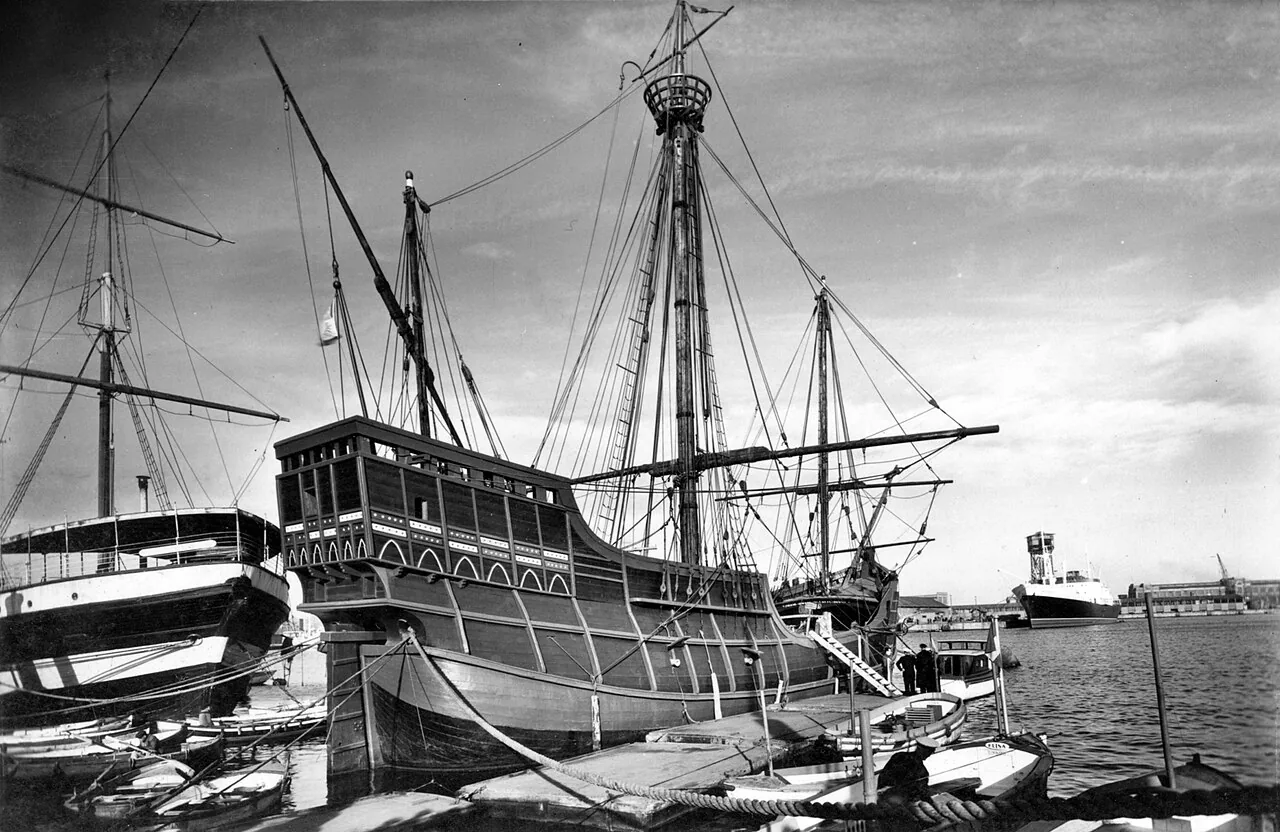
New tools and ships made long voyages possible. The caravel, a small ship with triangular sails, could sail close to the wind. The compass showed direction. The astrolabe let sailors find their latitude from the Sun or the stars. Better maps, called portolan charts, showed coasts and harbors. Portugal led the way. Under Prince Henry the Navigator (1394-1460), Portuguese captains explored the coast of West Africa step by step. In 1488 Bartolomeu Dias rounded the southern tip of Africa, which later became known as the Cape of Good Hope.
Definition: Caravel
A small, fast sailing ship used by Portuguese and Spanish explorers in the 1400s and 1500s, with triangular (lateen) sails that could sail close to the wind.
2. The voyages
Columbus and the Atlantic
Columbus, an Italian sailor from Genoa, believed that he could reach Asia by sailing west across the Atlantic. He asked Portugal for ships and was refused, then won the support of Queen Isabella and King Ferdinand of Spain. He sailed from Palos on August 3, 1492, with three ships, the Santa María, the Pinta, and the Niña. Columbus had underestimated the size of the Earth. When he landed in the Bahamas on October 12, he thought he was near Asia. Therefore he called the people he met “Indians.” He made three more voyages, until 1504, and never knew that he had come upon a continent new to Europeans.
Document 1 – Columbus lands in the Bahamas
The Admiral called upon the two Captains, and the rest of the crew who landed, as also to Rodrigo de Escovedo notary of the fleet, and Rodrigo Sanchez, of Segovia, to bear witness that he before all others took possession (as in fact he did) of that island for the King and Queen his sovereigns. […] As I saw that they were very friendly to us, and perceived that they could be much more easily converted to our holy faith by gentle means than by force, I presented them with some red caps, and strings of beads to wear upon the neck, and many other trifles of small value, wherewith they were much delighted, and became wonderfully attached to us.
Source: Christopher Columbus, Journal of the First Voyage, October 11-12, 1492, as summarized by Bartolomé de las Casas and translated into English; Internet Medieval Sourcebook, Fordham University (the passage in quotation marks gives the Admiral’s own words).
*Admiral: Columbus. *Lucayos: the Bahamas. *Guanahani: the island Columbus renamed San Salvador.
Commentary. The original journal is lost. What survives is a summary by Bartolomé de las Casas, a priest who read it and wrote it out. Passages in quotation marks give the Admiral’s own words. Columbus describes how he took possession of the island for the Spanish crown. He also describes how he gave small gifts to the islanders, the Taíno.
He says they are friendly and that they could be converted “by gentle means.” Historians point out that Columbus wrote for Ferdinand and Isabella, who were paying for the voyage. Therefore he stressed wealth and the chance to convert people. In later voyages, Columbus and the Spanish settlers forced the Taíno to work and to pay tribute in gold. Many died of disease, hard labor, and violence.
Da Gama, Cabral, and the Indian Ocean
Portugal kept going east. In 1497 Vasco da Gama sailed from Lisbon with four ships and rounded the Cape of Good Hope. With the help of a pilot from East Africa, he crossed the Indian Ocean to Calicut on the southwest coast of India. He arrived there in May 1498. The Portuguese came to buy spices and bring them home by sea. As a result, the voyage paid for itself many times over. In 1500 another Portuguese commander, Pedro Álvares Cabral, sailed toward India. He landed on the coast of Brazil and claimed it for Portugal. Portugal then built a chain of fortified trading posts along the coasts of Africa and Asia.
Document 2 – The Portuguese at Calicut, 1498
The first greeting that he received was in these words: “May the Devil take thee! What brought you hither?” They asked what he sought so far away from home, and he told them that we came in search of Christians and of spices. […] He said that the King of Portugal would not consent to their doing so, and they said he did the right thing. After this conversation they took him to their lodgings and gave him wheaten bread and honey. […] A lucky venture, a lucky venture! Plenty of rubies, plenty of emeralds! You owe great thanks to God, for having brought you to a country holding such riches!
Source: Álvaro Velho (attributed), A Journal of the First Voyage of Vasco da Gama, 1497-1499, entries for May 20-21, 1498; translated by E. G. Ravenstein (Hakluyt Society, 1898).
*Moors: Muslims of North Africa. *convict: one of the convicts carried on the ships to do dangerous tasks ashore.
Commentary. The journal is anonymous but is thought to be by a member of da Gama’s crew. He describes what he saw. This episode shows how the Portuguese learned about Indian Ocean trade. The first person to speak to the Portuguese in Calicut was a Muslim merchant from Tunis, who knew Spanish and Italian. The Indian Ocean had long been a world of merchants from many lands. The merchant’s words about “rubies” and “emeralds” also show that India was already linked to the Mediterranean world long before da Gama arrived.
Magellan and the first voyage around the world
Spain sent a Portuguese captain, Ferdinand Magellan, to reach Asia by sailing west around South America. He left Spain in September 1519 with five ships and about 270 men. In November 1520 the fleet passed through the strait that now bears his name. Then it entered a vast ocean which Magellan named the Pacific, because the weather was calm.
The crossing took more than three months and many of the crew died of hunger and disease. Magellan was killed in a fight with islanders of Mactan, in the Philippines, on April 27, 1521. The Basque captain Juan Sebastián Elcano took over. On September 6, 1522, the last ship, the Victoria, returned to Spain with eighteen men. It was the first voyage around the world.
3. Spain, Portugal, and the New World
Spain and Portugal quarrelled over the lands they found. In 1494, in the Treaty of Tordesillas, they agreed on a line in the Atlantic. It ran from north to south, 370 leagues west of the Cape Verde Islands. Lands to the west of the line would be Spain’s, and those to the east would be Portugal’s. The treaty gave Brazil, which was east of the line, to Portugal, and most of the rest of the Americas to Spain.
The map-makers of the time recorded the news of each voyage. A German mapmaker, Martin Waldseemüller, put the name America on his world map of 1507. He named it after the Italian navigator Amerigo Vespucci, who had argued that these lands were a new continent.
Document 3 – A Portuguese world map, 1502
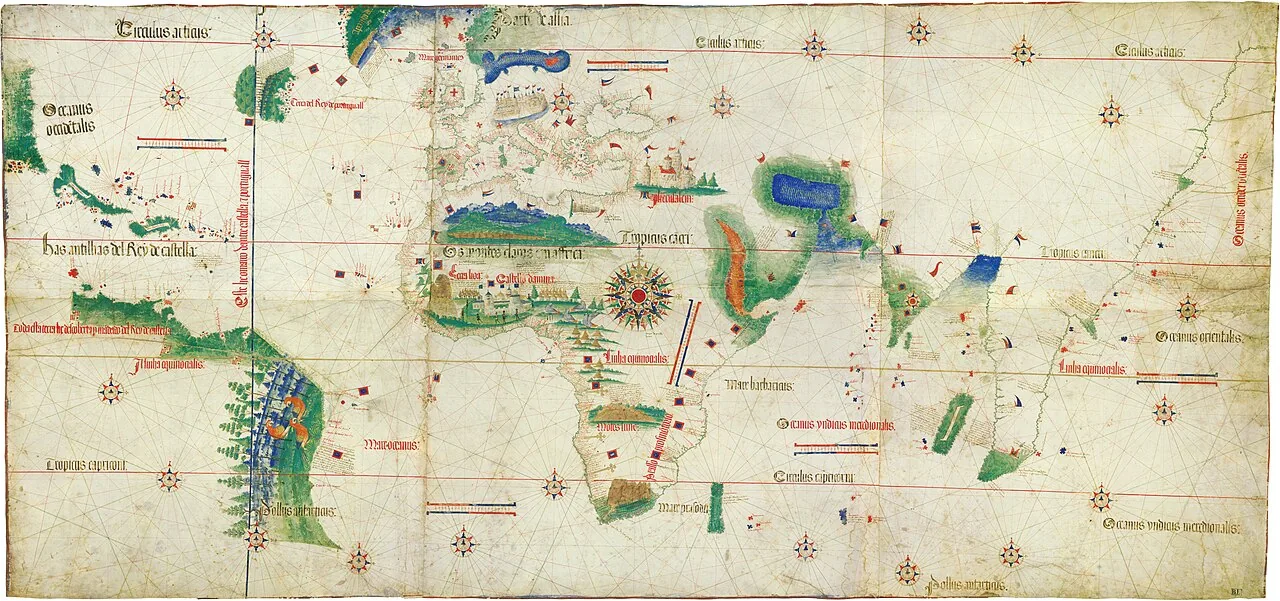
Commentary. The Cantino planisphere was made secretly in Lisbon in 1502 and smuggled to Italy. That is why it carries the name of the Italian agent, Alberto Cantino. The map shows how quickly Portugal turned the news of voyages into a picture of the world. For example, it draws the long coast of Africa, the Indian Ocean, and the shore of Brazil with growing accuracy. The vertical line on the left is the line of Tordesillas. The map was a state secret, because whoever knew the routes controlled the trade.
4. The Columbian Exchange
The voyages began a vast exchange of plants, animals, people, and diseases between the Eastern and Western hemispheres, which historians call the Columbian Exchange. From the Americas to Europe, Africa, and Asia came maize, potatoes, tomatoes, cacao, and tobacco. Potatoes and maize helped the population of Europe and Asia to grow. From the Old World to the Americas came horses, cattle, pigs, wheat, and sugar cane. However, diseases such as smallpox and measles also came, and Americans had no immunity to them. In some areas, as much as nine tenths of the native population died within a century or two.
Definition: Columbian Exchange
The transfer of plants, animals, diseases, and people between the Americas and the Old World that followed the voyages of Columbus in 1492.
The Spaniards set up colonies and forced Native Americans to work in mines and on farms. They also brought enslaved Africans to work on plantations. Portuguese traders had begun the Atlantic slave trade on the African coast in the 1440s. It grew into a vast system that carried millions of Africans across the ocean over three centuries. The wealth that flowed to Spain, especially silver from Mexico and Peru, made Spain the richest state in Europe for a time. It also helped open the Atlantic world to the Dutch, the English, and the French.
5. The Scientific Revolution
A new sky
While sailors were finding new lands, scholars were finding new ways to understand nature. For fourteen centuries, Europeans had believed the account of the Greek astronomer Ptolemy. The Earth, he said, stands still at the center of the universe, and the Sun, Moon, and planets circle around it.
In 1543 the Polish astronomer Nicolaus Copernicus published On the Revolutions of the Heavenly Spheres. There the Sun is at the center, and the Earth is a planet that circles it. In the same year, the Belgian doctor Andreas Vesalius published a book on the human body based on dissection. The Danish astronomer Tycho Brahe made exact observations of the planets. His assistant Johannes Kepler then used them to show that planets travel in ellipses.
Definition: Heliocentric
Centered on the Sun. The heliocentric theory of Copernicus held that the Earth and other planets travel around the Sun.
In 1609-1610 the Italian scientist Galileo Galilei pointed a telescope at the sky. He saw mountains and craters on the Moon, four moons circling Jupiter, and the phases of Venus. All of these supported Copernicus and contradicted the old view. He published his findings in a small book, Sidereus Nuncius, in 1610.
Document 4 – Galileo draws the Moon
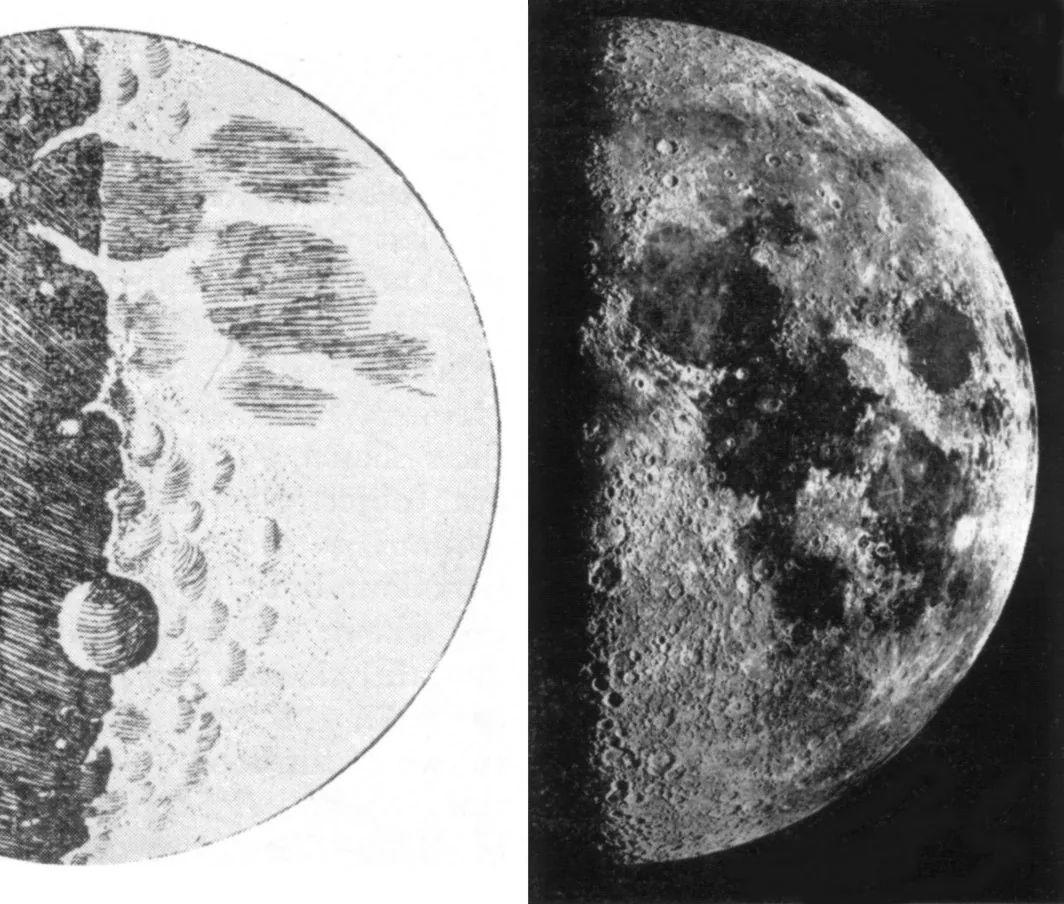
Commentary. Galileo drew what he saw through his telescope, with the light and dark areas of the Moon. He wanted to show that its surface was rough, with mountains and valleys. Ancient writers, however, had taught that the Moon was a perfect smooth sphere. Compare the drawing with a modern photograph on the right: Galileo’s sketch is simple but remarkably accurate. The pictures in the book made his observations available to every reader.
Science and the Church
Some church leaders thought that the idea of a moving Earth went against passages of the Bible. In 1616 the Catholic Church warned Galileo not to teach that Copernicus’s theory was true. In 1633 the Inquisition tried him and forced him to say that he had been wrong. It then kept him under house arrest for the rest of his life. Galileo had argued in a letter of 1615 that the Bible teaches how to go to heaven, not how the heavens go. He added that readers should not use scripture to contradict what careful observation shows.
Document 5 – Galileo on the Bible and science
With regard to this argument, I think in the first place that it is very pious to say and prudent to affirm that the holy Bible can never speak untruth—whenever its true meaning is understood. But I believe nobody will deny that it is often very abstruse, and may say things which are quite different from what its bare words signify. Hence in expounding the Bible if one were always to confine oneself to the unadorned grammatical meaning, one might fall into error. Not only contradictions and propositions far from true might thus be made to appear in the Bible, but even grave heresies and follies. […] These propositions uttered by the Holy Ghost were set down in that manner by the sacred scribes in order to accommodate them to the capacities of the common people, who are rude and unlearned.
Source: Galileo Galilei, Letter to the Grand Duchess Christina of Tuscany, 1615; translation in Stillman Drake, Discoveries and Opinions of Galileo, as posted in the Internet Modern History Sourcebook, Fordham University.
*abstruse: hard to understand. *expounding: explaining. *Holy Ghost: the Holy Spirit.
Commentary. Galileo was a devout Catholic. In this letter, he argues that the Bible cannot be wrong, but that human readers can misread it. The letter was addressed to the Grand Duchess Christina of Tuscany, the mother of Galileo’s patron, and it circulated widely. It shows that the debate was not simply “science against religion.” Galileo and his opponents were arguing about how to interpret scripture and who had the authority to decide.
New methods and Newton
Thinkers also changed the way people searched for knowledge. The Englishman Francis Bacon (1561-1626) argued for gathering facts by experiment and observation and then drawing general conclusions. The Frenchman René Descartes (1596-1650) used reason and mathematics, and said, “I think, therefore I am.” Together, these ideas built the scientific method: ask a question, observe, test with experiments, and revise the theory. In 1687 the English mathematician Isaac Newton published the Mathematical Principles of Natural Philosophy. In it, three laws of motion and the law of universal gravitation explained why planets move as they do and why apples fall. The same laws, he argued, ruled the heavens and the Earth.
Definition: Scientific method
A way of finding out about nature by asking questions, making careful observations and experiments, and testing explanations against the evidence.
Document 6 – Newton’s rules of reasoning
We are to admit no more causes of natural things than such as are both true and sufficient to explain their appearances. To this purpose the philosophers say that Nature does nothing in vain, and more is in vain when less will serve; for Nature is pleased with simplicity, and affects not the pomp of superfluous causes. […] Therefore to the same natural effects we must, as far as possible, assign the same causes. […] We are certainly not to relinquish the evidence of experiments for the sake of dreams and vain fictions of our own devising; nor are we to recede from the analogy of Nature, which uses to be simple, and always consonant to itself.
Source: Isaac Newton, Mathematical Principles of Natural Philosophy (1687), Book III, “Rules of Reasoning in Philosophy,” Rules I-III; translated by Andrew Motte (1729), American edition of 1846.
*superfluous: unnecessary. *consonant: in agreement with.
Commentary. Before he proves that gravity governs the planets, Newton states the rules by which a natural philosopher should reason. Rule I says to prefer the simplest explanation, and Rule III says to trust experiments before fancies. These rules express the new confidence that careful reasoning from evidence can uncover the laws of the universe. Newton’s work crowned the Scientific Revolution and inspired the Enlightenment of the 1700s.
- 1488 Dias rounds the southern tip of Africa
- 1492 Columbus reaches the Bahamas
- 1494 Treaty of Tordesillas
- 1498 Da Gama reaches Calicut
- 1519-1522 Magellan’s fleet sails around the world
- 1543 Copernicus publishes his Sun-centered theory
- 1610 Galileo publishes Sidereus Nuncius
- 1633 Galileo is tried by the Inquisition
- 1687 Newton publishes the Principia
Key takeaways
- Europeans sought spices and wealth, and used caravels, compasses, and maps to find new sea routes.
- Columbus (1492), da Gama (1498), and Magellan’s fleet (1519-1522) connected Europe, the Americas, Africa, and Asia.
- The Columbian Exchange moved plants, animals, and diseases across the oceans; native peoples suffered terribly, and the Atlantic slave trade grew.
- Copernicus, Galileo, and Newton replaced an Earth-centered picture of the heavens with a Sun-centered one governed by natural laws, using observation and mathematics.

Quick review: flashcards
Tap a card to see the answer.