


This worksheet on The Mongol Empire belongs to the Grade 7 Medieval and Early Modern World course. Its questions use primary sources, maps and timelines, and they move from basic recall to short writing tasks. Before you start, review the lesson; afterward, try the true or false quiz.
Exercise 1 : Vocabulary of the Mongol Empire
Match each term to its meaning, then use three of the terms in sentences of your own.
- Steppe
- Nomad
- Khan
- Yam
- Paiza
- Pax Mongolica
Meanings: (a) the Mongol messenger system with relay stations; (b) a person who travels with herds; (c) a metal tablet that gave a traveler the khan’s authority; (d) the period of Mongol peace that made trade safer; (e) a ruler of the Mongols; (f) a vast grassland of central Asia.
Exercise 2 : A monk describes the Tartars
Document 1 – Matthew Paris, 1240
Swarming like locusts over the face of the earth, they have brought terrible devastation to the eastern parts (of Europe), laying them waste with fire and carnage. After having passed through the land of the Saracens, they have razed cities, cut down forests, overthrown fortresses, pulled up vines, destroyed gardens, killed townspeople and peasants […] They are without human laws, know no comforts, are more ferocious than lions or bears, have boats made of ox-hides which ten or twelve of them own in common; they are able to swim or manage a boat, so that they can cross the largest and swiftest rivers without let or hindrance, drinking turbid and muddy water when blood fails them (as a beverage). They have one-edged swords and daggers, are wonderful archers, spare neither age, nor sex, nor condition.
Source: Matthew Paris, Chronica Majora, entry for the year 1240, as translated in Edward G. Browne, A Literary History of Persia, vol. 3 (Cambridge, 1920), pp. 6-8. Text checked at archive.org/details/literaryhistoryo03brow.
*Tartars: the Mongols; Europeans linked the name to Tartarus, the underworld of Greek myth. *Saracens: the word used by medieval Europeans for Muslims. *razed: leveled to the ground.
- Present the document (nature, author, date, context).
- How does Matthew Paris describe the Mongols?
- What does he say they did to the lands they passed?
- Why can the text not be treated as an accurate description of Mongol life?
- What does it tell us about European feelings in 1240?
Exercise 3 : How Genghis Khan came to power
Document 2 – Marco Polo on Chingis-khan
Some time after the migration of the Tartars to this place, and about the year of our Lord 1162, they proceeded to elect for their king a man named Chingis-khan, one of approved integrity, great wisdom, commanding eloquence, and eminent for his valor. He began his reign with so much justice and moderation, that he was beloved and revered as their deity rather than their sovereign; and as the fame of his great and good qualities spread over that part of the world, all the Tartars, however dispersed, placed themselves under his command.
Source: Marco Polo, Travels, Book 1, chapter 45 (written about 1298), translated by William Marsden (1818), Internet Medieval Sourcebook, Fordham University (sourcebooks.fordham.edu/halsall/source/mpolo44-46.asp).
*Chingis-khan: Genghis Khan. *Tartars: Mongols. *integrity: honesty. *valor: bravery.
- Present the document (nature, author, date).
- What qualities does Polo give to Chingis-khan?
- What happened to the Tartars after the election?
- Polo says the election was in 1162. Using the lesson, say what is wrong with that date.
- Why must a historian check what Marco Polo reports?
Hint: look at the date in the lesson for the title of Genghis Khan.
Exercise 4 : Money made of bark
Document 3 – Marco Polo on paper money
He makes them take of the bark of a certain tree, in fact of the Mulberry Tree, the leaves of which are the food of the silkworms,–these trees being so numerous that whole districts are full of them. What they take is a certain fine white bast or skin which lies between the wood of the tree and the thick outer bark, and this they make into something resembling sheets of paper, but black […] With these pieces of paper, made as I have described, he causes all payments on his own account to be made; and he makes them to pass current universally over all his kingdoms and provinces and territories, and whithersoever his power and sovereignty extends. And nobody, however important he may think himself, dares to refuse them on pain of death.
Source: Marco Polo, Travels, Book 2, chapter 24 (written about 1298), translated by Henry Yule, The Book of Ser Marco Polo, 3rd ed. (London, 1903), vol. 1. Text checked at gutenberg.org/ebooks/10636.
*Cambaluc: Khanbaliq, the Mongol capital, now Beijing. *tornesel and groat: small coins of Europe. *bast: the inner bark of a tree.
- Present the document (nature, author, date, context).
- What is the money made of?
- What happens to a person who refuses it?
- Why does Polo think that the khan has the secret of alchemy?
- What does the text suggest about the power of Kublai Khan?
Exercise 5 : The silver tree of Karakorum
Document 4 – William of Rubruck, 1254
[…] master William the Parisian had made for him a great silver tree, and at its roots are four lions of silver, each with a conduit through it, and all belching forth white milk of mares. And four conduits are led inside the tree to its tops, which are bent downward, and on each of these is also a gilded serpent, whose tail twines round the tree. And from one of these pipes flows wine, from another caracosmos, or clarified mare’s milk, from another bal, a drink made with honey, and from another rice mead, which is called terracina; and for each liquor there is a special silver bowl at the foot of the tree to receive it.
Source: William of Rubruck, report of his journey to the Mongols, 1253-1255, translated by W. W. Rockhill, The Journey of William of Rubruck to the Eastern Parts of the World (Hakluyt Society, London, 1900), p. 208. Text checked at archive.org/details/journeyofwilliam00ruys_0.
*caracosmos: kumiss, fermented mare’s milk. *terracina: rice wine. *master William the Parisian: William Boucher, a goldsmith from Paris who worked at the Mongol court.
- Present the document (nature, author, date, context).
- Who built the silver tree?
- What drinks flow from the tree?
- What does this passage show about the Mongol court?
- Why is an eyewitness like Rubruck valuable, and what are the limits of his report?
Exercise 6 : Two portraits of the Mongols
Document 5A – Matthew Paris, 1240
Swarming like locusts over the face of the earth, they have brought terrible devastation to the eastern parts (of Europe), laying them waste with fire and carnage. After having passed through the land of the Saracens, they have razed cities, cut down forests, overthrown fortresses, pulled up vines, destroyed gardens, killed townspeople and peasants […] They are without human laws, know no comforts, are more ferocious than lions or bears, have boats made of ox-hides which ten or twelve of them own in common; they are able to swim or manage a boat, so that they can cross the largest and swiftest rivers without let or hindrance, drinking turbid and muddy water when blood fails them (as a beverage). They have one-edged swords and daggers, are wonderful archers, spare neither age, nor sex, nor condition.
Source: Matthew Paris, Chronica Majora, entry for the year 1240, as translated in Edward G. Browne, A Literary History of Persia, vol. 3 (Cambridge, 1920), pp. 6-8. Text checked at archive.org/details/literaryhistoryo03brow.
*Tartars: the Mongols; Europeans linked the name to Tartarus, the underworld of Greek myth. *Saracens: the word used by medieval Europeans for Muslims. *razed: leveled to the ground.
Document 5B – Marco Polo, about 1298
Some time after the migration of the Tartars to this place, and about the year of our Lord 1162, they proceeded to elect for their king a man named Chingis-khan, one of approved integrity, great wisdom, commanding eloquence, and eminent for his valor. He began his reign with so much justice and moderation, that he was beloved and revered as their deity rather than their sovereign; and as the fame of his great and good qualities spread over that part of the world, all the Tartars, however dispersed, placed themselves under his command.
Source: Marco Polo, Travels, Book 1, chapter 45 (written about 1298), translated by William Marsden (1818), Internet Medieval Sourcebook, Fordham University (sourcebooks.fordham.edu/halsall/source/mpolo44-46.asp).
*Chingis-khan: Genghis Khan. *Tartars: Mongols. *integrity: honesty. *valor: bravery.
- Present each document.
- What picture of the Mongols does 5A give?
- What picture of their leader does 5B give?
- Why do the two authors see the Mongols so differently?
- Write two sentences that explain what a historian learns by reading both.
Exercise 7 : A ruler in words and in a portrait
Document 6A – Marco Polo on paper money
He makes them take of the bark of a certain tree, in fact of the Mulberry Tree, the leaves of which are the food of the silkworms,–these trees being so numerous that whole districts are full of them. What they take is a certain fine white bast or skin which lies between the wood of the tree and the thick outer bark, and this they make into something resembling sheets of paper, but black […] With these pieces of paper, made as I have described, he causes all payments on his own account to be made; and he makes them to pass current universally over all his kingdoms and provinces and territories, and whithersoever his power and sovereignty extends. And nobody, however important he may think himself, dares to refuse them on pain of death.
Source: Marco Polo, Travels, Book 2, chapter 24 (written about 1298), translated by Henry Yule, The Book of Ser Marco Polo, 3rd ed. (London, 1903), vol. 1. Text checked at gutenberg.org/ebooks/10636.
*Cambaluc: Khanbaliq, the Mongol capital, now Beijing. *tornesel and groat: small coins of Europe. *bast: the inner bark of a tree.
Document 6B – A portrait of Kublai Khan
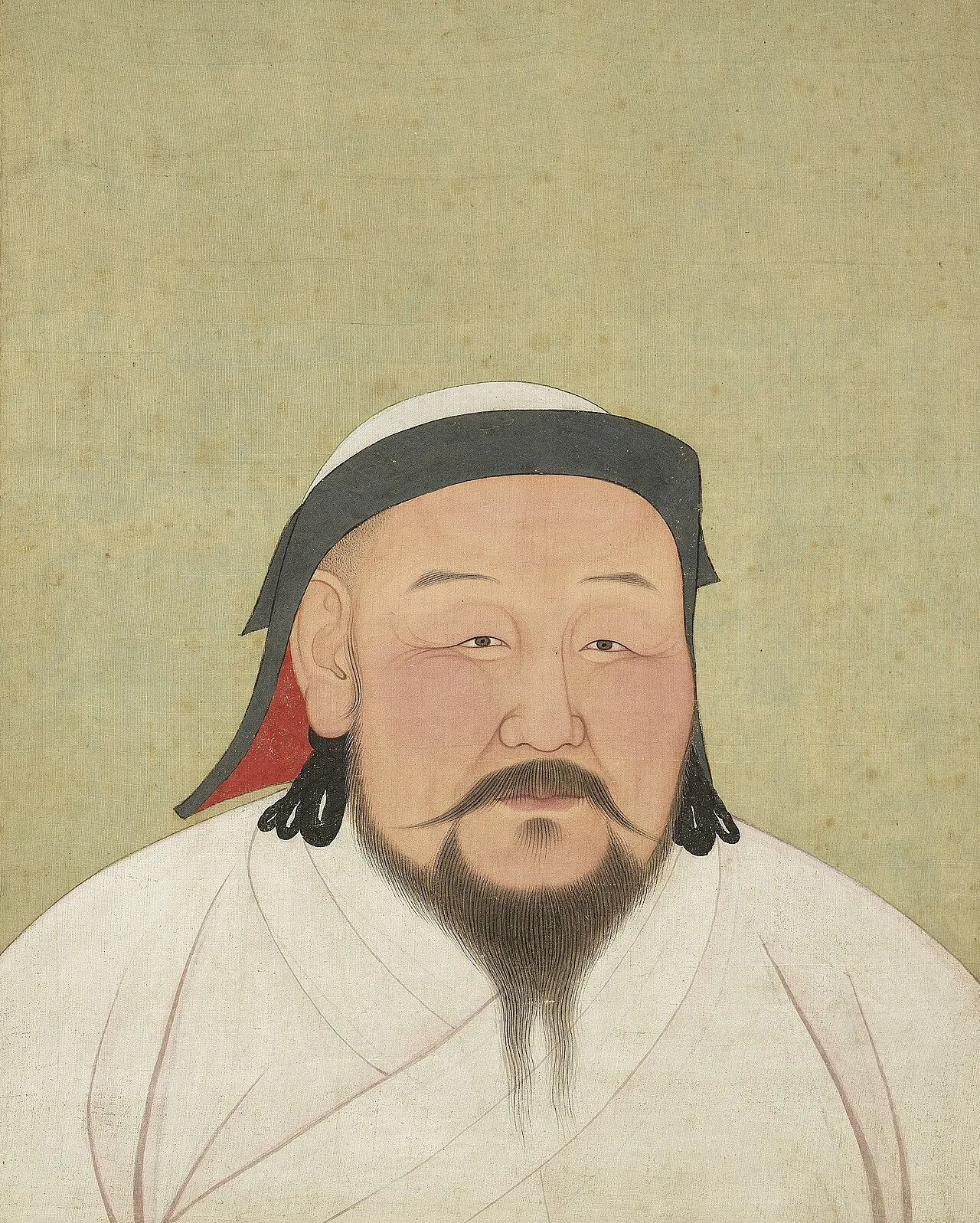
- Present each document.
- What does 6A tell us about Kublai’s power?
- Describe how Kublai is shown in 6B.
- What does 6B show that 6A does not?
- Write two sentences that compare the two documents.
Exercise 8 : The founder of the empire
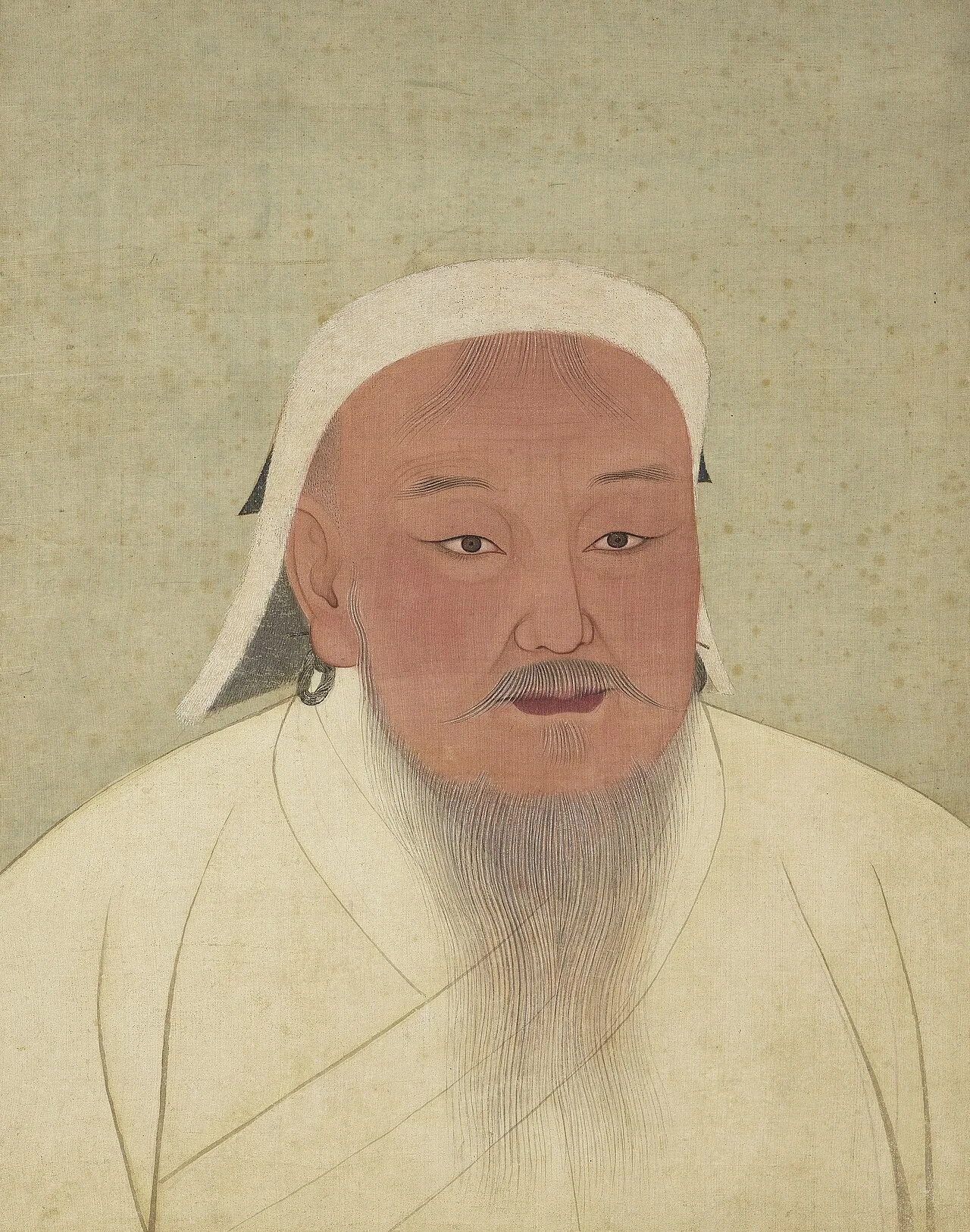
- Present the document (nature, date, location).
- Describe the man’s face, clothing, and pose.
- Why is the portrait not a true likeness made during his life?
- What does the portrait show about how the Yuan dynasty saw its founder?
Exercise 9 : The fall of Baghdad
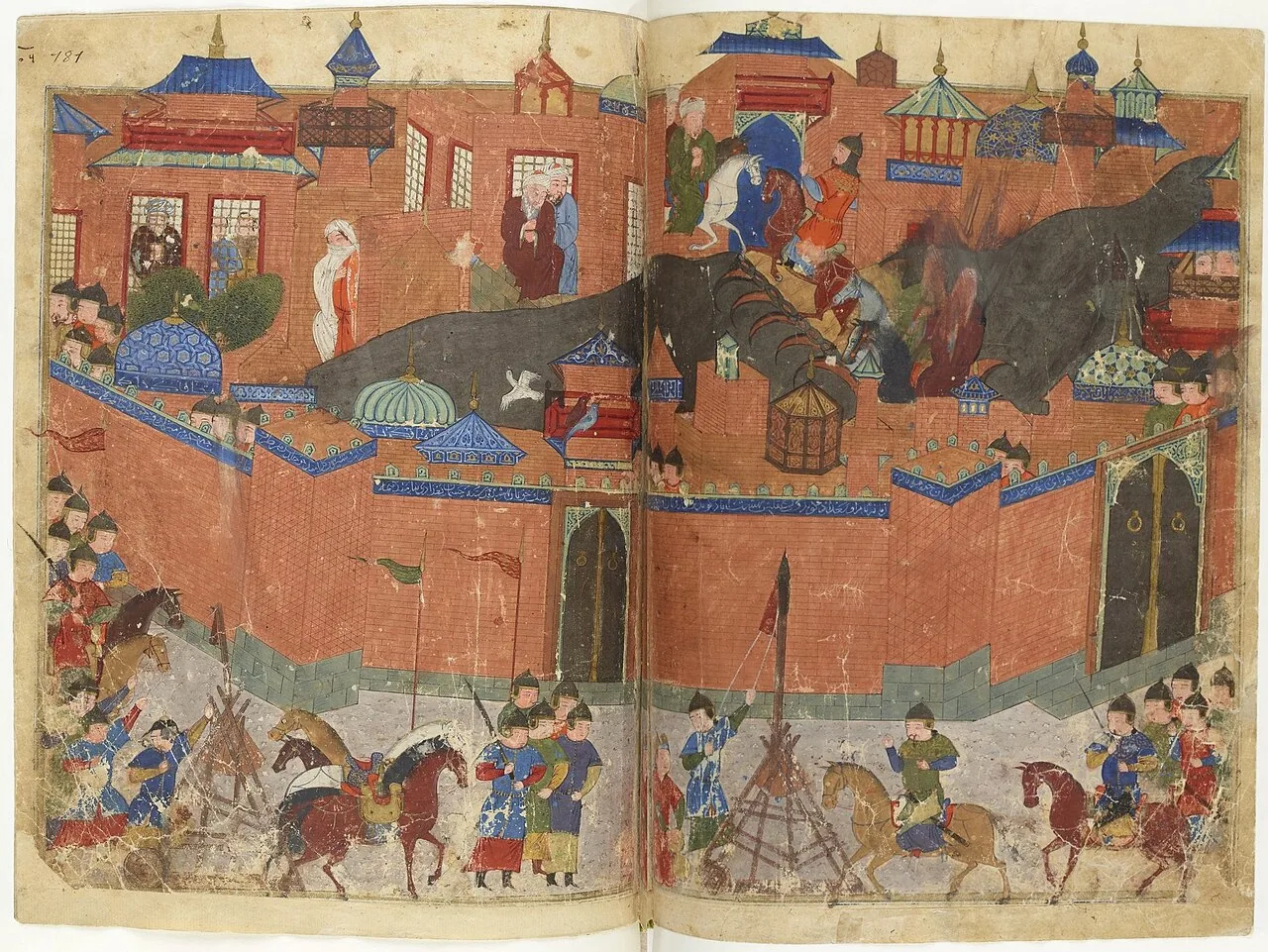
- Present the document (nature, date).
- Describe the city walls and the attackers.
- What weapons are shown?
- Why is this a useful but not a perfect source about the event of 1258?
Exercise 10 : Mongol horsemen
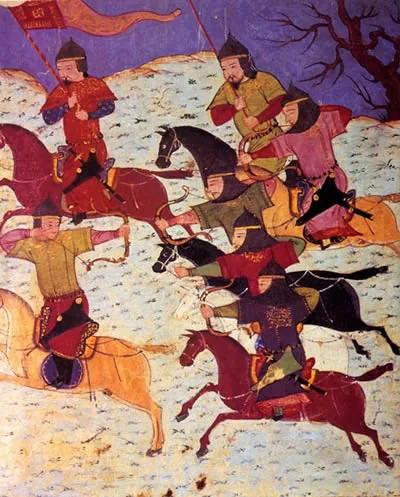
- Present the document.
- Describe the horsemen and their equipment.
- What does the picture show about Mongol fighting?
- Why were Persian artists painting the Mongols?
Exercise 11 : A tablet of authority
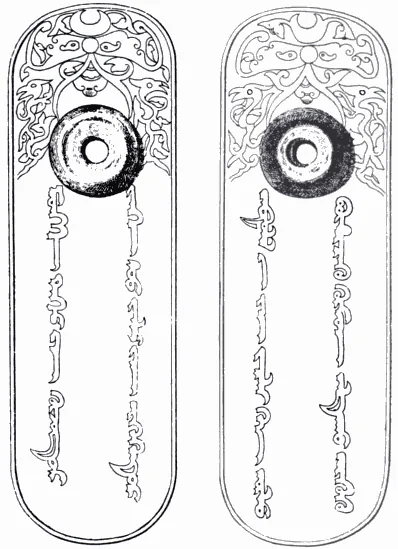
- Present the document.
- What was a paiza used for?
- Why would the Mongol rulers give such tablets to officials and envoys?
- How does the paiza help explain the Pax Mongolica?
Exercise 12 : The Great Khans
Study the table, which gives the first great khans of the Mongol Empire.
| Great khan | Reign | Main achievements |
|---|---|---|
| Genghis Khan | 1206-1227 | United the Mongols; conquered northern China and Central Asia |
| Ogedei | 1229-1241 | Built Karakorum; armies invaded Russia and Hungary |
| Mongke | 1251-1259 | Armies took Baghdad (1258) under Hulagu |
| Kublai | 1260-1294 | Founded the Yuan dynasty; conquered the Song (1279) |
Source: dates as given in standard reference works, such as the Cambridge History of Inner Asia.
- How many years did Genghis Khan reign as great khan?
- Which khan ruled the longest?
- Under which khan did the Mongols capture Baghdad?
- What does the table show about the spread of the empire in about 90 years?
Exercise 13 : Conquests of the Mongols
- Match the numbers to these names: Karakorum, Khanbaliq (Beijing), Samarkand, Baghdad, Kiev, Legnica, Hangzhou, Ain Jalut.
- Which city was the capital of the Mongols under Ogedei?
- Which city did Hulagu capture in 1258?
- Where were the Mongols stopped by a Muslim army in 1260?
Hint: Legnica is the western end of the map; Ain Jalut is on the eastern coast of the Mediterranean.
Exercise 14 : Marco Polo’s route
- Match the numbers to these names: Venice, Acre, Hormuz, Kashgar, Dunhuang, Khanbaliq (Beijing), Quanzhou, Constantinople.
- Where did Polo’s journey begin?
- Which city was the Mongol capital in China?
- By which sea route did Polo come back, and from which Chinese port?
Hint: the blue route goes by sea from the east coast of China to the Persian Gulf.
Exercise 15 : Order the events
Put these events in order from earliest to latest and write the date next to each.
- The Mongols capture Baghdad
- Temujin becomes Genghis Khan
- The Ming replace the Yuan
- The Mongols burn Kiev
- Kublai Khan founds the Yuan dynasty
- The Mongols take Bukhara and Samarkand
Exercise 16 : How long between events?
Calculate how many years passed between the following events, and name the century of each date.
- Genghis Khan takes his title (1206) and the fall of Baghdad (1258)
- The Mongols burn Kiev (1240) and the Mongols defeat the Poles at Legnica (1241)
- Kublai founds the Yuan dynasty (1271) and the Ming drive out the Mongols (1368)
- The Golden Horde takes control of Russia (about 1240) and Ivan III refuses to pay (1480)
Exercise 17 : Guided research: Marco Polo
Find out about Marco Polo and his book. Use at least two reliable sites, such as the British Library, Britannica, the Metropolitan Museum of Art, or the Library of Congress. Suggested keywords: Marco Polo travels Kublai Khan, Rustichello Marco Polo book, Marco Polo Il Milione.
- When and where was Marco Polo born, and when did he travel?
- Who helped him write his book, and where?
- What do some historians say about the accuracy of the book?
- Which sites did you use, and why do you trust them?
Hint: look for the dates of the journey and for the place where the book was written.
Exercise 18 : CER paragraph: destroyers or connectors?
Write a Claim, Evidence, Reasoning paragraph that answers: Were the Mongols more important as destroyers or as connectors of Eurasia?
- Claim: state your position.
- Evidence: use at least two details from the lesson or the documents.
- Reasoning: explain how the evidence supports your claim.
Hint: think of Baghdad and Kiev, and also the yam, the paiza, and the exchange of goods.
Exercise 19 : SAQ: the Mongol army
Answer in complete sentences.
- Identify two strengths of the Mongol army.
- Explain one reason why the Mongols were able to capture walled cities.
- Explain one effect of the Mongol conquest on Russia.
Exercise 20 : True or false? Justify
Say whether each statement is true or false and justify your answer with one fact.
- Genghis Khan was proclaimed ruler of all the Mongols in 1206.
- The Mongols stopped at Baghdad in 1258 and did not capture it.
- Kublai Khan founded the Yuan dynasty in China.
- The Mongol Empire stayed united for 300 years.
Exercise 21 : Causes and consequences: Mongol peace and trade
Complete the chain of causes and consequences. Write one or two sentences for each link.
- Cause: the Mongols conquer most of Asia
- Immediate consequence: a single government controls the roads
- Result: the Pax Mongolica and the growth of trade
- Possible long-term consequence: goods, ideas, and diseases travel between East and West


Quick review: flashcards
Tap a card to see the answer.