


This worksheet on West African Kingdoms: Ghana, Mali and Songhai belongs to the Grade 7 Medieval and Early Modern World course. Its questions use primary sources, maps and timelines, and they move from basic recall to short writing tasks. Before you start, review the lesson; afterward, try the true or false quiz.
Exercise 1 : Vocabulary of the West African kingdoms
Match each term to its meaning, then use three of the terms in sentences of your own.
- Sahel
- Mansa
- Griot
- Caravan
- Trans-Saharan trade
- Manuscript
Meanings: (a) a group of travelers and animals crossing the desert; (b) the emperor of Mali; (c) a handwritten book or document; (d) the dry grassland belt south of the Sahara; (e) a storyteller who keeps oral history; (f) trade across the Sahara.
Exercise 2 : Salt in the Sahara
Document 1 – The salt mines of the Sahara
In the sand is a salt mine; they dig for the salt, and find it in thick slabs, lying one on top. of the other, as though they had been tool-squared and laid under the surface of the earth. A camel will carry two of these slabs. No one lives at Taghaza except the slaves of the Massufa tribe, who dig for the salt; […] At Iwalatan a load of salt brings eight to ten mithqals; in the town of Malli [Mali] it sells for twenty to thirty, and sometimes as much as forty. The negroes use salt as a medium of exchange, just as gold and silver is used [elsewhere]; they cut it up into pieces and buy and sell with it.
Source: Ibn Battuta, Travels in Asia and Africa, 1325-1354, on Taghaza in the Sahara, 1352, translated by H. A. R. Gibb (London, 1929), as reproduced in the Internet Medieval Sourcebook, Fordham University.
*Taghaza: a salt-mining village in the Sahara. *Iwalatan: Walata. *mithqal: a unit of gold weight. *Malli: Mali.
- Present the document (nature, author, date, context).
- Describe the place where the salt is dug. What does the text say about the slabs of salt?
- Who works in the salt mine?
- What does the author say about the price of salt in Walata and in Mali?
- What does the text suggest about the trade between the desert and the south?
Exercise 3 : The court of Mansa Sulayman
Document 1 – The court of Mali
The negroes are of all people the most submissive to their king and the most abject in their behaviour before him. They swear by his name, saying “Mansa Sulayman ki” [in Mandingo, “the emperor Sulayman has commanded”]. If he summons any of them while he is holding an audience in his pavilion, the person summoned takes off his clothes and puts on worn garments, removes his turban and dons a dirty skullcap, and enters with his garments and trousers raised knee-high. He goes forward in an attitude of humility and dejection and knocks the ground hard with his elbows, then stands with bowed head and bent back listening to what he says. If anyone addresses the king and receives a reply from him, he uncovers his back and throws dust over his head and back, for all the world like a bather splashing himself with water.
Source: Ibn Battuta, Travels in Asia and Africa, 1325-1354, on the court of Mansa Sulayman of Mali, 1352-1353, translated by H. A. R. Gibb (London, 1929), Internet Medieval Sourcebook, Fordham University.
*abject: humble. *pavilion: a large tent or covered platform. *negroes: the word Ibn Battuta used for the black Africans he met; it is a historical term of his time.
- Present the document (nature, author, date, context).
- How do people behave when the king summons them?
- What do they do when the king speaks?
- What do these customs show about the power of the king?
- Ibn Battuta found these customs strange. Why is it important to remember that he was a foreigner when reading his report?
Exercise 4 : A land without robbers
Document 1 – Justice and security in Mali
The negroes possess some admirable qualities. They are seldom unjust, and have a greater abhorrence of injustice than any other people. Their sultan shows no mercy to anyone who is guilty of the least act of it. There is complete security in their country. Neither traveller nor inhabitant in it has anything to fear from robbers or men of violence. They do not confiscate the property of any white man who dies in their country, even if it be uncounted wealth. On the contrary, they give it into the charge of some trustworthy person among the whites, until the rightful heir takes possession of it.
Source: Ibn Battuta, Travels in Asia and Africa, 1325-1354, on the people of Mali, 1352-1353, translated by H. A. R. Gibb (London, 1929), Internet Medieval Sourcebook, Fordham University.
*abhorrence: strong dislike. *confiscate: take away by authority. *heir: the person who inherits.
- Present the document (nature, author, date, context).
- What admirable qualities does Ibn Battuta mention?
- How does the sultan treat those who commit injustice?
- What happens to the property of a white man who dies in Mali?
- Why would these facts encourage trade?
Exercise 5 : Timbuktu according to Leo Africanus
Document 1 – Timbuktu in the early 1500s
Here are many shops of artificers, and merchants, and especially of such as weave linen and cotton cloth. And hither do the Barbarie-merchants bring cloth of Europe. […] salt is very scarce here; for it is brought hither by land from Tegaza, which is five hundred miles distant. […] The rich king of Tombuto hath many plates and sceptres of gold, some whereof weigh 1300. pounds: and he keeps a magnificent and well furnished court. […] Here are great store of doctors, judges, priests, and other learned men, that are bountifully maintained at the king’s cost and charges. And hither are brought divers manuscripts or written books out of Barbary, which are sold for more money than any other merchandise.
Source: Leo Africanus, A Geographical History of Africa, on Timbuktu about 1510-1513, in the English translation of John Pory (London, 1600), modernized spelling as published in the EEBO-TCP/EarlyPrint text; marginal notes omitted.
*artificers: craftsmen. *Barbarie: North Africa. *Tegaza: Taghaza. *sceptres: staffs carried by kings as signs of power.
- Present the document (nature, author, date, context).
- Which trades does Leo mention in Timbuktu?
- What does the text say about salt, and where does it come from?
- Which goods sold for the highest profit, according to Leo?
- Leo Africanus was an outsider who later lived in Italy. How could this affect his account?
Exercise 6 : How Askia Muhammad came to power
Document 1 – The ruler of Timbuktu
Howbeit the king of Tombuto that now reigneth, called Abuacre Izchia, is a Negro by birth: this Abuacre after the decease of the former king, who was a Libyan borne, slew all his sons, and so usurped the kingdom. And having by wars for the space of fifteen years conquered many large dominions, he then concluded a league with all nations, and went on pilgrimage to Mecca, in which journey he so consumed his treasure, that he was constrained to borrow great sums of money of other princes.
Source: Leo Africanus, A Geographical History of Africa, on the ruler of Timbuktu (Askia Muhammad), about 1510-1526, translated by John Pory (London, 1600), modernized spelling; marginal notes omitted.
*Negro: a word used in Leo’s time for black Africans. *usurped: took power without a right to it. *Libyan: from the Sahara, here a Berber. *league: alliance.
- Present the document (nature, author, date, context).
- How did Askia come to power, according to Leo?
- How long did he conquer territories?
- What did he do afterwards?
- What problem did Askia have after the pilgrimage?
Exercise 7 : Salt as money
Document 1 – The salt mines of the Sahara
In the sand is a salt mine; they dig for the salt, and find it in thick slabs, lying one on top. of the other, as though they had been tool-squared and laid under the surface of the earth. A camel will carry two of these slabs. No one lives at Taghaza except the slaves of the Massufa tribe, who dig for the salt; […] At Iwalatan a load of salt brings eight to ten mithqals; in the town of Malli [Mali] it sells for twenty to thirty, and sometimes as much as forty. The negroes use salt as a medium of exchange, just as gold and silver is used [elsewhere]; they cut it up into pieces and buy and sell with it.
Source: Ibn Battuta, Travels in Asia and Africa, 1325-1354, on Taghaza in the Sahara, 1352, translated by H. A. R. Gibb (London, 1929), as reproduced in the Internet Medieval Sourcebook, Fordham University.
*Taghaza: a salt-mining village in the Sahara. *Iwalatan: Walata. *mithqal: a unit of gold weight. *Malli: Mali.
- Which sentence shows that salt could serve as a medium of exchange?
- Explain why salt was worth more in Mali than in Walata.
- Who lives at Taghaza, according to the text?
- Why did the people of the south need salt?
- Write one sentence that sums up the exchange between desert and savanna.
Exercise 8 : Two travelers, two kingdoms
Document 2A – Mali about 1352
The negroes are of all people the most submissive to their king and the most abject in their behaviour before him. They swear by his name, saying “Mansa Sulayman ki” [in Mandingo, “the emperor Sulayman has commanded”]. If he summons any of them while he is holding an audience in his pavilion, the person summoned takes off his clothes and puts on worn garments, removes his turban and dons a dirty skullcap, and enters with his garments and trousers raised knee-high. He goes forward in an attitude of humility and dejection and knocks the ground hard with his elbows, then stands with bowed head and bent back listening to what he says. If anyone addresses the king and receives a reply from him, he uncovers his back and throws dust over his head and back, for all the world like a bather splashing himself with water.
Source: Ibn Battuta, Travels in Asia and Africa, 1325-1354, on the court of Mansa Sulayman of Mali, 1352-1353, translated by H. A. R. Gibb (London, 1929), Internet Medieval Sourcebook, Fordham University.
*abject: humble. *pavilion: a large tent or covered platform. *negroes: the word Ibn Battuta used for the black Africans he met; it is a historical term of his time.
Document 2B – Timbuktu about 1510
Here are many shops of artificers, and merchants, and especially of such as weave linen and cotton cloth. And hither do the Barbarie-merchants bring cloth of Europe. […] salt is very scarce here; for it is brought hither by land from Tegaza, which is five hundred miles distant. […] The rich king of Tombuto hath many plates and sceptres of gold, some whereof weigh 1300. pounds: and he keeps a magnificent and well furnished court. […] Here are great store of doctors, judges, priests, and other learned men, that are bountifully maintained at the king’s cost and charges. And hither are brought divers manuscripts or written books out of Barbary, which are sold for more money than any other merchandise.
Source: Leo Africanus, A Geographical History of Africa, on Timbuktu about 1510-1513, in the English translation of John Pory (London, 1600), modernized spelling as published in the EEBO-TCP/EarlyPrint text; marginal notes omitted.
*artificers: craftsmen. *Barbarie: North Africa. *Tegaza: Taghaza. *sceptres: staffs carried by kings as signs of power.
- Present each document (author, date, place).
- What does 2A show about the power of the king of Mali?
- What does 2B show about the wealth of the city and the king?
- What do both documents show about the place of the ruler in society?
- Why was Leo Africanus likely to see things differently from Ibn Battuta?
Exercise 9 : Then and now: the salt caravan
Document 2A – Taghaza in 1352
In the sand is a salt mine; they dig for the salt, and find it in thick slabs, lying one on top. of the other, as though they had been tool-squared and laid under the surface of the earth. A camel will carry two of these slabs. No one lives at Taghaza except the slaves of the Massufa tribe, who dig for the salt; […] At Iwalatan a load of salt brings eight to ten mithqals; in the town of Malli [Mali] it sells for twenty to thirty, and sometimes as much as forty. The negroes use salt as a medium of exchange, just as gold and silver is used [elsewhere]; they cut it up into pieces and buy and sell with it.
Source: Ibn Battuta, Travels in Asia and Africa, 1325-1354, on Taghaza in the Sahara, 1352, translated by H. A. R. Gibb (London, 1929), as reproduced in the Internet Medieval Sourcebook, Fordham University.
*Taghaza: a salt-mining village in the Sahara. *Iwalatan: Walata. *mithqal: a unit of gold weight. *Malli: Mali.
Document 2B – A salt caravan
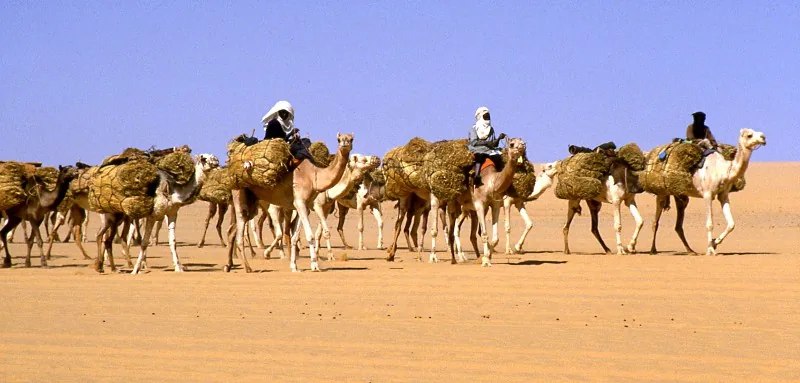
- Present each document (nature, date, place).
- What does 2A say about the salt that a camel can carry?
- What do you see in the photograph, and how is it similar to Ibn Battuta’s description?
- Why is the photograph not a primary source for the 14th century?
- What does the persistence of the salt caravan suggest about the trade?
Exercise 10 : The king of Mali on a map
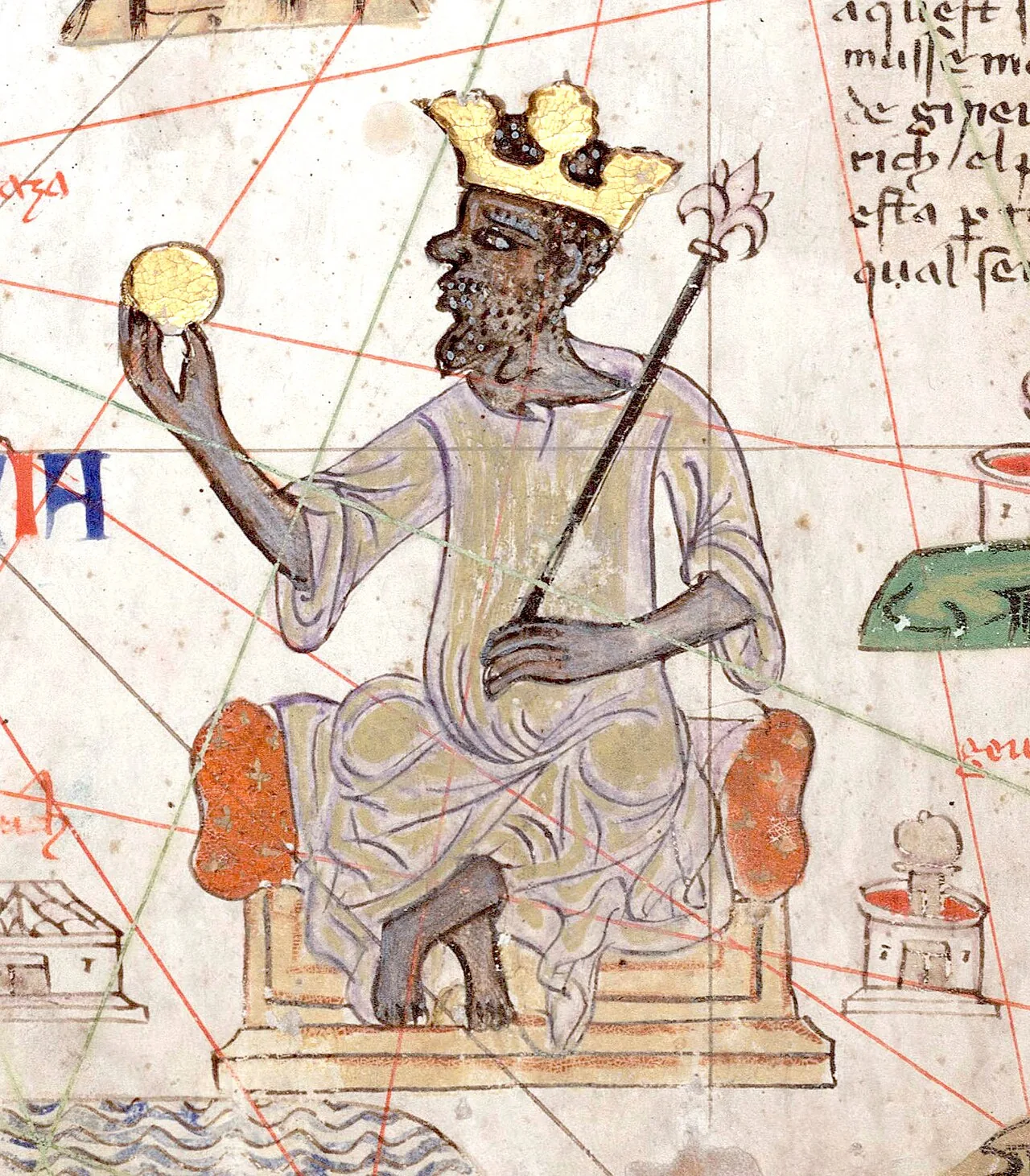
- Present the document (nature, date, place).
- Describe the king: his clothing, crown, and what he holds.
- What does the gold nugget symbolize?
- Why is this map not an eyewitness picture?
- What does it tell us about what Europeans knew about West Africa in 1375?
Exercise 11 : The Great Mosque of Djenné
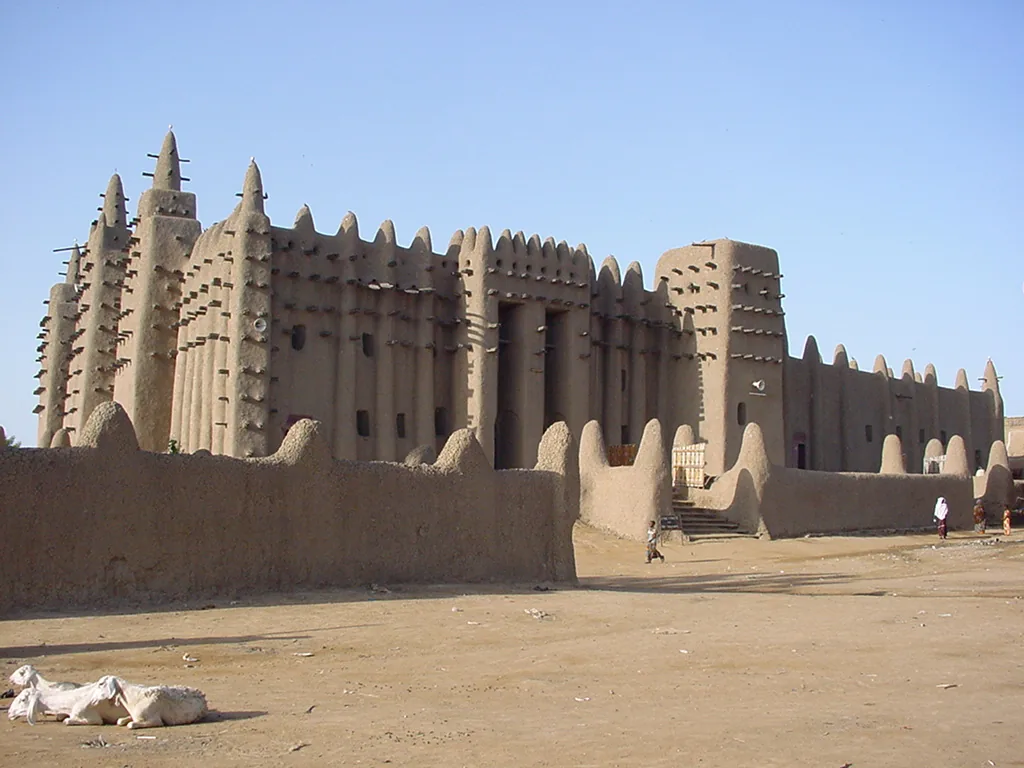
- Present the document (nature, date, place).
- Describe the building and what it is made of.
- Why do the wooden beams stick out of the walls?
- Why does the community replaster the mosque every year?
- What does this building tell us about local building traditions?
Exercise 12 : The manuscripts of Timbuktu
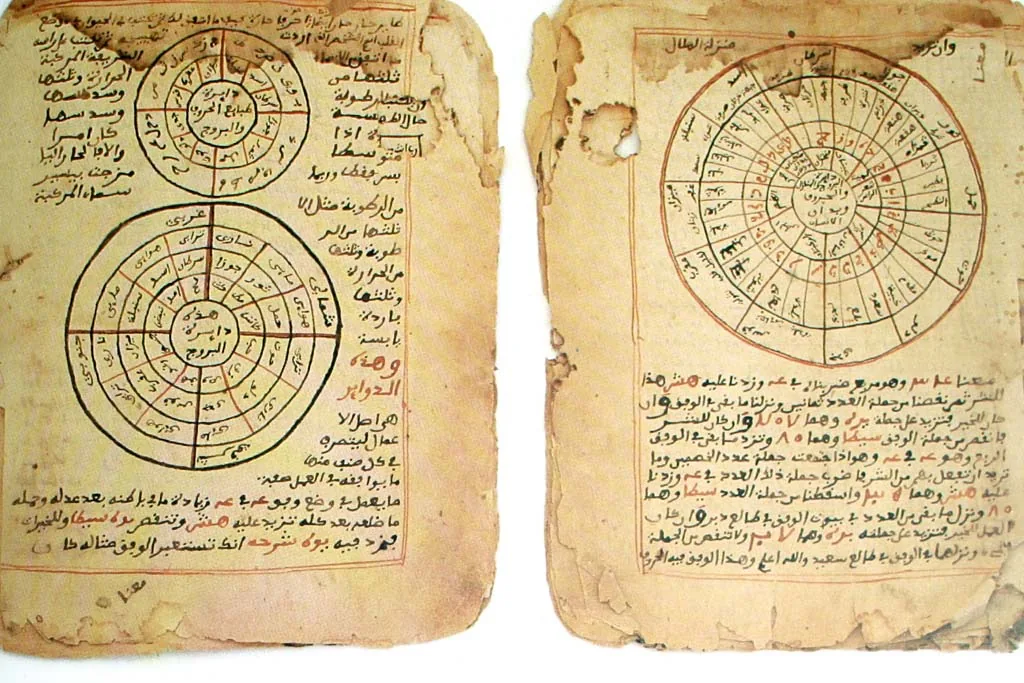
- Present the document (nature, date, place).
- Describe the pages: what do you see?
- What subjects do you think the manuscript deals with?
- What does it tell you about education in Timbuktu?
- Why are old manuscripts difficult to preserve in a hot, dry climate?
Exercise 13 : Timbuktu in 1830
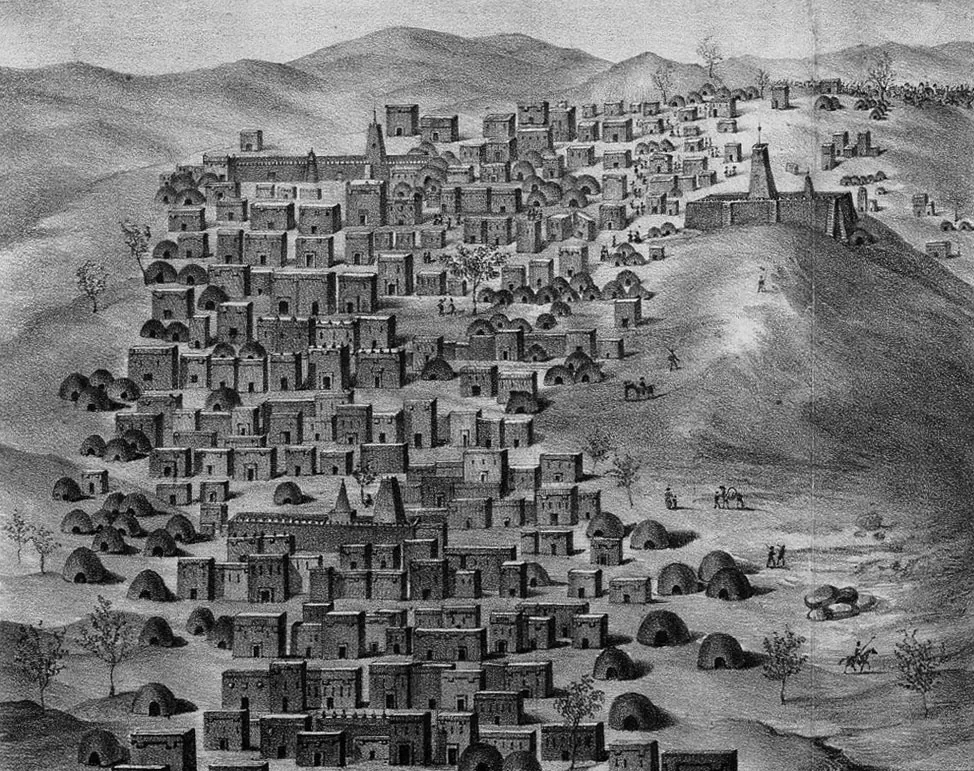
- Present the document (nature, date, place).
- Describe the buildings and the landscape.
- Timbuktu was already past its golden age. Which clues does the view give?
- Why is it important to know that the picture was made centuries after the age of Askia Muhammad?
- Compare the picture with what Leo Africanus wrote in about 1510.
Exercise 14 : The Sankore Mosque
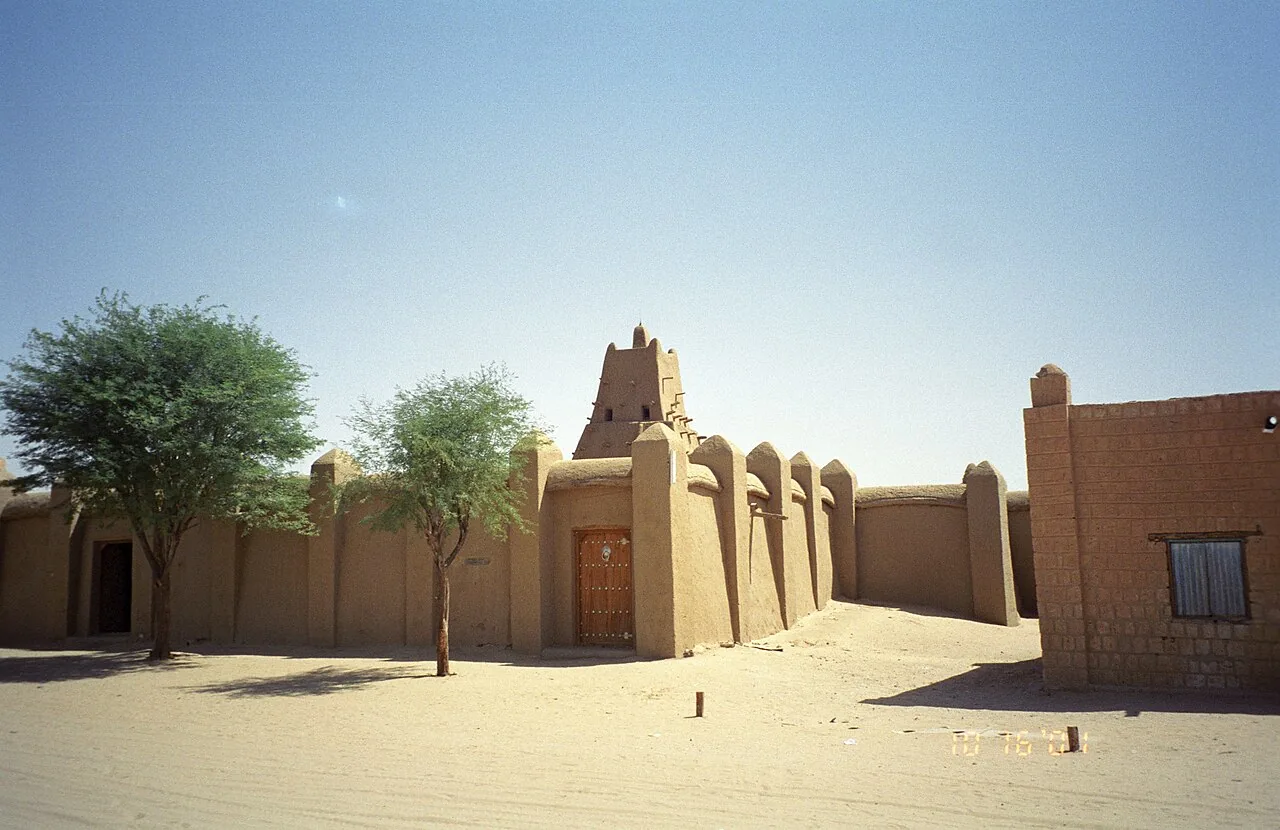
- Present the document (nature, date, place).
- Describe the building and the landscape.
- What was taught at Sankore?
- Why were mosques also schools in the Muslim world?
- Why did Mansa Musa and Askia Muhammad support such places?
Exercise 15 : Rulers of Mali and Songhai
Document 1 – Selected rulers
| Ruler | Kingdom | Reign (CE) |
|---|---|---|
| Sundiata Keita | Mali | about 1235-1255 |
| Mansa Musa | Mali | 1312-1337 |
| Mansa Sulayman | Mali | 1341-1360 |
| Sunni Ali | Songhai | 1464-1492 |
| Askia Muhammad | Songhai | 1493-1528 |
Source: dates as given in reference works such as N. Levtzion, Ancient Ghana and Mali (1973), and the Cambridge History of Africa; dates for early rulers are approximate. Table prepared for this unit.
- How many years did Mansa Musa reign?
- How many years did Askia Muhammad reign?
- How many years passed between the end of Mansa Sulayman’s reign and the start of Sunni Ali’s?
- Who reigned longer, Sunni Ali or Mansa Musa, and by how many years?
- Why are the dates of Sundiata marked “about”?
Exercise 16 : Locate the West African trade world
- Match the numbers to these names: Agadez, Djenné, Gao, Kumbi Saleh, Niani, Sijilmasa, Taghaza, Timbuktu, Walata.
- Which two places are the salt-trade stages in the north?
- Which river connects Timbuktu, Gao, and Djenné?
- Which places were the capitals of Ghana and of Mali?
Hint: the Niger flows in a big bend through the Sahel, and Timbuktu lies at its northern edge.
Exercise 17 : Three kingdoms
- Which color shows Ghana, which Mali, and which Songhai?
- Which kingdom extended farthest east, and which farthest west?
- Name the three areas where gold was found.
- Which route carried salt from the desert to the savanna?
- Explain why the three kingdoms were located on the southern edge of the Sahara.
Exercise 18 : Order the events
Put these events in order from earliest to latest and write the date next to each.
- Askia Muhammad becomes ruler of Songhai
- Sundiata wins the battle of Kirina
- Mansa Musa’s pilgrimage to Mecca
- Moroccan victory at Tondibi
- Ibn Battuta visits Mali
- Sunni Ali takes Timbuktu
Exercise 19 : How long between events?
Calculate each time span.
- From the battle of Kirina (about 1235) to the pilgrimage of Mansa Musa (1324).
- From the pilgrimage of Mansa Musa (1324) to the Catalan Atlas (1375).
- From Sunni Ali’s capture of Timbuktu (1468) to the battle of Tondibi (1591).
- From al-Bakri’s description of Ghana (1068) to the visit of Ibn Battuta to Mali (1352).
Exercise 20 : Guided research: the manuscripts of Timbuktu
Find out about the manuscripts of Timbuktu and why they matter. Use at least two reliable sites, such as Britannica, the Library of Congress, the British Library, or UNESCO. Suggested keywords: Timbuktu manuscripts, Sankore University Timbuktu, Ahmad Baba Timbuktu.
- How many manuscripts are said to survive, and what subjects do they cover?
- What were Sankore and the other Timbuktu schools?
- How have families and libraries protected the manuscripts?
- Which sites did you use, and why do you trust them?
Hint: figures differ between sources, so compare them and note the range.
Exercise 21 : CER paragraph: the power of trade
Write a Claim, Evidence, Reasoning paragraph that answers: How did trade make the West African kingdoms rich and powerful?
- Claim: state your position.
- Evidence: use at least two details from the documents or the lesson.
- Reasoning: explain how the evidence supports your claim.
Hint: think about gold, salt, taxes, and the cities along the Niger.
Exercise 22 : SAQ: Mansa Musa and Mali
Answer in complete sentences.
- Identify two reasons for the wealth of the kingdom of Mali.
- Explain one effect of Mansa Musa’s pilgrimage to Mecca.
- Explain one reason why Songhai fell in 1591.
Exercise 23 : True or false? Justify
Decide whether each statement is true or false, and justify your answer.
- Ghana is in the same place as the modern country of Ghana.
- Camels made trans-Saharan trade possible.
- Timbuktu was a center of learning under the Songhai.
- Mansa Musa took his gold to Rome.
Exercise 24 : Causes and consequences: the fall of Songhai
Complete the chain and explain each link.
- Cause: Askia Muhammad dies in 1528 and his sons quarrel. Effect: ______.
- Effect on the army: ______.
- Effect of the Moroccan invasion of 1591: ______.
- Later consequence: ______.


Quick review: flashcards
Tap a card to see the answer.