


This Grade 7 Medieval and Early Modern World test covers West African Kingdoms: Ghana, Mali and Songhai. Like a classroom assessment, it includes documents to analyze, knowledge questions and a short writing task. To prepare, review the lesson first, then practice with the worksheet.
Time : 50 min
The test has three parts: knowledge (32 points), documents (48 points), and a written argument (20 points). Answer in complete sentences and cite the documents.
Document 1 – Ghana, Mali, and Songhai
Schematic map prepared for this unit; borders and routes approximate.
Document 2 – The king of Mali on a map of 1375
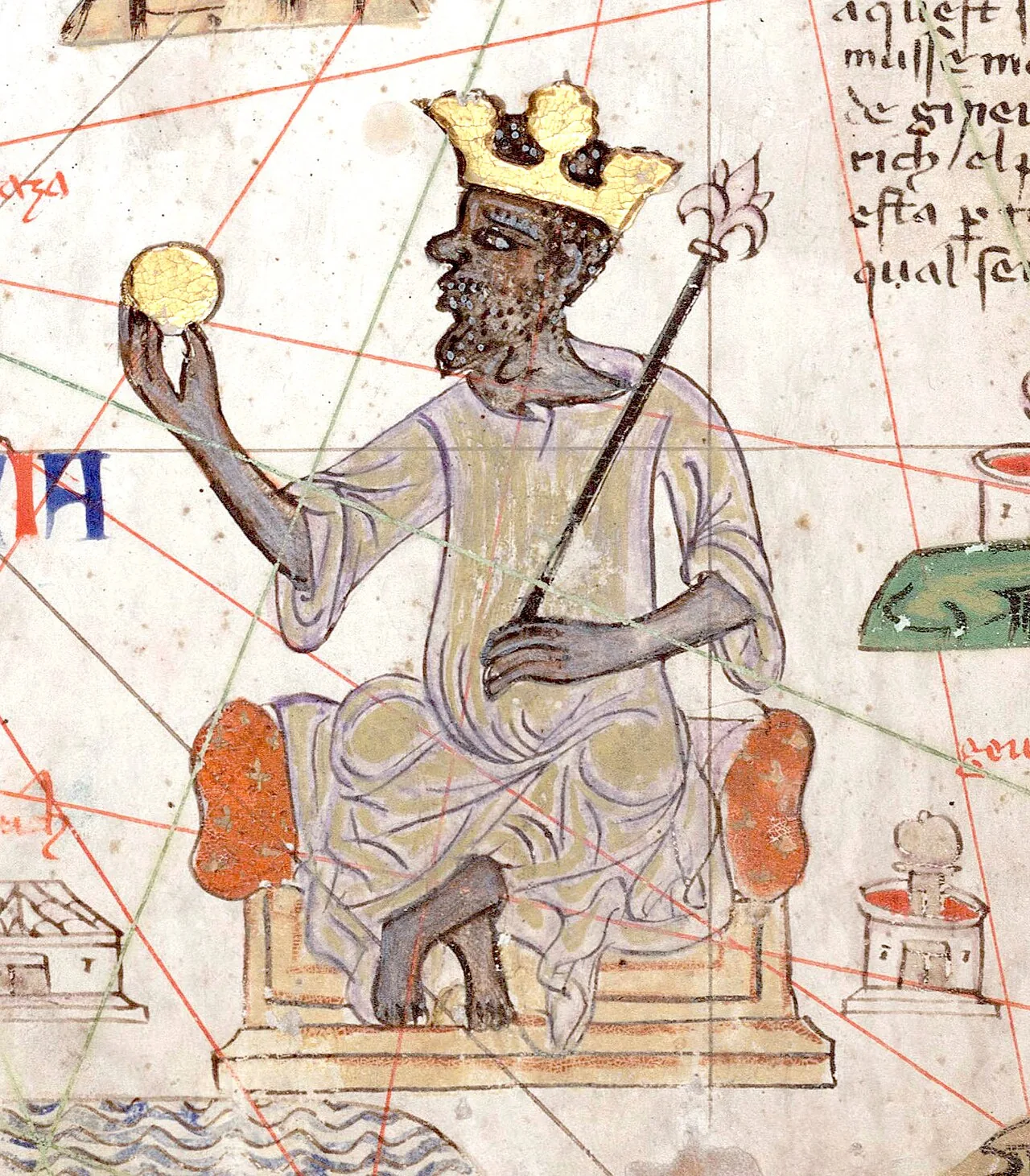
Wikimedia Commons; Catalan Atlas, 1375, National Library of France.
Document 3 – Timbuktu in the early 1500s
Here are many shops of artificers, and merchants, and especially of such as weave linen and cotton cloth. And hither do the Barbarie-merchants bring cloth of Europe. […] salt is very scarce here; for it is brought hither by land from Tegaza, which is five hundred miles distant. […] The rich king of Tombuto hath many plates and sceptres of gold, some whereof weigh 1300. pounds: and he keeps a magnificent and well furnished court. […] Here are great store of doctors, judges, priests, and other learned men, that are bountifully maintained at the king’s cost and charges. And hither are brought divers manuscripts or written books out of Barbary, which are sold for more money than any other merchandise.
Source: Leo Africanus, A Geographical History of Africa, on Timbuktu about 1510-1513, in the English translation of John Pory (London, 1600), modernized spelling as published in the EEBO-TCP/EarlyPrint text; marginal notes omitted.
*artificers: craftsmen. *Barbarie: North Africa. *Tegaza: Taghaza. *sceptres: staffs carried by kings as signs of power.
Leo Africanus, Geographical History of Africa (translation by John Pory, 1600).
Document 4 – Key dates
- about 1235 Sundiata wins the battle of Kirina.
- 1312 Mansa Musa becomes ruler of Mali.
- 1324 Mansa Musa’s pilgrimage to Mecca.
- 1352 Ibn Battuta travels to Mali.
- 1468 Sunni Ali takes Timbuktu.
- 1493 Askia Muhammad takes power.
- 1591 Moroccan victory at Tondibi.
Dates as commonly given in reference works such as the Cambridge History of Africa; early dates are approximate.
Questions
- Part 1 – Knowledge. Define trans-Saharan trade, griot, and Sahel. (12 pts)
- Part 1. Document 1: name the three kingdoms, name two gold-producing regions, and say what the dashed brown lines show. (12 pts)
- Part 1. Explain why salt and gold were exchanged across the Sahara. (8 pts)
- Part 2 – Documents. Document 2: present the document, describe what you see, and explain what it tells us about what Europeans knew about Mali. (14 pts)
- Part 2. Document 3: present the document, say what Leo Africanus describes about the king and about books, and explain why the source must be used with care. (14 pts)
- Part 2. Document 4: calculate how many years passed between Kirina and Mansa Musa’s pilgrimage, between 1324 and the visit of Ibn Battuta, and between 1493 and 1591. (10 pts)
- Part 2. Using Document 1, Document 4, and the lesson, explain two causes of the rise of the kingdom of Songhai or the fall of Songhai. (10 pts)
- Part 3 – Written argument. How did trade, Islam, and learning shape the kingdoms of Mali and Songhai? Write a paragraph or two with a claim, at least two pieces of evidence from the documents or the lesson, and your reasoning. (20 pts)


Quick review: flashcards
Tap a card to see the answer.