


This Grade 7 Medieval and Early Modern World test covers The Rise and Spread of Islam. Like a classroom assessment, it includes documents to analyze, knowledge questions and a short writing task. To prepare, review the lesson first, then practice with the worksheet.
Time : 50 min
The test has three parts: knowledge (32 points), documents (48 points), and a written argument (20 points). Answer in complete sentences and cite the documents.
Document 1 – The growth of the caliphate
Schematic map prepared for this unit; borders approximate.
Document 2 – The Dome of the Rock
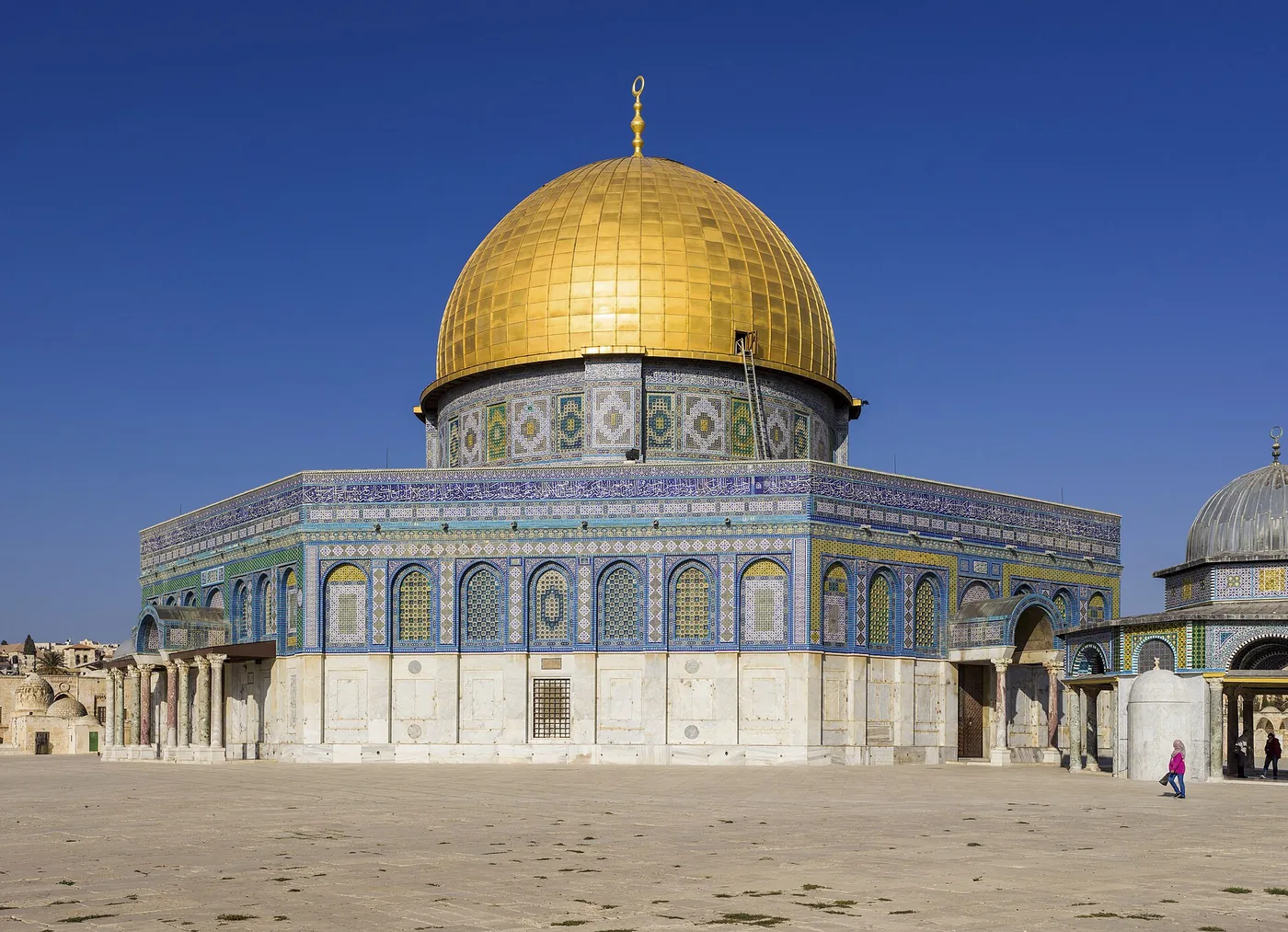
Wikimedia Commons; photograph (CC BY-SA 4.0).
Document 3 – The conquest of Egypt
After fighting three battles with the Romans, the Muslims conquered them. So when the chief men of the city saw these things, they went to Amr, and received a certificate of security for the city, that it might not be plundered. This kind of treaty which Muhammad, the chief of the Arabs, taught them, they called the Law; and he says with regard to it: “As for the province of Egypt and any city that agrees with its inhabitants to pay the land-tax to you and to submit to your authority, make a treaty with them, and do them no injury. But plunder and take as prisoners those that will not consent to this and resist you.” For this reason the Muslims kept their hands off the province and its inhabitants
Source: Sawirus ibn al-Muqaffa, History of the Patriarchs of the Coptic Church of Alexandria, written in Arabic by a Christian bishop in the 10th century, on the conquest of Egypt (639-642); translated by Basil Evetts (1904), as reproduced in the Internet Medieval Sourcebook, Fordham University.
*Romans: the Byzantines, whom the Copts called Romans. *Amr: Amr ibn al-As, the Muslim general. *land-tax: tax on farmland.
Sawirus ibn al-Muqaffa, History of the Patriarchs of Alexandria (translation by Basil Evetts, 1904).
Document 4 – Key dates
- 622 The Hijra.
- 632 Muhammad dies; Abu Bakr becomes the first caliph.
- 661 The Umayyad dynasty begins.
- 711 Muslim forces cross into Spain.
- 750 The Abbasids overthrow the Umayyads.
- 762 Baghdad is founded.
- 1258 The Mongols capture Baghdad.
Dates as commonly given in reference works such as The Encyclopaedia of Islam.
Questions
- Part 1 – Knowledge. Define Hijra, caliph, and dhimmi. (12 pts)
- Part 1. Document 1: name the capital of the Umayyad dynasty, name two regions added to the Muslim state between 661 and 750, and say which color shows Arabia in 632. (12 pts)
- Part 1. Name the Five Pillars of Islam and explain one of them. (8 pts)
- Part 2 – Documents. Document 2: present the document, describe what you see, and explain why the caliph built it in Jerusalem. (14 pts)
- Part 2. Document 3: present the document, say what the people of the city obtained, and explain why the point of view of the author is valuable. (14 pts)
- Part 2. Document 4: calculate how many years passed from the Hijra to the death of Muhammad, from 632 to the crossing into Spain, and from the founding of Baghdad to its capture by the Mongols. (10 pts)
- Part 2. Using Document 1, Document 4, and the lesson, explain two causes of the rapid expansion of the Muslim state. (10 pts)
- Part 3 – Written argument. How did the Abbasid caliphate contribute to learning and trade? Write a paragraph or two with a claim, at least two pieces of evidence from the documents or the lesson, and your reasoning. (20 pts)


Quick review: flashcards
Tap a card to see the answer.