


This worksheet on The Rise and Spread of Islam belongs to the Grade 7 Medieval and Early Modern World course. Its questions use primary sources, maps and timelines, and they move from basic recall to short writing tasks. Before you start, review the lesson; afterward, try the true or false quiz.
Exercise 1 : Vocabulary of Islam
Match each term to its meaning, then use three of the terms in sentences of your own.
- Hijra
- Caliph
- Hajj
- Dhimmi
- Hadith
- Mosque
Meanings: (a) a non-Muslim protected under Muslim rule; (b) the successor of Muhammad as leader of the Muslim community; (c) the migration from Mecca to Medina in 622; (d) the pilgrimage to Mecca; (e) a place of Muslim worship; (f) reports of what Muhammad said and did.
Exercise 2 : The first revelation
Document 1 – The first words
Read: In the name of thy Lord Who createth, Createth man from a clot. Read: And thy Lord is the Most Bounteous, Who teacheth by the pen, Teacheth man that which he knew not. Nay, but verily man is rebellious That he thinketh himself independent! Lo! unto thy Lord is the return.
Source: the Qur’an, Surah 96 (al-‘Alaq, “The Clot”), verses 1-8, in the English translation of Marmaduke Pickthall, The Meaning of the Glorious Koran (1930). Islamic tradition holds that these were the first verses revealed to Muhammad, about 610 CE.
*Lo!: Behold. *thy, thou: old forms of “your” and “you.” *Most Bounteous: Most generous.
- Present the document (nature, translator, date, context). Why must a historian say “according to Islamic tradition”?
- What is the first command in the text?
- Which object is named as a tool of teaching?
- What does the text say about people who think they are independent?
- What does the text suggest about the importance of learning in Islam?
Exercise 3 : One message for all humankind
Document 1 – Faith and humanity
There is no compulsion in religion. The right direction is henceforth distinct from error. And he who rejecteth false deities and believeth in Allah hath grasped a firm handhold which will never break. Allah is Hearer, Knower. […] O mankind! Lo! We have created you male and female, and have made you nations and tribes that ye may know one another. Lo! the noblest of you, in the sight of Allah, is the best in conduct. Lo! Allah is Knower, Aware.
Source: the Qur’an, Surah 2 (al-Baqarah), verse 256, and Surah 49 (al-Hujurat), verse 13, translated by Marmaduke Pickthall (1930).
*compulsion: force. *froward: stubborn. *Lo!: Behold.
- Present the document (nature, translator, date, context).
- Copy the sentence about compulsion in religion.
- According to the second extract, why did God create people as nations and tribes?
- According to the text, who is the “noblest” person?
- How could rulers use these verses when governing people of other faiths?
Exercise 4 : A model caliph
Document 1 – The first caliph
Abu ‘Bakr surpassed all the Muhammadans in his austerity, his frugality, and the simplicity of his life and outward appearance. During his rule he wore but a single linen garment and a cloak. In this simple dress he gave audience to the chiefs of the noblest Arab tribes and to the kings of Yemen. The latter appeared before him dressed in richest robes, covered with gold embroideries and wearing splendid crowns. But at sight of the Caliph, shamed by his mingling of pious humility and earnest gravity, they followed his example and renounced their gorgeous attire.
Source: al-Masudi, The Meadows of Gold (Muruj al-Dhahab), about 947 CE, on Abu Bakr, the first caliph (632-634); English translation in Charles F. Horne, ed., The Sacred Books and Early Literature of the East, vol. VI (1917), modernized in the Internet Medieval Sourcebook, Fordham University.
*Muhammadans: an old Western word for Muslims. *austerity: a plain and strict way of life. *frugality: thrift.
- Present the document (nature, author, date, context). Why is it not an eyewitness account?
- How did Abu Bakr dress and live?
- How did the kings of Yemen appear before him at first?
- What did they do when they saw the caliph?
- What message does the author want readers to take from this story?
Exercise 5 : The conquest of Egypt through Coptic eyes
Document 1 – The conquest of Egypt
After fighting three battles with the Romans, the Muslims conquered them. So when the chief men of the city saw these things, they went to Amr, and received a certificate of security for the city, that it might not be plundered. This kind of treaty which Muhammad, the chief of the Arabs, taught them, they called the Law; and he says with regard to it: “As for the province of Egypt and any city that agrees with its inhabitants to pay the land-tax to you and to submit to your authority, make a treaty with them, and do them no injury. But plunder and take as prisoners those that will not consent to this and resist you.” For this reason the Muslims kept their hands off the province and its inhabitants
Source: Sawirus ibn al-Muqaffa, History of the Patriarchs of the Coptic Church of Alexandria, written in Arabic by a Christian bishop in the 10th century, on the conquest of Egypt (639-642); translated by Basil Evetts (1904), as reproduced in the Internet Medieval Sourcebook, Fordham University.
*Romans: the Byzantines, whom the Copts called Romans. *Amr: Amr ibn al-As, the Muslim general. *land-tax: tax on farmland.
- Present the document (nature, author, date, context).
- What happened after the three battles with the “Romans”?
- What did the chief men of the city obtain from Amr?
- Which terms were offered to a city that agreed to submit?
- The author was a Christian. Why does this make the text valuable to a historian?
Exercise 6 : The pilgrim’s clothing
Document 1 – Setting out on the hajj
We then set out from Medina towards Mecca, and halted near the mosque of Dhu’l-Hulayfa, five miles away. It was at this point that the Prophet assumed the pilgrim garb and obligations, and here too I divested myself of my tailored clothes, bathed, and putting on the pilgrim’s garment I prayed and dedicated myself to the pilgrimage.
Source: Ibn Battuta, Travels in Asia and Africa, 1325-1354, the hajj of 1326, translated by H. A. R. Gibb (London, 1929), Internet Medieval Sourcebook, Fordham University.
*divested: took off. *tailored clothes: sewn clothes. *Dhu’l-Hulayfa: the place near Medina where pilgrims enter the sacred state.
- Present the document (nature, author, date, context).
- Where did the pilgrims stop, and why is it important?
- What did Ibn Battuta do with his clothes?
- Which of the Five Pillars is described here?
- Why do pilgrims wear the same simple clothes? Give a reason that fits the text.
Exercise 7 : Mecca and its people
Document 1 – Mecca in 1326
The inhabitants of Mecca are distinguished by many excellent and noble activities and qualities, by their beneficence to the humble and weak, and by their kindness to strangers. When any of them makes a feast, he begins by giving food to the religious devotees who are poor and without resources, inviting them first with kindness and delicacy. The majority of these unfortunates are to be found by the public bakehouses, and when anyone has his bread baked and takes it away to his house, they follow him and he gives each one of them some share of it, sending away none disappointed.
Source: Ibn Battuta, Travels in Asia and Africa, 1325-1354, on Mecca in 1326, translated by H. A. R. Gibb (London, 1929), as reproduced in the Internet Medieval Sourcebook, Fordham University.
*devotees: very religious people. *meal: food for a meal.
- Present the document (nature, author, date, context).
- What does the author praise about the people of Mecca?
- Who is invited first when a Meccan gives a feast?
- What do the poor people do when someone carries home his bread from the public bakehouse, and how does he respond?
- What does the author say about a man who has only one loaf?
- Which Pillar of Islam is linked to the generosity described in the text?
Exercise 8 : Principle and practice
Document 2A – The Qur’an
There is no compulsion in religion. The right direction is henceforth distinct from error. And he who rejecteth false deities and believeth in Allah hath grasped a firm handhold which will never break. Allah is Hearer, Knower. […] O mankind! Lo! We have created you male and female, and have made you nations and tribes that ye may know one another. Lo! the noblest of you, in the sight of Allah, is the best in conduct. Lo! Allah is Knower, Aware.
Source: the Qur’an, Surah 2 (al-Baqarah), verse 256, and Surah 49 (al-Hujurat), verse 13, translated by Marmaduke Pickthall (1930).
*compulsion: force. *froward: stubborn. *Lo!: Behold.
Document 2B – The conquest of Egypt
After fighting three battles with the Romans, the Muslims conquered them. So when the chief men of the city saw these things, they went to Amr, and received a certificate of security for the city, that it might not be plundered. This kind of treaty which Muhammad, the chief of the Arabs, taught them, they called the Law; and he says with regard to it: “As for the province of Egypt and any city that agrees with its inhabitants to pay the land-tax to you and to submit to your authority, make a treaty with them, and do them no injury. But plunder and take as prisoners those that will not consent to this and resist you.” For this reason the Muslims kept their hands off the province and its inhabitants
Source: Sawirus ibn al-Muqaffa, History of the Patriarchs of the Coptic Church of Alexandria, written in Arabic by a Christian bishop in the 10th century, on the conquest of Egypt (639-642); translated by Basil Evetts (1904), as reproduced in the Internet Medieval Sourcebook, Fordham University.
*Romans: the Byzantines, whom the Copts called Romans. *Amr: Amr ibn al-As, the Muslim general. *land-tax: tax on farmland.
- Present each document (nature, author, date).
- What principle does 2A state about religion?
- What did the conquerors actually offer to the people of Egypt in 2B?
- Do the two documents agree? Explain.
- Why should a historian be careful not to use only one of them?
Exercise 9 : Simplicity and splendor
Document 2A – The first caliph
Abu ‘Bakr surpassed all the Muhammadans in his austerity, his frugality, and the simplicity of his life and outward appearance. During his rule he wore but a single linen garment and a cloak. In this simple dress he gave audience to the chiefs of the noblest Arab tribes and to the kings of Yemen. The latter appeared before him dressed in richest robes, covered with gold embroideries and wearing splendid crowns. But at sight of the Caliph, shamed by his mingling of pious humility and earnest gravity, they followed his example and renounced their gorgeous attire.
Source: al-Masudi, The Meadows of Gold (Muruj al-Dhahab), about 947 CE, on Abu Bakr, the first caliph (632-634); English translation in Charles F. Horne, ed., The Sacred Books and Early Literature of the East, vol. VI (1917), modernized in the Internet Medieval Sourcebook, Fordham University.
*Muhammadans: an old Western word for Muslims. *austerity: a plain and strict way of life. *frugality: thrift.
Document 2B – The Dome of the Rock
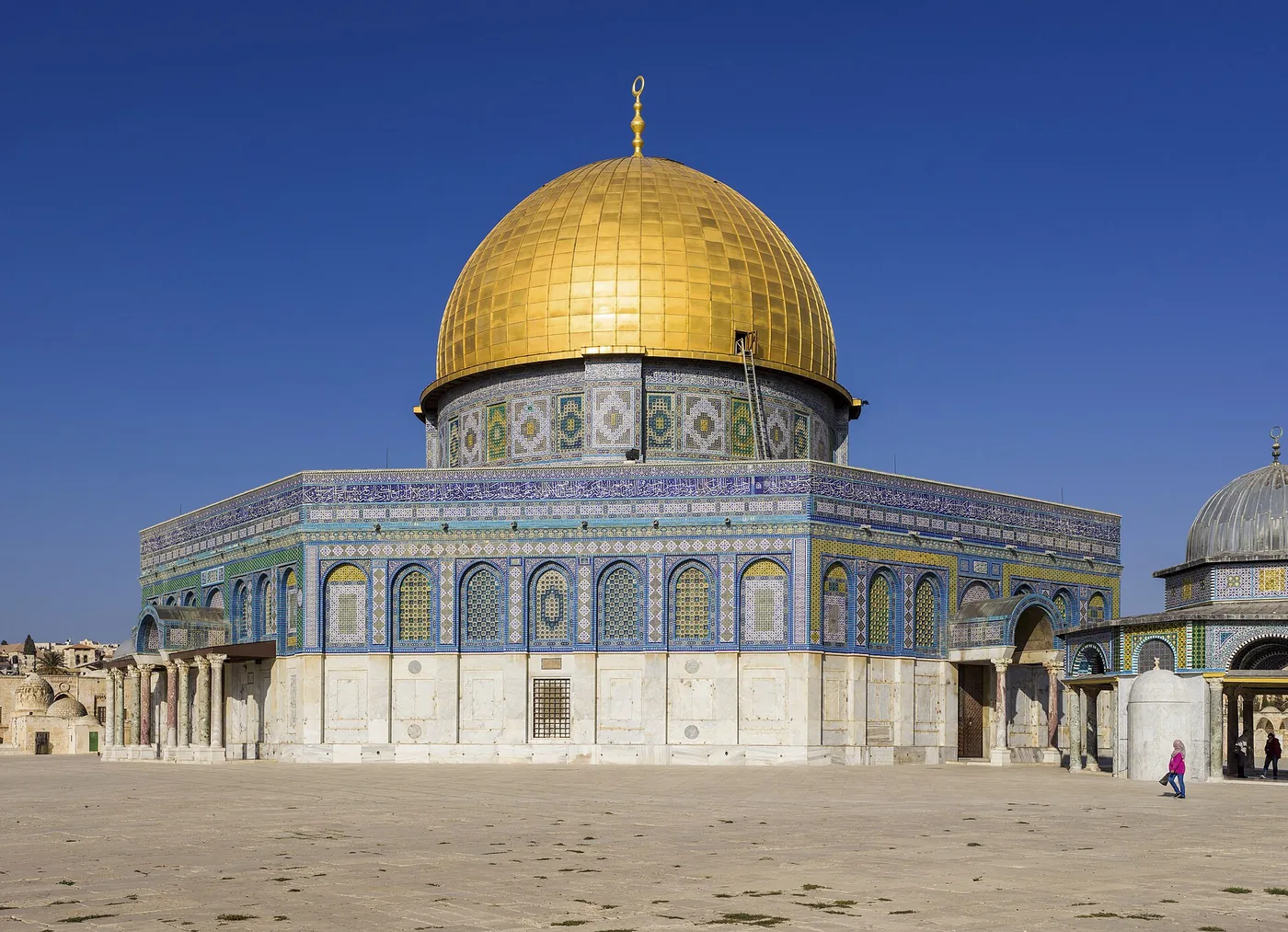
- Present each document (nature, author or builder, date).
- How is the first caliph shown in 2A?
- What does the Dome of the Rock suggest about the wealth and ambitions of the Umayyad caliphs?
- How many years passed between the death of Abu Bakr in 634 and the completion of the Dome in 692?
- Write two sentences to explain how the Muslim state changed in this time.
Exercise 10 : The Dome of the Rock
- Present the document (nature, date, place).
- Describe the shape of the building and its dome.
- Why did the Umayyad caliph build it in Jerusalem?
- Which earlier styles did the architects borrow?
- Is the Dome of the Rock a mosque? Explain.
Exercise 11 : The Great Mosque of Kairouan
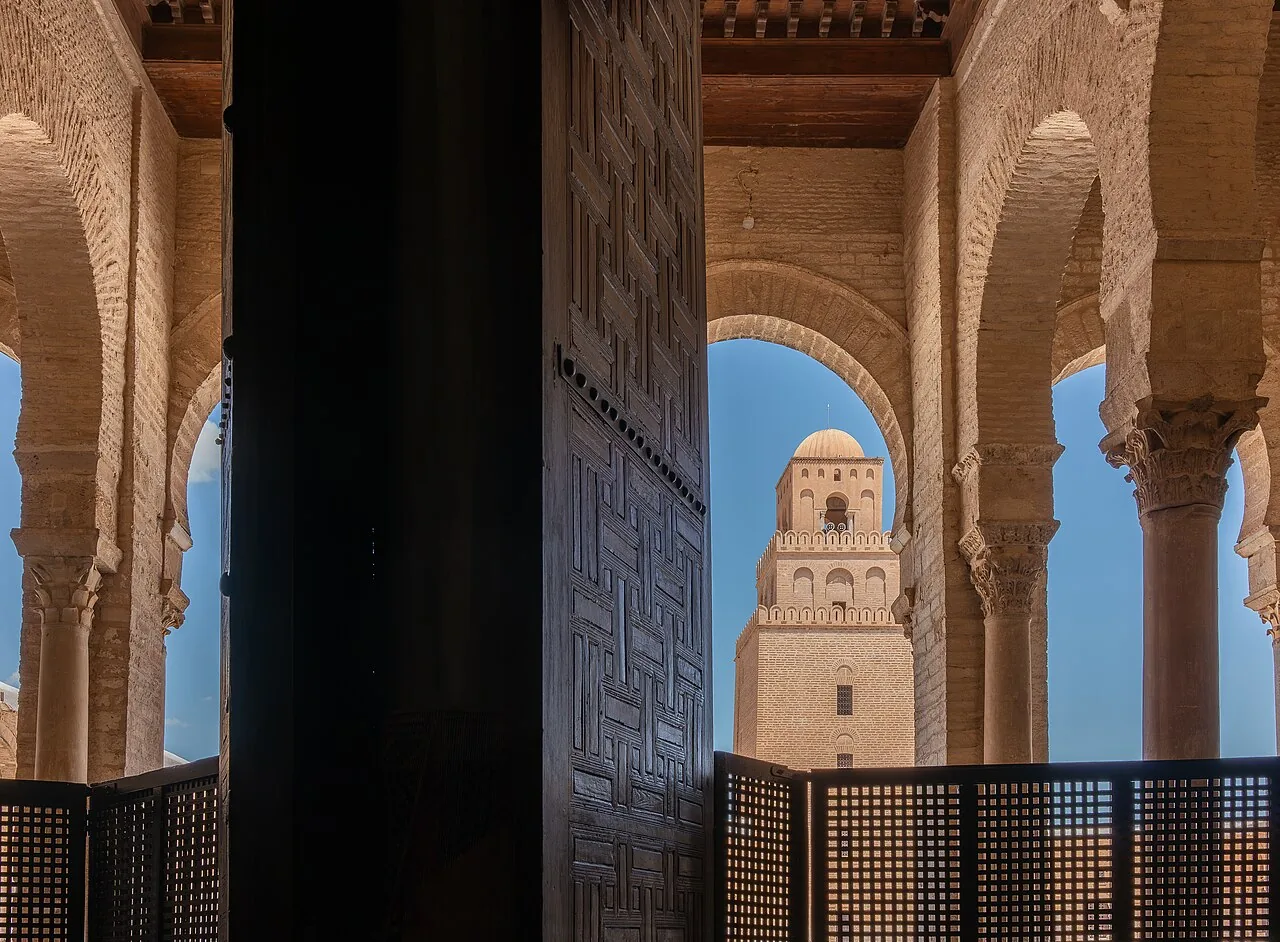
- Present the document (nature, date, place).
- Describe the arches and columns in the foreground.
- What is the tall tower in the background, and what was it used for?
- Why was the town of Kairouan founded in 670 as a base?
- What does the mosque show about the spread of Islam to North Africa?
Exercise 12 : The mihrab of Córdoba
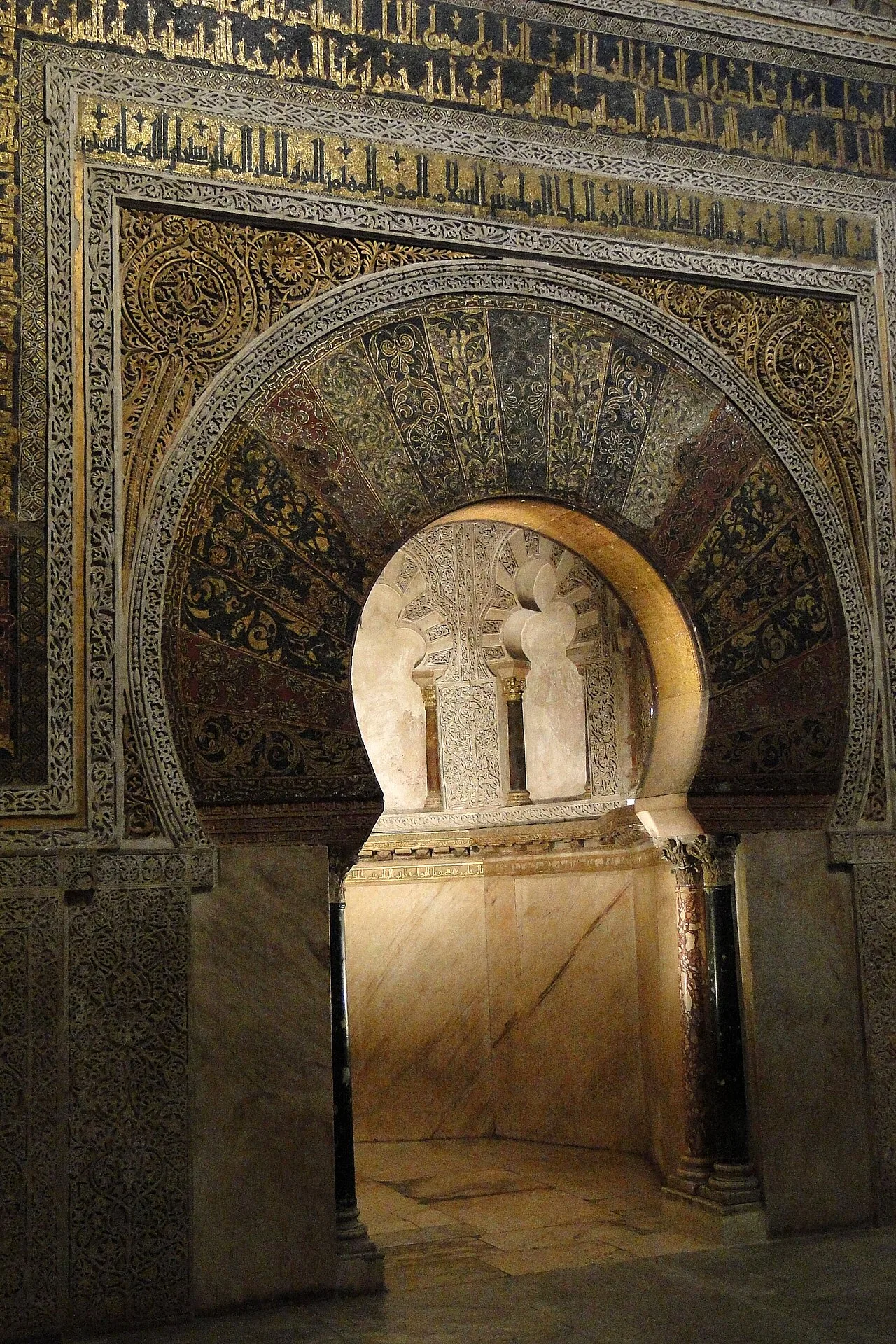
- Present the document (nature, date, place).
- Describe the arch and its decoration.
- What is the purpose of a mihrab?
- Why does the decoration use geometric and plant patterns and not human figures?
- Why was Córdoba an important city in the 10th century?
Exercise 13 : A library in the Abbasid world
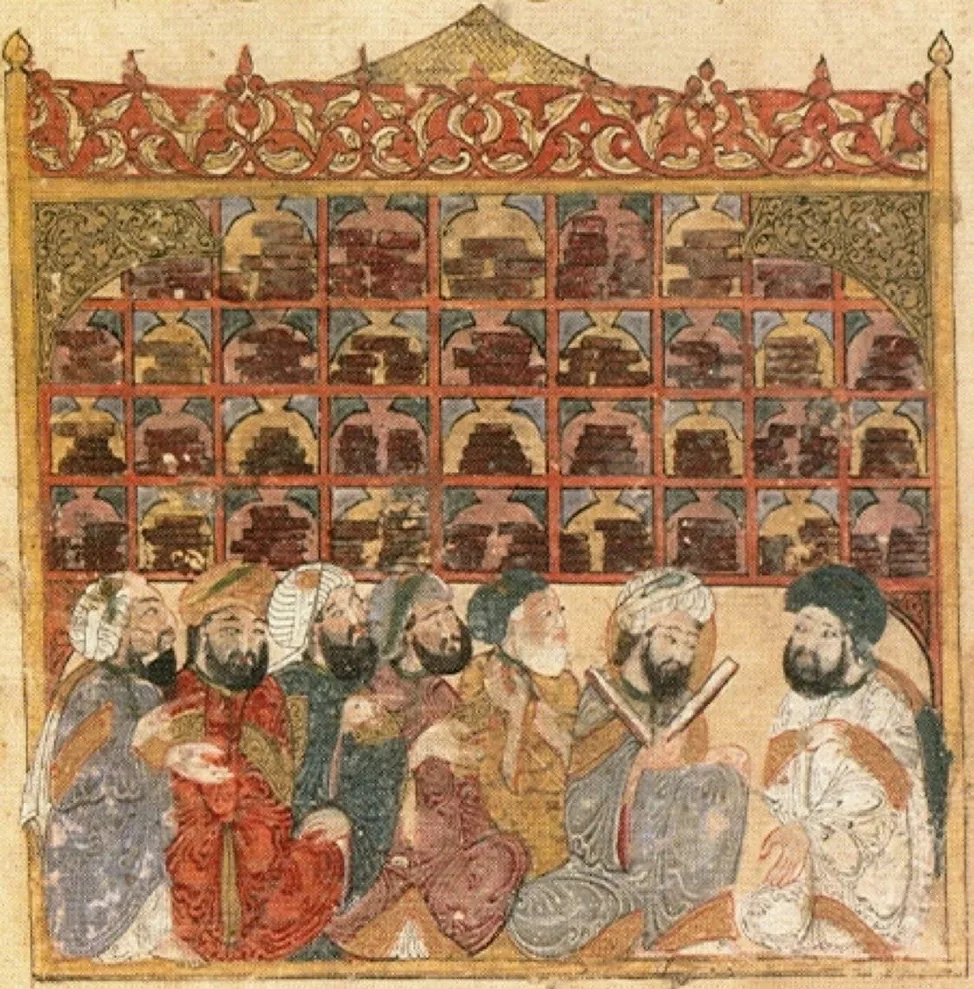
- Present the document (nature, date, place).
- Describe the people and the shelves.
- What does the scene show about the value of books?
- How did paper help to make libraries like this possible?
- Why is this picture not a photograph of an actual event?
Exercise 14 : The hajj today
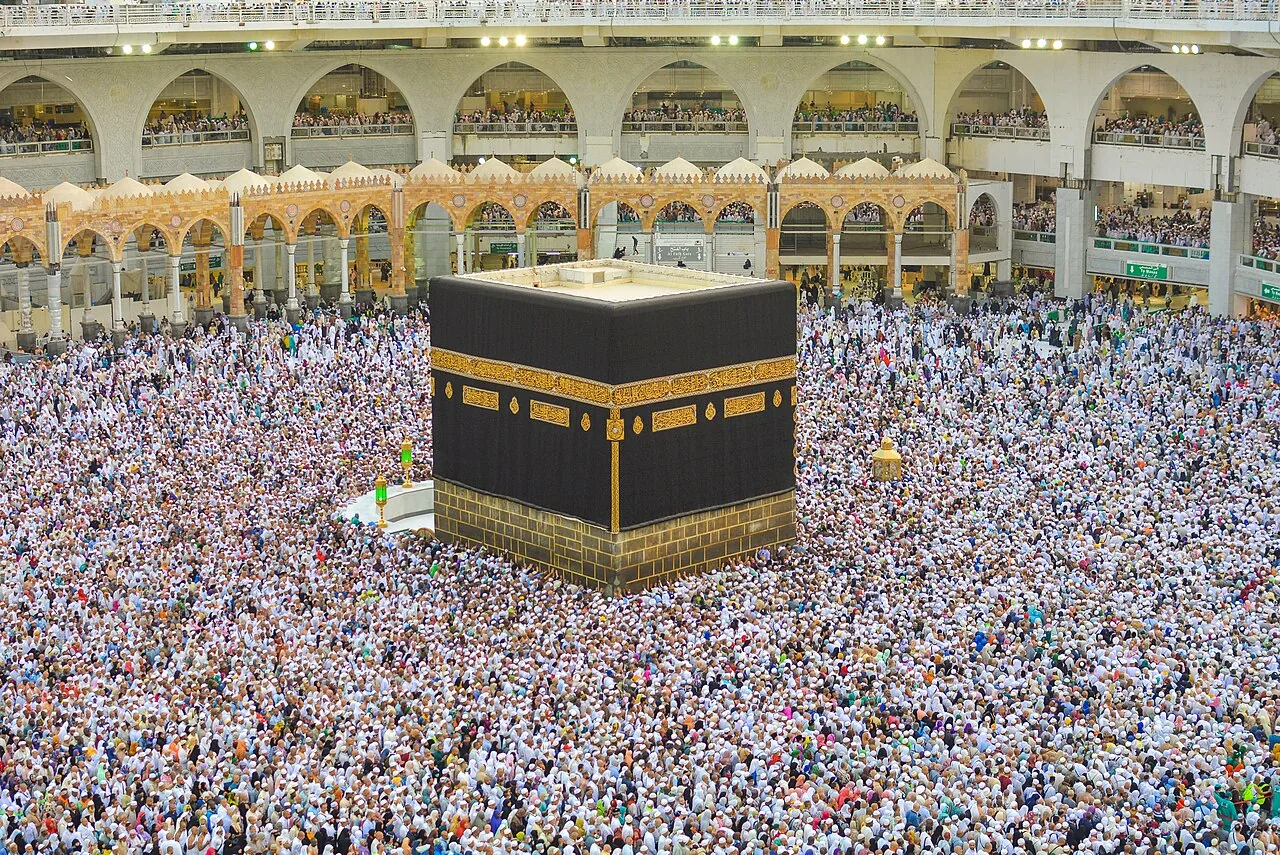
- Present the document (nature, date, place).
- Describe what you see in the center and around it.
- Which Pillar of Islam is shown?
- Why do Muslims from all over the world travel to this place?
- How does the photograph help us understand how Islam unites people of many nations?
Exercise 15 : Caliphates at a glance
Document 1 – The main caliphates
| Caliphate | Dates (CE) | Capital |
|---|---|---|
| Rightly Guided Caliphs | 632-661 | Medina |
| Umayyad Caliphate | 661-750 | Damascus |
| Abbasid Caliphate | 750-1258 | Baghdad |
Source: dates as given in reference works such as The Encyclopaedia of Islam and Encyclopædia Britannica. Table prepared for this unit.
- How many years did the Rightly Guided Caliphate last?
- How many years did the Umayyad Caliphate last?
- How many years did the Abbasid Caliphate last (until the Mongol capture of Baghdad)?
- Which caliphate lasted longest, and about how many times as long as the Umayyads?
- Which capital was the farthest east?
Exercise 16 : Locate the Muslim world
- Match the numbers to these names: Baghdad, Córdoba, Cairo, Constantinople, Damascus, Jerusalem, Kairouan, Mecca, Medina, Poitiers, Samarkand.
- Which two cities are the holiest for Muslims, and which one is farther north?
- Which city is in Spain, and which one in North Africa?
- Which city marks the northernmost point of the Muslim advance in Western Europe?
Hint: Mecca and Medina are close to the Red Sea, in the west of Arabia.
Exercise 17 : The growth of the caliphate
- In which color was the territory in 632? Name the two main cities of that area.
- Name two regions added by 661.
- Name three regions added between 661 and 750.
- Which two great empires lost land to the Arabs, and which one disappeared?
- Suggest two reasons why the conquest was so rapid.
Exercise 18 : Order the events
Put these events in order from earliest to latest and write the date next to each.
- Founding of Baghdad
- The Hijra
- The Mongols capture Baghdad
- Battle of the Yarmuk
- Muslim forces cross into Spain
- The Abbasids overthrow the Umayyads
Exercise 19 : How long between events?
Calculate each time span.
- From the Hijra (622) to the death of Muhammad (632).
- From the death of Muhammad (632) to the Muslim crossing into Spain (711).
- From the founding of Baghdad (762) to its capture by the Mongols (1258).
- From the Hijra (622) to the Abbasid revolution (750). How many centuries is that, roughly?
Exercise 20 : Guided research: the House of Wisdom
Find out about the scholars of the Abbasid Golden Age. Use at least two reliable sites, such as Britannica, the Metropolitan Museum of Art (Heilbrunn Timeline of Art History), the Library of Congress, or a university site. Suggested keywords: House of Wisdom Baghdad, al-Khwarizmi algebra, Ibn al-Haytham optics.
- What was the House of Wisdom, and who supported it?
- Choose one scholar (al-Khwarizmi, Ibn Sina, or Ibn al-Haytham) and describe one of his ideas.
- How did their work reach Europe?
- Which sites did you use, and why do you trust them?
Hint: some stories about the House of Wisdom are exaggerated, so compare two sources.
Exercise 21 : CER paragraph: why Islam spread
Write a Claim, Evidence, Reasoning paragraph that answers: What was the most important reason for the rapid spread of the Muslim empire between 632 and 750?
- Claim: state your position.
- Evidence: use at least two details from the documents or the lesson.
- Reasoning: explain how the evidence supports your claim.
Hint: think about weak enemies, strong armies, and the terms offered to conquered peoples.
Exercise 22 : SAQ: the early caliphate
Answer in complete sentences.
- Identify two of the Five Pillars of Islam.
- Explain one reason why Muslim armies defeated the Byzantine and Persian Empires.
- Explain one effect of the Abbasid capital being moved to Baghdad.
Exercise 23 : True or false? Justify
Decide whether each statement is true or false, and justify your answer.
- The Islamic calendar begins with the birth of Muhammad.
- The Umayyad capital was Damascus.
- Jews and Christians living under Muslim rule were usually killed or expelled.
- The word algebra comes from an Arabic title.
Exercise 24 : Causes and consequences: the succession
Complete the chain and explain each link.
- Cause: Muhammad dies in 632 without a clear successor. Effect: ______.
- Effect after the murder of Ali in 661: ______.
- Effect of the revolution of 750: ______.
- Later consequence in 1258: ______.


Quick review: flashcards
Tap a card to see the answer.